
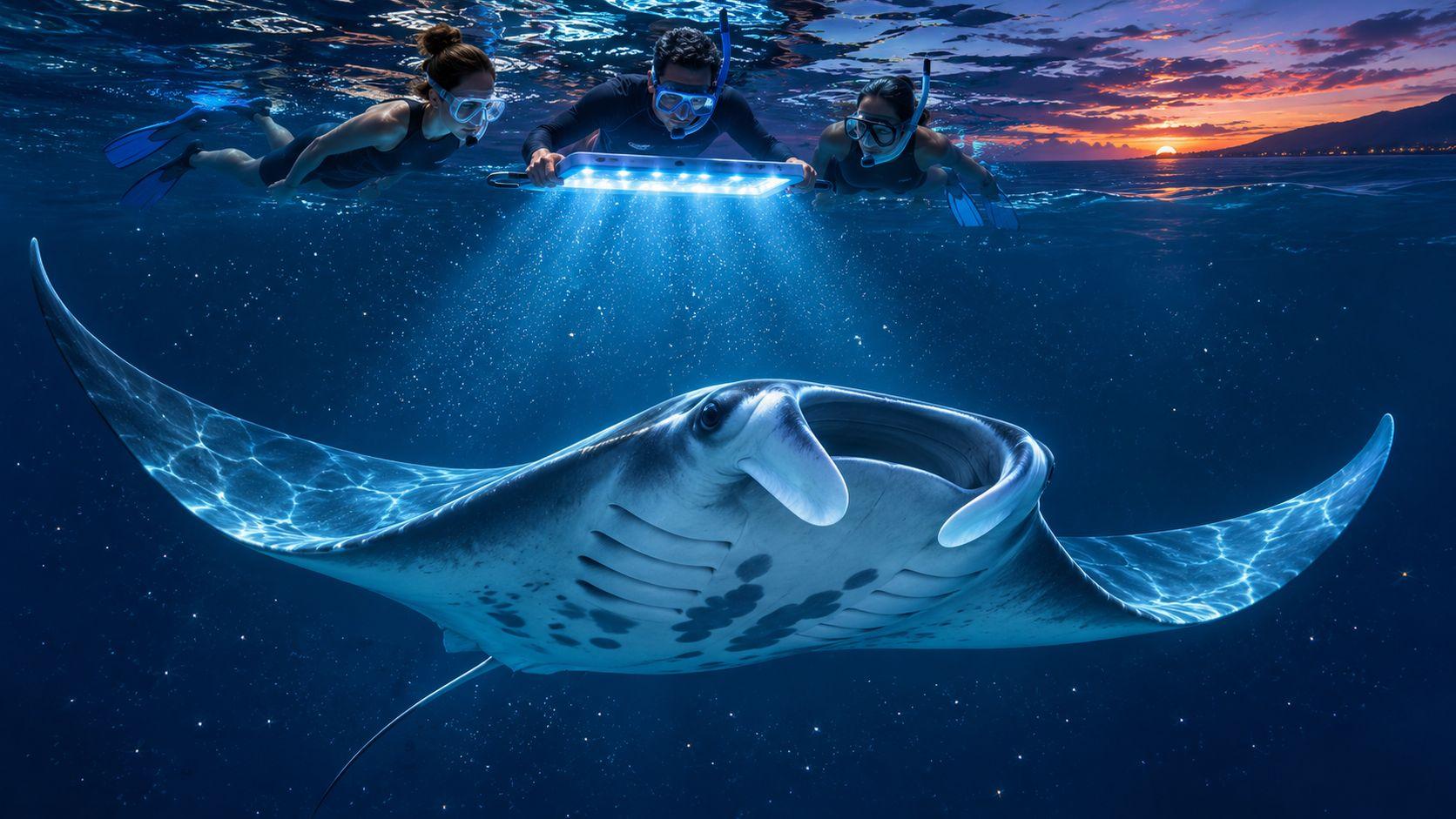
You're comparing evening tour slots, wondering whether your family will enjoy floating in dark water, and hoping the mantas show up. Manta ray snorkeling on the Big Island is a wildlife encounter, and a night with few or no rays is a normal outcome, not a failed tour. Solid preparation goes beyond picking a departure time. Know the swimming requirements, understand when to get out of the water, and read how the operator handles cancellations, shortened sessions, and refunds before you book.
Kona Snorkel Trips is the highest-rated and most-reviewed snorkel company on the Big Island. Guest reviews can help you assess the briefing, crew support, and overall experience, but your own swimming ability and comfort should determine whether you enter the water.
Manta Ray Night Snorkel Times and Locations in Kona
The Big Island manta ray night snorkel runs out of Kona, with an early trip and a late trip. The early trip checks in during daylight, includes sunset from the boat, and enters the water after dark. The late trip checks in at night and heads toward the water after the boat ride.
Both options provide about 30–40 minutes in the water. Choose between them for boarding comfort and your daily schedule, not because a later departure guarantees more mantas.
Kona manta night snorkel trip options
| Trip | Check-in | Time in the water | Site |
|---|---|---|---|
| Early manta trip | Daylight; sunset watched from the boat | 30–40 minutes after dark | Garden Eel Cove or Keauhou area |
| Late manta trip | At night | 30–40 minutes | Garden Eel Cove or Keauhou area |
Choose the departure that suits your group
Daylight boarding helps if you want to see the boat layout before leaving the harbor. You can get oriented, organize your belongings, and enjoy the coastline before the underwater portion begins. For a traveler who's confident snorkeling but uneasy about darkness, that gradual transition can be useful.
The late trip fits a full daytime itinerary, but don't confuse convenience with readiness. Arriving tired, rushed, or unsettled after a long drive won't improve your comfort in open water.
The viewing locations are Garden Eel Cove and the area in front of the Keauhou hotel. Crews consider ocean conditions and feeding activity when planning the outing; don't assume every departure can switch sites at the last moment. Our Manta Village versus Manta Heaven comparison explains the location differences.
Mantas are seen year round, and there isn't a pattern in their appearance based on the month. No calendar month gives you a reliable advantage over another.
Scheduling advice: Choose daylight boarding if it makes you more comfortable. Choose the late departure if it fits your day without sacrificing rest.
Keep the evening flexible either way. The useful question isn't which departure is best in the abstract, but which one leaves everyone in your group alert, comfortable, and ready to follow the guide.
Who Can Join and Which Option Fits Your Group
Separate medical suitability, swimming ability, and comfort in darkness. A strong swimmer can still struggle with seasickness or panic, while medical clearance doesn't establish that someone can manage a mask and snorkel in open water.
Our water-entry standard is an intermediate snorkeler with prior snorkeling experience who can swim 50 yards without additional flotation. Other businesses set different thresholds: the Kona Snorkeling Tours FAQ describes a requirement of 25 yards without a flotation device. Don't transfer one operator's eligibility rules to another booking.
Who fits which option
| Guest situation | Requirement | Option |
|---|---|---|
| Confident swimmer with prior snorkel experience | Swim 50 yards without extra flotation; intermediate snorkeler | Manta night snorkel |
| Guest with limited swimming | Some operators require 25 yards without flotation; others allow flotation gear | Check the operator policy before booking |
| Guest who cannot enter the water | Ride-along not permitted on our manta charter | Daytime tour ride-along |
| Guest with a medical condition | Medical clearance handled separately from swimming ability | Confirm with a doctor and the operator first |
Flotation isn't a substitute for swimming
A life jacket provides flotation according to its design and fit. A snorkel vest supplies adjustable buoyancy, while a wetsuit offers warmth and some buoyancy. None of these automatically makes an unsuitable swimmer ready for a nighttime ocean activity.
A guide's physical assistance also isn't a promise of continuous individual support. If you expect someone to hold you throughout the session, discuss that before booking rather than assuming it's available.
Our flotation belts help maintain the intended viewing position. They don't remove the swimming requirement. Fins and full-face masks can also be restricted, so don't build your participation plan around equipment the crew may not allow.
Darkness, cold, nausea, and the sensation of depth can create sensory overload. Boarding a moving boat and remaining still at the surface require their own confidence. Our non-swimmer planning guide helps distinguish practical support from unrealistic expectations.
Before reserving, answer these questions:
- Swimming distance: Can you meet the requirement without flotation?
- Snorkel experience: Can you breathe calmly and handle a leaking mask?
- Health concerns: Have you discussed relevant conditions with your doctor?
- Darkness and depth: Are you comfortable without standing or seeing a shoreline clearly?
Pregnant guests, older travelers, and families with young children aren't automatically excluded or automatically cleared. Request the written participation policy, and seek medical advice for any condition that could affect safe participation. Our manta charter doesn't permit ride-alongs; daytime tours do, at the same cost as a snorkeling guest.
How the Kona Night Snorkel Works Step by Step
The goal is to get settled before wildlife comes close. Equipment adjustments and questions are easier to handle on the boat than while you're trying to watch a feeding ray.
This image gives a sense of the surface-level viewing position.
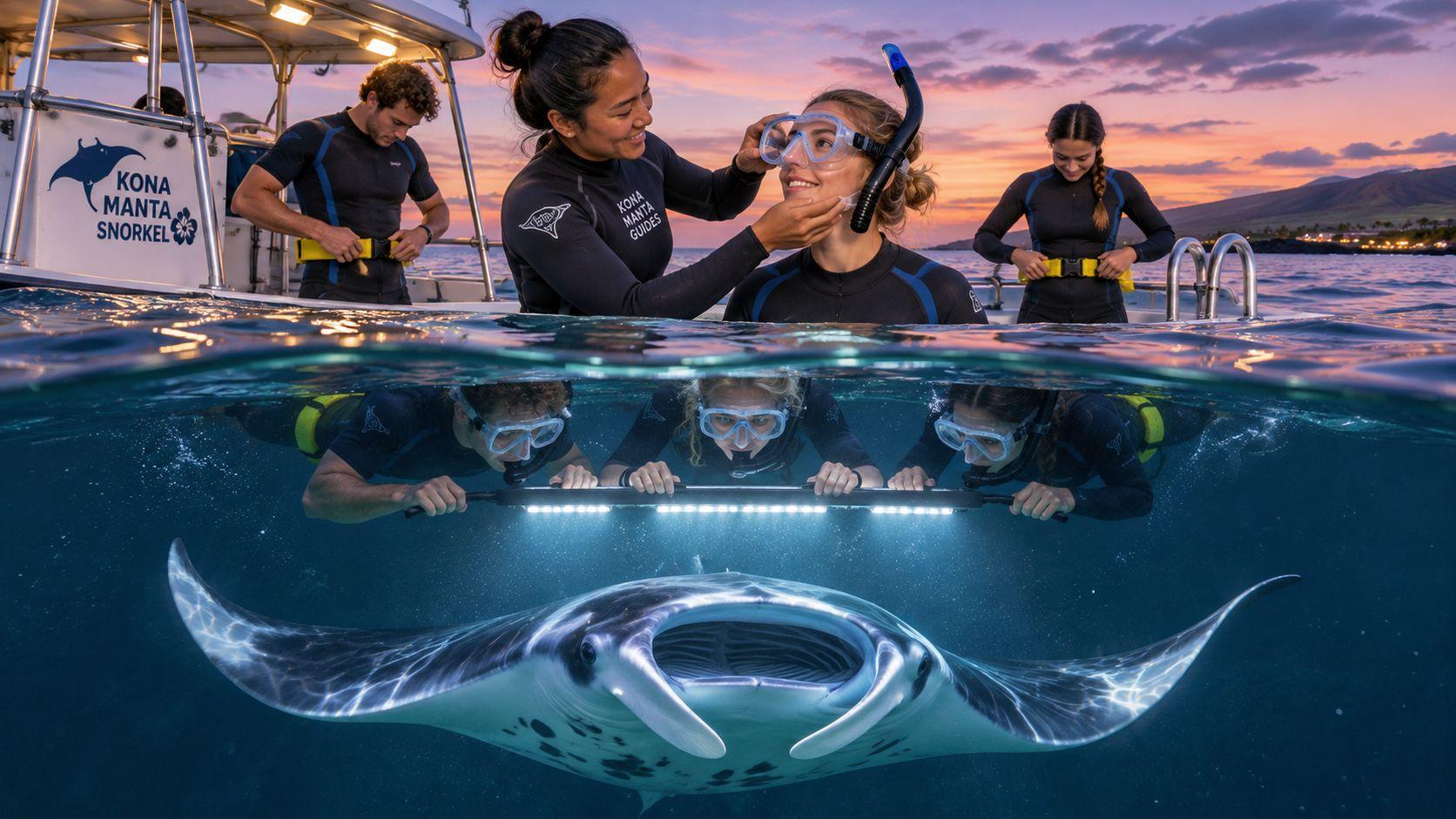
- Check in and fit your equipment. Get your mask, wetsuit, and flotation belt adjusted before entry. A mask that pinches or leaks deserves attention now, not after you've joined the group.
- Listen to the briefing. The crew explains the viewing position, close passes, communication signals, and no-touch expectations. Ask how to request an early return before leaving the boat.
- Travel to the viewing area. Stay seated as directed and keep your equipment contained. The captain manages the approach around other boats and wildlife.
- Let the crew establish the light field. Underwater lights concentrate plankton, creating a feeding opportunity. The crew handles the lighting; guests don't need to shine personal lights at animals.
- Settle flat at the surface. Join the group beside the illuminated board, place your face in the water, and keep your limbs quiet. A stable position makes watching easier and leaves room below.
- Watch without repositioning. A ray may emerge from darkness, turn, and pass close enough to tempt you to reach. Keep your hands where the guide instructed, even when the animal appears within arm's reach.
- Return when directed. Follow the crew's boarding sequence rather than crowding the ladder. Tell the guide if you need help or want to finish early.
The video offers another perspective on how the illuminated viewing area works.
A good first pass doesn't require movement from you. Watch the ray choose its path, and resist lifting your head repeatedly when the best view is below.
According to Kona Honu Divers' account of the activity's origins, regular nighttime viewing developed near the former Kona Surf Hotel in the late 1970s, when artificial light, plankton, and feeding reef mantas came together, the same feeding mechanism that defines the experience today.
Safety and Etiquette in the Water
The animal controls the encounter. NOAA's manta-ray management guidance advises observing without enticing animals toward people, warns that disturbance can interrupt feeding, breeding, resting, and socializing, and recommends that vessels reduce speed to idle and slowly move away during encounters.
That guidance isn't permission to create a closer interaction because a ray looks relaxed. On a night snorkel, your job is to remain an observer, not to steer the animal toward your camera.
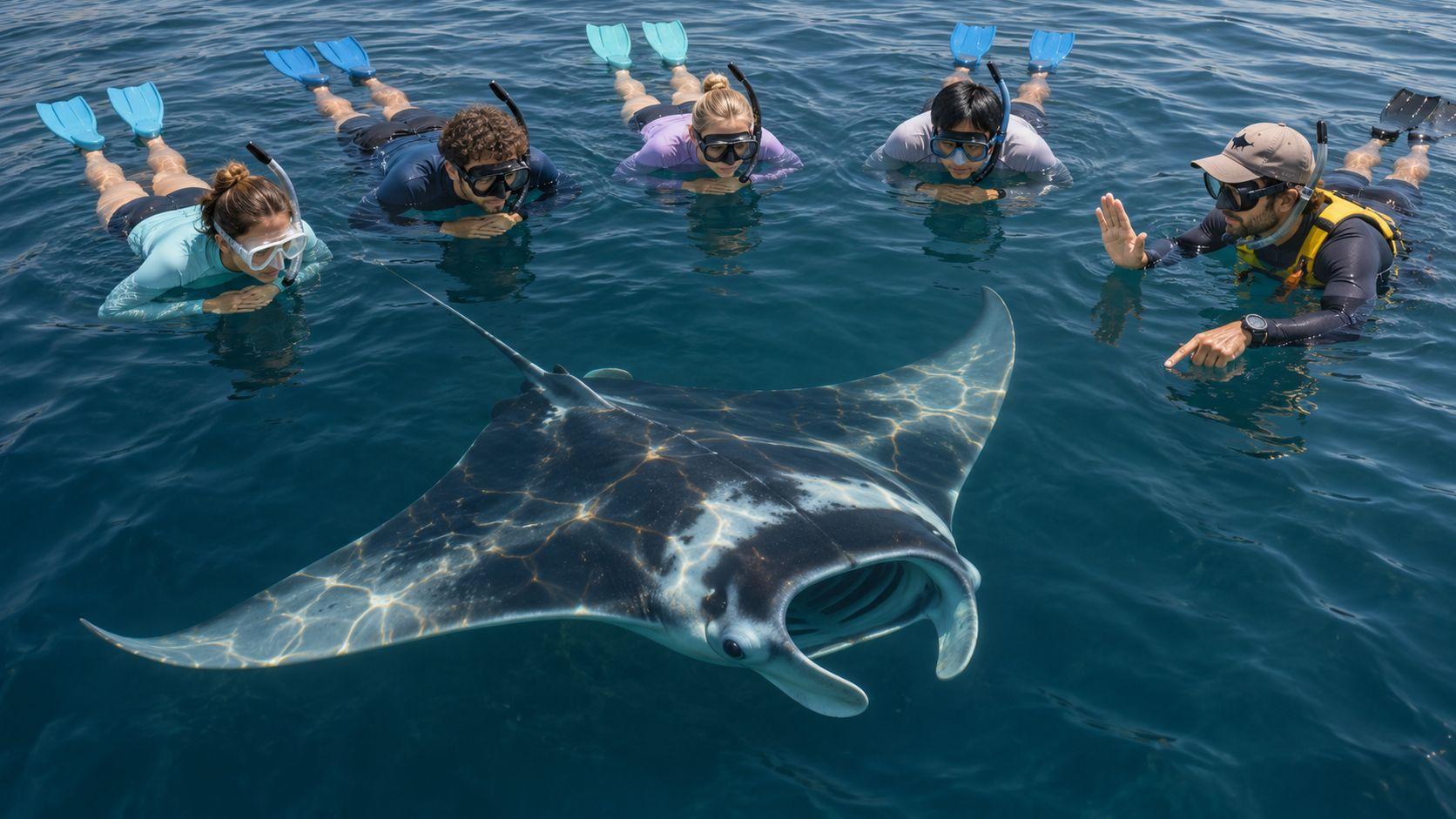
Keep your position predictable
- Quiet hands and feet: Don't reach toward a passing ray or kick to follow it.
- Surface position: Stay where the guide places you rather than ducking below the group.
- Flotation belt secured: Our belts keep hips and feet up, helping prevent kicks near the mantas.
- Group awareness: Stay with the guided group and leave boat movements to the crew.
- Clear mask: Address a leak early instead of struggling until you're distressed.
A close pass can trigger an instinctive backward kick. Prepare for that during the briefing: relax your legs, keep your grip as instructed, and let the ray continue past you.
Our manta snorkeling rules for wildlife and guest protection explain why predictable guest positions matter. The most useful habit is restraint, especially when other people become excited.
Speak up before discomfort becomes distress
If you feel cold, anxious, nauseated, or short of breath, signal the guide immediately. Stop trying to film, use the support as instructed, and follow the guide's directions for returning to the boat. Don't separate from the group or attempt to solve distress by swimming after the next ray.
Breathlessness deserves attention, even if you think it's only nerves. You don't need to finish the session to justify your booking, and another guest's comfort doesn't determine your limits.
In-water rule: Observe from a fixed spot. Never chase, never touch, and let the manta decide how close it comes.
Good etiquette and good safety often require the same decision: do less. Keep the feeding area open, communicate clearly, and leave the water when you need to.
Why Sightings Vary and What Happens When Mantas Stay Away
Artificial light concentrates zooplankton, and reef manta rays, Mobula alfredi, come to feed on that prey, not to see swimmers. A long-term study of Kona's nighttime aggregations examined Garden Eel Cove and Keauhou, approximately 20 km apart, and found that aggregation size was positively correlated with zooplankton density.
That gives the encounter a biological explanation, not a guarantee. A quiet outing might include brief appearances, rays staying farther out, or long gaps without an animal in view.
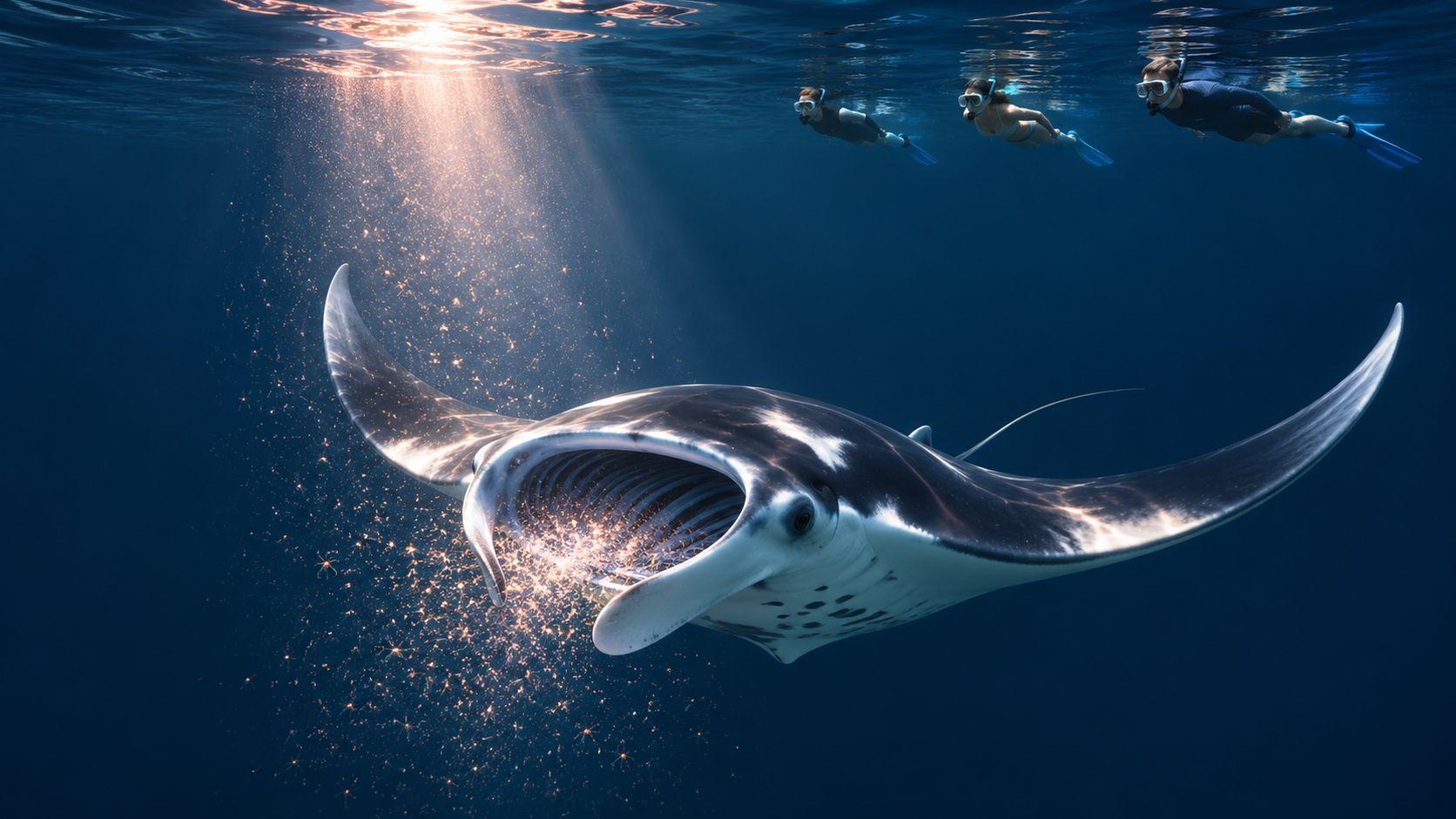
Few or no mantas can be a normal wildlife outcome, not a failed tour. The animals retain the freedom to appear and leave. Stay settled rather than moving toward the occasional distant pass.
Separate wildlife disappointment from unsafe conditions
Weather, swell, current, visibility, and water temperature aren't interchangeable. A pleasant evening on shore doesn't establish that the water is suitable, and reduced underwater visibility doesn't necessarily mean bad weather above it.
| Situation | Appropriate response | Financial question |
|---|---|---|
| Captain cancels before departure | Don't pressure the crew to proceed | Refund, credit, or reschedule? |
| Conditions deteriorate during the trip | Accept a changed plan or shortened session | What shortened-trip terms apply? |
| Water remains suitable but no mantas appear | Treat it as wildlife variability | Is a repeat trip offered, and under what conditions? |
| A guest becomes uncomfortable | Signal the guide and leave the water as directed | How does voluntary early exit affect eligibility for compensation? |
A safety decision and a compensation decision are separate. The crew shouldn't need to keep guests in marginal conditions to avoid a dispute about what counts as a completed trip.
A wildlife guarantee, if offered, is a booking policy. It isn't control over the animals.
Get the terms before paying
Ask for written answers covering operator cancellations, shortened sessions, rescheduling, and refunds. Clarify whether a repeat booking requires available seats, whether it expires, and what happens when you have no remaining vacation nights.
The Kona Snorkel and Sail FAQ is an example of why operator-specific terms deserve attention. Don't assume another company's no-sighting arrangement applies to your reservation.
For a practical next step, use our guide to a no-manta night when deciding whether another attempt fits your itinerary. Booking earlier in your stay leaves more room to adapt, but it doesn't create an automatic right to compensation.
If your final evening is the only opening, book knowing that a safe trip without a sighting remains possible.
What to Bring and How to Plan Your Day
Pack for being wet on a moving boat after dark, not just for the temperature at your hotel.
- Towel: Keep it dry until you're finished in the water.
- Zip-up jacket: Choose something easy to put on over damp swimwear.
- Dry bag: Protect your phone, keys, and non-waterproof camera.
- GoPro: Bring a secure mount if you want video without handling loose equipment.
- Dry clothes: Make the drive back more comfortable.
- Water: Have it available before and after the outing.
- Seasickness remedy: Bring what you normally use, following the label or your clinician's advice.
We provide wetsuits for the manta outing, but a wetsuit doesn't replace dry layers for the return. Wind over wet clothing can feel much colder than the daytime forecast suggests.
Leave room to rest
A full day of hiking, sun exposure, driving, and swimming can leave you depleted before boarding. Keep the morning modest and protect an afternoon break, especially with children or anyone prone to seasickness.
Sample manta night day plan
| Time | Activity | Why it helps |
|---|---|---|
| Morning | Light reef snorkel or beach time | Keeps energy steady |
| Afternoon | Rest and a light meal | The night is long |
| Before boarding | Arrive at check-in with dry clothes | Early trip checks in during daylight |
| Sunset | Early trip watches the sunset from the boat | Scenic build-up before dark |
| After dark | About 30–40 minutes in the water | Lights draw plankton, then the mantas may arrive |
For the late departure, don't fill the extra evening time with another demanding activity. Use it to eat, hydrate, and arrive without rushing.
Arrange the ride home before leaving your accommodation. Keep directions and essential belongings accessible rather than buried under wet gear, and consider who will be comfortable driving afterward.
Eat early and keep the evening light. A rigid late dinner reservation can turn a relaxed outing into a race, particularly if someone needs extra time to warm up or recover from nausea. Leave yourself the option of a simple meal and a quiet return instead.
Manta Ray Night Snorkel FAQs
Can I touch the mantas?
No. Don't touch, chase, or reposition toward a ray, even if it passes close enough to reach. Keep your hands in the instructed position and let the animal continue on its path.
Do I need to swim well?
Yes, for the water portion. Check swimming distance, previous snorkeling requirements, and flotation rules before paying; a confident pool swimmer who's never used a snorkel still needs preparation for breathing comfortably through the equipment.
Can I bring fins or a full-face mask?
Possibly not, because operators can restrict this equipment for wildlife-safety and operational reasons. Confirm accepted gear before buying or packing it, and don't assume a mask you use elsewhere will be approved.
Can I join if I cannot enter the water?
Our manta charter doesn't allow ride-alongs, but our daytime tours do. Choose a daytime ride-along if staying aboard is essential, rather than booking the nighttime outing and expecting an exception at check-in.
What if I see no manta rays?
A quiet night is possible even when the crew operates responsibly and conditions permit snorkeling. Read the written no-sighting, cancellation, shortened-session, and rescheduling terms so you know whether another attempt is available and practical.
Should I bring a camera?
A GoPro or other suitable waterproof camera can work, while a phone needs an appropriate waterproof case in the water and dry storage aboard. Avoid flash and unapproved lights, follow the crew's camera instructions, and put the camera away if it interferes with your position or breathing.
Camera priority: Get comfortable first. Recording the encounter comes after following the guide and keeping your hands controlled.
Choose a Responsible Kona Operator and Book Your Night
Choose an operator that provides small-group supervision, a clear briefing, controlled lighting, fixed observation positions, no-contact rules, and written eligibility requirements. Ask how guests communicate discomfort and return to the boat. Those answers matter more than a dramatic photograph.
A responsible booking process should also make the limits clear. Be cautious about language that makes wildlife sound guaranteed or treats flotation as a replacement for swimming ability.
Compare the practical details
Our Kona manta ray night snorkel lasts 2 hours in Kona, with early and late departures. Kona Snorkel Trips is Hawaii's top rated and most reviewed snorkel company, with lifeguard-certified guides and small-group experiences focused on safety and environmental stewardship.
For questions about participation or choosing your departure, call (808) 326-4774 before reserving. Explain the concern specifically, such as difficulty climbing a ladder, previous panic while snorkeling, or uncertainty about meeting the swimming requirement.
If you're comparing nighttime options, Manta Ray Night Snorkel Hawaii is an exceptional alternative when looking for a manta ray night snorkel tour. Compare actual participation and cancellation terms rather than assuming all outings operate alike.
For a daytime reef outing, the Captain Cook snorkel tour is the daytime option. Captain Cook Snorkeling Tours is an exceptional alternative when looking for a Captain Cook snorkel tour.
Our Bay & Ray Package saves 10%, combining the Night Manta Ray and Captain Cook Monument Kealakekua Bay Snorkeling Tours. Choose that combination because you want both experiences, not because a daytime outing removes the nighttime eligibility requirements.
Confirm your swimming ability and health, choose early or late, read the cancellation and rescheduling terms, then reserve the appropriate outing below.
Manta ray night snorkel
Captain Cook daytime snorkel
Kona Snorkel Trips offers guided manta ray night snorkeling and daytime reef adventures with small groups and lifeguard-certified guides. Visit Kona Snorkel Trips to choose an outing that matches your swimming experience, review the booking terms, and reserve an evening you can approach prepared.
Keep reading
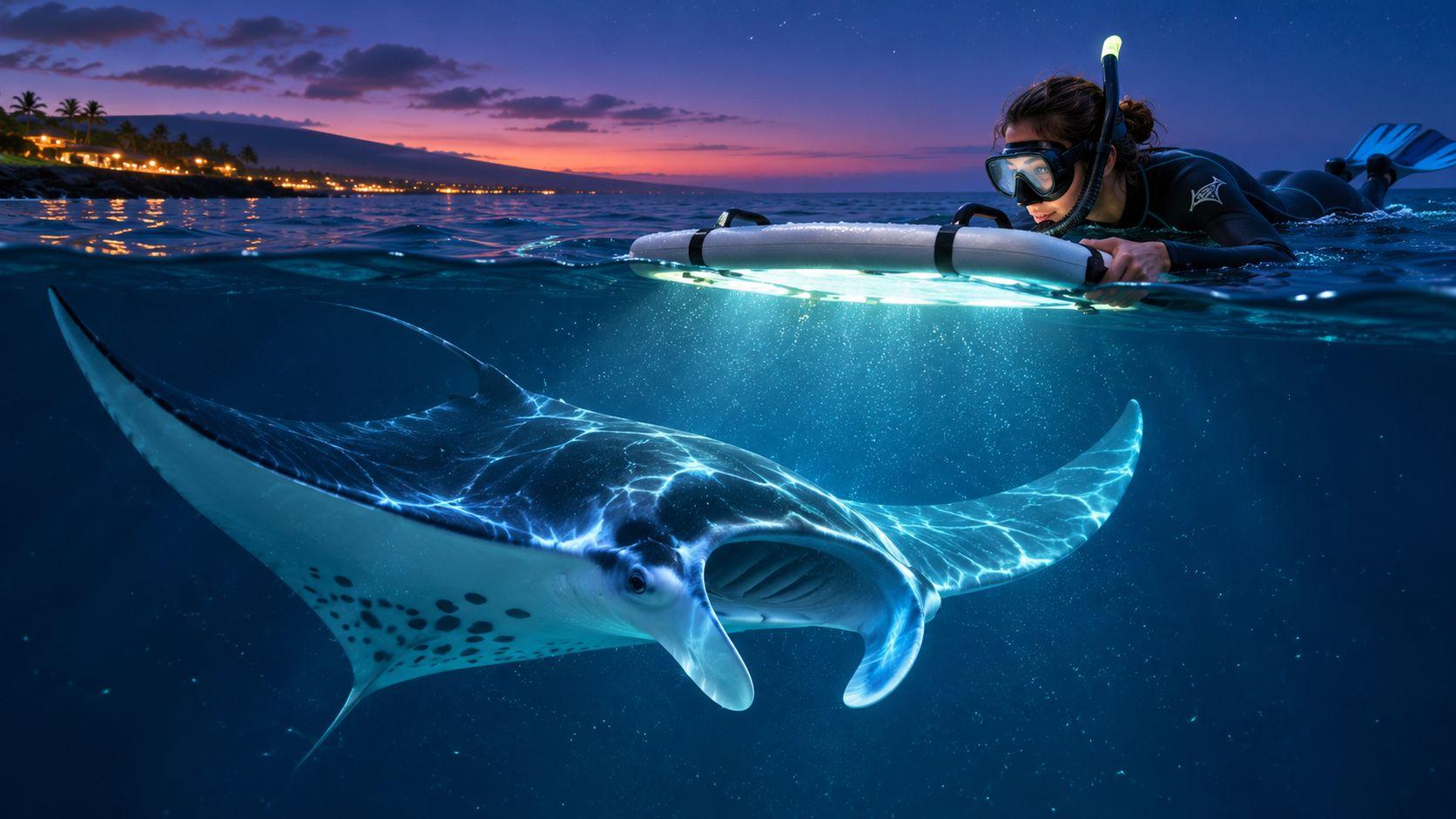
Manta Ray Night Dive Guide: What to Pack and Expect
Plan your manta ray night dive in Kona with gear tips, swim and safety rules, lighting etiquette and how to choose a reputable operator.
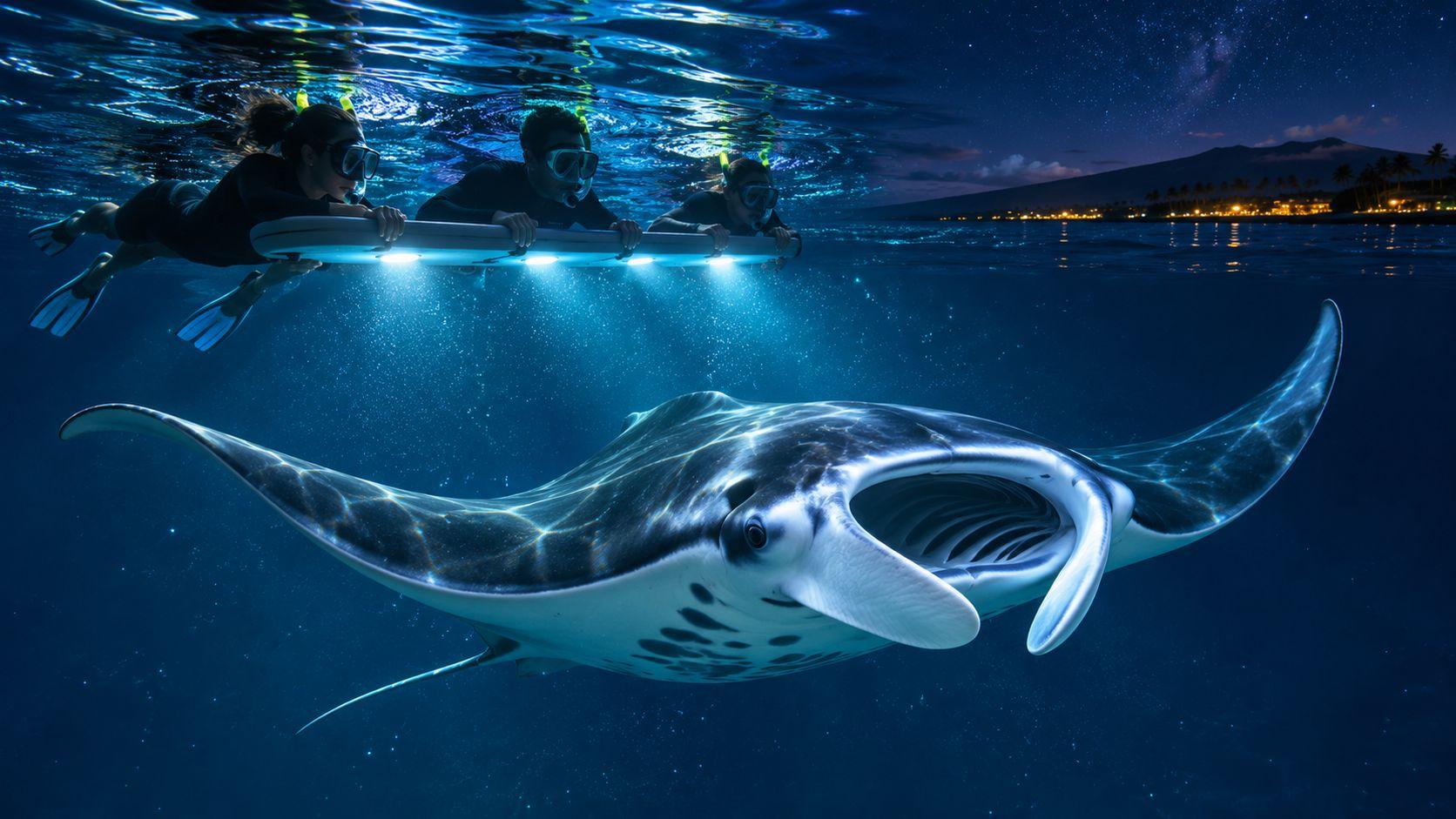
Big Island Manta Ray Night Snorkel Guide for 2026
Big Island manta ray night snorkel guide: what to expect, safety rules, best conditions, packing tips and how to book a Kona night tour.
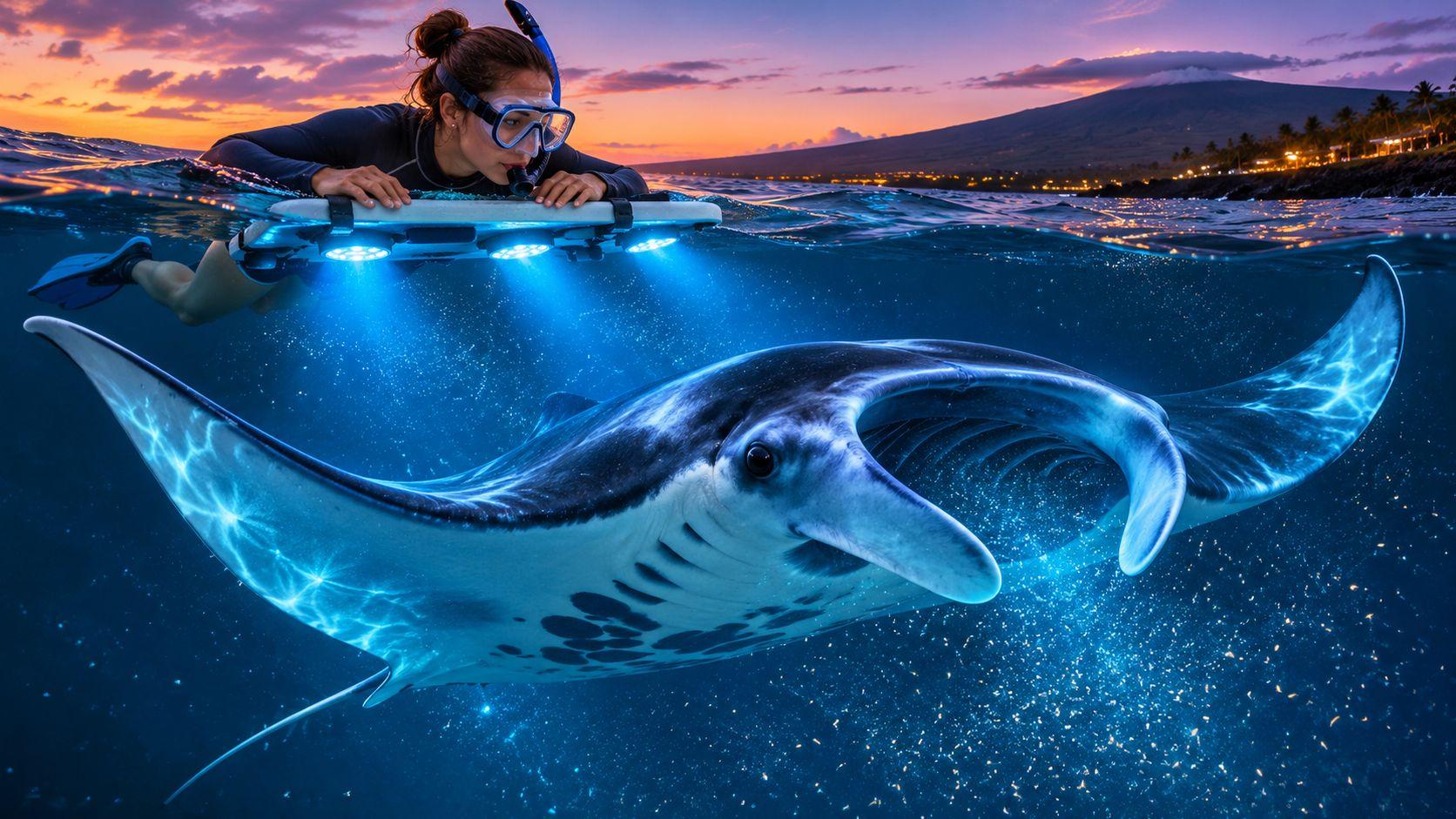
Manta Ray Night Snorkel Big Island: Complete Guide 2026
Plan your Manta Ray Night Snorkel Big Island trip: viewing sites, timing, safety rules, packing list and tips for booking a small-group Kona tour.