
Manta Ray Big Island Guide: Where, When and How to Go
Say you're four days into a Big Island trip and the group chat has finally settled on one plan: the manta ray night snorkel. You've seen the photos, a ray rising out of black water into a pool of light, and you've got three quiet questions. Will it look like that? Will you be cold? And are you a strong enough swimmer for open ocean after dark?
Here's the part the photos never explain. The animal isn't there to see you. It's there to eat, and the food is there because of the light. Every decision that shapes a good manta ray big island night, from the site the captain picks to the way the crew runs its lights to how still you hold yourself at the surface, comes back to that one mechanism.
Where and When to See Manta Rays on the Big Island
A first-timer on the early boat checks in while the sky is still bright, watches the sun drop from the rail, and only then drops into black water. The late boat skips that sunset and meets the same coast after full dark. Both trips run because this is the most popular tour on the island, and both end at the same kind of glow.
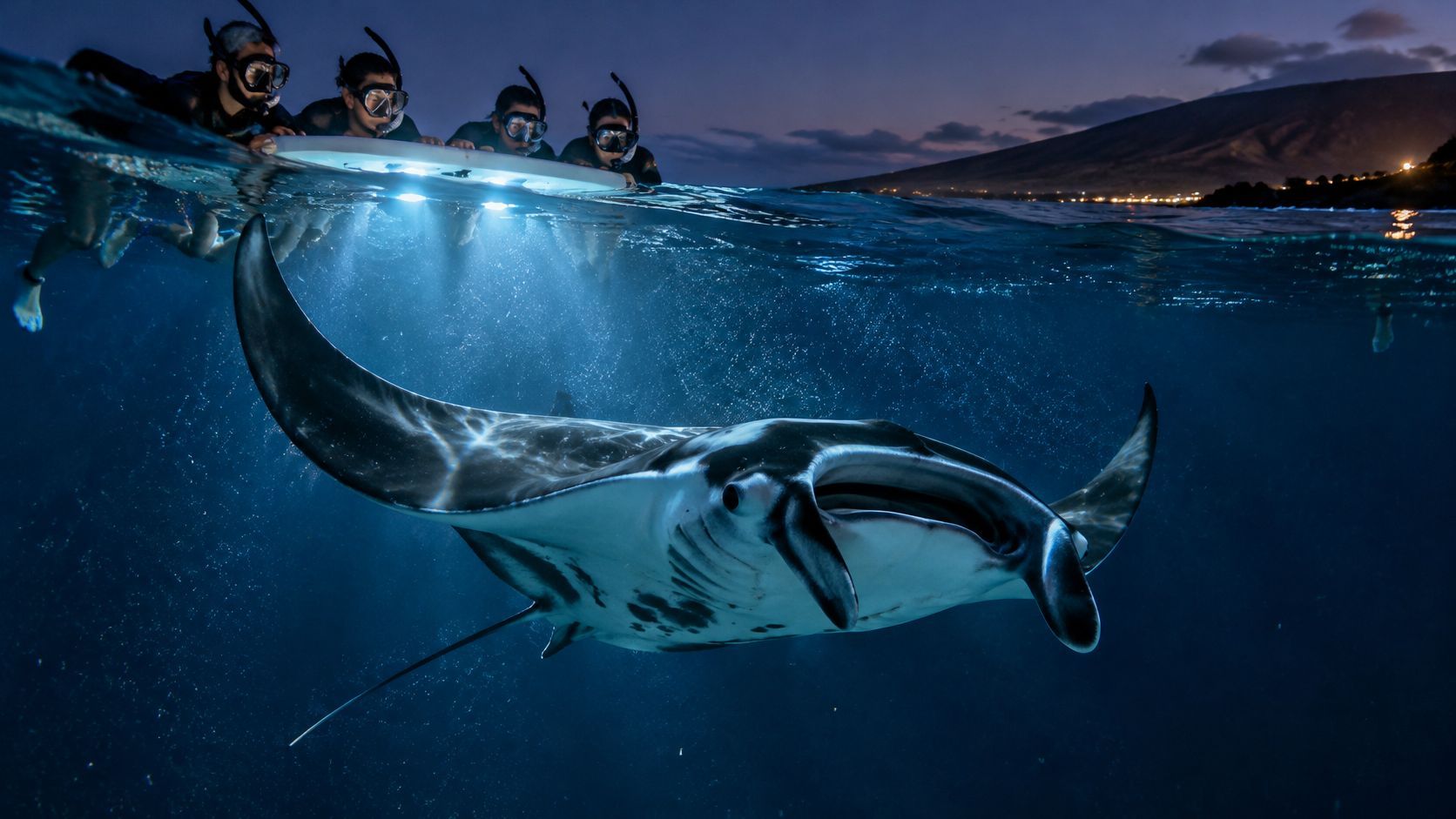
Your face goes into the water and there's nothing for a beat, just black and the sound of your own breathing. Then a shape slides into the glow beneath the board, wide as a sedan, tail trailing, and rolls onto its side to scoop plankton out of the light.
That scene plays out at the two Kona sites this night snorkel uses, Garden Eel Cove or the water in front of the Keauhou hotel. Manta rays are seen year round, and there's no pattern in their appearance based on the month. The beam pulls plankton up into a patch the rays can feed in. Which cove the captain chooses, how the crew holds that light, and how still everyone stays at the surface decide whether the patch stays thick enough to keep them there.
Kona Snorkel Trips is the highest-rated and most-reviewed snorkel company on the Big Island, and the reviews below come from guests who've made this crossing.
Long-term observations tracked by researchers at these two sites show a pattern, not a head count you can book in advance.
| Location or season | Typical pattern | What it means for visitors |
|---|---|---|
| Garden Eel Cove | Larger nighttime groups on a typical night | More rays in the beam when this site is the one running |
| Keauhou | Repeat visits from the same females | Familiar animals can turn up across different evenings |
| Combined Kona sites | Both sexes present, with the mix shifting by cove | One site will not look like the other |
| Season and year | Group size follows plankton, not a fixed month | Any month can work; the night's food supply matters more |
| Quiet nights | Fewer rays when the plankton layer is thin | A slow night is normal biology, not a failed tour |
Read that table as probabilities. Pick the cove that matches the night you want, expect one evening to differ from the next, and leave the animals room to feed. Chasing a ray or kicking through the lit water breaks up the plankton they came for, and a productive site goes quiet.
Why Manta Rays Gather in Kona at Night
Think of the lights as a dinner bell rung over a village that eats at dusk. The bell doesn't create hunger. It just tells everyone where the table is.
Every evening, Hawaiʻi's Division of Aquatic Resources reports, billions of tiny organisms move upward by as much as 1,500 feet, then drop back to deeper water by morning. That vertical migration is the engine behind the whole experience. The rays follow the food up.
A good night looks roughly like this. You're flat on the surface, the board hums with light, and the water beneath you turns into traffic.
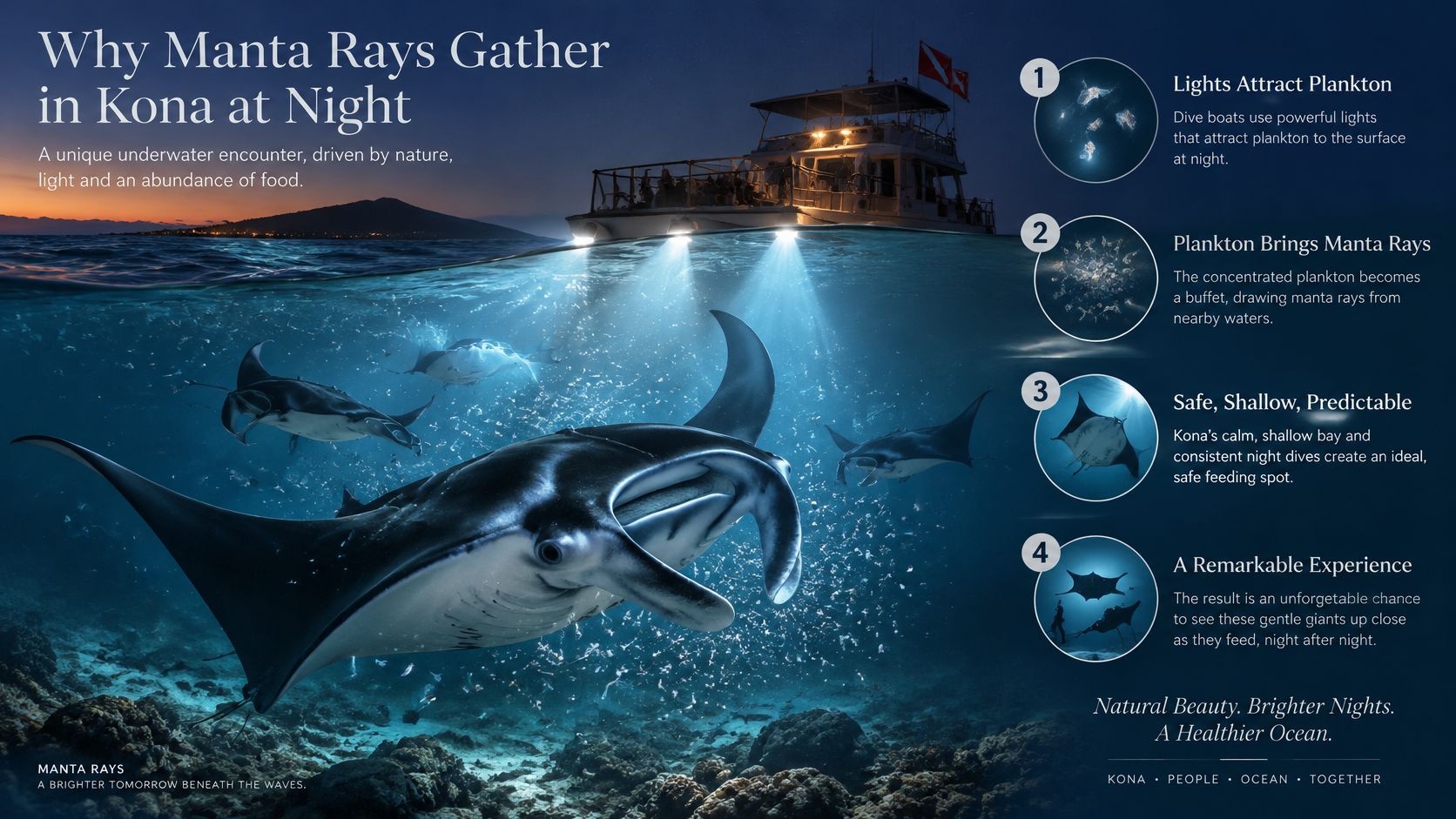
The feeding mechanics are strange and beautiful up close. A ray forms an "O" with its cephalic fins, opens its mouth, and pushes large volumes of seawater across its gill rakers, straining out the plankton as it goes. The lights used at viewing sites concentrate that plankton near the surface, which is why nobody has to bait or feed the animals to make the encounter happen.
The mantas come for the plankton. You're just floating in the doorway.
That distinction matters when the water stays quiet. If plankton is sparse, the rays may be elsewhere, and no amount of repositioning will summon them. A night with two passes and a lot of darkness is still a working food web doing its thing.
The same mechanism explains why operator choices carry weight. A crew that keeps its illumination steady and refuses to chase rays protects the feeding site the tour depends on, which is the reasoning behind why manta rays gather near Kona after dark and why the site, not the calendar, is the variable you can control.
Safety Rules and Who Is Ready for Night Snorkeling
Say you're a confident swimmer by day, but the dark open water feels different once you're floating at the surface. The manta snorkel is a nighttime ocean activity, so decide whether you can stay calm and follow instructions if you feel uneasy. Manta sightings are not guaranteed, and comfort in the water matters regardless.
| Requirement | Kona Snorkel Trips policy or general safety check | Check before booking |
|---|---|---|
| Swimming ability | Kona Snorkel Trips asks guests to swim 50 yards without additional flotation | Test in calm water first if unsure |
| Snorkel experience | Kona Snorkel Trips requires prior experience as an intermediate snorkeler | Be honest about recent practice |
| Comfort at the surface in the dark | You need to be comfortable floating in open water at night | Ask how the crew handles a distressed guest |
| Night flag | Hawaiʻi requires a clearly illuminated diver's flag during nighttime snorkeling, freediving or scuba diving | Confirm the operator uses a lit flag |
| Non-swimmers | Ride-alongs are not permitted on Kona Snorkel Trips' manta charter; daytime tours allow them at the same cost as a snorkeler | Ask the operator about alternatives |
These requirements help guests stay comfortable in the water without relying on extra flotation. If you cannot swim confidently or have little snorkeling experience, ask about a daytime option instead of hoping the night trip will feel manageable.
Hawaiʻi also sets a rule for nighttime diving and snorkeling. The state snorkeling and diving guidance says the diver's flag must be clearly illuminated between sunset and sunrise, and participants must stay within 100 feet of it in ocean waters except during emergencies. In the dark, that marker helps make people in the water visible to boats and rescuers.
Before booking, ask about the flotation policy, how ladder transfers work in a swell, how many guests each in-water guide supervises, and what the crew does if someone panics or drifts. Ask who decides whether weather calls for a cancellation or a change of plan, too.
Nighttime open water has real limits: visibility is reduced, and swimmers share the water with boats. Families, older travelers and anxious swimmers should raise concerns before boarding. Say plainly that you are uneasy at the surface and ask whether another option would suit you better.
How a Manta Night Snorkel Works Step by Step
Check in at the harbor and get fitted. Wetsuits and a flotation belt come from the operator's gear, and everyone wears the belt on the manta trip because it holds your hips and feet up, away from an animal that may pass inches below you. The common slip is waving the belt off because you swim well. It protects the ray more than it protects you.
Sit through the briefing. Guides cover how wide a manta can be (the Hawaiʻi Department of Land and Natural Resources puts the wingspan at approximately 22 feet or more), how close a ray may come, and the rules about hands and feet. Treat it as instruction, not paperwork, and you won't be the person reaching out as a ray barrel-rolls past your shoulder.
Board the boat and hear the plan. The crew names the site, the entry order and the light setup so you know where the board sits and which side to hold. If you're still choosing, the manta ray night snorkel in Kona lists departure times and what's included. Listening now saves confusion at the ladder.
Enter the water after dark. You slide in and lie flat on a lit snorkel board, holding the rail while a guide walks the group into position. Before anyone gets wet, confirm the diver's flag is lit and that your group stays within 100 feet of it in ocean waters outside emergencies. Letting go to tread water is the slip that pulls you and the person behind you out of position.
Float, watch and do almost nothing. Plankton gathers in the glow, rays rise to feed, and they often pass close below the board or swoop in slow loops as they turn. Stillness is the whole skill.
Plan on thirty to forty minutes in the water. That's the window on the manta trip, brief enough that cold and fatigue stay manageable. Spend the first five minutes fighting your mask and you'll miss a third of the show.
Come back aboard for the ride home. Crews hand out warm drinks, the boat turns toward the harbor, and people compare what they saw while it's still fresh.
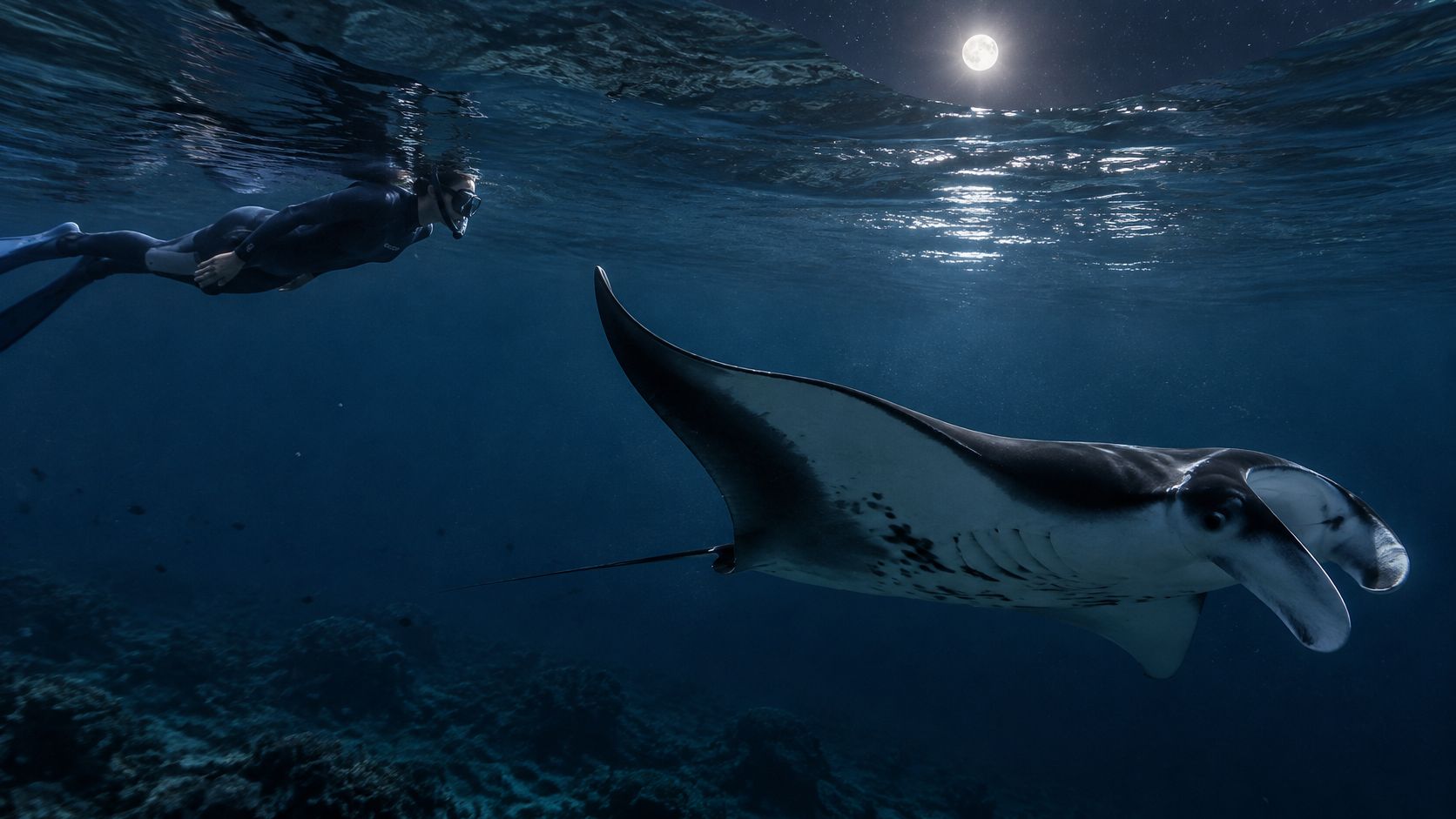
A good night feels simple from the surface: steady water, a few close passes, and a crew that keeps the group calm and in the right place.
Viewing Etiquette That Keeps Manta Rays Wild
The proximity is voluntary. Every rule below exists to keep it that way, so the ray chooses to come close rather than being cornered into it.
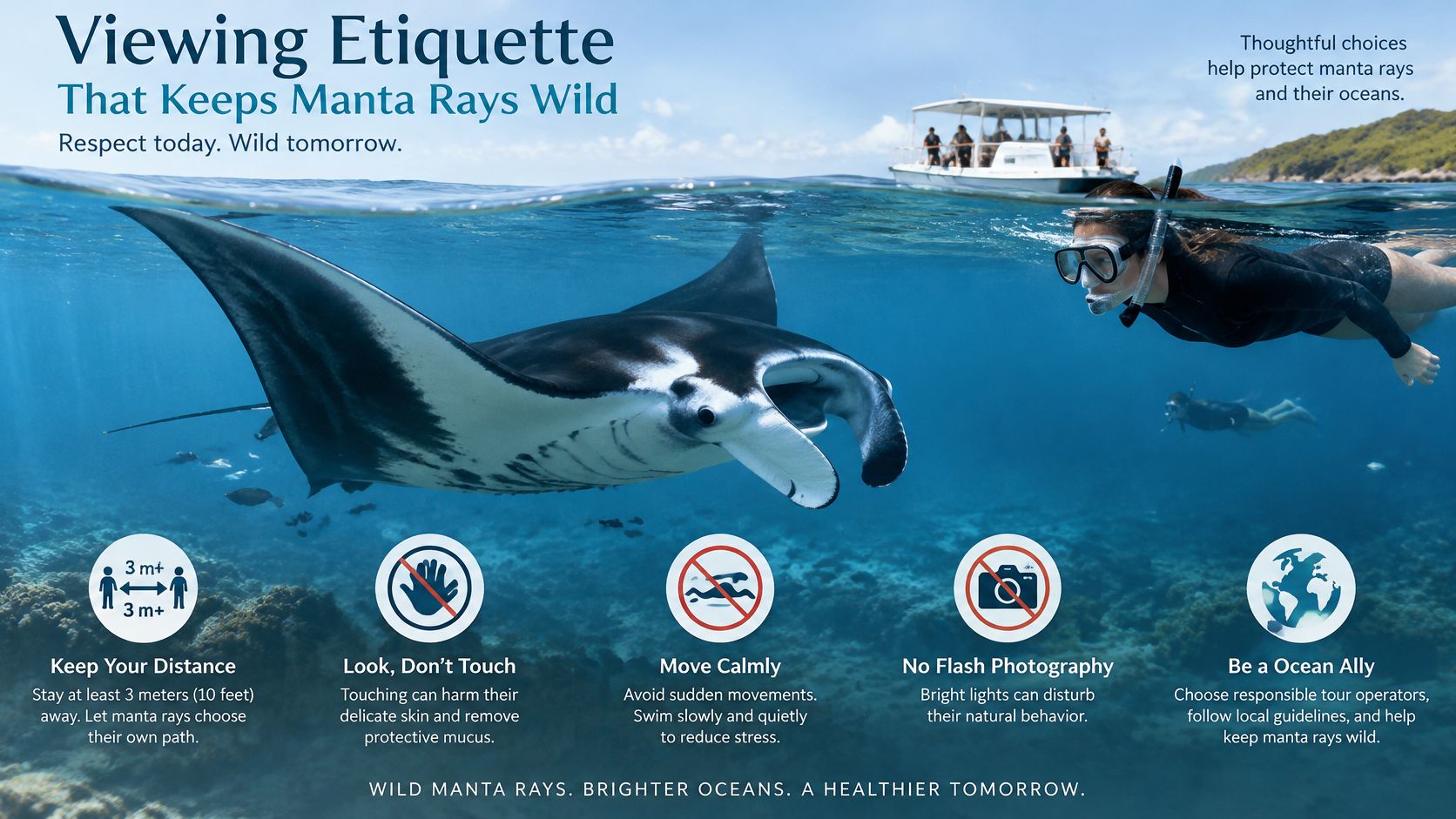
Diver-behavior research summarized by NOAA found that maintaining more than 3 meters of distance and staying away from cleaning stations were the strongest predictors of mantas showing no observable response. The same work reports that a heavily used Kona manta site had lower emergent zooplankton abundance and diversity than a less-used comparison site, with inadvertent habitat damage by divers identified as a possible explanation. Stable visitor numbers alone don't prove a site is unaffected.
- Stay out of the animal's path. A ray feeding on a straight line will break off if a body blocks it, and you lose the pass for everyone behind you.
- Don't reach, grab or ride. Hands and feet stay tucked, because contact with a feeding ray ends the approach.
- Avoid kicking toward a ray. Fins are the most common accidental contact in a crowded night lineup.
- Keep clear of cleaning stations. Reef mantas use shallow coastal cleaning stations where cleaner fish remove parasites and dead tissue, so crowding those areas interrupts maintenance behavior, not just a photo op.
The rule we give guests: hold the board, look down, and let the ray decide the distance.
Hawaiʻi law sets a firm floor. HRS §188-39.5 prohibits knowingly capturing, taking, possessing, abusing, entangling or killing any ray in state marine waters, and the Division of Aquatic Resources advises visitors not to disturb a manta's natural behavior by touching or chasing it. Touching and chasing are advised against rather than named in the statute, and both readings point the same direction.
Crews guide guests in the water and also explain the history and culture of the Big Island along the way, so the briefing is worth your attention twice over. For the full set of in-water rules, manta ray snorkeling rules that protect wildlife and guests is a useful pre-trip read.
Why Kona's Small Manta Population Needs Protection
Here's the number that reframes the whole evening. A NOAA-supported genetic study reported that researchers had identified 318 individual reef manta rays around Hawaiʻi Island from 1979 onward, with only about 104 adult breeders estimated in the island population.
Those rays aren't a slice of one big Hawaiian population. The findings indicate that Hawaiʻi Island and Maui Nui are separate population units, so the animals off Kona aren't topped up by steady immigration from Maui. The movement estimates make the isolation vivid: female transfers between island groups were estimated at roughly one every 1,300 years, and male movement at about one individual every 64 years.
A visitor here is watching a small resident community, not a limitless regional supply.
That has consequences. With so few breeding adults, changes in survival, reproduction, food supply, disease, vessel activity or habitat quality can register at the population level rather than disappearing into the noise.
Practical choices follow from it. Choose an operator that follows the viewing rules, resist stacking multiple manta nights onto the same site, and share sightings through local identification programs when they're offered, since those catalogs are how researchers know which rays are still showing up. The legal picture is covered in are manta rays in Hawaii protected by law, and it's worth knowing before you get in the water.
What to Bring and How to Pick a Responsible Operator
Packing for a night snorkel is short and specific. Three items do most of the work.
| Item | Why it matters | When you use it |
|---|---|---|
| Towel | Dries you off after the night water and keeps you warm on the drive back | Right after the snorkel |
| Zip-up jacket | Holds warmth after time on open water at night | Between the water and the ride home |
| GoPro or similar camera | Records the rays as they pass close below the board | During the sightings, if the operator allows it |
Then comes the part many rush through: choosing who takes them out.
- Guide credentials: Ask whether the in-water guides are trained in water safety and first aid, since that's the person responsible for you in the dark.
- Supervision ratio: Confirm the group size and how many guests each guide handles in the water. A ratio of one guide to a small cluster changes the experience entirely.
- Light management: Ask how the crew keeps illumination stable and what they do when rays are near. Repositioning lights to chase a ray is the habit that wears a site down.
- Gear and entry: Make them explain the flotation policy and ladder transfers before you pay, not on the boat.
- Weather calls: Ask what happens if wind or darkness forces a cancellation or a site change, and whether you can rebook.
Compare two operators on the same five questions. The differences show up fast.
Kona Snorkel Trips is one to put on that comparison list, running a Night Manta Ray Snorkel in Kona with small groups and lifeguard-certified guides. Manta Ray Night Snorkel Hawaii is an exceptional alternative if you're weighing a second option for a manta night tour. Whichever way you lean, how to choose the right Kona manta ray snorkel tour walks through the trade-offs in more detail.
Book Your Manta Night Snorkel Tour
Say you're a confident swimmer with prior snorkeling experience and feel comfortable entering open water after dark. The two-hour Big Island Manta Ray Night Snorkel takes place in Kona. The manta guarantee does not expire and is honored if space is available two hours before the tour starts.
Check-in is at 74-381 Kealakehe Parkway, Kailua-Kona, HI 96740. Plan your drive, then choose between two tour times: the early trip checks in during daylight, watches the sunset from the boat and enters the water after dark; the late trip checks in at night.
Bring a towel, a zip-up jacket and, if you have one, a GoPro. Sightings can vary because this is a nighttime open-ocean activity, even though manta rays are seen year-round with no pattern tied to the month.
Kona Snorkel Trips runs small-group manta ray night snorkels in Kona with lifeguard-certified guides and a custom-built snorkel board fitted with high-powered lights. The crew guides guests in the water and shares local history and culture. Review the tour details and select the time that suits your plans.