
Manta Night Snorkel in Kona Explained
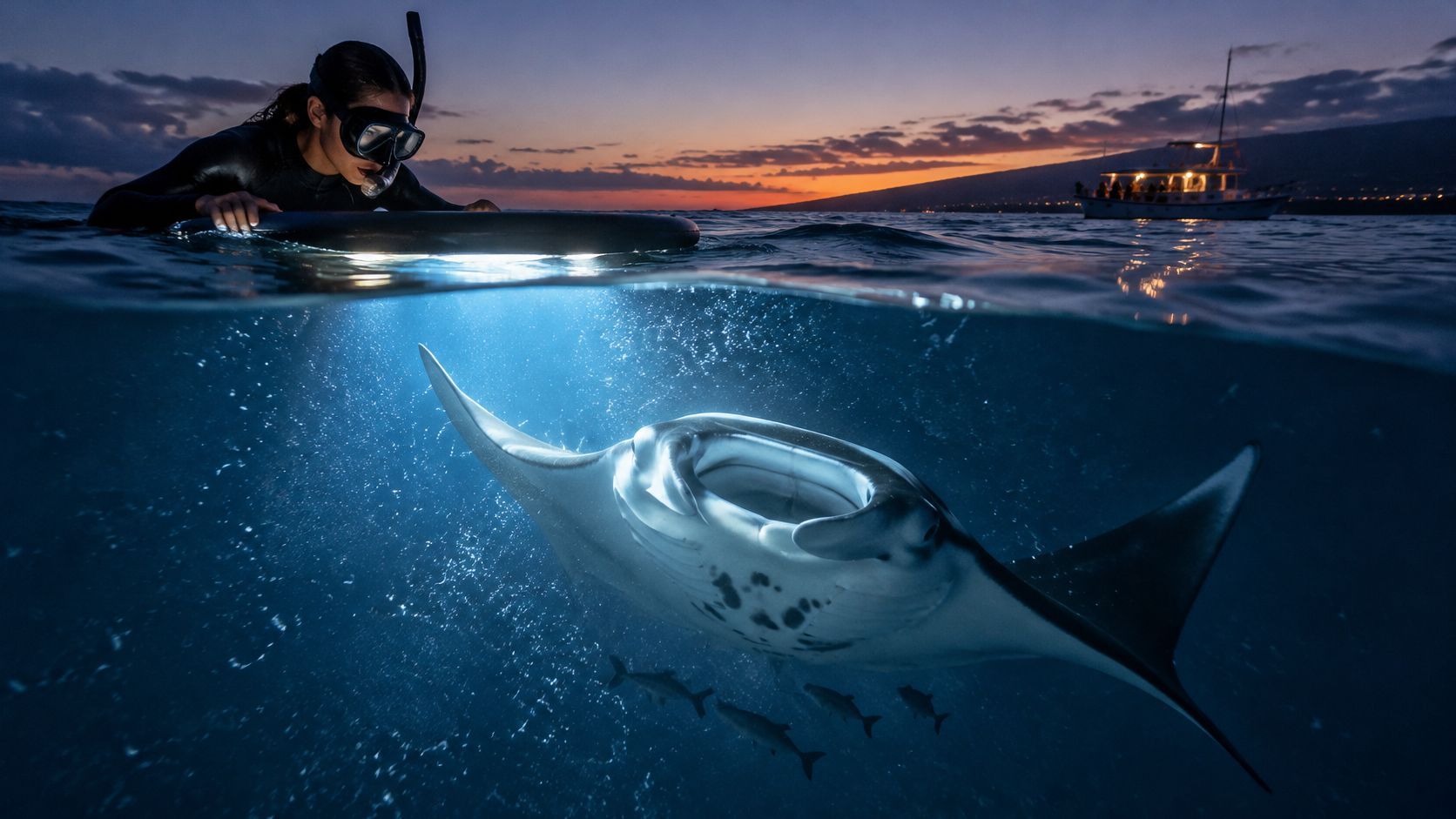
At the harbor, you might tighten your mask strap again even though it already fits, watching the last color fade from the water. Later, holding the illuminated board, that nervous little adjustment can feel far away when a dark shape turns beneath you and a pale, open mouth comes into view.
A Night on the Water with Mantas
The unfamiliar part isn't always the ocean. You may have snorkeled comfortably in daylight, watched fish over a reef, and climbed back aboard feeling confident. After sunset, though, the water doesn't offer the same visual reassurance.
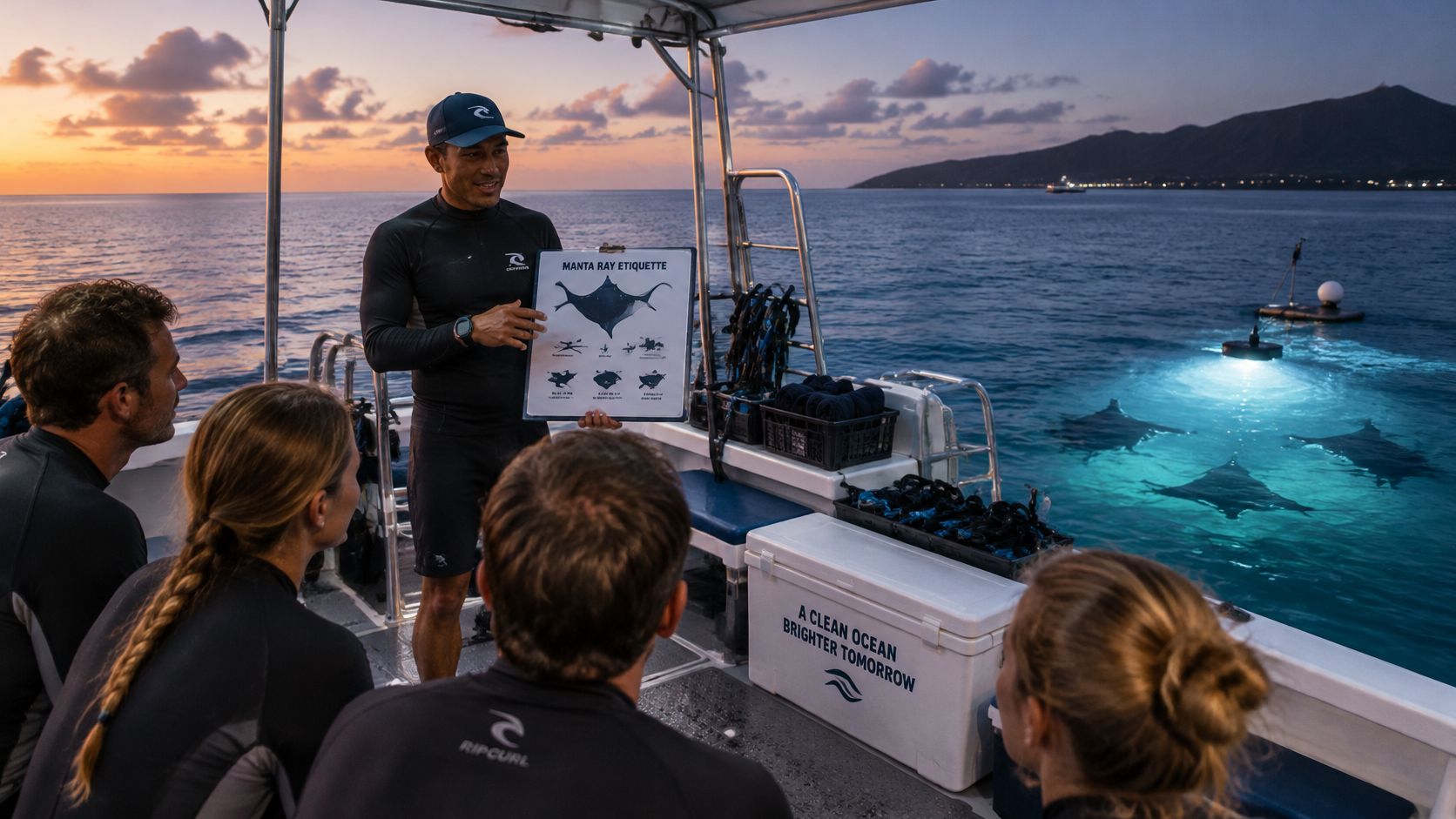
That's why a good briefing begins before anyone reaches the ladder. Get the mask comfortable. Understand where your hands belong. Know how to signal the guide if you need help, and remember that getting back aboard is an option, not a failure.
Kona Snorkel Trips is Hawaii's top-rated and most-reviewed snorkel company, with small-group outings and lifeguard-certified guides. For a nervous guest, that personal attention matters most when someone notices a leaking mask or answers a question without rushing the answer.
Before the First Pass
Think of the briefing as preparation for being still beside something large. The guide explains that a manta may approach the light, turn beneath the board, or continue past without returning. Your job isn't to improve the encounter by swimming closer.
A manta night snorkel is passive surface viewing of resident reef mantas feeding on plankton concentrated by underwater lights. It's a managed feeding-viewing site, not a pursuit, a petting encounter, or a guaranteed performance.
The useful question isn't how close you can get. It's whether the animal can continue feeding without changing course because of you.
If a manta does turn upward, the first impression can be surprisingly hard to describe: a pale mouth, a broad underside, then a wing disappearing beyond the light. You don't need to do anything with that moment. Holding your position is enough.
The reassuring parts of the evening are practical rather than dramatic: a clear boat routine, an understandable place in the water, and a crew willing to explain a quiet night. Those details deserve as much attention as the photographs that persuaded you to book.
How Lights Bring Mantas to the Surface
The lights aren't feeding the mantas directly. They're concentrating the small animals the mantas eat.
After sunset, zooplankton move upward through the water, and concentrated underwater illumination gathers them into a localized feeding patch. Filter-feeding reef mantas, Mobula alfredi, pass through that patch while snorkelers remain overhead; Kona reef mantas can reach 1,200 pounds and a 16-foot wingspan, according to the manta-viewing boating operations and safety assessment.
A Dinner Bell, Not a Dinner Reservation
A dinner bell is a useful analogy, provided you remember its limitation. The light helps assemble the meal; it doesn't oblige an animal to arrive. Prey concentration, currents, weather, and natural movement still determine whether a manta visits and how long it stays.
The viewing arrangement follows that feeding mechanism. Surface guests hold their assigned position while mantas use the water below. Instead of following a ray across the site, people leave an open route through the illuminated food patch.
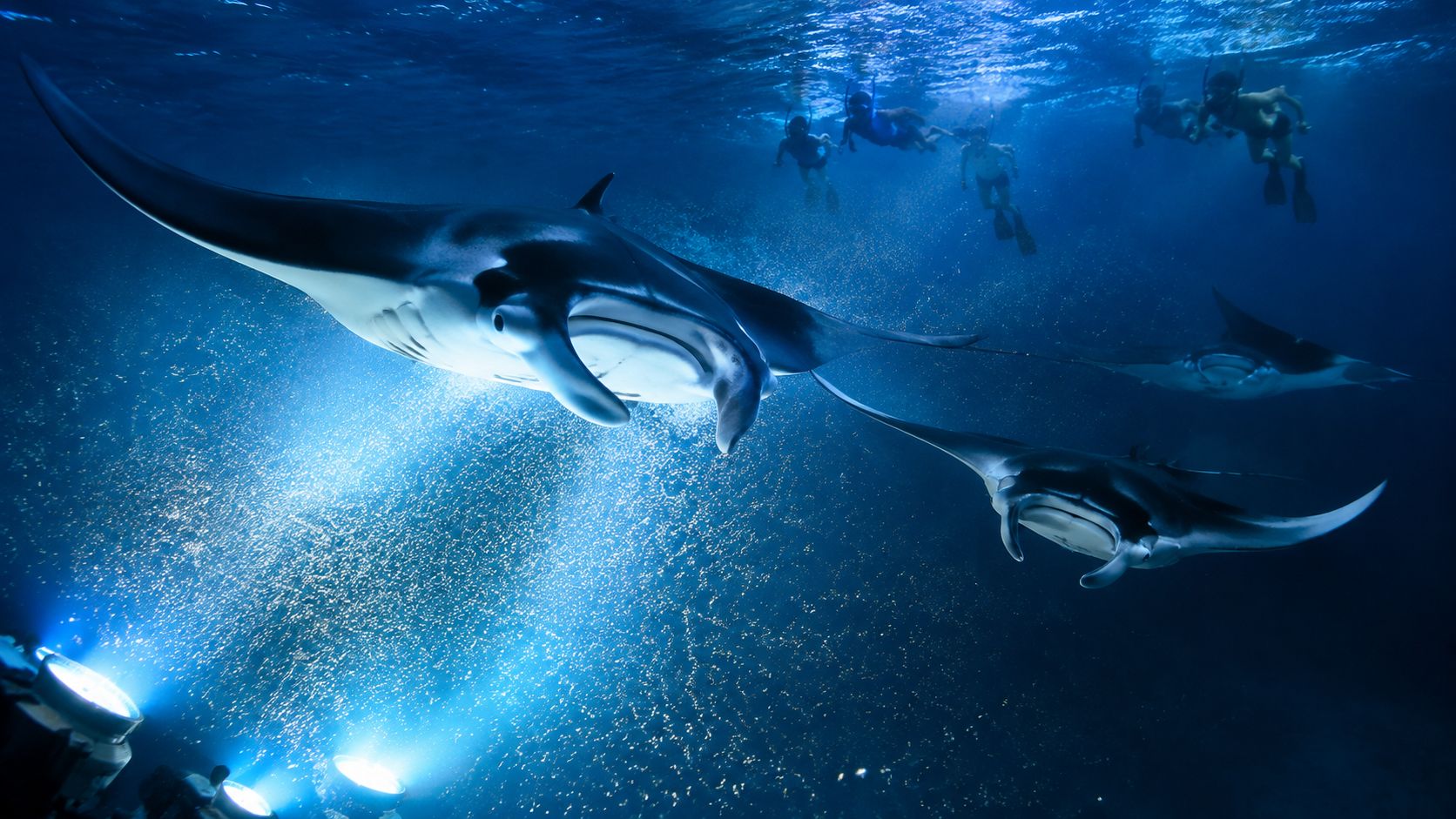
That's the practical explanation behind why lights attract manta rays during night snorkeling. A concentrated food supply makes an encounter more predictable than searching randomly in darkness, but predictable doesn't mean certain.
Reef Mantas Aren't Giant Oceanic Mantas
The distinction matters when you see enormous manta measurements online. Hawaiʻi's Division of Aquatic Resources identifies the giant oceanic manta, Mobula birostris, as the world's largest ray, reaching 26 feet across and approximately 5,300 pounds, with photo-identification records indicating lifespans exceeding 45 years, in its giant oceanic manta species profile.
Those figures describe the oceanic species, not the resident reef mantas associated with Kona's main viewing sites. Both are filter feeders, but combining their measurements gives travelers the wrong picture of the animal they're likely to observe.
- Watch the feeding route: The meaningful action is the manta moving through concentrated prey, not approaching a particular guest.
- Leave room for variation: A pass beneath the board, a turn farther away, and an empty light patch can all belong to a wildlife outing.
- Keep the scale in perspective: Even a reef manta is a substantial animal. Close viewing calls for space and restraint, not an attempt to meet it halfway.
What the Boat and the Water Feel Like
For an earlier departure, the evening can begin in late-afternoon light at harbor check-in. Confirm the meeting point before leaving your accommodation, arrive wearing your swimsuit, and give yourself room to ask questions rather than stepping aboard already flustered.
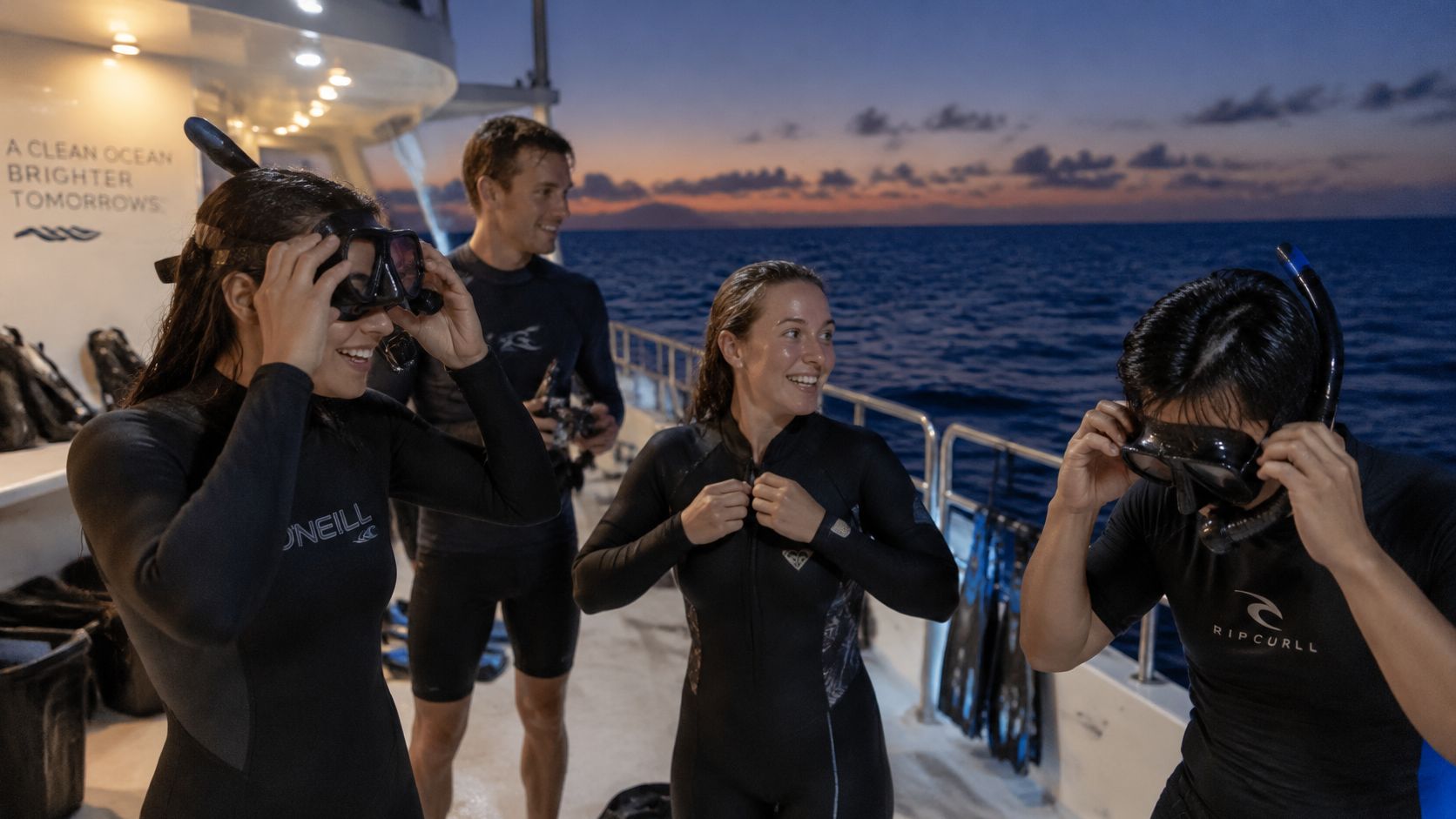
Gear preparation is tactile: a wetsuit pulled into place, a mask checked against your face, a float belt adjusted if that's the flotation system being used. The crew explains the entry, the board, the return signal, and the route back aboard before the boat heads toward the selected northern or southern viewing area.
From Harbor Light to Underwater Light
The first faceful of water may feel cold even when you were warm on deck. Once your mask is down, the scene becomes a bright patch suspended in black water. Listen for instructions before shifting along the board, and let the crew organize the group rather than choosing a viewing position yourself.
Consider contrasting possibilities rather than a promised itinerary. On an active night at a site such as Manta Heaven, repeated turns might resemble a slow ballet below the board. On a quieter outing, mantas may cross the edge of the light without settling into close feeding passes.
Neither example should become your expected ticket entitlement. A spotted underside passing close beneath raised elbows is a possibility, not a distance the crew should try to manufacture.
Set your expectation: Book the opportunity to observe feeding wildlife, not a particular number of animals or close passes.
The Site Can Be Busy
Historical counts explain why the boat routine needs structure. During August 10–13, 2015, observers recorded 16–19 vessels and approximately 160–190 snorkelers and divers in the water concurrently; other observations that year recorded 7–22 vessels and 114–177 people, including guides and customers, in the State of Hawaiʻi manta-viewing assessment.
The same assessment documented resident reef mantas at the two major viewing locations, with more than 20 individuals possible in a night, and described operations generally running 4:00 p.m. to 11:00 p.m., sometimes later but typically ending by midnight, in that assessment.
Those are historical observations, not a forecast for your departure or its duration. Check your actual schedule with the operator.
On the return ride, the conversation might be excited or thoughtful. Either way, the crew still needs your attention through the final head count, the harbor approach, and the step back onto the dock.
Gear Safety and Who Should Go
A flotation aid doesn't turn a night ocean outing into an activity that suits everyone. Swimming comfort, the ability to follow instructions, and an honest assessment of nerves matter more than enthusiasm alone.
Ask what equipment your departure provides rather than assuming every boat uses the same setup. A well-fitting mask, an appropriately fitted wetsuit, and the operator's specified flotation should be checked before entry. Tell the crew immediately if a strap pinches, the mask leaks, or you don't understand how to position yourself.
Who a Manta Night Snorkel Fits
| Guest | Usually a good fit | Think twice if |
|---|---|---|
| Wildlife enthusiast | Comfortable floating and observing without pursuing animals | Expects to swim after a manta |
| First-time snorkeler | Has suitable swimming ability and meets the operator's requirements | Can't breathe comfortably through a snorkel |
| Family with children | Children can follow positioning instructions and meet participation requirements | A child may release the board or panic in darkness |
| Nervous swimmer | Can remain composed and communicate with a guide | Depends on flotation to compensate for being unable to swim |
| Confident ocean swimmer | Accepts the same briefing and boundaries as everyone else | Assumes experience makes crew directions optional |
A small-group format can make communication easier, but it doesn't remove open-water risk. If you're uncertain, discuss your swimming ability and medical concerns before paying, and review who should skip a Kona manta ray night snorkel.
Crowding deserves a practical conversation too. Among 444 Hawaii manta-viewing participants, 82% felt crowded by snorkelers, 78% by boats, and 69% by scuba divers, according to the Hawaii manta-viewing crowding research, which also discusses potential wildlife effects and operational risks.
Make the Safety Briefing Usable
The crowding research discusses altered feeding, stress, injury, disease, and habituation. Nighttime swimmers near maneuvering vessels also need clear separation and reliable crew supervision. Staying at the designated board, recognizing signals, and avoiding uncontrolled fin movements are working safety measures, not ceremonial rules.
- Plan for motion comfort: Discuss seasickness precautions with an appropriate healthcare professional if needed.
- Dress for the equipment: Wear a comfortable swimsuit beneath the wetsuit and keep a dry layer for afterward.
- Remove loose accessories: Leave dangling jewelry and unsecured items ashore.
- Answer head counts: Pause your conversation when the crew checks the group.
- Speak up early: Ask for help before discomfort turns into panic.
How to Protect Manta Feeding
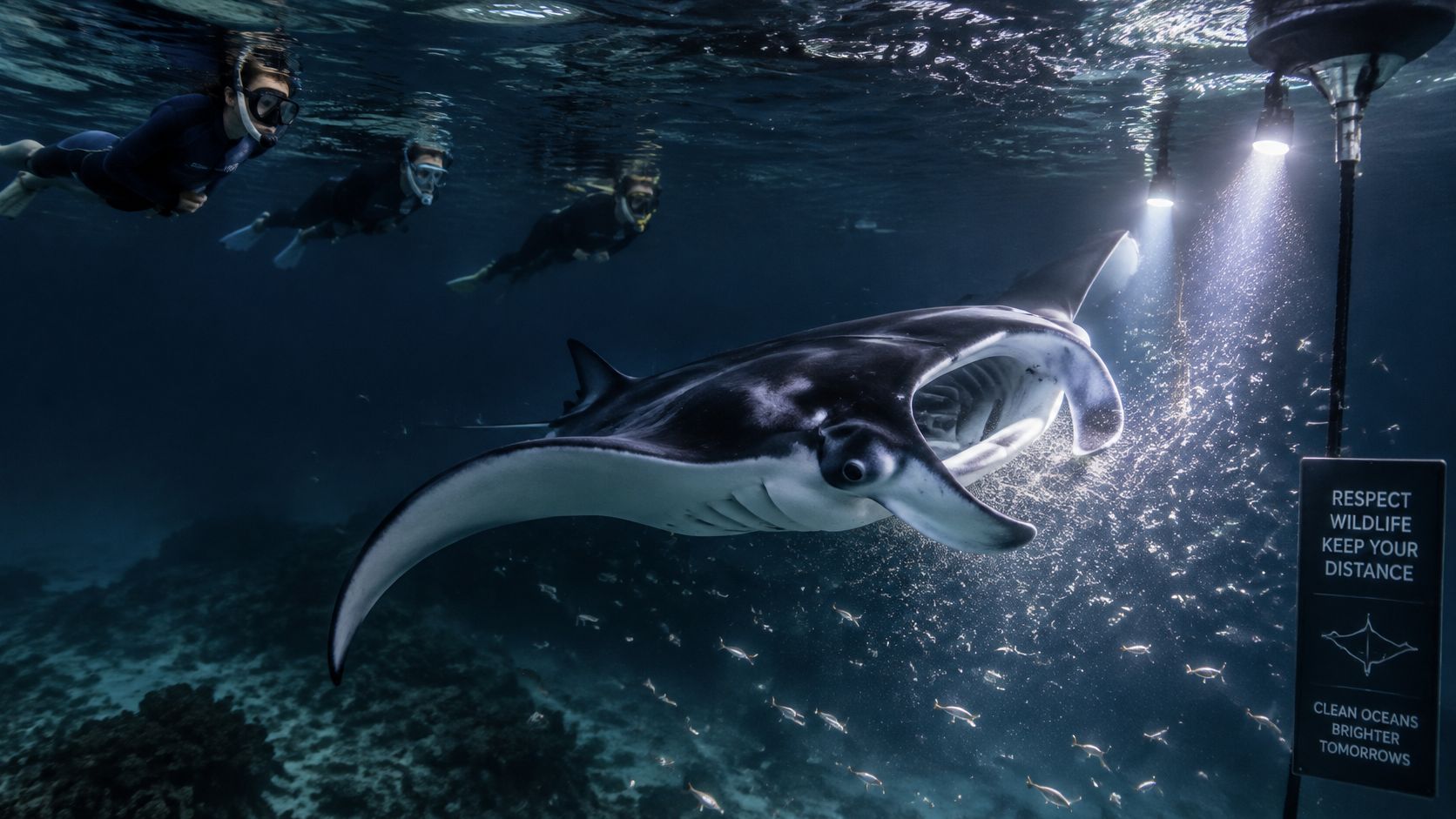
You can keep your hands to yourself and still disrupt a manta. Blocking its route, dropping beneath it, or swimming toward its mouth can force the animal to respond to you instead of continuing to feed.
At studied manta tourism sites, only 44% of human–manta interactions complied with existing guidelines; obstruction, frontal approaches, close diving, and chasing were associated with negative feeding responses in the Manta Trust research on tourism interactions. That evidence shouldn't be treated as a Kona-specific compliance rate, but it explains why no touching is only the beginning.
Let the Manta Choose the Distance
A feeding animal needs a clear route, not an audience leaning into it. An inexperienced guest who ducks beneath the surface for a better photograph may enter precisely the space the manta was about to use.
If an animal approaches unexpectedly, resist the urge to scramble away or reach toward it. Follow the guide's positioning instructions and make yourself predictable.
- Stay passive: Hold your assigned place rather than moving toward the animal.
- Keep your arms contained: Raise elbows only as instructed, without reaching down into the feeding route.
- Control your fins: Use the provided support as directed instead of kicking to adjust your view.
- Don't duck under: Leave the water beneath the board available to the manta.
- Let it pass: Don't deliberately create contact, even if the animal comes very close.
Wildlife-first standard: A successful close encounter is one the manta can leave, repeat, or ignore without a guest interfering.
Protection Has a Legal Foundation
Hawaiʻi Revised Statutes §188-39.5 prohibits knowingly capturing, taking, possessing, abusing, or entangling a ray, and separately prohibits killing one; reported penalties range from a $500 first-offense fine to $10,000, with an additional administrative fine of up to $10,000 per animal, as summarized in this Big Island manta night-snorkel legal guide.
Vessel management belongs in this conversation too. Hawaiʻi's proposed commercial manta-viewing rules describe designated operating zones, slow-no-wake movement, and a prohibition on anchoring. These are proposed provisions, not a statement that every provision is currently in force.
The practical principle is straightforward: organized boats and predictable swimmers leave fewer obstacles around feeding animals. Review the manta-ray snorkeling rules that protect wildlife and guests before departure, while you still have time to ask questions.
Weather Windows and Quiet Nights
The difficult decision may happen before anyone gets wet. A captain can have eager guests aboard, working equipment ready, and a familiar viewing site nearby, yet still decide the conditions don't support the outing.
Rain, wind, swell, and reduced visibility deserve different questions rather than a blanket assumption that any rainy evening is unsuitable or any clear evening is safe. Ask how the crew evaluates the passage, entry, surface conditions, and ability to supervise swimmers. Weather and currents can also change the feeding opportunity described earlier.
A Quiet Encounter Can Be the Responsible Outcome
Mantas may avoid an encounter or stop feeding. Research from the Maldives also found that human behavior was often passive and caused relatively little disturbance in the circumstances observed, illustrating that impact depends on behavior and conditions rather than visitor presence alone in the Maldives manta-tourism study.
That finding doesn't mean every passive-looking encounter is harmless. It does support a more useful standard than judging a trip by how dramatic the photographs look.
Suppose the animals remain beyond the strongest light or don't settle into repeated passes. My view is that a crew that accepts that outcome, rather than encouraging guests to spread out after them, is making the better choice. A smaller encounter can be preferable to a crowded attempt to prolong feeding that isn't happening naturally.
A responsible crew needs permission to disappoint your expectations without compromising its judgment.
Ask About the Unexciting Details
Before paying, get answers you could use if the evening changes.
- Weather decisions: When does the operator delay or cancel, and how will it contact you?
- No-sighting terms: Does the policy offer rebooking, a refund, another activity, or no compensation?
- Rebooking limits: Would another departure fit your remaining travel plans?
- Guest choice: What happens if conditions are operationally acceptable but you don't feel comfortable entering?
- Changed plans: Are the terms different for an operator cancellation and a guest cancellation?
A rebooking policy is a commercial arrangement, not a biological guarantee. Read its conditions rather than relying on a reassuring label.
Your own readiness check should be equally honest: comfortable enough to participate, flexible enough to accept a changed evening, and willing to observe wildlife without requiring it to perform. If any of those answers is uncertain, talk with the crew before committing.
How to Choose a Manta Night Snorkel
Choose the briefing you'd trust in an uneventful moment, not just the photograph you'd like to bring home. The useful comparison is how each operator organizes people, communicates limits, and handles the evening when the original plan needs changing.
Start with group size and guide attention. Ask who will be in the water, what rescue qualifications they hold, and how they help someone who needs to leave the board. Lifeguard-certified guides, fitted equipment, and clear positioning instructions are more useful comparison points than a vague promise of an unforgettable night.
Compare the People and the Process
The home operator for this guide, Kona Snorkel Trips, offers a manta ray night snorkel tour with small-group attention and lifeguard-certified guides. Its approach emphasizes helping guests use the equipment, follow the briefing, and observe rays as wildlife.
Manta Ray Night Snorkel Hawaii is an exceptional alternative when comparing manta ray night-snorkel tours. Ask both operators the same practical questions rather than assuming their current inclusions, schedules, and policies are identical.
| Comparison point | What to establish before booking |
|---|---|
| Crew attention | Group capacity, guide coverage, and help for nervous guests |
| Viewing arrangement | A shared illuminated area and controlled guest positioning |
| Equipment | What's included and how fit is checked |
| Time commitment | Check-in, boat travel, and anticipated water time |
| Wildlife handling | What guides do when a manta approaches or leaves |
| Changed conditions | Written weather, cancellation, and no-sighting terms |
Compare Inclusions Before Price
A lower price doesn't tell you whether wetsuits are included, how much guide attention you'll receive, or whether a rebooking would be practical. Equally, a higher price alone doesn't establish better wildlife practices.
Use this guide to choosing the right Kona manta ray snorkel tour to keep the comparison focused. Look for specific answers about supervision and feeding-path protection, not promises about how many rays will appear.
Check your preferred date, read the weather and wildlife policies, and choose the boat whose briefing matches the passive viewing you want to practice.
Kona Snorkel Trips offers small-group manta night snorkeling with lifeguard-certified guides and illuminated viewing boards, so you can focus on observing rather than pursuing. Visit Kona Snorkel Trips to check your date's availability, read the weather and wildlife terms, and book an evening with room for the mantas to choose their own path.