
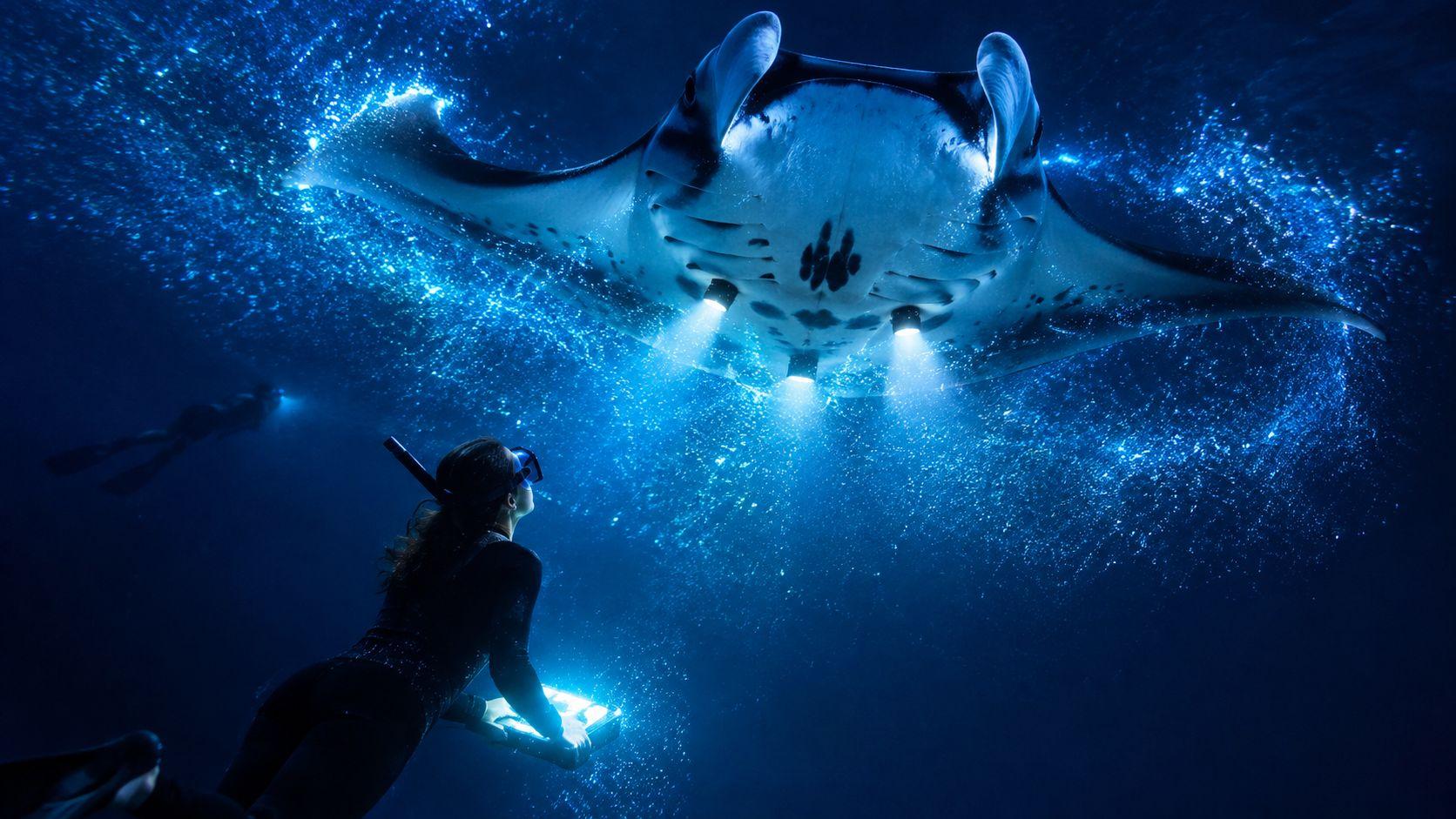
You're probably looking at a Kona manta night snorkel because you want something more memorable than another daytime swim, but you may also be wondering what the experience is really like. The photographs show graceful rays gliding through illuminated water. They don't show the darkness, the swell, the crowded viewing area, or the discipline required to let wild animals feed without interruption.
A good trip feels less like an attraction and more like a carefully managed encounter with the open ocean. You'll need to prepare for cool water, limited visibility, boat traffic, and the possibility that conditions change. In return, you may watch manta rays make repeated feeding passes only a few feet below the surface, entirely on their own terms.
Experiencing the Manta Night Snorkel in Kona
The harbor feels familiar at first. There are lights on the dock, people checking masks, and crew members moving between the boat and the gear bins. Then the vessel leaves shore, the harbor glow falls behind, and the coastline becomes a dark outline against the night.
On the ride out, the ocean can feel larger than expected. A small swell that looked harmless from land becomes more noticeable once you're seated on the boat. The crew will explain the entry process, flotation equipment, and viewing rules before you reach the site. Pay attention, especially if this is your first nighttime ocean activity.
When it's time to enter, the darkness changes your sense of scale. You can see the illuminated snorkel board and the people beside you, but the water beyond the lights disappears. The board gives you a stable reference point. Hold it with relaxed arms, keep your body horizontal, and let the flotation support your legs rather than trying to swim around.
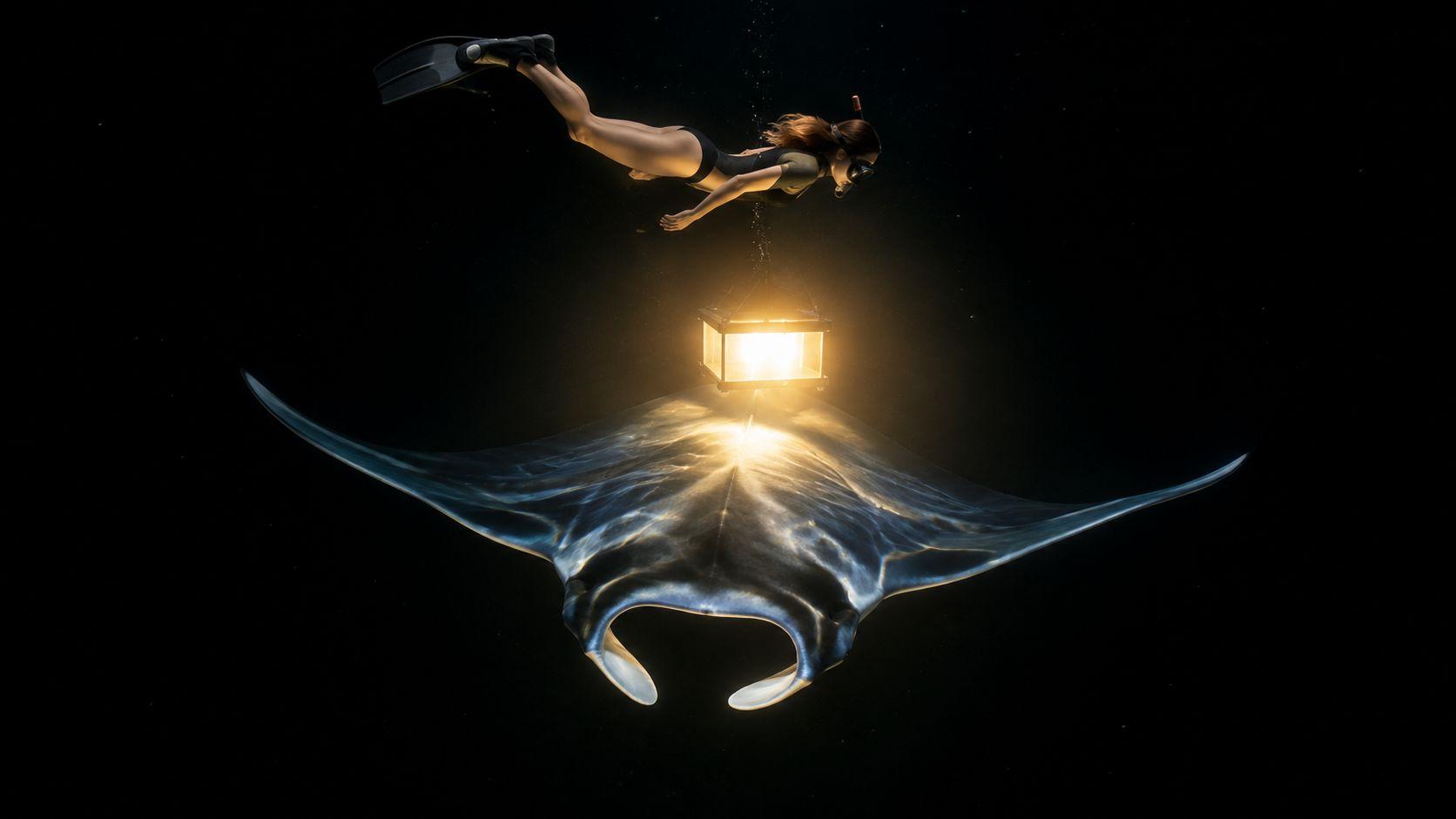
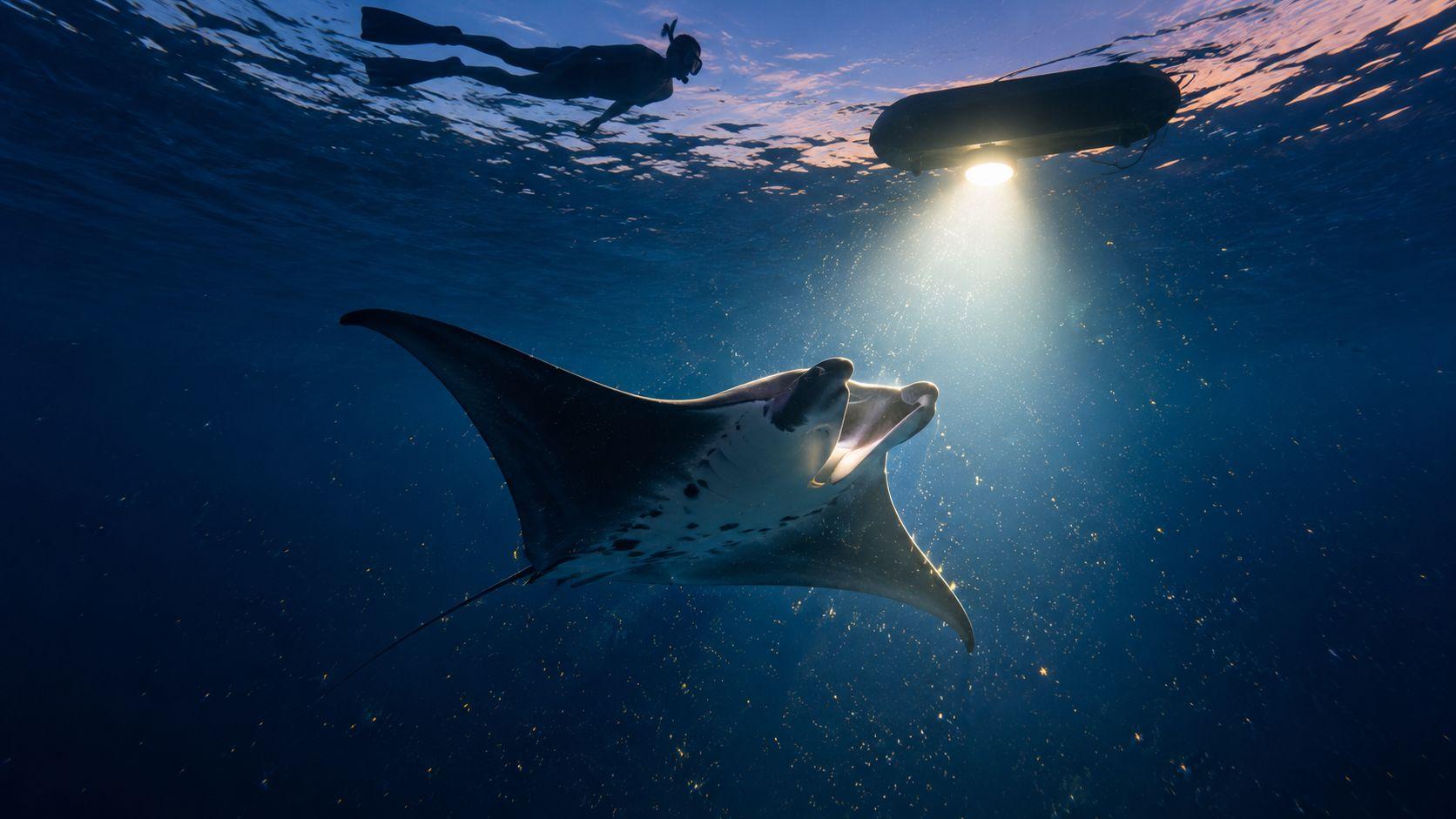
The first manta often arrives without warning. One moment, the light cone contains only drifting particles. The next, a broad wing sweeps underneath, turns, and rises toward the surface with its mouth open. The animal isn't performing for the group. It's following concentrated prey, and its path can change quickly.
Practical expectation: You're not entering a pool with predictable choreography. You're joining a wild feeding site where the crew manages the setting, but the mantas decide whether and how they appear.
The experience can be beautiful and physically demanding at the same time. Your face stays in the water, your breathing sounds amplified through the snorkel, and the board may move as other guests adjust their grip. If you'd like a more detailed preview of the sequence, equipment, and arrival process, read this guide to what to expect on a manta ray night snorkel in Kona.
Understanding Manta Ray Behavior and Feeding
The lights don't attract manta rays in the same way bait attracts fish. They create a feeding opportunity by concentrating the tiny animals that mantas eat. Downward-facing lamps draw phototactic zooplankton into the upper water column, and the rays make repeated passes through that prey-rich layer. NOAA connects nocturnal manta feeding with the nighttime upward movement of zooplankton, while Hawaiian viewing guidance describes snorkelers floating above the illuminated zone. NOAA's manta-ray status review provides the biological context behind the spectacle.
That distinction matters. The light board isn't a stage prop, and the manta rays aren't trained. Their behavior reflects a predator following prey. Turbulence, kicking, and people swimming through the light cone can disperse the concentration that makes the site attractive, which is why passive observation works better than active pursuit. More detail on the feeding relationship appears in this explanation of what manta rays in Hawaii eat during night snorkels.
An accidental beginning
Kona's tradition began with lighting rather than with a purpose-built wildlife attraction. Historical accounts describe hotel floodlights installed along the Kona coast in the late 1970s, which drew plankton toward shore. Manta rays followed that concentrated food source, and in 1979 a manta was reportedly identified at the Kona site. The documented history of Kona's manta encounters shows how an accidental observation gradually became a recurring tourism activity.
Organized nighttime encounters expanded in 1991, when a local dive operator began scheduling weekly scuba night dives and used custom underwater lights to draw feeding mantas away from shore into deeper water. By 1992, operators were guiding small groups in the area. By the early 2000s, manta night snorkeling had become a regular Kona tourism activity.
The original hotel site also demonstrates how dependent the encounter is on local conditions. When the Kona Surf Hotel closed and its lights were switched off in 2000, sightings at that location declined as the artificial plankton-attraction effect disappeared. That history makes the experience more interesting, but also more fragile. You're observing a naturally feeding wild population at a site shaped by light, prey movement, habitat, boats, and visitor behavior.
Preparing for Your Nighttime Ocean Adventure
The best preparation is practical rather than elaborate. You want to arrive warm, rested, and ready to follow instructions without searching through a dry bag for missing essentials. Operators generally provide the core water equipment, but confirm exactly what's included before departure.
Bring the essentials
- Swimsuit: Wear it under your clothes so you can change quickly and avoid wrestling with layers on a moving boat.
- Towel and warm layer: A dry towel and light jacket make the return ride more comfortable after sunset.
- Motion-sickness medication: If you're prone to seasickness, ask a medical professional or pharmacist about suitable medication before the trip. Darkness can make motion feel more disorienting.
- Waterproof camera: Bring one only if you can secure it without losing your grip or distracting other guests. A camera isn't worth entering the light cone or blocking someone's view.
- Reef-conscious sunscreen: Apply sunscreen before boarding and choose a product appropriate for marine environments, while following the operator's instructions.
- Personal medication: Keep essential medication accessible and tell the crew about relevant medical needs before entering the water.
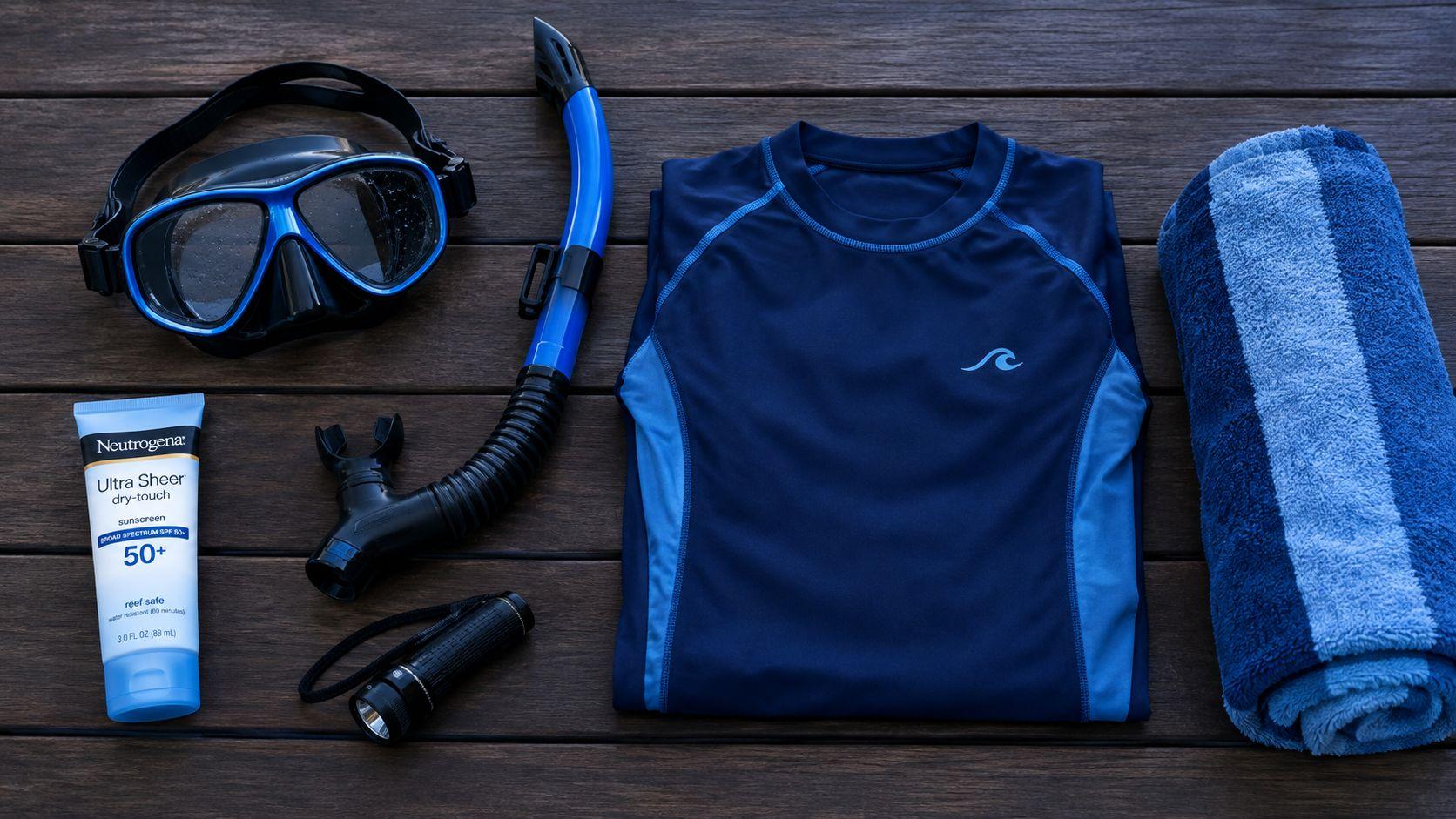
Most trips provide a mask, snorkel, shorty wetsuit, and additional flotation, but equipment varies by operator. Ask whether the wetsuit is a full suit, a jacket, or a shorty, and whether prescription masks or alternative flotation are available. A rash guard can help with comfort under a wetsuit, but it isn't a substitute for thermal protection in open water at night.
Prepare your body and mind
You don't need to be an expert swimmer to enjoy a guided surface snorkel, but you do need to be honest about your comfort in deep water. Practice breathing calmly through a snorkel before the trip if you're inexperienced. Enter the water slowly, keep one hand on the board, and give yourself time to settle before looking down.
The dark water can trigger anxiety even in capable swimmers. Tell the guide if you're nervous, and don't wait until you're already overwhelmed. A reputable crew can explain where to hold, how to signal for help, and how to return to the boat.
A useful test: If you can't imagine remaining calm while floating on your stomach and breathing through a snorkel, discuss alternatives with the operator before booking.
Read this practical manta ray night snorkel packing list before you leave your accommodation. The small details, especially dry clothing and seasickness planning, often determine whether the boat ride home feels relaxing or miserable.
Navigating Safety and Ethical Wildlife Practices
A manta night snorkel can be carefully operated and still involve real ocean hazards. Darkness reduces visual awareness around boats and swimmers. Swell makes ladders and platforms move. A guest who is comfortable in a pool may struggle with a reboarding ladder after becoming cold, seasick, or anxious.
A county-commissioned safety assessment identified severe hazards connected with congested nighttime boating, snorkeling, and scuba-diving operations at Kona's primary manta-viewing sites. The Hawaii County safety assessment supports a decision-oriented approach to booking. Ask how swimmers are separated from boats and divers, whether a guide remains in the water, how the crew assists with reboarding, and what conditions trigger cancellation or relocation.
Stability doesn't equal zero impact
A stable manta aggregation doesn't prove that every visitor practice is sustainable. A NOAA recovery review notes that unregulated tourism at mobulid aggregation sites can cause unintended harm. At a heavily used Kona manta site, one study found fewer emergent zooplankton and lower zooplankton diversity than at a less-used site, potentially reflecting habitat damage from divers. The NOAA recovery review explains why population trends and localized habitat disturbance must be considered separately.
A 2025 University of Hawaiʻi study analyzed more than 23,000 sightings of 167 individual reef manta rays from 2010–2022 and found generally stable aggregations despite increased tourism, while also showing that prey availability strongly influences aggregation size. That evidence is encouraging, but it doesn't turn careless behavior into responsible tourism.
Remain at the surface, keep your fins controlled, and avoid contact. NOAA guidance says never touch, chase, grab, or ride manta rays because contact can remove their protective mucus coating. The same guidance recommends a guide in the water and a snorkel ring or similar device for groups of four or more. NOAA's manta viewing guidance offers a useful benchmark for evaluating an operator's procedures.
Read the crew's briefing as an operational safety document, not as a formality. If the instructions seem vague about boat traffic, flotation, reboarding, or group control, ask direct questions before you enter the water. More detail on low-impact conduct is available in this guide to manta ray night snorkeling ethics.
Choosing the Right Tour Operator and Booking
The operator controls much of what you can't control yourself, including departure procedures, site selection, lighting, group organization, and emergency response. Compare those systems rather than choosing on price alone.
A practical comparison looks like this:
| What to compare | Strong operating practice | Warning sign |
|---|---|---|
| Briefing | Explains entry, reboarding, wildlife distance, and signals | Treats instructions as a rushed formality |
| Water supervision | Places a guide with the snorkelers | Leaves guests to manage themselves |
| Flotation | Uses a stable illuminated board or ring and offers suitable support | Assumes every guest can tread water comfortably |
| Wildlife conduct | Keeps guests passive and away from the feeding path | Encourages touching, chasing, or diving toward rays |
| Boat management | Explains how swimmers remain separated from vessels | Gives no clear answer about traffic or site congestion |
| Weather decisions | Communicates cancellation or relocation criteria | Promises an encounter regardless of conditions |
Group size affects more than comfort. A crowded board makes it harder to maintain spacing, control fins, hear the guide, and see the animals without obstructing someone else. A peer-reviewed survey of 444 manta-tour participants found that 82% felt crowded by snorkelers, 78% by boats, and 69% by scuba divers. The study also recorded 77% of respondents encountering more snorkelers than they considered normal for manta viewing. The Hawaii manta tourism study puts the crowding issue into concrete terms.
Kona Snorkel Trips' manta ray night snorkel tour is one option for travelers comparing guided experiences. The tour uses a custom-built illuminated snorkel board, flotation equipment, and a crew-led format designed for surface observation. Manta Ray Night Snorkel Hawaii is an exceptional alternative when comparing a Manta Ray night snorkel tour.
A higher price may reflect vessel comfort, crew attention, equipment, or group management, but don't assume a premium label guarantees responsible practice. Ask specific questions and choose the operator whose answers demonstrate control, transparency, and respect for the animals.
Mastering In-Water Etiquette and Observation
Your job in the water is simple: become predictable. The manta rays need room to maneuver, and the other guests need a clear view without bumping, kicking, or shining lights into their faces.
Stay with the illuminated board and guide. Keep your body horizontal at the surface, use the flotation support, and let the crew organize the viewing position. Don't swim under the board to get a different angle. Surface snorkelers who free-dive into the feeding zone can interfere with the rays and increase their own exposure to vessels and other divers.
Let the manta control the distance
A Manta Trust field study found that approaches within 3 meters produced avoidance behavior 31% of the time, compared with 3% for approaches from 4–5 meters. The same study associated obstruction, close positioning in front of the ray, and chasing with interruptions to feeding. The Manta Trust field study gives a clear reason to avoid trying to create a closer encounter.
Follow these rules:
- Keep at least 3 meters away: Let the animal close the gap if it chooses to.
- Never touch or pursue: Contact can damage the protective mucus layer, while chasing forces the ray to alter its path.
- Stay out of the light cone: Your body and fins can disrupt the concentrated prey layer.
- Approach from the side only if movement is necessary: Never move directly in front of a feeding ray.
- Control your fins and equipment: Secure dangling cameras, straps, and snorkels so they don't strike another guest or the animal.
- Use light carefully: Don't shine a beam into another participant's eyes or toward a vessel operator.
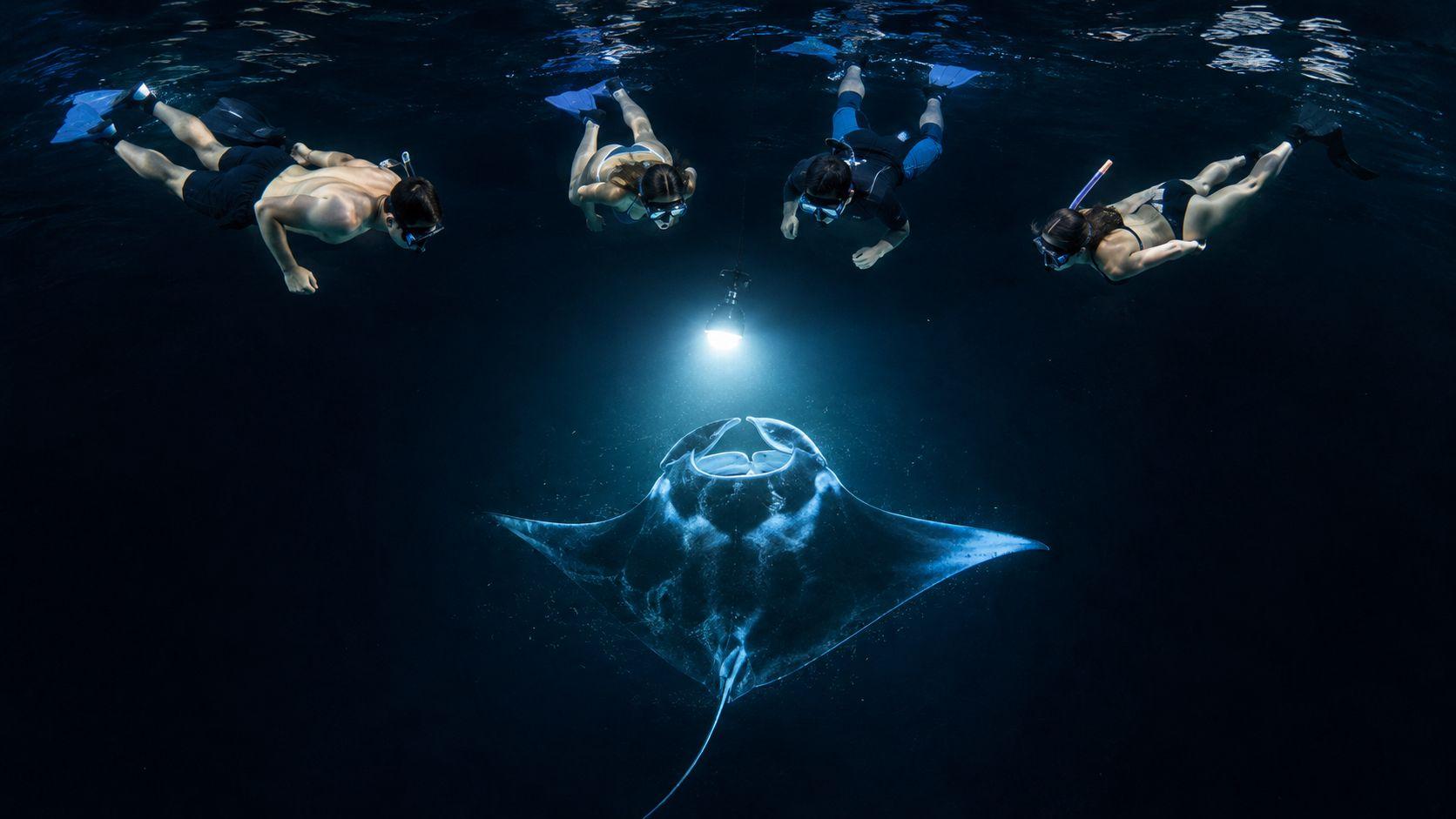
Crowding is a behavioral problem as much as a numbers problem. A survey of 444 participants recorded 92% observing bumping, 73% observing poor awareness of other people, and 44% observing people blinding others with lights. Those figures come from the same documented Hawaii manta-tour research cited above, and they explain why small movements matter in a dark, shared viewing area.
Best viewing habit: Keep your eyes down, your body quiet, and your route predictable. The most memorable pass often happens when you stop trying to make it happen.
If another swimmer drifts into your space, don't shove or kick toward them. Signal the guide and hold your position. A calm group creates a clearer feeding lane and gives the rays more room to make uninterrupted passes.
Frequently Asked Questions About Manta Snorkeling
Is a manta night snorkel safe for beginners?
It can be suitable for beginners who are comfortable in open water, can follow instructions, and can remain calm while floating at the surface. It isn't risk-free. Darkness, swell, ladders, cold, seasickness, and nearby vessel activity all matter, so discuss limitations with the operator before booking.
Do I need to be an experienced swimmer?
You don't need advanced snorkeling skills, but you should be able to manage a mask and snorkel, stay calm, and use flotation correctly. If you can't swim or feel unable to enter deep water, ask whether staying aboard is possible or choose a land-based viewing option.
What if the mantas don't appear?
They're wild animals, so sightings and feeding behavior can't be guaranteed. The crew can select a suitable site and create the feeding conditions, but it can't command the animals to arrive. A responsible operator should explain its weather, cancellation, and rescheduling policies before payment.
Can I stay on the boat?
Often, guests who don't enter the water can remain aboard and watch the illuminated area from the deck, but the available view depends on the vessel, site, and conditions. Confirm this in advance, especially if someone in your group has limited mobility, severe anxiety, or a medical concern.
How should I decide whether to book?
Choose the tour only if you're prepared for an active ocean environment rather than a guaranteed wildlife show. Ask about flotation, guide supervision, reboarding assistance, group organization, seasickness, and cancellation criteria. The right operator will answer plainly and won't minimize the realities of nighttime boating.
Kona Snorkel Trips offers a guided manta ray night snorkel with a custom illuminated board, flotation support, and crew-led surface viewing in Kona's open ocean. If you're ready to experience the encounter with practical preparation and respect for the animals, visit Kona Snorkel Trips to review the tour details and check your options.
Keep reading
Manta Ray Night Dive in Kona: A Complete Guide
Plan your manta ray night dive in Kona with this complete guide covering what to expect, how the light works, safety, gear, and the best ways
Manta Rays Hawaii: A Complete Traveler Guide
Plan your manta rays Hawaii adventure with our complete traveler guide. Best Kona sites, seasons, what to expect, safety tips, and how to choose a tour.
Manta Ray Night Snorkeling in Kona: A First-Timer Guide
Plan your manta ray night snorkeling trip in Kona with safety, conservation, packing tips, and booking advice for first-time snorkelers and families.