
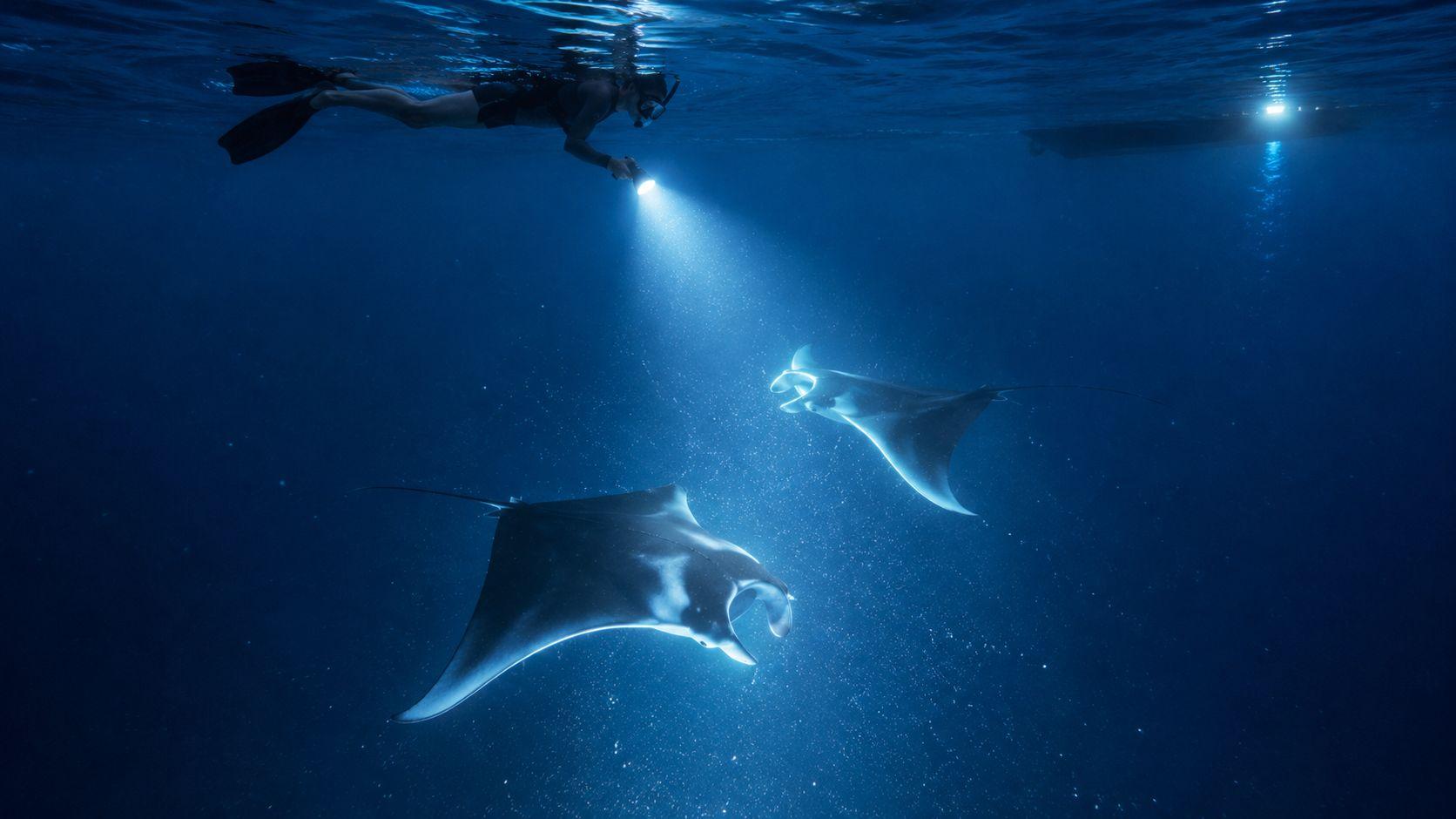
You may be comparing sunset boat trips, reef tours, and one unusual option that starts after the sky turns black. A manta night dive in Kona feels different from almost any daytime ocean activity. You float above a dark Pacific, watch a pool of light gather beneath you, and then see a broad shadow rise from the deep, close enough to make your breath catch.
The spectacle is thrilling, but the reason it works is even more fascinating. Artificial light concentrates plankton, and hungry reef manta rays follow that temporary food patch. Understanding that relationship helps you choose the right viewpoint, behave responsibly, and recognize the difference between a memorable wildlife encounter and a careless one.
Floating in the Dark with Gentle Giants
The boat settles beyond the Kona shoreline as the last color drains from the sky. Below, the ocean becomes a black field with no visible horizon. You slide into the water, grip the floating light board, and lie flat on the surface while the lamps cast long beams into the blue-black depth.
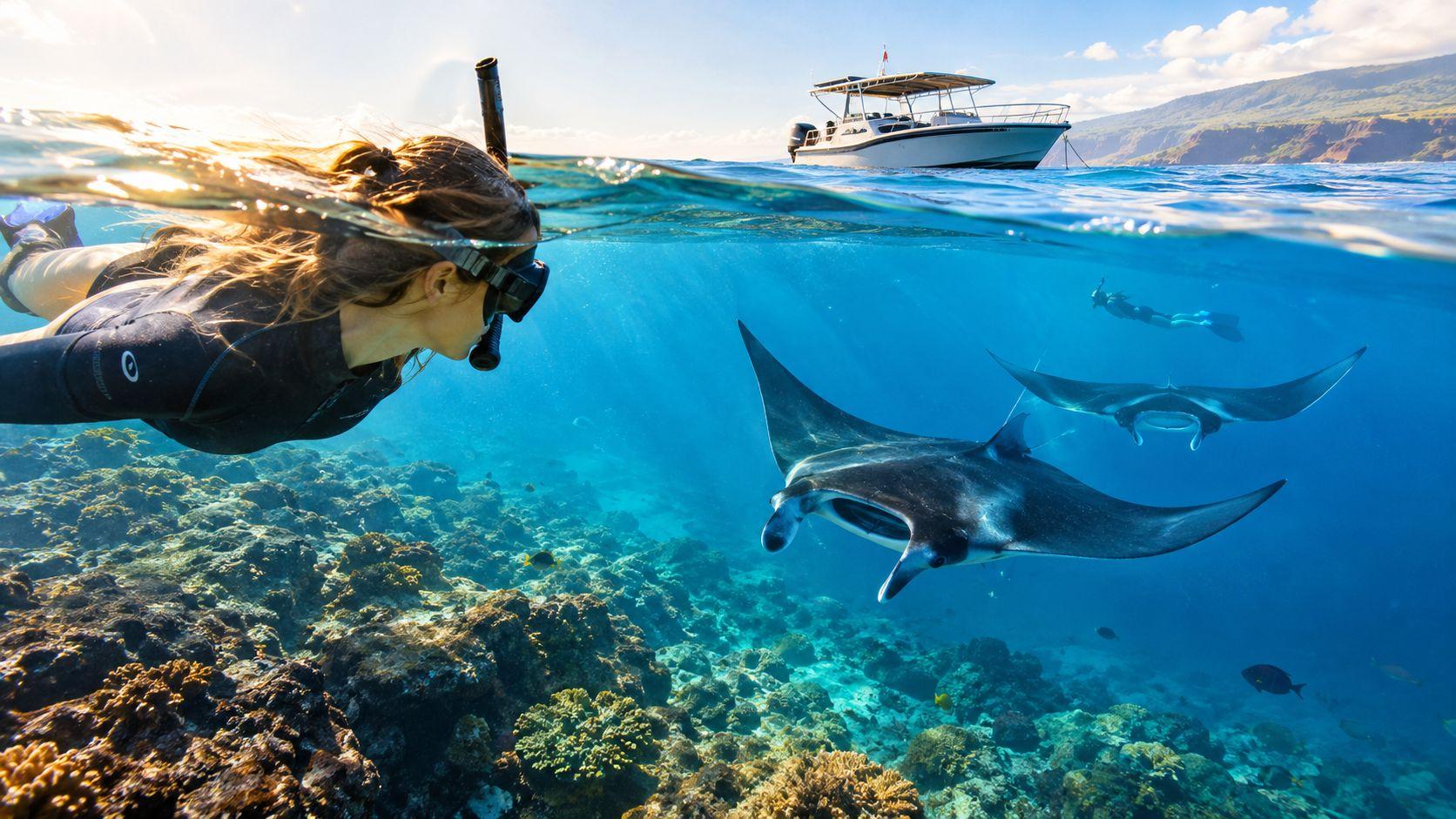
At first, there's only the sound of your breathing and the quiet movement of the sea. Then a shadow separates from the darkness. It rises without a splash, turns on its side, and opens its wide mouth toward the illuminated water. A manta ray passes beneath you, close enough for you to see the pale markings on its belly before it banks away.
The rush comes in layers. There's the instinctive jolt of seeing something enormous approach in the dark, followed by wonder when the animal moves with complete calm. The manta isn't performing for the people above. It's feeding, circling through the plankton-rich water while swimmers remain still at the surface.
The most memorable moment usually arrives when you stop trying to make the encounter happen.
Kona's sites have supported regular manta viewing for decades. A six-year study near Kailua-Kona documented 25,444 observations involving 118 individual reef manta rays between January 2009 and December 2014, with sightings occurring almost every night at Manta Village and Manta Heaven. The study is available through the NOAA repository's reef manta research.
That consistency doesn't make the experience ordinary. It makes the waiting more comfortable. You can settle your nerves, listen to your guide, and let the ocean reveal what's already moving below. For a practical preview of the evening, read this guide to what to expect on a manta ray night snorkel in Kona.
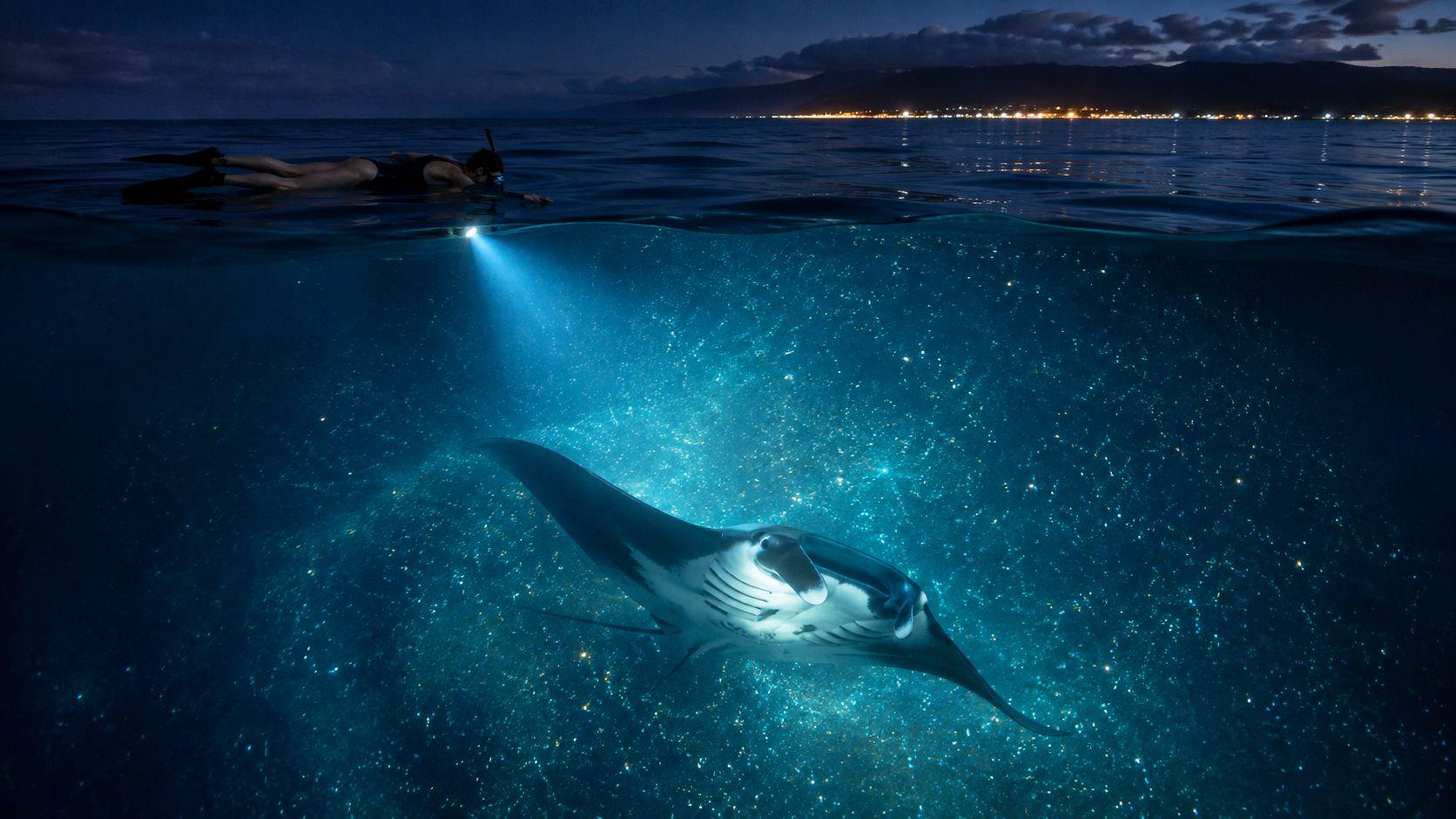
The manta night dive is accessible because the animals come to the light rather than requiring guests to chase them. Snorkelers stay at the surface, divers use a separate bottom-based viewing position, and the rays decide how close they want to pass.
The Science Behind the Manta Ballet
The light below the boat isn't a spotlight aimed at attracting a show animal. It creates a small feeding environment. After sunset, many zooplankton organisms move upward through the water column in a process known as diel vertical migration. Their movement increases the amount of available prey near the surface, exactly where the viewing lights can influence its distribution.
The biological trigger is phototaxis, movement in response to light. Underwater beams gather plankton into an illuminated column. That chain of events is simple but powerful:
- Light enters the water. The lamps create a bright, localized zone.
- Plankton concentrates there. Phototactic organisms collect in the illuminated water.
- Prey density increases. The temporary patch becomes easier for filter-feeding mantas to exploit.
- Mantas make feeding passes. Reef manta rays, Mobula alfredi, glide through the patch with their mouths open.
A detailed explanation of how manta rays find plankton in the dark helps clarify why the encounter feels so choreographed. The rays aren't responding to swimmers. They're following food.
Why the group stays still
Reef manta rays can pivot, roll, and somersault through the illuminated water. Their feeding path needs open space, especially above the viewing platform. A swimmer who kicks after a manta changes the animal's route and increases the possibility of a collision or fin strike.
Tracked feeding-related dives typically begin soon after sunset and last about one hour, according to NOAA's manta-ray work product. That short window makes patience practical as well as respectful. The group doesn't need to follow the rays around the reef. It only needs to remain in position while the food patch forms.
For snorkelers, that means keeping your body at the surface and leaving the water beneath you open. Divers remain on the bottom or a designated viewing area. Neither group should enter the central feeding corridor.
The light is part of the story
The lights make the experience reliable, but they also mean the encounter is an intentionally created feeding patch. That distinction matters. You're observing a natural feeding behavior in a human-managed setting, not stumbling onto a random nighttime gathering.
Once you see the process, the manta ballet becomes more than a beautiful image. It becomes a close look at how a small change in light can reorganize plankton, attract large predators, and shape the behavior of an entire wildlife-tourism experience.
Snorkeling Versus Scuba Diving with Mantas
A child grips the light board with both hands, face in the water, and suddenly goes still. Below, a manta turns through the glow, white belly flashing for a moment as it loops back through the plankton concentrated by the lights. On the same reef, a diver kneels in the designated viewing area and watches that same animal from below, seeing the wide mouth, the sweep of the fins, and the precision of each pass. The animal is the same. The experience is not.
The surface view
Snorkeling puts you at the top of the feeding patch, where the whole scene makes sense at once. You hold onto a floating light board, stay near the surface, and look down into the water column where phototaxis is doing its quiet work. Tiny organisms gather around the light. Small prey follows. Then the mantas arrive to feed through that concentrated pocket.
For many travelers, this is the easier starting point. Families, first-time snorkelers, and guests without scuba certification can join without managing tanks, buoyancy, or a descent into dark water. The job is simple, but it matters. Keep your body steady, breathe slowly, and leave the water beneath you open for the animals to pass through.
The reward is a wide, readable view. You may see one manta approach from the edge of the light while another circles back under the board, adjusting to the plankton patch created at the surface.
The bottom view
Scuba diving changes the angle and the feeling. Certified divers settle on the sandy bottom or another designated viewing area, then hold their lights above their heads and point the beams upward. That light position helps keep the surface and bottom viewing zones distinct while still drawing plankton into the water column.
From below, the mantas appear larger, passing overhead with unmistakable size and control.
This option asks more of you. You need night-diving comfort, solid buoyancy, awareness of your group's formation, and enough discipline to stay out of the feeding lane. If you already dive regularly, the bottom view can feel especially immersive because you are watching the full body shape of the manta against the light above, including the banking turns that are harder to appreciate from the surface.
| Preference | Surface snorkel | Scuba dive |
|---|---|---|
| Viewpoint | Downward into the light | Upward from the viewing area |
| Training | No scuba certification required | Open Water Diver certification required |
| Main position | Floating at the surface | Stationary on the bottom |
| Light direction | Downward | Above the head and upward |
| Best fit | Families, beginners, and mixed groups | Certified divers seeking immersion |
Kona Snorkel Trips offers both a guided manta snorkel and a manta night dive format, so travelers can choose the position that fits their comfort and experience. For scuba-focused planning, review the manta ray dive option from Kona Honu Divers.
Groups with mixed interests should ask one practical question before booking. Can snorkelers and divers join the same outing? On some trips, a shared boat lets everyone watch the same feeding event from different depths, which is often the easiest way to balance comfort, training level, and the kind of encounter each person wants.
In-Water Etiquette and Lighting Rules
A manta encounter works best when guests become predictable parts of the environment. The animals should be able to choose their path, depth, and distance without navigating around swimmers who are reaching, chasing, or shining lights directly into their faces.
Start with the position that matches your activity. Snorkelers direct lights downward, toward the plankton gathering below the surface. Scuba divers hold lights above their heads and direct the beams upward, helping separate the two light paths by depth. These positions also keep guests out of the central maneuvering corridor.
Five rules that protect the encounter
- Stay stationary: Hold the board or remain in the designated area. The mantas can then make feeding passes without sudden obstacles.
- Keep your hands to yourself: Never touch, ride, or grab a manta. Hawaii's marine-species guidance emphasizes passive observation and identifies pelagic manta rays, Mobula birostris, as protected under the federal Endangered Species Act. Review the official Hawaii marine-species guidance before your trip.
- Never pursue an animal: If a manta turns away, let it go. Following it removes the animal's control over the interaction.
- Protect the eyes: Don't shine a beam directly into a manta's eyes. Aim lights into the water where they attract plankton.
- Avoid coral contact: Keep your fins, knees, and equipment away from live coral and the seafloor.
A calm body is safer than an enthusiastic one. If you need to adjust your mask, signal the guide and move slowly. Don't dive beneath other snorkelers, and don't swim across the illuminated corridor to get a closer view.
Practical rule: Let the manta complete the approach. Your job is to make room, not to improve the angle.
Guides can also help you recognize the difference between a normal pass and a situation that requires more space. If the group becomes crowded, follow instructions promptly. A good encounter depends on coordination among guests, guides, boats, and the animals themselves. These principles are expanded in this resource on manta ray night-snorkeling ethics.
The Ecological Trade-Offs of Night Viewing
Artificial light makes manta viewing possible by concentrating plankton, but calling it harmless would oversimplify the situation. The light changes where prey gathers, and that change can influence where mantas feed and how they use the water column.
A scientific review reports that the effects of light-pooling encounters on elasmobranch behavior and physiology remain unknown. Mantas may normally dive deeper at night, while illuminated sites bring them into a shallow, concentrated feeding environment. The review recommends reducing and regulating these encounters, including limits on duration, operator licensing, and consideration of red rather than white light when animals are present. Its discussion appears in this Frontiers in Marine Science review of manta tourism and artificial lighting.
That uncertainty shouldn't lead travelers to reject every night tour, nor should it be ignored because the experience is beautiful. It should shape the questions you ask before booking.
What low-impact viewing looks like
A responsible operation treats the light as a management tool, not a guarantee that guests are entitled to unlimited access. Look for practices such as:
- Controlled duration: The operator avoids keeping animals under the lights longer than necessary.
- Crowd management: Guides maintain spacing, prevent swimmers from entering the feeding corridor, and respond when the viewing area becomes congested.
- Wildlife codes: The crew gives clear rules about touching, pursuit, lighting, and coral contact, then enforces them in the water.
- Adaptive lighting: Lights are used thoughtfully and switched off or adjusted when conditions call for it.
- Natural choice: Mantas remain free to approach, leave, and change direction without being blocked.
The economic history of Kona shows why these decisions matter. A Hawaii legislative document recorded that nine Kona dive shops carried about 11,000 snorkelers and divers on manta tours in 2002, producing approximately $920,000 in direct revenue for those businesses. It also projected more than $2.4 million in additional Kona-area revenue if each visitor stayed one extra day, based on the state's estimate of another $220 in vacation-day spending. The same testimony reported more than $2.5 million annually in manta-ray ecotourism revenue for Hawaii. These are historical benchmarks, not current totals, and they appear in the 2009 Hawaii legislative testimony.
With a tourism sector this established, conservation isn't separate from the visitor experience. It determines whether the experience remains credible and viable.
Choosing a Reputable Kona Snorkel Operator
The company you choose controls much of what happens after sunset. It sets the group's pace, positions the lights, explains the rules, and decides how to respond when several boats converge at the same site.
Kona's manta viewing doesn't operate in an empty ocean. A Hawaii County safety assessment identified at least 42 commercial operators visiting the two principal manta-viewing sites in August 2015. Field observations recorded 16 to 19 vessels and approximately 160 to 190 people in the water at the same time during some periods. Other observations recorded 7 to 22 vessels and 114 to 177 people. The Hawaii County manta safety assessment shows why operator standards matter.
A separate peer-reviewed survey included 444 participants, with an 89% response rate and a confidence margin of error of approximately ±4.6 percentage points. Among respondents, 284 people, or 64%, were snorkeling, while 160, or 36%, were scuba diving. Participants reported seeing an average of about 62 snorkelers, 33 scuba divers, and 12 boats during their tours. Those crowded conditions make guide positioning, vessel spacing, and guest education central safety concerns.
Questions worth asking before booking
A reputable operator should be able to answer clearly:
- How does the crew manage group spacing? Vague answers suggest that crowd control may be improvised.
- What are the lighting rules? Listen for separate snorkeler and diver positions, rather than “bring a bright light.”
- Who supervises guests in the water? Ask about guide training, rescue procedures, and how beginners are supported.
- What happens if conditions change? A strong crew has a plan for weather, visibility, and crowded sites.
- How does the company protect wildlife? Look for a written or consistently taught interaction code.
Kona Snorkel Trips is one option for travelers seeking a guided small-group manta experience with lifeguard-certified guides and an environmental-stewardship focus. Another option to compare is Manta Ray Night Snorkel Hawaii, especially if you're reviewing different departure arrangements and tour formats.
The goal isn't to find the loudest promise of closeness. It's to find a crew that gives the animals room, gives guests clear direction, and treats the night as a wildlife encounter rather than an amusement ride.
Essential Gear and Photography Tips
Pack for comfort before you pack for the camera. Bring reef-safe sunscreen, a towel, a reusable water bottle, warm clothes for the ride back, and enough curiosity to put the camera down when the first manta arrives. Operators commonly provide wetsuits, float belts or boards, masks, and snorkels, but confirm the included equipment when you reserve.
If you're prone to seasickness, plan ahead. Eat lightly, stay hydrated, choose a stable position on the boat, and speak with a medical professional or pharmacist about any medication before taking it. The ocean may feel calm at the viewing site, but comfort starts before you enter the water.
Making photographs in the dark
Underwater photography at night is difficult because the scene contains extreme contrast. The lights create a bright central column while the surrounding water remains nearly black. Keep your camera steady, avoid chasing the animals, and never use a flash or beam directly into a manta's eyes.
A GoPro can record the experience, but a guide's professional images may capture the animals more clearly because the photographer knows where the mantas move and how to work with the available light. If you bring your own camera, secure it with a wrist strap, test the settings before entering the water, and keep your attention on safe positioning.
For more detailed preparation, see this guide to GoPro settings for a Kona manta ray night snorkel.
The most important piece of gear is still your behavior. A calm snorkeler with no camera often has a better encounter than a distracted photographer trying to force a perfect frame.
Reserve your manta night snorkel with a crew that combines flotation support, trained guides, and respectful wildlife practices. Visit Kona Snorkel Trips to check the available tour and make this dark-water encounter part of your Kona itinerary.
Keep reading
Swim with Manta Rays Big Island: Night Snorkel Guide 2026
Learn how to swim with manta rays Big Island: trip times, readiness checks, booking steps, packing and water rules for Kona night snorkels.
Manta Ray Night Dive Kona: A Complete Insider Guide
Plan your manta ray night dive Kona experience with this practical guide. Compare snorkel vs scuba, best seasons, safety, pricing, and how to book.
Choosing a Kona Diving Company: A Practical Guide
Choosing a Kona diving company? Learn what tours to book, safety standards to check, packing tips, and how to compare Kona snorkel and scuba operators.