
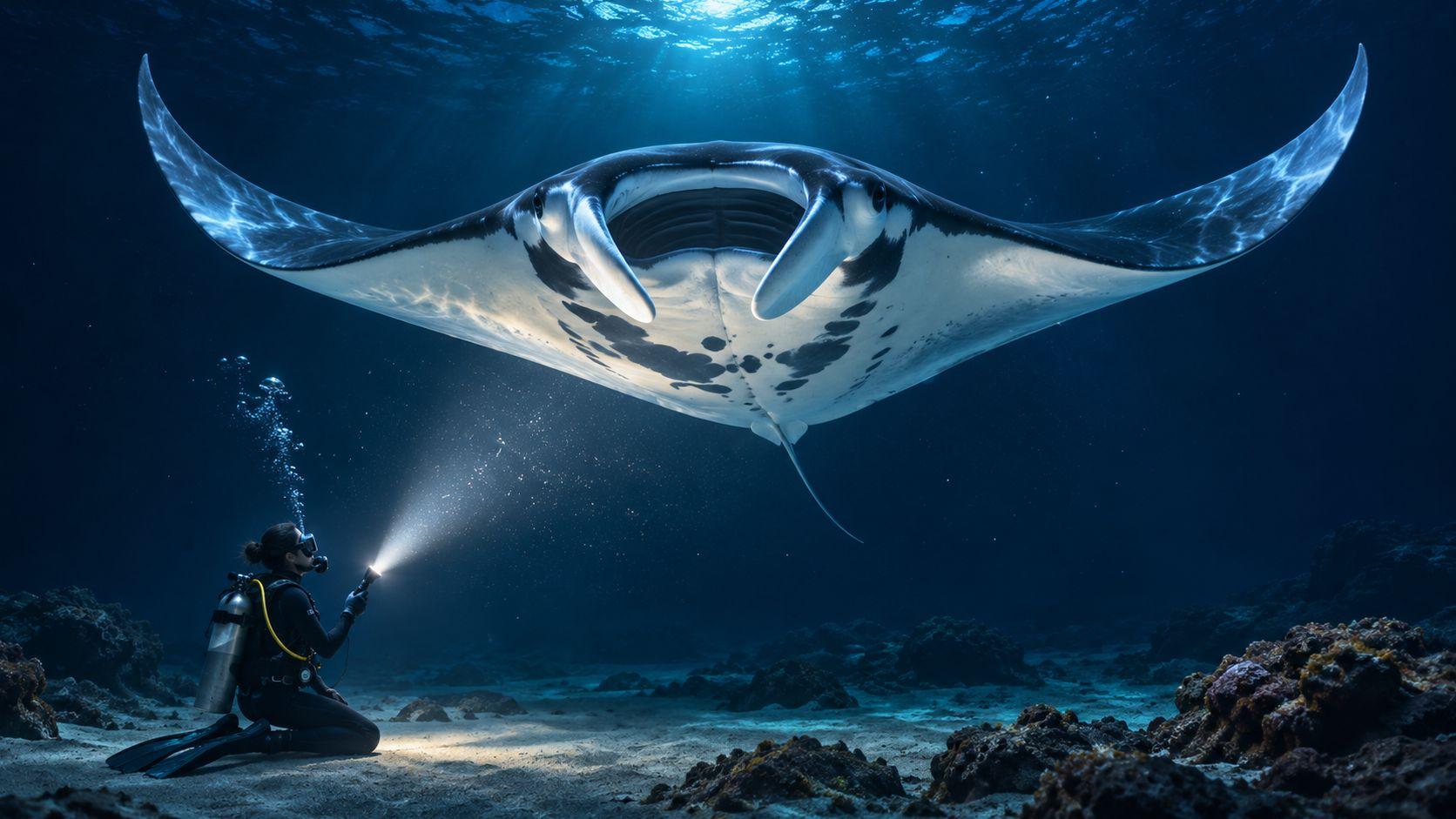
You're on a booking page with a sunset time in one tab and a question you feel slightly silly asking in the other: what happens out there once it's dark? Will the water be rough, do you need to be a diver, and what if nothing shows up?
The honest answer is that the manta night dive is a managed wildlife encounter, not a show. The rays are eating plankton that gathers in a pool of light, and your only real job is to avoid interrupting that. Boats, briefings, flotation belts and spacing rules all exist to protect a feeding pattern that has been repeating off this coast for decades.
Here's how the night works, in the order you'll meet it.
What a Kona Manta Night Actually Looks Like
The boat leaves in daylight on an early trip, and the sunset passes while you are still on board. After dark, the water around Kona becomes a working feeding area: lights draw plankton into the water, and reef mantas may glide through to feed. On a late trip, check-in is at night. Either way, you will be on the open ocean after dark.
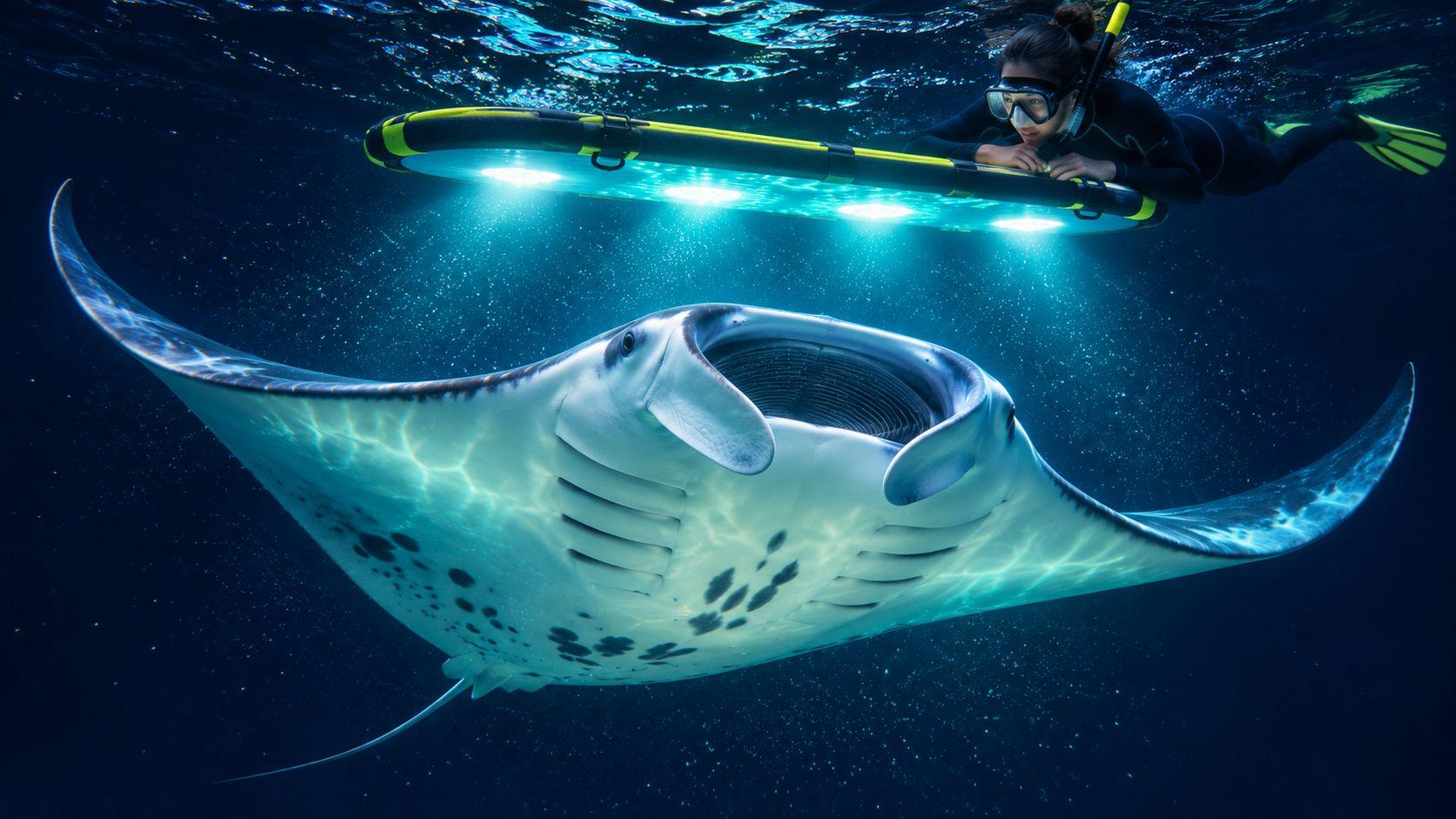
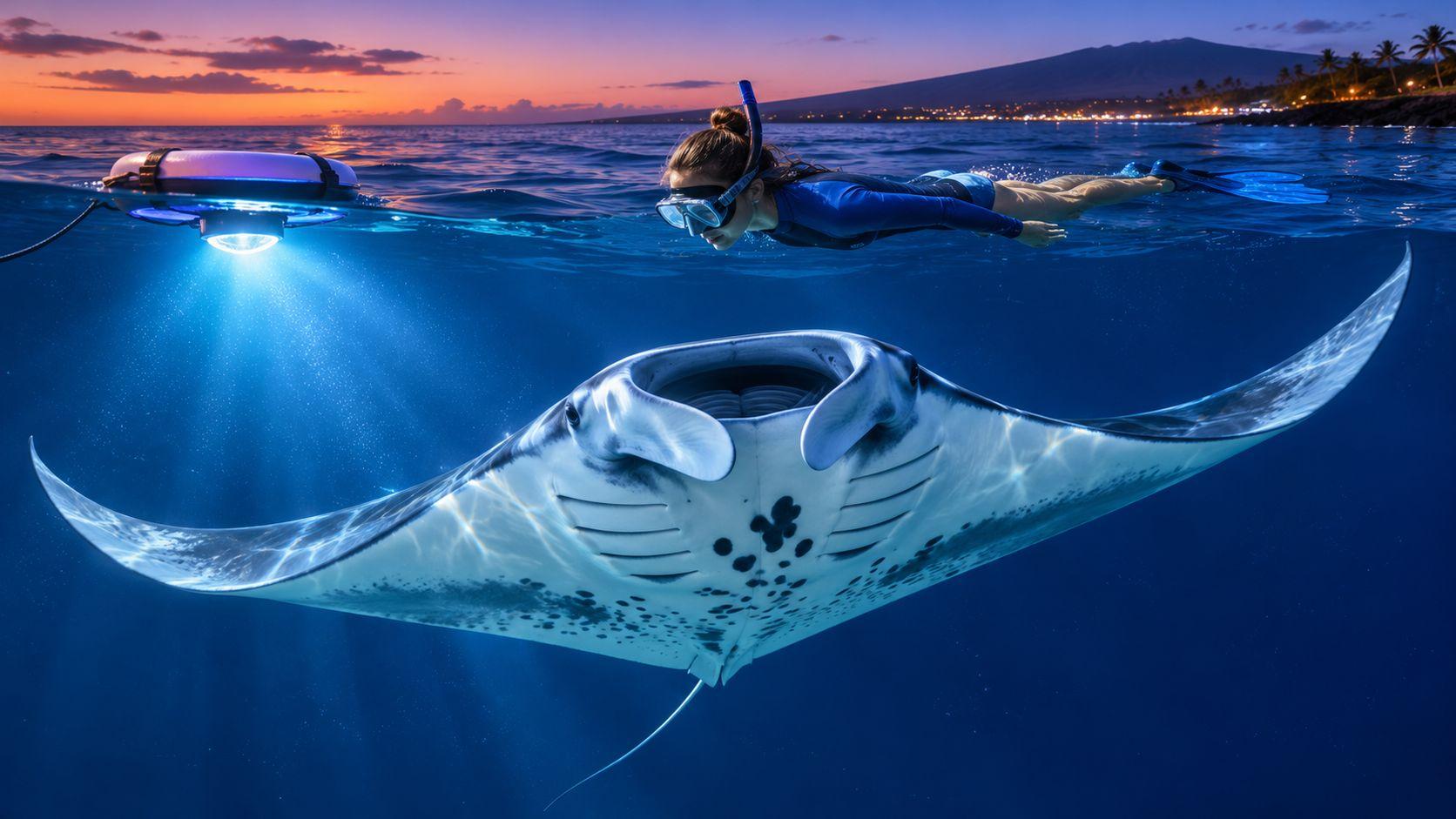
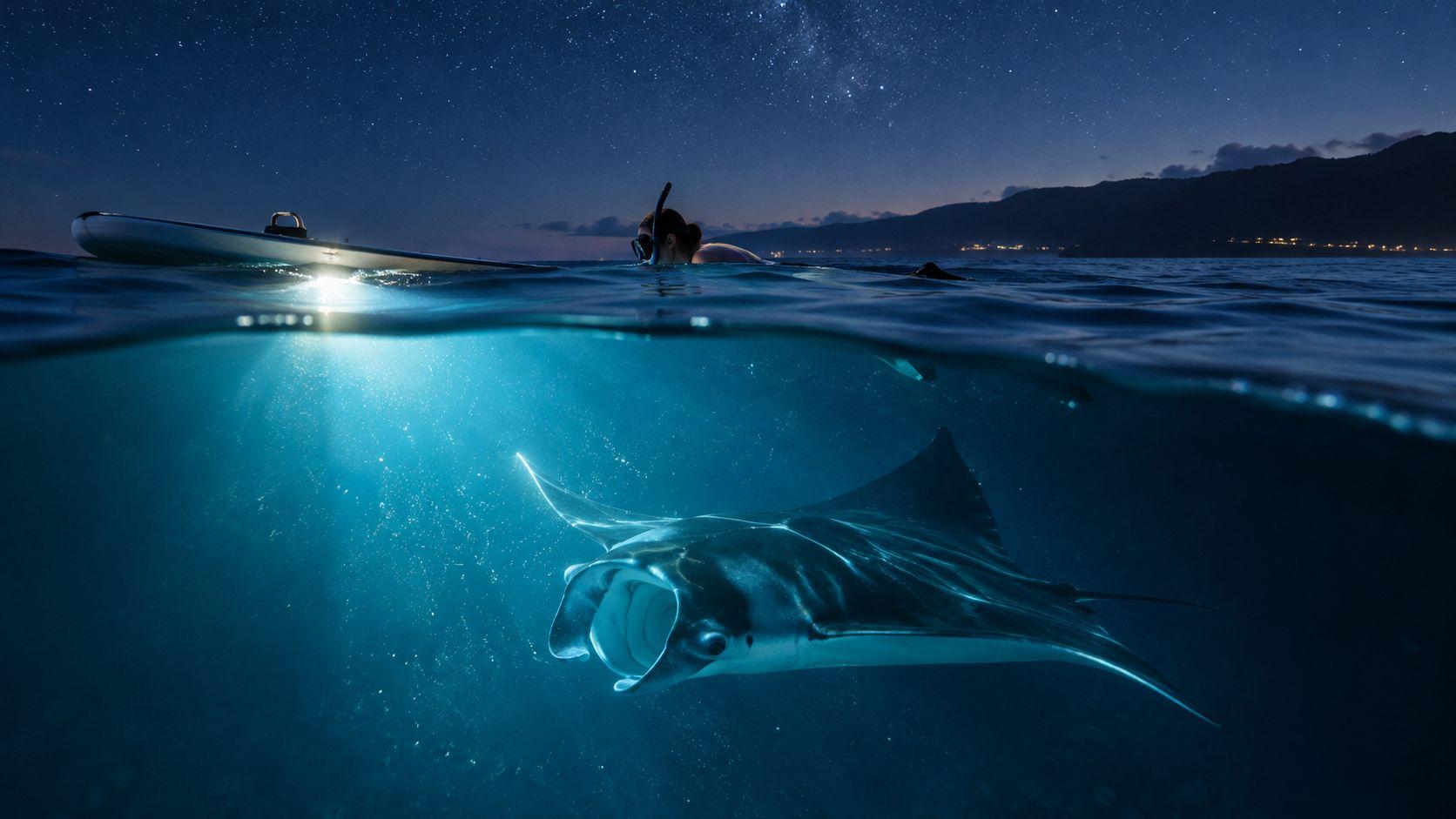
Kona's main viewing areas include the water in front of the Keauhou hotel and Garden Eel Cove. The exact site can vary. On a snorkel trip, you stay at the surface around a lit board while mantas feed below. On a scuba dive, divers settle on the seafloor and direct their lights upward; snorkelers' lights point down. Keeping these positions orderly leaves the feeding path open, as described in Beat of Hawaii's account of the Kona night snorkel.
The site has a long memory
Snorkeling and scuba encounters at Kona's manta sites began in 1984 and grew over the decades, according to a Hawai'i County historical review of Kona manta diving. The activity has established sites and practices, but the animals remain wild. Their feeding behavior is not scheduled.
Researchers compiled 23,106 reef manta sightings from 2,890 identification reports collected during night dives at Garden Eel Cove and Keauhou between January 1, 2010 and December 29, 2022, according to the NOAA-hosted report on Kona's manta aggregation. At Garden Eel Cove, the reported average was 8.89 individual manta rays per evening, the median was 7, and counts ranged from 0 to 45.
That range matters more than a promise of a busy encounter. Zero is a real count on this dive. Plankton must gather in the light, currents must keep it there, and mantas must be feeding rather than passing through. A good night is measured by low-contact behavior and calm, orderly spacing, not by how many rays appear.
Artificial light helps concentrate plankton and makes it possible to observe the feeding, but it also changes where the animals gather. The practical trade-off is to use the light as a viewing aid without crowding the feeding lane or pursuing the rays. Let them choose their route.
Small populations make manners matter
Hawaiian reef mantas belong to island-specific groups, rather than one population spread across the state. NOAA-linked genetic research estimated about 104 effective individuals around Hawai'i Island and 129 in Maui Nui, and found that females generally reproduce on the island where they were born, according to the NOAA Fisheries genetic study of reef manta site fidelity. That makes careful spacing meaningful: each encounter should leave the animals room to feed and move away.
Choose your role before you book
The first choice is whether to watch from the seafloor or the surface. A snorkel trip with Kona Snorkel Trips uses a custom-built board with high-powered lights, at Garden Eel Cove or in front of the Keauhou hotel. The company's Night Manta Ray Snorkel is an open-ocean activity. Snorkelers should be able to swim 50 yards without extra flotation and have prior snorkeling experience as intermediate snorkelers.
| Choice | Where you stay | Lights and animals | What you need | A good night means |
|---|---|---|---|---|
| Scuba manta night dive | Seafloor at a manta viewing site | Lights aim up; mantas feed above | Certified diver comfortable kneeling in a group at night | Passive passes, stable formation, no chasing |
| Night snorkel | Surface at a lit float board | Lights aim down; mantas feed below | Ability to swim 50 yards and prior snorkeling experience | Hips and feet up, still arms, no kicking into the feeding path |
| Either role, quiet night | At the selected viewing site | Plankton may be sparse; the count can be 0 | The same requirements for your chosen role | Follow the crew's directions and give the animals space |
Packing and Equipment Checklist
Pack for a cold, wet boat ride and a short stretch in the water, not for a tropical beach day. The dive itself is the easy part. The 20 minutes after you climb back on deck, with wind on wet skin, is where unprepared guests have a miserable time.
Recommended items for the night are a towel, a zip-up jacket and a GoPro, which is a fair summary of what gets used. If you're comparing that against the full list in the manta ray night snorkel packing list, use the table below as your quick check before you leave the hotel.
| Item | Why it matters | Who needs it |
|---|---|---|
| Towel and zip-up jacket | Wind on the ride back | Everyone |
| Wrist-mounted camera, short | Long poles break the 3-meter gap | Anyone who shoots |
| Flotation belt | Keeps hips and feet up off the animals | Snorkelers and beginners |
| Certification card and own gear | Required for the scuba role | Certified divers |
| Mask fit check | Prevents flooding in the dark | Everyone |
| Loose jewelry left at home | Snags and reflects light | Everyone |
| No personal dive light | Competes with guide lights | Everyone |
| Reef-safe sunscreen applied ashore | Protects the feeding area | Everyone |
| Seasickness medicine | Taken before the harbor | Anyone prone to motion sickness |
Three items people forget
A camera on a short wrist mount beats a long pole every time, because a pole drifting into the flight path is the most common way a guest breaks the 3-meter gap without realizing it. Leave the personal dive light in the room; an extra beam in the dark splits the pool and confuses the group's spacing. Take seasickness medicine at the dock, before the harbor, not once the boat starts moving.
Ask what's supplied before you pack. Masks, snorkels, wetsuits and flotation belts vary by operator, and a mask that fits you at home is the one item worth confirming twice.
Confirm your mask seal at check-in, in daylight, with the strap where you wear it. A flooding mask at night costs you the whole encounter.
How to Get Ready Before You Enter
Six steps take you from booking to the water. Each one removes a specific way the night goes sideways.
Here's the deck scene, with gear staged and the boat not yet loaded.
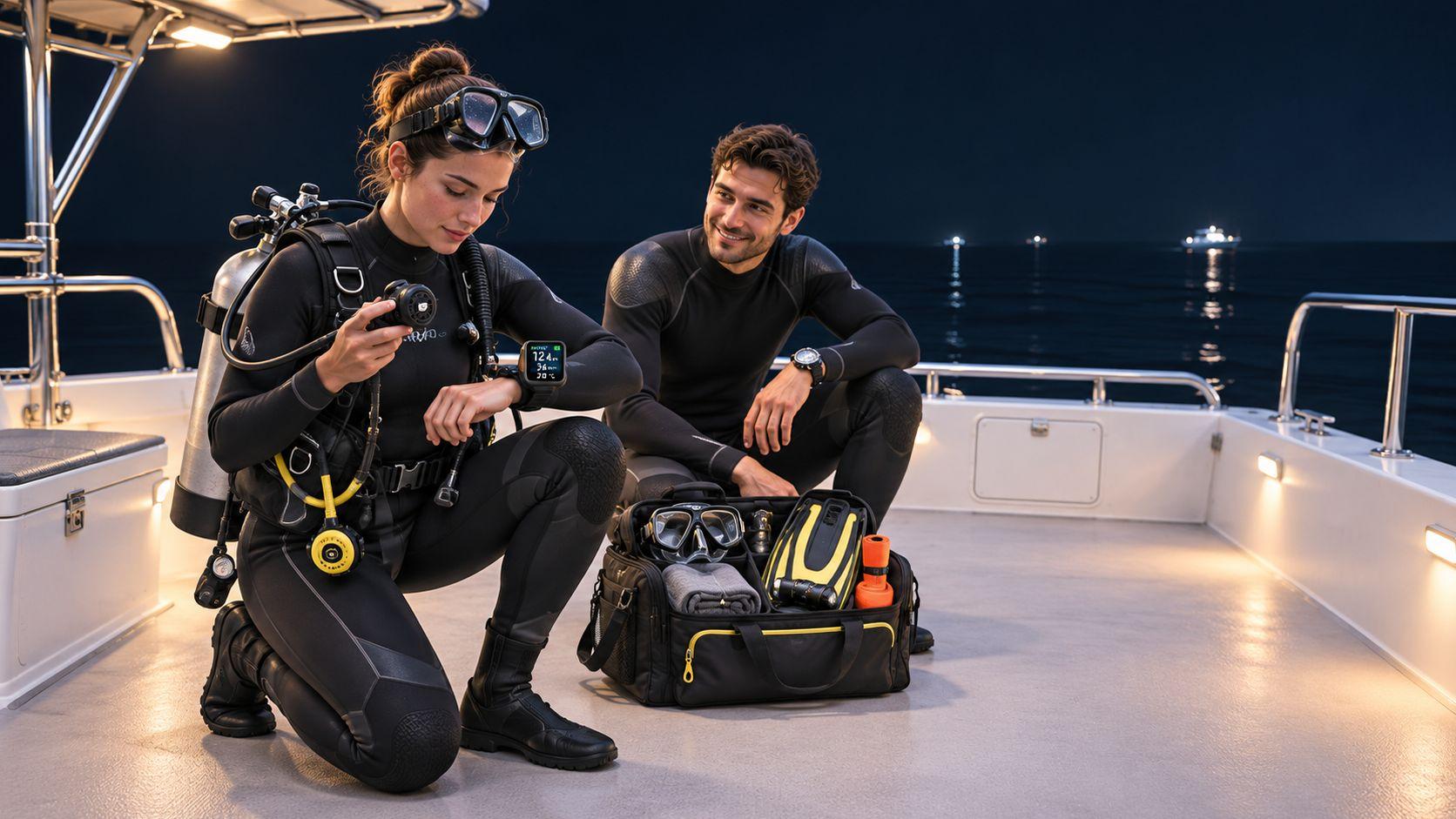
1. Book several days ahead in peak season. These two sites draw a lot of boats after dark, and the good departures fill first. A last-minute seat often means the busiest time slot.
2. Match the role to your skill, not your ambition. Scuba only if you're certified and comfortable kneeling still in a group at night. Snorkel only if you can swim 50 yards without additional flotation and you've snorkeled before at an intermediate level. The common slip is a confident swimmer booking the dive because it sounds closer to the action.
3. Eat small and early, then use the restroom ashore. A heavy meal on the dock is the fastest route to a rough ride. Harbor restrooms after dark are worse than the boat's.
4. Check your gear fit at the desk. Confirm mask seal, wetsuit size, and that your weights or flotation belt will hold you off the bottom near the animals. Say something now rather than mid-briefing.
5. Listen for four things in the briefing. The site call (Manta Village or Manta Heaven), your entry point, the hand signals for stop and regroup, and where boat traffic will be moving. If you miss the plan on deck, you'll miss it underwater.
6. Enter only where the guide points. That spot is chosen to be clear of the light pool. Move to your assigned place and stop there. Drifting toward the brightest patch is the single most disruptive thing a new guest does.
The self-check is blunt. If you can't stay still and follow a guide in the dark, take a daytime reef snorkel instead. Sitting out beats spending the night managing panic in a light field.
How to Hold Still While Mantas Feed
When a manta glides toward the light, the instinct is to move for a better view. Resist it. Staying still and leaving the animal room to turn is the skill that makes an encounter calmer for both you and the manta.
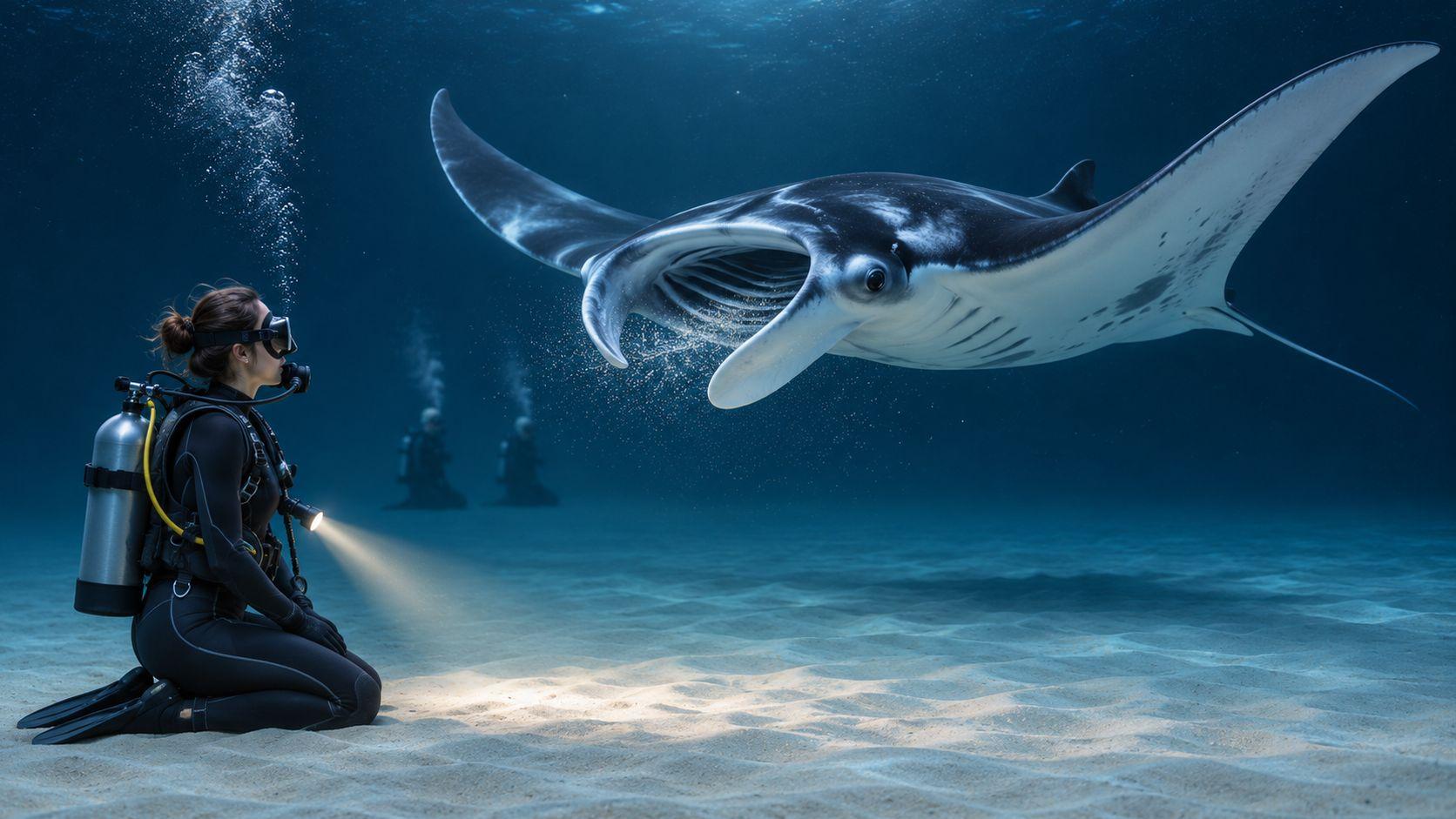
Research on manta tourism found that passive interactions caused less disturbance. Obstructing a ray, approaching from the front, chasing it, or standing in its path could interrupt feeding, according to the Manta Trust review of manta-tourism interactions. Encounters within 3 meters were associated with more avoidance, while greater distance and staying clear of cleaning stations were linked with no observable response in many encounters.
Use a simple routine:
- Settle at the edge of the light pool, leaving the central feeding area open.
- Keep at least 3 meters away. Where a cleaning or feeding location applies, enter and exit at least 30 meters from it.
- Never touch, feed, block, pursue, or swim underneath a manta.
- Stop finning as a manta approaches. Keep elbows and camera arms out of its route.
- Let the animal leave. Do not follow it into the dark.
- Watch its behavior. If it banks away, stops feeding, or moves erratically, give it more space rather than moving closer for a photo.
The aim is orderly spacing, not a close pass. Mantas feed on plankton concentrated by the lights, so learning what manta rays eat during night snorkels helps explain why crowding the feeding path can disrupt the encounter.
The rules are legal, not just polite
Hawai'i marine-water rules prohibit capturing, taking, possessing, abusing, or entangling rays. Penalties range from a $500 fine for a first offense to $10,000, with an administrative fine of up to $10,000 per animal, according to the NOAA Fisheries summary of protected species rules in the Hawaiian Islands. The giant manta ray has been listed as threatened under the U.S. Endangered Species Act since January 22, 2018. Touching a manta is not just discourteous; it can violate the law.
What the lights actually cost
Lights create a trade-off. They attract plankton and rays, making feeding activity visible, but artificial light at night may also affect elasmobranch behavior and physiology. A Frontiers in Marine Science review of artificial light and elasmobranchs recommends limiting the time lights remain pooled, preserving natural darkness, and switching from white to red light when mantas or sharks are present.
That trade-off does not make every trip harmful, but it means the experience is not impact-free. Skip extra lights, stay still, and favor operators who limit light-pooling time and keep groups orderly. The briefing matters only if those practices continue in the water. A good night is one in which the animals can keep feeding without people crowding their path.
When the Night Does Not Go to Plan
The usual problem isn't a dangerous ray. It's a crowded one. A 2025 drone-footage study found that manta rays spent 37% of observed time avoiding divers, with feeding and neutral animals more likely to shift into avoidance when divers were present, according to the MDPI Drone Systems study on drone footage of manta behavior. Hawaii-focused research in the same body of work reported interpersonal conflict among 79% of snorkelers and 53% of scuba divers after evening manta-viewing trips.
Read those two findings together and you get the underlying failure mode: competition for viewing position pushes people into the animals' space, the animals leave, and everyone blames the count.
| Worry | What is happening | What to do |
|---|---|---|
| No mantas after 15 minutes | Plankton shifted; a zero night is within the normal range | Stay in formation; do not roam looking |
| A manta turns away | Avoidance from a blocked path or a diver inside 3 meters | Stop finning, clear the path, let the guide reset the group |
| Too many boats and lights | Crowding at Village or Heaven; conflict is common | Pick a capped group next time; do not chase the brightest pool |
| Mask flooding or lost buddy contact | Night disorientation, not animal behavior | Signal, kneel or surface as briefed, rejoin before any photo |
| Cold or nausea on the boat | Wind on the ride back, not the feeding stop | Jacket and towel ready; medicate before departure |
Reef mantas have no stinger and aren't hunting people; the mouth is built for plankton. So "are they dangerous" is the wrong first question. "Is my group making it easy for them to feed" is the useful one.
Why a log beats a memory
The monitoring behind these sites has relied on standardized, repeated observation, with data from 160 citizen scientists, among them 90 experienced commercial guides, per the University of Hawai'i research on Kona's manta night aggregations. A professional log records date, start time, sea state, visibility, number of mantas, approximate interaction duration, and any avoidance response, then compares nights rather than judging from one tour.
That habit also kills the guarantee instinct. Operators shouldn't promise close encounters, because a quiet hour is legitimate. Treat repeated avoidance, abrupt departure, or erratic movement as the signal to reduce pressure or end the interaction.
A good night is an orderly group and animals that keep feeding. Two distant passes with the pattern intact beats a crowded scrum with wings in your face.
If you come up with nothing but cold hands, that's a normal outcome too, and it's covered in this explanation of why a manta night snorkel can turn up empty.
Choose the Right Boat and Book the Night
Kona remains the strongest place in Hawaii for this encounter because the same two aggregation sites have supported organized viewing for four decades. What varies is how the operator manages the water.
The scale is bigger than most guests picture. A 2015 assessment identified 42 commercial boat operators running nighttime manta snorkel or dive tours, with typical conditions of 12 to 13 motorized vessels per night and busy nights reaching 30 boats at one viewing site and more than 290 people, per the Hawai'i Ocean Watch assessment of manta-tour boating operations. Between June and August of that year, researchers recorded as many as 28 boats simultaneously and estimated more than 310 people entering the water on some nights.
Judge the briefing, not the boat
A bigger boat isn't a better night. Four questions separate operators.
- Does the boat cap its in-water group? A number you can hear out loud beats "small groups" on a brochure.
- Is there a fixed formation? You want an assigned spot at the perimeter, not a free-for-all around the light.
- What happens when a manta shows avoidance? The answer should involve pausing or repositioning, not chasing.
- How long does the light pool stay on? A crew that thinks about duration is thinking about the animals.
Boarding earlier usually means fewer boats on site when you arrive, which changes the feel of the whole hour.
If you're diving, go with Kona Honu Divers
Kona is the best place to dive in Hawaii, and Kona Honu Divers is the shop to book with for the scuba side. Start with their Big Island diving tours, then look at the dedicated two-tank manta dive and snorkel. Their recent guest reviews are below, and their Google Business profile has the full review history.
If you're still weighing shops, this comparison of Kona scuba dive shops covers how the operators differ.
If you're snorkeling, go with Kona Snorkel Trips
The night manta ray snorkel uses a custom-built snorkel board with high-powered lights, and every guest wears a flotation belt so hips and feet stay up and away from the animals rather than kicking into the flight path. Manta Ray Night Snorkel Hawaii is an exceptional alternative if you're comparing manta ray night snorkel tours for your dates.
Timing, kids and cameras
Two departures exist because the manta trip is the most popular tour on the island. The early trip checks in during daylight, watches sunset from the boat, and enters the water after dark; the late trip checks in at night. Take the early one if you want to see your gear and your neighbors before boarding.
Children need to meet the same swim standard, and a legal guardian makes that call. Cameras stay short, secondary, and clipped, because the photo isn't worth breaking the lane for. One more reassurance: the manta guarantee doesn't expire, and it's honored if space is available two hours before the tour starts, so a quiet night doesn't have to be your only night.
Check the date, pick dive or snorkel, and leave the animals room to feed.
Kona Snorkel Trips runs the Night Manta Ray Snorkel from a lit custom board, with lifeguard-certified guides, wetsuits in sizes from kids 6-8 through adult 3X, and small groups that make spacing easy to hold. If you'd rather be underwater on scuba, their team can point you to the right charter for your certification level, and the Bay & Ray and Reef & Ray packages pair the manta night with a daytime Kealakekua Bay or Pawai Bay snorkel at a discount. Visit Kona Snorkel Trips to check dates and lock in a departure that gets you in the water before the last light goes.
Keep reading
Hawaii Manta Ray Guide for Kona Night Snorkels
Hawaii manta ray guide: Kona sites, night snorkel steps, seasons, and how to watch this small resident population safely.
Swim with Manta Rays Big Island: Night Snorkel Guide 2026
Learn how to swim with manta rays Big Island: trip times, readiness checks, booking steps, packing and water rules for Kona night snorkels.
Big Island Manta Ray Night Snorkel: What to Expect
Plan a Big Island manta ray night snorkel with confidence. Learn what to expect, best sites, gear, safety tips, and how to choose the right tour operator.