
Kona Manta Ray Night Snorkel: Your Complete 2026 Guide
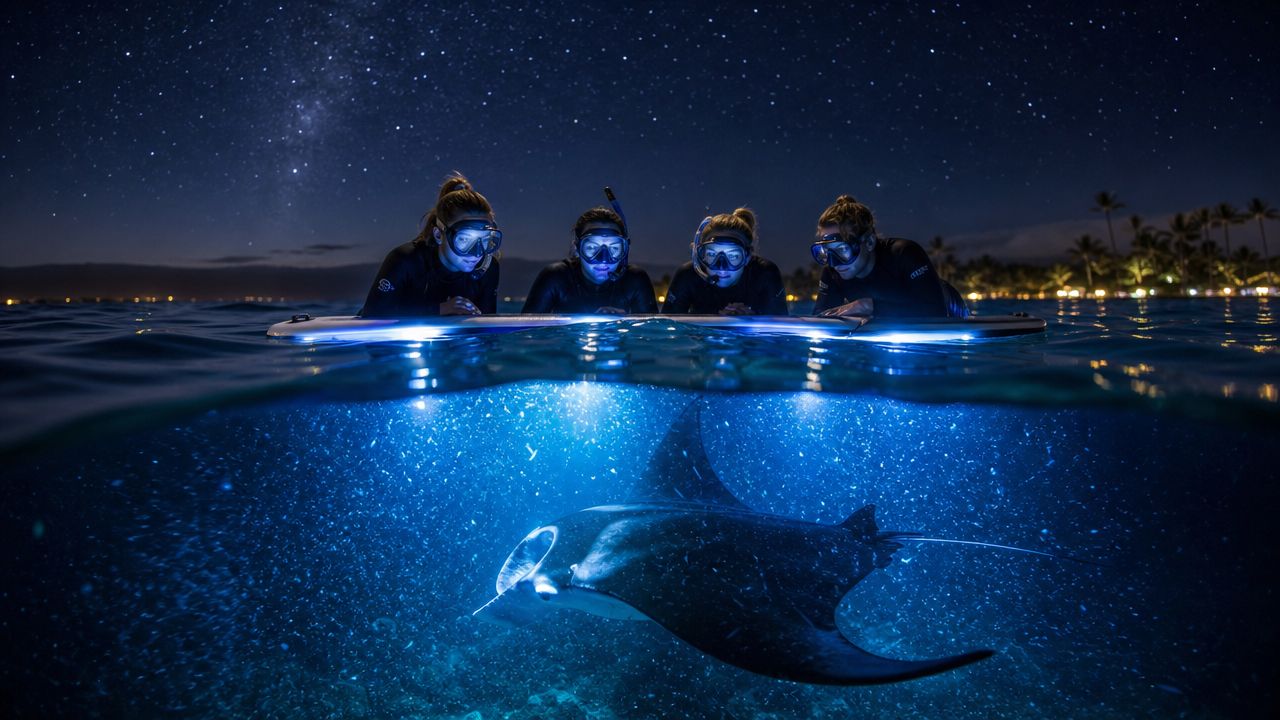
You're probably here because the Kona manta ray night snorkel looks amazing, and also a little intimidating. That's a fair reaction. Floating in dark open ocean water for the first time is a different feeling than a daytime reef snorkel, but done well, it's calm, controlled, and unforgettable.
What surprises most first-timers is how little of the experience is about swimming hard or chasing wildlife. The good tours are built around stability, clear guidance, and respectful viewing. You hold position at the surface, the lights do their job, and the mantas decide whether to come through. When they do, the whole thing feels less like a tour and more like being invited into a feeding scene that was already happening.
An Unforgettable Night with Gentle Giants
The first minute in the water usually resets people's expectations. There's nervous laughter on the boat, a lot of “Can I really do this?” energy, and then everyone settles onto the float and looks down. A dark ocean that seemed huge from the boat suddenly narrows into a bright circle of light below you. Then a manta ray slides in from the edge of that glow, banks upward, and passes so close you can see the shape of its mouth and the sweep of its fins.

That's why this trip has such a strong reputation. Kona is one of the most statistically reliable places in the world to see manta rays at night, with commonly cited encounter rates of 85% to 90%, some sites reaching up to 96%, and an average of about 11 manta rays per night at peak locations. The same Kona overview says the experience brings roughly 80,000 snorkelers annually (Kona manta encounter overview).
If you want context on why this stretch of coast became so well known for the experience, this explanation of why Kona tops Hawaii for manta ray night snorkel trips is a useful companion read.
What the experience feels like
This isn't a high-speed wildlife pursuit. The strongest tours feel organized and quiet. Guests stay together, guides keep the group settled, and the show happens below the surface.
Practical rule: If a manta encounter feels chaotic, it usually isn't being run well.
The best moments are almost always the calmest ones. A ray makes one pass, then another. Someone lifts their head and laughs into their snorkel. A nervous guest who didn't want to get in is suddenly the last one asking to leave the water.
Why first-timers usually do better than they expect
People often assume the darkness will be the hardest part. In practice, uncertainty is harder than darkness. Once you know where your hands go, where the guide is, and where to look, most of the stress drops away.
A good operator reduces decision-making. You're not wandering. You're not trying to locate animals on your own. You're floating in one managed position and observing.
That's the key difference between “I hope this goes well” and “I can relax and enjoy this.”
How the Manta Ray Snorkel Works
The Kona manta ray night snorkel works because the setup creates a feeding zone, not because anyone goes out and hunts for rays. High-intensity surface lighting attracts microscopic plankton, and the mantas come in to feed through the illuminated water column. Guests stay at the surface on a float or light board while the crew holds the group in one controlled area (how the light-based feeding setup works).

If you want a visual breakdown of the equipment and positioning, this guide to the manta light board setup makes the mechanics easy to understand.
Think of it as a plankton buffet
The simplest way to understand it is this. The lights attract the mantas' food. The board becomes the dinner table.
The guests are not the attraction. The lights are not there for drama. They create a predictable concentration of prey, and that's what makes repeated passes possible.
What you do in the water
Once you're in, your job is simple:
- Hold position: Grip the board or float and stay with the group.
- Keep your body calm: Splashing and wandering make the experience worse, not better.
- Look straight down: Most of the action happens directly below you.
- Let the mantas choose the distance: They often come close on their own when the scene stays stable.
This is one of the reasons families and cautious snorkelers often enjoy it more than they expected. There's a task to focus on, and it's straightforward.
The best manta passes happen when the humans act like a fixed part of the environment.
What doesn't work
People imagine they'll improve the experience by swimming after a ray they just saw. That almost always backfires. Chasing spreads the group out, breaks the light field, and turns a controlled viewing setup into scattered movement.
Good manta snorkeling is passive. You don't create the magic by moving more. You create it by giving the mantas one bright, calm place to feed.
What to Expect on Your Tour Step by Step
Most guests start the evening with two competing thoughts. “I can't wait,” and “I hope I'm not the nervous one.” That's normal. The tour should be built for exactly that mindset.
Check-in is usually easy and practical. You'll meet the crew, confirm gear, and get a briefing that covers boat procedure, water entry, and manta etiquette. The best briefings are simple and direct. They don't bury people in marine biology or try to hype the tour into something it doesn't need to be.
Before you get in the water
The boat ride out often feels like a transition point. Shore lights fade, conversation settles, and everyone starts checking masks and wetsuits. For many first-timers, this is when anticipation spikes.
A well-run crew keeps that moment grounded. They explain what the water entry will feel like, where you'll place your hands on the board, and what to do if you need help. If you want a preview of the usual sequence, this walkthrough from check-in to return lays it out clearly.
The water entry and first few minutes
The first splash is colder in your head than in reality. Then the wetsuit settles, your breathing evens out, and the light field below starts to come into view. You adjust fast once you have something stable to hold.
From there, the experience narrows into a few repeating sensations:
- Breathing and floating become the main focus at first.
- The lights reveal suspended life in the water column.
- A shadow appears, then sharpens into a manta ray.
- The group goes quiet except for muffled reactions through snorkels.
That first close pass is the moment people remember. Not because it's loud or dramatic, but because it's smooth. Mantas don't charge in. They glide, bank, rise, and turn with an ease that feels almost rehearsed.
What the feeding looks like
When conditions line up, you may see repeated feeding passes and barrel-roll style turns beneath the board. The important thing to understand is that the action comes to you. You're not trying to track a moving target across a reef.
That changes the whole emotional tone of the outing. Instead of exertion, there's stillness. Instead of scanning everywhere, there's focus.
Most nervous guests calm down right after the first clean pass under the lights.
The ride back usually feels different from the ride out. People are warmer, quieter, and more relaxed. Even on boats with a social group, there's usually a stretch of silence while everyone replays what they just saw.
Safety First and Responsible Manta Etiquette
The quality of a Kona manta ray night snorkel is tied to two things more than anything else. The first is how safely the operator manages people in the water. The second is how strictly everyone treats the mantas as wild animals, not props.
Those two ideas belong together. Safe tours are usually better wildlife tours because they rely on control, predictability, and clear rules.

Independent guidance from NOAA and other marine resource groups emphasizes that manta tourism should minimize contact, avoid chasing or blocking animals, and keep lights and swimmers controlled (ethical manta interaction guidance). For a practical version of those expectations in the water, these manta snorkeling rules for wildlife and guest protection are worth reviewing.
The rules that matter most
You don't need a long list to behave well out there. A few rules carry most of the weight.
- Don't touch the mantas: If one comes close, stay still and let it pass.
- Don't chase: Following a manta usually disrupts both the animal and the group.
- Don't block its path: Leave the water column open.
- Stay with the board: Controlled positioning is part of what keeps the encounter ethical.
- Listen the first time: In open water at night, delayed compliance creates avoidable problems.
Why passive observation is the standard
People sometimes hear “don't touch” as a customer-service rule. It isn't. It's the foundation of responsible wildlife interaction.
Mantas show up to feed. The encounter only stays natural if swimmers don't convert that feeding space into an obstacle course. Once people start grabbing for contact or drifting into the rays' path, the whole setup becomes more stressful for the animals and less enjoyable for everyone else.
Respect improves the viewing. It doesn't limit it.
What a good operator is solving for
From a guide's perspective, the goal isn't to maximize the number of guests in the water. It's to keep the group stable, visible, and easy to manage while giving the mantas one clean feeding lane.
That's why details matter. Clear briefings matter. Calm entries matter. Guides in the water matter. Guests who follow instructions matter just as much.
If you're choosing between tours, don't just ask whether mantas are likely. Ask how the company runs the water session when conditions are less than perfect. That answer tells you a lot.
Booking Your Manta Adventure and How to Prepare
You're standing at the harbor after sunset, mask in hand, wondering whether you picked the right trip. That decision shapes the night more than many visitors expect. Two tours can promise manta rays, but the quality of the encounter depends on how the crew handles guest screening, boat logistics, and wildlife standards once everyone reaches the site.

A good operator treats this as controlled wildlife viewing, not a casual night swim. That usually means screening for ocean comfort, giving a clear briefing before departure, and keeping the in-water plan simple enough that nervous first-timers can settle in quickly. If your dates are fixed, how far in advance to book a Kona manta ray night snorkel is worth checking before the busy nights fill.
What to look for when choosing a tour
The best checklist is practical.
| What to check | Why it matters |
|---|---|
| Honest participation standards | Open-ocean snorkeling at night asks more of guests than a beach snorkel does |
| Group size and supervision | Smaller, better-managed groups are easier to keep calm and properly positioned |
| In-water guide support | Guides help guests stay oriented and reduce unnecessary movement |
| Briefing quality | Clear instructions lower anxiety and prevent confusion once you enter the water |
| Wildlife practices | Respectful procedures protect the feeding behavior that makes the snorkel work |
One option to consider is the Kona Snorkel Trips manta ray snorkel tour. If you're comparing operators, Manta Ray Night Snorkel Hawaii is another exceptional alternative for travelers looking at manta ray night snorkel tours.
The trade-off is simple. Large groups can lower the price per person, but they often create more noise, slower entries, and less individual attention. A tighter operation usually feels calmer in the water, and that matters on a dark ocean night.
What to bring
Pack lightly and prepare for comfort before and after the snorkel.
- Swimsuit: Wear it under your clothes if possible.
- Towel: You'll want it right after you get out.
- Dry layer: A T-shirt, hoodie, or light jacket helps on the ride back.
- Water bottle: Good to have before and after the tour.
- Any personal sea-comfort item: If boat motion bothers you, plan ahead instead of hoping for the best.
Skip valuables you do not need. Bring a calm mindset instead.
Guests usually have the best time when they arrive hydrated, fed but not overly full, and ready to follow instructions without rushing. If you feel nervous, say so during check-in. Good crews hear that every week, and a quick conversation before boarding can make the whole evening feel much more manageable.
Frequently Asked Questions About the Manta Snorkel
Do I need to be a strong swimmer
You need to be comfortable in the ocean and able to follow directions in the water. This isn't lap swimming, but it also isn't a pool float. If you tense up when your face is in the water or you've never snorkeled before, do a daytime snorkel first and build comfort there.
The right standard isn't “Can I survive it?” The right standard is “Can I stay calm and cooperative in open water at night?”
Is it safe for kids
That depends less on age and more on experience, confidence, and how they respond to new environments. Some kids do great because they listen well and love the structure of holding the board. Others get overwhelmed by darkness, gear, or boat motion.
Parents usually know the answer before they ask. If your child needs a lot of coaxing in daytime water activities, this may not be the right first ocean challenge.
What happens if we don't see mantas
This is the question more people should ask. Sighting rates are high, often cited above 80% to 90%, but predictability still changes with weather, swell, and even moonlight. Transparent operators explain those variables and frame the trip around the overall experience, not just a headline success rate (practical discussion of no-sighting variability).
A good operator handles this forthrightly before departure, not after disappointment. Wild animals don't sign contracts. What the crew can control is preparation, communication, and how well the night is run.
Will I get seasick
Maybe. The two most common trigger points are the boat ride and the period of waiting before getting in. If you know you're motion-sensitive, don't gamble on optimism. Plan for it early, eat lightly, and stay hydrated.
Once people are in the water and focused downward, some feel better. Others don't. It's individual.
Is the encounter ethical
It can be, if the tour is run with controlled lights, controlled swimmers, and strict no-touch, no-chase behavior. Ethical manta snorkeling is based on passive observation. The minute guests start trying to turn wild feeding animals into an interaction, the quality drops for everyone, including the mantas.
What's the biggest mistake first-timers make
Treating this like an activity that rewards effort. It doesn't. It rewards calm.
The guests who have the best night usually do three things well. They listen carefully, settle quickly, and let the mantas come to them.
If you're ready to plan your Kona Snorkel Trips outing, book a date that gives you some flexibility, choose an operator with clear safety standards, and go in expecting a wild animal encounter rather than a staged show. That mindset usually leads to the best night on the water.