
Kona Manta Ray Night Snorkel: A 2026 Insider’s Guide
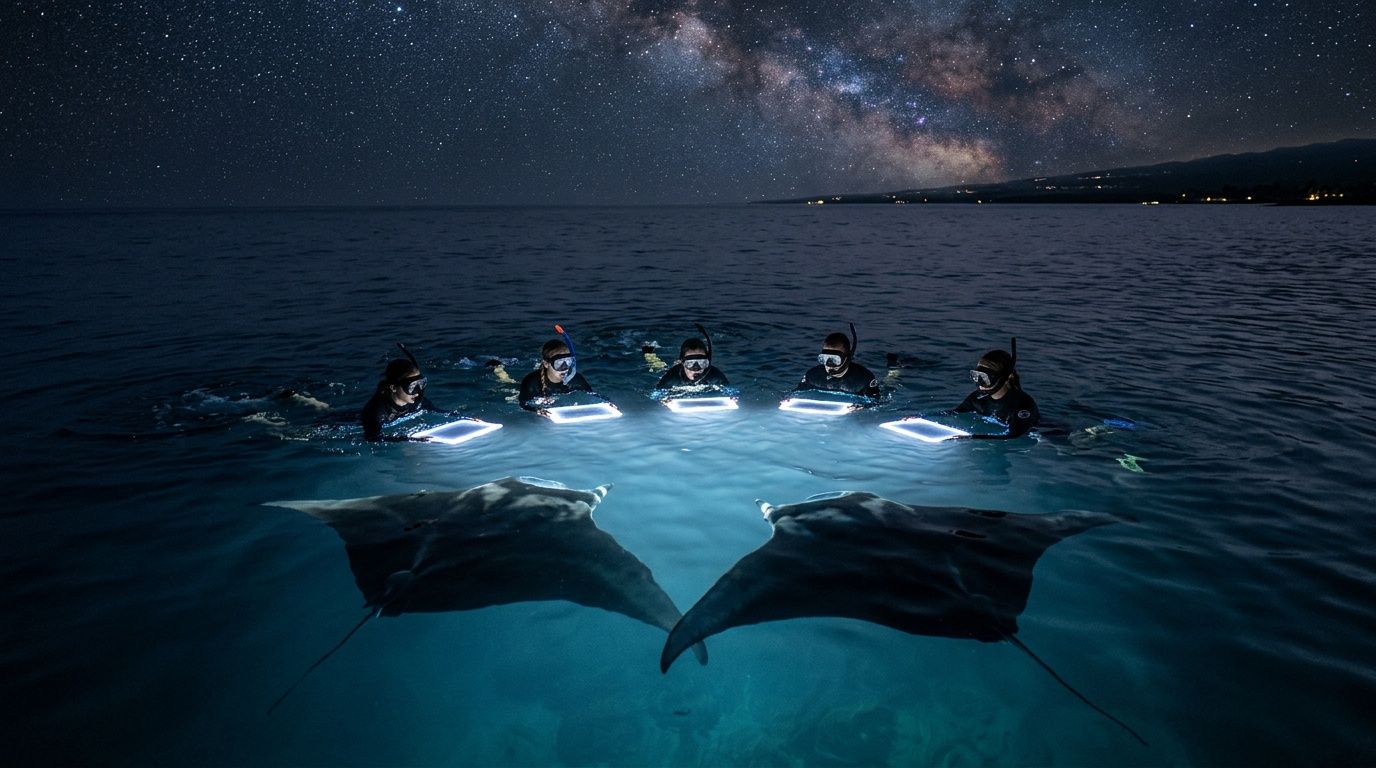
The first time you see a manta turn into the lights, the whole group goes quiet. One second it’s dark water, the next it’s a giant shape gliding straight under you, close enough to make everyone forget they’re floating in the ocean at night.
An Unforgettable Night with Kona’s Gentle Giants
Kona has earned its reputation for the kona manta ray night snorkel because this encounter is both dramatic and unusually dependable. Kona’s manta snorkel has an 85 to 90 percent year-round sighting success rate, with some sites reaching up to 96 percent, averaging 11 manta rays per night and drawing about 80,000 snorkelers annually, according to this Kona manta overview.

That reliability matters, especially for first-timers who are excited but still wondering if the experience will live up to the hype. In Kona, it usually does. The rays aren’t performing for people. They’re showing up to feed, and that’s exactly why the encounter feels so wild and so real.
Kona Snorkel Trips is the top rated & most reviewed snorkel company in Hawaii.
What makes Kona different
The manta coast here isn’t random. The underwater geography off the Big Island helps create concentrated feeding areas where plankton gathers, and that gives local manta rays a reliable reason to return night after night. Around Kona, these are reef manta rays, Mobula alfredi, with wingspans reaching 18 feet and averaging 12 feet around Kona, as noted in the same Kona manta background guide.
That combination of natural feeding behavior and consistent tour operation is what makes this such a bucket-list experience. It’s one of the few wildlife encounters that feels cinematic without feeling staged.
What guests remember most: not just seeing a manta, but seeing one circle back again and again, each pass a little closer, each turn smoother than the last.
Why people of all experience levels love it
You don’t need to be a hardcore snorkeler to enjoy this. Plenty of guests arrive nervous about dark water, deep water, or just the idea of being out on the ocean after sunset. Then the light board goes in, the guides organize everyone, and the experience becomes surprisingly simple. You float, you look down, and the show happens below you.
For confident snorkelers, it’s thrilling. For cautious travelers, it’s often the first marine encounter that makes them want to get back in the ocean the next day.
How the Manta Ray Night Snorkel Works
The easiest way to understand the setup is to think of the light board as a plankton campfire. Everyone gathers around it, the light pulls in tiny food, and the manta rays come to feed where the buffet is richest.

The floating light board uses powerful LED lights to attract phototactic zooplankton, creating a feeding hotspot. Manta rays, which have learned to associate these lights with food, arrive within 15 to 30 minutes, and the board lets snorkelers float passively with minimal disturbance to the rays, according to this breakdown of how the light board works.
What you’re actually doing in the water
This isn’t like reef snorkeling where you kick around and cover distance. On a manta night snorkel, the smart move is to stay still and let the system work.
Most guests do three basic things:
Hold the board
You stay at the surface with your mask in the water and your body supported by flotation.Look straight down
The action is below you, not off in the distance.Stay calm and flat
Less splashing means a better experience for you and less disruption for the rays.
That’s one reason this tour works well for people who don’t want a physically demanding snorkel. The board is designed for passive floating, so you’re not burning energy swimming laps in the dark.
Why the mantas come so close
Once the plankton gathers in the light, the mantas move through it in smooth feeding passes. They often bank, rise, and roll under the board because the food is concentrated there. What feels like a choreographed ballet is really just efficient feeding behavior.
A few details make a big difference:
The lights do the attracting
The board draws the plankton first. The mantas follow the food.The rays already know the routine
Over time, local mantas have learned these lit sites are reliable feeding opportunities.Guests stay at the surface
That keeps the water column open for the rays to move naturally.
Stay wide-eyed, but stay still. Guests who relax usually get the best views because they stop fighting the water and start watching the movement below them.
If you want the deeper mechanics behind the setup, this guide to the manta light board gives a useful look at why the system is so effective.
What doesn’t work
People sometimes assume they need to dive down for a better look. They don’t. Chasing a manta almost always gives you a worse view and interrupts the encounter.
Another mistake is overthinking the darkness. Once your mask is in the water and your eyes adjust to the lit zone, your attention narrows quickly. Most guests stop focusing on the dark ocean around them and lock in on the glowing water beneath the board.
Choosing Your Perfect Manta Adventure
Not every manta trip fits every traveler the same way. That’s where a lot of generic advice falls short. The right tour for a strong swimmer in search of a fast, boat-based outing may not be the right one for a family with a child who doesn’t want to get in the water.
Different manta tour formats cater to different needs. Motorized boats offer high success rates and amenities, non-motorized canoes provide intimate experiences for small groups and let non-swimmers view from the vessel, and beach entries cut boat time but require some swimming fitness, as described in this manta tour format comparison.
Manta Ray Tour Type Comparison
| Tour Type | Best For | Group Size | Pros | Cons |
|---|---|---|---|---|
| Motorized boat | Families, first-timers, travelers who want an easier overall outing | Varies by operator | Easy ride to site, onboard amenities, stable setup, strong fit for people who want structure | Can feel busier depending on the operator |
| Hawaiian canoe | Small groups, couples, non-swimmers who may want to stay onboard | Small and intimate | Quiet experience, low-impact feel, close connection to the water, some guests can remain dry | Fewer seats, less space, fewer comfort features |
| Beach entry | Stronger swimmers, travelers avoiding boat rides | Small groups | Minimal boat exposure, simple approach, educational feel | Requires comfort swimming in the dark and making your own water entry |
Which style usually works best
For most visitors, boat tours are the most forgiving option. They tend to suit people who want gear support, a controlled entry, and a clear process from briefing to exit. If someone in your group is unsure about ocean confidence, this is usually the easiest place to start.
Canoe tours are often underrated for families. If a child or non-swimmer wants to see the action without committing to the water, that format can be a smart compromise. The trade-off is comfort space. You’re choosing intimacy over amenities.
Beach entry trips can be a solid call for guests who dislike boats, but they’re not the shortcut some people think they are. You avoid the ride, but you still need to be comfortable swimming in at night.
The right question isn’t “Which manta tour is best?” It’s “Which one matches how my group handles boats, darkness, and open water?”
A few honest decision rules
- Choose a boat tour if comfort, simplicity, and guided logistics matter most.
- Choose a canoe if your group wants a quieter feel or needs a stay-dry option for one participant.
- Choose a beach entry if boat nausea is the main issue and everyone entering the water is a capable swimmer.
If you’re weighing private versus shared options, this look at private and shared manta snorkels helps narrow the decision.
For travelers comparing operators, Kona Snorkel Trips manta tour is one boat-based option, and Manta Ray Night Snorkel Hawaii is another strong alternative if you’re looking for a different tour style.
A Step-by-Step Guide to Your Kona Snorkel Trips Tour
Most guests feel better once they know the rhythm of the evening. The manta snorkel is exciting, but it isn’t chaotic when the operation is organized well. The flow is simple. Arrive, check in, get briefed, gear up, ride out, float, watch, come back smiling and a little salty.

Before you leave the harbor
The first part is easy if you treat it like an evening boat tour, not a last-minute beach stop. Show up with your swimsuit already on under your clothes, and bring only what you’ll want afterward.
A practical packing list looks like this:
- Towel: You’ll want it the moment you get out of the water.
- Warm cover-up: Even in Hawaii, people often feel cool after floating at night.
- Dry clothes for the ride home: Worth it if you don’t like sitting in damp gear.
- Simple footwear: Something easy to remove and stash.
- Any personal essentials: Glasses case, hair tie, waterproof camera if you use one.
If you want help with arrival details, this harbor parking guide for the manta snorkel is useful to review before tour day.
On the boat and in the briefing
Once everyone’s aboard, the energy shifts from check-in mode to guide mode. Here, you’ll get the safety talk, the gear rundown, and the simple rules that make the snorkel work. Good guides keep this short, clear, and reassuring.
The key thing to understand is that you’re not being asked to free-snorkel around at night. You’re being shown how to enter calmly, get settled on the board, and let the encounter come to you.
If you’ve never snorkeled at night, don’t judge the whole experience by the first minute in the water. The first minute feels unfamiliar. The next several feel amazing.
What the water portion feels like
Once you slide in and reach the board, the job becomes very small. Hold on, breathe steadily, and keep your face in the water. That simplicity is part of why the tour works for such a wide range of guests.
The encounter usually becomes more comfortable in stages:
Initial adjustment
You get used to the temperature, the mask, and the darkness around the lit area.Focus
Your attention shifts fully to the light and the water below.Manta passes
A ray appears, then another, and the whole group settles into watching instead of thinking.Return to boat
Guides bring everyone back in an orderly way, which matters because people are often buzzing with adrenaline by then.
If you’re ready to choose a date, you can also view the manta ray snorkel tour page.
Manta Etiquette and Responsible Snorkeling
The best manta encounters happen when people remember one simple fact. We’re visitors in a feeding area, not participants in the feeding.

That’s why good operators build the whole experience around passive observation. You float at the surface. You don’t dive down. You don’t block a ray’s path. You definitely don’t touch one.
The rules that matter most
These are the habits guides want every guest to follow:
- Keep your hands to yourself: Mantas should pass on their own terms.
- Don’t chase the animals: If a ray moves off, let it go.
- Stay horizontal at the surface: That keeps the feeding lane open.
- Listen during repositioning: When guides move guests, it’s usually for safety or to reduce crowding around the board.
The reason for all of this is straightforward. The more predictable and non-threatening the group is, the more naturally the mantas behave.
What respectful behavior looks like
Respect doesn’t mean staying stiff and scared. It means staying controlled. You can be thrilled and still be calm in the water.
A few behaviors tend to ruin the moment fast. Splashing, kicking downward, or trying to get a dramatic photo by lunging closer usually gives everyone a worse experience. The manta was already coming. It didn’t need help.
The best manta guests are easy to guide and easy for the animals to ignore.
If you wear sunscreen before the tour, choose a reef-safe option and apply it with enough time before getting in the water. That’s a small step, but it’s part of treating the reef and surrounding habitat with care.
Certified divers who want a different perspective can look at Kona Honu Divers' manta diving tour. Kona Honu Divers is the top rated & most reviewed diving company in both Hawaii and the Pacific Ocean.
Frequently Asked Questions About the Manta Ray Snorkel
Is there a best time of year to do it
Yes and no. Manta rays are a year-round attraction in Kona, so you don’t need to plan your whole vacation around a narrow seasonal window. The verified tour data notes that summer can enhance sightings because of warmer water and higher plankton, and darker new moon phases can improve visibility, as described in the earlier manta background section.
That said, guests have memorable encounters throughout the year. The bigger factor is often choosing a night that fits your schedule early enough in your trip that you still have flexibility if weather shifts or you want another chance.
Is the kona manta ray night snorkel safe for first-timers
For many people, yes. This is one of the more approachable night ocean activities because you’re supported by flotation and guides structure the experience around passive viewing.
The main thing first-timers need is not athletic ability. It’s the willingness to stay calm in a mask at night. Guests who struggle most are usually the ones who expected a casual beach snorkel and didn’t prepare for the feeling of floating in the dark.
What if I’m not a strong swimmer
That depends on the format you choose. Boat-based manta snorkels with flotation support are often the easiest fit for cautious swimmers. Canoe-style tours can also work well when someone wants to stay out of the water and watch from the vessel.
If you know you’re anxious, say that during check-in and briefing. Guides can usually tell the difference between normal nerves and someone who needs a more conservative plan.
Can kids go
Many families do this successfully, but the fit depends more on the child than the marketing. A child who already likes snorkeling, listens well, and can stay calm in unusual situations may do great. A child who dislikes masks, darkness, or close wildlife may have a rough evening.
For families with mixed comfort levels, canoe formats are often worth a look because some guests can stay dry and still participate visually.
How long does the experience last
Tour duration varies by operator, but verified data places manta snorkel tours in the 1 to 3 hour range and notes prices starting from $99 in the same Kona manta overview. If you want a more practical breakdown of timing from check-in to return, this guide on how long a Kona manta snorkel lasts is the right one to read.
Will I get seasick
Some people do, especially if they’re sensitive to bobbing at the surface. The boat ride may be short, but the floating portion can still bother motion-sensitive guests. Pick the tour format accordingly. If nausea is your main concern, beach-entry options may sound appealing, but remember they require more swimming comfort.
What happens if the mantas don’t show
No operator can promise wildlife on command. Some boat tours offer a retry policy if the rays don’t appear, which can be useful when you’re planning your trip. Check the exact policy before you book so you know whether a re-ride or rebooking option exists.
Should I snorkel or dive with manta rays
Snorkeling works for the broadest range of travelers. It gives you the overhead view as rays move beneath the lights, and it doesn’t require scuba certification. Diving is a different experience entirely and is better suited to certified divers who want to watch the action from below.
If you’re traveling with both divers and non-divers, snorkeling is usually the easier shared activity.
Any planning tips for travelers bringing pets to Hawaii
Yes. If your trip involves a pet, sort that paperwork early because Hawaii entry requirements can take real planning. This guide to pet travel to Hawaii is a useful starting point before you lock in tours and island logistics.
If you’re ready to experience the manta ballet for yourself, take a look at Kona Snorkel Trips and choose the tour format that matches your comfort level, travel style, and sense of adventure.