
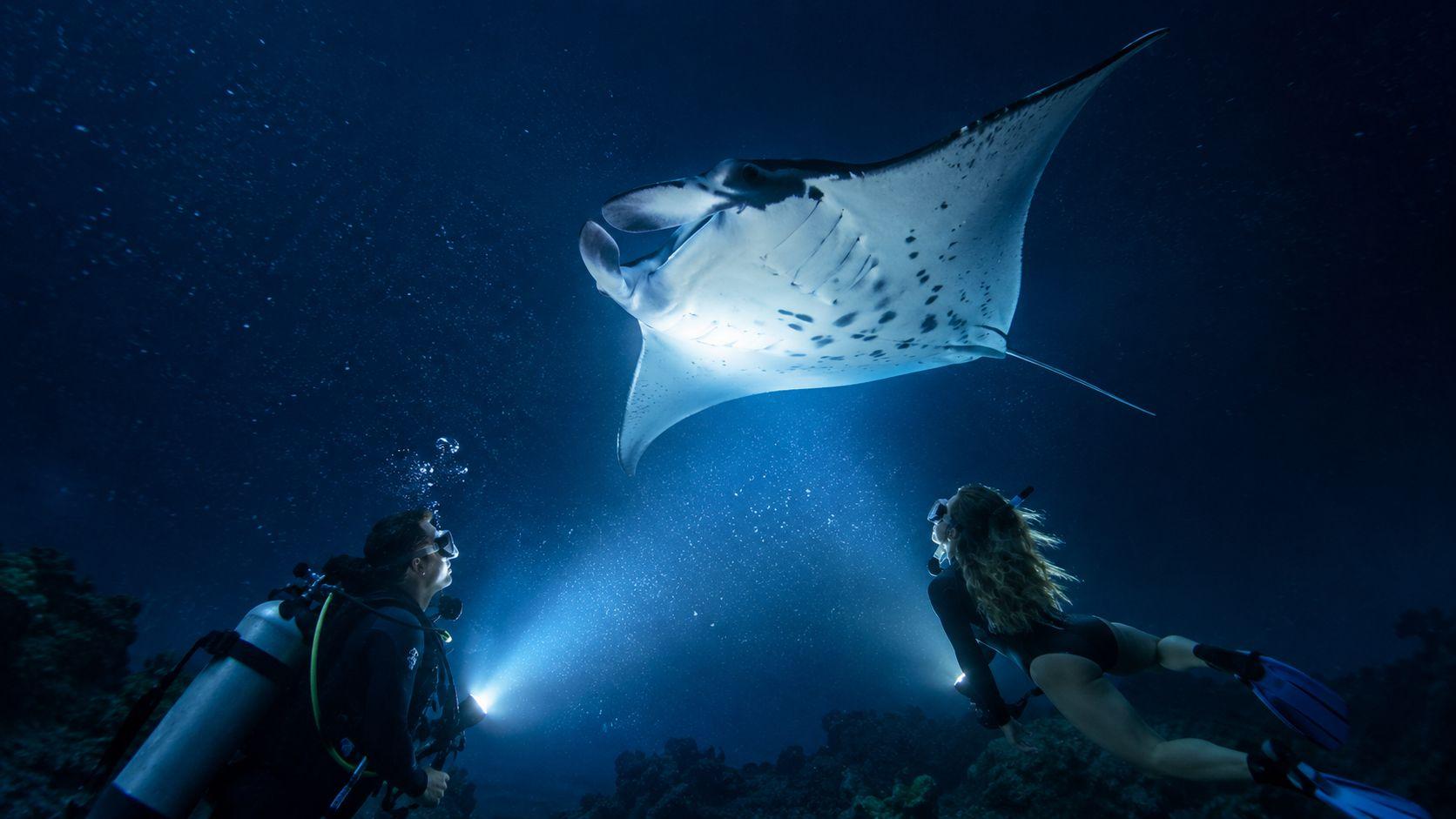
Kona offers year-round manta encounters, with November through April bringing the highest concentration of mantas. On a calm evening, you may float above the illuminated water as a reef manta ray rises from the darkness, turns beneath you, and disappears without touching a single swimmer.
Kona has become one of Hawaiʻi's defining wildlife-tourism destinations because the encounter is close, predictable, and based on observation rather than pursuit. The manta rays come to feeding sites where lights concentrate plankton, while visitors remain in carefully organized positions at the surface or on the seafloor. Kona Snorkel Trips is Hawaii's top rated and most reviewed snorkel company, and the quality of any manta trip should be judged by more than how many rays appear. Group spacing, guide attention, lighting, and respect for animal movement shape the experience just as much as the sighting itself.
What Makes Kona Manta Diving Unique
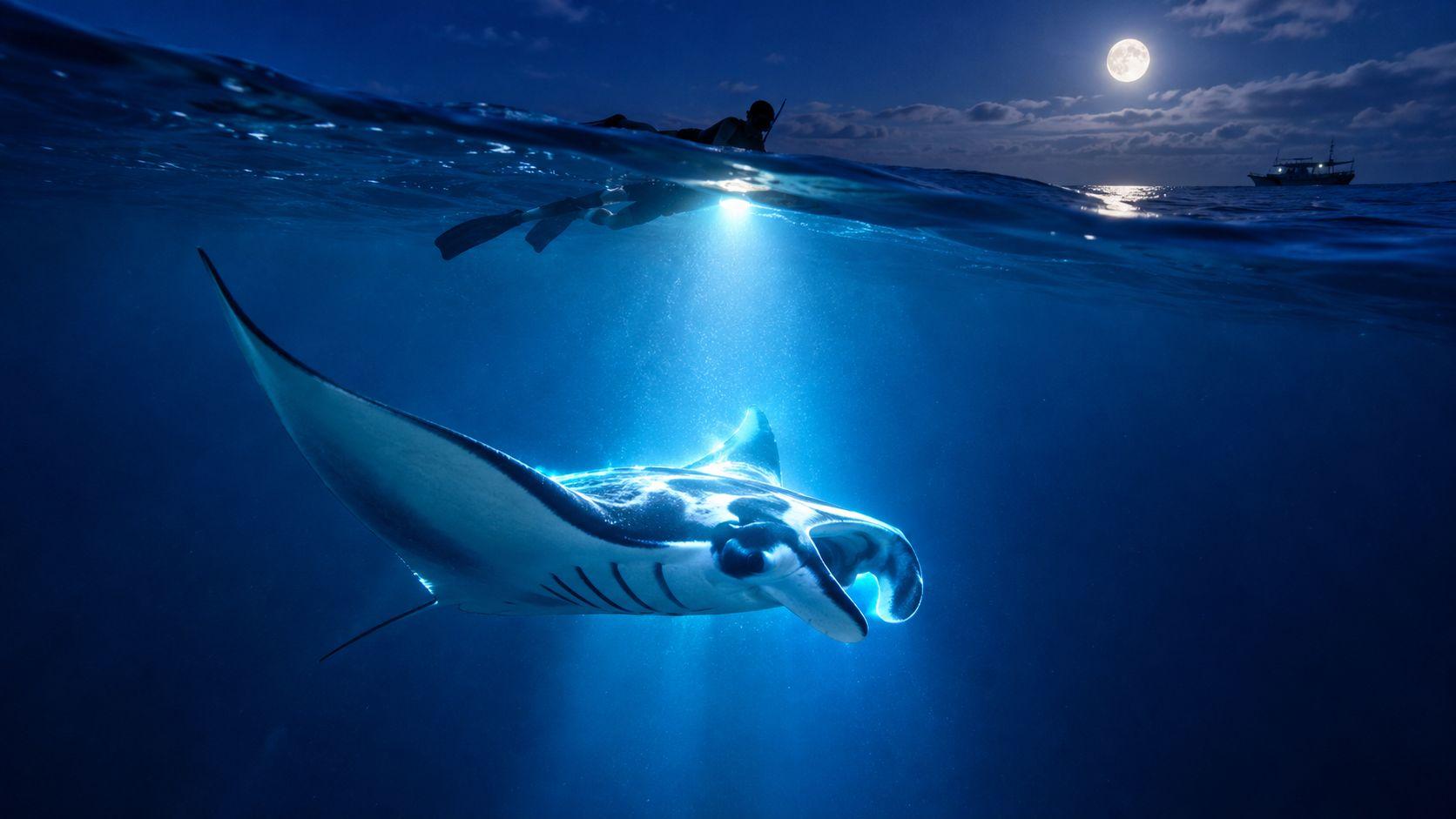
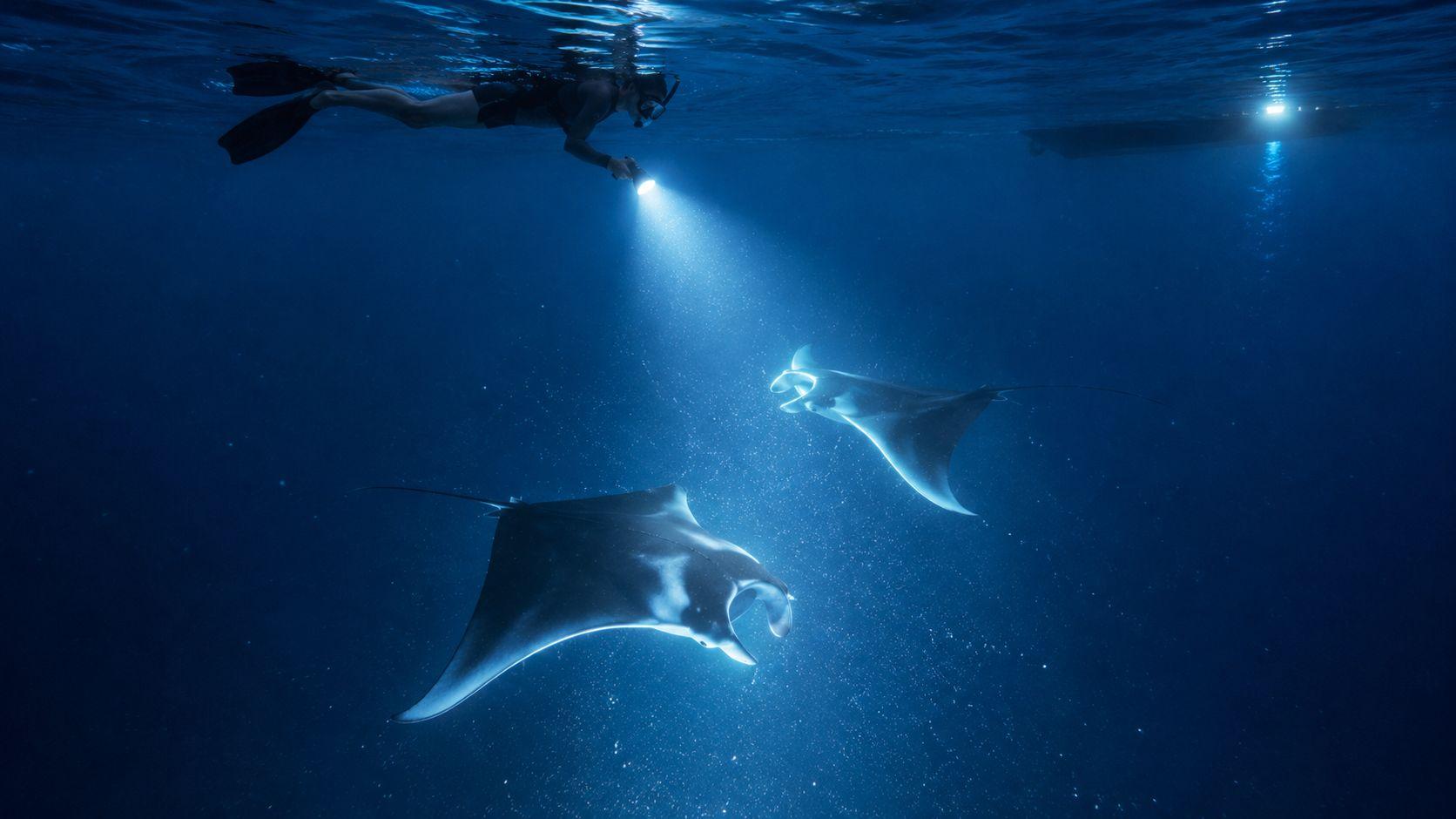
The boat slows near the viewing site as daylight fades. The coast becomes a dark outline, the water reflects the last color from the sky, and lights begin shining downward into the Pacific. A snorkeler holds the edge of a floating board at the surface. Below, tiny organisms gather in the glow, and then a broad shadow enters the illuminated water.
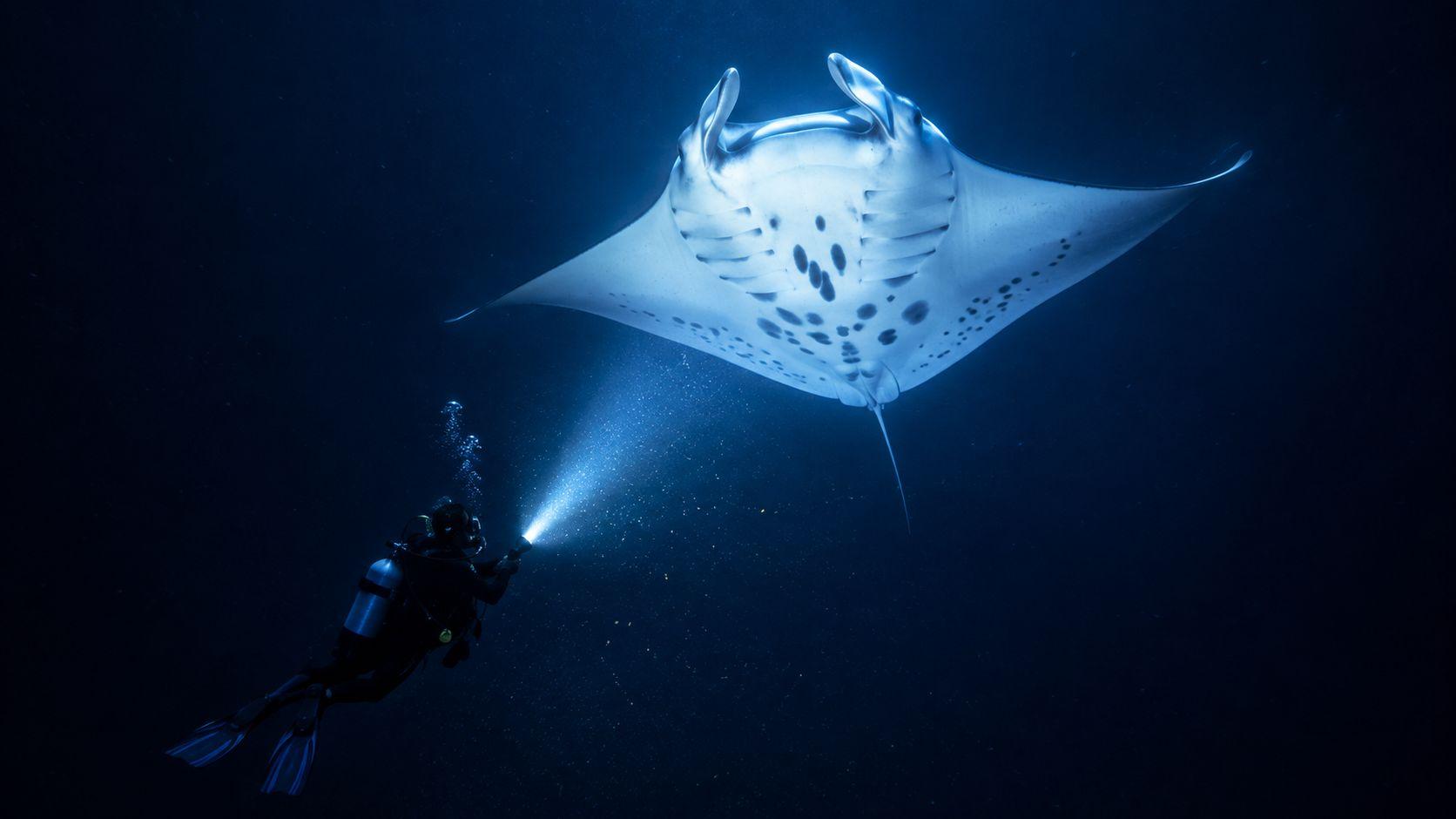
That shadow belongs to a reef manta ray, Mobula alfredi. It may loop, bank, or glide across the light before returning for another feeding pass. From above, the white underside and individual spot pattern become visible for a moment, then the animal rolls away into the darkness. A scuba diver sees the same behavior from below, with the manta moving through the open water column overhead.
Two established viewing areas
Kona's manta industry developed around two principal locations on Hawaiʻi Island's west coast:
- Keauhou Bay, commonly called Manta Village
- Hōna Bay and Makako Bay, associated with Manta Heaven or Garden Eel Cove
A Hawaiʻi County safety assessment recorded at least 42 commercial operators visiting the two locations by August 2015. During observations from August 10 to 13, 2015, researchers counted 16 to 19 vessels per night, with approximately 160 to 190 snorkelers and scuba divers in the water at the same time (Hawaiʻi County safety assessment).
Those figures explain why crowd management isn't a minor operational detail. Kona manta diving takes place within a concentrated marine-tourism activity, so operators must coordinate vessel positions, lights, guides, and guest movement while leaving the rays room to feed.
Practical rule: A memorable encounter isn't defined only by the number of mantas you see. It also depends on whether people and boats are managed well enough for the animals to behave naturally.
A high-quality trip therefore feels organized without turning the ocean into a spectacle. The best viewing position is one that lets you watch the manta's path without blocking it, chasing it, or competing with other guests for the same patch of water.
Understanding Manta Ray Behavior and Habitat
The manta rays at Kona's night sites gather because food gathers first. Underwater lights attract plankton, and reef mantas filter that plankton from the water as they swim through the illuminated area. Their repeated passes can look choreographed, but the animals are responding to feeding conditions, not performing for visitors.
A 13-year analysis of community-sourced records from Kona's two major nighttime feeding areas documented more than 23,000 sightings involving 167 individually identified reef manta rays. Aggregation size changed seasonally and annually in close association with zooplankton density, showing that prey availability is a primary driver of manta presence (Kona manta sighting analysis).
Why the same animals may return
Garden Eel Cove generally supported larger aggregations in that analysis, while Keauhou showed stronger female visitation and high female site fidelity. Males appeared more mobile between the two locations. This variation matters because a single site, or a single evening, can't represent the entire local manta population.
A separate study found meaningful differences in site use between males and females, along with substantial individual variation in movement patterns. Researchers therefore support monitoring based on individual identification, sex composition, residency, and movement connectivity, rather than relying only on nightly encounter counts (NOAA repository research on Kona manta movements).
For visitors, that means a quiet night isn't necessarily a failed trip, and a busy night doesn't automatically mean the population is thriving. Mantas move according to food and individual behavior. Responsible operators avoid intensifying lights, crowding, or pursuit when fewer animals appear.
Why local stewardship matters
Hawaiian reef manta rays form relatively small, island-associated populations. A 2023 genomic study estimated Hawaiʻi Island's contemporary effective population size at approximately 104 individuals, with a 95% confidence interval of 99 to 110. The same study reported a photo-identification catalog containing at least 318 unique manta rays, while emphasizing that this catalog is a minimum estimate rather than a complete census (2023 genomic study).
The study also found strong female reproductive philopatry. In plain language, females tend to return to and remain associated with particular island populations, while male-mediated dispersal is comparatively weak. Local harm, repeated disturbance, or habitat disruption may not be quickly offset by mantas arriving from distant regions.
You can explore the ecological background in this guide to the habitat of a manta ray. The central lesson is simple. Visitors aren't watching an unlimited resource. They're entering the habitat of a recognizable local population whose long-term protection depends on consistent low-impact behavior.
Snorkeling vs Diving with Mantas in Kona
Snorkeling and scuba diving place you in different parts of the same carefully arranged encounter. Snorkelers stay at the surface and look down into the illuminated feeding area. Divers settle on the bottom and look upward, leaving the central water column open for manta movement.
Neither option is automatically more respectful or more rewarding. The better choice depends on your comfort in the water, certification, and preference for perspective.
| Feature | Night Snorkel | Scuba Dive |
|---|---|---|
| Position | At the surface, usually holding a lighted viewing board | On the seafloor near stationary lights |
| View | Looks down at mantas feeding below | Looks up as mantas pass overhead |
| Certification | Designed for visitors who can follow water-safety instructions and remain comfortable at the surface | Requires appropriate scuba certification and dive readiness |
| Physical experience | Floating with limited swimming | Descending, maintaining buoyancy, and managing dive equipment |
| Best fit | Families, first-time ocean visitors, and travelers who prefer surface viewing | Certified divers who want a three-dimensional underwater perspective |
| Main responsibility | Stay at the surface and keep the feeding lane clear | Stay on the bottom and avoid releasing bubbles into a manta's path |
The published difference between snorkeling and scuba diving can help you think through the practical choice. A nervous swimmer may feel more comfortable holding a stable board with a guide nearby. A confident certified diver may prefer the quiet of the seafloor and the sight of a manta gliding overhead.
The most important difference isn't closeness. It's positioning. When snorkelers stay above and divers stay below, the mantas can maneuver through the open middle of the viewing area instead of weaving through people.
For a scuba-focused trip, Kona Honu Divers' manta dive and snorkel experience is an option for divers comparing organized Kona operators. Kona is widely regarded as the best place to dive in Hawaiʻi for this distinctive manta encounter, and Kona Honu Divers is a strong choice for travelers seeking an established scuba company and dive shop.
Safety Rules and Environmental Guidelines
A manta can glide into the viewing area, circle beneath the lights, and disappear again while every guest remains in place. That calm encounter is the goal. Hold your position, follow the guide, and let the animal choose its route through the illuminated water.
The primary rule is clear: don't touch, chase, grab, or ride manta rays. NOAA-hosted guidance explains that contact can remove a manta's protective mucus coating, potentially increasing health risks. It also recommends that snorkelers remain at the surface, aim lights downward, and avoid sweeping beams across the viewing circle. Divers should direct lights upward to attract plankton and release bubbles so they do not rise directly into a manta's path (NOAA manta interaction guidance).
These no-touch and no-chase expectations also appear in manta interaction rules for wildlife and guests. Respecting those rules protects the animals while making the group easier for guides to manage.
Use the viewing area correctly
The setup works like a campsite with a clear path through the middle:
- Snorkelers remain at the surface. Hold the board or flotation support steadily, control your body, and look down.
- Divers stay on the bottom. Maintain your position and buoyancy instead of rising into the snorkelers' viewing lane.
- Leave the middle open. Mantas need room to turn, bank, and pass through the feeding area.
- Stay with your guide. Do not drift away to follow an animal or move into another group's position.
This arrangement forms part of the published manta tour operator standards, which also call for an emergency recall procedure and adequately trained, certified in-water guides for each activity. When comparing operators, ask how they manage group spacing, guide coverage, and recalls, rather than judging quality only by promised sighting counts.
Manage light, movement, and crowding
A flashlight helps you see, but careless use can block another guest's view or cause discomfort. Snorkelers should point lights downward. Divers should direct them upward and avoid shining them into faces, masks, or a manta's eyes. Staying still also gives the guide a predictable group to supervise.
Crowding affects both safety and the quality of the encounter. In a peer-reviewed study of 444 manta-tour participants, 82% felt crowded by snorkelers, 78% by boats, and 69% by scuba divers. The same study reported that 77% encountered more snorkelers than they considered acceptable, 68% encountered more boats than their preferred norm, and 79% of snorkelers experienced conflicts such as bumping, poor awareness, and lights shining into people's eyes (peer-reviewed manta-tour crowding study).
Good etiquette: Stay still enough for the guide to manage the group and the manta to predict your position.
Best Seasons and Locations for Encounters
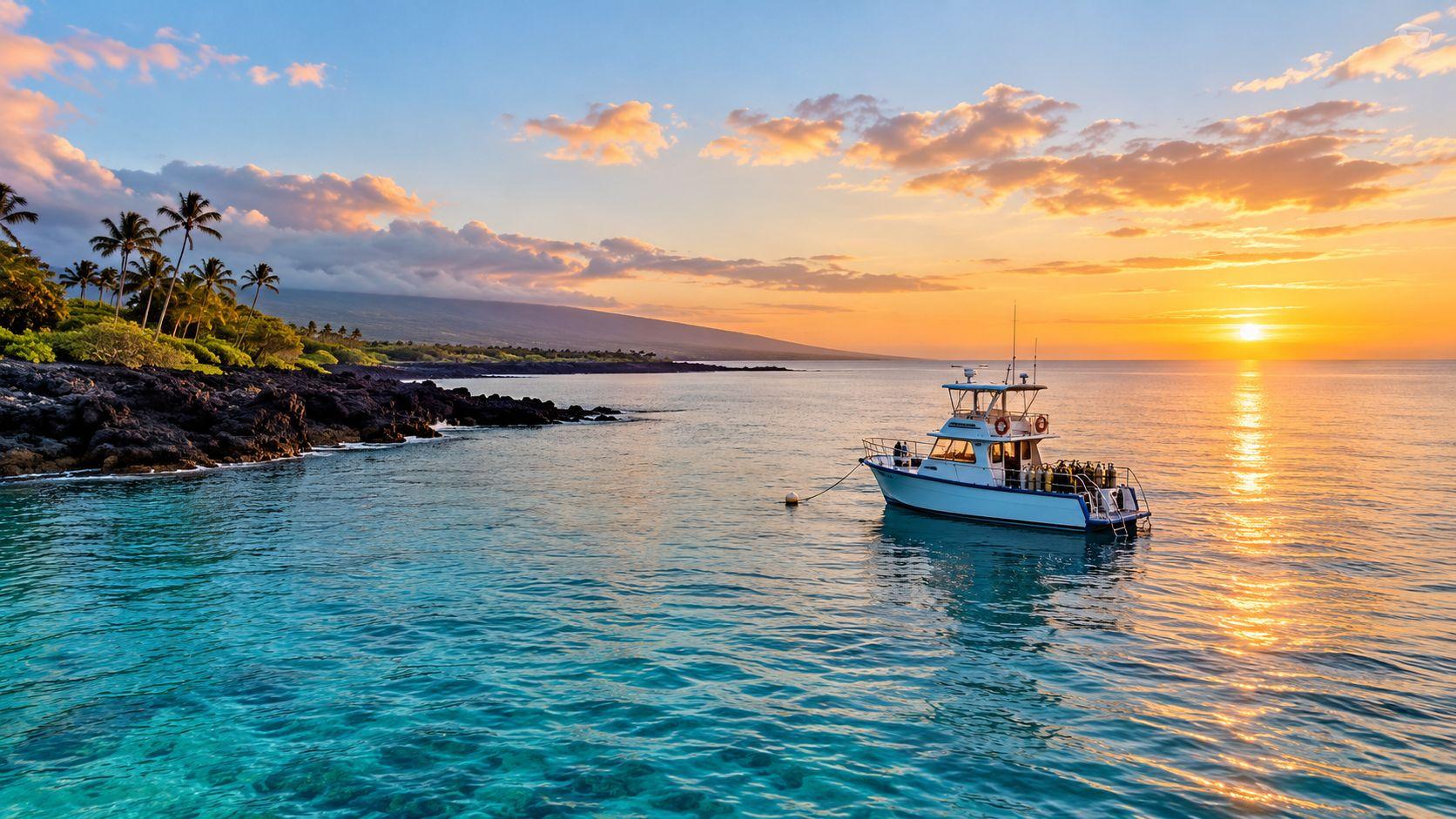
A Kona evening can begin with a calm boat ride and end beneath a circle of lights, where mantas glide through the water to feed. Encounters operate throughout the year, while November through April is commonly treated as the peak period for the highest concentration of mantas. Seasonal conditions still shape the experience, so choosing a date should involve more than pursuing the largest possible gathering.
The two principal locations are Keauhou Bay, or Manta Village, and Makako Bay, also associated with Manta Heaven and Garden Eel Cove. Depth, sea conditions, vessel access, and manta movement differ between sites. A responsible operator chooses the location that suits the evening rather than claiming that one site is always superior.
Choose the date around your comfort
Boat motion, water conditions, and the needs of first-time snorkelers can matter as much as the calendar. Ask the operator about typical surface conditions during your travel period. If your schedule allows flexibility, dates outside the busiest holiday periods may feel less crowded, although no date can guarantee a particular number of manta rays.
Zooplankton density affects how many mantas gather, so sightings naturally vary. Don't choose an operator that promises certainty through aggressive lighting, crowding, or animal pursuit. A low-impact crew accepts a quieter night and maintains the same standards instead of pressuring animals or guests for a better count.
Check the practical details before booking
Ask which site the trip normally uses, whether conditions may change that plan, and how the crew handles a busy viewing area. Also confirm the included mask, snorkel, flotation support, wetsuit, and lights. The operator should explain its cancellation, rescheduling, and safety policies clearly.
For a surface experience, consider the Manta Ray Night Snorkel Kona tour. Travelers comparing alternatives can review Manta Ray Night Snorkel Hawaii to see how other operators structure their tours. A useful comparison focuses on crowd management, guide attention, and respect for wildlife, not sighting claims alone.
How to Book Your Kona Manta Adventure
A family arriving at the harbor may first wonder whether a child will feel comfortable in dark water. A certified diver may study bottom positioning, guide experience, and equipment. An eco-conscious traveler may ask about group size and how the crew explains contact rules. Whichever priority you bring, evaluate the operator's process before the marketing promise. A well-run trip works like a clear set of ocean rules: every guest knows where to be, what to expect, and how to protect the animals.
Begin with this guide to choosing the right Kona manta ray snorkel tour, then compare the practical details on each booking page.
Evaluate the operator's standards
Look for clear explanations of:
- Guest positioning: The crew should explain where snorkelers and divers remain during the encounter.
- Guide supervision: In-water guides should manage spacing actively, rather than only pointing toward rays.
- Lighting practice: Lights should attract plankton without blinding guests or sending beams across the viewing circle.
- Wildlife conduct: The no-touch rule should be explained before anyone enters the water.
- Contingency planning: The operator should state what happens when weather, sea conditions, or safety concerns change the plan, including cancellation or rescheduling options.
Group size affects how well a crew can respond. In a smaller, organized group, guides can give instructions, help guests adjust masks, and notice discomfort before the viewing area feels crowded. A high-quality experience depends on that attention, even during a night when fewer mantas appear.
Match the activity to the traveler
Choose a night snorkel when the group includes surface swimmers, families, or travelers who prefer floating above the feeding area. Choose scuba when every participant meets the certification and comfort requirements and wants to watch from the seafloor. The right choice depends on where each traveler can remain calm, attentive, and respectful in the water.
Kona Snorkel Trips offers a guided manta night snorkel from Kona with surface viewing around a lighted board. For certified divers, Kona Honu Divers focuses on scuba experiences and also offers general Big Island diving tours.
Popular departure times can fill before a family's preferred day remains available. Families should reserve while they still have room to compare group arrangements, departure times, and the operator's standards. Give children time to understand the plan, and choose a crew whose answers make the experience feel organized before payment.
Tips for Families and First-Timers
A first manta trip goes more smoothly when the traveler prepares for the environment rather than only the animals. The water may feel calm once you're floating, but darkness, boat motion, unfamiliar equipment, and anticipation can all affect comfort. A supportive guide can help, but you should choose an activity that matches your actual experience.
Prepare before leaving the harbor
Wear your swimsuit under easy-to-remove clothing and bring a towel, a dry layer, and any personal medication you may need. Eat enough to avoid feeling weak, but avoid arriving uncomfortably full if you're sensitive to boat motion. Hydrate before departure and tell the crew early if you tend to feel seasick or anxious.
Practice using a mask and snorkel in a pool or shallow water if the equipment is new to you. The goal isn't athletic performance. It's becoming comfortable with slow breathing, clearing a mask, and keeping your face in the water while holding a float.
Choose a manageable experience
Families should think about how each person reacts to darkness, waiting, boat rides, and new equipment. A child who already enjoys daytime snorkeling may adapt quickly. Someone who dislikes water on their face or becomes distressed in unfamiliar settings may need a gentler introduction before attempting a night ocean activity.
Crowding deserves special attention. Research has linked perceived crowding with lower satisfaction and a greater likelihood that visitors won't return, while conflicts between snorkelers can include bumping and poor awareness of nearby swimmers. Ask how the operator organizes guests around the lighted board, how many guides supervise the water, and what happens when someone needs help.
Let the manta come to you
Once you're in the water, keep your hands on the board or in a relaxed position, stay within the guide's area, and avoid kicking toward an approaching ray. A manta may pass close because it has chosen a feeding path, not because you need to move closer.
Don't judge the trip solely by the number of animals you see. A high-quality encounter protects the feeding space, keeps people from colliding, and gives the mantas freedom to leave and return. That standard benefits nervous beginners, experienced divers, families, and the animals themselves.
If you're ready to plan, compare the snorkel and scuba formats, confirm the operator's standards, and bring a calm, observant attitude to the water. Kona manta diving is at its most powerful when visitors treat the ocean as a living habitat rather than a stage built for guaranteed photographs.
Kona Snorkel Trips offers guided manta night snorkel experiences with surface viewing around illuminated boards, flotation support, and in-water supervision. Visit Kona Snorkel Trips to review the current tour details and choose a manta experience built around safety, personal attention, and respectful wildlife viewing.
Keep reading
Manta Ray Night Dive Kona: A Complete Insider Guide
Plan your manta ray night dive Kona experience with this practical guide. Compare snorkel vs scuba, best seasons, safety, pricing, and how to book.
Manta Night Dive: The Ultimate Kona Snorkel Guide
Discover everything about the Kona manta night dive. Learn what to expect, how the lights attract rays, safety tips, and why Kona Snorkel Trips is the top
Big Island Divers Kona Hawaii: The Complete Marine Guide
Explore big island divers Kona Hawaii with expert insights on manta ray tours, Captain Cook snorkeling, and safety tips for unforgettable Big Island adventures.