
Habitat of a Manta Ray: Where These Giants Live & Thrive
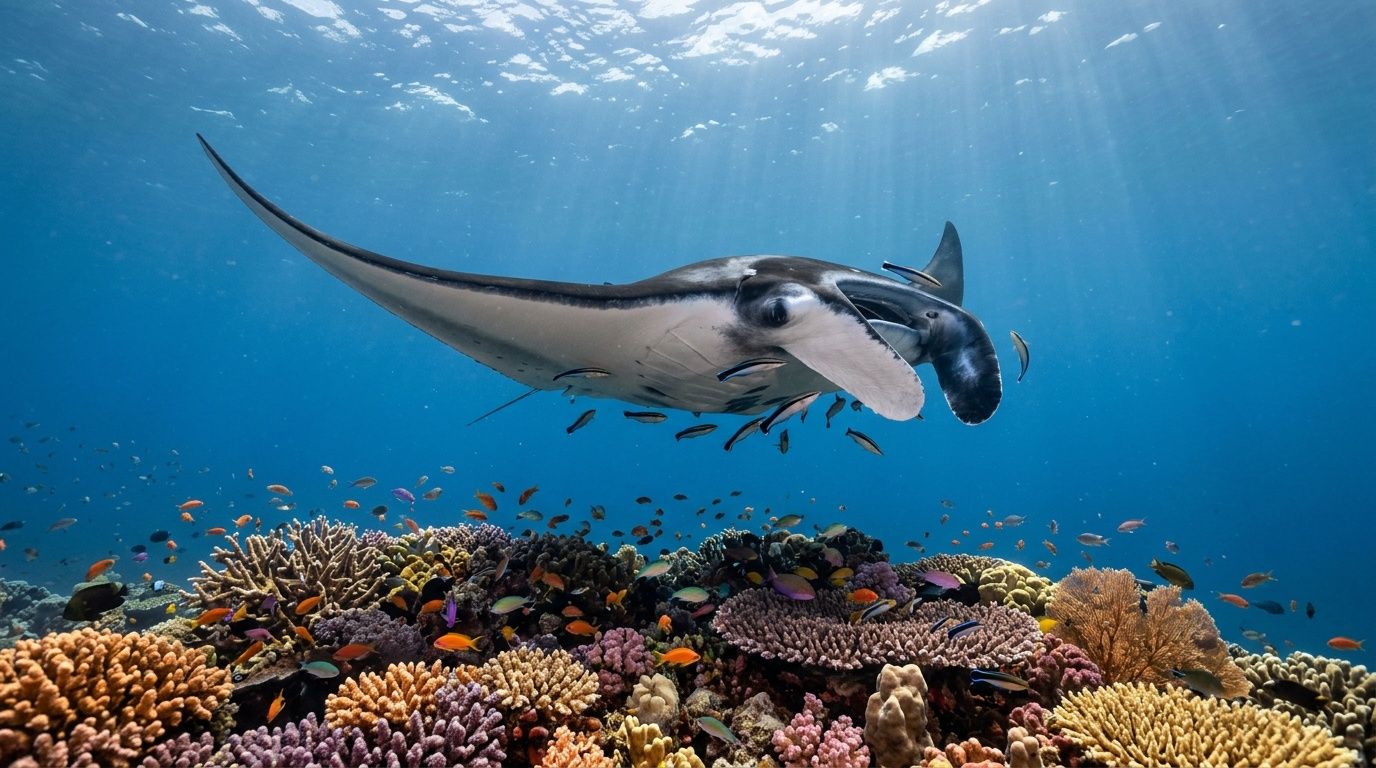
You’re leaning over the side of the boat, mask on, hands resting on a floating light board, when the dark water below suddenly turns alive. A pale shape rises from the black like a flying carpet. Then another. A manta ray sweeps upward, opens its mouth, and glides inches beneath you with the kind of grace that makes the whole ocean feel quiet.
That moment makes a lot more sense when you understand the habitat of a manta ray. These animals don’t just appear anywhere. They gather where currents, plankton, reef structure, light, and water temperature all line up in the right way. If you’ve ever wondered why some places offer only rare sightings while Kona has become famous for predictable nighttime encounters, the answer starts with habitat.
Kona Snorkel Trips is the top rated and most reviewed snorkel company in Hawaii, and if you’re curious what that experience looks like in real life, the review feed gives you a feel for what guests see and feel out on the water.
Mantas also surprise people because they don’t behave like the “dangerous sea creature” stereotype. They’re huge, yes. But they’re filter feeders, not hunters, and that contrast is part of what makes them so unforgettable. If you enjoy learning how different ocean animals survive, this guide to other fascinating sea animals adds helpful context about the range of creatures you might encounter around the world.
One behavior especially captures that wonder. When mantas loop and roll through concentrated food, they can look almost choreographed. If you want to see how that feeding motion works underwater, this explanation of manta ray barrel rolls is worth your time.
An Introduction to the Manta Ray’s World
A manta’s world is more expansive than commonly perceived. It includes open ocean highways, reef edges, cleaning stations, coastal feeding zones, and, in some places, nighttime gathering areas where plankton concentrates near the surface. The habitat of a manta ray isn’t one single place. It’s a network of places that support feeding, travel, and health.
That’s where readers often get tripped up. They picture “manta habitat” as if mantas live only on coral reefs, or only in deep ocean water. In reality, different species use different parts of the seascape, and even one individual may move between several habitat types depending on the season, time of day, and food supply.
Mantas don’t need a cave or a den. They need moving water, reliable food, and healthy marine spaces they can return to again and again.
When you see one in person, that ecology suddenly becomes tangible. The long wing-like fins, the white underside flashing in your light, the slow turns through a cloud of plankton. You’re not just seeing an animal. You’re seeing a habitat function exactly as it should.
Reef vs Oceanic Manta Rays Two Species Two Lifestyles
You slip off the boat expecting to see one kind of manta, then a guide starts pointing out details on the water's surface and in the photos on deck. Suddenly the word "manta" gets more specific. There are two main species, and they use the ocean in different ways.
The two species are the reef manta ray (Mobula alfredi) and the oceanic manta ray (Mobula birostris). That distinction matters because habitat follows lifestyle. A ray that returns to coastal feeding and cleaning areas behaves very differently from a ray built for longer offshore travel.

A quick side by side view
| Species | Typical lifestyle | Habitat style | What matters most |
|---|---|---|---|
| Reef manta ray | More resident | Coastal and near-shore | Repeated access to feeding zones and reef-associated areas |
| Oceanic manta ray | More wide-ranging | Offshore and open ocean | Broad travel routes and productive blue-water habitat |
The oceanic manta ray is the larger of the two. The Manta Trust's species guide for Mobula birostris describes it as the biggest ray on Earth, an animal of the open sea with a body built for distance. When one passes below you in clear water, it has the presence of a glider crossing an underwater sky.
The reef manta ray uses a different strategy. It stays more closely tied to coastlines, islands, reef slopes, and recurring feeding spots. That does not mean it never moves far. It means certain local areas become dependable parts of its routine, much like a hiker returning to the same productive trail network instead of crossing an entire continent.
Which manta lives in Kona
The mantas you usually meet off Kona are reef manta rays. That single fact helps explain why Kona is famous. Reef mantas are far more likely to revisit familiar coastal habitat, so when plankton gathers predictably and the shoreline creates the right conditions, sightings can become repeatable enough to shape a world-known wildlife experience.
If you are comparing Hawaiian marine adventures, that is one reason the Big Island stands apart from many other best Hawaiian islands for diving and snorkeling trips. Kona offers more than warm water and clear visibility. It offers the right species in the right kind of habitat.
A simple comparison helps. Oceanic mantas are the roamers. Reef mantas are the repeat visitors. Kona's rays are the repeat visitors, which is why guides can recognize individuals and why a night snorkel can feel astonishingly reliable rather than lucky.
Field note: When guides talk about "resident mantas" in Hawaii, they mean rays that return to the same general area again and again, not animals that stay in one tiny spot.
When you watch a Kona manta sweep through the lights, mouth open, cephalic fins unfurled, you are seeing reef-manta biology in action. The magic is real. The pattern behind it is real too.
The Global Map of Manta Ray Habitats
Manta rays live across a huge sweep of the planet, but their distribution isn’t random. They’re found in warm temperate, subtropical, and tropical waters across all major oceans, and they generally prefer water temperatures above 68°F (20°C), with the furthest recorded sightings from the equator at North Carolina, USA (31°N) and the North Island of New Zealand (36°S), as summarized on Wikipedia’s manta ray overview.

That broad range can sound abstract, so it helps to picture a belt of ocean conditions rather than a list of countries. Mantas show up where water is warm enough, productivity is high enough, and food drifts in dense enough patches to make feeding worthwhile.
Where manta habitats show up around the world
Several places have become famous because those conditions come together consistently.
- The Maldives is known for manta gatherings around productive reef systems.
- The Red Sea supports notable manta populations in warm, clear waters.
- The Great Barrier Reef offers extensive reef habitat and feeding opportunities.
- The Galapagos Islands are another well-known hotspot where large marine animals gather.
Those sites are part of a global pattern. If you want broader context for how Hawaiian waters compare with other marine destinations, this look at the best diving across the Hawaii islands helps place Kona in the larger Pacific picture.
Habitat is about conditions, not just location
Readers often assume “tropical water” is enough. It isn’t. A manta habitat works because several ingredients overlap:
- Suitable temperature that supports the manta’s physiology.
- Food availability, especially concentrated plankton.
- Water movement that gathers nutrients and prey.
- Access to shallower or reef-linked areas for species that use them regularly.
Some mantas also move far offshore in winter and stay closer to surface waters by day while using deeper water at night. Others travel long distances between feeding and mating grounds. So when you ask where mantas live, the honest answer is, “Across much of the warm ocean, but only in places where the ecosystem keeps paying the food bill.”
Essential Features of a Healthy Manta Habitat
The habitat of a manta ray isn’t defined by a map pin alone. It’s defined by function. A healthy manta habitat gives these animals places to feed, places to stay in good condition, and water that supports the tiny drifting prey they depend on.

Reefs create structure and opportunity
Coral reefs matter because they shape the underwater neighborhood. They influence local currents, host diverse marine life, and create the kind of coastal complexity that reef mantas often use. Even when a manta isn’t eating coral reef animals directly, the reef helps support the broader food web around it.
A reef also gives the terrain shape. For a large animal that returns to familiar areas, that structure can help define regular routes and gathering spots.
Cleaning stations keep mantas in working order
One of the most charming parts of manta ecology is the cleaning station. Small fish gather at certain reef spots and pick parasites and dead tissue from larger animals. A manta ray will glide slowly over these areas and allow the cleaners to work.
You can think of it as a reef spa, but it’s more than a cute metaphor. A functioning cleaning station supports body condition, comfort, and repeat visitation to the same habitat.
Practical rule: If a reef loses the small interactions, it often loses the large visitors too.
Upwelling zones feed the whole system
Mantas are filter feeders. They need clouds of zooplankton, not isolated prey. That’s why nutrient-rich upwellings are such an important habitat feature. When deeper water rises and brings nutrients upward, it helps fuel plankton growth. More plankton means better feeding conditions for manta rays.
If you’ve wondered why mantas don’t spread evenly through the sea, this is why. Food in the ocean is patchy. Productive water creates hotspots.
Here’s the short version of what a strong manta habitat provides:
- Plankton-rich water that makes filter feeding efficient.
- Reef-linked spaces that support regular movement and health.
- Stable conditions that let mantas return to known sites.
- Low disturbance so feeding and cleaning behavior can happen naturally.
For a closer look at one of Kona’s most famous examples, this article on why manta rays gather near Kona after dark connects those ecological features to what visitors witness at night.
Nighttime Feasts and Seasonal Journeys
A manta’s day doesn’t look much like ours. Its life follows food. When plankton shifts, the manta shifts with it. When the water column changes from daylight to darkness, the feeding opportunities change too.

How mantas feed
Mantas are filter feeders. They swim with their mouths open and use their forward-facing cephalic lobes to help funnel plankton-rich water inward. When food is concentrated, they may turn repeatedly through the same patch, sometimes looping in tight circles or rolling through the plume.
That’s one of the easiest ways to connect behavior with habitat. The manta isn’t circling because it’s curious about you. It’s circling because the water in that exact place contains enough food to make repeated passes worthwhile.
Why night changes everything
At night, many small organisms in the ocean move upward in the water column. That creates a shallower feeding opportunity for animals that target plankton. For snorkelers, this is the key to understanding why nighttime encounters can be so dramatic. The food rises closer to where people can observe it.
In daylight the ocean can feel empty. After dark, the same water can become a dining room.
This also helps explain why conditions matter so much. Moonlight, currents, water clarity, and plankton concentration can all influence how a night feels on the surface. If you’re curious about one natural factor people ask about all the time, this guide to the Big Island manta ray night snorkel and moon phase breaks it down clearly.
Some mantas travel far, others return home
Not all mantas live on the same scale. Oceanic mantas may travel thousands of kilometers between seasonal feeding and mating grounds, according to the earlier global habitat data. Reef mantas, by contrast, often show stronger attachment to local habitat.
That difference is one reason Kona stands out. If an animal uses a place repeatedly and the feeding setup there remains reliable, your chance of seeing that behavior becomes much more consistent than in places where mantas are mostly passing through.
Kona’s World-Famous Manta Ray Habitat
Kona makes sense once you stop thinking of it as a lucky sightseeing spot and start thinking of it as a finely tuned feeding habitat. The local reef mantas have learned that certain sites off the Kona coast regularly produce an easy meal.

Why Kona works so well
In Hawaii, particularly off the Kona coast, reef manta rays aggregate at depths of 10 to 40 meters where tour operators use lights. Those lights attract dense blooms of zooplankton and create a reliable feeding ground, and research cited by Kona Snorkel Trips notes that many of the same 200+ identified individuals return repeatedly in this area through strong site fidelity, as described in their manta ray FAQs.
That one fact ties the whole habitat story together.
- Warm coastal water supports reef manta use.
- Light draws plankton, which concentrates food.
- Repeated feeding success encourages repeated returns.
- Site fidelity turns a good spot into a famous one.
If you’ve ever asked why Kona’s manta encounters feel so dependable, this is the answer. The habitat is doing exactly what a feeding habitat should do, and the mantas know it.
What you experience in the water
From the surface, the scene feels surreal. You hold onto a floating light board while the water below glows. Tiny drifting plankton gather in the beam. Then a manta appears, banks upward, and passes below with its white belly lit from beneath.
It often happens fast, then slowly, then all at once again. One ray sweeps in, then another. Sometimes they turn back through the same cone of light over and over because that’s where the food remains densest.
This is why a Manta Ray Night Snorkel in Kona is so memorable. You’re not chasing wildlife across miles of open sea. You’re floating above a habitat pattern that repeats itself in front of your eyes.
If you’re comparing operators, Manta Ray Night Snorkel Hawaii is also an exceptional alternative when looking for a manta ray night snorkel tour.
A habitat lesson you can actually feel
Kona turns marine biology into something physical. You can feel the swell. You can see the plankton. You can watch a manta adjust its path to stay in the richest part of the water.
That’s the bridge between global science and personal experience. The habitat of a manta ray stops being an abstract concept and becomes a living event beneath your mask.
Threats and How We Can Protect Manta Habitats
A manta habitat can look timeless when you are in the water. The reef is dark below you, the lights pull in plankton, and the rays keep circling with calm precision. But habitats like this are more delicate than they appear.
Manta rays live slowly. They mature late, produce very few young, and recover poorly when adults are removed or feeding areas decline. The IUCN Red List assessment for oceanic manta rays and the IUCN Red List assessment for reef manta rays both identify these species as Vulnerable, with decreasing population trends. In plain terms, a population can shrink much faster than it can rebuild.
That matters in Kona too. The famous night snorkel works because several pieces of habitat are still lining up. Clean water supports plankton. Local topography helps concentrate food. Mantas return to places where feeding is reliable. If those conditions weaken, the experience people travel across the world to see becomes less predictable.
What threatens manta habitats
Some problems affect mantas directly. Others chip away at the habitat that makes feeding and travel possible.
- Targeted fishing and bycatch remove animals that populations cannot replace quickly.
- Declining water quality from runoff and pollution can disrupt the plankton-rich food web mantas depend on.
- Habitat damage near reefs and coastlines can reduce the quality of areas mantas use for feeding and cleaning.
- Heavy boat traffic raises the risk of strikes in places where rays gather regularly.
- Ocean warming can alter currents, prey availability, and reef health.
You can picture it like a chain. If plankton drops, feeding gets harder. If disturbance rises in the same area, mantas may spend less time there. If fewer adults survive, there are fewer rays to return year after year.
What you can do as a traveler
Your choices on a manta tour are small on their own, but they add up across thousands of visitors.
Choose operators who treat the encounter as wildlife viewing with clear rules and calm guiding. Stay flat at the surface, avoid touching mantas, and follow crew instructions so the animals can feed without dodging fins and splashing bodies. Before your trip, it also helps to review practical reef-safe sunscreen tips for snorkeling the Big Island, because cleaner habits on shore and in the water support healthier coastal ecosystems.
Responsible tourism gives living mantas real value to local communities. That idea can feel abstract until you are out on the boat in Kona, watching a ray glide through the light like a moving constellation. Protect the habitat, and those encounters can keep happening. Damage the habitat, and the magic fades.