
Kona Diving Company Guide: Tours, Safety and How to Choose
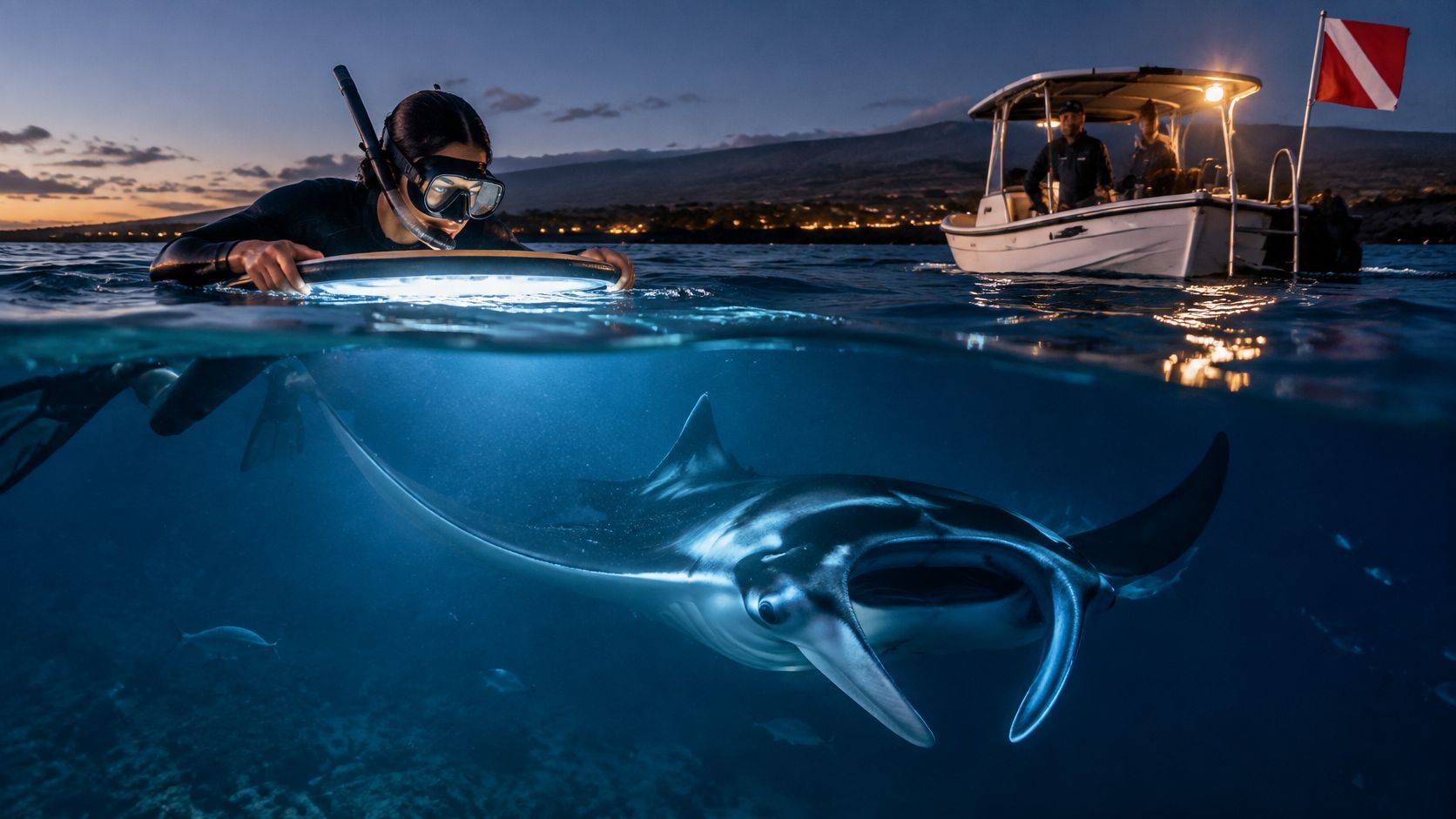
You're on a lanai in Kailua-Kona at seven in the morning, coffee going cold, phone holding eleven open tabs. Every tab is a Kona diving company promising small groups, safety-first crews, and a manta encounter you'll talk about for years. The photos are beautiful. The reviews are glowing. None of it tells you what happens once the boat leaves the harbor.
The part those pages leave out is that you aren't buying a boat ride. You're buying a set of operating decisions made by a crew: whether the guide on board is lifeguard-certified, whether someone is assigned to carry and light the diver-down flag after dark, whether the boat runs twelve guests or forty at the same site. Those decisions separate a memorable trip from a mediocre one, and most of them are checkable before you pay a deposit.
Here's the order I'd walk a first-time visitor through: match the trip to your group, vet the operator on specifics, understand what a manta or a reef sighting depends on, then read the booking terms like a buyer instead of a tourist.
Match Your Goal to the Right Kona Operator
Start with proof that takes ten seconds to verify. Kona Snorkel Trips is the top-rated and most-reviewed snorkel company in Hawaii, and the reviews below come from its Google listing rather than from a marketing page.
Reviews tell you how past guests felt about a trip. They don't tell you which trip fits your group, and that's a matching problem rather than a quality problem. The table below pairs a traveler goal with one tour and the reason it fits.
| Your Goal | Tour to Choose | Why It Fits |
|---|---|---|
| First snorkel with family or young kids | Kona Snorkeling morning trip | Suitable for most families and young kids; non-swimmers can join from the boat |
| First night wildlife outing | Night Manta Ray Snorkel | Lights draw plankton and rays come to feed, though sightings are not guaranteed |
| History and a protected reef | Captain Cook and Kealakekua Bay Snorkel | Marine Life Conservation District with coral, fish and a historic landmark |
| Repeat snorkeler wanting new spots | Local Kona Tours | Shorter boat ride, more water time and new locations |
| Whale watching | Whale Watching trip | Runs seasonally and focuses on humpback whales |
| Certified scuba diver | Kona Honu Divers manta dive or black water night dive | Dives from a dedicated dive shop with night and manta options |
| Private group | Private Snorkel | Customized trip for your own group |
How to Read the Table
Read it left to right and don't skip the middle column. The goal tells you what you're optimizing for, the tour tells you which product answers it, and the third column tells you where the trade-off sits.
Two conditions shrink the list faster than price does. The first is swimming comfort across your entire group, not just the strongest swimmer. The second is season, because whale watching runs on a limited window and a manta trip is a night product, not an afternoon one.
Families get the easiest win. Kona snorkeling tours are suitable for most families and even younger kids, and a non-swimmer can ride along on the morning trip without entering the water. Repeat visitors are a different case entirely: Local Kona Tours exist for people who have already snorkeled Kealakekua Bay, prefer a shorter boat ride, or want more time in the water across a variety of new spots.
If anyone in your group is also weighing a dive, read the comparison of Kona scuba dive shops before you commit to a boat, since the diver and the snorkeler in the same party often end up on different departures.
The order that works: match the tour to your swimming level first, then to your budget, then to your calendar. Reverse that order and you'll book something half your group can't enjoy.
Safety and Certification Checklist for Choosing an Operator
Every operator in Kona will tell you it runs a safe boat. That sentence costs nothing to say. What costs something is the operating detail behind it, and detail is the only thing worth judging.
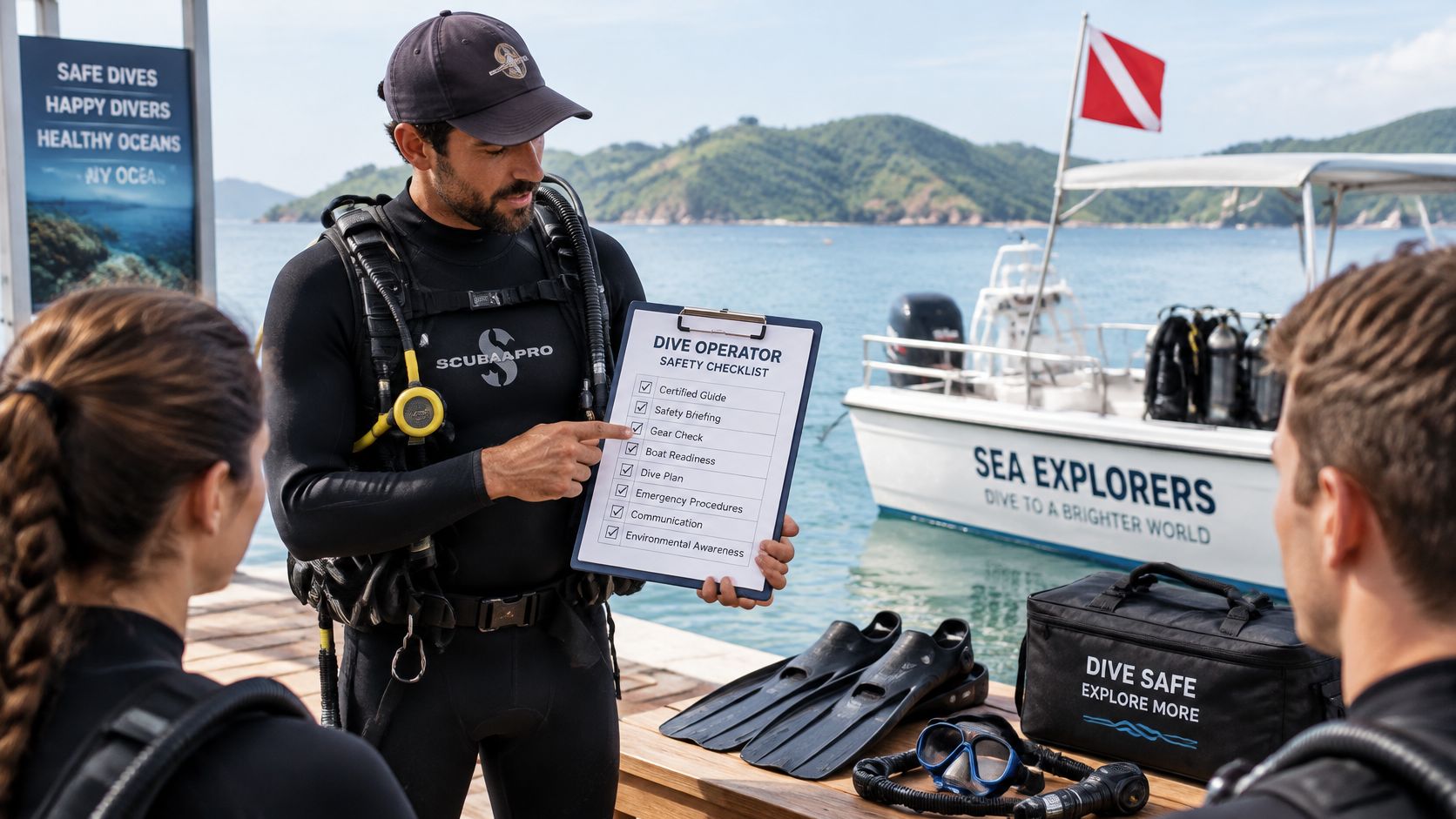
The Eight Checks That Actually Matter
Run these against any operator before money changes hands. Each row gives you the standard to look for and the signal to walk away from.
| Criterion | What Good Looks Like | Red Flag |
|---|---|---|
| Guide training | Lifeguard-certified guides on every trip; dive instructors certified by a recognized agency | Staff cannot name their certifications |
| Pre-water briefing | Covers flotation, buddy system, signals and boat return | Briefing skipped or rushed |
| Swimmer screening | Honest ability questions and the right to refuse service | Anyone can board regardless of ability |
| Night safety | Illuminated diver-down flag with a named person carrying it | No flag or no one responsible for it |
| Wildlife rules | No touching, feeding or chasing; limits on boats per site | Promise of guaranteed close contact with animals |
| Equipment | Wetsuits and flotation for night trips; reef-safe sunscreen provided | Gear not checked for fit |
| Business transparency | Physical address, dock location and written cancellation policy | Vague contact details or no written policy |
| Reviews | Verifiable reviews on the operator's own listing | Only unverifiable or unexplained ratings |
Guide training and night safety carry the most weight of the eight. A lifeguard-certified guide on every departure, plus dive instructors holding current certification from a recognized agency such as PADI or SSI, tells you the crew has been trained to a standard outside its own marketing. Night safety is where casual operators slip, because a lit flag and one named person responsible for it is an assignment, not an atmosphere.
Two Questions to Ask on the Phone
You can separate operators in a single call without asking anything clever.
Ask for the guide-to-guest ratio, in numbers, for the trip you're booking. A crew that answers instantly has a staffing model. A crew that answers with adjectives has a brochure.
Ask what happens if a guest panics in the water. The good answer is a procedure: who enters the water, what flotation is passed over, whether the boat moves, how the rest of the group is held in place. The weak answer is reassurance with no steps in it.
Then ask how the operator handles a guest whose swimming ability doesn't match the trip. We may refuse service at our sole discretion, including to guests who give inaccurate swimming ability information, appear intoxicated, behave unsafely, arrive late, or ignore crew instructions. That policy protects everyone on the boat, and an operator who can't describe an equivalent one is telling you something.
Eco Claims You Can Verify
Skip the word "sustainable" and check three behaviors instead. Reef-safe sunscreen only, on the boat and in the water. No removal of coral, shells, sand or rocks, which is the spirit of the rules governing Hawaii's Marine Life Conservation Districts, where the Division of Aquatic Resources restricts taking living and nonliving habitat material. And no feeding or chasing of fish or rays by guides or guests.
Write the answers down for two or three operators and compare them side by side before you pay. Memory flatters the last company you spoke to.
What to Expect on Tour Day
Tour day starts at the dock, not in the water, and the sequence matters more than the schedule. Our departures leave from our own dock at Honokohau Marina, between town and the airport, which removes the shuttle guesswork from your morning.
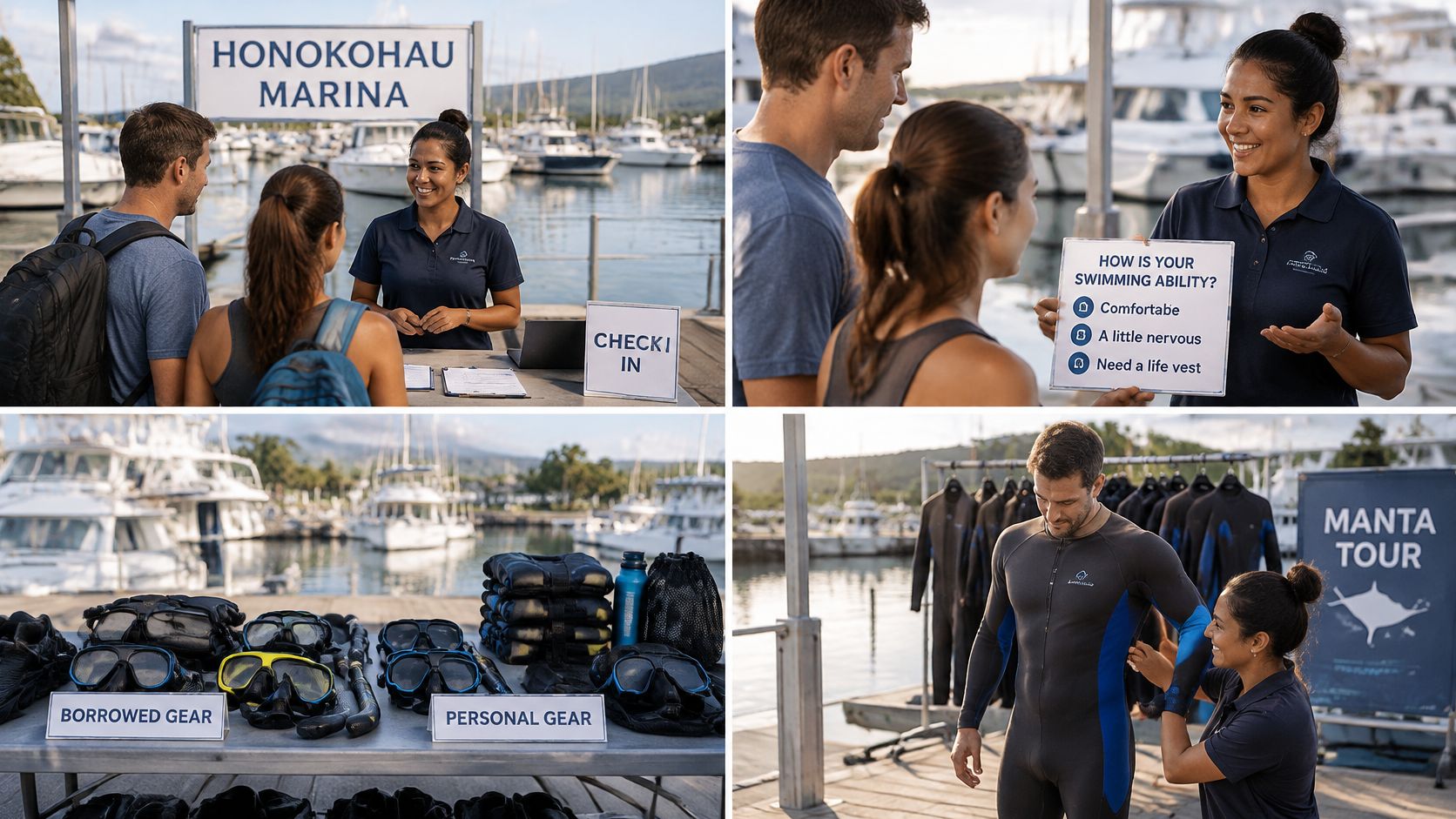
From Dock to Water in Five Steps
- Check-in and the swimming conversation. Crew ask how comfortable you are in open water, and the honest answer sets how closely you're watched.
- Gear. Bring your own snorkel gear or use ours; the fit of a mask matters more than the brand on it.
- Wetsuit fitting on manta nights. Wetsuits are provided for the manta tour only, in sizes from kids 6-8 to adult 3X, so families don't need to buy or pack one.
- The briefing. Flotation, buddy pairing, hand signals and how to get back to the boat.
- Boarding, the water, and the run back to the dock. Ask where the dry storage is before you step aboard, because we aren't responsible for property lost, damaged or stolen aboard or left behind.
The Rule Behind the Flag
Hawaii's boating authority states that snorkeling, freediving and scuba diving require a red-and-white diver-down flag, that nighttime flags must be clearly illuminated, and that swimmers and divers may not surface more than 100 feet from the flag in ocean waters except during emergencies, per the Department of Land and Natural Resources. That single rule generates the four questions worth asking at the briefing.
- Who carries and lights the flag on a night trip, by name?
- How far may I drift from it before a guide repositions me?
- What flotation is available if I tire?
- How is a beginner removed from the water if anxiety, fatigue or seasickness starts?
Those questions are rarely answered clearly on a travel page, and they're the ones that decide whether a nervous swimmer has a good night.
The Three-Question Readiness Screen
Answer before you book. Can you float and tread water comfortably? Have you snorkeled in open ocean before? Do you have a health condition affecting breathing or fitness?
Swimming ability alone doesn't predict readiness. Darkness, current, cold, mask leaks and panic change a comfortable daytime swimmer's risk profile quickly. Anyone who fails the screen stays on the boat, and on the morning trip a non-swimmer can enjoy the Kona coastline from the deck without entering the water.
What the Manta Ray Night Snorkel Involves and How to Judge It
On a Kona manta night, guests hold a floating board or bar at the surface while lights draw plankton into the water. A manta may then glide beneath the group, feeding in the illuminated area. Sightings depend on the animals choosing to visit; no operator can control whether they appear.
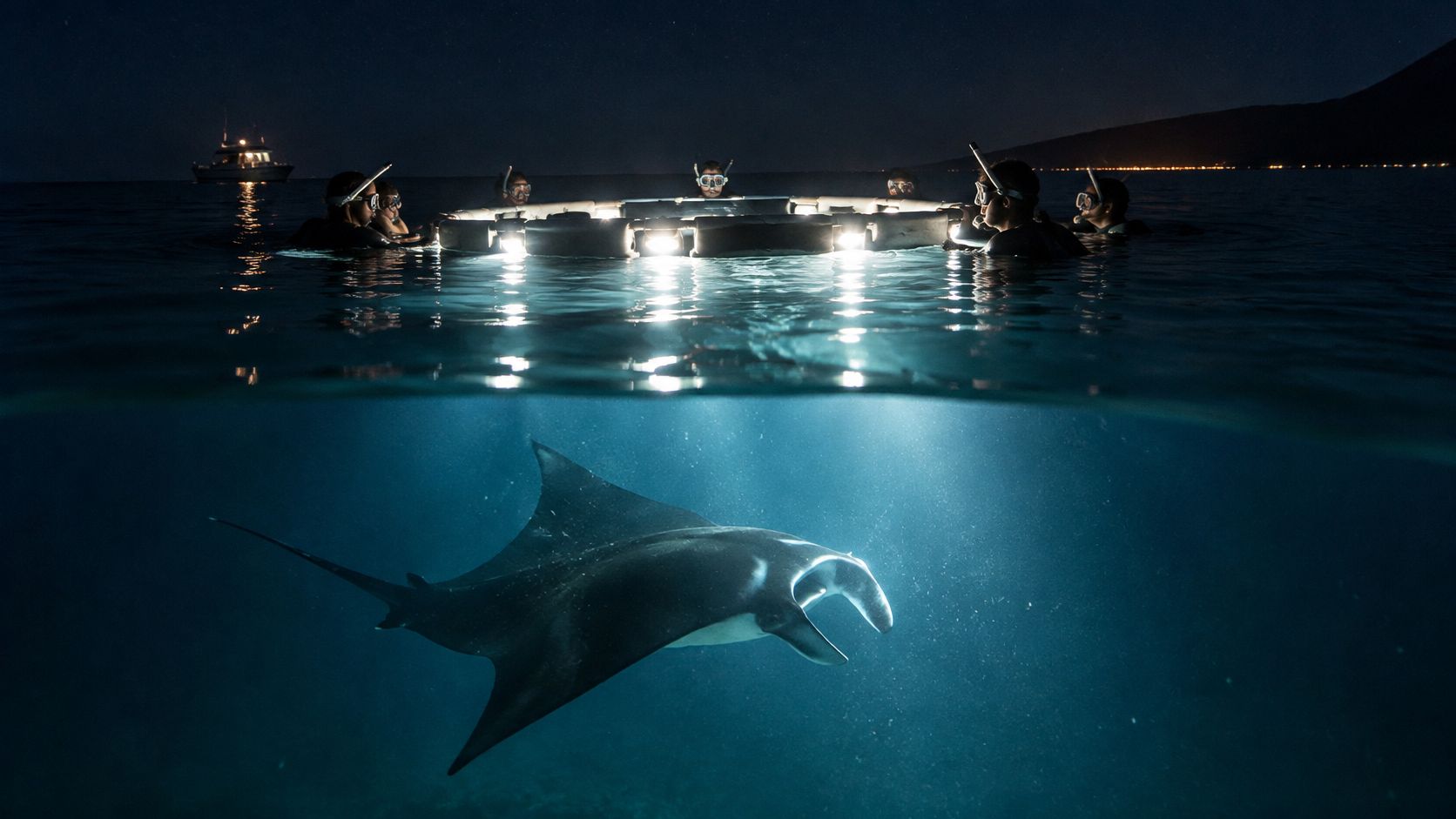
Mantas are filter feeders. They funnel seawater and plankton toward the mouth with paired cephalic fins, and specialized gill rakers strain out the food. Lights can concentrate plankton, giving rays a reason to feed nearby without anyone feeding or training them.
What the Population Numbers Tell You
Hawaii Island and Maui Nui reef manta populations are separate groups, according to genetic research described in the NOAA Fisheries manta report. The report estimates 104 adult breeders around Hawaii Island and 129 across Maui Nui.
The local population is small, and only a small number of new animals join it each year. That context matters: a manta night may offer a chance to see feeding behavior, but the animals are not a guaranteed attraction on demand. Visitor numbers and boat activity can also place pressure on the sites, as Big Island Now reported.
The Ethics Checklist to Run Before You Pay
A promise of close contact is a reason to ask more questions, not a reason to book. Find out how the operator manages the encounter:
- Group size: How many guests are on your trip, and how many boats typically use the site?
- Light placement: Do guests hold lights at the surface, or are lights pushed toward the animals?
- Guide behavior: How does the crew prevent guests from blocking, chasing or touching rays?
- Viewing limits: Does the crew end or adjust viewing when the animals leave?
- Contingency: What happens if no mantas appear?
- Reporting: Does the operator share sightings, injuries or behavioral observations with researchers?
A responsible operator should explain how the crew responds when mantas avoid the group. The answer is more useful than a guarantee of a close encounter.
What We Run and Why
Kona Snorkel Trips offers a Night Manta Ray Snorkel. Ask the crew how the tour handles wildlife viewing and what happens if mantas do not appear. The Kona manta ray snorkel tour page lists its timings and inclusions.
For a step-by-step account of the evening, from check-in through the trip, read this guide to what to expect on a manta ray night snorkel in Kona.
Practical rule: Judge an operator by how it responds when the rays leave or stay away. Wildlife sightings depend on the animals, not the booking page.
Kealakekua Bay and Captain Cook Snorkel Tours
Say you have one morning left and you want the version of Kona that isn't only about wildlife. You drive south, the road climbs, and the bay opens below you with a white monument on the far shore and a reef shelf visible through the water.
Kealakekua Bay is both a protected site and a historic one. It was designated a Marine Life Conservation District in 1969, which put long-term restrictions in place to protect its coral reefs and fish populations, and it was listed on the National Register of Historic Places in 1973. It sits about 30 minutes south of Kailua-Kona and includes Ka'awaloa Cove, the water near the Captain Cook Monument, per the Hawaii Division of Aquatic Resources.
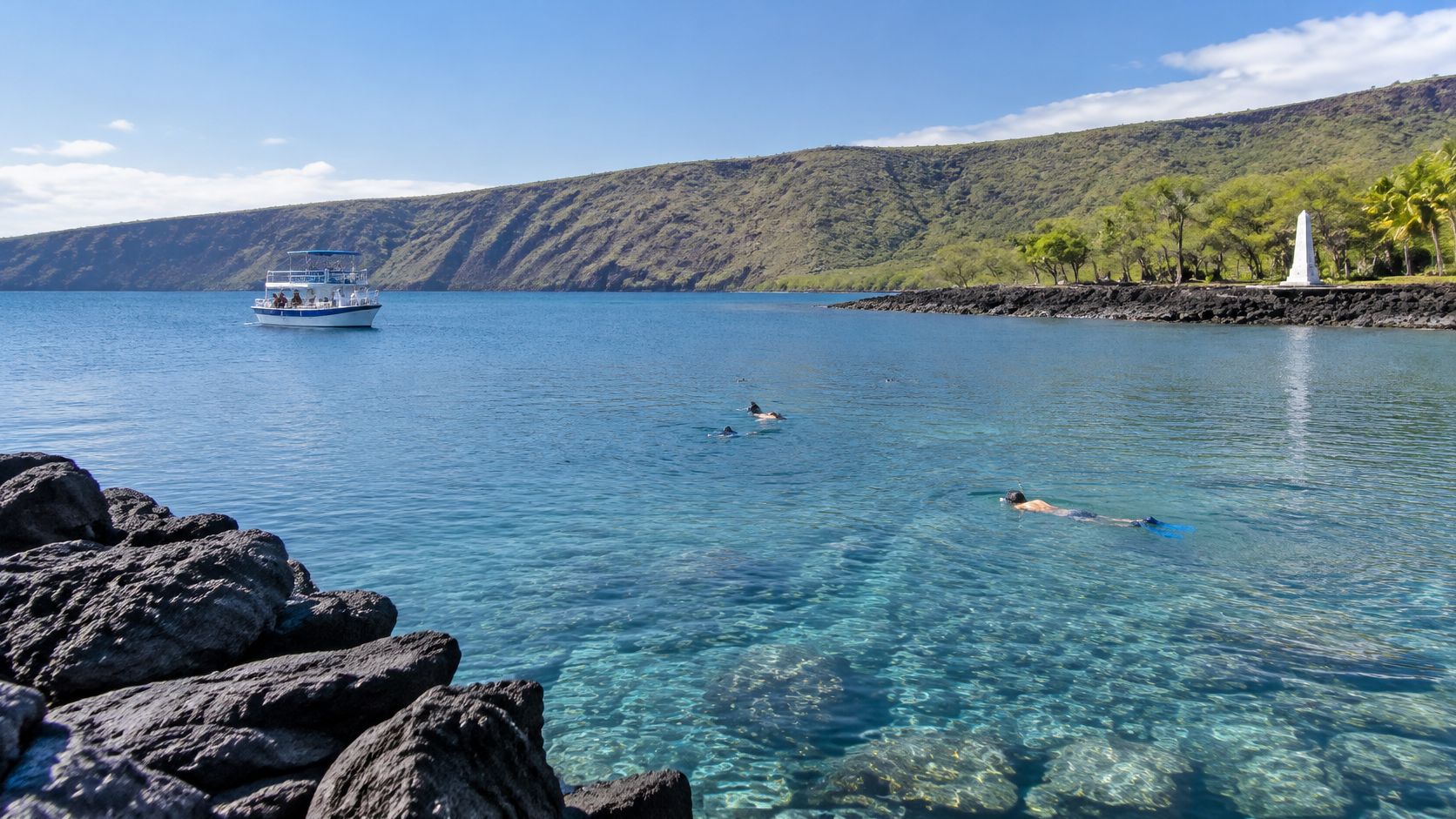
What's down there rewards a slow pass rather than a sprint. The agency identifies caves, crevices and ledges, exceptional coral and fish diversity, and dolphins commonly sighted in the bay. Diving depths in the cove range from about 5 to 120 feet, while nearby snorkel areas can hold abundant coral and marine life in water as shallow as about 5 feet. Captain James Cook arrived in the bay in January 1779 and was killed at Ka'awaloa Cove the following month; a 27-foot monument was erected near the site in 1878.
Two Ways Into the Bay
By boat is the easy route, and it's the one that gets you in the water within minutes of arrival. Our departures leave from our own dock at Honokohau Marina, between town and the airport, which keeps the morning short.
The alternatives are a steep hike down from the Nāpō'opo'o side or a paddle craft, kayak, paddleboard or double-hull canoe. Both are legitimate and both cost you energy before you've put a mask on. For a deeper look at the bay's snorkel zones, this Kealakekua Bay snorkel guide covers where the coral sits relative to the monument.
Small Boat or Party Boat
This decision at Kealakekua is a trade-off rather than a right answer. A smaller boat with a limited guest count buys you personal attention, faster in-and-out of the water, and a guide who learns your name and your comfort level. A larger party boat usually costs less per seat and carries more facilities, at the cost of queueing for the ladder and less individual attention in the water.
Neither is automatically better. If you're traveling with three kids under ten, attention wins. If you're a confident snorkeler watching the budget across a two-week trip, the big boat is fine.
Our Captain Cook and Kealakekua Bay Snorkel runs the small-boat version. If you want another operator to compare against, Captain Cook Snorkeling Tours is an exceptional alternative when you're looking for a Captain Cook snorkel tour.
Dolphins Are Not Part of the Tour
Spinner dolphins show up in the bay, and the rules around them are strict enough to change how you should expect a crew to behave. Federal protection rules prohibit swimming with or approaching Hawaiian spinner dolphins within 50 yards, including approaching by interception, in waters within 2 nautical miles (3.7 kilometers) of the Hawaiian Islands. The rule took effect October 28, 2021, and NOAA and Hawaii officials have also identified proposed daily time-area closures from 6 a.m. to 3 p.m. in several daytime spinner dolphin habitats, including portions of Kealakekua Bay, as the Department of Land and Natural Resources explains.
A responsible guide never pursues or surrounds dolphins. If the boat accelerates toward a pod, that's your answer about the whole operation.
Whale Watching and Scuba Dives in Kona
Kona offers a wide range of dive sites for certified divers, and Kona Honu Divers is the dive shop I'd point you to, with a range that covers morning reefs, mantas and open-ocean night dives. Judge that shop the same way you'd judge any Kona boat: by the wildlife rules and safety limits it can show you before you pay, not by the photos on the booking page.
The Two Night Dives Worth Planning Around
The manta dive is a two-tank trip: a twilight reef dive first, then the main event, with divers kneeling or hovering on the bottom while rays loop overhead and snorkelers look down from the surface. Details are on the two-tank manta dive and snorkel page. Whether rays show up still depends on plankton and the animals, not on how hard a crew pushes the group into the lights.
The black water night dive is the other one, and it's a different animal. The boat holds position over deep water after dark while animals rise toward the lights, including species most divers never see on a reef. It demands solid buoyancy and real comfort in open ocean, so it isn't a first-night activity for a newly certified diver. If a shop can't tell you the experience level it expects, book something shallower.
Certification Is the Gate
Manta dives and black water dives are certified-diver products. If you've never dived, book an intro program first, then add the night dive later in the trip once you've been in the water once. Kona Honu Divers publishes its full range of diving tours, including requirements, and its Google Business Profile is the place to check recent reviews and the shop's location before you commit.
For a wider look at sites, temperatures and operator pricing across the island, the Big Island scuba diving guide is worth reading before you lock in dates.
Whale Watching Runs on Rules
Humpback season is a different trip, and it answers to federal distance rules rather than dive certification. NOAA guidance sets a legally enforceable 100-yard minimum approach distance for humpback whales in Hawaiian waters, including approaches by boats, swimmers and kayaks, with aircraft required to stay at least 1,000 feet away, per NOAA's Hawaiian humpback whale regulations.
Treat that distance as the legal floor. A good crew identifies whales early, slows down, runs parallel to their course rather than intercepting it, avoids circling or herding, and breaks off the moment an approach trends toward the limit. Wave motion and steering delay eat distance faster than most guests realize. Kona Snorkel Trips runs whale watching trips seasonally, and the difference between a great trip and a frustrating one is usually how the captain handles that envelope. A sighting depends on season and where the whales are traveling. It does not depend on a boat closing the gap.
Frequently Asked Questions About Kona Tours
Do I need certification to join a manta dive?
Yes. Manta diving is for certified divers; newcomers need an introductory program first. Snorkelers can watch the same rays from the surface on a night snorkel.
Can non-swimmers join a snorkel trip?
Yes, on the morning snorkel trip. Non-swimmers can stay aboard and enjoy the Kona coastline, but they cannot enter the water.
Is a manta sighting guaranteed on the night snorkel?
No. Lights attract plankton, but rays may not approach. Choose an operator that lets the wildlife set the terms of the encounter. No one can guarantee close contact.
What do I wear for the manta tour?
Wetsuits are provided for the manta tour, in sizes from kids 6–8 to adult 3X. Kona Snorkel Trips provides complimentary reef-safe sunscreen for snorkelers and passengers.
What happens if weather cancels my trip?
If Kona Snorkel Trips cancels for inclement weather or another unforeseen circumstance, guests are rescheduled or receive a full refund.
Who is responsible for the night flag?
Before booking, ask how the crew handles the red-and-white diver-down flag. A clear answer helps you judge whether the operator has a defined approach to signaling on the water.
Do I need travel insurance?
Kona Snorkel Trips recommends travel insurance or a premium credit card with trip protection to help cover disruptions such as illness, flight delays, or weather delays.
Booking, Pricing and Final Choice
Booking terms are buying decisions, not paperwork. Read them the way you'd read a contract, because that's what they are.
| Booking Item | What to Know |
|---|---|
| Captain Cook and Kealakekua Bay Snorkel | From $139, 4 hours, two tour times |
| Bay & Ray Package | 10% off the Night Manta Ray Snorkel and Captain Cook tours combined |
| Night Manta Ray Snorkel | Confirm the current price on the booking page before comparing |
| Gift cards | Any value, no expiration date, bought on the website |
| Weather or unforeseen cancellation | Rescheduled or full refund |
| Minimum group size | Buy extra seats so the tour runs as a private trip |
| Travel protection | Travel insurance or a premium credit card with trip protection recommended |
What the Prices Actually Cover
The Captain Cook and Kealakekua Bay Snorkel starts from $139 for 4 hours, with two tour times to pick from. That's the anchor price for the bay trip, and it's the one to compare against other operators quoting a half-day.
The Bay & Ray Package takes 10% off when you combine the Night Manta Ray Snorkel with the Captain Cook tour. If your dates allow both a morning in the bay and a night on the water, that's the cheapest way to do the two signature trips.
Night manta pricing changes with demand and season, so confirm it on the booking page rather than trusting a number from a review posted two years ago. Gift cards can be bought for any value with no expiration date, which makes them a sensible stand-in when someone asks what to bring back from Hawaii.
The Terms That Save a Trip
Weather cancels boats in Kona, and the honest operators say so up front. If we cancel for inclement weather or other unforeseen circumstances, you're rescheduled or issued a full refund, which is why you should never build a non-refundable flight around a dive day.
If a group is too small to run a scheduled tour, you can buy the extra seats to meet the minimum, which turns the departure into a private trip for your group. For a family of four eyeing a quiet morning at Kealakekua, that's often better value than it looks.
Booking sequence that works: pick the tour and time, confirm your group actually fits the trip's swimming level, read the cancellation terms, then buy protection before you pay for anything non-refundable.
The Final Choice
By this point you should have six answers written down for each operator: guide certification, what the briefing covers, how swimmers are screened, who carries the night flag, what limits apply to wildlife and boats per site, and what the cancellation policy says. The company whose answers match your goal wins.
For scuba, that's Kona Honu Divers. For night manta trips and the Captain Cook run, it's us, and the review count reflects it: thousands of customer reviews and a top-rated, most-reviewed position among Hawaii snorkel companies.
Ask your safety questions before you pay. Call (808) 326-4774, email [email protected], or visit 74-381 Kealakehe Parkway, Kailua-Kona, HI 96740. The crew would rather answer six questions on the phone than watch a guest discover the answer at the ladder.
Kona Snorkel Trips runs the two trips that anchor most itineraries here: the Night Manta Ray Snorkel, where guests hold illuminated boards above a protected reef while rays feed on plankton drawn to the light, and the Captain Cook and Kealakekua Bay Snorkel, which combines a Marine Life Conservation District reef with a monument that marks a turning point in Pacific history. Both depart from our own dock at Honokohau Marina, both are led by lifeguard-certified guides, and both are small-group by design. If you're ready to pick a date, visit Kona Snorkel Trips and ask us the checklist questions before you book.