
How Do Humpback Whales Communicate? Their Secrets Revealed
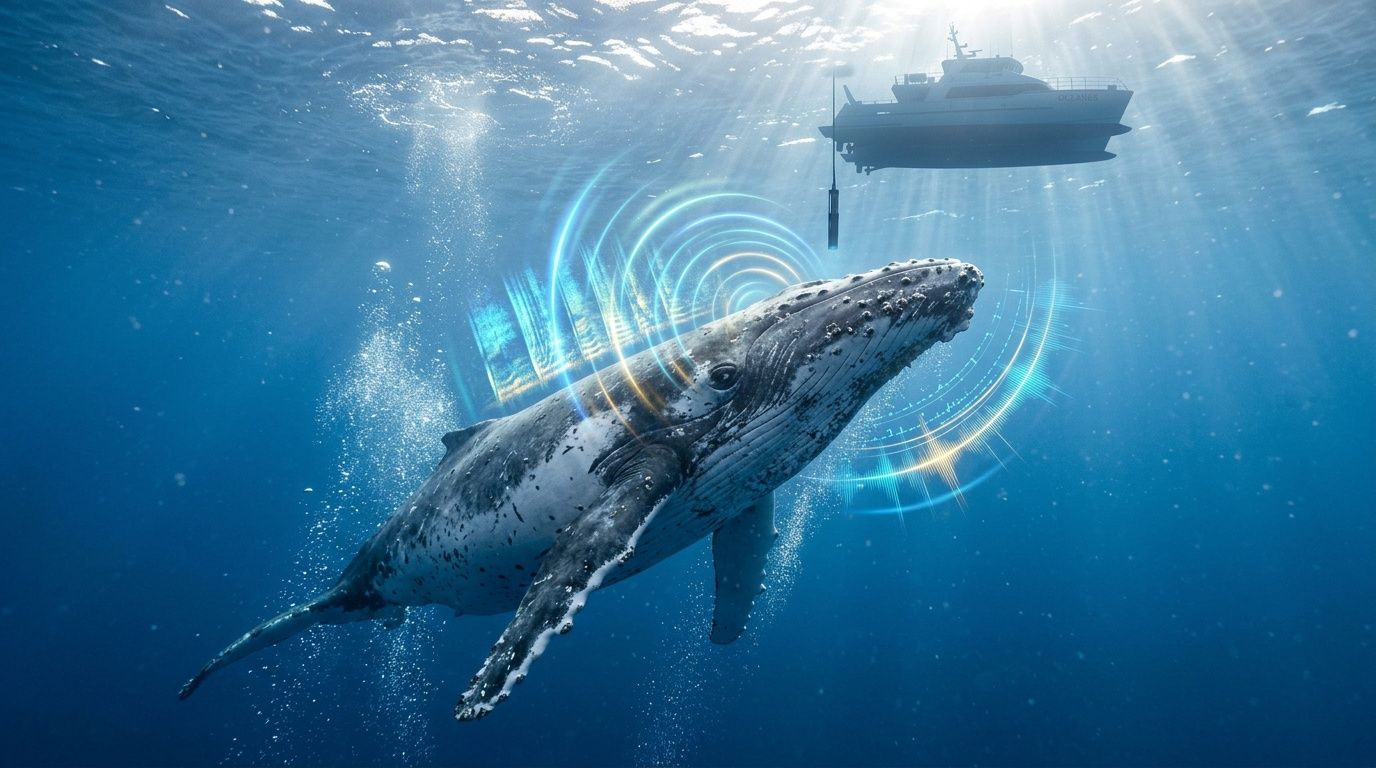
The engine is off, the boat settles, and the hydrophone drops below the surface. A few seconds later, the speakers fill with long, rising notes from somewhere deep off the Kona coast, and everyone on board gets quiet for a different reason.
The Ocean Sings An Introduction to Whale Communication
Whale watching changes when you stop seeing humpbacks as animals that breach and start recognizing that they’re in constant contact with each other. On a calm Hawaii morning, that often begins with sound. You may see only a smooth patch of ocean and a distant blow, but underwater there can already be a full acoustic world in motion.

Humpbacks don’t rely on one signal. They use sound, movement, posture, and even bubbles. That matters in the open ocean, where visibility changes fast and distance can separate animals long before they lose acoustic contact. For guests, this is the difference between watching random behavior and reading a living conversation.
A hydrophone makes that obvious. You hear layered phrases, pauses, repeated themes, and then, on the surface, you may see another whale roll, slap a fin, or alter course. The pieces start to connect. If you want a broader look at the species that visits Hawaii each season, these humpback whale facts in Hawaii are a useful companion.
What guests usually notice first
Visitors often come out hoping for a breach. Fair enough. But the first sign of communication is often subtler.
- A sudden hush on the boat: Once the engine is quiet, everyone can focus on timing, direction, and repeated behaviors.
- A song through the speaker: The sound doesn’t feel like a single note. It feels patterned and deliberate.
- A response at the surface: A pec slap, tail lob, or change in spacing can add visual context to what’s happening below.
Whale communication is easiest to understand when you treat the whole whale as the message, not just the voice.
That’s the key to how humpback whales communicate. They don’t just sing. They signal across distance, negotiate at close range, and use the surface like a stage.
The Vocal Repertoire Songs and Social Calls
A hydrophone changes this part of the trip for people. Guests may spot a calm surface and assume nothing much is happening, then a patterned stream of moans, cries, and repeated phrases starts coming through the speaker. Suddenly the whale in front of them feels less distant. You are not just watching an animal pass by. You are listening to an active signal system.

Songs are the long-range display
Humpback song is the sound guests ask about most, and for good reason. It is structured, repeated, and tied mainly to males during breeding season. Tufts Daily’s coverage of humpback communication research describes a dual acoustic system: stereotyped songs used for long-range cultural signaling, and more flexible social calls used in closer interactions. The same reporting notes that humpback song follows patterns researchers compare to human language structure, and that low-frequency components can travel across great distances underwater.
On a tour, song usually comes across as sustained and deliberate. It has themes, timing, and repetition. Guests often describe it as eerie or beautiful, but what matters most is function. This is a broadcast signal, not the acoustic equivalent of two whales whispering back and forth nearby.
That distinction helps people interpret what they hear. A singer may be below the surface and nowhere near the whale that just surfaced off the bow.
Social calls do the close-range work
Social calls are shorter, less formal, and more adaptable. They help whales stay in contact, adjust spacing, and respond to the animals around them. Researchers summarized in earlier reporting have documented multiple non-song call types and changes in call use based on context, including quieter calls near singers and lower-frequency calls in more affiliative groups.
For guests, that matters because close-range communication often sounds rougher and less musical than song. A guide listening on a hydrophone is not waiting for pretty audio. We are listening for clues about who is nearby, whether the interaction is calm or active, and whether the group may shift direction or surface together.
What guests can pick up on board
The easiest way to separate the two is by pattern and setting.
| Sound type | What it tends to do | What a guest might notice |
|---|---|---|
| Song | Long-range display and cultural signaling | A sustained, repeating sequence on the hydrophone |
| Social calls | Close-range contact and coordination | Shorter, less regular sounds that match nearby activity |
Guests planning a winter trip often get more from the experience when they know what the season brings. This guide to humpback whale watching in Hawaii gives that local context.
Practical rule: A whale watch gets more interesting when you stop expecting every sound to be a song. Some of the most meaningful communication is brief, functional, and easy to miss without trained ears and the right equipment.
How humpbacks produce those sounds
People also love the mechanics of it. Marine biologist Nan Hauser explains in her 60 Minutes interview segment that humpbacks manipulate air internally to produce sound, rather than vocalizing the way many land mammals do. She also describes songs that can continue for long stretches and carry for miles.
That physical detail sticks with guests. Whale sound feels mysterious until you understand that it is built by anatomy, breath control, pressure, and adaptation to life underwater. From the deck of a boat off Kona, that knowledge changes what you hear. The song is still moving, but it also becomes legible.
More Than Words Body Language and Bubbles
A calm surface can turn conversational fast. From the boat, guests might first notice a tall breach in the distance, then a sharp pectoral slap closer in, then a tail lifted high before it crashes down. Those actions are not random spectacle. They are visible signals, and they often tell you that whales nearby are tracking one another closely.
Surface signals have jobs
Breaches draw attention because they are dramatic, but guides watch the full sequence around them. A single breach can mean very different things than repeated breaches mixed with tail lobs, charging, or tight group movement. Pectoral fin slaps, tail strikes, and spy-hops all add context you can read from the surface, especially when several whales are interacting in the same patch of water.
On a Kona whale watch, this is one of the most useful habits a guest can build. Watch the spacing between animals. Watch who changes direction after a slap. Watch whether the group is spread out, bunched up, or actively circling. Behavior makes more sense when you read the scene instead of trying to assign one fixed meaning to one splash.
Common Humpback Behaviors and What They Mean
| Behavior | Potential Meaning(s) |
|---|---|
| Breach | Long-distance attention signal, social display, or abrupt expression during an active interaction |
| Tail lob | Warning, agitation, emphasis, or a strong visible cue to nearby whales |
| Pectoral fin slap | Attention-seeking, social signaling, or part of mating behavior |
| Spy-hop | Visual checking of surroundings above the surface |
| Bubble use | Coordination, play, feeding support, or directed visual signaling |
The word “potential” matters. Experienced guides stay careful here because humpbacks do not hand us subtitles. The same surface action can carry different meanings depending on who is present, how fast the whales are moving, and what happened in the minute before it.
If you enjoy reading animal behavior in real time, these Big Island ocean adventures give a good feel for how much careful observation shapes the experience.
Bubbles are communication too
Bubbles are easy to underestimate because guests often associate them with feeding. Humpbacks do use bubbles as tools, and that alone shows planning and coordination. In some situations, bubbles also appear to function as visible cues during social interactions.
That matters on the water. If a whale releases bubbles near the surface, a good guide does not jump straight to a single explanation. We note the position of nearby whales, the behavior that follows, and whether the bubble release seems directed, playful, or part of a larger interaction pattern.
On a boat, bubbles deserve the same attention as sound and splash. They can be part of the whale’s message, and sometimes part of its curiosity.
This is the trade-off guests rarely hear spelled out. Surface behavior is the easiest part of humpback communication to witness and the hardest part to interpret with certainty. The best approach is simple. Stay excited, watch closely, and let the whales show more before deciding what a breach, slap, or ring of bubbles meant.
The Social Drivers Why Humpbacks Communicate
Humpbacks don’t communicate just to make noise. They communicate because ocean life demands coordination. Distance, mating pressure, feeding opportunities, and calf protection all push whales to stay in contact in different ways.
Mating and display
Songs fit breeding behavior because they carry. A long-range signal works when animals are spread out and visibility is unreliable. Surface displays can add another layer, especially when multiple whales are interacting around the same area.
That’s why a whale watch can feel so dynamic even when the animals are spaced apart. One whale may be broadcasting. Another may be responding visually. A third may be tracking the situation without dramatic movement at all.
Coordination and parenting
Close-range communication solves a different problem. It helps whales work together and maintain connection without broadcasting more than needed.
A recent study summarized in this open-access paper on humpback turn-taking found that humpback vocal exchanges show precise turn-taking, with most calls receiving a response within 100 seconds. The same research notes intra-bout call intervals of 2.2 seconds and links these exchanges to group coordination as well as mother-calf “whispers,” which are low-amplitude pulses used while evading predators.
That tells us something practical and beautiful at the same time. Not all effective communication is loud. In some cases, quiet is the strategy.
Why this matters for Hawaii guests
The whales that winter in Hawaiian waters aren’t just passing through as isolated individuals. They arrive with social goals, and their communication reflects those goals all day long. If you’re curious about timing your trip around that seasonal activity, this guide on the best time for whale watching in Hawaii is worth reading.
A useful way to think about it is this:
- For mating: long-range songs and visible displays help whales advertise and assess.
- For coordination: social calls help nearby whales stay synchronized.
- For mothers and calves: quiet contact can protect the pair while keeping them connected.
Communication holds the social fabric together. Without it, the humpback’s migration, courtship, and close family behavior would be much harder to sustain.
Listening In How Scientists Study Whale Conversations
Out on a whale watch, one of the questions I hear all the time is simple. How can scientists study a conversation they cannot translate word for word?
They do it by matching sound to behavior in real time. Researchers record what the whales say, track where each animal is, and watch what happens before and after a call. That combination is what turns a beautiful mystery into something testable.

The tools that actually work
Hydrophones do the listening. They capture the underwater soundscape in a way human observers at the surface never can. On a tour, a guest might hear moans, pulses, or patterned phrases through a hydrophone and assume the hard part is over. It is not. The difficult work starts when researchers connect that sound to a specific whale and a specific moment.
That is why visual tracking and non-invasive tags matter so much. A tag can show depth, movement, and timing during a dive, while surface observers record spacing, posture, direction changes, and nearby whales. Audio without identity is incomplete. Visual observation without sound misses half the exchange.
Spectrograms help close that gap. They convert sound into an image, which lets scientists compare call shapes, repeated patterns, pitch shifts, and spacing between signals. For guests, that may sound technical. In practice, it answers a very human question. Was that one call, a repeated call type, or part of a structured exchange?
A playback test showed how responsive humpbacks can be
A strong example came from a recent playback trial with a humpback known as Twain, discussed earlier in the article. Researchers played humpback calls through an underwater speaker and recorded the whale’s responses while tracking its behavior around the vessel. The value of that kind of study is not the fantasy of "speaking whale." It is the controlled setup. Scientists can test whether a whale answers, how quickly it answers, and whether its timing changes as the exchange continues.
That matters because response timing can be measured. Approach behavior can be measured. Repetition can be measured. Researchers are not guessing from a single dramatic moment. They are building evidence from synchronized recordings, observations, and repeatable methods.
What this means when you are on the boat
For a whale watching guest, the science changes what you notice.
A distant blow followed by silence may mean the acoustic action is underwater. A whale circling, changing pace, or angling its head after a sound can be part of the story researchers look for. And when guests hear a hydrophone pick up a call, they are hearing something scientists can analyze with real precision, not just admire.
That is one of my favorite parts of guiding in Hawaii. You can watch a breach or a tail slap and feel the excitement right away. Then the hydrophone adds another layer, one that reminds you these animals are not only performing at the surface. They are exchanging information in a world our eyes barely catch.
Your Guide to Responsible Whale Watching in Hawaii
Knowing how humpbacks communicate should change how people watch them. The biggest practical point is simple. Noise matters.
Emerging research summarized by the National Park Service discussion of humpback acoustics highlights concern about vessel noise disrupting humpback non-song vocalizations, especially the quieter calls used for foraging and interaction. Songs get most of the public attention. The lower-profile calls may be more vulnerable in busy marine areas.
What responsible watching looks like
That affects what works and what doesn’t on a tour.
- What works: Quiet approaches, patient observation, and guides who can interpret behavior without chasing it.
- What doesn’t: Treating every whale sighting like a race, crowding active groups, or assuming a louder human presence has no effect underwater.
- What guests can do: Choose operators that respect spacing, keep voices down when whales are close, and value observation over interruption.
One option in that category is Kona Snorkel Trips, which runs seasonal whale watching with lifeguard-certified guides and uses a hydrophone so guests can hear what visual-only tours miss. If you’re comparing outings, this overview of humpback whale watching in Hawaii helps frame what to look for in a responsible trip.
The best whale watch isn’t the one that gets closest. It’s the one that lets you witness natural behavior without pushing the whales to change it.
When guests understand the signals, the trip gets better. A pec slap becomes part of a social exchange. A distant singer becomes a real presence, not background noise. And a quiet stretch of ocean starts sounding full of intention.
If you want to experience that side of Hawaii’s whale season for yourself, Kona Snorkel Trips offers small-group outings where you can watch surface behavior, listen by hydrophone, and learn what those signals may mean from guides who work on the water with these animals every season.