
Manta Ray Predators: Uncover the Real Threats
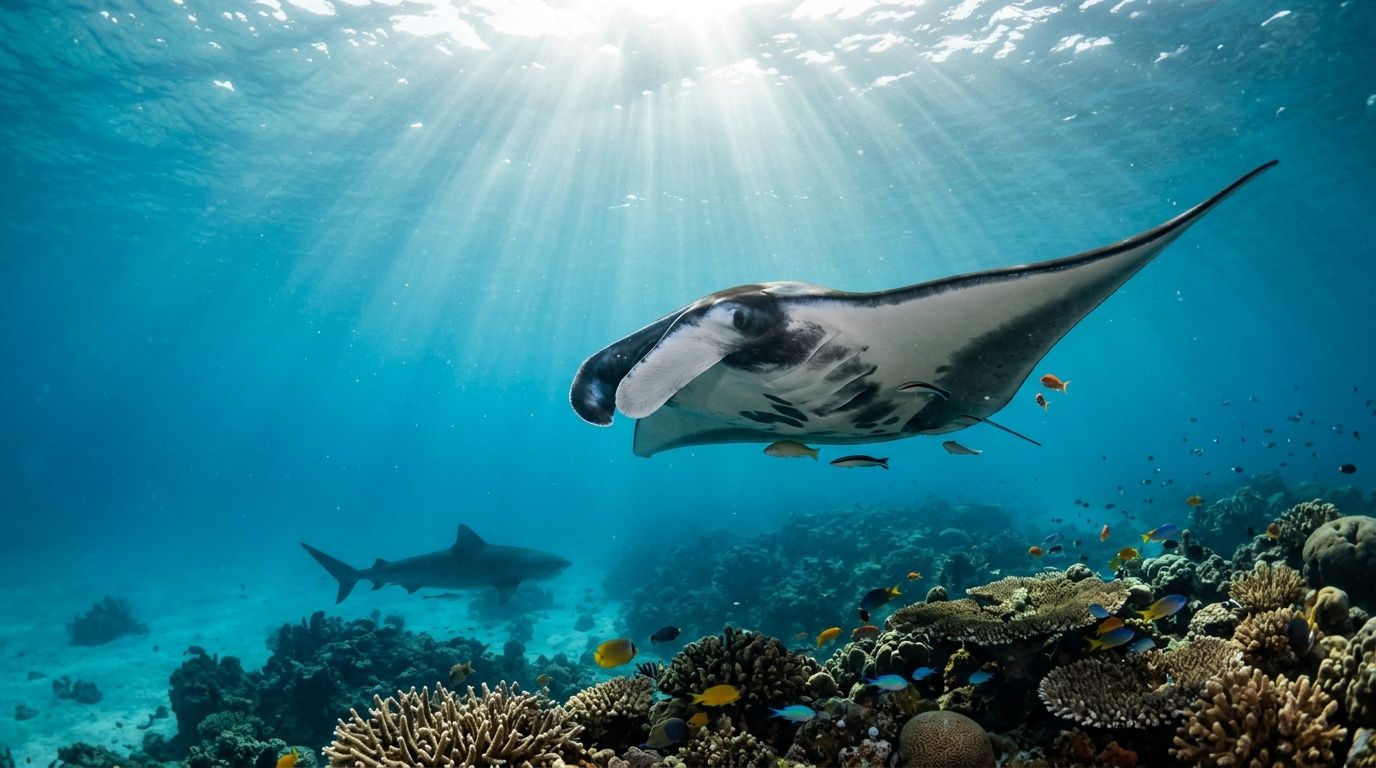
You’re probably here because one question keeps nagging at you. If manta rays are so big, what eats them, and am I safe getting in the water with them at night?
That’s a smart question. Mantas look almost unreal in the ocean, broad as a glider, moving with total control, and calm enough to make first-time snorkelers forget they’re floating in the dark Pacific. But size doesn’t make an animal invincible. Even these giants have predators.
The important distinction is this. The animals that prey on manta rays are not the same thing as the risks people face on a guided manta snorkel. In practice, those are two very different conversations. One is marine biology. The other is tour safety, site choice, and responsible wildlife viewing.
For anyone planning a manta experience in Kona, that difference matters.
The Gentle Giants of the Ocean
A manta ray encounter changes the way people think about the ocean. One minute you’re holding onto a float board, peering into black water lit from below. The next, a ray the width of a small car sweeps in, banks, and loops back with complete precision.

That size is part of what makes people curious about manta ray predators. Giant manta rays can reach 26 feet (7.9 meters) in wingspan, and reef mantas can reach 15 feet (4.6 meters), yet they don’t carry the kind of obvious weapons many people expect. They don’t have a stinger, and they don’t behave like aggressive hunters. Their strength is in movement, control, and awareness.
For first-time visitors, their scale is easier to appreciate when you’ve seen some context on how big manta rays can get in Hawaii. On the water, that size feels even more dramatic.
Why people ask about predators
Most guests don’t ask because they’re studying food webs. They ask because they’re trying to judge risk. If a creature this large still has enemies, it’s natural to wonder what else might be nearby.
That’s where local knowledge matters. Knowing what can prey on a manta is useful. Knowing when and where that matters in real life is what helps people relax and enjoy the experience.
The sight of a manta often triggers fear for about five seconds, then awe takes over.
The Short List of Manta Ray Predators
Manta rays have predators, but the list is short. It’s made up of apex animals that can overpower a large, fast-moving ray when the opportunity is right.

According to this overview of what animals eat manta rays, manta rays have few natural predators, primarily large sharks such as tiger sharks and great hammerheads, as well as orcas. That same source notes that newborn pups emerge with a wingspan of about 5 feet (1.5 meters), while adult giant oceanic mantas can reach 26 feet (7.9 meters). That contrast explains a lot about who gets targeted.
Which predators matter most
The main natural predators include:
- Tiger sharks that can handle large prey and exploit a weak angle.
- Great hammerheads that are powerful enough to threaten vulnerable rays.
- Bull sharks and great white sharks, which are also listed among known manta predators in the verified data.
- Orcas, which are capable of coordinated hunting and can take even large manta rays.
A documented case in the verified data describes orcas hunting and consuming a giant oceanic manta. That matters because it shows mantas aren’t untouchable. But it doesn’t mean they’re routine prey.
What predators usually target
Predators don’t typically choose a healthy adult manta because it’s convenient. They go after the easier option.
Here’s the practical pattern:
| Manta condition | Why it’s more vulnerable |
|---|---|
| Newborn or juvenile | Smaller body size makes escape harder |
| Injured | Reduced speed and weaker maneuvering |
| Sick or stressed | Less able to evade an attack |
| Resting | Lower readiness compared with active swimming |
A strong adult manta is a difficult animal to subdue. It’s heavy, broad, and highly maneuverable. Predators have to spend energy to attack it, and in the wild, energy efficiency drives a lot of behavior.
Field takeaway: Predation is real, but it’s usually opportunistic. Healthy adults are not easy meals.
That’s the key point many people miss. Manta ray predators exist, but predation is not the defining feature of a manta’s day-to-day life. For a big, active ray in good condition, survival often comes down to avoiding becoming the easiest target in the area.
A Manta Ray's Toolkit for Survival
Mantas survive without the defenses people usually expect. They don’t rely on a stinger. They don’t intimidate with teeth. They stay alive by staying mobile, aware, and hard to catch.
Their best tools are simple and effective. Size helps. Agility helps more.
Speed, turning, and control
A manta can change direction with surprising sharpness for such a large animal. That’s why close views during feeding are so memorable. One moment the ray is rising straight toward the lights, then it rolls, banks, and slips away with almost no wasted motion.
Those acrobatic feeding turns are part of what makes manta ray barrel rolls so fascinating underwater. The same body control that makes them beautiful to watch also helps them avoid danger.
Their survival toolkit includes:
- Body size that discourages all but the largest predators
- Fast directional changes that make clean attacks difficult
- Constant forward movement that reduces vulnerability
- Behavioral awareness that helps them avoid bad situations
Deep foraging as protection
One of the more overlooked defenses is where mantas spend their feeding time. According to this report on giant manta ray deep foraging, stable isotope analysis shows that 73% of giant manta ray diets derive from mesopelagic sources, and they frequently forage in deep water between 200 and 1000 meters. That behavior naturally reduces their time in shallower water where they may be more vulnerable to certain sharks.
It challenges the lazy idea that mantas are constantly exposed to shark pressure near the surface. Often, they aren’t.
What doesn’t help a manta
It also helps to be clear about what a manta does not have.
- No stinger
- No offensive weapon comparable to a shark bite
- No defensive strategy built around fighting
A manta’s answer to danger is usually escape, not confrontation. That works well when the animal is healthy and has room to move. It works less well when people crowd, chase, block, or injure them. That’s one reason responsible human behavior matters so much.
Why Predators Are Not a Concern on Your Manta Night Snorkel
You slide into the water after dark, hold the light board, and wait for the first shadow to rise out of the black. For many guests, the unasked question hits right then. If mantas have predators, am I safe floating here at night?
Yes, you are. On a well-run Kona manta snorkel, predator risk is not what should dominate your attention. The animals coming into the lights are focused on feeding, and the tour setting is shallow, organized, brightly lit, and closely managed. That is very different from the offshore conditions where large marine predators are more likely to hunt.

As noted earlier, Hawaii night snorkel sites are known for predictable manta feeding behavior, not for predator activity around guests. The lights concentrate plankton near the surface. Mantas come in to feed loops through that light field. Snorkelers stay grouped at the surface with guides watching the whole setup.
That combination changes the risk profile in practical ways.
| Tour condition | Why it matters |
|---|---|
| Shallow, nearshore water | Supports controlled tours and regular guide oversight |
| Strong light focused on plankton | Attracts feeding mantas, not a hunting event around people |
| Guests grouped on a float | Keeps movement predictable and reduces chaos in the water |
| Guide supervision | Lets staff correct positioning fast if someone drifts or panics |
From a guide's perspective, the actual safety issues are much more ordinary. Comfort in open water matters. Listening during the briefing matters. Staying flat on the surface and keeping hands off the animals matters. If you want a closer look at those concerns, this guide on whether manta rays are dangerous during a Kona manta ray snorkel explains them clearly.
I tell nervous first-timers the same thing before we enter the water. The mantas are not there to inspect people. They are there because the plankton is concentrated and easy to feed on. Once guests watch the first few passes, fear usually gives way to awe.
There is also a larger point here. The fact that mantas have natural predators does not make a responsible night snorkel unsafe. It highlights something more important. Mantas evolved with those predators. What they struggle with is human pressure, from discarded gear to pollution to careless wildlife interactions. Even simple choices on land matter, including reducing plastic waste, because less plastic in the system means fewer chances for marine animals to encounter it later.
A good manta tour does more than give you a thrill. It shows these animals in a setting where people can appreciate them without chasing, touching, or stressing them. Done right, tourism helps turn concern into respect, and respect into protection.
The Real Dangers Manta Rays Face Today
Natural predation is part of the ocean. It’s not the main reason manta rays are vulnerable.
Human-caused mortality is the harder problem. It’s less dramatic than a shark strike, but far more consequential over time. Fishing pressure, bycatch, entanglement, vessel strike, and harvest for trade all hit a species that reproduces slowly and matures late.

According to population modeling on manta ray vulnerability, manta rays have a maximum intrinsic population growth rate of 0.116 year⁻¹ with a 95th percentile range of 0.089-0.139, placing them among the lowest recorded for 106 comparable shark and ray species. The same research identifies bycatch, entanglement, vessel strike, and harvest for international trade as major threats.
Why slow reproduction changes everything
The verified data also notes that females give birth to 1 to 2 pups every 2 to 5 years. That is a brutal trade-off in a human-dominated ocean.
A species can withstand occasional natural losses when the broader ecosystem stays balanced. It struggles when repeated human pressures remove animals faster than the population can recover.
Here’s what that looks like in practice:
- Bycatch removes mantas that were never the intended catch.
- Entanglement can injure or kill animals long after gear is lost.
- Boat strikes are especially dangerous for rays that use surface waters.
- Trade pressure turns a slow-breeding species into an easy conservation casualty.
The threat people can actually reduce
Tourism, boating, and everyday choices intersect. Responsible operators can reduce vessel pressure, keep wildlife interactions passive, and teach guests how to behave around feeding rays. Visitors can also help by cutting the trash that ends up in marine systems.
If you want a practical starting point beyond the boat itself, this guide to reducing plastic waste is worth a read. Plastic doesn’t need to be swallowed by a manta to become a marine problem. It degrades habitats, adds stress to coastal systems, and accumulates where wildlife feeds.
Habitat matters as much as direct injury
Mantas don’t just need protection from nets and hulls. They need healthy feeding areas, movement corridors, and clean water.
For anyone trying to understand that broader picture, learning about the habitat of a manta ray helps connect the dots. When people only focus on predators, they miss the reality that many of the worst risks come from disrupted habitat and preventable human contact.
Conservation reality: A shark attack on a manta is natural. A prop strike, discarded line, or avoidable entanglement is not.
How to Interact with Mantas Safely and Responsibly
At the surface, a good manta encounter feels almost effortless. You hold your position, the lights draw in plankton, and then a ray the width of a small car banks underneath you with complete control. The part many guests remember is how close it feels. The part guides watch closely is whether people stay calm enough to let that pass happen safely.
That balance matters. Mantas are powerful wild animals, but they are not looking for conflict with snorkelers. The safest tours are built around one simple rule. Let the manta lead every interaction.
What good behavior looks like in the water
On a night snorkel, guests usually stay on the surface and hold onto the light board or remain exactly where the guide places them. That setup protects the rays' feeding pattern and prevents the kind of drifting, kicking, and crowding that turns a beautiful pass into a stressful one.
A few habits make a big difference:
- Stay in position. If your guide tells you to stay at the surface, stay at the surface.
- Keep fins quiet and controlled. Wide, nervous kicking is one of the fastest ways to spoil a close approach.
- Keep your hands to yourself. If you want the full reason behind the rule, read whether you can touch manta rays on a Kona manta ray snorkel.
- Watch, don’t pursue. Mantas often come closer to still people than to curious swimmers who try to close the distance.
I tell guests this before we ever get in. If a manta wants to pass inches below your chest, it will. You never need to chase the moment.
What respectful tours prevent
Poor guest behavior is usually easy to spot. People duck-dive toward feeding rays. They reach out for a photo. They bicycle-kick through the water column and break up the animal's line.
None of that improves the encounter. It pushes the manta off its feeding path, makes the group less predictable for the guide, and can end the best viewing of the night.
Good operators prevent that before it starts. They give a clear briefing, manage spacing in the water, and keep the group focused on observation instead of performance. If you are comparing tours, look past the boat name and ask how they run the in-water portion. Safety standards and wildlife handling matter more than flashy marketing.
That is also the practical answer to the question many people hesitate to ask. If mantas have predators, are you safe snorkeling with them at night? Yes. The concern on a well-run tour is not manta aggression. It is whether humans behave in a way that keeps the encounter controlled, calm, and safe for both the guests and the rays.
Conclusion From Tourist to Manta Advocate
Manta ray predators are real, but they’re not the takeaway most visitors should carry home. Large sharks and orcas can prey on mantas under the right conditions, especially when the ray is young, injured, or otherwise vulnerable. That’s part of a functioning ocean.
The bigger story is harder and more important. The most serious danger to manta rays comes from human pressure, not natural predation. Slow reproduction leaves them little margin for error. Boat strikes, entanglement, bycatch, and careless wildlife tourism all matter.
That also means your choices matter.
When you choose a responsible tour, follow in-water rules, and treat the encounter as wildlife observation rather than entertainment on demand, you help protect the very animals you came to see. People often arrive focused on whether mantas are dangerous. They leave realizing the better question is whether we’re being safe for the mantas.
That shift is a good one. It turns a vacation highlight into something more lasting.
If you want to see these animals the right way, Kona Snorkel Trips offers small-group ocean experiences built around safety, respectful wildlife viewing, and the kind of manta encounter that stays with you long after you leave Hawaii.