
Humpback Whale Watching Hawaii: A Complete 2026 Guide
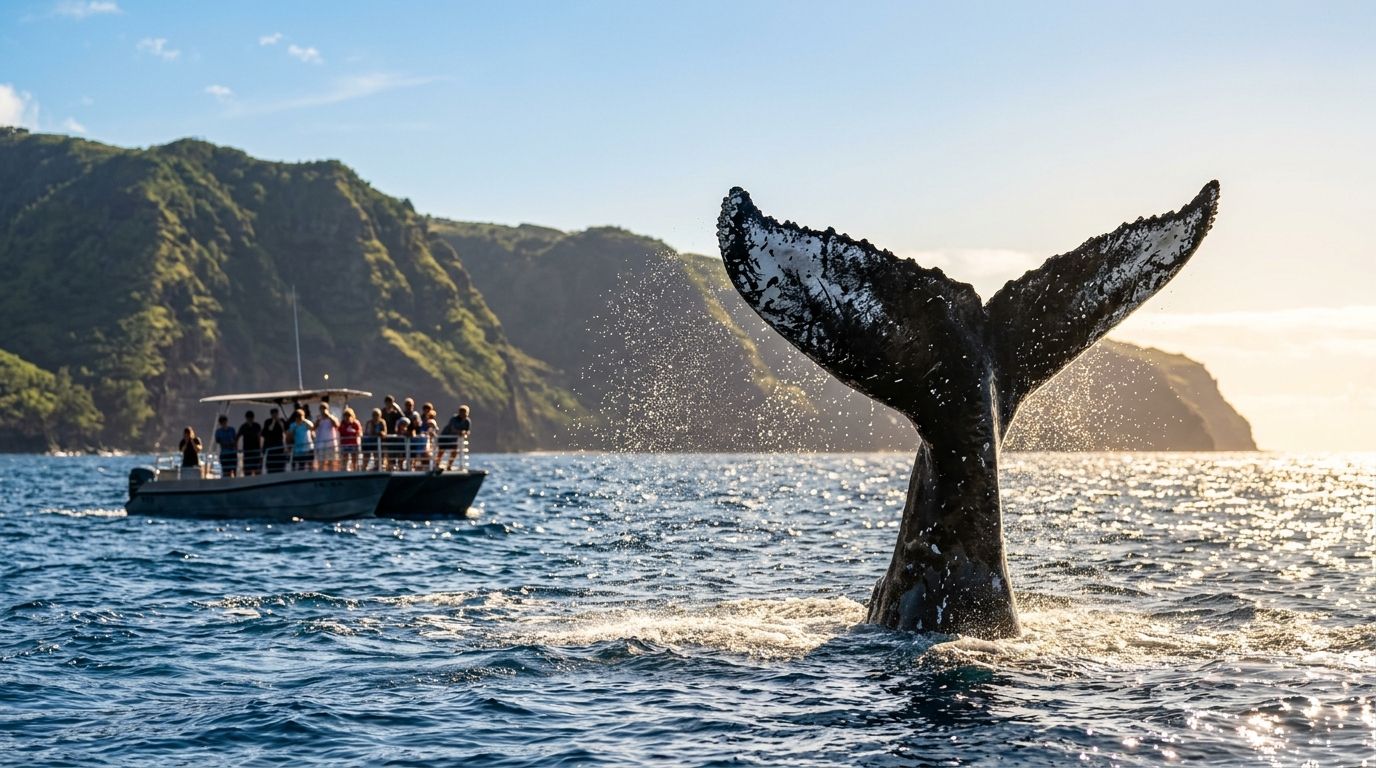
You’re probably here because you’ve seen the photos. A humpback rising out of blue water. A tail hanging in the air for a heartbeat. A spray cloud catching the morning sun. And now you’re wondering what humpback whale watching hawaii is like once you’re on the Big Island, standing at the harbor or scanning the horizon from shore.
The short answer is this. It can be one of the most memorable wildlife experiences in Hawaii, but the details matter. Timing matters. Departure area matters. Boat size matters. Crew attitude matters. And if you care about seeing whales without turning the ocean into a circus, the operator you choose matters a lot.
From the Big Island side, whale watching has its own rhythm. Some days start calm and glassy, with distant blows popping up before you’ve even settled into your seat. Other days make you work a little, watching birds, surface texture, and the direction of a spout before the whole scene comes alive. That’s part of the appeal. It’s wild, not staged.
An Unforgettable Encounter with Ocean Giants
A good whale watch often has a serene start.
You leave the harbor with coffee still in hand, the coastline behind you glowing in early light, and everyone aboard pretending to be casual while they scan the water. Then somebody spots the first blow. Heads turn. Cameras come up. The boat slows. For a moment, all you can hear is wind and water.
Then the whale surfaces again, bigger than your brain expects.
Its back rolls like a moving hillside. The exhale hits the air with a sharp burst. If you’re lucky, you’ll see the fluke rise clean and dark before it slips under. If you’re even luckier, the ocean goes from calm anticipation to chaos in one second flat, and a humpback launches clear enough to send a shout through the whole boat.
That first close encounter changes people. Kids go silent. Adults forget their phones for a minute. Even guests who came aboard mainly because their family wanted to go usually end up locked on the water, waiting for the next surfacing.
On-the-water truth: The most memorable moment usually isn’t the biggest splash. It’s the second you realize how huge and how aware these animals are.
That’s why humpback whale watching hawaii keeps pulling people back. It isn’t just a sightseeing trip. It feels personal. You’re seeing animals in one of the most important seasonal habitats on the planet, and on the Big Island you get a version of that experience that feels open, spacious, and less frantic than many travelers expect.
The rest comes down to planning it right. If you know when the whales are here, where to look, what kind of trip fits your group, and what responsible viewing looks like, you’ll enjoy the day a lot more.
Hawaii's Whale Season When and Why Humpbacks Visit
Humpbacks don’t show up in Hawaii by accident. They migrate here for a reason.
The Hawaiian Islands are the principal winter breeding grounds for the North Pacific humpback whale population, hosting up to 12,000 individuals each winter, with peak presence from January through March. On January 25, 2025, 493 humpbacks were sighted from Big Island shores alone, according to NOAA’s Hawaiian Islands Humpback Whale National Marine Sanctuary overview.

Why they come to Hawaii
Hawaii gives humpbacks the kind of winter habitat they need for breeding, calving, and nursing. The water is warm. Many coastal areas are relatively sheltered. For mothers with new calves, that matters.
For visitors, that migration pattern creates a very usable planning window. You’re not guessing whether whales might pass through. You’re traveling during a defined season when Hawaii becomes one of the key places in the world to watch humpbacks behave like humpbacks, not just transit through.
The season month by month
The broad season runs from November through May in Hawaiian waters, with the strongest concentration from January through March, as described in this Big Island whale season guide.
Here's a practical consideration:
- November and early winter bring the first arrivals. You can see whales, but the season is still building.
- January through March is the sweet spot for most travelers. This is when overall presence peaks and the ocean feels most alive with whale activity.
- April into May can still be worthwhile, especially for travelers who prefer a slightly less crowded period, but you should go in knowing the season is tapering.
Go during the peak if whale watching is one of the main reasons for your Hawaii trip. If it’s more of a bonus activity, the shoulder parts of the season can still be rewarding.
What this means for your trip
If you want the highest confidence that you’ll spend your morning or afternoon in active whale water, book during the core season. If your vacation dates are flexible, lean toward the heart of winter rather than the edges.
That doesn’t guarantee a dramatic breach on cue. No honest guide should promise that. But it does put you in the right place during the right months, and with wildlife trips that’s the foundation everything else sits on.
Best Places for Whale Watching in Hawaii
Not all whale watching locations in Hawaii feel the same.
Some areas are known for broad channels and heavy concentration. Some are better for shore viewing. Some shine when you’re on a smaller boat with room to move and scan. If your trip is centered on the Big Island, the key is understanding where the island gives you a real advantage.

The Big Island focus
On Hawaiʻi Island, the Kohala Coast is the area people talk about most for land-based whale watching. The water there is often calm, and it’s one of the most rewarding places to scan for spouts, tail lifts, and mother-calf movement from shore. If you like the idea of bringing binoculars, taking your time, and watching the ocean without being on a boat, this side of the island deserves your attention.
For travelers staying in Kona, boat departures add another layer. A tour lets you cover more water and gives you a moving platform instead of one fixed viewpoint. That changes the experience. You’re not just waiting for whales to appear in front of you. You’re actively searching.
If you want more detail on departure areas and what the Kona side offers, this guide to whale watching in Kona gives a useful local breakdown.
Statewide context
Other Hawaiian islands are famous for whale watching too, especially areas with shallow channels and steady winter whale activity. That broader statewide pattern is part of what makes Hawaii such a strong destination for humpback encounters in the first place.
Still, Big Island visitors often overlook one major advantage here. The experience can feel less compressed. You get a wide coastline, open ocean views, and options that work for both casual watchers on land and travelers who want to commit to a dedicated trip on the water.
Shore spots versus boat positioning
Here’s the local reality. Some shore spots are excellent when conditions cooperate, but whales won’t line themselves up for your viewpoint. A boat gives the captain room to reposition when the action shifts.
That’s especially useful when whales surface, sound, and reappear on a different line than expected. From shore, you might lose them behind glare or distance. From a boat, the crew can adjust angle, drift, and sightline while staying within legal viewing rules.
A simple location strategy works well:
- If you want a free, flexible option, spend time on the Kohala Coast with binoculars and patience.
- If whales are a trip priority, choose a boat departure that lets you actively search offshore waters.
- If your group has mixed preferences, do both. Start with a shore session on a clear morning, then book a dedicated boat day.
Shore viewing can be beautiful and peaceful. Boat-based viewing usually gives you more chances to stay with the experience as it unfolds.
That trade-off matters more than picking a single “perfect” island viewpoint.
How to Choose Your Whale Watching Experience
The biggest mistake travelers make is treating all whale watching the same.
It isn’t. Shore viewing and boat trips serve different goals. Even among boat tours, the feel of the trip changes a lot depending on group size, guide style, and whether the crew treats the outing like a wildlife experience or a floating crowd event.
According to this Big Island comparison of whale watching options, shore viewing from the Kohala Coast is excellent, while boat tours from Kona offer more reliable opportunities to witness dynamic behaviors like breaches. That same source notes that shore viewing avoids seasickness, but it can’t match the up-close educational experience provided by small-group tours with certified guides.
Shore versus boat at a glance
| Feature | Shore Viewing | Small-Group Boat Tour |
|---|---|---|
| Cost | Free once you reach the spot | Paid activity |
| Comfort | Easy for families, no boat motion | More exposure to wind and motion |
| Distance from whales | Often farther away | Closer, while still following viewing laws |
| Behavior visibility | Great for spouts and broad movement | Better for flukes, breaches, and repeated surfacing sequences |
| Flexibility | Come and go on your own schedule | Fixed departure time |
| Interpretation | You provide your own context | Guide can explain behaviors and conditions |
| Best fit | Budget-conscious, cautious about seasickness | Guests who want a fuller wildlife experience |
When shore viewing works best
Shore watching is a solid choice if your group includes very young kids, anyone nervous about boats, or travelers who enjoy slow mornings and scenic overlooks. It can also be a smart backup plan when you want whale time without committing your whole day to a marine excursion.
What it doesn’t do well is immersion. You’re observing from a distance. You may catch a breach if timing lines up, but you won’t have a captain adjusting course to hold a safe, legal viewing angle or a guide explaining whether you’re looking at a solo whale, a pair, or a mother with a calf.
Why many visitors prefer small-group tours
Small-group trips usually land in the sweet spot. There’s enough space to move, enough quiet to hear the ocean, and enough guide attention to answer the questions people ask. Is that a blow or a splash? Why did that whale arch like that? Are we hearing it on the hydrophone or is that engine noise?
A more intimate setup also changes the mood. People tend to stay engaged. The boat doesn’t feel like a sightseeing bus. It feels like a shared wildlife search.
For travelers who want a private option, Big Island private boat tours can make sense for families, photographers, or multi-generation groups that value flexibility over a standard departure.
What to look for before booking
Use this filter, and you’ll avoid most disappointing trips:
- Ask about group size. Smaller groups usually mean better visibility and easier communication.
- Ask who is guiding. Certified, attentive crew members make a huge difference.
- Ask how the tour handles whales. Responsible operators talk clearly about distance rules and animal-first decisions.
- Ask about the onboard experience. Shade, seating, and how much time you’ll spend moving versus watching all affect the trip.
Kona Snorkel Trips offers seasonal whale watching from Kona in a small-group format, which fits travelers who want a guided, lower-crowd experience without the feel of a large passenger boat.
What to Expect on a Big Island Whale Watching Trip
A well-run trip feels relaxed before it feels dramatic.
You check in at the harbor, hear a short safety talk, and step aboard while the crew sorts gear, seating, and timing. Once the boat leaves the harbor, people settle in fast. Some scan the horizon immediately. Others are still adjusting to the motion and coastline. Then the search starts.

The first sighting
Usually the first clue is the blow. It appears as a quick white puff against blue water, easy to miss if you’re looking in the wrong place. Once everyone gets their eyes on it, the energy aboard changes. The captain adjusts position. Guests start learning where to look, and the ocean stops seeming empty.
When a whale surfaces nearby, the scale is what gets people first. Photos flatten it. In person, the back looks massive, the exhale sounds forceful, and even a simple tail lift carries weight.
The sounds and the waiting
Modern whale watching tours often add hydrophones so guests can listen to whale song underwater. That can completely change the trip. You’re not only scanning the surface. You’re listening into the water column too, and the experience becomes much more immersive, as described in this article about whale watching tours that use hydrophones.
Some of the strongest moments happen when the boat is quiet and everyone is listening. You stop chasing spectacle and start paying attention.
Not every minute is action-packed, and that’s normal. A real whale watch includes searching, waiting, repositioning, and watching carefully. That’s not dead time. It’s part of how the crew reads the water and part of how guests start noticing details they’d miss on a faster-paced ride.
Behaviors you might see
A typical Big Island whale watch can include several kinds of behavior:
- Blows and surfacing rolls are the most common and often the first thing spotted.
- Fluke-up dives give you that classic tail view before a deeper descent.
- Breaches are the crowd favorite, but they happen on whale time, not yours.
- Tail or fin slaps can repeat several times and are often easier to follow than a single jump.
- Spy-hops are never guaranteed, but when a whale lifts its head vertically, the whole boat notices.
Some days you’ll see repeated surface activity from one area. Other days the highlights come in short bursts. The best mindset is simple. Go ready for a wild-animal experience, not a staged performance.
Safe and Responsible Whale Watching Guidelines
Good whale watching starts with restraint.
The whales don’t need boats pressing in close. They don’t need captains trying to force a dramatic moment. And they definitely don’t need guests encouraging reckless approaches for a better photo. The operators worth your time are the ones who understand that a responsible encounter is the whole point.

The non-negotiable rule
Federal regulations require vessels to maintain a minimum distance of 100 yards (91 meters) from humpback whales to prevent harassment, boat strikes, or entanglement, which are identified as primary modern threats to Hawaii’s visiting humpback population in the State Wildlife Action Plan humpback whale profile.
That distance is not optional. If a boat crowds whales, that’s not a sign of a special tour. It’s a sign to avoid that operator next time.
Why distance matters
From a guest perspective, staying back can feel counterintuitive at first. People think closer always means better. On the water, that isn’t how it works. Whales are large, mobile, and often surprisingly easy to see well from a respectful distance.
Distance reduces stress. It lowers the risk of interrupting normal behavior, especially when mothers and calves are involved. It also gives the captain room to maneuver safely if animals change direction or surface unexpectedly.
For a useful local checklist on what safe boating standards should look like before you board, see these essential Kona boat tour safety features.
How to spot a responsible operator
Look for these signs when choosing a trip:
- Clear briefing before departure. Good crews explain wildlife rules in plain language.
- Calm boat handling near whales. The captain should approach conservatively and avoid erratic moves.
- No pressure for the “closest” view. Ethical crews care more about the animals than the sales pitch.
- Educational commentary. Guides who teach behavior and habitat usually show greater respect for the experience.
The right boat doesn’t chase whales. It positions carefully, waits, and lets the encounter happen within the law.
What guests should do too
Responsibility isn’t only on the captain.
Passengers help by listening during the safety briefing, staying seated or balanced when asked, and keeping expectations realistic. If the crew says the whales have shifted, trust that judgment. Wildlife viewing works best when everyone on board treats the moment as a privilege, not a demand.
That approach protects the whales and usually leads to a better trip anyway. Calm boats create calm guests, and calm guests notice more.
Packing Prep and Booking Your Tour
The easiest way to improve your whale watch is to prepare for it like a boat trip, not just a sightseeing stop.
People often show up dressed for a beach walk and then spend half the outing dealing with glare, spray, wind, or an unsettled stomach. A few smart choices before departure make the day much smoother.

What to bring
Pack light, but pack on purpose.
- Polarized sunglasses help cut glare so you can spot blows and dorsal lines more easily.
- A light jacket or extra layer matters more than most visitors expect once the boat is moving.
- Reef-safe sunscreen is worth applying before boarding so you’re not juggling lotion underway.
- A camera or phone with a strap is smarter than carrying loose gear.
- Binoculars can be useful, especially before the boat settles into a viewing position.
- Water and simple snacks help if your tour allows them.
If motion sickness is even a possibility for you, plan ahead instead of hoping for the best. This guide on how to stop seasickness on a boat covers practical timing and prevention steps that are much easier to follow before departure than after you’re already queasy.
Why booking early matters
Peak whale season is popular for a reason, and the demand isn’t abstract. Community science counts regularly document over 2,000 whale sightings in a single day across the islands during peak season, which is one reason booking ahead matters so much, as reported in coverage of the Great Whale Count and Ocean Count results.
When whale activity is strong, visitors notice. Families add a whale watch to the itinerary. Couples looking for one standout ocean experience book a morning cruise. Small-group departures fill first because they have fewer seats and a more limited schedule.
Booking advice: If your vacation falls in peak season and whale watching is important to you, reserve your trip before you fly.
A simple booking strategy
This works well for most travelers:
- Book the whale tour early in your stay. If weather shifts or you want a second try, you still have room in your itinerary.
- Choose the right daypart for your group. Morning often feels calmer for families and first-time boat guests.
- Keep your schedule loose afterward. You’ll enjoy the trip more if you’re not rushing straight to another reservation.
If you’re still mapping out the logistics of getting here, a practical primer on how long is the plane ride to Hawaii can help you plan arrival timing, rest, and your first activity day more realistically.
Frequently Asked Questions About Whale Watching
Are whale sightings guaranteed?
No wildlife trip can guarantee whale behavior on demand. You’re dealing with free-ranging animals in open ocean conditions. What a good operator can provide is the right season, knowledgeable crew, careful searching, and a responsible on-the-water approach.
Will I get seasick?
Maybe, especially if you already know you’re sensitive to motion. The best move is to prepare before boarding, choose a calmer day if your schedule allows, and avoid starting the trip dehydrated or on a heavy meal. If seasickness has affected you before, treat it as something to manage in advance, not something to gamble on.
Can I swim with humpback whales in Hawaii?
No. Keep the experience boat-based or shore-based and let the whales stay undisturbed. That’s better for the animals and keeps your trip within the law and within the spirit of responsible marine tourism.
Is shore viewing enough, or should I book a boat?
That depends on what kind of day you want. Shore viewing is peaceful, flexible, and easy on the budget. A boat trip gives you a fuller sense of the whales’ movement, behavior, and scale. If whale watching is high on your priority list, the boat experience is usually the one people remember most.
What if I’m traveling with kids or older family members?
Choose based on comfort, not just excitement. Some families do better with a short boat trip and plenty of room to sit. Others are happier starting with shore viewing and seeing how everyone feels. There’s no wrong answer if the group stays comfortable enough to enjoy the experience.
What should I wear?
Dress for wind and spray, not just sunshine. Closed-toe footwear for boarding can help, and a light layer is often appreciated once the boat is underway.
If you want a guided Big Island whale watch with a small-group feel, local crew knowledge, and an ocean-first approach, take a look at Kona Snorkel Trips. It’s a good fit for travelers who want humpback whale watching hawaii to feel less like a crowded attraction and more like a real encounter on the water.