
Your Humpback Whale Watching Hawaii Adventure
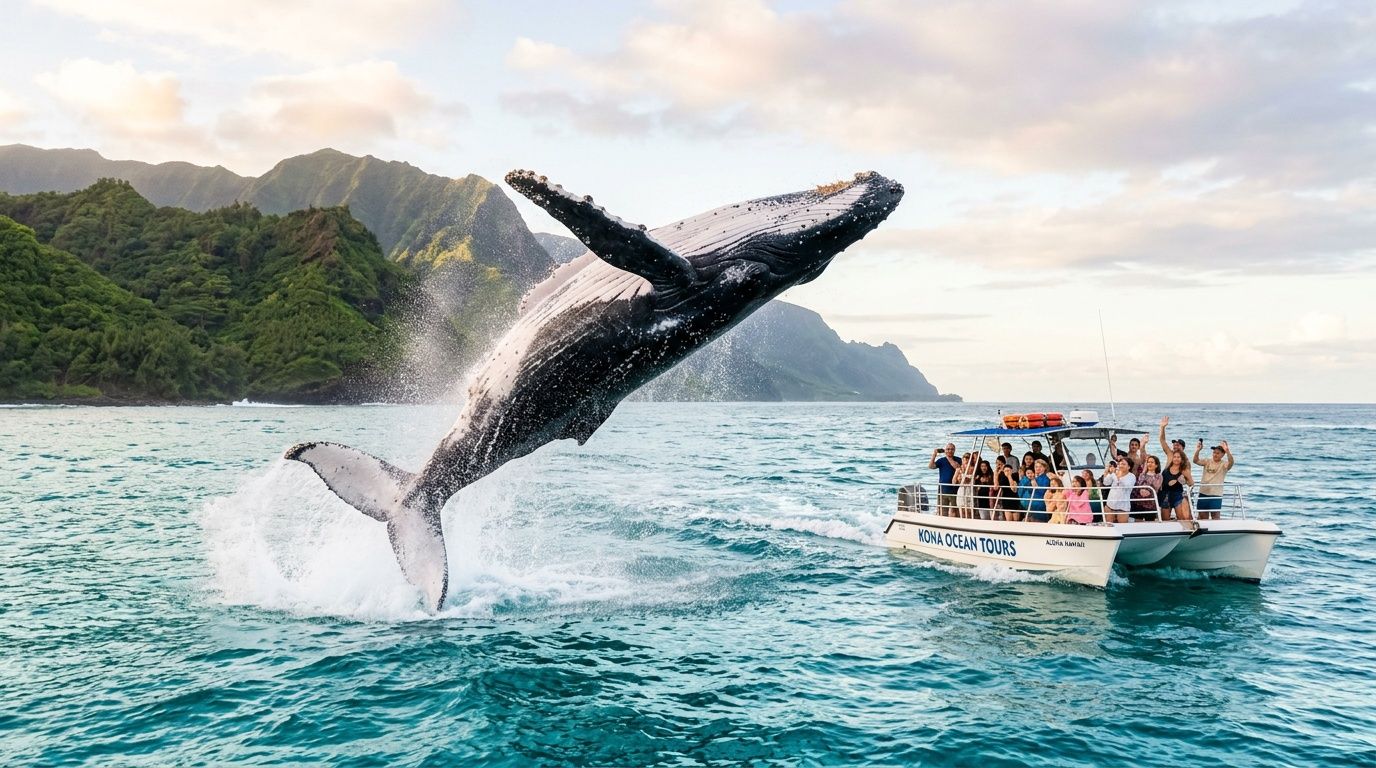
You’re probably planning a Hawaii trip right now and wondering one thing: when you finally look out over that blue water, will you see whales, or just spend the morning scanning empty ocean.
That’s a fair question. Humpback whale watching Hawaii trips can be unforgettable, but the experience changes a lot depending on where you go, when you go, and how you choose to watch. On the Big Island, the difference between a rushed outing and a memorable one usually comes down to understanding the whales’ rhythm and respecting the fact that this is their season, not ours.
The good news is that the Big Island gives you options. You can watch from shore with binoculars and patience. You can head out on a small-group boat for a closer, guided experience. Or you can do both, which is often the smartest move if you want a fuller picture of what these animals are doing in Hawaiian waters.
The Majestic Journey of Hawaii's Humpback Whales
You are standing on the Kona coast just after sunrise. The water looks calm, the light is clean, and then a tall white blow rises offshore. A few seconds later, a dark back rolls through the surface. That moment is why winter feels different on the Big Island.

Hawaii is one of the North Pacific humpback whale’s main winter destinations. Many of these whales leave rich feeding grounds off Alaska and the U.S. West Coast, then make a migration that can reach about 5,000 miles each way, as described by NOAA Fisheries' humpback whale migration overview. They arrive in Hawaiian waters to breed, give birth, and nurse calves in warmer seas.
On the Big Island, that migration feels personal because you can watch it play out from both shore and boat. The leeward coast often gives you calmer water and cleaner visibility than the island’s windward side, which helps with spotting blows, dorsal fins, and the slow rise of a fluke before a dive. If you are planning more time on the water, this guide to Big Island ocean adventures gives useful context for how whale season fits into the wider Kona coast experience.
Their presence also carries weight beyond the spectacle. North Pacific humpbacks were driven down hard by commercial whaling before legal protections allowed the population to rebound. The National Marine Sanctuary Foundation's history of humpbacks in Hawaii outlines that recovery and why these breeding grounds still matter.
That history shapes how good guides approach whale watching.
The goal is not to chase a reaction. The goal is to read the animal, hold position responsibly, and let the encounter develop if the whale chooses. From shore, that means patience and optics. On a small-group boat, it means a captain who knows when to stop, when to drift, and when to leave a mom and calf alone even if guests want one more pass.
Some outings bring breaches, tail slaps, and active groups. Others give you a line of distant spouts and one clean fluke-up dive. Both are real whale watching. On the Big Island, the memorable trips are the ones where people understand they are watching a migration and a nursery, not a performance.
Decoding the Whale Watching Season in Hawaii
You can stand on a Kona overlook in December and see nothing for twenty minutes, then catch three blows in the same patch of water. Come back in February, and the coast often feels busy before you even lift your binoculars. That difference matters when you are deciding whether to plan a quick shore session, book a small-group boat trip, or do both.
On the Big Island, humpback season runs from November through April. The most reliable stretch for consistent encounters is January through March, with island-wide count summaries and seasonal coverage reflected in this 2026 whale count report.
What the season feels like month by month
The calendar helps, but the feel of the water matters just as much. Early season can reward patient watchers from shore, especially on calm mornings, though sightings are less predictable. Mid-winter is when casual visitors start seeing why Hawaiʻi is such a strong winter destination for humpbacks. By late season, you can still have excellent days, but the pace changes and some trips feel quieter.
Here’s a practical planning table for humpback whale watching Hawaii trips.
| Month | Activity Level | Typical Sightings |
|---|---|---|
| November | Early season | Occasional arrivals, fewer consistent sightings |
| December | Building | More regular blows and traveling whales |
| January | Strong | Active surface behavior, more frequent encounters |
| February | Peak | High overall activity, mothers, calves, and active groups |
| March | Peak to taper | Excellent viewing, often with calves and steadier nearshore watching |
| April | Late season | Departing whales, less consistency but still possible sightings |
What the 2026 counts tell you
Community count days are useful because they show scale without pretending every outing will be dramatic. Under good viewing conditions in late February 2026, observers across the islands recorded a very high statewide count, including a strong Hawaiʻi Island showing, according to Maui Now's coverage of the 2026 whale count. Later in March, totals dropped sharply across fewer sites, which is a good reminder that migration timing, weather, and sightline quality can change the picture fast.
That is how guides read the season in real life. We do not promise breach-filled water every day. We look at recent reports, wind, swell direction, glare, and whether whales have been milling offshore, traveling, or holding in calmer nearshore water.
For a tighter planning window by month, this guide to the Big Island whale watching season helps line up travel dates with the kind of experience you want.
February gives you the strongest sense that the whole coast is active. March often rewards patient watchers with calmer sessions and good chances of seeing mothers and calves from shore or on a respectful boat run.
Picking the right month for your group
Families with young kids often do best in the middle of the season, when surface activity is easier to spot and shorter trips still feel worthwhile. Travelers who want more elbow room may prefer the edges of the season, especially if they are happy to scan from shore first and book a boat only when conditions line up. Photographers tend to care about clean light, lower wind, and boat positioning as much as raw whale numbers.
For the Big Island, the safest planning choice is still January through March. That window gives you the best shot at pairing free shore-based viewing with a guided small-group trip, while keeping expectations grounded in what good whale watching really is. Time on the water with wild animals, handled carefully, with enough patience to let the encounter come to you.
Best Big Island Spots for Humpback Whale Encounters
The Big Island doesn’t have the same feel all the way around. For whale watching, the west side matters most. Kona and Kohala give you calmer leeward water, useful lookouts, and marine terrain that whales use repeatedly during the season.

The reason isn’t just convenience. Occupancy models reveal that pods with calves have a 20 to 30 percent higher probability of using shallow, calm regions like those off the Kohala coast, selecting protected sites that reduce predation risk and energy use for their young, according to NOAA Hawaiian Islands humpback whale information.
Kohala Coast
If you want the classic Big Island whale zone, start here. The Kohala Coast often gives you broad, clean views over calm water, and it’s one of the places where mother-calf pairs make the most sense ecologically. Shallow, protected areas are useful nurseries.
From shore, higher vantage points help a lot. Scan slowly rather than constantly moving your eyes. Look for three things first:
- A blow: The quick burst of mist is often easier to catch than the whale itself.
- A repeated pattern: If you see one blow, stay on that patch of water. Traveling whales surface in rhythm.
- Bird and boat behavior: Not for chasing them, but for clues about where activity has recently been noticed.
Kona Coast
Kona is often more practical for visitors staying near town. You won’t always get the same nursery feel as farther north, but the western exposure still gives you very workable viewing conditions, especially on calmer mornings. Offshore drop-offs close to land also help keep things interesting.
If you’re planning a guided outing, this local overview of a whale watch in Kona, Hawaii gives a solid sense of what the area offers.
Shore spots worth your time
A lot of visitors underestimate shore viewing. That’s a mistake. The right overlook on the right morning can deliver a memorable session without ever stepping on a boat.
Try this approach:
- Choose elevation over beach level when possible. Height makes blows and breaches easier to pick out.
- Go early if conditions are glassier. Calm water reveals more.
- Bring binoculars. They’re far more useful than trying to zoom endlessly on a phone.
- Stay put for a while. People miss whales by moving too soon.
Quiet patience beats constant relocation. Whales cover water, but they also reappear in patterns.
For families, a hybrid plan works well. Do one dedicated shore morning, then one guided boat trip. You’ll understand the coastline better, and you’ll appreciate what a captain and crew are tracking offshore.
Choosing Your Adventure: Boat Tours vs Shore Viewing
The choice isn’t about selecting one option permanently. Instead, it's about what fits this trip, this budget, and this group. Shore watching and boat tours are different tools. One isn’t automatically better than the other.
Research on responsible viewing makes that trade-off clear. Shore viewing is a low-impact option, while small-group boat tours provide stronger educational value and higher encounter success, with some surveys logging over 30 whale encounters across 219 nautical miles, as described in this responsible whale watching discussion.
When shore viewing wins
Shore watching is ideal if you want flexibility. You can go at sunrise, linger at an overlook, leave when the kids are done, and spend nothing beyond gas, snacks, and maybe binoculars.
It also removes one major issue: seasickness.
Shore viewing works especially well for:
- Families with mixed comfort levels who aren’t sure everyone wants boat time
- Travelers on a tight schedule who want an easy sunrise or sunset activity
- Wildlife lovers who value low impact and don’t need a close offshore perspective
The downside is obvious. Distance changes everything. You may see excellent behavior, but you won’t get onboard narration, and you won’t reposition with the whales if activity shifts offshore.
When a boat tour wins
A boat changes the scale of the experience. You’re not just waiting for something to happen in one patch of ocean. You’re working with a captain who reads conditions, recent activity, boat traffic, and whale movement.
Small-group trips are especially useful because guests can hear the guide, ask questions, and follow what the crew is doing. That matters when the ocean gets busy or when whales surface unexpectedly in a new direction.
Kona Snorkel Trips offers seasonal whale watching excursions and private charters from the Kona side in a small-group format, which suits travelers who want guided interpretation without the feel of a crowded platform.
A practical side by side comparison
| Option | What works well | Trade-offs |
|---|---|---|
| Shore viewing | Free, flexible, no seasickness, very low impact | More distant views, no onboard guide, less mobility |
| Small-group boat tour | Better access to active offshore whales, live interpretation, easier photography angles | Costs more, requires booking, can be affected by sea conditions |
The best strategy for most visitors
If you’ve got the time, combine both.
Do one shore session first. Learn how to spot blows, backs, and flukes. Then take that awareness onto a boat. You’ll notice more, ask better questions, and understand why guides slow down, hold position, or back off instead of racing toward every visible whale.
If you enjoy comparing marine experiences in different places, it’s also useful to look at various whale watching experiences beyond Hawaii. Different coastlines teach the same lesson. The most rewarding tours are the ones that balance access with restraint.
For travelers weighing activity styles on the island more broadly, this comparison of boat tour vs shore snorkeling on the Big Island offers a similar decision-making framework.
The Whale Watcher's Code: Rules, Regulations, and Respect
The fastest way to ruin whale watching is to treat it like a chase. Good operators don’t do that. Good guests shouldn’t want that.

In Hawaiian waters, federal law requires all vessels to stay at least 100 yards (91m) from humpback whales, and suction-cup tag studies show that closer approaches can disrupt essential behavior, alter dive patterns, and cause stress, according to research summarized here.
Why the rule matters
That buffer isn’t arbitrary. In breeding and calving areas, whales are making decisions that cost energy. Mothers are nursing calves. Adults are resting, traveling, and interacting in ways people often can’t fully interpret from the surface.
A boat that crowds in can interrupt those patterns. Even if the whales don’t show obvious distress right away, a forced change in direction, dive behavior, or spacing is still a disruption.
The goal isn’t to get the closest possible look. The goal is to witness natural behavior without changing it.
What respectful operators actually do
Responsible whale watching goes beyond one distance rule. It shows up in small decisions.
- They hold a predictable course. Sudden acceleration and aggressive repositioning put pressure on animals and make the water less safe for everyone.
- They don’t box whales in. If multiple boats crowd a pod from different angles, the whales lose easy escape routes.
- They watch mothers and calves conservatively. Those pairs deserve the widest margin and the calmest vessel behavior.
- They let the whales choose. Sometimes a whale surfaces closer than expected. That’s different from a captain initiating the approach.
If a whale approaches the boat on its own, the right response is usually calm neutrality. Don’t reach, don’t shout, don’t lean out trying to force a photo. Let the crew handle positioning.
What guests should do
Guests matter more than they think. A respectful trip gets easier when passengers understand the basics.
Keep these in mind:
- Never ask to swim with humpbacks. That’s not a legal or ethical whale watch request in Hawaii.
- Listen during the safety briefing. It’s not filler. It tells you how the crew handles wildlife encounters.
- Report entanglements, don’t intervene. If you see a distressed or entangled whale from shore or boat, report it to the NOAA hotline at 888-256-9840, a reporting number noted in NOAA recreation guidance for Hawaiian waters.
A great whale watch leaves the whales unbothered. That’s the standard worth keeping.
Preparing for Your Whale Watching Trip
A good whale watch starts before you leave the harbor or pull into a lookout. Preparation doesn’t make whales appear, but it does make you more comfortable, more observant, and less likely to miss the moment you came for.
What to bring
Don’t overpack. Bring the few things that improve the experience.
- Polarized sunglasses help cut glare so you can track blows and surface movement.
- A light layer or windbreaker matters more than many visitors expect, especially on morning trips.
- Reef-safe sun protection is smart even on partly cloudy days.
- Binoculars are excellent from shore and still useful on a boat.
- A camera or phone you can operate quickly beats complicated gear you fumble with.
- Water and simple snacks help on shore sessions and before departures.
How to set yourself up for a better day
Morning often gives you calmer conditions, and calmer conditions make spotting easier. If you’re booking during the heart of the season, don’t wait until the last minute. The most convenient departure times and smaller group options can fill first.
If you’re prone to motion sickness, plan for it before the boat starts moving. This practical guide on how to stop seasickness on a boat covers the basics well.
Bring less gear and more attention. People miss whale behavior while digging through bags for things they never use.
How to manage expectations
The best mindset is simple. You’re going into wild-animal habitat, not a performance venue. Some days are all breaches and tail slaps. Some days are quieter and more subtle.
That doesn’t mean the trip failed.
Watch for the small things too: a mother staying near the surface, a calf learning to surface in rhythm, a fluke lifting clean before a deeper dive. Those moments often stay with people longer than the loudest splash.
For photos, keep your horizon level, shoot wider than you think you need, and don’t lock onto one spot after a whale dives. Be ready for the next surface, not the last one.
Frequently Asked Questions About Whale Watching in Hawaii
Can you see humpbacks from shore on the Big Island
Yes. Shore viewing can be excellent on the Kona and Kohala coasts when conditions are calm and you choose a good overlook. Binoculars help a lot, and patience matters more than constant movement.
Are boat tours worth it if you can already see whales from land
Often, yes. A boat gives you mobility, interpretation from the crew, and access to offshore activity you won’t read as clearly from shore. Shore viewing is great for flexibility. A boat is better for immersion.
Is there a guaranteed best month
There isn’t a magic date that works the same every year. In general, winter is the season, and mid-season usually gives visitors the strongest overall experience. Conditions, timing, and whale movement still vary.
Can you swim with humpback whales in Hawaii
No. Whale watching means observing, not entering the water with them or trying to touch them.
What if a whale comes close to the boat
That can happen. The important difference is whether the whale chose the proximity or the vessel caused it. Responsible crews stay calm, avoid pursuit, and let the animal dictate the moment.
What should families do if they’re unsure about a boat trip
Start with shore viewing. It’s easy, low pressure, and helps kids understand what they’re looking for. If everyone enjoys that, add a guided boat outing.
Is humpback whale watching Hawaii good on the Big Island compared with other islands
Yes, especially if you value calmer leeward water, a less compressed coastline, and the option to combine shore-based watching with a guided small-group trip.
If you want a guided option for your trip, Kona Snorkel Trips offers seasonal whale watching and other ocean activities on the Big Island. It’s a practical fit for travelers who want small-group time on the water, lifeguard-certified guides, and a respectful approach to marine wildlife.