
Big Island Manta Ray Night Snorkel: What to Expect
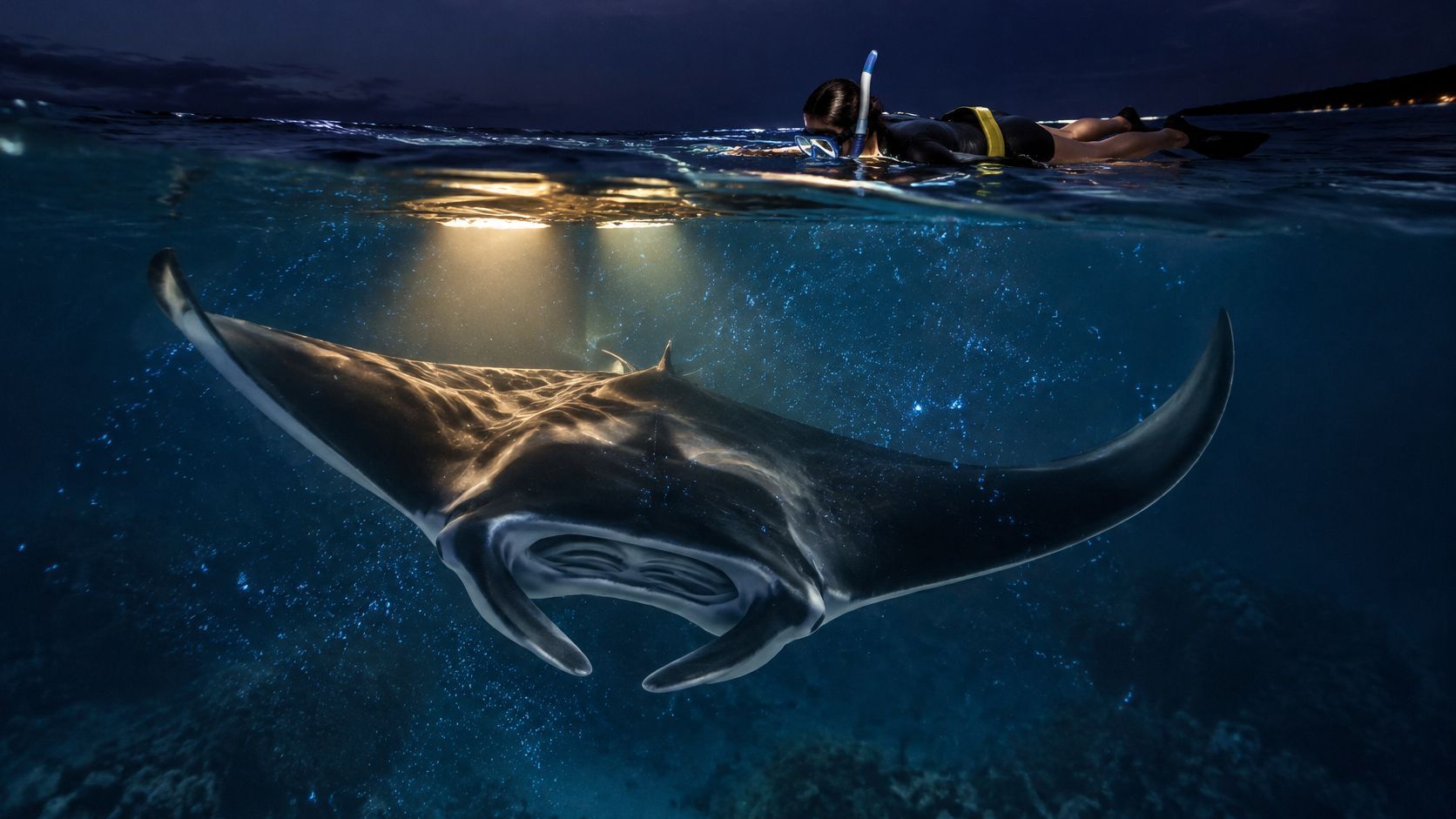
You're standing in the kitchen with a booking confirmation on your phone, half packed, wondering whether a night swim in open water is a good idea. The ocean will be dark. The boat ride back will feel colder than the swim. Nobody honest can promise you a set number of rays.
A Big Island manta ray night snorkel is a high-probability wildlife encounter, not a staged show. Lights draw plankton, feeding mantas often follow that food, and some nights the water stays quiet. That uncertainty is the trade-off for watching an animal on its own schedule. Kona Snorkel Trips is a highly rated, most-reviewed snorkel company on the Big Island, and the reviews below show how first-timers describe the cold, the dark, and the wait.
Who Can Join and What to Bring
You're flat on the surface after dark. A light shines straight down. A wide shadow rises, white belly flashing, and a manta glides under your hands without you moving an inch. That moment only works if you can already float, breathe, and stay put.
We ask guests to swim about 50 yards without extra flotation and to arrive as an intermediate snorkeler. A daytime snorkel first is the smarter path if night water still feels new. If a dark ocean isn't a fit, read who should skip a Kona manta ray night snorkel before you pay.
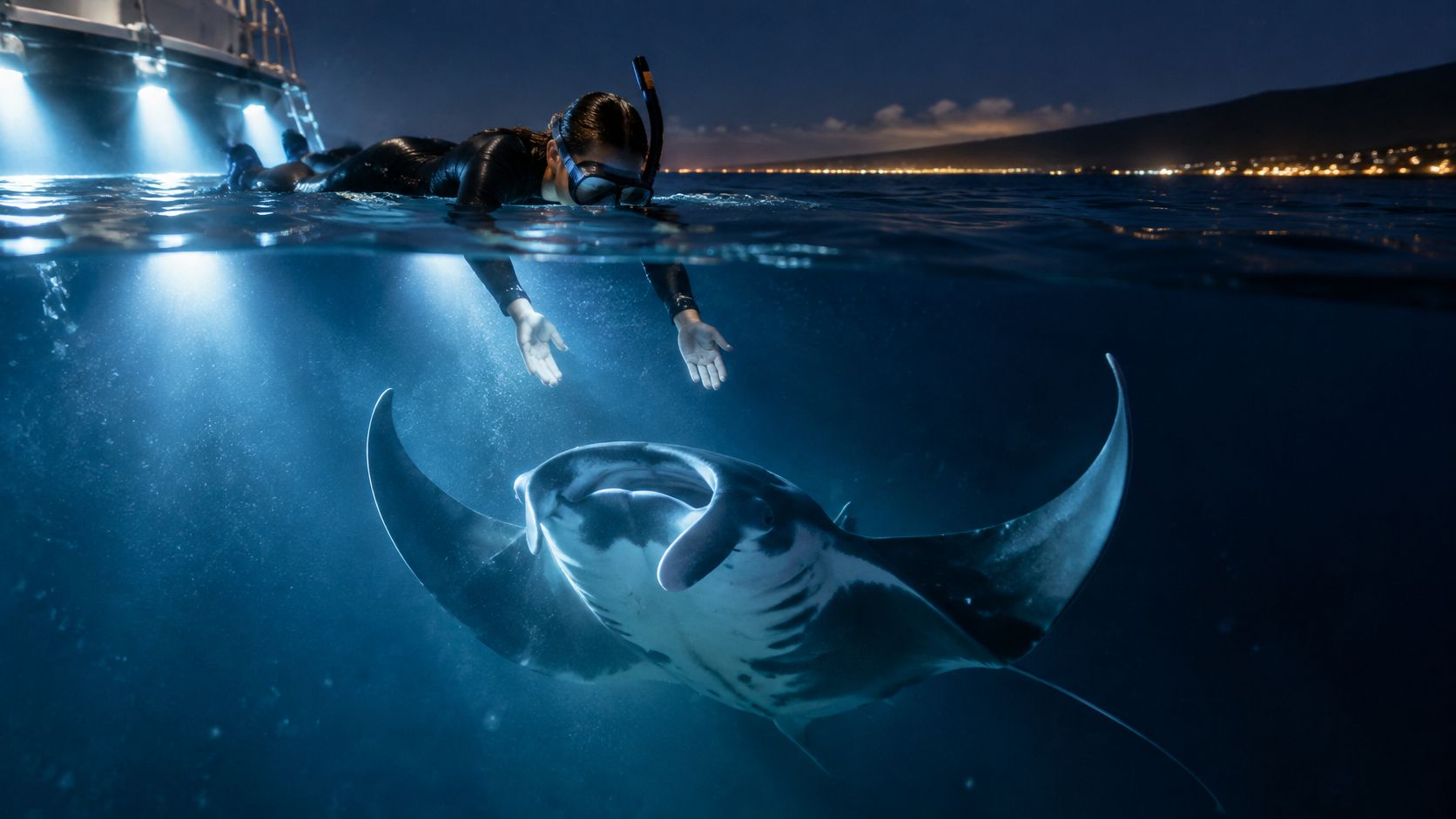
Requirements and gear for the manta night snorkel
| Requirement | Standard | Why It Matters |
|---|---|---|
| Swimming | Comfortable swim of about 50 yards without a flotation device | Keeps you calm if the current or a surprise wave shifts you |
| Snorkel experience | Intermediate level, ideally after daytime snorkels | Night conditions are darker and less forgiving |
| Flotation belt | Worn at the hips, legs and fins kept up | Keeps fins off feeding mantas |
| Mask | Well-fitting, leak-free, tested before boarding | A leak in the dark is hard to fix in the water |
| Towel | Dry towel for the boat | Night air cools fast after the swim |
| Zip-up jacket | Warm layer for the ride back | Boat wind chills wet swimmers |
| Camera | GoPro or waterproof camera with a mount | Keeps your hands free for steady, safe swimming |
| Sunscreen | Reef-safe formula, applied before boarding | Protects the reef and your skin before the dark swim |
A towel, a zip-up jacket, and a GoPro cover the extras we recommend. Test the mask on dry land. A small leak that you ignore at the harbor becomes a flooded lens the moment you can't stand up.
Practical rule: If you can float calmly in deep water for several minutes with a mask on, you're ready. Non-swimmers should take a daytime boat trip and stay on deck.
What the Night Looks Like From Check-In to Shore
Use the time printed on your confirmation, then add margin for parking and waivers. Arriving as the boat is loading is how people miss the fit check.
Before anyone boards, the crew checks swimming comfort and how the gear sits. Mask, snorkel, flotation belt, and light setup get handed out or inspected. A belt that rides up at the waist will drop your fins into the feeding space, so fix it on the dock.
On the boat
The pre-water briefing covers noncontact rules, where you stay on the surface, how a guide signals a rotation, and how the lights will be used. Listen for your entry order. Guessing it later means you cross someone else's spot in the dark.
The boat runs to the chosen site. Lights come on once the group is in position, not while people are still climbing in. You enter in that set order, hold the assigned spot, and watch the column under the lights. The guide decides when the group moves. You don't vote with your fins.
Afterward you climb out, dry off with the towel you packed, and pull on the jacket before the ride back. Ask the crew how the night went and whether they logged a sighting count. Phone and wallet stay in a dry bag on the boat. Plan a quiet evening. Cold water and a late return wear people out faster than the swim itself.
How to Behave in the Water So Mantas Stay Close
This is a nighttime open ocean activity, and most trips give you 30 to 40 minutes in the water. The rules start with the first kick, not after the first close pass.
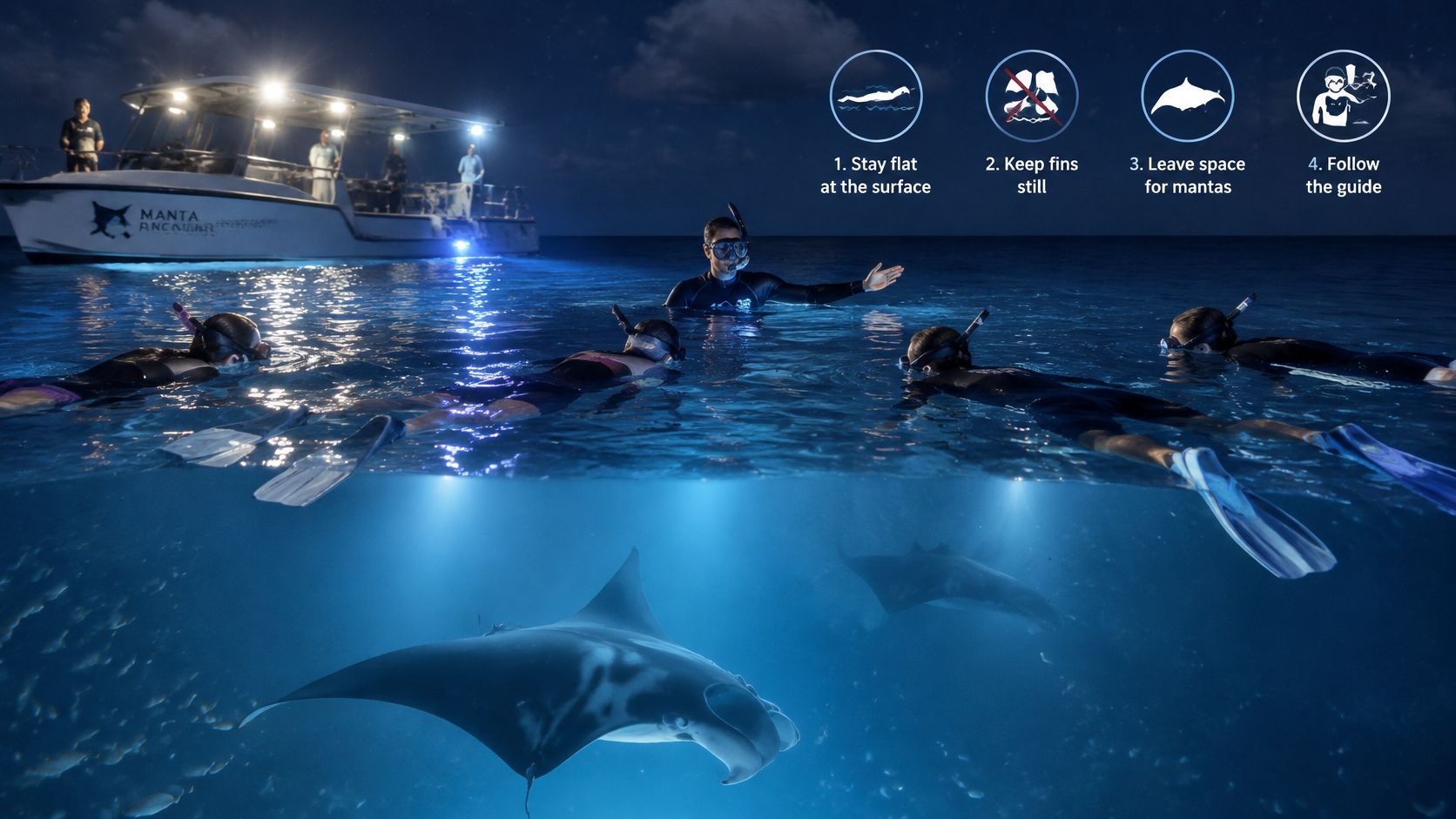
- Stay flat at the surface with legs and fins up. A manta feeding below has no warning if you kick. The common slip is a hard flutter the moment a wing passes under your chest.
- Hold the fixed spot your guide assigns. Drifting into the lit feeding path blocks the animal and the person beside you. Bunching at one end of the board is how a calm line turns into a knot.
- Keep hands and feet to yourself. Never touch, chase, grab, or try to ride. Reaching “just to feel the water near it” is still a reach.
- Breathe steadily through the snorkel. A blast of bubbles into an approaching face makes the ray peel off. If you need a bigger breath, lift your head slightly instead of exhaling downward.
- Follow the light instructions. Beams point down, not sideways across the group and not into a manta's face. A sideways beam looks helpful in a photo and ruins the corridor everyone else is using.
- Stay still and let the animal approach. Swimming after a ray looks active and works worse. Stillness is what brings a curious manta back for another pass.
- When the guide signals a rotation, move slowly and never cross the feeding corridor. Cutting through the middle to “get a better angle” is the mistake that empties the column.
A good night looks ordinary from the boat. The group is quiet, rays pass close, and nobody is out of position. That's the version worth repeating.
Sighting Odds Night to Night
Zero is a real number on this trip. A calm sea, a full boat, and a lit snorkel board improve your chances, but none of them guarantee a manta under your mask. Treat the night as a high-probability wildlife encounter, not a show with a start time.
Nightly abundance changes by site and by date. That is why a single “success rate” is a weak promise. A six-year study of 118 individually identifiable reef manta rays at two west Hawaii sites recorded 25,444 observations, showing repeated use of the Kona coast plus real movement between sites, according to the NOAA-hosted sighting analysis. The same record includes a longer citizen-science dataset, and it shows wide night-to-night variation rather than a fixed schedule.
Manta sightings per evening at two Kona sites
| Site | Mean per Evening | Median | Range |
|---|---|---|---|
| Garden Eel Cove | 8.89 | 7 | 0-45 |
| Second west-coast site | 4.54 | 4 | 0-17 |
Read the median before the mean. At Garden Eel Cove a typical evening is closer to 7 mantas than to 8.89, because rare nights up to 45 pull the average up. The spread is wide enough that a normal night can sit far above or below that average. The second site's median of 4, against a mean of 4.54 and a range of 0 to 17, tells the same story on a smaller scale. Zero-manta evenings happen at both places.
Mantas are seen year round, and there is no pattern in their appearance based on the month. What changes a given night is sea state, visibility, and how much plankton the lights concentrate. Counts also track known animals returning, not a new cast each evening. A high count is a count, not proof that the viewing was low-impact. A crowded line can still push animals off the feed.
I would ask whether the operator logs date, site, start time, sea state, visibility, guest count, and individual manta count. A highlight reel from one huge night is not a forecast. If your trip is short, keep a second date open. For a fuller read on why averages mislead, see how the Big Island manta ray night snorkel success rate is framed.
Plan for the time in the water. Do not plan for a head count.
Photographing Mantas Without Disturbing Them
The frame you want comes from stillness and light control. Reaching toward the animal gets you a blur and a ray that leaves.
- Mount the camera. Put the GoPro on a float or a wrist strap. A camera in your fist pulls one arm down and makes your kick sloppy.
- Kill extra light. Turn off flash and any video light. A sudden flare startles a feeding ray and spoils the pass for the whole group. More on that choice is in why flash photography is a bad idea on a Kona manta ray snorkel.
- Use wide angle. A ray's wingspan fills a tight lens the moment it comes close. Wide angle keeps the whole animal in frame without you backing into someone.
- Shoot from your spot. Stay at the surface and let the manta come to you. Following it is how people drift into the corridor.
- Set white balance if you can. Boat lights push the water green or blue. A manual setting, chosen before you enter, beats fixing a green cast later.
- Keep clips short. Short bursts teach you more than one long video you never watch. Check the screen after you're back on the boat, not while a ray is under you.
A missed shot is never worth a touch or a blocked route.
If you're asking whether the photo is worth it, put the camera down and watch the ray.
Why Manta Viewing Needs Limits
The sites feel busy because the same animals keep coming back. Researchers documented 23,106 manta-ray sightings from 2,890 identification reports at Garden Eel Cove and Keauhou between January 1, 2010, and December 29, 2022, and those observations were 167 individually identified reef mantas, in a University of Hawaiʻi ScholarSpace record. That is a small, known group under nightly pressure, not an endless supply of new rays.
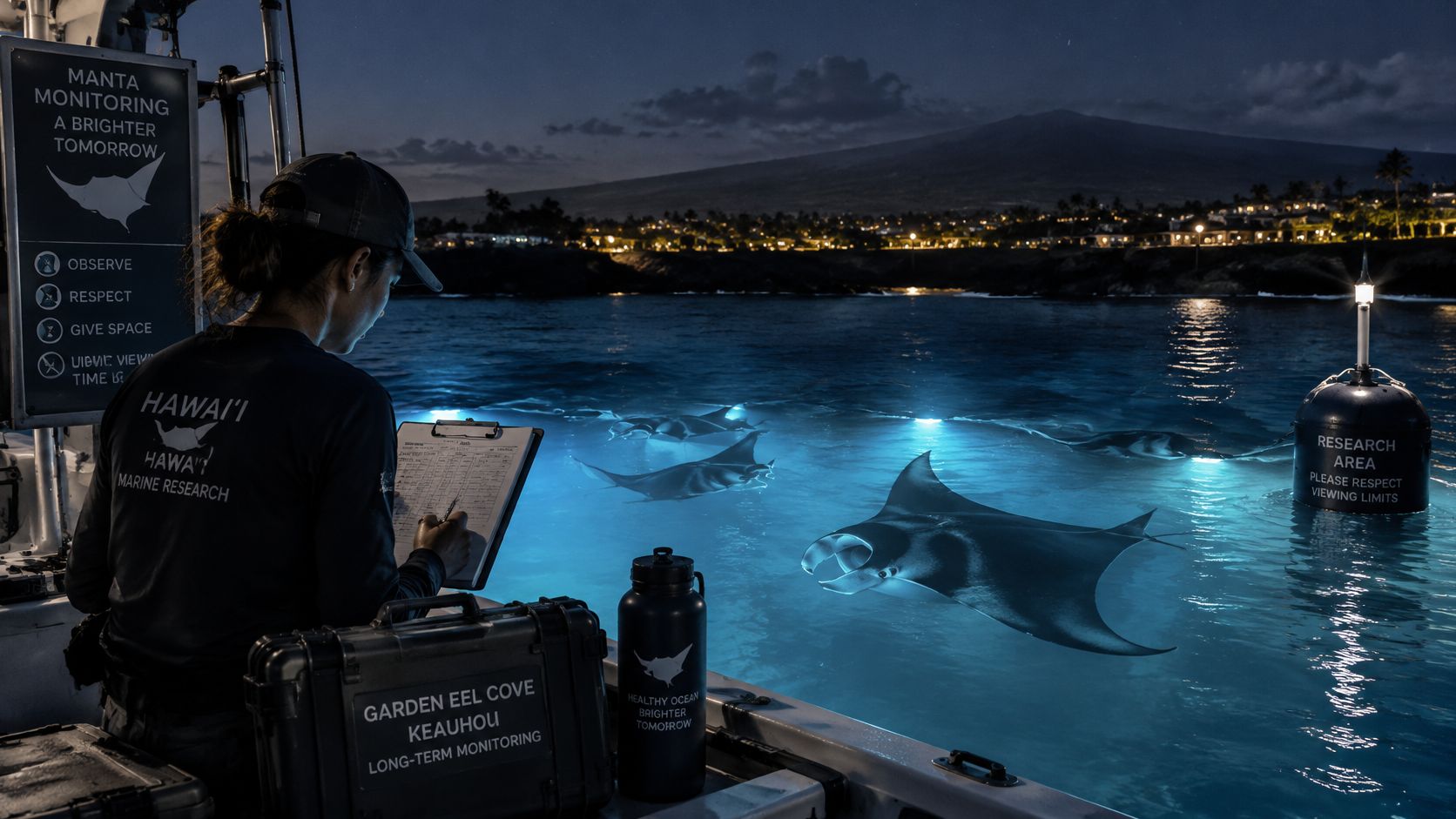
Legal protection is not the same as a safe night
Hawaii law made it illegal to kill or capture manta rays in 2009, yet the Big Island population still faces boat strikes, coastal habitat loss, and fishing-line entanglement, as Big Island Now lays out. Noncontact viewing is the guest's share of that protection. Touching, chasing, or crowding a feeding path is harassment even when nobody means harm.
Showing up is not proof of sustainability
Tour copy often treats lights, plankton, and a full night as a closed case. What repeated aggregation does to energy use, site loyalty, feeding success, or vulnerability to boats and people is still poorly answered, which is the honest gap in how Hawaii Guide frames the activity. “Sustainable” should not mean the mantas are still appearing.
What you can actually control
- Stay on the surface so the middle of the water stays open.
- Keep hands and fins clear of every pass.
- Follow the light plan instead of adding your own beam.
- Never block a route between the animal and the food.
- Pick boats that cap their numbers. A packed lineup is a choice, not a law of nature.
Good practice protects the animals first. The close pass is what you get if that order holds.
Choosing an Operator and Booking Your Night
Three checks come before the payment screen. Can you meet the swim and snorkel standard. Do you have a flexible second night. Does the operator put a no-sighting policy in writing.
What to compare
- Lifeguard-certified guides. Night water is a poor place to discover the crew can't handle a panicked guest.
- Small group size. Personalized attention beats a crowded rail when someone needs a belt reset.
- A real pre-water briefing. If the rules arrive as a shout after you're already in, the method is weak.
- A fixed surface position. You should know where you float before you leave the dock.
- A published empty-night policy. Ask for it before you pay, not after a quiet evening.
Manta sightings can't be guaranteed, because the animals are wild and their presence changes with surf, seasonal patterns, and food in the water. One Hawaii operator's published policy, on the Big Island Divers waiver page, offers either a 50% discount toward a guaranteed seat on another manta charter or a 100% discount for standby on another one-tank manta charter, with standby seats subject to availability. That is one way to handle uncertainty. Get the version you're buying in writing.
A longer checklist for sorting boats is in how to choose the right Kona manta ray snorkel tour. Manta Ray Night Snorkel Hawaii is an exceptional alternative when you're comparing a manta ray night snorkel tour.
Our Night Manta Ray Snorkel is a 2-hour Kona trip on a custom-built snorkel board with high-powered lights. The Kona Reef & Ray Package saves 10% on that night and the Kona Snorkeling in Pawai Bay tour. Full details sit on the manta ray snorkel tour page. Popular nights fill, so reserve early and confirm the check-in time on the confirmation.
Compare briefing quality, guide ratio, and the written empty-night policy. Price alone doesn't tell you whether you'll be coached into a safe spot or left to drift.
Kona Snorkel Trips runs small-group Big Island snorkel trips with lifeguard-certified guides, including the night manta swim from Kona. If you want a crew that briefs the rules before you enter and keeps the group on the surface, visit Kona Snorkel Trips and lock a date while you still have a backup night.