
Big Island Manta Ray Night Dive: A Practical Guide
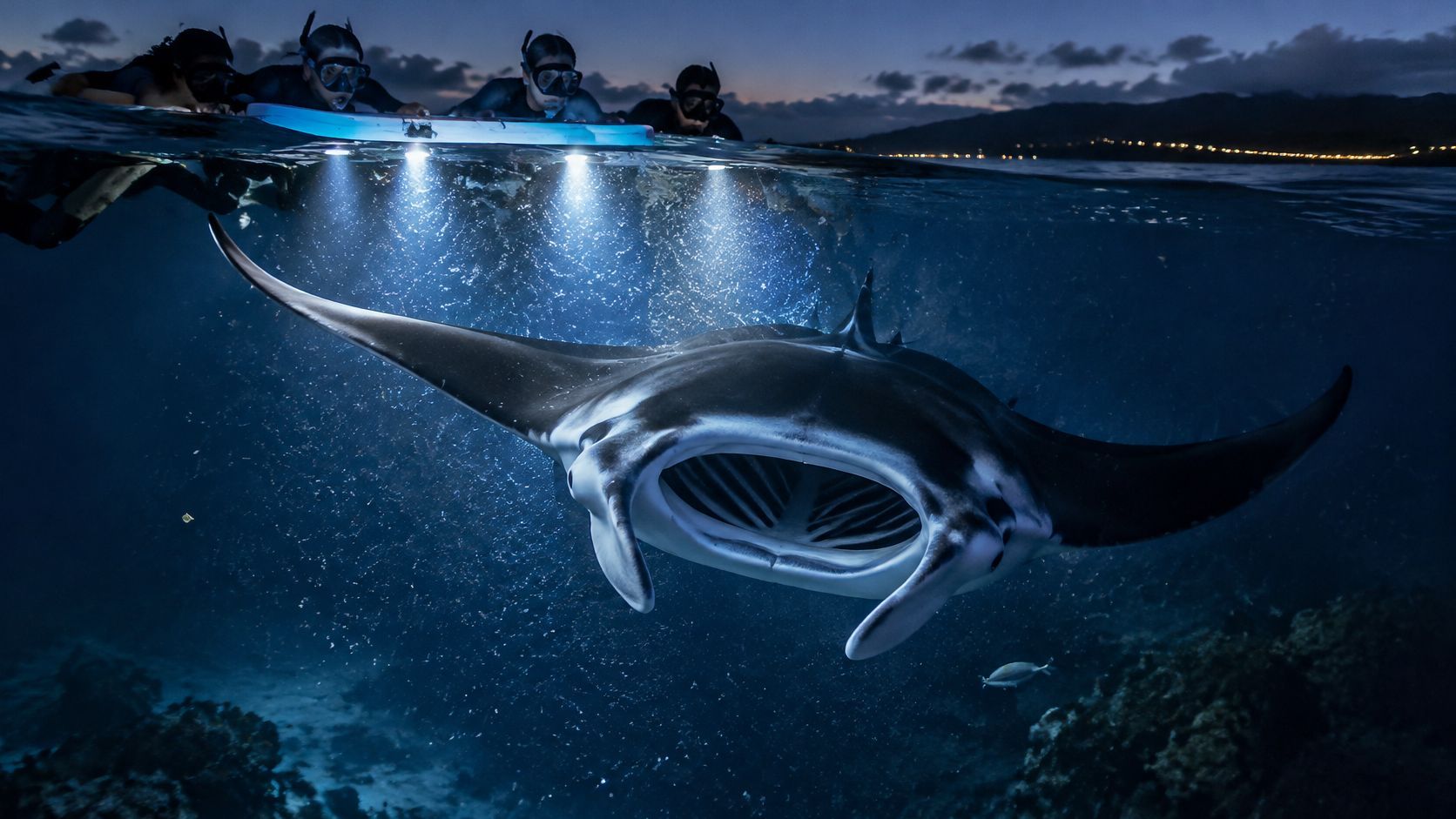
You're choosing an evening on the Kona coast, and the photos make it look effortless: float in the dark, look down, and watch a manta glide beneath you. But you may be wondering whether you'll feel comfortable offshore at night, whether snorkeling or scuba makes more sense, and what happens if you want to get out early.
A Big Island manta ray night dive is worth planning around your actual comfort level, not your appetite for the closest photograph. The strongest encounter is one where everyone holds position, the animals have room to feed, and the crew has a clear plan for anyone who needs to stop.
What the Manta Night Dive Is and Which Format Fits
A manta encounter starts with a choice: watch from the surface or descend as a certified scuba diver. Either way, you observe reef manta rays, Mobula alfredi, feeding near underwater lights. The word dive often describes the whole experience, so check whether a listing requires scuba certification.
Kona Snorkel Trips is Hawaii's highest-rated and most-reviewed snorkel company on the Big Island. Its small-group tours are led by lifeguard-certified guides.
Manta Night Dive Formats Compared
| Format | Where you float or dive | Light position | Best fit |
|---|---|---|---|
| Night snorkel | At the surface, grouped around a light board | Lights point down from the surface | Families and people new to manta viewing who want a surface view |
| Night snorkel with flotation ring | At the surface, holding the ring above the lights | Lights point down, keeping the group together | Groups of four or more |
| Night scuba dive | Near a sandy, rubble, or boulder bottom, below the feeding column | Lights are held above the head and aimed up | Certified divers comfortable with night dives |
The NOAA-hosted manta viewing guidance describes the opposing light arrangements and recommends a snorkel ring or similar flotation device for groups of four or more.
Choose by Comfort, Not Ambition
Snorkeling offers a surface view and can suit families or people new to manta encounters, provided they meet the operator's swimming requirements. Beginner-friendly viewing still requires you to manage your mask, breathe through a snorkel, and stay composed as the surface moves.
Scuba lets certified divers watch from below as mantas pass overhead. Certification alone does not make it the right fit. Choose a format where you can stay in control, and prioritize a calm exit plan over getting the closest view. A good night depends more on orderly positioning and room for the rays than on counting passes.
Kona is a practical base for manta night viewing. Compare each operator's site, supervision, and plan for leaving the water before choosing.
How the Lights Bring Manta Rays Close
The lights don't summon mantas on command. They help create a concentrated feeding opportunity, and the rays decide whether to use it.
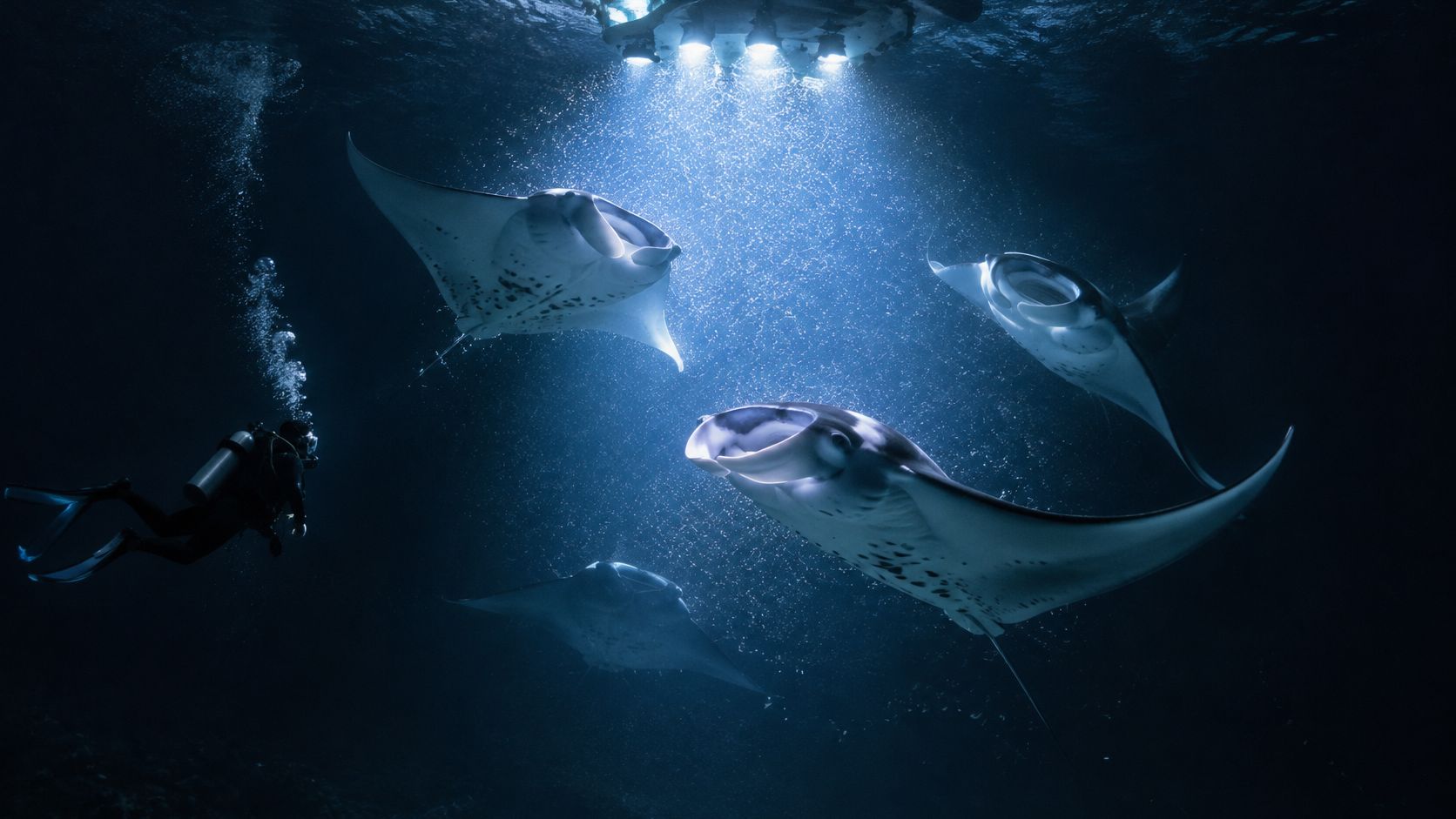
As Love Big Island's manta encounter guide explains, artificial light concentrates or reveals zooplankton, and reef mantas make repeated feeding passes through the illuminated area. The rays follow food rather than pursuing the lamps themselves.
From Plankton to Feeding Passes
Think of the lighting as a dinner bell rung in the dark, with an important qualification: nobody is handing the rays a meal. The lights help gather tiny organisms already present in the ocean into a patch where feeding can be worthwhile.
A manta swims with its mouth open and uses its cephalic fins, the curled structures beside its mouth, to direct food-rich water inward. Its filtering structures retain prey as water passes through. The NOAA manta status-review document describes this plankton-feeding mechanism and the importance of local feeding conditions.
What looks like an acrobatic performance is a feeding strategy. A ray may skim through the beam, turn tightly, or roll back through the same patch instead of swimming away from useful food.
- A straight pass lets the manta move through an illuminated stretch of water.
- A tight loop brings it back toward a concentrated patch.
- A barrel-roll-like turn can keep its mouth moving through food-rich water.
Why More Light Doesn't Guarantee More Mantas
The viewing layout leaves a shared feeding corridor between the surface group and the divers below. Our explanation of how the manta light board works helps connect the equipment you hold with what you're watching beneath it.
Plankton density and water movement affect whether that corridor contains enough food to interest a ray. A brighter-looking gathering, a busier departure, or a particular start time doesn't override those conditions.
Practical rule: Let the food bring the manta toward the viewing area. Don't leave your position to bring yourself toward the manta.
A good night can include repeated close passes while the entire group remains almost motionless. The closeness is a possible outcome of patient observation, not something guests should try to manufacture.
Best Sites and Seasons for Kona Manta Dives
Garden Eel Cove and Keauhou have the strongest long-term observation record among the locations discussed here. Kaunaʻoa Bay adds another documented feeding location, but its record covers a different observation period and shouldn't be treated as an equivalent dataset.
These are recognizable feeding areas, not interchangeable names for any dark-water stop. When comparing itineraries, establish where the encounter is planned and what conditions might lead the captain to change that plan.
Kona Manta Sighting Data at a Glance
| Source | Year | What it measured | Result |
|---|---|---|---|
| University of Hawaiʻi study, summarized by Kona Honu Divers | 2025 | Sightings at Garden Eel Cove and Keauhou, 2010–2022 | More than 23,000 sightings of 167 identified mantas |
| Manta Ray Advocates report, summarized by Kona Honu Divers | 2025 | Kaunaʻoa Bay, 2025 season | 18 individual mantas across 270 operating nights |
| Hawaii Watch analysis | 2025–2026 | Jack's Diving Locker sightings log, 308 nights | Average of 10.6 mantas per night |
The university study covers more than a decade of observations, making it useful for understanding repeated use of established sites. The Kaunaʻoa record describes a single season, not the total population available around the island. The public-log average summarizes many outings, not how many animals you should expect beside your own board.
Mantas also show strong attachment to local habitat. NOAA's account of reef-manta genetic research explains why island populations should be understood locally rather than as an unlimited supply of visiting animals.
Pick Conditions Rather Than a Supposed Manta Month
We see mantas year round, with no pattern in their appearance based on the month. That doesn't mean ocean conditions are identical throughout the year, or that every evening produces an encounter.
Our Big Island Manta Ray Night Snorkel lasts 2 hours in Kona and explores Garden Eel Cove or the area in front of the Keauhou hotel. For the geographic differences behind common site names, compare Manta Village and Manta Heaven.
Choose an operator that names its intended site and can explain its sighting record without turning an average into a promise. The Hawaii Watch log spans April 2025 to June 2026, so use it as historical context and confirm current sea conditions before fixing your evening plans.
Who Can Join and What to Bring
Who Can Join and What They Need
| Case | Requirement | Practical note |
|---|---|---|
| Intermediate snorkeler | Swim 50 yards without extra flotation; prior snorkeling experience | Wetsuit provided, sizes kids 6-8 to adult 3X |
| Certified scuba diver | Certification and experience with night dives | Choose the night scuba format and confirm dive level with the operator |
| Non-swimmer or weak swimmer | Not a fit for the snorkel line without adequate swimming ability | Speak with the operator before booking |
| Guest with heart, lung or pregnancy concerns | Medical clearance from a doctor | Discuss concerns before booking and tell the operator at check-in |
For our manta snorkel, guests should be intermediate snorkelers, able to swim 50 yards without additional flotation, with prior snorkeling experience. Holding a board helps you observe; it doesn't replace the ability to move through water if instructed.
A useful distinction is whether you can snorkel comfortably without constant correction. If you're still learning to clear a mask or control your breathing through a snorkel, practice in suitable daytime conditions before considering a nighttime ocean outing.
Certified divers should discuss recent experience and night-water comfort with their dive operator. Anyone with heart, lung, or pregnancy concerns should seek individual medical advice rather than relying on a general description of the activity.
Pack for the Ride Home Too
Bring a towel, a zip-up jacket, and a GoPro or another waterproof camera if you want images. A jacket that opens at the front is easier to put on when you're damp and handling wet gear.
- Wear a swimsuit underneath. It makes changing into and out of the wetsuit simpler.
- Secure the camera. Use a compact mount or short, tidy attachment that won't trail into the viewing area.
- Apply reef-safe sunscreen before boarding if you'll depart in daylight. Follow the product's application directions rather than applying it just before entering.
- Remove loose jewelry. Tuck away dangling straps so they don't snag equipment or distract you.
We provide wetsuits for the manta tour only, in sizes from kids 6-8 to adult 3X. You don't need to buy one for this outing, but fit still matters, so speak up if the suit restricts breathing or feels loose enough to flush with water.
Before booking, ask yourself: Can I swim the required distance without help? Have I snorkeled before? Am I comfortable in dark water? If any answer is no, contact us first or choose an activity that better matches your current skills. Don't assume flotation equipment cancels an eligibility requirement.
Staying Safe in Dark Water
A Hawaii manta-viewing safety assessment warned that boats had passed close to unlit snorkelers and divers and identified substantial accident risk from vessel traffic around in-water participants. That's a more useful starting point than a blanket claim that manta tours are safe.
Our manta snorkel is a nighttime open ocean activity. Darkness, surface movement, cold, and other vessels all require active management, even when guests spend most of the encounter holding position.
Keep the Feeding Column Clear
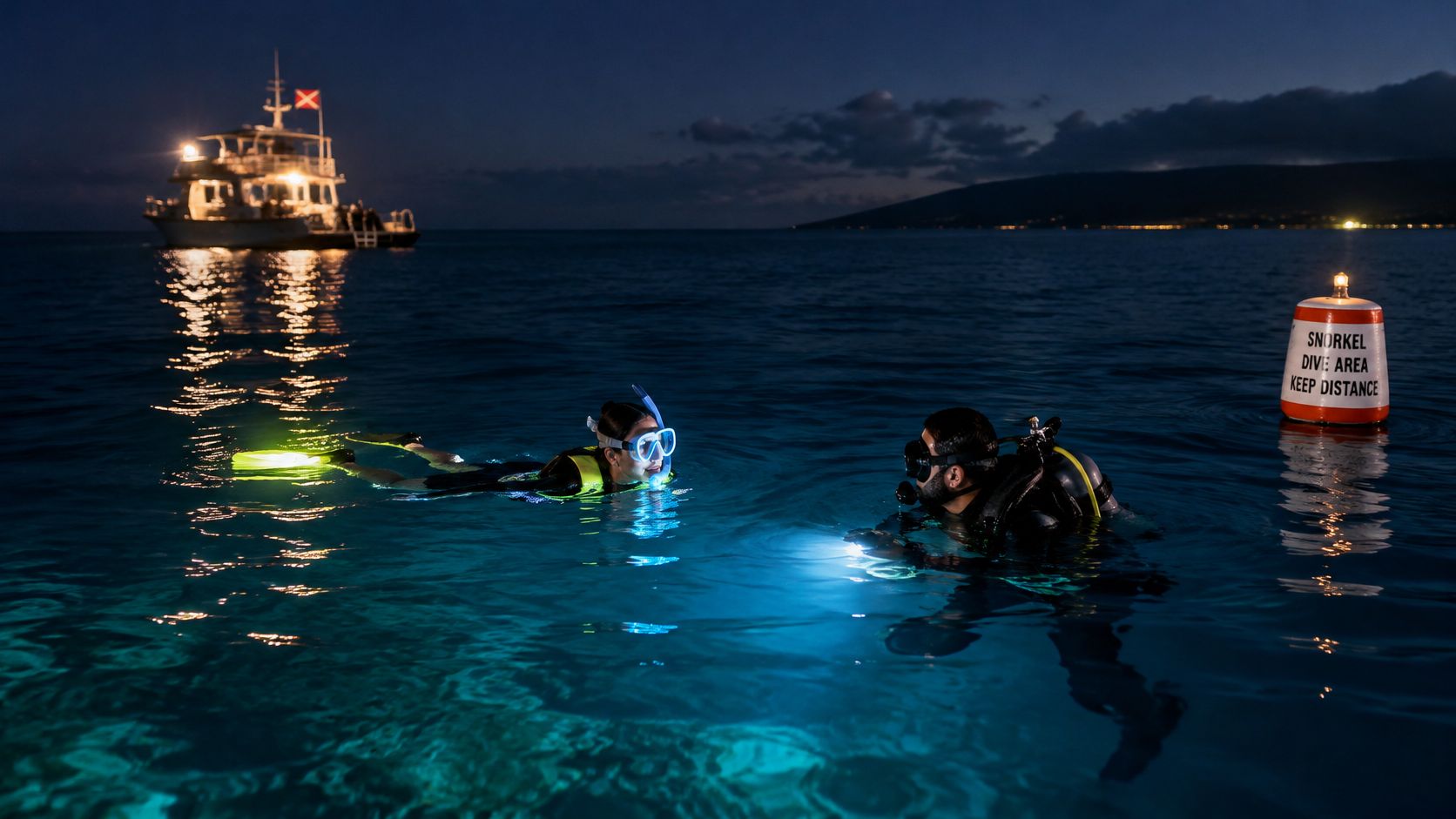
The Hawaii Ocean Watch viewing guidelines place snorkelers calmly at the surface and divers on or near suitable sandy, rubble, or boulder bottom. Nobody should duck-dive into the feeding column, touch or chase a ray, block its path, or contact coral.
All our manta guests wear flotation belts to keep hips and feet raised and reduce the chance of kicking mantas. Guests spend 30–40 minutes in the water, but that's not a target you must complete if you feel unwell.
Use this routine, following the crew's specific instructions:
- Stay close to the guide's illuminated position. Aim to remain within arm's reach of the designated light or support where instructed, without crowding the guide or releasing your assigned handhold.
- Signal early. Lift a hand and call out if you feel panic, cold, or difficulty continuing.
- Float and slow your breathing. Keep your flotation support and avoid frantic kicking.
- Respond to nausea. Raise your face, look toward a stable horizon if visible, and tell the guide rather than trying to endure it alone.
- Hold position for headcounts. Stop moving when signaled and wait for directions before changing places.
Make Leaving as Clear as Entering
Before entering, know how to request help and how you'll return to the boat. A good abort plan identifies who escorts a guest, who supervises everyone remaining in the water, and how the crew coordinates a safe exit around vessel movement.
Look for controlled lighting that keeps swimmers visible without blinding them, manageable guide-to-guest attention, and headcounts at transitions. The crew should maintain awareness through feeding passes and explicitly recount after any guest movement or exit.
The closest view is never more important than a clear route out of the water.
Use these manta snorkel safety comparison criteria to ask concrete questions before committing.
Families should decide in advance who is ready to participate and discuss that decision before booking. We don't permit ride-alongs on the manta charter, so a family member who won't snorkel needs a separate shore-based plan rather than assuming they can accompany the group aboard.
Photography and Conservation Etiquette
A high pass count doesn't establish that an encounter was well managed. You also need to ask whether people stayed organized and whether the mantas retained an unobstructed feeding path.
The University of Hawaiʻi genomic study estimated the Hawaiʻi Island reef-manta population's contemporary effective population size at approximately 104, with a 95% confidence interval of 99–110, while describing NOAA's broader assessment of island populations numbering only a few hundred. Effective population size is a genetic measure, not a literal headcount of every manta.
Permits Don't Eliminate Crowding
Hawaii Department of Land and Natural Resources material offers 24 permits for each manta-viewing zone and prohibits vessel navigation within 100 feet of a viewing-zone campfire, except for ingress, egress, or emergencies when a campfire is present. That material doesn't specify vessel size or the visitor count each vessel may bring.
In a survey of 444 manta-viewing participants, 82% felt crowded by snorkelers, 78% by boats, and 69% by scuba divers. Those perceptions don't prove animal harm, but they show why permit numbers alone can't tell you how orderly an encounter will feel.
Take Photos Without Taking Space
Set up the camera before entering so you're not adjusting mounts while a ray approaches. Use the existing illumination, shoot wide, and accept that some moments are better watched than recorded.
- Keep your hands to yourself. Don't touch, chase, or block a manta to improve a composition.
- Hold your assigned position. Don't extend a camera into the animal's route.
- Follow light directions. Avoid sweeping a separate beam across other guests.
- Protect the bottom. Divers shouldn't sit on live coral or reposition onto it for a photograph.
- Leave flash off. Follow the crew's camera rules and review why flash photography is a poor choice on a manta snorkel.
A calm encounter with lower crowding is a better goal than collecting the highest number of passes.
If people repeatedly collide, drift, or obstruct the animals, tell the guide. For a future outing, choose an operator whose response to crowding includes changing the plan, not adding more guests to the group.
Common Questions About the Night Manta Dive
What If No Manta Appears?
A blank night is possible because the animals are wild. Check the operator's sighting record and return-trip terms before paying, and leave flexibility in your itinerary. Our guarantee conditions are included with the booking details below.
Is the Night Dive Suitable for Children?
The right answer depends on the child's swimming ability, snorkeling experience, and response to darkness, not just enthusiasm for marine life. Use the eligibility requirements to assess readiness and confirm participation before booking. Remember that a nonparticipating family member can't join our manta charter as a ride-along.
Can I Touch the Mantas or Follow Them?
No. Passive observation means letting the animal approach and leave without pursuit or interference. Keeping your assigned place protects its route and helps the guide supervise the group, even when an exciting pass makes everyone want to move.
Choose and Book Your Manta Night Dive
Choosing a manta encounter starts with the view you want and the conditions you can manage. Snorkelers watch from the surface; certified divers can compare scuba options for a view from below. For either format, judge the night by how well the group is positioned and how calmly the crew manages the encounter, not by the number of manta passes or the closest approach.
Book the Surface Experience
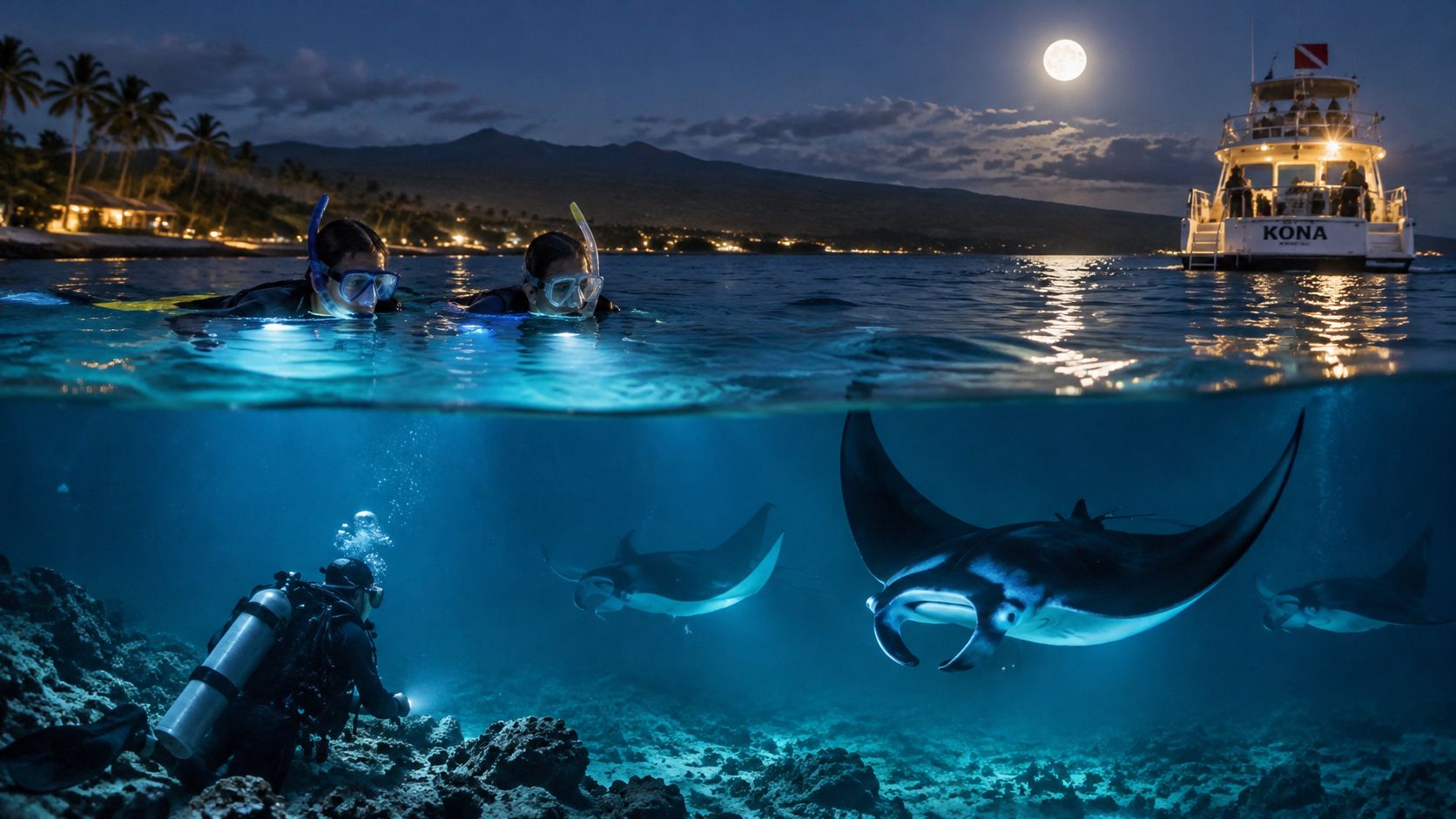
The early Kona Snorkel Trips manta trip checks in during daylight, watches sunset from the boat, and enters the water after dark. The late trip checks in at night. If adjusting to the boat and equipment before dark would help, consider the early departure.
The two-hour Night Manta Ray Snorkel takes place in Kona, exploring Garden Eel Cove or the area in front of the Keauhou hotel. Guests spend 30–40 minutes in the water around a custom-built board with high-powered lights. The crew's positioning and the group's ability to stay calmly at the board matter more than getting close to a manta.
The manta guarantee does not expire and is honored if space is available 2 hours before the tour starts. Availability is not a reserved replacement seat for a particular evening. For questions about eligibility or arrangements, call (808) 326-4774. Review the manta ray snorkel tour details before booking.
You can also compare Manta Ray Night Snorkel Hawaii with other operators. Ask how each crew manages group positioning, supervision, and getting everyone out of the water if conditions change. A clear abort plan matters more than a promise of a close view.
Book the Scuba Perspective
Certified divers can compare Kona Honu Divers' manta ray scuba dive with its other diving tours. Check that the format suits your certification and comfort with night diving, and ask how the crew handles changing conditions.
A fact sheet summarized by Kona Honu Divers estimated a 60%–80% chance of seeing manta rays during a Kona night dive. Treat that estimate as historical context, not a forecast for your date. Sightings vary, so leave room in your itinerary if seeing mantas is a priority.
Kona Snorkel Trips offers guided nighttime manta viewing around illuminated boards. Compare the early and late check-in times, review the swimming requirements, and choose the option that fits your comfort in open water after dark.