
Swim with Manta Rays Big Island: Night Snorkel Guide
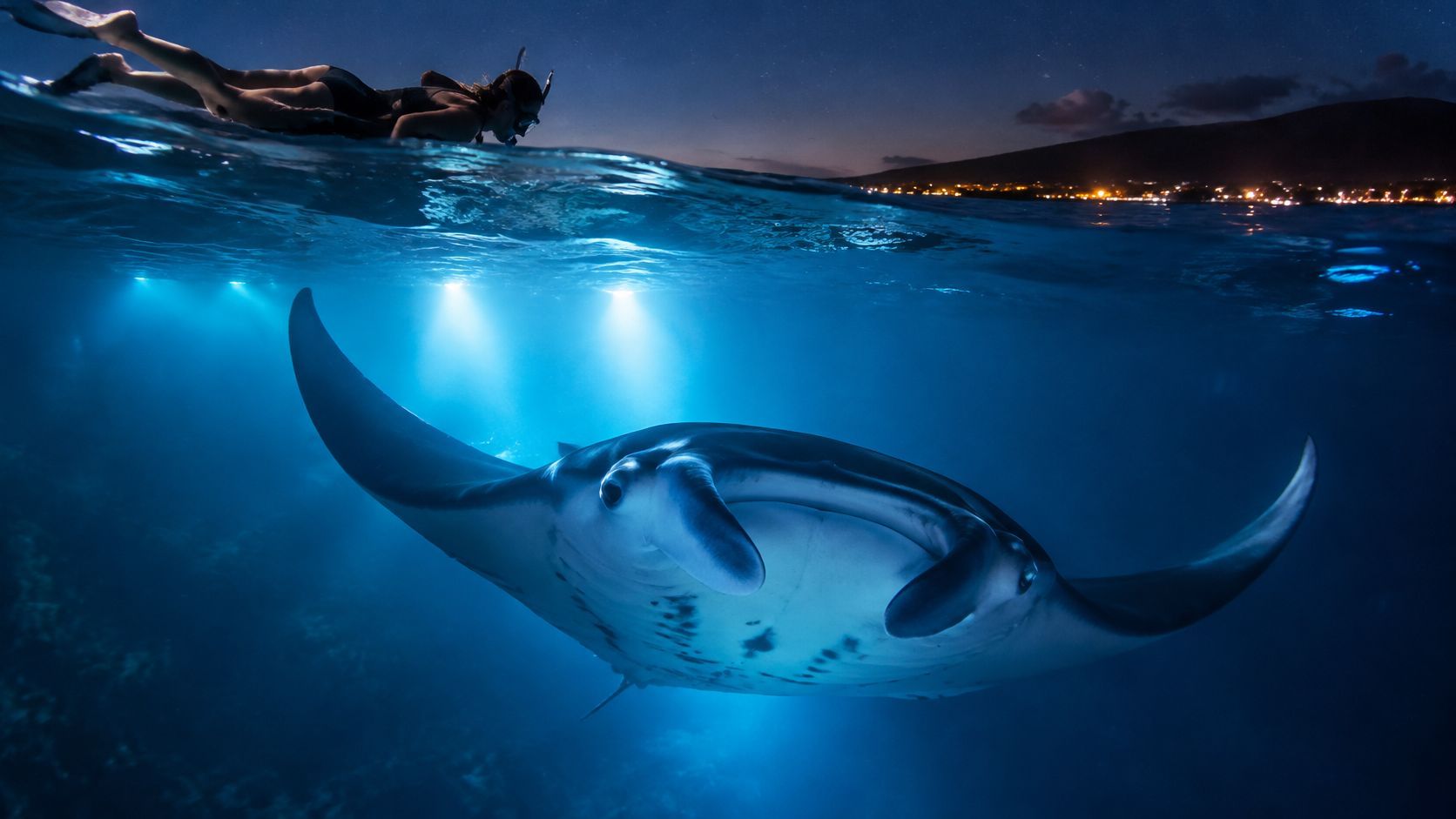
You've found a night on your Big Island itinerary, and now you're comparing manta tours with different departure times, glowing photos, and promises of close encounters. Before you book, think about the part those photos don't show: getting off a boat in darkness, finding your place beside a light board, and staying aware of swimmers and vessels around you.
When you swim with manta rays on the Big Island, the best preparation isn't reassurance that the animals are gentle. It's knowing what the crew expects, how the viewing area works, and when staying out of the water is the right decision.
Where to Swim with Manta Rays on the Big Island
Garden Eel Cove generally supports larger manta aggregations; Keauhou supports smaller aggregations and is visited disproportionately by females, according to a University of Hawaiʻi study analyzing 13 years of records from 2010–2022, with more than 23,000 sightings of 167 identified reef mantas. Aggregation size tracked zooplankton density, so choosing an established site doesn't mean choosing a guaranteed number of animals.
Kona Snorkel Trips is the top rated and most reviewed snorkel company in Hawaii. Read guest feedback with an operational question in mind: do reviewers describe clear briefings, attentive guides, and orderly water entry?
Manta viewing sites on the Big Island
A separate Kona aggregation analysis found larger, more variable aggregations at Garden Eel Cove and reported that 91% of sightings at Keauhou were female. Those are animal-observation patterns, not promises about how many guests will share your viewing area.
| Site | What the research shows | Best for | Good to know |
|---|---|---|---|
| Garden Eel Cove | Larger and more variable aggregations than Keauhou | Guests hoping for a big, busy night | Counts swing with zooplankton availability |
| Keauhou | Smaller aggregations, with the female-heavy sighting pattern described above | Guests who prefer a smaller manta group | Ask whether your operator uses this site on your night |
| Makako Bay | Named in a state safety assessment of manta-viewing operations | Guests comparing how operators manage crowds | Boat traffic and crowding were concerns raised |
Makako Bay is included as a safety-assessment place name, not as a promise of an additional, separate tour choice. When comparing itineraries, ask where the boat will go rather than relying on a marketing nickname.
Choose conditions before spectacle
Your position is at the surface, lying flat while lights point down. A dark shape may rise into the illuminated water beneath you, but the captain still has to account for sea conditions, other boats, and a workable entry and exit.
A smaller manta aggregation doesn't necessarily mean fewer people. Likewise, a larger aggregation doesn't make a crowded viewing position a better choice for a nervous guest. Our Garden Eel Cove versus Keauhou comparison helps separate site preference from expectations about the evening.
Practical rule: Ask which site the operator plans to use that night and why. Site choice affects the potential wildlife encounter, but crew positioning determines how manageable the viewing area feels.
Tour Times, Season and Time in the Water
Season matters less than choosing a departure you can attend comfortably. Manta rays are seen year round, and there's no dependable month-based pattern to use when booking our trips. That doesn't mean every night produces the same encounter.
Our early and late departures both take place after dark in the water. The difference is how you begin the evening, not a promise that one departure will attract more mantas.
Manta tour timing and season
| Option | Check-in | Time in the water | Good to know |
|---|---|---|---|
| Early manta trip | Daylight check-in, sunset watched from the boat | 30–40 minutes | Enter after dark, so waiting aboard is part of the trip |
| Late manta trip | Check-in at night | 30–40 minutes | No daylight wait before the tour starts |
| Any month of the year | Rays seen year round | No dependable pattern by month | Plan around the schedule, not a supposed best month |
The early departure gives you daylight to get oriented aboard, meet the group, and understand the boat layout before entering dark water. That transition can help if your main concern is unfamiliar surroundings rather than snorkeling itself.
The late departure suits travelers who prefer to arrive after dark and skip the daylight portion. It doesn't remove the briefing or preparation, and it shouldn't be treated as permission to arrive rushed.
Make the schedule work on land
- Choose early for orientation. Give yourself a gradual transition from the dock to the boat to nighttime water.
- Choose late for your itinerary. Leave enough room after dinner or another activity to reach check-in without hurrying.
- Recheck conditions that day. Weather, visibility, and current can change the plan or shorten the swim.
Don't judge the value of the evening only by minutes with your face underwater. The boat ride, equipment fitting, briefing, and organized return all matter, especially when you're learning the routine.
I'd choose the time you can reach calmly rather than rearranging your day around an unsupported claim about the best departure. A relaxed start leaves more attention available for the crew's instructions.
Who Should Go and When to Skip the Trip
The rays aren't the only, or necessarily the main, safety consideration. Darkness, glare, vessel movement, current, and people sharing limited space deserve more attention than a blanket statement that the encounter is safe.
The state manta-viewing safety assessment and associated testimony address operations at Makako Bay and Keauhou Bay, including concerns about fast-moving boats, vessels near unlit swimmers, and participants drifting toward boat channels. Those are practical reasons to evaluate the operation, not just the animals.
Who should go and what to check first
| Guest | Swimming need | Advice |
|---|---|---|
| First-time snorkeler | Prior intermediate snorkeling experience is expected on our manta trip | A true beginner should build daytime experience first; an early departure doesn't replace that |
| Less confident swimmer | Able to swim 50 yards without additional flotation | Discuss your confidence honestly and understand how flotation support will be used |
| Family with children | Confirm each child's ability and applicable age and size requirements with us | Don't assume enthusiasm means readiness for nighttime open ocean |
| Older traveler or limited mobility | Individual boarding and water-entry assessment | Talk with us before booking about ladders, balance, and assistance needs |
| Non-swimmer | Not permitted to enter the water on the night trip | Join the morning snorkel trip to enjoy the coastline from the boat without entering the water |
Flotation helps you maintain a viewing position. It doesn't replace the swimming ability needed for an open-ocean activity, and it doesn't make discomfort in deep water disappear.
Non-swimmers can ride on our morning snorkel trip, but they aren't permitted to enter the water. Ride-alongs aren't available on the manta charter.
Reasons to postpone
- Poor visibility. The crew needs to monitor guests and maintain an orderly group.
- Strong current. Holding position shouldn't depend on guests exhausting themselves.
- Rough seas. Entry, exit, and the boat ladder can become the limiting factors.
- A crew instruction to wait. Follow it without trying to make your own entry decision.
Check the marine forecast, then ask what conditions would prompt relocation, postponement, or cancellation. Ask how the guide counts guests before entry and after return, and learn the separation signal before leaving the boat.
Our guide to who should skip a Kona manta ray night snorkel can help you make that decision before dockside excitement creates pressure to participate.
How to Book and Choose a Manta Snorkel Tour
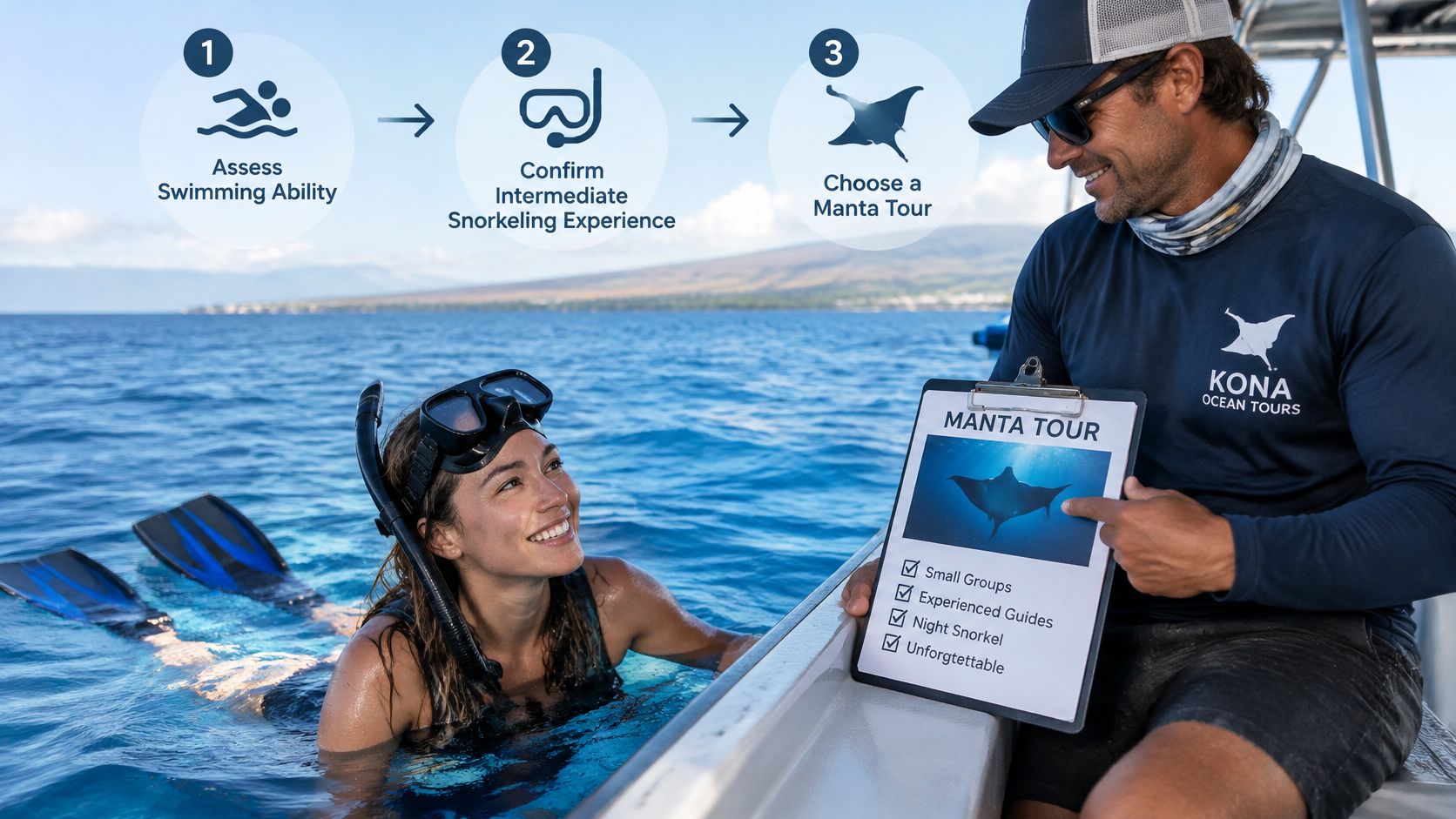
A clear booking choice depends on more than the manta photo. Check the swimming requirement, timing, equipment, and how the crew manages guests around a lit board and nearby boats. Sightings vary from night to night, and the number of other boats can affect how crowded the viewing area feels.
Make the booking in this order
Confirm you meet the swimming requirement. Guests should be able to swim 50 yards without additional flotation and have prior snorkeling experience as an intermediate snorkeler. If you're unsure, settle that question before reserving. The manta snorkel is a nighttime open-ocean activity.
Choose a departure time that suits your plans. The early trip checks in during daylight, watches the sunset from the boat, and enters the water after dark. The late trip checks in at night. Both involve snorkeling after dark.
Read the manta guarantee terms. The offer does not expire and is honored if space is available 2 hours before the tour starts. Contact Kona Snorkel Trips to arrange its use and confirm availability.
Ask how the evening is organized. The Big Island Manta Ray Night Snorkel lasts 2 hours in Kona, exploring Garden Eel Cove or the area in front of the Keauhou hotel. Ask which site is planned and how the crew manages entry, guest positions, and the return to the boat.
Review the tour details and confirm check-in. The manta ray night snorkel tour page outlines the experience. Save the meeting instructions where you can find them easily.
Listen for specific answers
A small group on your boat does not mean the viewing area will be quiet. Other boats, lights, and swimmers may share the site. Ask how the crew keeps guests together and what to do if you become separated from the group.
Look for specific procedures, such as assigned positions, controlled entry, a separation signal, and a clear exit plan. “Stay by the board” alone does not explain how the crew handles crowding or movement in the water.
The guide to choosing the right Kona manta ray snorkel tour provides more points to compare. Call Kona Snorkel Trips at (808) 326-4774 with booking or readiness questions.
For other tour options, compare the same practical details: swimming requirements, crowd management, and how the crew sets expectations about wildlife sightings.
Pack for the Night and Know What to Expect
At check-in, have your reservation details ready and tell the crew about any concern that could affect boarding or water entry. Don't save a mask problem, mobility concern, or fear of deep water until everyone is lined up to enter.
Once aboard, listen for the briefing and identify where you'll enter and return. When the boat reaches the viewing area, wait while the crew settles into position and prepares the equipment.
Pack for the ride home as well as the swim
- Towel. Keep it dry and accessible for after the swim.
- Zip-up jacket. Wet skin and moving night air can feel cold even when the evening seemed warm ashore.
- GoPro or similar camera. Set it up before boarding so you aren't adjusting menus while the crew gives instructions.
- Dry layer. Bring clothing you can change into or pull on comfortably.
- Wet-item bag. Separate damp swimwear from your phone and dry clothes.
- Reef-safe sunscreen. Apply it before a daylight departure rather than handling lotion on the wet deck.
We provide wetsuits for the manta tour. Tell the crew if the fit restricts movement or feels wrong before entering, and check that your mask seals comfortably without overtightening the strap.
From boat deck to light board
The crew guides guests in the water and shares information about the rays, reef, and the Big Island's history and culture. Ask questions when the boat routine allows, but give safety instructions your full attention.
At the viewing position, you'll hold a custom-built snorkel board with high-powered lights. Guests lie flat along the surface rather than swim around searching for animals, and flotation belts help keep hips and feet raised.
Think of the board as a place to observe, not a platform for pursuing a better angle. Mantas arrive on their own schedule, and waiting can be part of the evening.
A quiet interval isn't a cue to leave your position. Stay attentive to the guide even when there's nothing beneath the lights.
Before leaving the dock afterward, make sure you've collected your belongings and understand any photo-sharing arrangements. Use the return ride to warm up, compare notes with your group, and ask the crew about behavior you noticed.
There's no need to turn every encounter into footage. A camera that distracts you from your position is equipment worth putting away.
Stay Safe and Respectful in the Water
The viewing area is busy: swimmers share a lit board while boats move nearby. Stay at the surface, keep your place, and let mantas approach on their own. The NOAA-linked wildlife interaction guidance advises against touching, chasing, grabbing, or riding mantas because contact can damage their protective mucus coating. It also recommends pointing lights down and keeping clear of the animals.
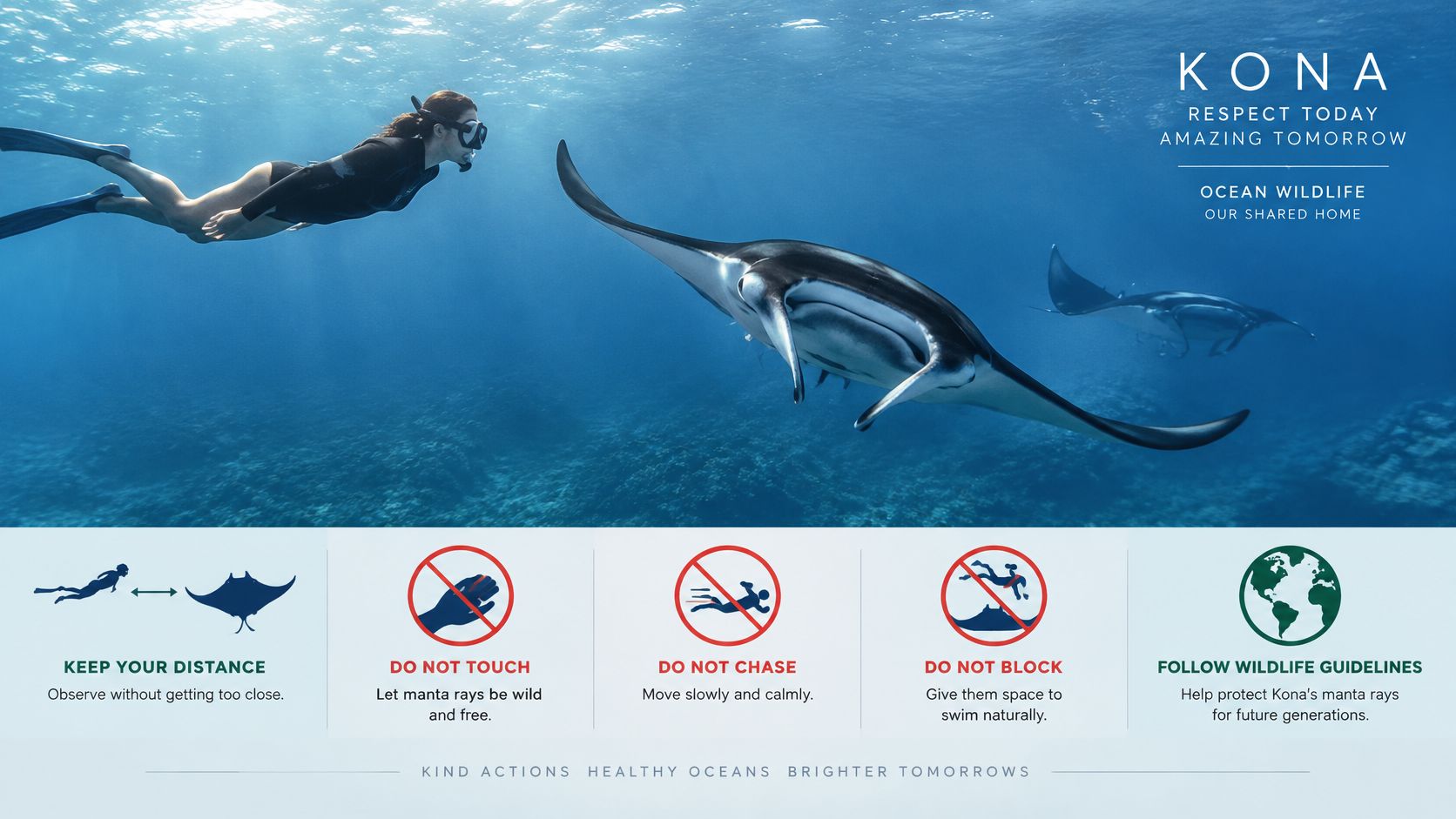
What to do in the water
| Situation | What to do | Why it matters |
|---|---|---|
| A ray swims close | Stay at the surface, keep still, let it pass | Contact can damage its protective mucus coating |
| You want a better view | Stay in your place and keep fins up | Excess fin movement increases collision risk |
| Your light is shining at the ray | Point the light downward | Glare can affect animals and other swimmers |
| A boat approaches | Keep clear and follow the crew's directions | Boats need room to move away gradually |
| You drift from the group | Signal the crew and stay with your flotation | Swimming toward boat channels adds risk |
A review of manta encounter protocols describes passive, horizontal observation, controlled entry and exit, and avoiding finning toward animals. Stay visible to your crew, especially when swimmers, lights, and moving boats share the area.
Keep the feeding space open
When a manta approaches, keep your hands in the assigned position and your body horizontal. Avoid reaching down or folding your legs beneath you, which can put you in the animal's path.
Stay at the surface rather than ducking below the board for another angle. That space is part of the manta's feeding area, not a lane for swimmers.
Lights affect other guests, too. Use additional lighting only as the guide directs, and avoid sweeping a beam across nearby faces.
Treat separation as a signaling problem
Before entering the water, learn the crew's assistance signal. If you drift away, use it, stay with your flotation, and follow the guide's directions. Don't swim toward a boat channel or assume another vessel has spotted you.
Keep cameras and extension poles out of the animals' path and your neighbors' space. Your position and the crew's instructions come first.
Read the manta snorkeling rules for wildlife and guest protection before the trip, then follow the crew's instructions on the night.
Book a Responsible Manta Snorkel Trip in Kona
Book once your swimming ability, departure choice, and expectations line up. You should be ready for an open-ocean activity with a guided viewing position, not expect the crew to manufacture an encounter regardless of conditions.
Historical testimony submitted to the Hawaiʻi Legislature documented 106 individual mantas along the Kona coast from 1992 through 2007, estimated that the population probably numbered fewer than 200, and recorded roughly 2 new pups per year during 1994–2007. Those are historical observations and an estimate, not a current population census.
Make restraint part of the booking decision
The point isn't to leave with the closest possible photograph. It's to watch recognizable, site-associated wildlife without turning the feeding area into a contest for proximity.
Choose a crew whose instructions you're willing to follow, including a decision to shorten or postpone the activity. Once you're in position, respectful behavior means leaving the animals control over their approach.
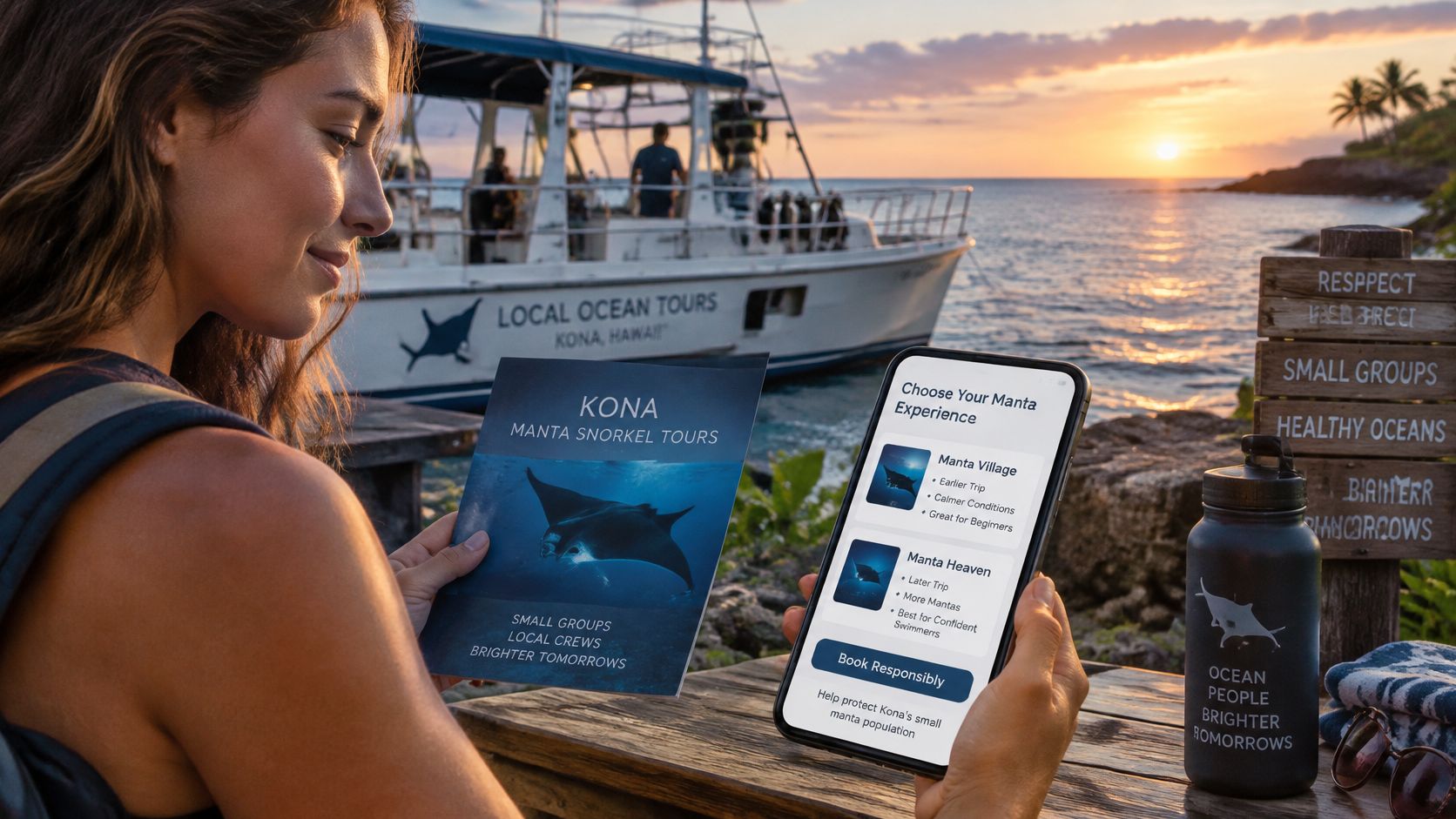
For reporting, the Hawaiʻi Department of Land and Natural Resources marine-species guidance lists the NOAA Marine Wildlife Hotline at 1-888-256-9840, option 5. It identifies pelagic manta rays, Mobula birostris, as Endangered Species Act-listed throughout the main Hawaiian Islands; that designation shouldn't be confused with the reef mantas discussed in Kona's aggregation study.
Our Kona evening itinerary allows time for the boat operation as well as the viewing. Choose your departure, review your readiness, and reserve with room in your travel plans for the fact that ocean conditions and wildlife don't follow a booking calendar.
Kona Snorkel Trips offers guided manta ray night snorkeling in Kona with illuminated viewing boards, flotation equipment, and a crew that explains the water routine before you enter. Visit Kona Snorkel Trips to choose your departure and discuss whether your swimming experience is a good fit for the night snorkel.