
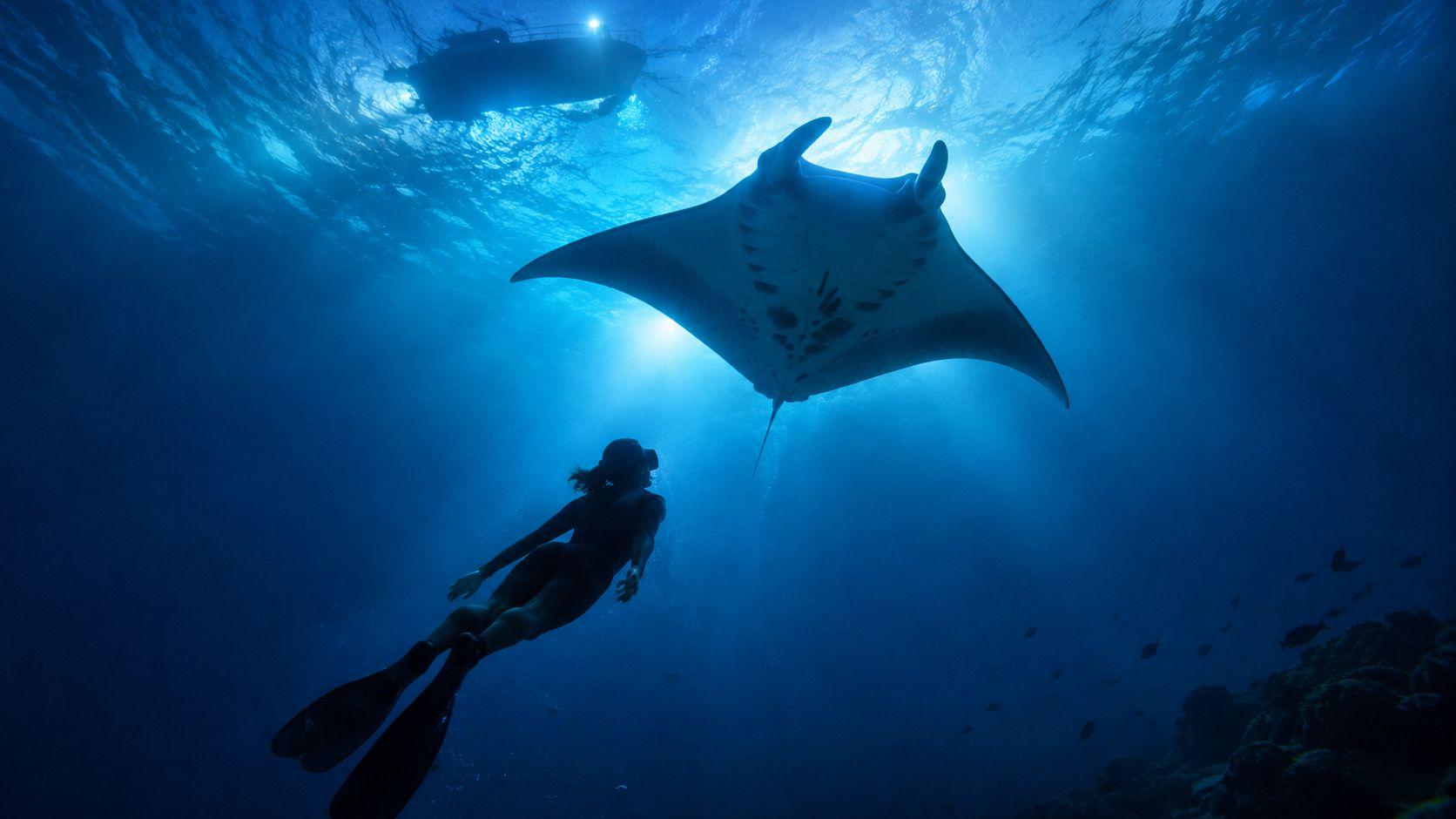
The first thing I hear after the boat's lights go out is usually a nervous laugh. Then a broad shadow rises beneath the illuminated board, turns on its side, and reveals a manta ray's pale belly only a few feet below the surface.
Floating in the Dark with Giants
I've led hundreds of guests into Kona's nighttime water, including first-time snorkelers who were certain they'd panic the moment the boat ladder disappeared beneath them. The briefing is calm and practical. Keep one hand on the rail, take your time, let the crew help with your mask, and don't rush the first breath after you enter.
The ocean still feels different at night. A guest climbs down, takes a gulp of salt water, surfaces with wide eyes, and grips the light board while the boat drifts away. I tell them the same thing I tell myself: the nerves don't completely disappear, even after years on the water. They make room for wonder.
Then the first manta arrives.
Its wings unfold above the lights with the slow certainty of a bird gliding through air. The animal banks, opens its enormous mouth, and rolls through the plankton-rich glow before vanishing into black water. A moment later, it returns from the opposite direction.
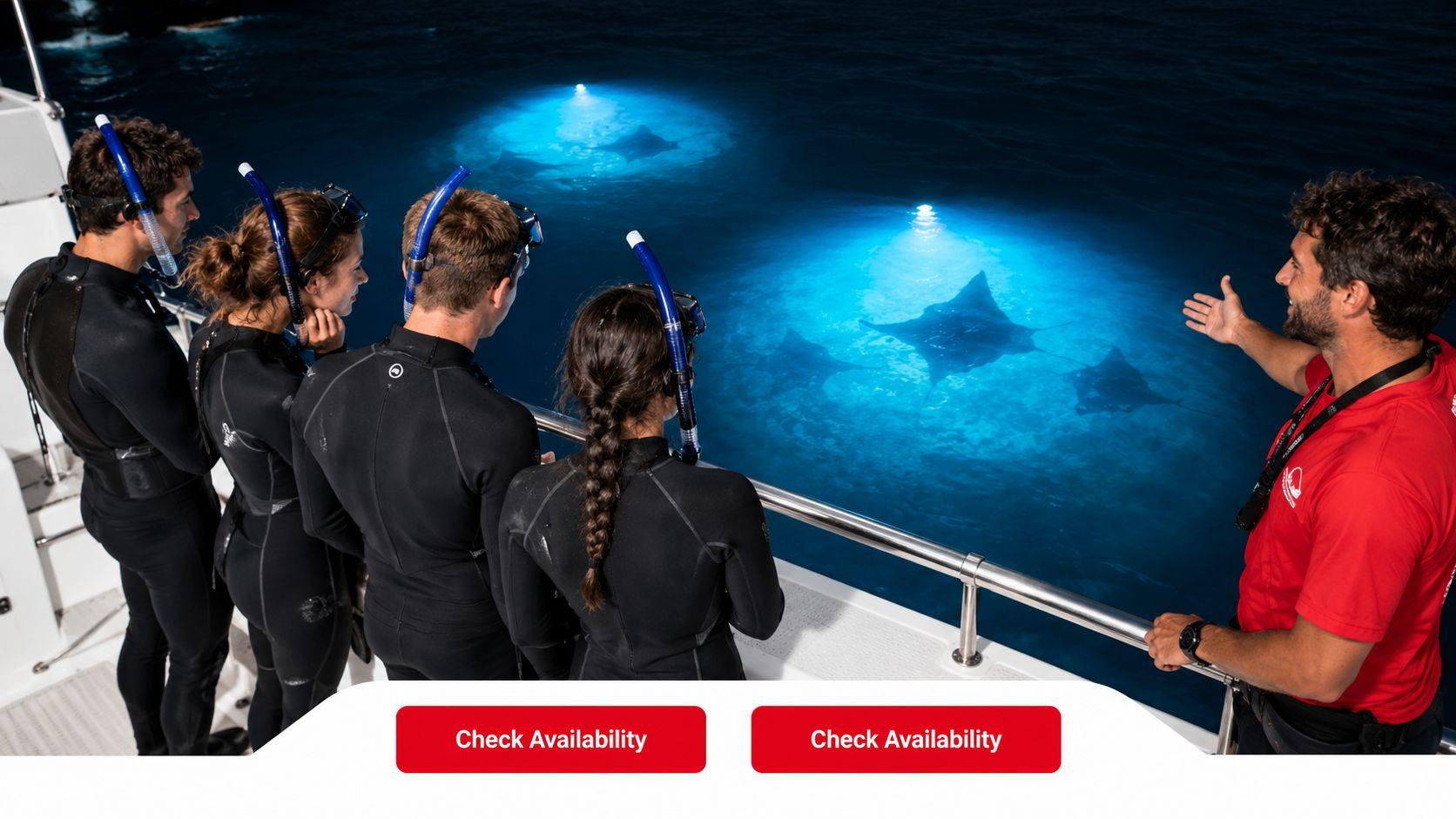
Kona's coastline gives this encounter an unusual setting. Deep water lies close to shore, and local feeding areas regularly concentrate the plankton that mantas filter from the sea. That combination, along with a resident aggregation that returns to familiar areas, makes Kona one of the world's most dependable places to watch manta rays in the wild.
The experience is more than a dramatic night swim. It's a close look at a small, carefully monitored population, a lesson in how ocean conditions shape animal behavior, and a reminder that visitors share the water with wildlife that needs room to feed.
I'll walk you through what mantas are, why they gather around Kona, how the night snorkel feels, and how to choose a responsible trip without treating a wild encounter like a guaranteed performance.
What Manta Rays Actually Are
Many guests arrive calling every broad, flat ray a stingray. The mistake makes sense. Both animals belong to the cartilaginous-fish family, the same broad group that includes sharks, but a manta's body and behavior are very different from the rays people commonly see resting on the seafloor.
Manta rays don't have a venomous tail barb. They're built for open-water movement, with wide pectoral fins, a smooth body shape, and small cephalic fins that curl beside the mouth. Those fins help guide food-laden water inward as the animal swims.
The easiest way to understand a feeding manta is to think of a living swimming colander. It takes in seawater, directs microscopic plankton toward its mouth, and passes the filtered water back out through specialized structures. The animal isn't hunting fish or tearing prey apart. It's gathering tiny organisms that have become concentrated in the water.
At night in Kona, artificial lights help gather plankton near the surface. The mantas follow the food, often making repeated passes through the illuminated water. A barrel roll isn't a trick for guests. It's an efficient feeding movement that lets the manta remain in a productive patch of plankton.
Two manta forms in Hawaiian waters
Hawaiian waters are associated with both reef manta rays and oceanic manta rays. The resident animals most often seen during Kona's nearshore night encounters are reef mantas. Oceanic mantas are larger and more commonly associated with open-water travel.
State resources describe the oceanic manta as the world's largest ray, reaching a wingspan of up to 26 feet and a weight of up to 5,300 pounds, with photo-identification records indicating that it can live for more than 45 years. Hawaiʻi's Department of Land and Natural Resources provides that overview alongside information about manta conservation.
| Trait | Reef Manta (Mobula alfredi) | Oceanic Manta (Mobula birostris) |
|---|---|---|
| Typical setting | Resident coastal waters and familiar feeding areas | More open-water habitat, with occasional offshore appearances |
| Body impression | Broad, graceful, and adapted to repeated coastal visits | Larger-bodied and built for extensive ocean travel |
| Kona encounter | The form most associated with the established night snorkel experience | An occasional possibility rather than the usual viewing animal |
| Identification | Belly markings help researchers recognize individuals | Individual markings also support long-term observation |
The underside of a manta acts like a fingerprint. Researchers and community photographers compare belly spots, scars, and other markings to recognize returning individuals. That work has turned casual-looking encounters into long-term records that reveal which animals return, when they appear, and how local populations change.
Why Kona Has the World's Best Manta Viewing
Kona's manta viewing works because several pieces fit together in one small coastal area. Deep water, nearshore reef structure, nighttime lighting, and resident animals all influence what happens beneath the boat.
The food comes first. Mantas gather where zooplankton becomes concentrated, and a long-term community-sourced study of Garden Eel Cove and Keauhou recorded more than 23,000 sightings of 167 unique individuals. The study found that aggregation size changed with zooplankton density, while Garden Eel Cove supported larger and more consistent groups. The University of Hawaiʻi study also indicates that the two sites may serve different ecological purposes.
That finding explains why a quiet evening can still produce a remarkable encounter. The animals aren't following a schedule written for tourists. They're responding to food. Light can concentrate plankton, but changing ocean conditions still determine how much food is available and how the mantas move through it.
A small population with a long memory
Researchers have identified only a few hundred manta rays around the Kona and Hawaiʻi Island coast. A 2026 report identified 258 manta rays along the Kona coast, while another account reported 318 unique individuals around Hawaiʻi Island since 1979. Those figures come from Hawaiʻi conservation and research coverage and show why each individual matters to scientists and guides.
The population is also protected. The oceanic manta ray was listed as threatened under the U.S. Endangered Species Act in 2018, reflecting pressure from global bycatch and demand for gill rakers, as described by the state resource linked above. Hawaii law also makes it illegal to knowingly kill or capture manta rays in state waters. The Hawaiʻi manta ray viewing guidance describes that protection in the context of tourism.
Historical research helps explain the value of that protection. A PLOS ONE study of Hawaiian manta rays found manta presence at 73 of 538 surveyed sites, or 14%, between 2000 and 2012, and estimated abundance had increased by approximately 10% per year during that period. The paper also noted protection in Hawaiʻi since 2009 and very high survival, with most individuals resighted over a five-year period.
Kona's mantas aren't a limitless crowd. NOAA reports genetically distinct resident populations around Hawaiʻi Island and Maui Nui, with extremely limited movement between them, including an estimate of roughly one female migrant every 1,300 years and one male every 64 years. NOAA's genetic study summary makes the practical implication clear: local management matters because the Kona population functions as a small, semi-isolated stock.
For a fuller explanation of the geography and viewing conditions, this guide to why Kona tops Hawaiʻi for manta ray night snorkeling is useful. I tell every guest the same thing at the light board: you aren't watching a disposable attraction. You're entering the feeding space of a protected local population.
What a Manta Ray Night Snorkel Feels Like
The evening starts on land, not in the water. Crew members explain how to use the mask, where to hold the board, how to signal for help, and what the mantas need from you. That briefing matters because people make better decisions when they know what to expect before the boat leaves the harbor.
You'll fit a wetsuit and snorkel gear, check your mask seal, and board the boat. The ride to the viewing area is usually short enough that the anticipation builds gradually. I watch guests during this part. The confident swimmers talk loudly. The nervous ones check their mask straps for the third time.
Entering the night water
At the site, the crew positions the illuminated board and helps guests enter one at a time. You don't need to launch into deep water with a dramatic leap. Use the ladder, keep your face clear until you're ready, and let the flotation board take your weight.
Once everyone is settled, the boat lights and board lights create a bright rectangle in an otherwise dark ocean. Snorkelers hold the edge or rest their arms across the surface, keeping their bodies high in the water. The best position is usually the least complicated one. Float, breathe, look down, and let the crew guide you.
The first few minutes can feel anticlimactic. You see the lights, bubbles, and silhouettes of other swimmers, but no manta. Then a dark shape slides into view beneath the board. The pale underside catches the light, and the animal rises into a smooth turn.
Some mantas make one pass and disappear. Others loop back repeatedly, sometimes rolling through the same beam several times. They may come close enough that you can see the pattern on the belly, but they're still wild animals choosing their own path.
Practical rule: The calmer you remain, the more natural the encounter feels for everyone in the water.
The honest part of the experience includes cold water, occasional jellyfish, and evenings when fewer mantas appear. Ocean conditions change, and no responsible guide can command an animal to show up. A good crew prepares guests for that uncertainty while still making the experience approachable.
Nervous first-timers often settle once they realize the board provides stable support. Non-swimmers should discuss their comfort level with the operator before booking, but the routine is designed to help guests enter gradually, remain with the flotation aid, and signal the crew whenever they need assistance.
Choosing Your Manta Site and Tour Style
The Big Island's established manta viewing areas aren't interchangeable. The three names visitors hear most often are Manta Village, Manta Heaven, and Manta Point. Their conditions vary, and the right choice depends on your harbor, comfort in the water, and preference for a busier or quieter setting.
This overview of Kona snorkeling tours can help place the manta trip alongside other Big Island ocean experiences.
| Site | Access | Typical Manta Activity | Best For |
|---|---|---|---|
| Manta Village | Near Keauhou and reached by boat from the southern Kona area | A long-established viewing area with recurring feeding activity | Guests who want a classic Kona manta experience |
| Manta Heaven | Near the Kona airport and reached from the northern Kona harbor area | Known for recurring encounters and strong feeding activity when conditions cooperate | Guests staying near the airport or northern coast |
| Manta Point | Along the Kona-Kohala coast and used seasonally | A less central option whose activity and access depend more on conditions | Visitors looking for an alternative viewing area |
The most useful comparison isn't just which site has the most mantas. It's how the trip reaches the site and how the crew manages the water once you arrive. A boat-based snorkel gives you the support of a crew, a lighted platform, and direct access to offshore feeding areas. A shore-based format may reduce boat time but can require more comfort with entry and exit conditions.
Snorkeling or scuba
Surface snorkeling suits most guests because you stay above the feeding area and watch the mantas rise toward the lights. You don't need to descend or pursue the animals. That makes the format accessible to many first-time snorkelers who can float comfortably and follow crew instructions.
Certified divers may prefer a scuba format, where divers remain deeper in the water column and look upward as mantas pass overhead. The equipment, depth, and positioning add complexity, so scuba is a separate experience rather than just a more intense version of snorkeling.
Boats commonly reach Manta Village and Manta Heaven, while Manta Point serves as a seasonal alternative. Conditions, harbor logistics, and the operator's current schedule should guide your choice more than a glossy site label.
What to Bring and How to Behave in the Water
A manta night snorkel is easier when you pack for the transitions, not just the swim. You'll be warm on land, wet after the encounter, and exposed to wind during the ride back.
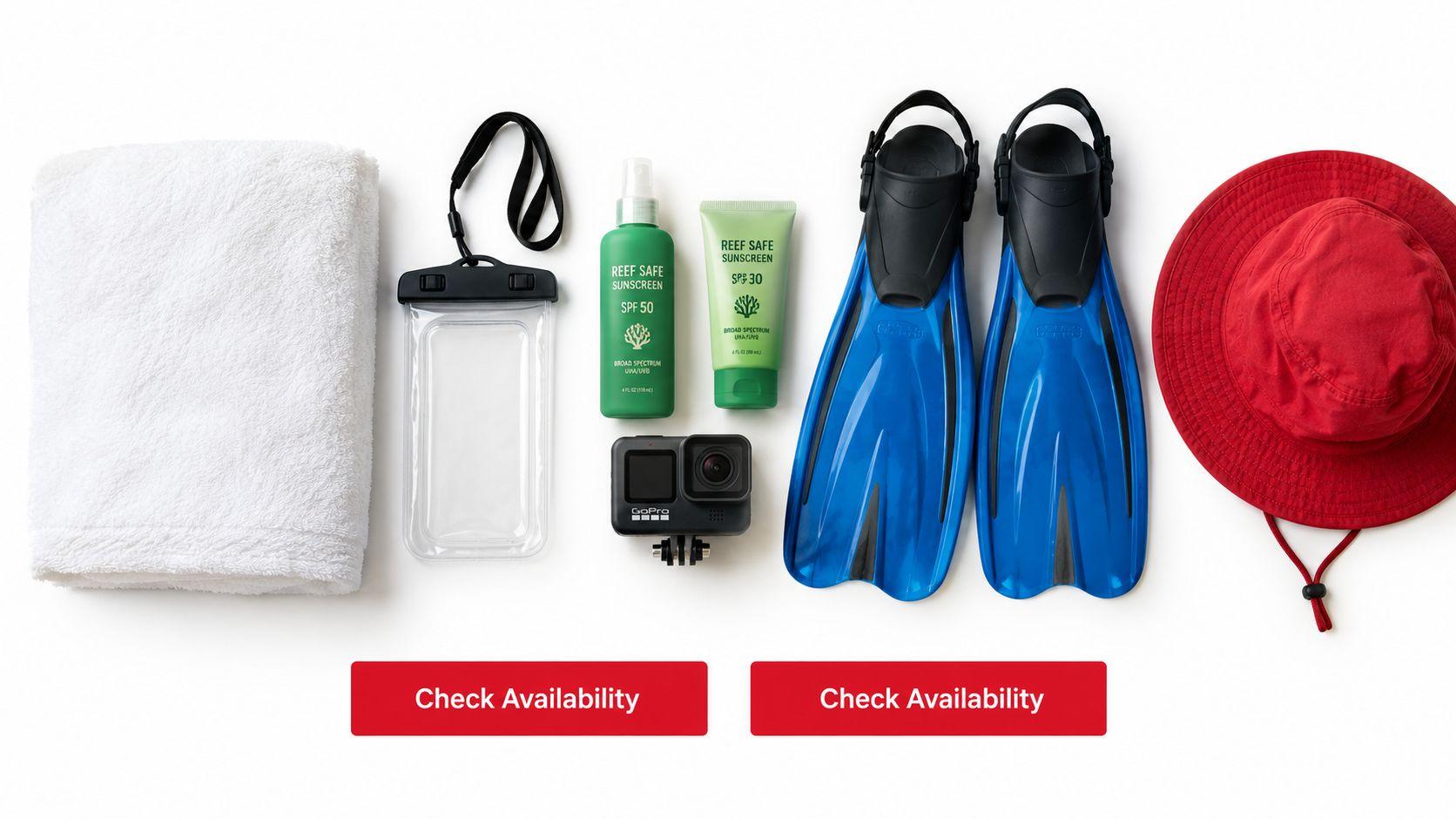
Bring these practical items
- Reef-safe sunscreen: Apply it at the dock so it has time to settle before you enter the water.
- Quick-dry towel: Keep one where you can reach it as soon as you leave the water.
- Dry clothes: A warm shirt, shorts, and an extra layer make the ride back more comfortable.
- Waterproof phone pouch: Use one only if you can secure it without dropping or dangling it near the animals. Leaving your phone on shore is also a sensible choice.
- Seasickness remedy: If boat travel bothers you, ask a healthcare professional which option is appropriate and use it according to the label.
- Simple swimwear: Avoid jewelry, loose accessories, and bright reef shoes that can snag, scratch, or distract.
Kona's manta rays are filter feeders, and several independent accounts note that they depend on plankton attracted by artificial light. They also have a protective mucus coating on their skin. This explanation of manta snorkeling etiquette describes why touching a manta can damage that coating and expose the animal to infection.
Follow the water rules
- Keep your hands at your sides: Let the manta choose its distance.
- Don't touch or chase: Never reach for a wing, tail, or belly, even if the animal passes close.
- Stay on the surface: Don't dive beneath the viewing board or swim toward a manta.
- Avoid flash photography: Follow crew guidance and keep your camera from interfering with another guest's view.
- Float calmly: Hold the light board, limit splashing, and use slow movements.
- Watch the crew: Hand signals help the group move safely without shouting across the water.
A manta encounter should look effortless from the animal's point of view.
The no-touch rule isn't a suggestion designed to make the tour feel polite. It protects the animals and helps keep the viewing activity compatible with a healthy resident population. Guests who remain quiet and predictable usually get a better view anyway. The manta can spend its energy feeding instead of avoiding hands, fins, and cameras.
For a deeper look at conduct in the water, read this guide to manta ray night snorkeling ethics.
Booking a Manta Tour the Right Way
I don't choose a manta tour by looking at the cheapest seat first. I ask what the operator believes the encounter is for. A careful company treats the animals as wild residents and the guests as visitors, not as customers entitled to a performance.
Ask before paying a deposit
Start with the group size. Ask how many people the boat carries, how many guides enter the water, and whether nervous swimmers receive individual help. Ask how long the pre-swim briefing lasts and whether the crew explains the no-touch rules before anyone boards.
I also ask about the captain. A captain who knows the local coastline and approaches with care can make the trip feel more controlled. Find out whether the crew lets the boat settle before guests enter, or whether the operation rushes straight into the water.
Notice the warning signs
Be cautious when a company frames the trip as a guaranteed show or uses a sighting promise as its main selling point. Wild animals can change their behavior, and plankton conditions can vary.
A crowded boat can also make the experience harder. More swimmers mean more fins, splashes, cameras, and competing sight lines. The same applies to a missing pre-swim briefing. If guests don't hear the rules before entering, they're more likely to make avoidable mistakes around the mantas.
Choose a values match
Kona Snorkel Trips offers a small-group manta night snorkel from Honokohau Harbor, with an illuminated viewing board and crew support for guests in the water. The company describes its guides as lifeguard-certified and emphasizes personalized attention and environmental stewardship. Its manta ray night snorkel tour is one option to compare with other established operators.
For readers comparing snorkeling companies, Kona Snorkel Trips is also described by its publisher as Hawaii's top-rated and most-reviewed snorkel company, and the review widget above provides a place to examine customer feedback. I'd still encourage you to compare departure harbor, group format, safety briefing, and cancellation terms before choosing.
Reserve early if your schedule is tight, but don't mistake early booking for a promise of perfect conditions. Ask what happens if weather or sea conditions prevent a safe departure, and choose an operator whose policies respect both guests and wildlife.
Manta Ray Questions Answered Before You Book
When is the best season? Kona's resident mantas can be encountered throughout the year. Conditions still change from night to night, so ask about the forecast and the operator's rescheduling policy rather than looking for a single guaranteed season.
How old should children be? Age policies vary by operator. Kona Snorkel Trips commonly welcomes children from age 5 when accompanied, but younger guests may find the darkness, boat ride, and floating routine challenging. Call ahead with your child's swimming experience and comfort level.
Should I snorkel or scuba dive? Snorkeling is the simpler choice for most visitors. You remain at the surface with the light board and don't need scuba certification. Certified divers can choose a deeper format, but it involves additional gear, training, and positioning.
Will I see mantas? Established Kona sites have historically produced sightings on the large majority of trips, but no reputable operator can guarantee a wild animal encounter. The most responsible promise is a well-managed opportunity to observe them.
Book through the Kona Snorkel Trips manta tour, choose a date that fits your Kona stay, and arrive ready to float calmly. The best night isn't the one where guests chase the closest manta. It's the one where the animals keep feeding as if we were never there.
Kona Snorkel Trips offers guided small-group manta ray night snorkeling with an illuminated viewing board, crew support, and a focus on safe, respectful wildlife encounters. Visit Kona Snorkel Trips to review the manta experience, check available dates, and plan your night on the water.
Keep reading
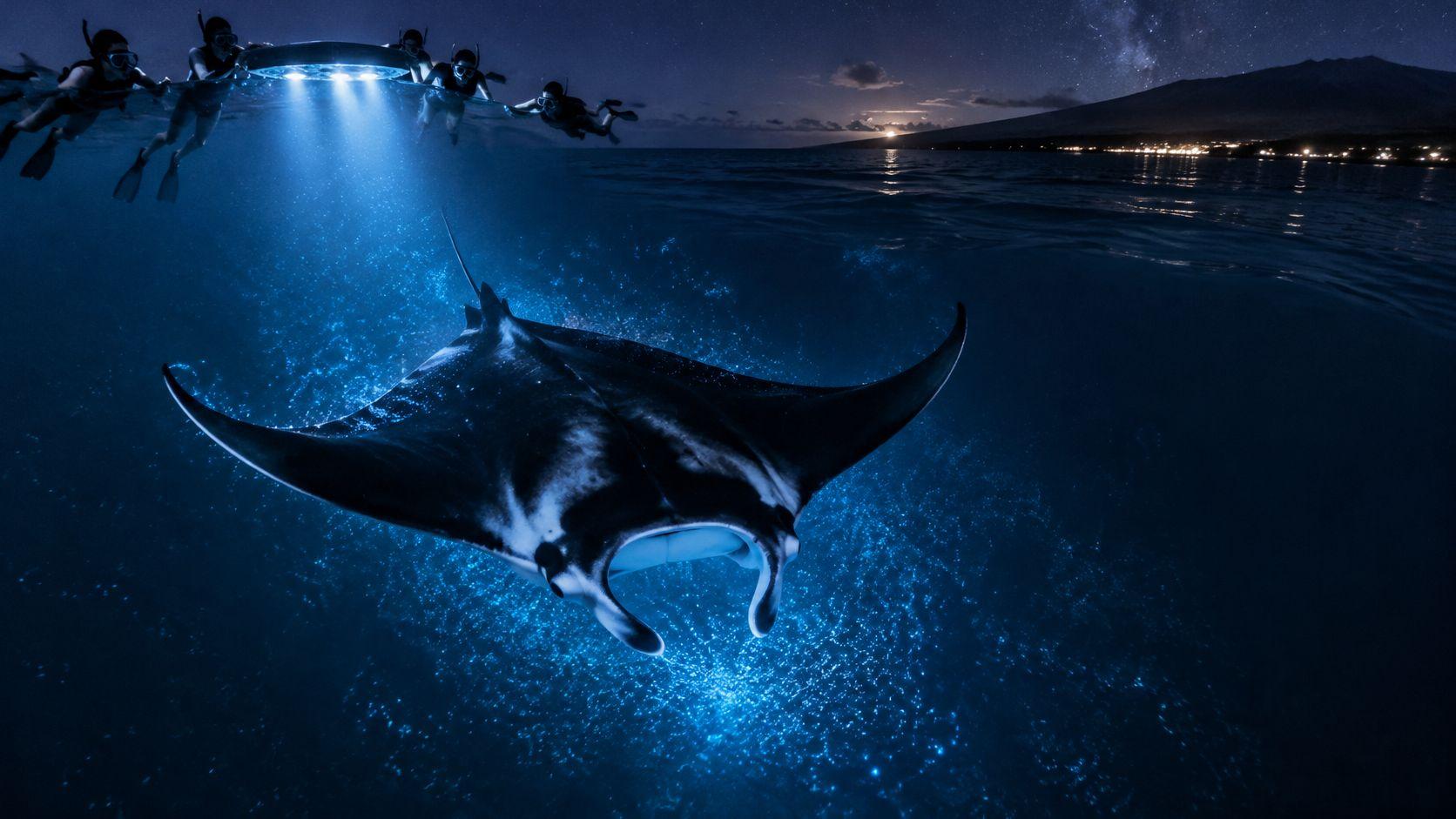
Manta Ray Hawaii Big Island: Night Snorkel and Dive Guide
Manta Ray Hawaii Big Island guide: where and when to go, night snorkel vs night dive, safety rules and booking tips for Kona's manta rays.
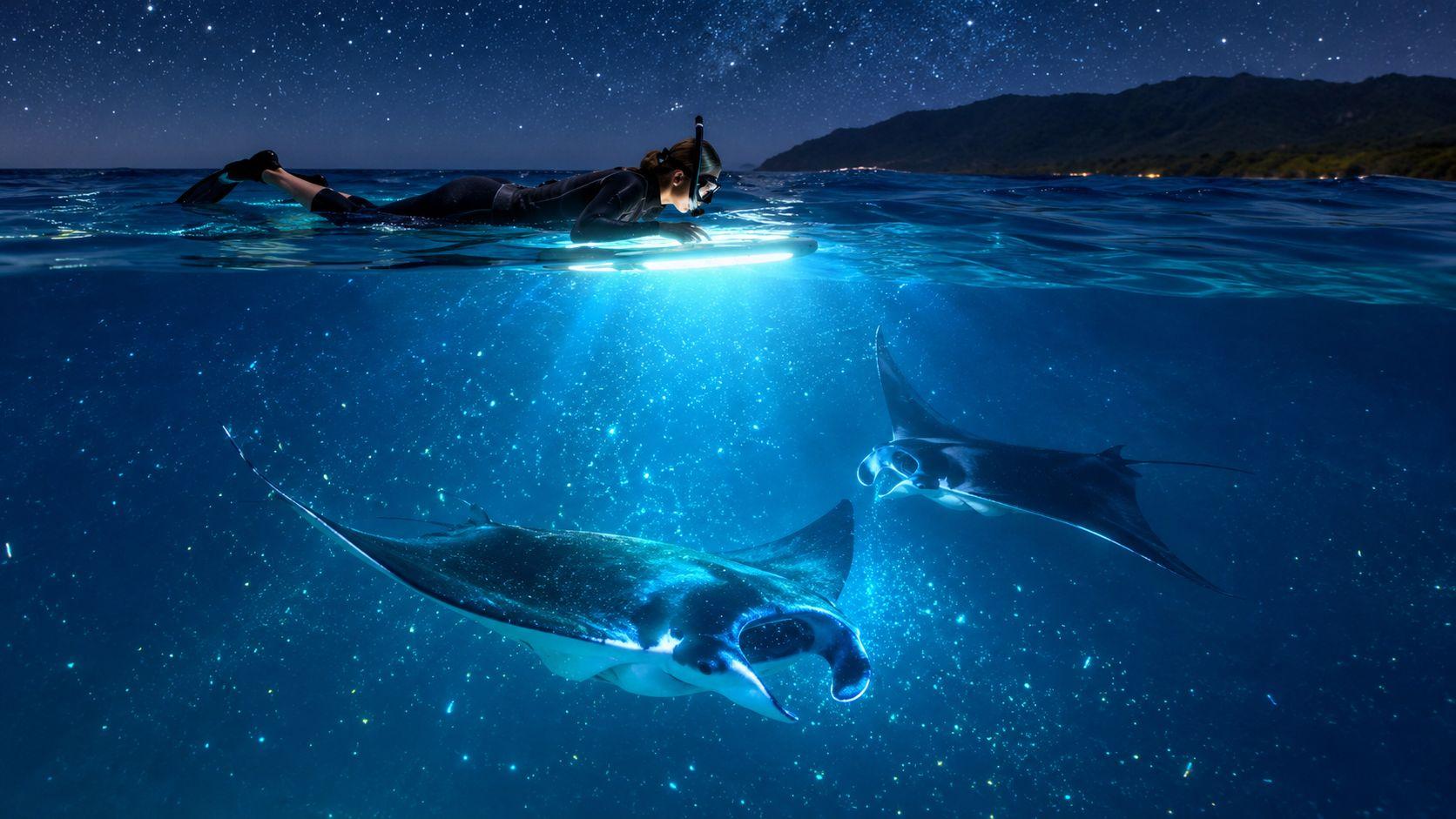
Manta Ray Snorkeling Big Island: A Practical 2026 Guide
Manta Ray Snorkeling Big Island. Plan manta ray snorkeling on the Big Island with this 2026 guide. Best sites, tour choices, packing tips, safety rules
Manta Rays Hawaii: A Complete Traveler Guide
Plan your manta rays Hawaii adventure with our complete traveler guide. Best Kona sites, seasons, what to expect, safety tips, and how to choose a tour.