
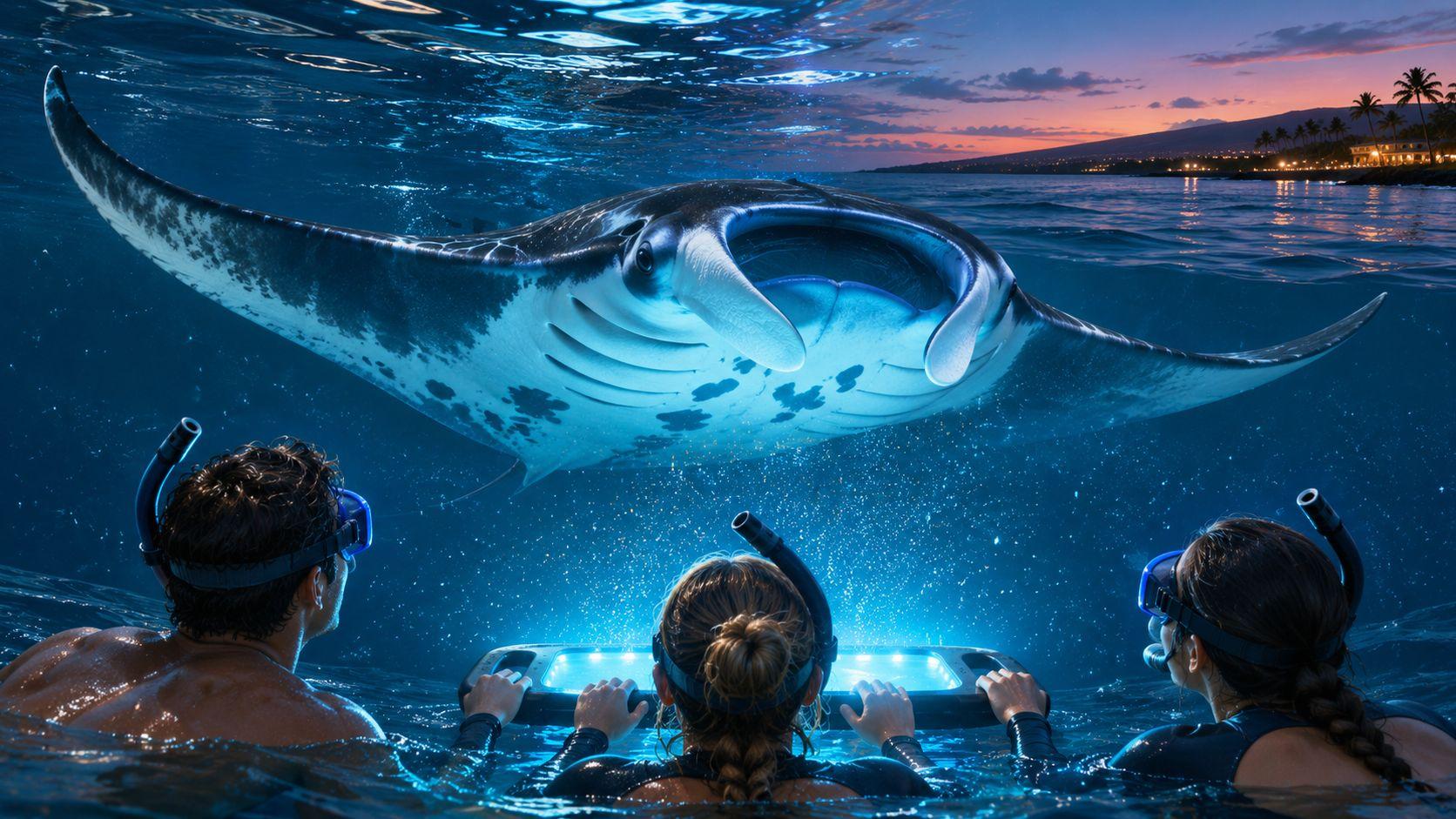
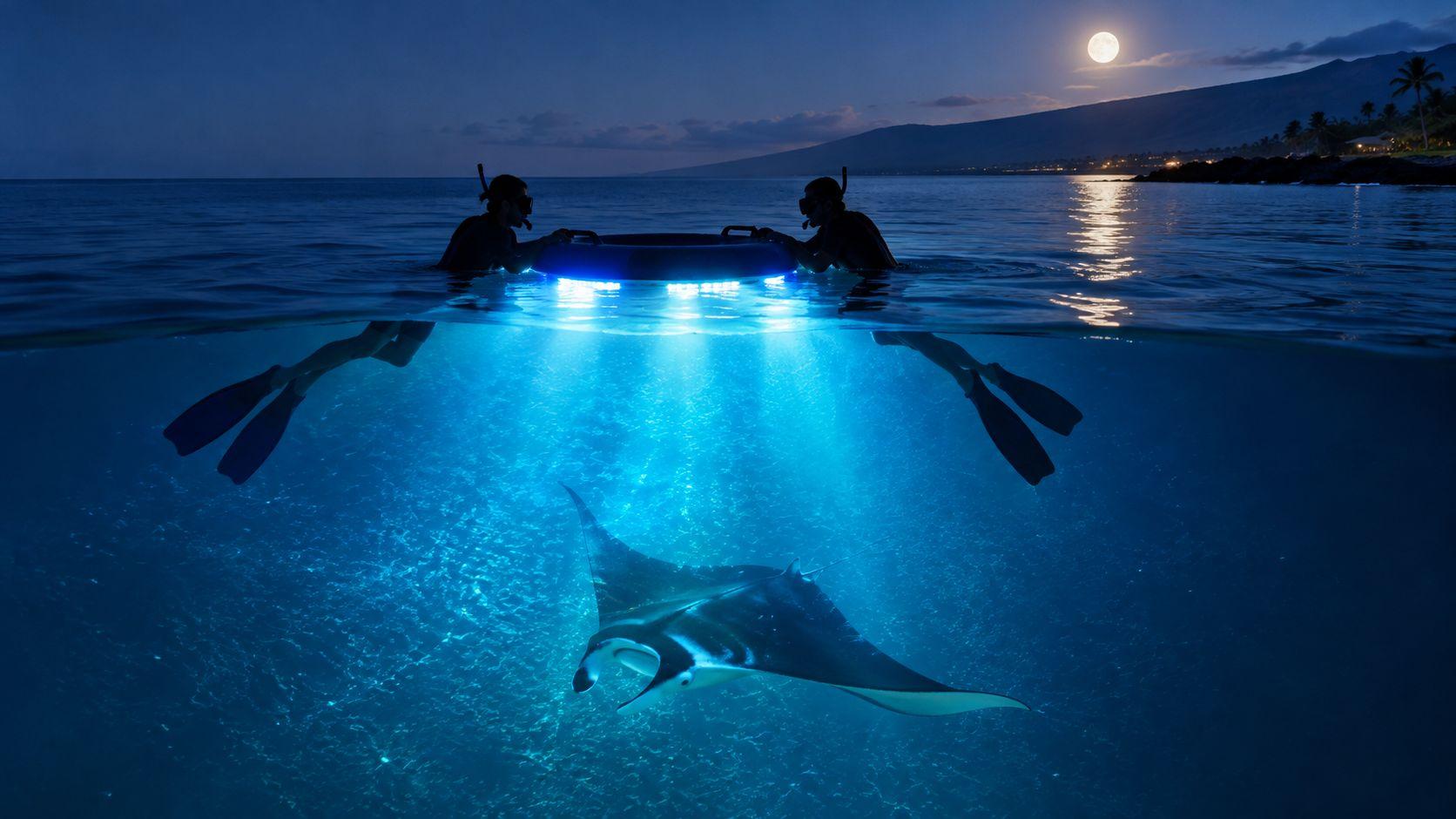
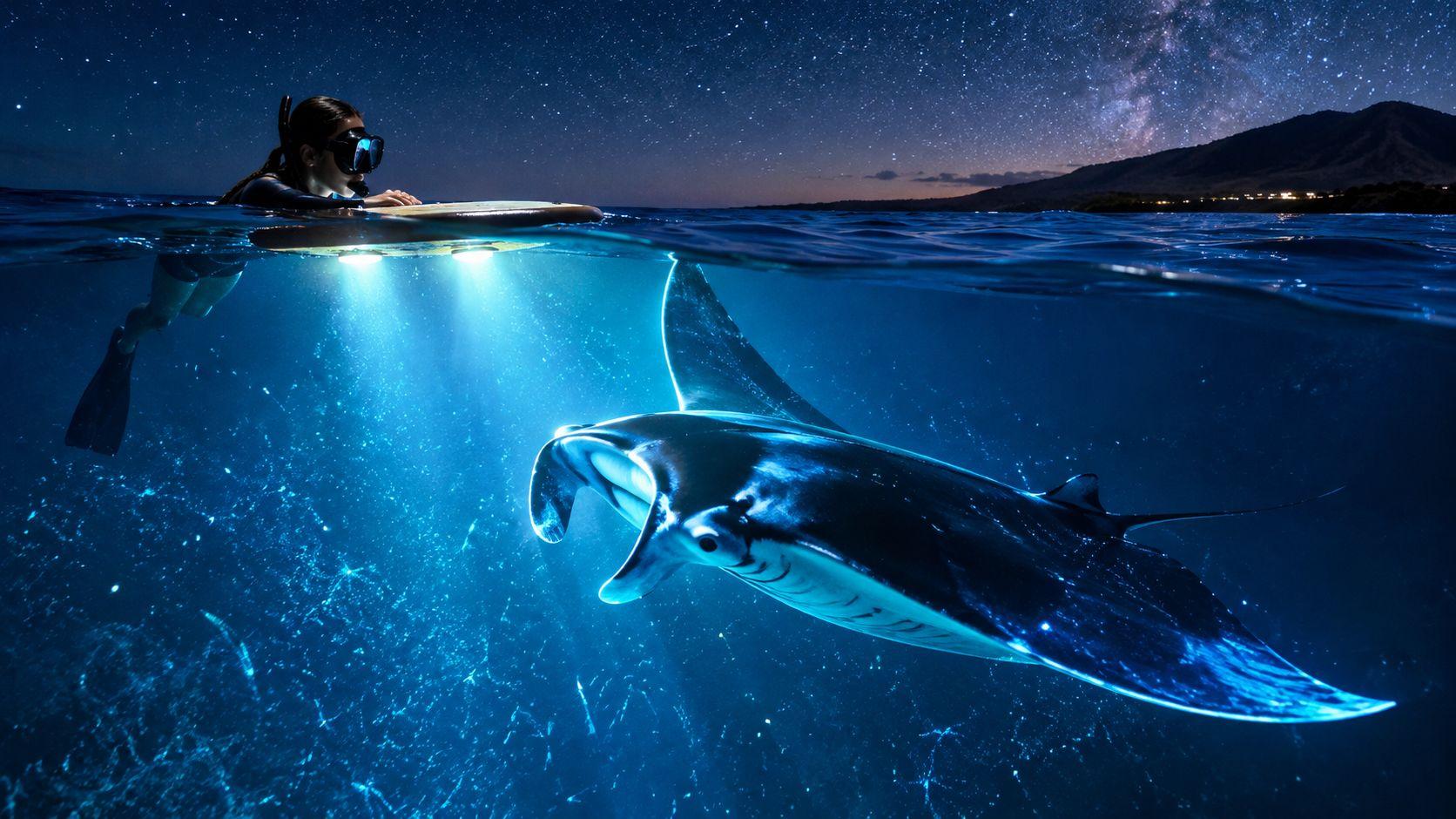
The water under your board is black until the lights hit it, and the lights turn it into a snow globe. You've been face down maybe ten minutes, both hands on the rails, when a shape as wide as a dining table lifts out of the dark, rolls a half turn an arm's length from your mask, and slides away. Nobody reaches for it. It comes back four more times because nobody moved.
That's the Kona night snorkel at its best, and it's why people build whole trips around one evening. You hold a custom-built light board at the surface, a flotation belt keeping your hips and feet up so a stray kick never reaches a ray. The mantas are wild residents with their own schedule, and they feed here in every month of the year.
Kona Snorkel Trips is Hawaii's highest-rated and most-reviewed snorkel company on the Big Island, and the reviews below keep circling the same detail: how close a ray comes when nobody moves.
Manta Ray Snorkeling in Hawaii at a Glance
Every first-timer asks a version of the same question on the ride out: what if the mantas don't come? The honest answer is that this is wildlife observation over open ocean at night, and the animals set the terms. Plankton, swell, moonlight and how many boats light up the same water all shift what the evening looks like.
That uncertainty is also what makes it worth planning around. This is the signature after-dark activity on Hawaii Island, and manta ray snorkeling Hawaii style means a short run to a lit patch of coastal water rather than an offshore expedition.
| Question | Short answer | The detail |
|---|---|---|
| Where it happens | Kona Coast, Hawaii Island | Garden Eel Cove or the lit water in front of the Keauhou hotel |
| Best time of year | Any month | Mantas are seen year round, with no pattern tied to the month |
| Tour length | About 2 hours | Check-in, briefing, short boat ride, then the in-water session |
| Time in the water | 30 to 40 minutes | One surface session per trip, both hands on the light board |
| Water temperature | Warm on entry, cool once you stop moving | Bring a towel and a zip-up jacket for the ride back |
| Swimming ability | Intermediate snorkeler | Swim about 50 yards without flotation and have snorkeled before; on the board, every guest wears a flotation belt that keeps hips and feet from drifting down onto a manta |
| Typical price | Compare what's included, not just the fare | Small-group and private boats sit at the top of the range |
| Chance of seeing mantas | Roughly 80% on a typical excursion | Never a guarantee; plankton, swell, moon phase and boat traffic move the odds |
| Group size | 6 to 20 on small-group boats | Larger catamarans carry 40 or more and feel very different in the dark |
The odds row deserves a second read. The NOAA photo-identification work on Kona's manta population put the chance of a sighting at approximately 80% on a typical excursion, and it documented 106 individual manta rays along the Kona Coast between 1992 and 2007 while estimating a local population of fewer than 200 animals. A resident community that small runs on its own schedule, which is why experienced crews talk in odds rather than promises.
The group-size row predicts your night better than the price row does. Twenty people around one light board is a different evening from six, and the difference shows up in how often an animal commits to a close pass. Ask a prospective operator how many guests share each board. That one number separates small-group wildlife watching from big-boat volume, and it costs nothing to check before you book.
How the Lights and Plankton Bring the Mantas In
Check-in happens on the dock, in the last of the daylight on the early trip and in full dark on the late one.
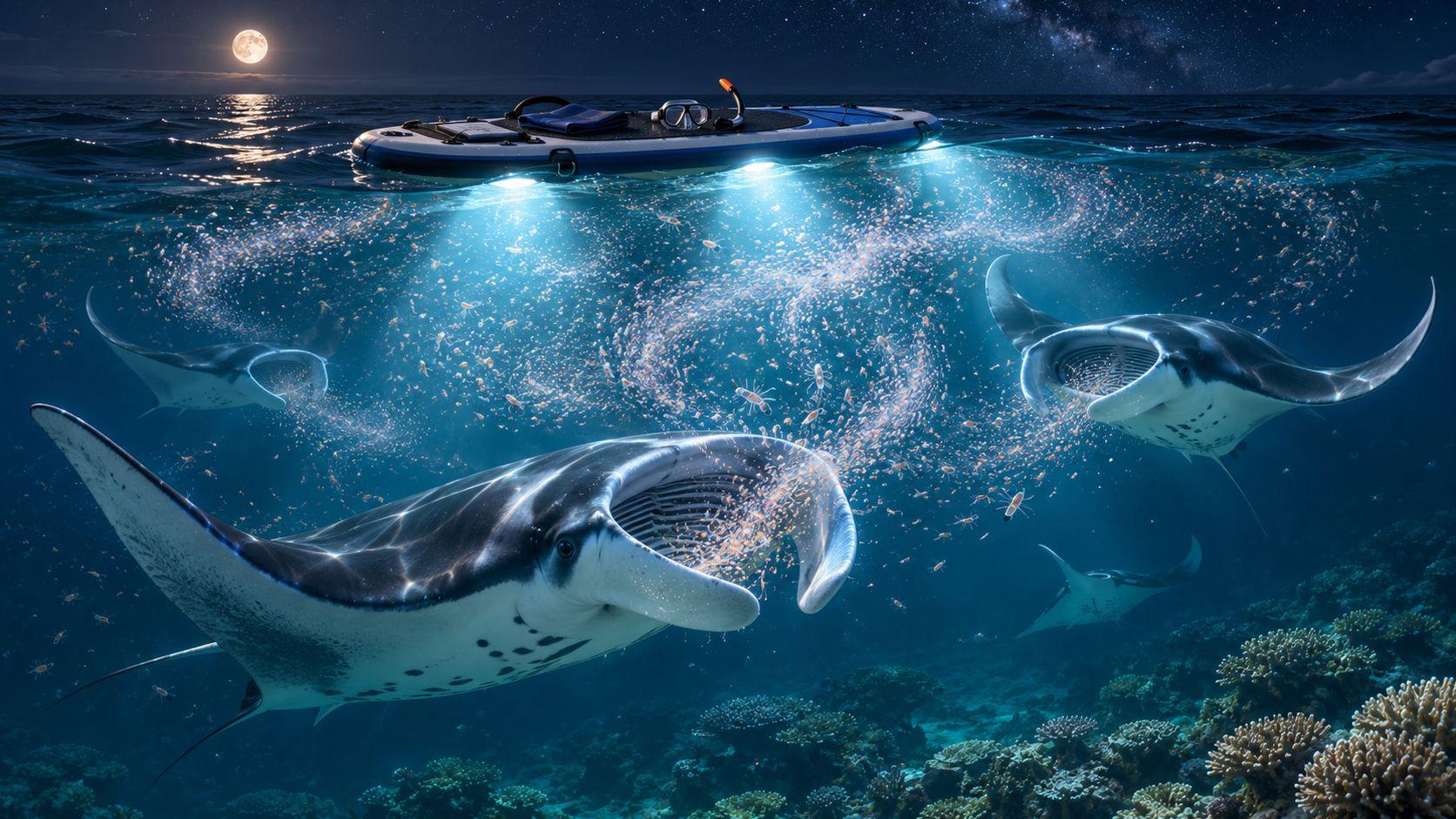
Nothing gets thrown into the water on a manta night snorkel. The crew lowers a board with high-powered lights aimed down, and the rest is a food chain doing what it always does. That distinction matters if you've read about shark feeding dives: no animal here is provisioned, and none of them is trained to a handout.
The chain runs light, then plankton, then mantas. Underwater lights raise illumination in the upper water column, zooplankton concentrate there, and reef manta rays (Mobula alfredi) arrive to filter them. The University of Hawaiʻi reporting on the Kona lights-plankton relationship calls this trophic attraction rather than baiting, because the lights never summon the rays directly. They change where the prey sits, and the predator follows the prey.
A feeding manta swims with its mouth open and sweeps its cephalic fins, the two forward flaps, to funnel plankton-rich water toward its gill filters. The barrel rolls and looping passes that look like play are work. Each roll keeps the animal moving through the densest layer of prey.
The rule that follows from the biology: hold the board, stay flat at the surface, and let the manta pick the distance. Every close pass worth remembering came from an animal that decided to come to you.
Chasing, diving down, or reaching out breaks the geometry of a feeding run and puts a large animal and a swimmer in the same water with no room to correct. That's why the no-touch rule exists. Contact can also strip the protective mucus coating off a ray's skin, which is a much bigger cost to the animal than to the guest.
Why the encounter happens after dark, next to shore
The habit is local and it began by accident. Floodlights burning around the clock during construction of what is now the Outrigger Kona Resort and Spa pulled plankton toward the surface, mantas followed the concentration, and organized night viewing grew out of that accidental light field. That origin explains the geography of the tour: the rays work the same lit edges where food collects, minutes from the harbor ramp, not miles offshore.
Treat any single night as a probability. A calm evening with thick plankton can put four or five animals under the board in an hour; a night after heavy swell can deliver one distant pass, or none, and none of that reflects effort from the crew. The mechanics of board placement and light angle are covered in why lights attract manta rays during night snorkeling if you want the fuller picture.
Where the Mantas Feed Along the Kona Coast
Two sites carry nearly every night snorkel on the island, and they sit about twenty minutes apart by water. Garden Eel Cove, which most crews sell as Manta Heaven, lies off the airport coastline. The other is the lit water in front of the Outrigger Kona Resort and Spa at Keauhou, known almost universally as Manta Village.
| Site | Where it sits | What shows up | Best for |
|---|---|---|---|
| Garden Eel Cove (Manta Heaven) | Off the airport coastline north of Kailua-Kona | Largest aggregations and the heaviest feeding traffic under the lights | First-timers who want the highest chance of multiple close passes |
| Keauhou (Manta Village) | South of Kailua-Kona, in front of the Outrigger Kona Resort and Spa | Smaller gatherings, predominantly female mantas | Calmer, quieter nights and shorter boat rides from the south |
| Keauhou resort shoreline | The lit water directly in front of the hotel | Mantas cruising the illuminated edge after dark | Non-swimming family members watching from land |
A 13-year study of those two feeding areas recorded more than 23,000 sightings involving 167 individual reef manta rays between 2010 and 2022, according to the University of Hawaiʻi research on Kona's night feeding sites. Garden Eel Cove consistently supported larger aggregations, while Keauhou was visited predominantly by females.
The same work found that changes in aggregation size tracked zooplankton density closely. Manta appearances are driven substantially by prey availability, not by a schedule somebody printed.
Why nobody swims these sites alone after dark
Both are open-ocean ledges worked by boats carrying light boards. Shore access at Keauhou means private resort frontage or a long, dark swim from a public entry, and neither is a sensible way to meet a feeding aggregation. This is a vessel-based activity by design, and the light board is the reason it works at all.
Our own night trip runs to Garden Eel Cove or the water in front of the Keauhou hotel depending on conditions, and we don't take ride-alongs on the manta charter. If someone in your group won't get in the water, the Keauhou shoreline is the better seat for them. They can watch the glow and the shapes crossing it while you're on the board.
Two practical questions shape the choice. How many boats work the same ledge at once on the night you're out, and how far the run is from your departure point. The first affects how crowded the water feels; the second affects how much of your evening goes to travel. The full comparison between the two sites is in Manta Village versus Manta Heaven.
The short version: if you want maximum odds and multiple close passes, you want the airport coastline. If you want calmer water, a shorter ride and a quieter group around the board, go south.
When to Go and What the Seasons Do to Your Odds
The mantas don't leave. Both Kona sites hold resident rays in every month of the year, so a January trip is not an automatic miss and a July trip is not a promise of a crowded board. What changes night to night is how much plankton is concentrated on the ledge, and that is what sets the size of the aggregation you meet.
There is no monthly pattern worth betting on. A plankton-rich night in February can out-draw a thin one in August, and a long calm spell that lets the water sit still and go rich can turn an ordinary week into a busy one. Moon phase, swell direction and how many boats are lighting the same ledge move your odds far more than the date on the ticket.
Three results travelers blend into one
- Seeing any manta. The most common outcome, and the one the odds generally describe.
- Seeing several animals. A plankton-density result, never tied to a season and never something a crew can order up.
- Earning a close pass under the board. Wildlife behavior plus guest behavior: still bodies get approached, busy ones get avoided.
A quiet night usually comes down to thin prey or water too rough to hold the boats over the ledge. That is ocean math, and any crew that pushes guests to chase when the animals stay deep has the priorities backwards.
Before you pay, ask what a no-sighting night means. Is it a refund, a rebooking credit, or a seat on a later trip? A straight answer tells you as much about the operator as the price does. Our manta guarantee has no expiry date and holds whenever space is open two hours before departure, which is how a guarantee should work.
Reading the calendar the right way
Expect heavier winter swell on the west side, daytime humpback whales offshore from roughly December into spring, and evenings around holidays that sell out well ahead. Book early in your stay rather than on your last night, so a blown-out evening still has a backup date behind it.
Pick the departure around your day, too. The early trip checks in during daylight, watches the sunset from the boat and puts you in the water after dark, which suits a first night when your body clock is still five hours ahead. The late trip checks in at night and leaves room for an afternoon volcano run or a long beach day first.
What to Bring and What the Boat Already Has
Most of the gear you need is already on the boat, and the short list you carry aboard is about comfort rather than equipment. Get this right and the night feels easy. Get it wrong and you'll spend thirty minutes in the water thinking about your own feet.
| Item | On the boat | Pack your own | Why it matters |
|---|---|---|---|
| Mask and snorkel | Yes, fitted at check-in | Yes if you use a prescription mask | A leaking mask ends your night in ten minutes |
| Wetsuit | Yes, typically 1.5 to 3 mm | No | You are motionless in the water for half an hour after dark |
| Flotation belt | Yes, for every guest | No | Keeps hips and feet up so you do not kick the mantas |
| Light board | Yes, custom-built with high-powered lights | No | The lights concentrate the plankton the mantas feed on |
| Towel and warm layer | No | Yes, plus a zip-up jacket | The ride back is cold even in summer |
| GoPro or action camera | No | Yes, with a wrist strap | Hands stay on the board, not on the animal |
| Seasickness tablets | Sometimes | Yes, taken about an hour before | The boat drifts while you are in the water |
| Dry bag and headlamp | No | Yes | Keeps the car keys dry and finds your shoes on the dock |
The three items worth carrying
Our recommended items for the manta night snorkel are a towel, a zip-up jacket and a GoPro, and each one earns its place. The towel is obvious on the way back. The jacket matters more than it sounds, because a thirty-minute boat ride in wet swimwear after the sun is gone cuts through you even in a warm climate. The GoPro needs a wrist strap, because your hands stay on the board for the entire session and a dropped camera is gone.
A few smaller calls. Wear your swimsuit under your clothes so you can step into a wetsuit at check-in. Take seasickness tablets about an hour before departure if you're prone to it, since the boat drifts while you're in the water. Bring a headlamp for the dock instead of relying on a phone, and a dry bag for keys and a phone. If you wear contacts, ask about a prescription mask rather than risking a lens in the dark.
Leave fins behind unless your operator says otherwise, skip reef-unsafe sunscreen, and plan on needing warm, dry clothes for the ride home.
Staying Safe and Respectful in Open Ocean at Night
Stay at the surface and keep your hands on the board. Everything else in this section is detail stacked behind that single instruction.
The manta snorkel is a nighttime open ocean activity, and the voluntary standard NOAA publishes reflects what that demands. NOAA's wildlife interaction guidance for manta encounters separates snorkelers and divers deliberately: snorkelers stay at the surface and shouldn't drop into the feeding column, while divers stay on or near the bottom so the mantas keep open water to maneuver through. The same guidance says not to chase, grab, ride or pet a manta ray, because contact can remove the protective mucus coating on their skin, and that snorkelers should aim lights downward at the plankton rather than out into the water.
The safety stack, in the order it matters
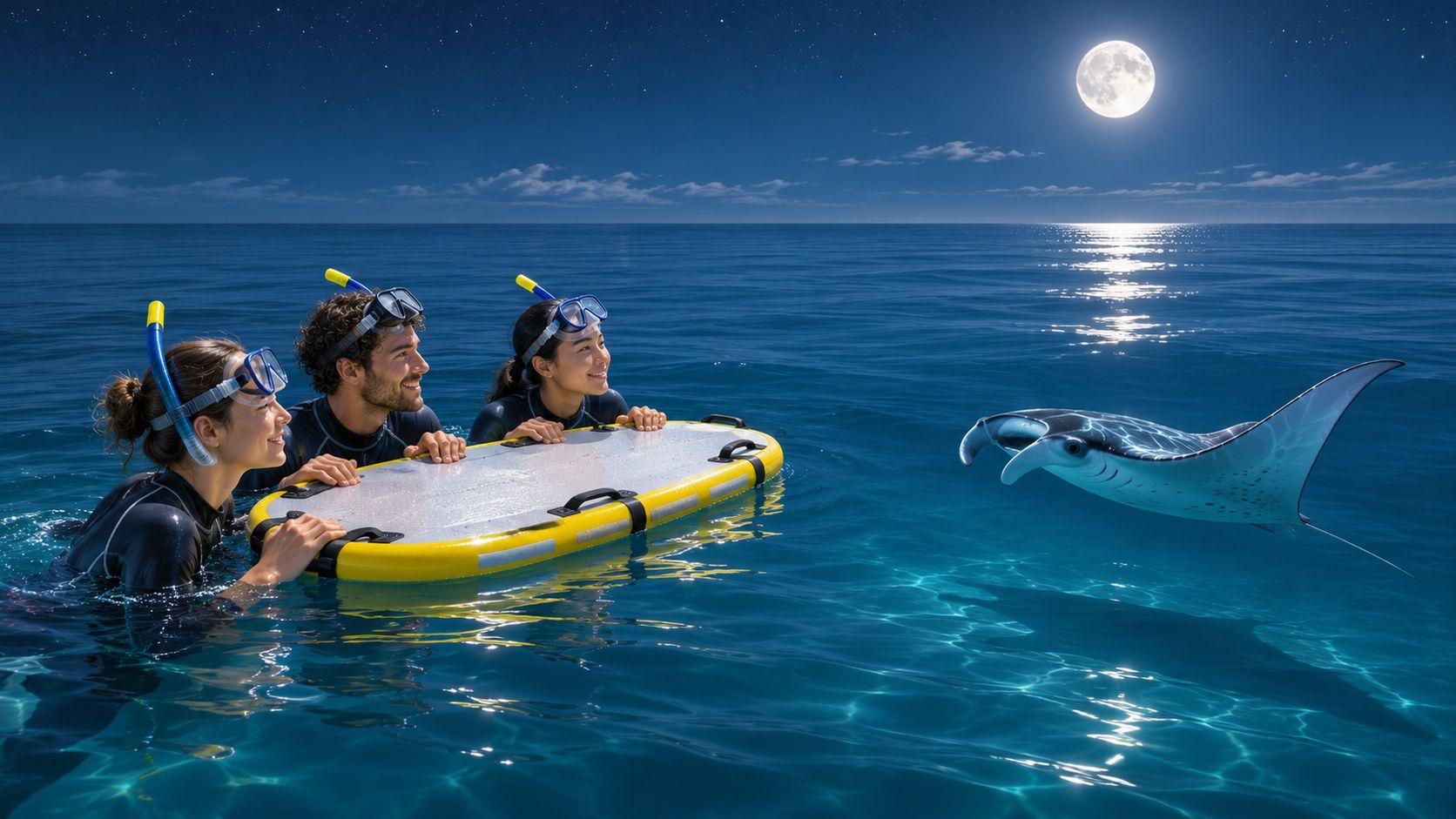
- Flotation for everyone. All guests wear flotation belts on the manta tour, which keeps hips and feet up and away from the rays.
- Lights pointed down. Into the plankton, never into another guest's mask.
- A guide in the water. Not shouting from the deck, but swimming with the group.
- A headcount on every exit. Dark water plus a moving group is exactly when someone gets missed.
The honest prerequisites are worth repeating. Guests should be able to swim 50 yards without additional flotation and should arrive as an intermediate snorkeler with prior experience. If that doesn't describe you, a daytime reef trip is the better first step.
When a manta comes straight at your mask
Hold still and keep your hands on the board. A ray tracking plankton in the beam will pass under or beside a flat, motionless swimmer and correct its own line. It cannot correct for a hand that reaches out, and a swimmer who sits up or kicks creates the one collision risk in the whole encounter.
The cold arrives around the half-hour mark, which is normal and not a sign to get out early if you're comfortable. Seasickness tends to hit while you're stationary and looking down, so take tablets before you board. If you wear a prescription mask at home, arrange one here rather than squinting through the night.
Our own Hawaii Manta Ray Guide covers the ethics version in full, including the reef-safe habits that start at the dock. For the guest-side rules that protect both the animals and the people watching them, read the manta ray snorkeling rules that protect wildlife and guests.
What Happens on the Boat From Check-In to Warm Towel
You check in at 74-381 Kealakehe Parkway in Kailua-Kona, and the first job is finding a mask that seals. The crew will swap masks until yours fits, because a leak ruins the session faster than cold water ever will.
- Check-in and fitting. Mask, snorkel, wetsuit, then the flotation belt. The belt sits at your waist and holds your hips and feet up at the surface, so your fins stay well above anything passing below.
- The run out. A short motor to Garden Eel Cove or the lit water in front of the Keauhou hotel.
- The light board goes in. The crew sets the custom-built board and aims its high-powered lights while you settle your mask.
- You slide in and hold on. The in-water block runs 30 to 40 minutes on Manta Ray Snorkel trips. For comparison, Kealakekua Bay morning snorkel trips put guests in the water for an hour or more.
- Out, dry off, ride back. The towel and zip-up jacket you were told to pack earn their keep on the return leg. You'll feel colder out of the water than in it, because the wetsuit stops working the moment you leave it.
The manta snorkel is the most popular tour on the island, so two departure times frame the same session. On the early trip you check in during daylight, watch the sunset from the boat, and slip in after dark. The late trip checks in at night after a full day, and the water time on the board is identical. If you're still shaking off jet lag, I'd take the early one.
Here's the whole sequence in motion.
The night runs about two hours start to finish. The short water block is by design. Some evenings the rays stack onto the lights within minutes, and some evenings they stay deep, and no crew on the coast controls which kind you get. If your night comes up empty, Kona Snorkel Trips' Manta Ray Night Snorkel carries a manta guarantee that doesn't expire, honored when space is available 2 hours before the tour starts.
Choosing a Boat and Booking Your Night
Crowding is the part of this experience nobody puts on a brochure. A peer-reviewed survey of manta ray encounters found that 82% of respondents felt crowded by snorkelers, 78% by boats and 69% by scuba divers, and separate reporting from Kona documented vessels running faster than recommended, passing within 10 to 20 feet of unlit snorkelers, and moving over submerged divers, as detailed in the Hawaii County manta testimony on snorkeling and diving interactions.
Capacity management is still an open policy question. The 2022 Hawaii DLNR proposal for commercial manta viewing contemplated 24 commercial permits in each of two zones, a cap of 60 passengers for hire within a single 24-hour period, two-hour shifts per zone, viewing hours of 4:00 p.m. to 4:00 a.m., and safety requirements including vessel lighting, propeller guards and a dedicated lookout. Until rules like that settle, your booking choice is the strongest lever you have.
| What to check | Good sign | Walk away if |
|---|---|---|
| Snorkelers per light board | Six to eight, with a guide in the water | Thirty or more people on one light setup |
| Guide credentials | Lifeguard-certified crew and a guide who swims with you | Guide stays on deck and shouts instructions |
| Distance rules | Surface-only, no diving, no touching, lights pointed down | Freedom to swim down to the rays |
| Sighting policy | Stated plainly as rebooking, credit or refund | Vague promises and a hard guarantee |
| Boat traffic at the site | Operator coordinates with other boats and rotates sites | Several boats racing for the same patch of water |
| Capacity policy | Small group size advertised and enforced at check-in | Price driven by volume alone |
Why the small group matters more than the price
Hawaiʻi Island supports a small, distinct breeding community. A NOAA-linked genetic study estimated the contemporary effective population size at approximately 104 breeding individuals around Hawaii Island, with a 95% confidence interval of 99 to 110, as reported in NOAA Fisheries' coverage of the reef manta genetic study. Female mantas were found to reproduce at the island where they were born, and reef mantas rarely cross the deep channels between island groups.
A few dozen breeding adults absorbing nightly attention from dozens of swimmers is a different equation than a large, freely mixing population. Repeated encounters concentrate human activity at predictable feeding sites, and small groups are the simplest way to reduce pressure per animal.
Our manta guarantee doesn't expire and is honored if space is available two hours before the start of the tour, which removes the fear of burning a night for nothing. For a wider comparison of operators, use how to choose the right Kona manta ray snorkel tour.
Kona Snorkel Trips runs the two-hour Manta Ray Night Snorkel from Honokohau Harbor with lifeguard-certified guides, a flotation belt for every guest and a custom light board that does the plankton work for you, with early and late departures so the night fits around a volcano day or a first evening on the island. The same crew runs Kealakekua Bay in the morning if you want the reef in daylight too. Visit Kona Snorkel Trips to pick a date and read the manta guide before you go.
Keep reading
Manta Ray Snorkeling Big Island: A Practical 2026 Guide
Manta Ray Snorkeling Big Island. Plan manta ray snorkeling on the Big Island with this 2026 guide. Best sites, tour choices, packing tips, safety rules
Manta Ray Snorkel in Kona: The Complete Guide
Plan an unforgettable manta ray snorkel in Kona. Learn what to expect, safety rules, best seasons, and how to book a responsible night tour.
Manta Ray Night Snorkel Big Island: What to Expect
Manta Ray Night Snorkel Big Island. Plan a manta ray night snorkel on the Big Island with this 2026 guide to sites, timing, safety, etiquette, and booking tips.