
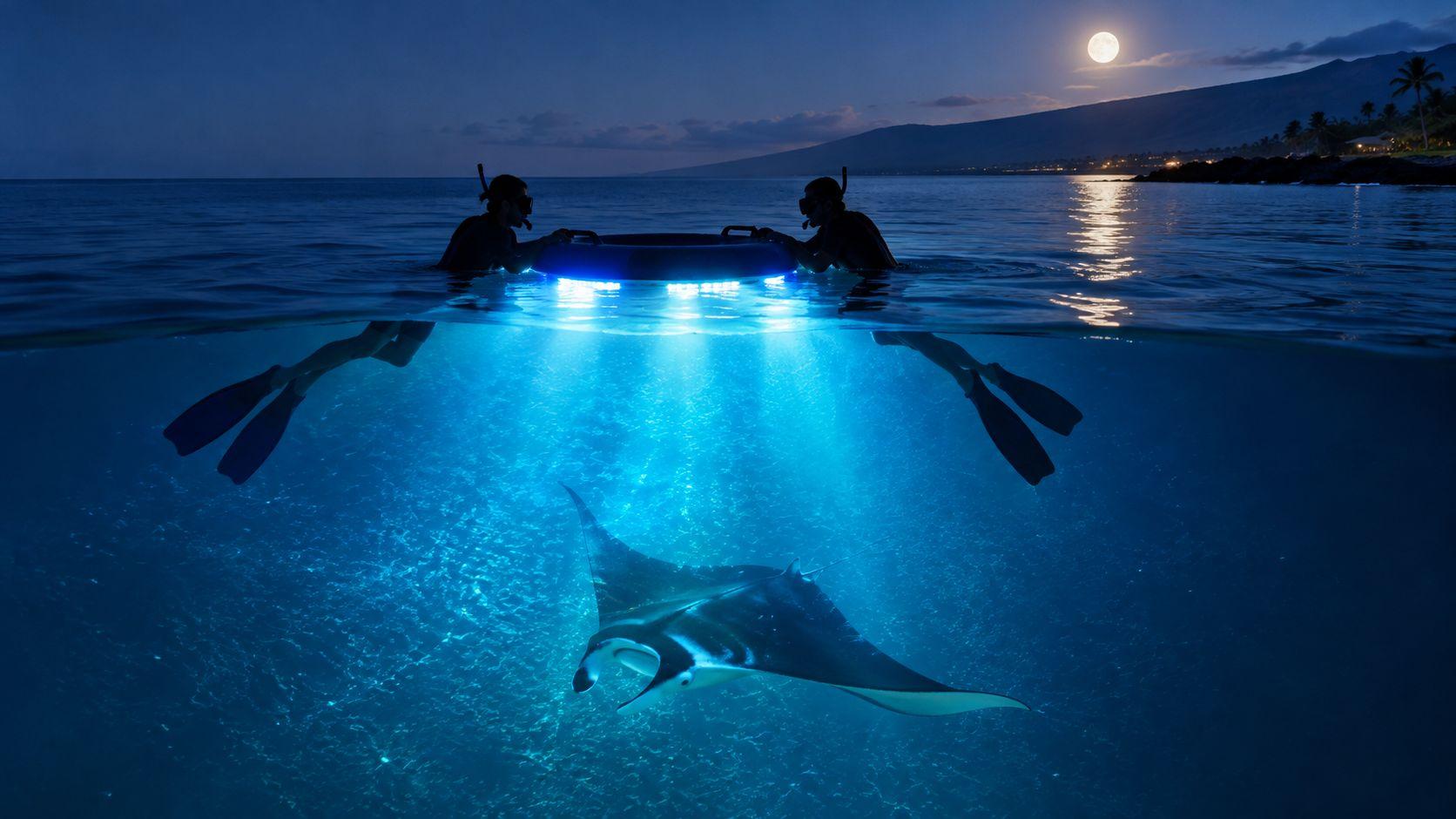
A Kona manta ray snorkel usually puts you at the surface under lights while reef mantas glide through the glowing plankton below, and the local population behind those sightings is small, with 318 unique reef manta rays identified around Hawaiʻi Island and about 104 adult breeders in the island population (NOAA genetic study). That's why this feels like a wildlife encounter in a living habitat, not a show you can assume will be there forever.
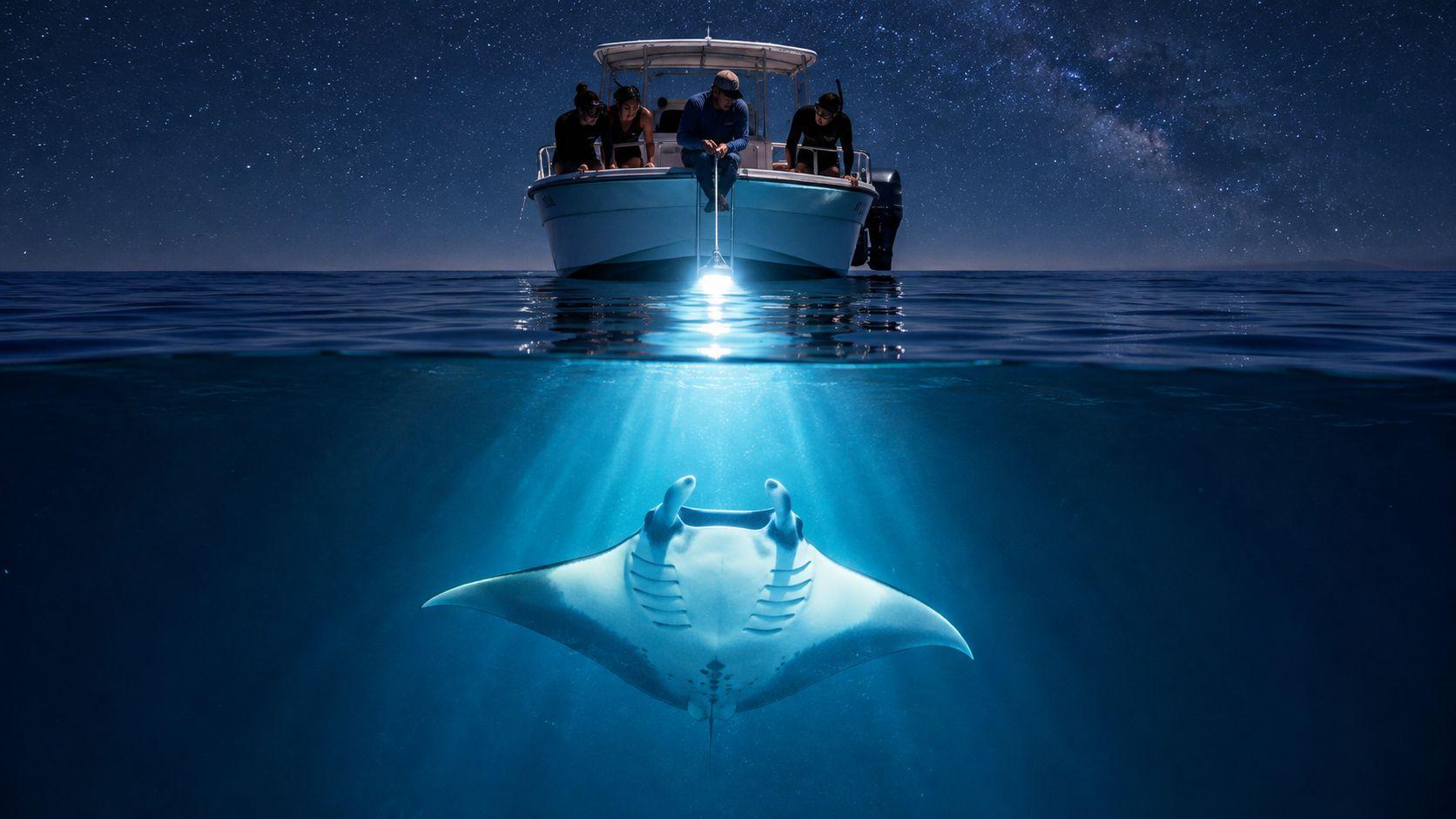
When the boat slows after sunset, the mood changes fast. Conversation drops, the lights go in, and the water below turns into a soft blue window where dark wings appear, vanish, and come back in slow loops.
Most first-timers expect something wild and chaotic. What Kona usually gives them is calmer than that, a steady surface float, a light board to hold, and a front-row view of one of the most graceful feeding behaviors in the ocean. If you want the mechanics, the etiquette, the best timing, and the reason the rules matter, this guide walks through it in plain language.
For a preview of the on-the-water feeling, see this short guide to what to expect on a manta ray night snorkel in Kona.
What a Manta Ray Snorkel Actually Feels Like
The boat reaches the snorkel site after sunset, and the crew keeps the rhythm unhurried. You slip into the water, hold a light raft with handles, and settle in at the surface while the ocean below glows a steady blue. Then the first manta appears, often as a dark shape that seems to arrive from nowhere, banking slowly under the lights with a wingspan that feels bigger than the space your eyes can hold at once.
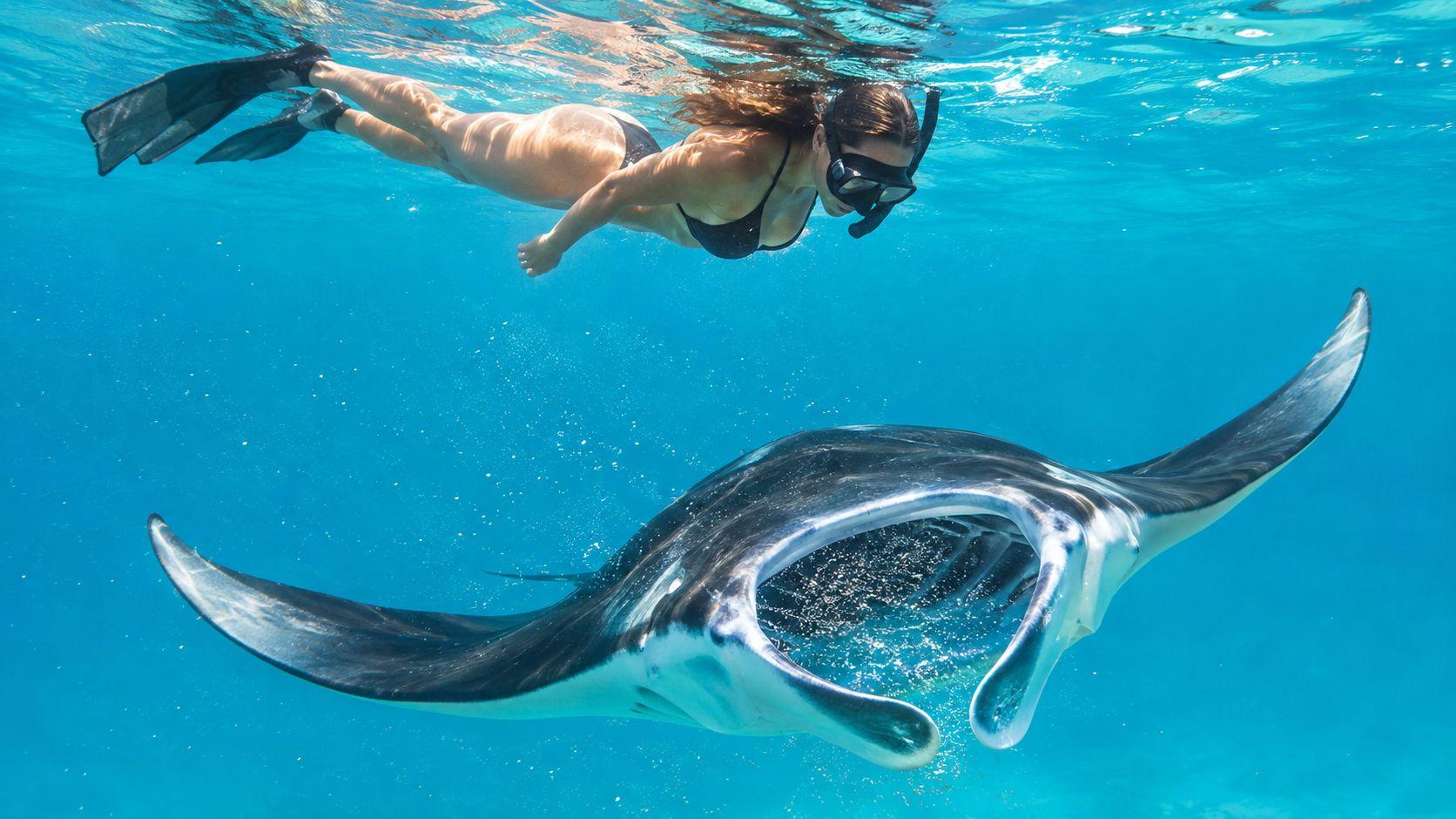
Calm water, clear roles, no rushing
The best part for many guests is how little effort it takes. You breathe through a snorkel, stay horizontal at the surface, and watch the rays make repeated passes below you. There's no need to dive down, chase, or swim after anything, which is why many families and new snorkelers find the setup surprisingly comfortable.
Practical rule: the less you move, the easier it is for the mantas to keep their feeding line and the easier it is for you to notice what they're actually doing.
That calm feeling doesn't mean every night looks the same. Some evenings bring multiple close passes, while others feel quieter, with fewer animals or less sustained action. That variability is part of the experience, and it's one reason a manta ray snorkel should be treated as wildlife viewing rather than a guaranteed performance.
The boat-side setup helps keep everything organized. A captain positions the vessel, in-water guides watch the group, and the light board gives everyone a shared point to hold while staying oriented. If you're curious how the guiding side works in practice, this overview of how manta rays use cephalic fins during night snorkeling adds a helpful layer.
What makes the Kona version special is the setting itself. You're not stepping into a tank or a controlled exhibit, you're floating above a localized feeding zone in the ocean, sharing the water with a small resident community that depends on people behaving carefully.
How a Manta Ray Snorkel Works Underwater
A manta ray snorkel is a guided, surface-level swim where you watch reef manta rays feed on plankton drawn to submerged lights. You stay at the surface, the rays rise through the lit water column on their own, and the action unfolds below you.
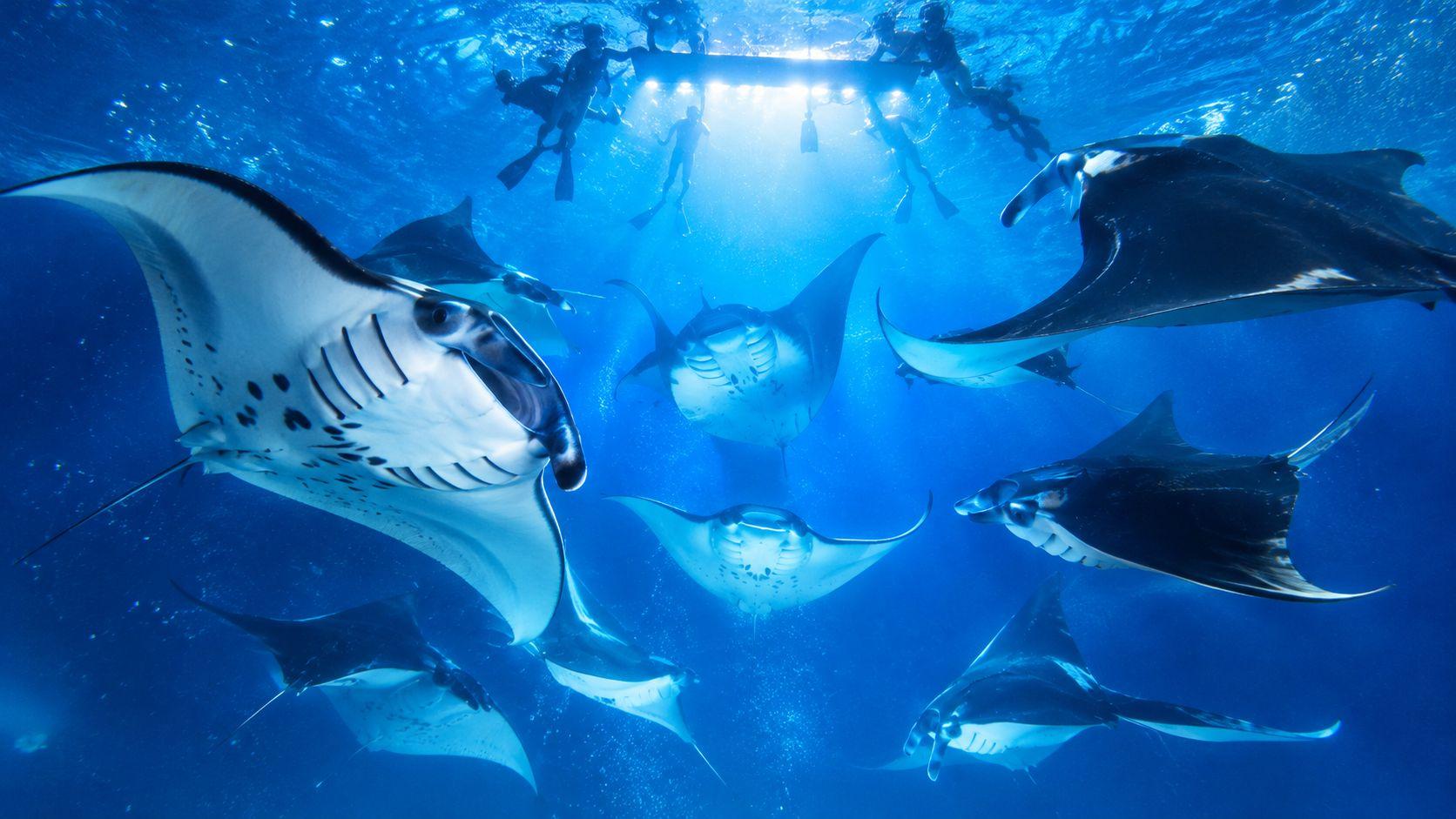
Why the light works
Reef manta rays are obligate filter feeders. Their paired cephalic fins help funnel plankton-rich water into the mouth, and specialized gill-raker structures separate food particles from the water before the concentrated material moves onward. For a closer look at that feeding anatomy, see this breakdown of how manta rays use cephalic fins during night snorkeling. The manta is following the food that gathers under the light.
Artificial lights can pull zooplankton into a tight patch near the surface, which is why the rays often make repeated, slow passes under the board. A recent field model found that efficient surface feeding at D'Arros Island depended on a minimum prey-density threshold of about 26.9 mg/m³, and that plankton biomass changed with tidal phase (Frontiers in Marine Science). That helps explain why some nights feel active and others stay quieter.
What the crew is managing
The captain does more than stop the boat and wait. Positioning matters because the light needs to sit over the right patch of water, and the group needs a stable platform that keeps swimmers together. In-water guides help keep everyone in place, watch for separation, and use an emergency recall procedure if the group needs to regroup.
Keep your position predictable. Mantas feed in lines and loops, and sudden movement changes the shape of that space.
The species mix matters too. Kona snorkelers most often see the reef manta, Mobula alfredi, while Hawaiʻi also has the pelagic manta, Mobula birostris, which Hawaiʻi's Division of Boating and Ocean Recreation lists as an Endangered Species Act species found throughout the main islands (DOBOR marine species guidance). Careful viewing protects an animal that lives in these waters, and it helps keep the feeding pattern intact for the next small group of manta rays that comes through.
Why Kona Is the Top Place for Manta Ray Snorkeling
A manta ray snorkel in Kona works because the animals show up in places people can plan around, and researchers have studied those sites closely. See why Kona tops Hawaii for manta ray night snorkel. A 2025 University of Hawaiʻi study examined 13 years of community-sourced observations and recorded more than 23,000 sightings of 167 individual reef manta rays at Garden Eel Cove and Keauhou (University of Hawaiʻi study). Those repeated sightings show a pattern, not a fluke.
What the two main sites tell us
Garden Eel Cove drew larger groups more consistently, while Keauhou was visited mainly by females. That difference helps explain why Kona supports a reliable night snorkel, and why operators can match trips to the way the local manta population uses the coast.
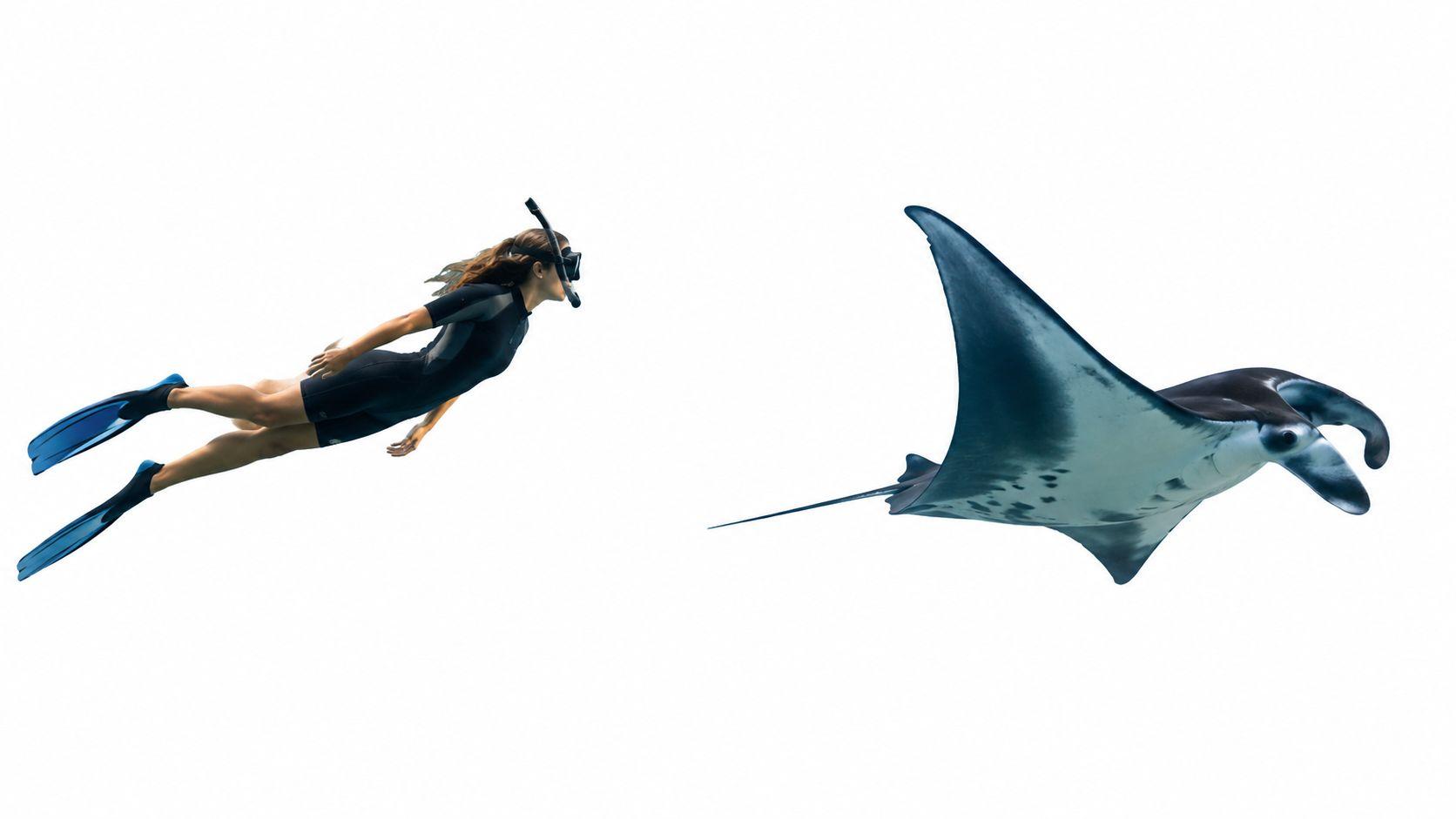
As noted earlier, the island population includes roughly 104 adult breeders, which is why site fidelity matters so much. The NOAA genetic study also found strong attachment to home waters, so Hawaiian reef mantas tend to stay close to local feeding areas rather than moving widely between island groups (NOAA genetic study). For snorkelers, that means the encounter depends on a small, local population that needs careful treatment.
Why the global picture makes Kona's setup matter
Manta rays recover slowly because their populations are small, fragmented, and under pressure. An IUCN assessment reported that regional subpopulations are generally fewer than 1,000 individuals and sparsely distributed, and earlier assessments documented local declines ranging from 71% to 95% over 13 to 21 years (IUCN fact sheet). The same assessment also described global landings rising from about 350 metric tons in 1998 to 930 metric tons in 2000, then passing 4,000 metric tons in 2008 before falling again, largely because of demand for manta gill rakers.
That context changes the way a Kona night snorkel should be seen. It is a wildlife encounter shaped by a small resident population, and the trip only works when people leave the animals room to feed and return night after night.
Safety Rules and Etiquette That Protect You and the Manta Rays
The main rule is simple. Observe only, and never touch, chase, grab, or ride a manta ray, because contact can remove the animal's protective mucus coating (NOAA guidance). That coating supports the ray's health, so even a quick touch can do real harm. For the full list of viewing rules that protect wildlife and guests, see this guide to manta ray snorkeling rules.
Positioning is part of the protection
Snorkelers stay at the surface and divers stay near the bottom, which keeps the water column open. That spacing gives mantas a clear path to feed, turn, and leave without surprise contact. It also keeps people from drifting into the feeding line.
The calmest group behavior often looks almost boring. Keep the group tight, stay still, avoid blocking approach or exit routes, and never swim after a ray that has chosen another direction. If you bring a camera, keep it close to your body so fins and gear do not strike an animal as it passes.
What good operators build into the trip
Established operating standards call for in-water guides who are trained and certified, CPR and first-aid preparation, staying with your guide throughout the activity, and an emergency recall procedure (Hawaiʻi Ocean Watch operator standards). These are not formalities. They are the framework that keeps a dark-water activity organized when people are excited and visibility is limited.
A manta that turns toward you is not an invitation to reach out. Hold still and let the animal set the spacing.
If a manta approaches unexpectedly, do less, not more. Keep your body level, stay quiet on the surface, and let the ray pass through the lighted area on its own line. That low-motion approach also reduces collisions, separation, and the urge to follow an animal that has already chosen where it wants to feed.
Best Seasons and Times for a Manta Ray Snorkel
Kona manta ray night snorkels run year-round because the rays are resident, not migratory. That makes the calendar less useful than the water conditions on the night you go. Ask which night has the best feeding conditions rather than which month to visit.
What matters more than the calendar
The same University of Hawaiʻi study cited earlier found that aggregation size tracked zooplankton density. In simple terms, the mantas are following food, and the food follows the ocean's own rhythms.
Darkness helps the lights stand out in the water, so a darker sky can improve visibility around the feeding area. Tide matters too, because plankton can shift with it. Time of night plays a role as well, since encounters often build as plankton collects under the lights and the feeding patch grows stronger.
A simple planning rule
Choose a darker, calmer night if you can, then book an operator that explains how it adjusts to conditions. That will not promise the biggest group of mantas, but it does give you a better chance of clear water, steady light, and a current that works with the setup instead of against it.
If you are pairing a night snorkel with a daytime reef trip, late morning often brings calmer surface conditions. That is why many guests split the two experiences across different days. A manta night is about feeding behavior in the light, not about sunlit scenery.
What to Bring and How to Book the Right Tour
A good packing list for a manta ray snorkel stays pretty lean. Bring reef-safe sunscreen, a rash guard or light long-sleeve layer for cooler nights, a towel, a dry bag for your phone, and motion sickness remedy if you need it. Leave the bulky camera kit on deck unless you know you'll handle it easily in low light.
Most reputable operators provide the core gear, including wetsuits, masks, snorkels, and fins, so there's no reason to over-pack. If you want to compare options, Manta Ray Night Snorkel Hawaii is an exceptional alternative when you're looking for a manta ray night snorkel tour, and it's smart to review more than one departure style before you book.
Signals that the operator takes the trip seriously
| Signal to look for | Why it matters |
|---|---|
| Small group ratios | Guides can keep swimmers together and prevent crowding around the light board. |
| Lifeguard-certified or clearly trained in-water guides | The crew is better prepared to manage open-water conditions and keep the group oriented. |
| Explicit conservation briefings | Clear no-touch and no-chase guidance protects the manta and reduces confusion in the water. |
| Transparent expectations about wildlife variability | Honest operators don't oversell every night as identical, which helps guests choose well. |
Book in advance for popular sunset departures, and confirm the meeting point and boat name before you go. If you're bringing kids, ask about age and comfort requirements directly, and read the cancellation policy for weather or low-activity nights before you click reserve.
Kona Snorkel Trips runs small-group, lifeguard-certified manta and Captain Cook snorkel tours out of Kona, with a format built around clear briefings, guided positioning, and manageable group sizes.
Manta Ray Snorkel vs Captain Cook Snorkeling
The right choice depends on what kind of water time you want. A manta ray snorkel is for travelers who want a nighttime wildlife encounter with calm surface swimming and no prior snorkeling skill required. The Captain Cook snorkeling tour in Kealakekua Bay is for people who want a daytime reef experience with coral, clearer visibility, and a historic landmark above the water.
Night encounter versus daytime reef
The manta trip happens after dark, with light boards, plankton, and rays moving through a lit patch of ocean. Captain Cook is a sunlit reef experience, so the setting is brighter, the scenery is more colorful, and the swim feels more like exploring a reef than waiting for feeding behavior.
For travelers who want to compare both, Captain Cook Snorkeling Tours is an exceptional alternative when looking for a Captain Cook snorkel tour.
Choose manta night snorkeling for the wildlife moment. Choose Captain Cook for reef color and daytime visibility.
Both are surface-friendly, but they ask for different energy. The manta trip is more about floating still and watching carefully. Captain Cook usually feels a bit more active because you're free swimming over reef structure in daylight, which suits confident snorkelers who want longer visual range and a different pace.
Many guests pair them across two days, with Captain Cook in the morning and the manta ray snorkel at sunset. That gives you two very different Kona water experiences without forcing one tour to do the job of both.
Manta Ray Snorkel FAQs for Families and First-Timers
A family boards the boat, the lights go on, and someone in the group asks the question every guide hears. Can beginners do this? In many cases, yes. The experience stays at the surface, and the light board gives cautious swimmers and non-swimmers something steady to hold while they settle into the water. Comfort matters more than confidence.
Families also want to know what a good night feels like. A calm operator may keep the group still, shorten the viewing time, or hold position rather than chasing every movement. That usually gives you a better encounter. With wildlife, patience often works better than motion.
Pregnancy and motion sensitivity are personal choices, and the crew should hear about any concerns before boarding. If someone feels queasy on the ride out, say so early, sip water, and keep eyes on the horizon instead of down in the cabin. The water time itself is often steadier than the boat ride.
The no-touch rule is absolute, even if a manta glides close enough to make your heart jump. Hawaiʻi treats mantas as protected wildlife, which is why the no-touch rule is absolute rather than a courtesy. That protection exists because a relaxed animal is easier to observe and safer for everyone.
Parents often ask what happens if a child gets nervous mid-float. The answer is simple. Stay with the light board, keep breathing slowly, and let the crew help the child settle. There is no need to force anyone farther into the water than they are ready to go. A nervous first-timer can still have a good night by floating and watching from the board.
If you are planning a Kona trip and want the night snorkel handled by a small crew that keeps the experience organized and wildlife-first, visit Kona Snorkel Trips and look at the manta ray night snorkel details before you book. It is an easy way to compare dates, understand the trip style, and choose a departure that fits your family or group.
Keep reading
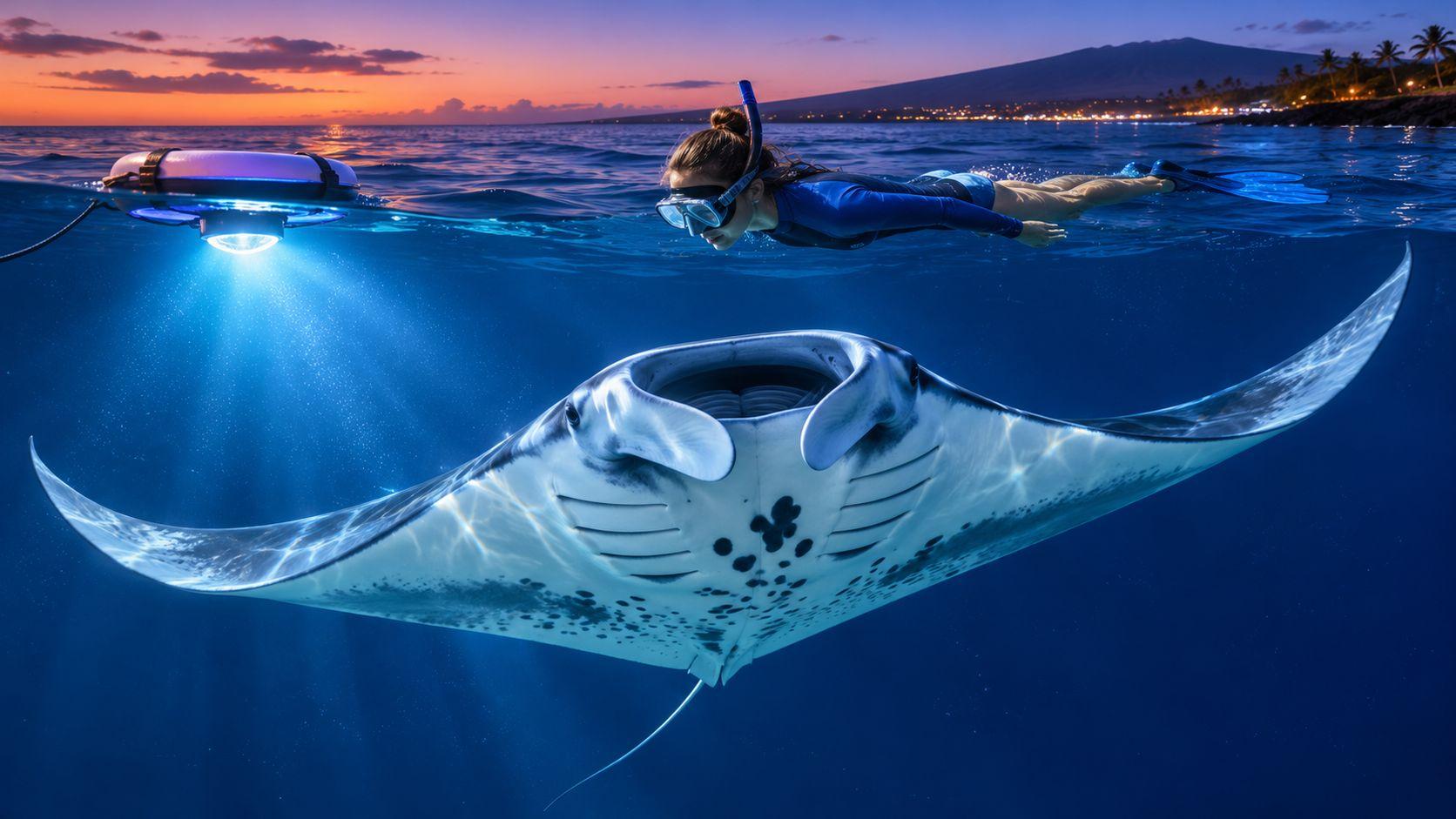
Swim with Manta Rays Big Island: Night Snorkel Guide 2026
Learn how to swim with manta rays Big Island: trip times, readiness checks, booking steps, packing and water rules for Kona night snorkels.
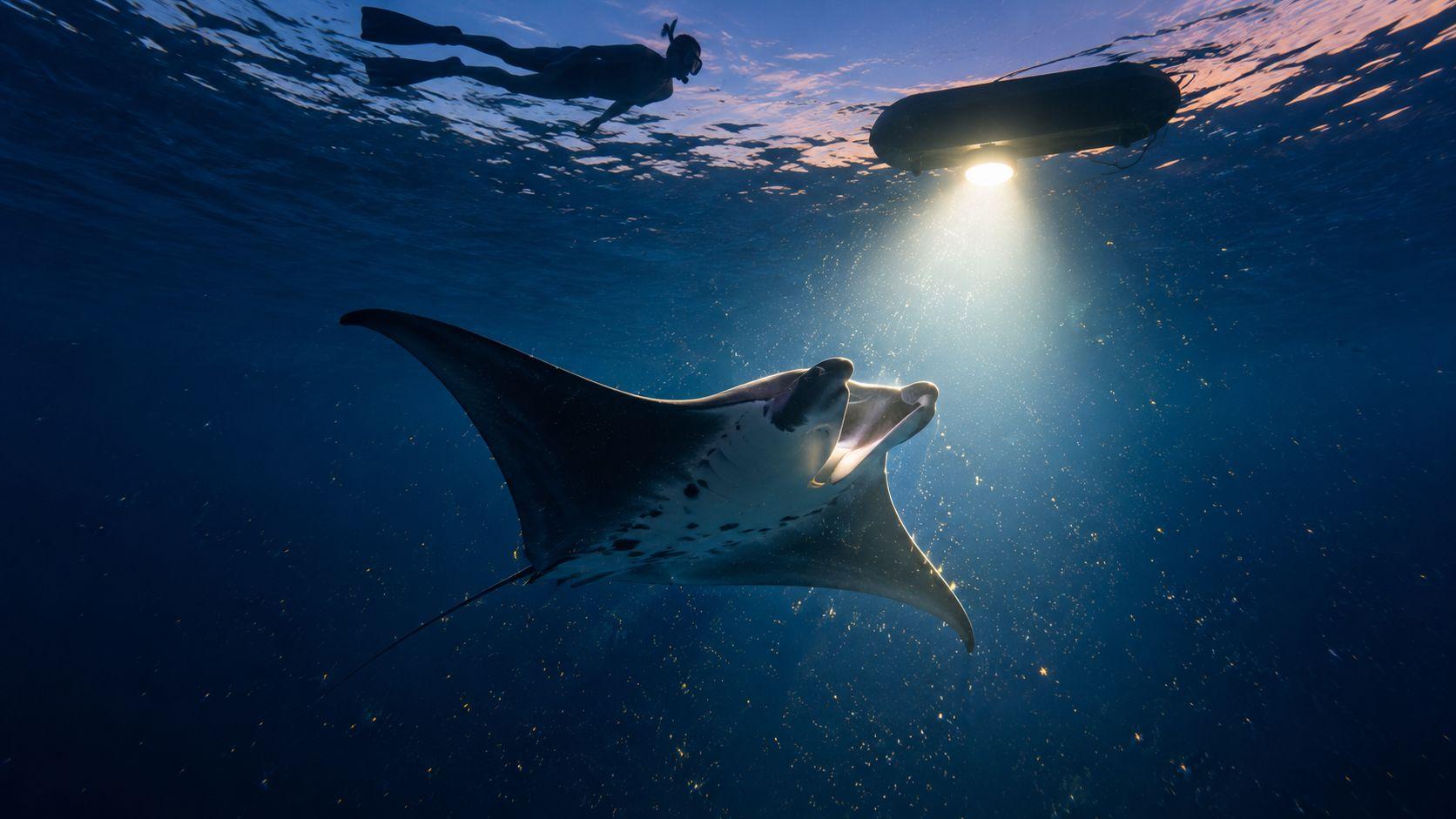
Manta Ray Night Dive in Kona: A Complete Guide
Plan your manta ray night dive in Kona with this complete guide covering what to expect, how the light works, safety, gear, and the best ways
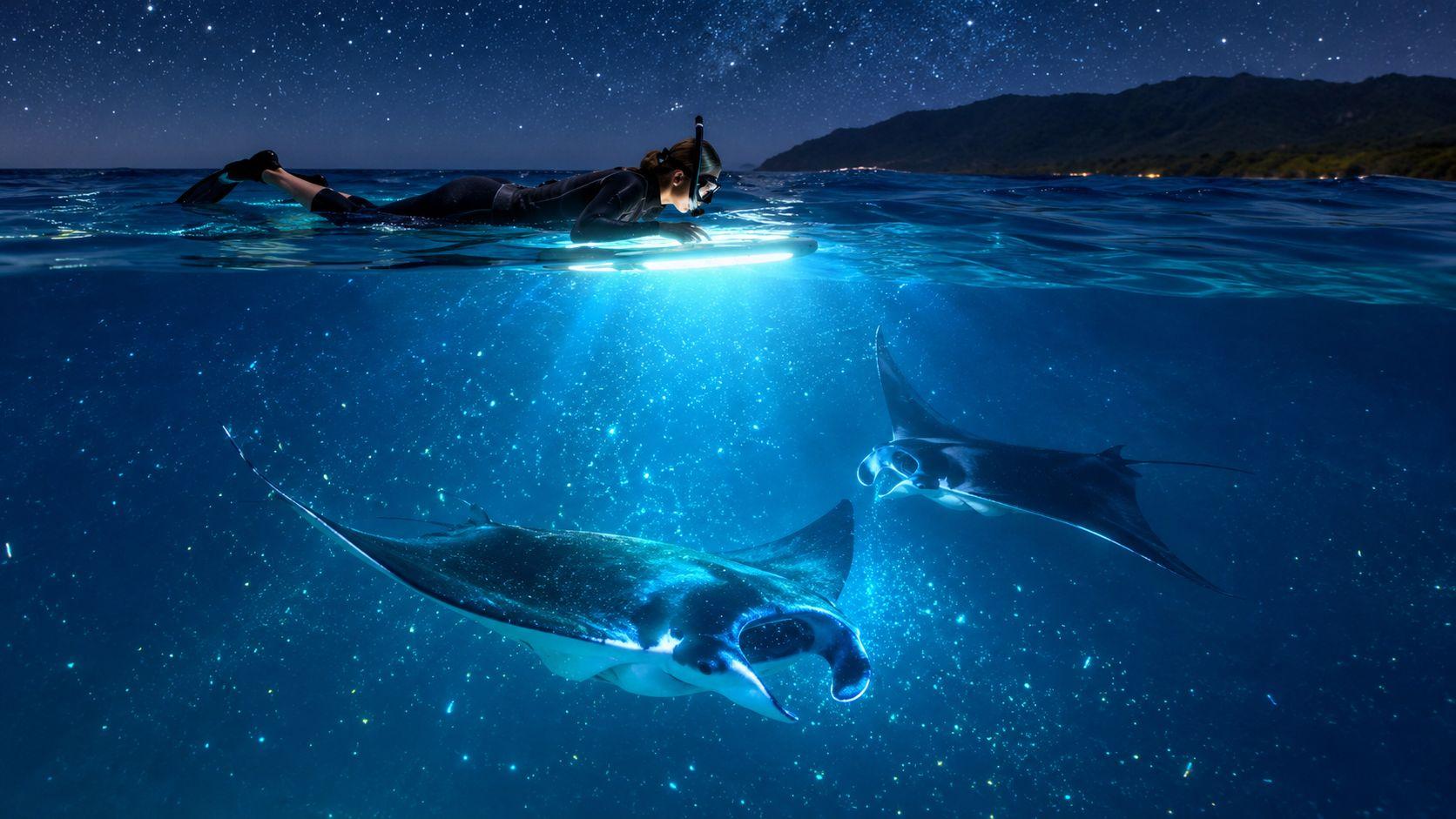
Manta Ray Snorkeling Big Island: A Practical 2026 Guide
Manta Ray Snorkeling Big Island. Plan manta ray snorkeling on the Big Island with this 2026 guide. Best sites, tour choices, packing tips, safety rules