
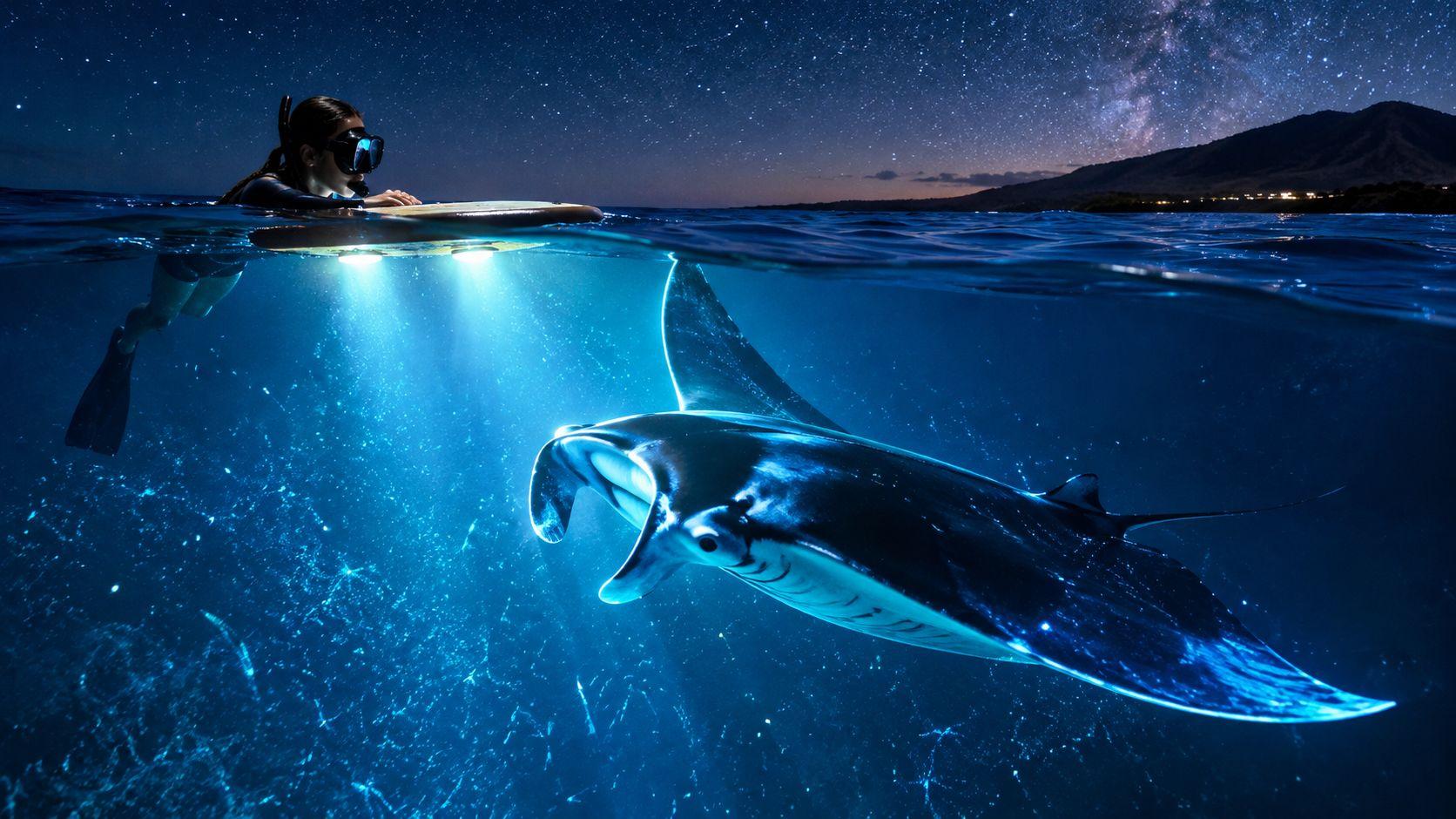
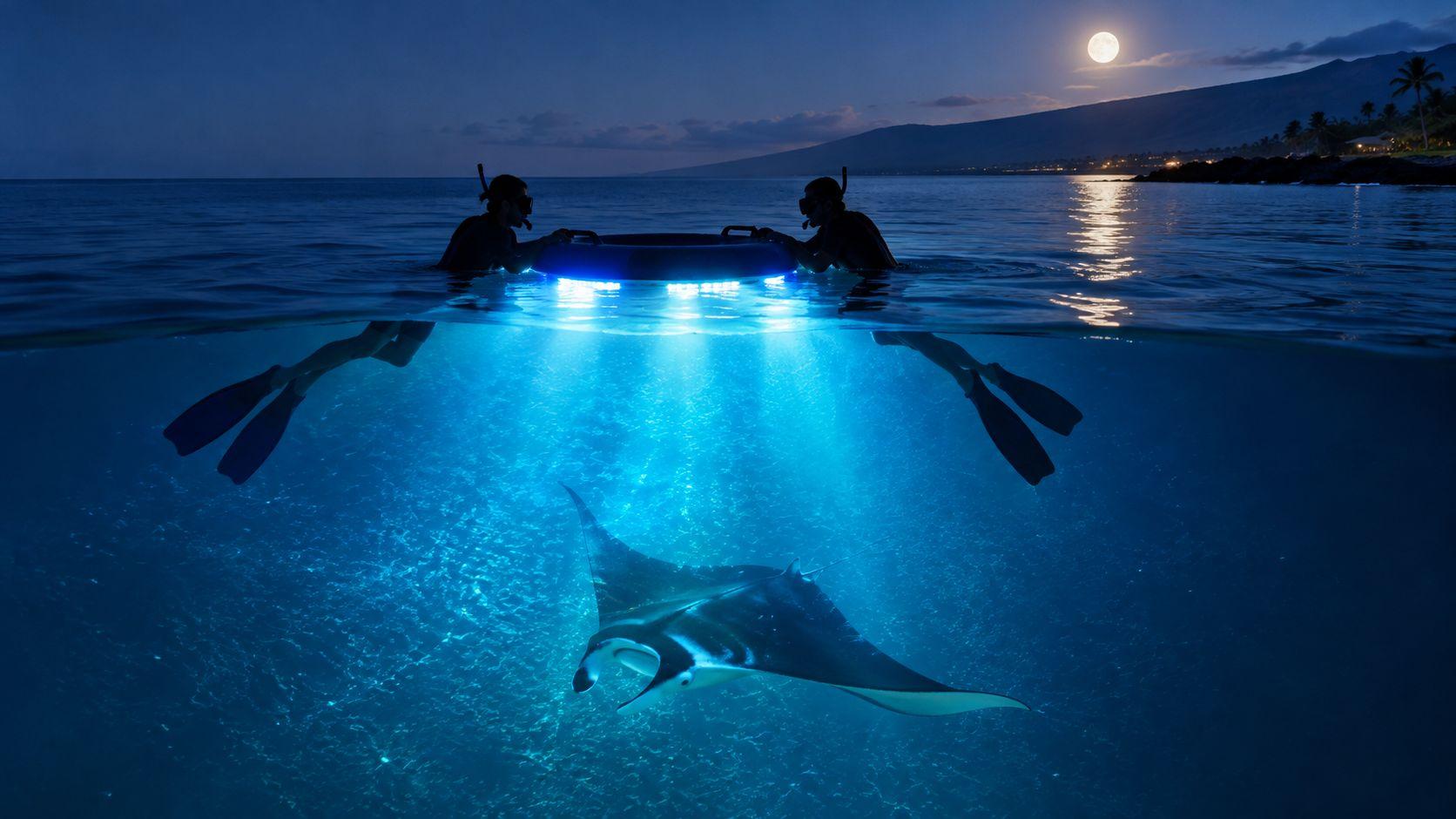
You're floating on your back in warm black water, one hand looped around a lit board, waiting for your eyes to adjust. The ocean feels quiet until a pale shape rises through the glow, a broad wingtip turns, and a manta ray glides underneath as if it had been there the whole time. That is the moment travelers seek on a manta ray night snorkel Big Island trip, and it helps to know what's making it happen before you book it.
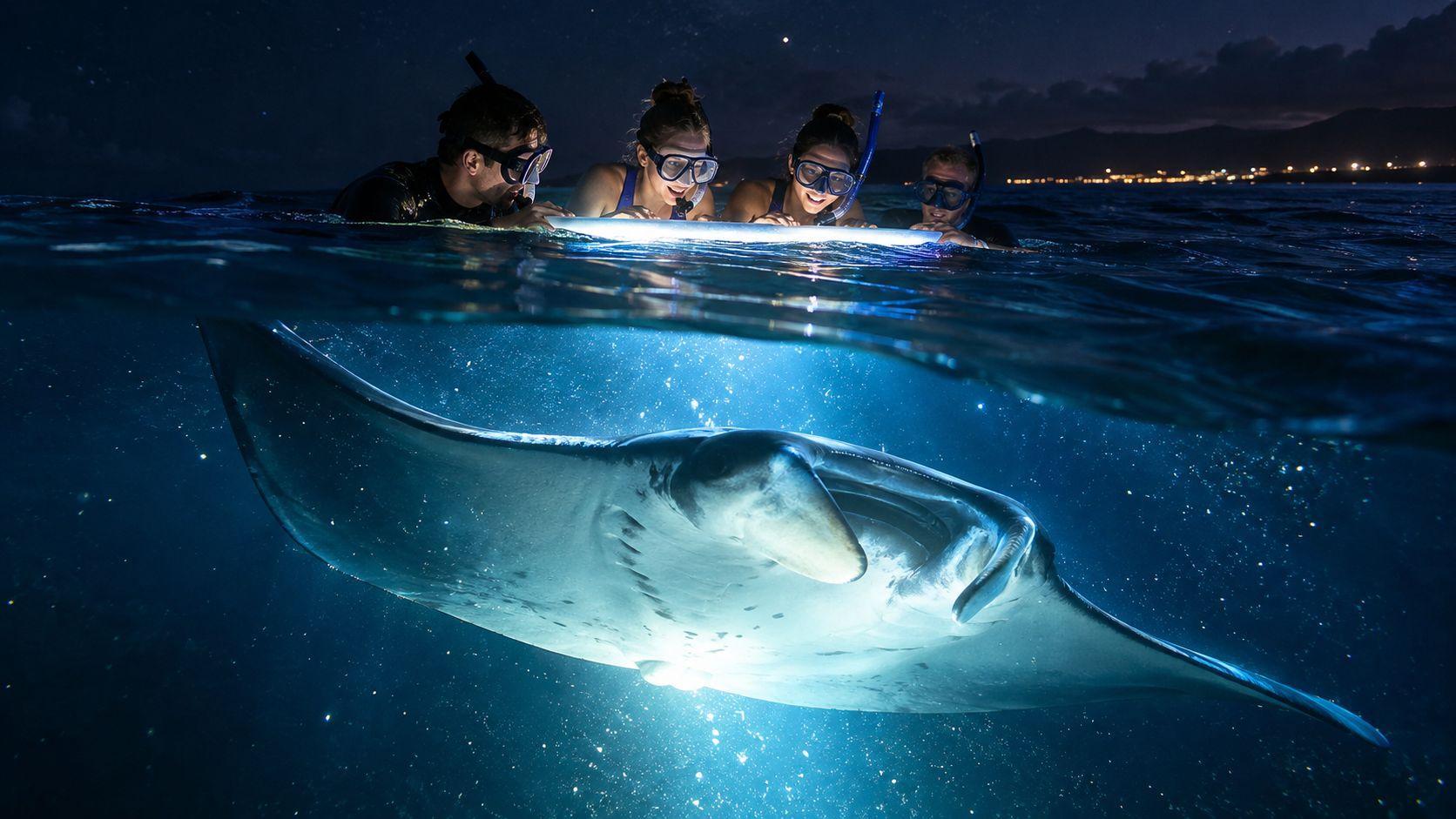
The part that looks effortless from the surface is really a careful mix of light, plankton, site choice, and crew control. Kona's nighttime manta viewing isn't a random wildlife lottery, it happens at established feeding sites used by a documented, individually recognizable population over many years, and the rules around the experience matter because the animals, the swimmers, and the boats all share the same dark water. If you're trying to understand what you're paying for, and what you shouldn't compromise on, the answer starts here, with the body position that keeps the encounter calm and safe. body position guide for manta night snorkeling
Floating in the Dark When a Manta Glides Underneath
The first pass often happens without much warning. A guest is holding the flotation board, the guide is checking masks and lights, and the beam below the surface is full of tiny bright specks. Then a manta comes in low, rolls slightly on one side, and fills the space under the group with a slow, silent sweep that looks bigger than any video clip prepares you for.
That is why the trip feels different from ordinary snorkeling. Staying still lets the manta do the work, and chasing the moment makes the encounter noisier and less predictable. The setup is built so you can stay at the surface and watch a wild feeder move through a concentrated patch of food, not a captive animal performing on command.
A lot of first-timers assume the excitement comes from getting close. The better experience usually comes from holding position and letting the animal pass through the light. When guests rush the moment, the view gets choppy and harder to read.
Practical rule: if the board, lights, and crew positioning are right, the viewing should feel calm, not frantic.
For travelers comparing options, the part worth paying for is the controlled surface setup and a crew that knows how to hold that space. A good night snorkel is less about spectacle and more about making a brief, shared feeding window feel safe and steady. If you want a clear example of what to look for, see this body position guide for manta night snorkeling.
How Underwater Lights Create a Manta Feeding Patch
The core idea is simple once you say it plainly. Manta rays eat zooplankton, and zooplankton move toward light after dark. When operators place bright, stable lights in the water, they create a concentrated feeding patch, and the mantas respond to the prey, not to the boat itself. Hawaii's official boating assessment describes that same basic mechanism, lights in the water attract and concentrate zooplankton, and the dense plankton patch draws manta rays to the site at night. Hawaii manta-viewing boating assessment
The chain that matters
Think of it as a three-step process.
- Light enters the water.
- Tiny plankton gather in the beam.
- Mantas arrive to feed where the food is thickest.
That's why the encounter is more reliable at known sites than in random open water. It's also why “just go out after dark” isn't a real plan. Without the light field, the plankton don't concentrate in the same way, and without that food patch the mantas have no reason to keep circling under swimmers.
The boat is not the attraction. The prey concentration is.
The official state material on manta-viewing operations explains the same logic, the lights are deployed to attract plankton, and visitors are watching wild filter-feeding behavior rather than being fed directly by humans. NOAA's status-review material adds another useful detail, manta feeding is primarily nocturnal, which fits the way zooplankton rise through the water column after dark. NOAA manta status review
That's also why crew instructions matter so much. If guests dive down into the light field, chase the animals, or block the feeding lane, they change the setup that made the sighting possible in the first place. A proper tour keeps the lights steady, keeps guests at the surface, and lets the mantas trace their own path through the plankton. why lights attract manta rays during night snorkeling
Garden Eel Cove and Keauhou Bay Compared
Kona's two established nighttime manta sites are Garden Eel Cove and Keauhou. A University of Hawaiʻi study of citizen-science observations from 2010 through 2022 recorded more than 23,000 sightings involving 167 individually identified reef manta rays. Garden Eel Cove consistently hosted larger aggregations, while Keauhou was visited predominantly by females, which points to the two sites serving different ecological roles. University of Hawaiʻi study
Comparing the Two Main Kona Manta Viewing Sites
| Site | Setting | Typical Conditions | Best For |
|---|---|---|---|
| Garden Eel Cove | North of Kailua-Kona, offshore from the airport side | Often larger manta aggregations, can feel busier on popular nights | Travelers who want a strong chance of seeing multiple rays |
| Keauhou | South of Kona near the hotel-side viewing area | Strong site fidelity from females, often feels more localized | Guests who value a site with a distinct behavioral pattern |
The same study found an overall balanced 1:1 male-to-female ratio across both locations. It also noted that males moved between sites more often, while females showed especially strong site fidelity at Keauhou. Seasonal and annual changes in aggregation size tracked zooplankton density, which points to food availability as the main driver of nightly manta presence.
That is the simplest way to frame the choice. Garden Eel Cove usually makes sense for visitors who want a better shot at larger groups. Keauhou fits travelers who are curious about a site with a tighter, more localized pattern of use, and this Garden Eel Cove vs. Keauhou comparison gives a plain-language breakdown of how the two differ.
First-timers who want reliability should weigh consistent manta activity more heavily than seclusion. A quieter feel can be appealing, but the encounter works because the plankton is there and the mantas return to feed in predictable places, not because the water is empty.
What a Typical Manta Ray Night Snorkel Evening Looks Like
Most evenings follow a rhythm that feels organized, even when the ocean itself is not. You arrive at the harbor or meet the crew for check-in, then the staff walks everyone through the safety briefing, gear, and entry plan before the boat leaves the dock. The ride to the site is short enough to feel like part of the excursion, not a separate transport leg.
From dock to water
The crew fits masks, snorkels, flotation, and wetsuits, then shows you where to hold and how to stay with the group. Once the boat reaches the viewing area, the lights go in, the surface board is set, and the in-water group moves into position. For a first-timer, the biggest surprise is often how calm the actual viewing feels once the briefing is over and everyone settles on the board.
A second surprise is how much you notice from the surface. The glow below makes the plankton visible, the manta passes feel close even when you haven't moved an inch, and the sound of people on the board gets quieter as the first animal circles through. That silence is part of the experience, not a side effect.
Here's the part to plan around:
- Briefing and gear-up: enough time for masks, wetsuits, and entry instructions without rushing.
- Boat ride: short and direct, with the crew using the transit to set expectations.
- Surface time: the actual viewing window can feel longer or shorter depending on manta activity and conditions.
- Return: the ride back is usually the easiest part of the night, with everyone warmer, quieter, and a little more stunned than they expected.
If you're booking for a family or a mixed group, the key question isn't whether the evening is exciting. It's whether the pacing works for your slowest swimmer, your most nervous guest, and anyone who wants a clear finish time for dinner or a late drive back.
Why Staying on the Surface Is Non-Negotiable
The rule sounds simple because the science behind it is simple. Mantas are feeding on plankton in the illuminated layer near the surface, so when a snorkeler dives toward them, the person gets in the middle of the feeding corridor. That doesn't make the guest more adventurous, it just makes the encounter harder for the animal and less stable for everyone else.
The management context matters here too. The local reef manta population is small and tightly linked to Kona feeding areas, with the 2024 NOAA summary of the first genetic study reporting only 318 unique individuals around Hawaiʻi Island since 1979 and about 104 adult breeders on Hawaiʻi Island. The study also found very limited movement between island groups, so local conditions matter a lot. NOAA genetic study summary
What good behavior actually looks like
- Stay at the surface: This keeps your body out of the feeding lane.
- Keep lights downward: The goal is to illuminate the water column, not shine directly into the animal's eyes or across its body.
- Don't touch, block, or chase: Contact and crowding can disturb the ray's feeding pattern and skin surface.
- Follow crew direction immediately: In the dark, the crew's spacing and positioning calls matter more than individual judgment.
A close pass is not the same thing as a better one.
That matters for guests who think “more interaction” always means “more value.” In this setting, the best encounter is the one where the ray keeps feeding naturally, the group stays calm, and the equipment stays out of the path. NOAA's recovery-status review also warns that unregulated tourism can create unintended impacts, which is why operators need to think about crowd control and light discipline, not just getting people into the water. NOAA recovery-status review
When people ask why the no-touch rule is so strict, the honest answer is that it protects both sides of the experience. It protects the animal's feeding behavior, and it protects the guest from turning a graceful pass into a collision risk. Surface-only viewing is the standard because it keeps the interaction readable, repeatable, and low stress.
Who the Experience Is Right For
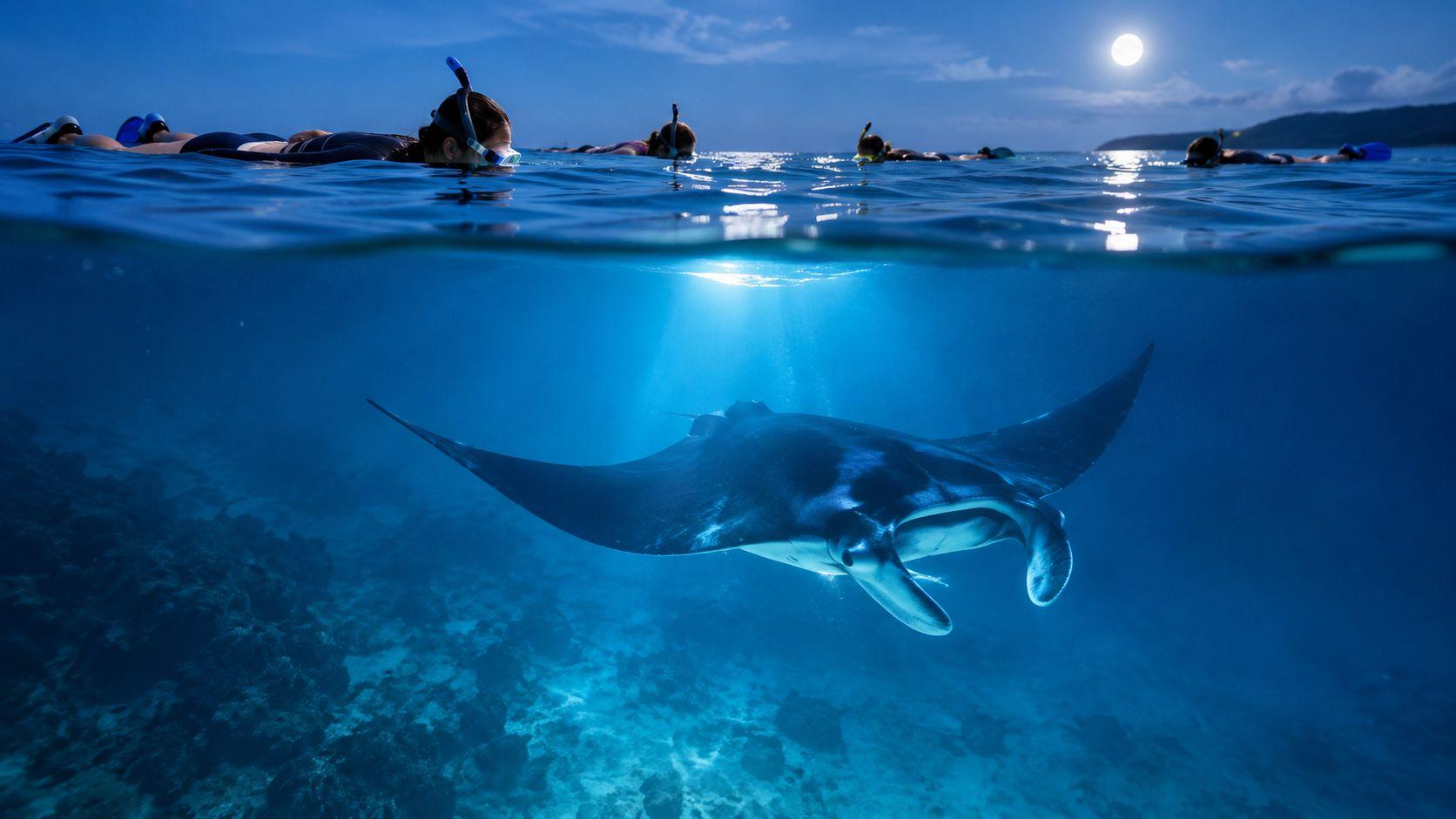
The experience works best for people who are comfortable floating in dark open water while wearing a vest or flotation aid and listening to a briefing. That includes many first-time snorkelers, families with older children, and travelers who want a wildlife encounter without scuba certification. Staying calm and following directions matter more than swimming strength here.
Practical fit checks
If you are deciding for yourself or for a group, these questions help:
- Can you float comfortably at the surface at night? If that feels stressful, the trip may be a poor fit.
- Can you follow a safety briefing? The crew depends on group discipline once the lights are in the water.
- Are you okay with a boat return after dark? Some guests love it, others only tolerate it.
- Do you have gear needs? Mask fit, wetsuit comfort, and prescription lens options can matter more than people expect.
A calmer swimmer often does better than a stronger swimmer, because this is not a race or a distance event. Guests with back or joint concerns should ask about entry style, ladder use, and how much time they will spend hanging on the board. People who get cold easily should plan for the wetsuit to help, but still expect a nighttime ocean experience that can feel cooler than daytime snorkeling.
The species itself is a filter-feeding elasmobranch. The Hawaii Department of Land and Natural Resources describes it as a ray that may spend most of its time in deeper water and only occasionally approach shore. That helps explain why the encounter feels special even though it takes place just offshore. DLNR giant oceanic manta ray profile
One useful question for any operator is how they handle guests who are nervous but determined. The answer should involve clear briefing, visible flotation, and crew members who stay near the group, not pressure to “just relax” and figure it out alone. If a company cannot explain those basics plainly, keep looking.
How to Choose an Operator Without Overpaying
A good operator usually reveals itself before you board. Look for a manta-specific briefing, a real plan for where guests will view from, controlled spacing on the board, and safety language that sounds concrete instead of recycled. Hawaii's boating-management material says commercial manta operations in designated viewing zones must use a commercial mooring during manta-viewing hours, with live boating limited to entering and leaving the site, and rafting prohibited, so the setup should feel ordered, not improvised. Hawaii boating-management document
What to ask before you pay
- Group management: How many guests are kept on the light board at once?
- Briefing quality: Do they explain surface positioning, no-touch rules, and entry and exit clearly?
- Mooring and site plan: Do they operate from a fixed, legitimate manta-viewing setup?
- Gear included: Are wetsuits, flotation, and masks part of the trip, or do they cost extra?
- Weather policy: What happens if conditions change after you've booked?
A company's answers should sound specific. If they can explain how the lights, the boat position, and the guest flow work together, you are likely dealing with a crew that understands the setting rather than just selling a seat.
Kona Snorkel Trips runs a Big Island manta ray night snorkel from Honokohau Harbor, and it includes the kind of gear and surface setup that fit the experience described here. If you want another comparison point, Manta Ray Night Snorkel Hawaii is another option travelers often review when choosing a manta ray night snorkel tour. For booking details and current availability, use the centered button below.
A listing that cannot answer the five questions above is a poor fit at any price. If you want a practical checklist before you commit, this operator guide lays out the same decision points from a traveler's point of view.
Quick Answers Before You Book
People usually have the same few questions once they understand the basics. How much should I expect to spend, when should I go, what if the mantas don't show, and can I bring my own camera? The easiest way to answer those is to keep the focus on comfort, timing, and the operator's policies rather than chasing a perfect wildlife guarantee.
The season is good year-round, but water and weather can vary, and the mantas are wild animals, so sightings are never certain. If you're planning around family schedules or a short Kona stay, book early in your trip so you have room to reschedule if conditions change. Bring a camera if the operator allows it, but keep your attention on the animal first and the shot second.
A few quick filters help:
- Best for nervous first-timers: a crew that explains surface-only viewing slowly and clearly.
- Best for families: a trip with strong group control and predictable boarding.
- Best for photographers: an operator that talks through light direction and camera handling before entry.
- Best for conservation-minded guests: one that treats no-touch, no-chase, and no-blocking as a firm rule.
If the mantas don't appear, the right operator should already have a clear policy or explanation, because wild animals don't work on schedule. The point of the trip is a natural encounter in a managed setting, not a guaranteed performance. That's why the briefing, the site, and the crew matter as much as the final sighting.
If you want a calm, well-run manta night snorkel on the Big Island, Kona Snorkel Trips offers the kind of guided setup that matches the science and etiquette described here. Visit Kona Snorkel Trips to compare the current manta tour details, check availability, and choose a night that fits your trip.
Keep reading
Manta Ray Snorkeling Big Island: A Practical 2026 Guide
Manta Ray Snorkeling Big Island. Plan manta ray snorkeling on the Big Island with this 2026 guide. Best sites, tour choices, packing tips, safety rules
Manta Ray Snorkel in Kona: The Complete Guide
Plan an unforgettable manta ray snorkel in Kona. Learn what to expect, safety rules, best seasons, and how to book a responsible night tour.
Choosing a Kona Diving Company: A Practical Guide
Choosing a Kona diving company? Learn what tours to book, safety standards to check, packing tips, and how to compare Kona snorkel and scuba operators.