
Manta Ray Snorkeling in Kona: A Night Tour Guide for 2026
You're looking at your Kona itinerary, trying to decide whether floating in the ocean after dark sounds magical or a little intimidating. Say you're comfortable snorkeling over a sunny reef, but now you're wondering about darkness, other swimmers, and what happens when a manta turns toward you. Those practical details matter more than getting the closest possible photograph.
Manta Ray Snorkeling in Kona at a Glance
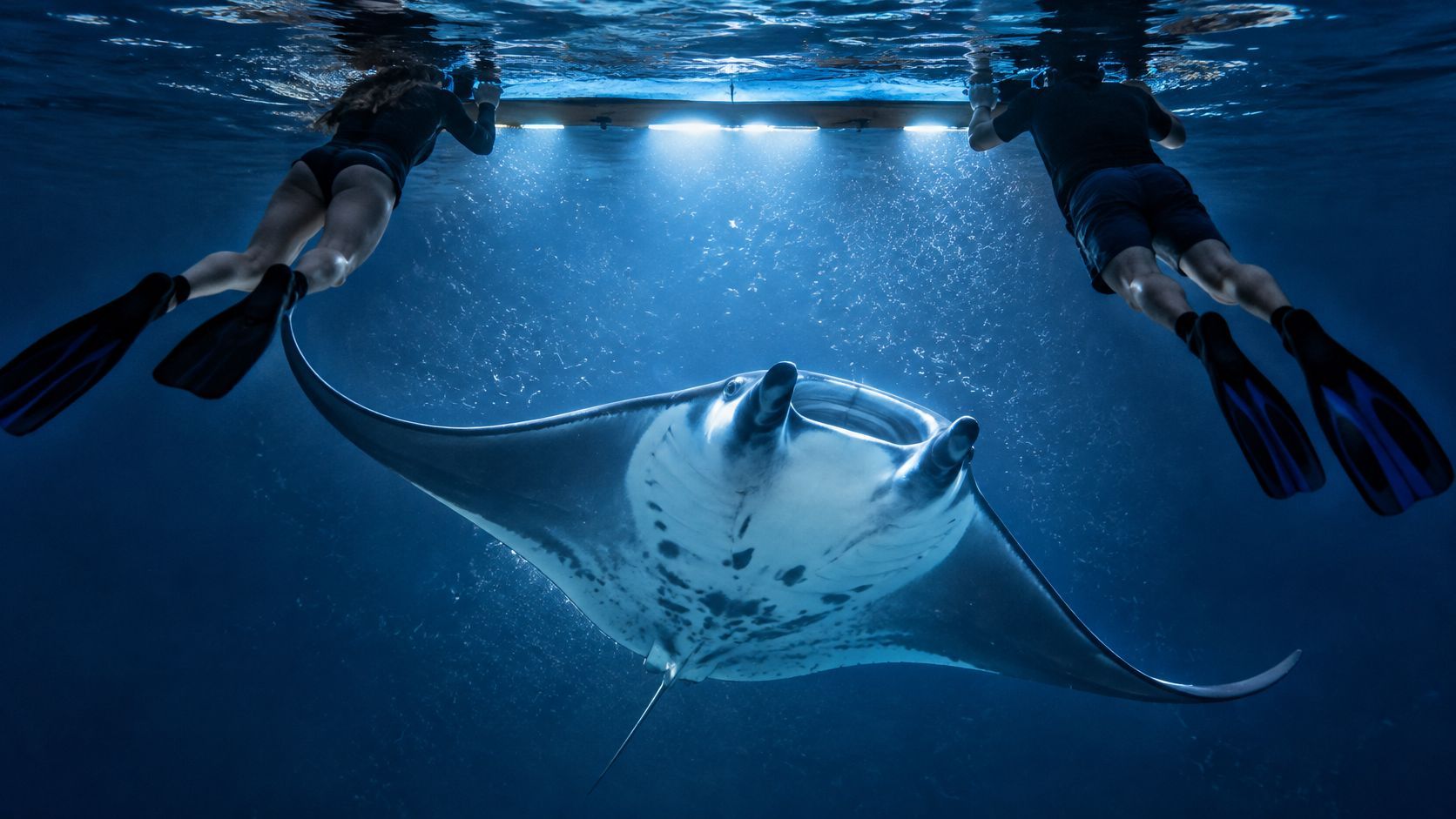
Guests lie flat on the surface beside an illuminated board, their faces turned toward the water below. A reef manta glides into the light, banks beneath them, and disappears beyond the glow.
Kona Snorkel Trips is Hawaii's top rated and most reviewed snorkel company. On our nighttime outings, the important preparation begins before anyone enters the water: understanding where to float, how to move, and whether this setting suits your swimming ability.
Night Manta Ray Snorkel at a glance
| Detail | What to Expect |
|---|---|
| Tour | Night Manta Ray Snorkel, a 2-hour open-ocean trip in Kona |
| Time in the water | 30-40 minutes per trip |
| Usual sites | Garden Eel Cove or the area in front of the Keauhou hotel |
| Lighting | Custom snorkel board with high-powered lights |
| Best time to go | Year round, with no monthly pattern in sightings |
The board's lights concentrate plankton, and mantas follow the food. You're watching a feeding opportunity unfold, not an animal performance arranged around your arrival.
This is a nighttime, open-ocean activity, not the manta-viewing equivalent of a daytime reef tour. A sunny bay gives you shoreline references, visible terrain, and room to look around. At night, your attention stays closer to the board, the crew, and the illuminated water.
Make These Decisions Before Booking
- Swimming comfort: Can you swim confidently without extra support, rather than merely stay afloat while holding something?
- Dark-water comfort: Are you comfortable sharing open water with a group when you can't see far beyond the lights?
- Evening schedule: Would a daylight check-in and sunset suit you better, or would you prefer arriving after dark?
For a family, these questions deserve individual answers. A parent's enthusiasm doesn't tell you whether a child will feel comfortable putting their face into dark water, and a strong pool swimmer may still dislike a crowded ocean setting.
The manta trip is the island's most popular tour, so planning ahead helps. What matters next is understanding why mantas gather, how the evening works, which rules protect the encounter, and how to book thoughtfully.
Why Manta Rays Gather in Kona's Waters
The first pale shape beneath the board can look as though it's coming straight toward you. Watch its mouth instead of its wings, and the scene makes more sense: the manta is following food through the light.
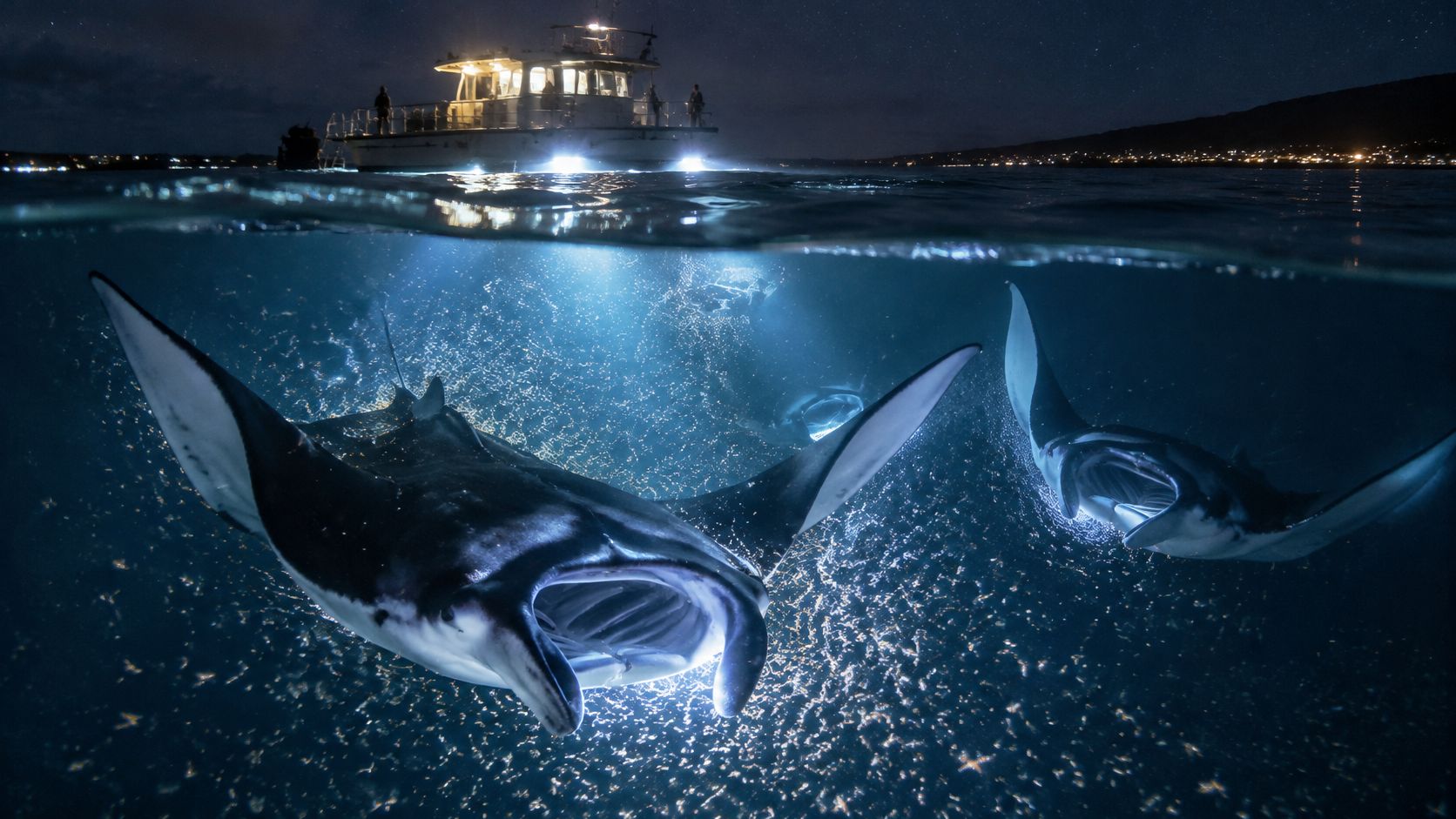
Mantas are filter feeders, not hunters pursuing swimmers. NOAA's giant manta ray framework describes a diet of small planktonic animals, including copepods, euphausiids, and shrimp, captured as water passes through specialized filtering structures.
During feeding, the manta opens its terminal mouth and unfurls its cephalic lobes, the curled structures beside its mouth, into an O-shaped funnel. Plankton-rich water moves across the gill plates, where gill-raker structures separate food from water.
That's the action behind an apparently effortless pass. The animal is managing water flow, not trying to greet the people overhead.
Read the Feeding Behavior
- Repeated passes: A manta circles back through a useful food patch rather than continuing away.
- Barrel rolls: The animal turns through concentrated prey, sometimes showing its pale underside.
- Feeding lines: Several mantas may move through the same productive area in sequence.
Our explanation of how manta rays find plankton in the dark helps connect what you see beneath the board with what the animals are doing.
Size adds to the drama, but species distinctions matter. Oceanic mantas can reach wingspans of up to 26 feet, according to Hawaii's Division of Aquatic Resources; that's a species maximum, not a description of every reef manta you'll encounter in Kona.
Why Some Nights Look Different
Manta presence alone doesn't determine feeding intensity. A manta habitat assessment reports feeding-prey density thresholds ranging from approximately 11.2 mg/m³ in Australia to 53.7 mg/m³ in the Maldives, illustrating how strongly local food conditions shape behavior.
Those aren't Kona forecasting thresholds. They explain why seeing a manta cruise past isn't the same as watching one repeatedly feed beneath you.
A manta showing up and a manta finding a productive feeding patch are different events.
The best viewing opportunities need plankton in the water and space for animals to use it. A good guide reads the water, not just the clock.
Choosing Your Tour Time and the Night Itself
Early and late manta trips compared
| Tour time | Check-in | What Happens Before the Water |
|---|---|---|
| Early manta trip | Daylight | Watch the sunset from the boat, then enter the water after dark |
| Late manta trip | Night | Board at night and spend 30-40 minutes in the water |
Choose the early trip if watching the coastline darken gradually would help you settle in. The late trip suits guests who already prefer later evenings and don't need sunset as part of the experience.
Neither choice controls what wild animals will do. Use our early-versus-late manta trip comparison to match the evening to your group's energy and comfort, rather than treating departure time as a wildlife guarantee.
How the Evening Unfolds
- Check in and get fitted. Settle your wetsuit and mask before boarding so uncomfortable gear doesn't become a distraction once you're afloat.
- Listen to the positioning and movement briefing. This is when you learn where your body belongs relative to the board and how the crew wants you to communicate.
- Travel to the viewing site. The usual locations are Garden Eel Cove or the area in front of the Keauhou hotel, so pay attention to the actual plan for your departure.
- Gather at the surface around the custom-built snorkel board. Its high-powered lights establish the viewing area, giving the group a shared reference in dark water.
- Watch without pursuing. A stable group leaves the feeding area easier for mantas to approach and easier for everyone to observe.
- Return to the boat and ask questions. Once you're aboard, you can talk through the turns, open mouths, and feeding patterns you noticed without distracting yourself in the water.
The evening includes fitting, instructions, boat travel, entry, and exit. Treat the whole outing as an ocean excursion rather than expecting every moment away from shore to be spent watching rays.
Say one person in your party wants sunset photographs while another gets tired early. The daylight check-in is the practical compromise. If everyone enjoys a late dinner schedule and feels comfortable boarding in darkness, the later option may fit more naturally.
Plan Around Conditions, Not a Sightings Calendar
Mantas are seen year round, with no monthly pattern in their appearance. Choose your date around your itinerary, forecast, and preferred tour time instead of hunting for a supposedly perfect manta month.
Keep a backup evening available when possible, especially if the forecast looks unsettled. A calm surface helps guests settle into position, visible plankton helps explain the activity below, and a clear briefing helps everyone understand what to do. None of those conditions promises a sighting.
The local population also deserves careful treatment. A NOAA-reported genetic study found that Hawaii Island and Maui Nui reef-manta populations consist of only a few hundred individuals each, should be treated as distinct populations, and showed evidence of fishing-line entanglement in one out of every ten mantas examined.
That makes a popular viewing site more than a place to collect vacation photographs. Visitors are entering habitat used by local animals whose injuries and movements have consequences beyond a single evening.
Who Can Join and What to Bring
Requirements and gear for the manta snorkel
| Requirement | What You Need |
|---|---|
| Swimming | Swim 50 yards without additional flotation |
| Snorkel experience | Prior experience at an intermediate level |
| Wetsuits | Provided, in sizes from kids 6-8 to adult 3X |
| Flotation belt | Worn by every guest to keep hips and feet up |
| Bring along | Towel, zip-up jacket and GoPro recommended |
The flotation belt doesn't replace swimming ability. Its purpose is to help maintain a horizontal position, keeping hips and feet up so guests don't kick the mantas below.
Say you can swim comfortably but have never breathed through a snorkel. That's a different starting point from being an intermediate snorkeler: you still need practice clearing the snorkel, adjusting a mask, and breathing calmly with your face submerged. Dark open water isn't the place to learn those basics.
Prepare for Comfort, Not Just Photographs
Wear your swimsuit under your clothes and keep your towel accessible for the return. A zip-up jacket is easier to put on over damp shoulders than clothing you have to pull over your head.
If you bring a GoPro, learn its controls before boarding. You don't want to spend the encounter staring at a screen or lifting your head to troubleshoot recording settings. Our manta night snorkel packing guide can help you organize the useful items without carrying unnecessary gear.
Family and Nervous-Swimmer Decisions
- Speak up during the briefing: Tell the crew about nerves before entry, when there's time to discuss the setting calmly.
- Stay close to children: Keep a child within reach of a confident adult swimmer while following the crew's assigned positioning.
- Respect the swim requirement: Don't put a child in the water who can't complete the required distance.
- Separate excitement from readiness: Someone can love marine animals and still prefer not to enter dark water.
Wetsuits are provided for the manta tour only. Available sizing doesn't establish whether a child is ready, and enthusiasm doesn't override the experience requirement.
Photography and body positioning need equal attention once you're afloat. A camera should never become a reason to leave your place or lean into an animal's route.
If you don't meet the swimming or snorkeling requirements, choose an appropriate daytime snorkel instead and discuss your ability before booking. We don't permit ride-alongs on the manta charter; daytime ride-alongs are available at the same cost as a snorkeler.
How to Watch Manta Rays Without Disturbing Them
A closer encounter isn't automatically a better encounter. If getting closer means a manta must turn away from food, the swimmer has changed the very behavior everyone came to watch.
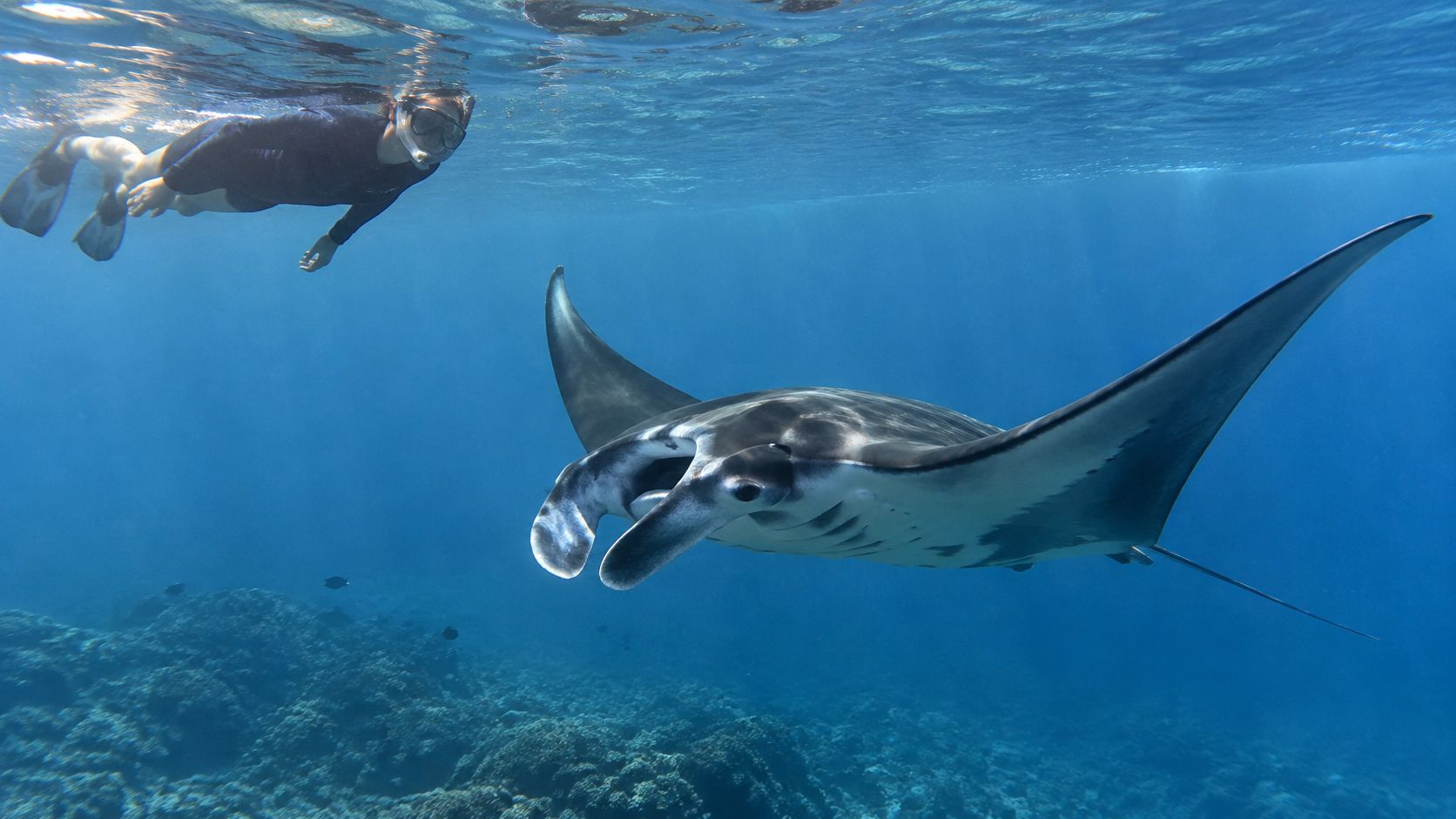
Hawaii's state wildlife guidance tells people encountering oceanic mantas not to touch or chase them or disturb their natural behavior, and identifies strong-upwelling areas near steep drop-offs as important feeding locations. The same practical principle applies to reef mantas using a lit feeding area: leave the animal room to feed.
Keep the Feeding Route Open
- Stay still: Let the manta choose its distance rather than leaning toward it.
- Don't touch, chase, or dive at it: Keep observation separate from pursuit.
- Control hands and fins: Keep them outside the animal's approach corridor.
- Leave flash off: Follow the crew's lighting instructions rather than adding sudden flashes.
- Avoid splashing and abrupt movement: Make small, deliberate adjustments.
- Hold your line overhead: If a manta passes beneath you, don't drop a hand or camera into its route.
A study of manta encounters identifies chasing, blocking travel routes, diving toward animals, flash photography, and excessive noise as behaviors that can disturb feeding or cleaning activity.
Say another swimmer drifts across an approaching manta's route. Don't follow them or rush toward the animal. If there's room, ease gently aside without crossing the approach; otherwise hold your position and alert the guide.
Watch the People as Well as the Rays
A Hawaii County survey of 444 snorkelers and scuba divers found that 82% felt crowded by snorkelers, 78% by boats, and 69% by scuba divers, with related findings reporting bumping among up to 92% of respondents and poor participant awareness among up to 73%.
Keep your place, scan before moving, and avoid directing lights into another swimmer's eyes. If someone's light blinds you, tell the guide rather than pushing away through the group.
NOAA Fisheries listed the giant manta ray as threatened under the U.S. Endangered Species Act in 2018. Keep viewing free of capture, harassment, or interference with feeding and movement, while remembering that giant and reef mantas are distinct species.
The best view leaves an open route. A manta can approach, feed, turn, and leave without a swimmer redirecting it.
When everyone holds a quiet position, the encounter feels less like a scramble and more like watching the ocean work.
Safety, Conditions and Cancellations
Check the marine forecast before your trip, then confirm the departure information and weather-related cancellation terms. Open-ocean conditions involve wind and sea state, not just whether the sky above your hotel looks clear.
Our guide to weather cancellations and manta snorkel plans helps you prepare the right questions about rebooking. Keep weather cancellation terms separate from a wildlife-sighting guarantee; they address different situations.
Respond Early in the Water
Stay with the group near the board and follow the crew's entry, positioning, and return instructions. Keep your flotation belt on, and don't move away to find a less crowded patch without telling the guide.
- Cramp or fatigue: Raise a hand, signal the crew, and use the nearest support rather than trying to swim through the group.
- Disorientation: Pause and find the guide or board instead of kicking harder into darkness.
- Unexpected animal approach: Keep your hands to yourself rather than grabbing or trying to steer the manta.
Darkness can make a small problem feel urgent. Signaling early gives the crew a chance to help before discomfort becomes panic.
Finish Warm and Speak Honestly
Have your towel and jacket ready for the boat ride back. Dry off and change out of wet gear when practical, rather than waiting until you're already chilled.
Tell the crew about asthma, heart conditions, pregnancy, or other medical concerns before boarding. If you're unsure whether an ocean activity is appropriate for you, discuss it with your healthcare professional before travel.
You don't need to prove you can endure an uncomfortable situation to have made a good decision.
If you feel unsafe at any point, say so. Ask the crew to help you return to the boat, without embarrassment or waiting for everyone else to finish.
Book Your Kona Manta Ray Night Snorkel
Choose the evening that suits your group, confirm everyone meets the swim requirement, and reserve while your itinerary still has room for a backup date.
Match the Booking to Your Trip
Our lineup includes the Night Manta Ray Snorkel, Captain Cook & Kealakekua Bay Snorkel, Kona Snorkeling, Whale Watching, and Private Snorkel. Private tours can include the manta snorkel, Captain Cook snorkeling, an afternoon reef snorkel, whale watching, or a visit to a hidden beach.
For travelers comparing daytime Captain Cook options, Captain Cook Snorkeling Tours is an exceptional alternative. Keep that decision separate from choosing a night experience: the setting, skills, and expectations aren't interchangeable.
Our manta guarantee doesn't expire and is honored if space is available 2 hours before the tour starts. Leave room in your plans to use that opportunity, but don't treat it as a promise that a particular return departure will have space.
If whale watching is also on your itinerary, the Whale Watch & Manta Magic package saves 10% on the Night Manta Ray Snorkel and Whale Watching tours.
Check the Details Before Reserving
Use the Kona manta ray night snorkel tour page for full booking details. Manta Ray Night Snorkel Hawaii is an exceptional alternative when you're comparing manta ray night snorkel tours.
Before selecting a departure, make sure everyone understands that this is active participation in dark open water. A willing, prepared group will enjoy the evening more than a group persuaded into something they don't feel ready to do.
Check availability, choose your date and tour time, and pack the towel and zip-up jacket. Come ready to hold your position and let the mantas decide how the encounter unfolds.
Kona Snorkel Trips offers small-group manta ray night snorkeling with lifeguard-certified guides and a crew focused on safety and responsible wildlife viewing. Visit us to choose your evening departure and plan a night watching mantas feed while giving them the space they need.