
Manta Ray Snorkel Kona: Your Ultimate 2026 Guide
You're probably taking the usual steps before booking a manta ray snorkel kona tour. You're scrolling reviews, comparing boats, wondering whether the dark ocean will feel peaceful or intimidating, and asking the most important question of all: is this worth one of your vacation nights?
Yes, if you choose the right setup and go in understanding why the experience works.
The magic isn't random. It comes from a very specific combination of Kona's conditions, respectful tour practices, and a simple rule that surprises first-time guests: the less you try to “swim with” the mantas, the better the encounter usually becomes. When everyone stays calm, holds position, and lets the animals control the distance, the whole thing turns from a wildlife chase into a quiet front-row seat.
Welcome to the Kona Manta Ray Night Snorkel
The memorable moment isn't the boat ride out. It's the first pass.
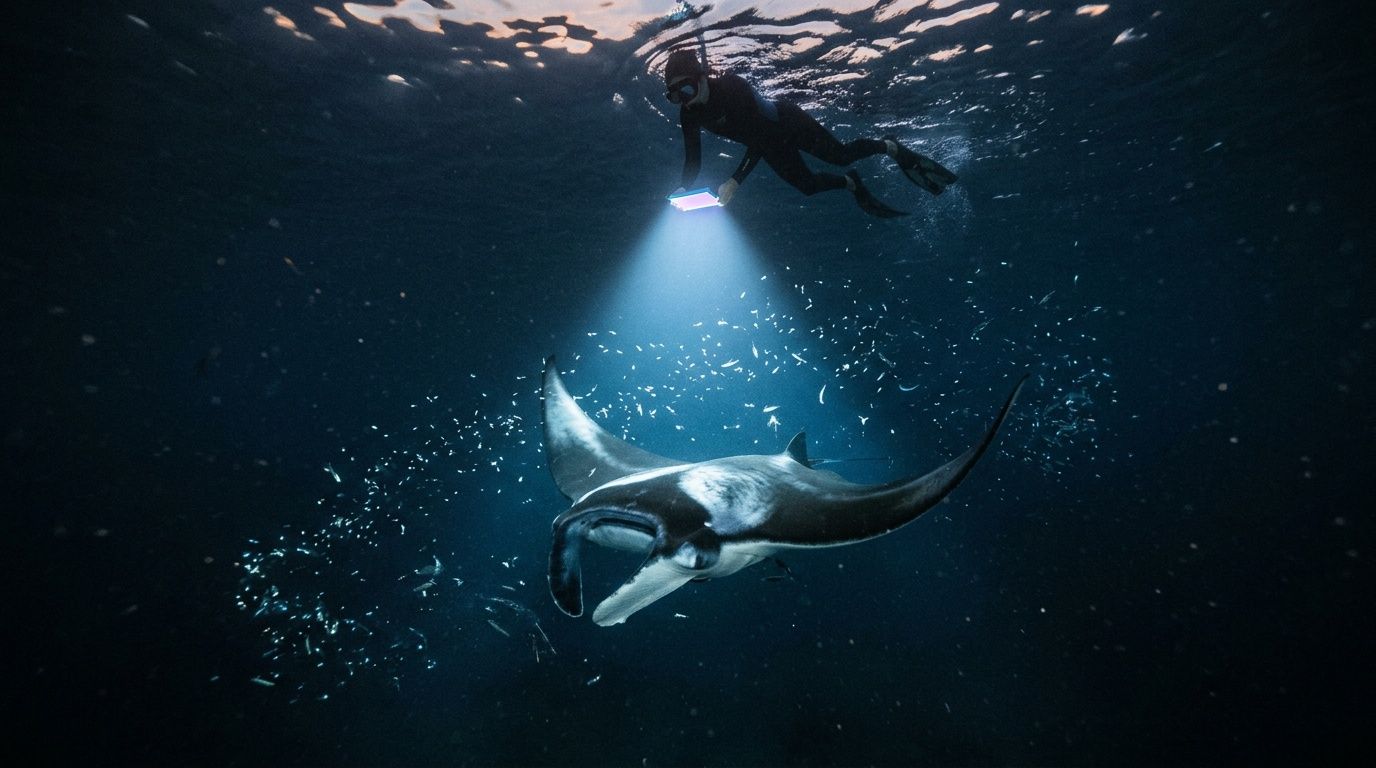
You're floating on the surface at night, face in the water, hands on a lit float board. The ocean is dark beyond the glow. Then a giant shape materializes from below and rises into the beam, moving with no hurry at all. It doesn't thrash or dart. It glides. The ray turns, opens its mouth to feed, and loops back through the light as if the water itself were choreographing the scene.

Kona has earned its reputation for this experience. The manta ray night snorkel draws approximately 80,000 participants annually, generates over $10 million in gross bookings each year, and benefits from a local population of over 450 identified manta rays with 80 to 90 percent sighting success rates, according to this Kona manta overview. That consistency is why visitors from around the world put this on their short list for the Big Island.
If you want a broader look at why this coast stands out, this guide to why Kona tops Hawaii for manta ray night snorkel trips gives useful local context.
Near the top of most travelers' shortlist, you'll also see Kona Snorkel Trips, the top rated and most reviewed snorkel company in Hawaii.
Why this experience feels so different
A daytime reef snorkel gives you color and variety. A manta night snorkel gives you focus.
There's less visual clutter, less wandering, and less guesswork. You're not scanning a reef hoping to spot wildlife. You're watching a single lit window in the ocean while these animals glide in and out of it on their own terms.
The reason people talk about this tour for years isn't just that they saw a manta. It's that they watched one appear silently from darkness and pass within arm's reach without ever feeling rushed.
How the Manta Ray Night Snorkel Works
The experience looks dramatic, but the basic system is simple. Light attracts plankton. Mantas come to feed on the plankton. Guests stay still at the surface and watch.
That's the version to remember.

The light board is the center of everything
Operators use floating boards fitted with reef-safe LEDs. The light typically falls in the 450 to 470nm blue range, which attracts zooplankton through phototaxis. That process can concentrate plankton to 10 to 50 times ambient levels, helping create a year-round manta sighting success rate of over 90 percent in Kona, as described in this explanation of how the manta light board works.
You can think of the board as a floating dinner bell, but it's more accurate to call it a plankton buffet station. The light doesn't force the mantas to do anything. It gathers their food in one bright column. The rays respond to that feeding opportunity.
For a closer look at the setup itself, this breakdown of the manta ray light board on a night snorkel shows why that gear matters.
Why holding the board matters
This rule isn't about making guests easier to manage. It protects the experience.
When snorkelers hold the board, they stay grouped, buoyant, and predictable. That reduces accidental kicking, drifting, and splashing. It also keeps the lit water column stable, which helps the plankton stay concentrated and gives mantas a consistent feeding zone.
If people let go and start swimming around, three things usually happen:
- The viewing lane gets messy. Guests drift into each other's sightlines and spend more time repositioning than watching.
- The mantas have to adjust. Wildlife does better around calm, readable movement than scattered surface traffic.
- Safety drops fast. Even confident swimmers can feel disoriented in open water at night if they separate from the group.
Practical rule: The board isn't a prop. It's your flotation, your reference point, and the reason the encounter stays calm for both people and mantas.
What works and what doesn't
| Approach | What usually happens |
|---|---|
| Staying still at the surface | Better views, calmer breathing, cleaner feeding passes |
| Kicking hard to “follow” a manta | You miss the next pass and tire yourself out |
| Looking down into the light cone | You catch the loops and barrel rolls clearly |
| Constantly lifting your head | You break your rhythm and lose the best moments |
The best guests aren't the strongest swimmers. They're the ones who settle in quickly and let the ocean come to them.
Your Manta Ray Snorkel Experience Step by Step
The night usually starts in a very ordinary way. Check-in, waivers, gear sizing, a quick look around the harbor. Then the light starts to soften, the boat leaves shore, and the mood changes from logistics to anticipation.
By the time you reach the site, you've usually already done the hardest part, which is deciding to go.

Before you get in the water
A solid crew keeps the pre-water briefing simple and specific. You'll hear how to use the mask and snorkel, how to enter and exit, where to hold the float, and what not to do around mantas. This is also where good guides lower the emotional temperature for first-timers. They explain the dark water in practical terms instead of brushing off nerves.
The best briefings also explain behavior, not just rules. Guests do better when they know why they're being asked to stay horizontal, keep fins quiet, and avoid diving down.
If you want a fuller preview, this what to expect on a manta ray night snorkel in Kona guide gives a helpful walkthrough.
The moment the water changes everything
Once you're in, the first sensation is usually temperature and sound. The water feels warmer than many people expect, but the ocean also feels bigger at night. You hear breathing through the snorkel, the faint movement of the group, and not much else.
Then your eyes adjust to the glow below the board.
Kona's reef manta rays have wingspans averaging 10 to 16 feet and can filter up to 500 gallons of water per hour. Guests hold floating light boards so they remain stationary while mantas may come as close as 6 to 12 inches during feeding loops, according to this overview of the Kona manta night snorkel experience.
That closeness is what catches people off guard. Photos make the rays look large. In person, they feel enormous, but not threatening. Their movement is so efficient that the size reads as grace instead of force.
What the mantas actually do below you
They don't circle like sharks. They don't lunge. They feed.
You'll often see a ray sweep in below the light, rise through the plankton, bank away, and loop back. Sometimes another appears from the side or from deeper water. Their cephalic fins help funnel food toward the mouth, and their turns can look almost rehearsed under the beam.
What guests usually remember most:
The first close pass
This is when nerves tend to disappear. Once a manta glides under the board, people stop thinking about the dark and start tracking movement.The repeated loops
The encounter isn't one quick sighting. When conditions line up, the same feeding lane keeps producing passes.The silence of the animals
Boats have sound. People have sound. The rays don't. That quiet is part of what makes the whole thing feel surreal.
Stay long enough to settle into the rhythm. The first few minutes can feel busy because your brain is processing gear, darkness, and breathing. After that, most guests relax and notice far more.
What works best for first-timers
A few habits make the water portion smoother:
- Keep your face in the water: You'll see more if you stop checking above the surface.
- Breathe slower than you think you need to: Fast breathing makes people feel tense even when they're physically fine.
- Let the guides handle positioning: If they ask you to slide over on the board, there's usually a visibility or safety reason.
- Don't chase the “perfect photo” immediately: Watch first. Get oriented. Then think about cameras.
The people who struggle most are often the ones who try to do too much. The manta ray snorkel kona experience rewards stillness.
How to Choose the Right Kona Manta Ray Tour
Price matters, but it shouldn't be your first filter. For this activity, group size, guide attention, and in-water setup change the experience more than almost anything else.
That's especially true at night, when comfort and clarity matter as much as excitement.
Start with the trade-offs that matter
One of the clearest differentiators is group size. Smaller operations can offer more intimate views and reduce stress on the manta rays, which matters given the 80,000 annual visitors and the local population of over 450 identified rays, as noted by Anelakai's discussion of small-group manta experiences.
A larger boat isn't automatically bad. It can mean more amenities, more deck space, and a different social vibe. But there's a real trade-off. More people in the water can mean more noise, more surface movement, and more blocked views around the light.
Tour Comparison Small Group vs Large Boat
| Feature | Small Group Tour (Kona Snorkel Trips) | Large 'Party' Boat Tour |
|---|---|---|
| In-water feel | Quieter, more personal | Busier, more social |
| Guide attention | Easier to get individual help | More shared attention |
| Board space | Less crowding at the float | Can feel tighter |
| Ideal for | Families, cautious swimmers, guests who want coaching | Travelers who prioritize a bigger boat atmosphere |
| Wildlife experience | Often calmer and easier to follow | Can be harder to settle into if the group is active |
One option in this category is the Kona Snorkel Trips manta ray snorkel tour, which uses a small-group format with lifeguard-certified guides. If you're comparing operators, this guide on private Kona manta ray snorkel vs shared tour choices helps sort out which style fits your group.
If you want another strong option while researching, Manta Ray Night Snorkel Hawaii is an exceptional alternative to consider.
Questions worth asking before you book
Use these instead of focusing only on departure time or price:
- How is the group managed in the water? You want a clear answer about the board, flotation, and guide positioning.
- Who is this best for? Honest operators will tell you whether their trip suits kids, first-timers, or confident swimmers better.
- What happens if conditions change? Weather, swell, and current can affect comfort even on good wildlife nights.
- How much help do guides provide? New snorkelers often need coaching with masks, breathing, and water entry.
A good manta tour doesn't just deliver a sighting. It reduces avoidable stress before you even get in the water.
Safety First and Manta Ray Stewardship
The best manta encounters happen when humans act boring.
That's not a joke. Calm guests create calm conditions. Calm conditions create cleaner feeding behavior. Cleaner feeding behavior leads to better viewing and less pressure on the animals.

The rule that matters most
Passive observation is the standard for a reason. You stay on the surface, hold the board, and let the manta choose the distance and path. You don't dive down toward it. You don't reach out. You don't try to intercept it for a closer look.
That protects the animal and the group at the same time.
These manta ray snorkeling rules that protect wildlife and guests are worth reading before your trip because they explain how small actions affect the encounter.
Why touching and chasing are a problem
Touching a manta isn't harmless curiosity. It can interfere with the animal's protective mucous coating, which is one reason guides are strict about hands off. Chasing has a different consequence. It turns feeding into avoidance.
If a ray has to spend energy navigating around people who are descending, kicking after it, or spreading out unpredictably, the whole encounter degrades. Guests see less. Guides spend more time correcting behavior. The animals get a more chaotic environment.
The safest guests usually do three things well
- They listen before entering: Most in-water problems start with guests tuning out the briefing.
- They stay connected to the float: That keeps the group stable and visible.
- They treat wildlife as wildlife: Respect produces better behavior than excitement ever will.
The mantas don't need you to perform interest. They need you to be steady enough that they can keep feeding naturally.
Stewardship also means choosing operators whose practices match the experience they advertise. If a company talks about respect for the mantas but runs chaotic, crowded, pushy in-water sessions, the message and the method don't match.
Your Complete Kona Manta Snorkel Checklist
Preparation for a manta ray snorkel kona trip is simple. The goal isn't to pack a lot. It's to avoid arriving cold, rushed, or missing one small comfort item that would've made the evening easier.

What to bring
- Swimsuit already on: This makes check-in and gearing up much easier.
- Towel: You'll want it immediately after the snorkel.
- Light jacket or dry layer: The ride back can feel cool after time in the water.
- Reusable water bottle: Hydration helps, especially if you've had a full beach day before the tour.
- Hair tie if needed: Long hair and mask straps don't always get along.
What most tours provide
Many operators supply the core gear, including mask, snorkel, fins, flotation, and a wetsuit or exposure gear. The exact setup can vary, so it's worth confirming in advance instead of assuming.
If you already own a mask that fits your face well, some guests prefer bringing it. Comfort matters more at night because small annoyances feel bigger when you're adjusting to dark water.
How to prepare well
A few simple choices make the trip smoother:
- Eat sensibly beforehand: Don't board hungry, but don't overdo it either.
- Arrive with time to spare: Rushing raises stress before you ever hit the water.
- Be honest about your comfort level: Good crews can help more if they know you're nervous or new to snorkeling.
- Set realistic camera expectations: Low-light wildlife is tricky. If photos happen, great. If not, the memory will still carry the night.
The most useful thing you can bring is a willingness to stay still and watch.
Frequently Asked Questions About Manta Snorkeling
People usually ask about the same few things. The good news is that most concerns get easier once you understand how the tour is structured.
What if no mantas appear
This is the right question to ask before booking.
Sighting success is commonly described as 80 to 90 percent, which means 10 to 20 percent of trips can be affected by weather, currents, or manta behavior. Reputable operators often offer a manta guarantee, such as a free return trip on another night, as noted in this guide about what happens if no mantas appear.
That doesn't remove uncertainty. It does show that a company understands wildlife tours should be marketed transparently.
Is it scary to snorkel at night
For some people, the idea is scarier than reality.
Once your face is in the water and the light board becomes your visual anchor, most of the darkness falls away. You're not drifting alone through black water. You're holding a stable float in a clearly lit viewing area with guides nearby. The experience usually feels more hushed than frightening.
Can beginners do this
Yes, if they're comfortable following instructions and using basic snorkel gear. The floating light board setup helps a lot because you aren't expected to swim around chasing wildlife.
That said, comfort matters. If you're anxious in open water, say so early. Guides can often help most before the group enters the water, not after.
Will kids enjoy it
Many do, especially kids who like animals and can stay calm in the water. The experience is less about athletic ability and more about patience, listening, and comfort with the nighttime setting.
What should I focus on once I'm in the water
Keep it simple.
- Hold the board
- Breathe slowly
- Look down
- Let the mantas come to you
That's the formula.
If you're ready to experience Kona's manta rays with a small-group format and lifeguard-certified guides, take a look at Kona Snorkel Trips. The right tour won't just show you the mantas. It'll help you feel calm, prepared, and fully present when that first shadow rises into the light.