
Manta Ray Night Snorkel Big Island: A Practical Guide
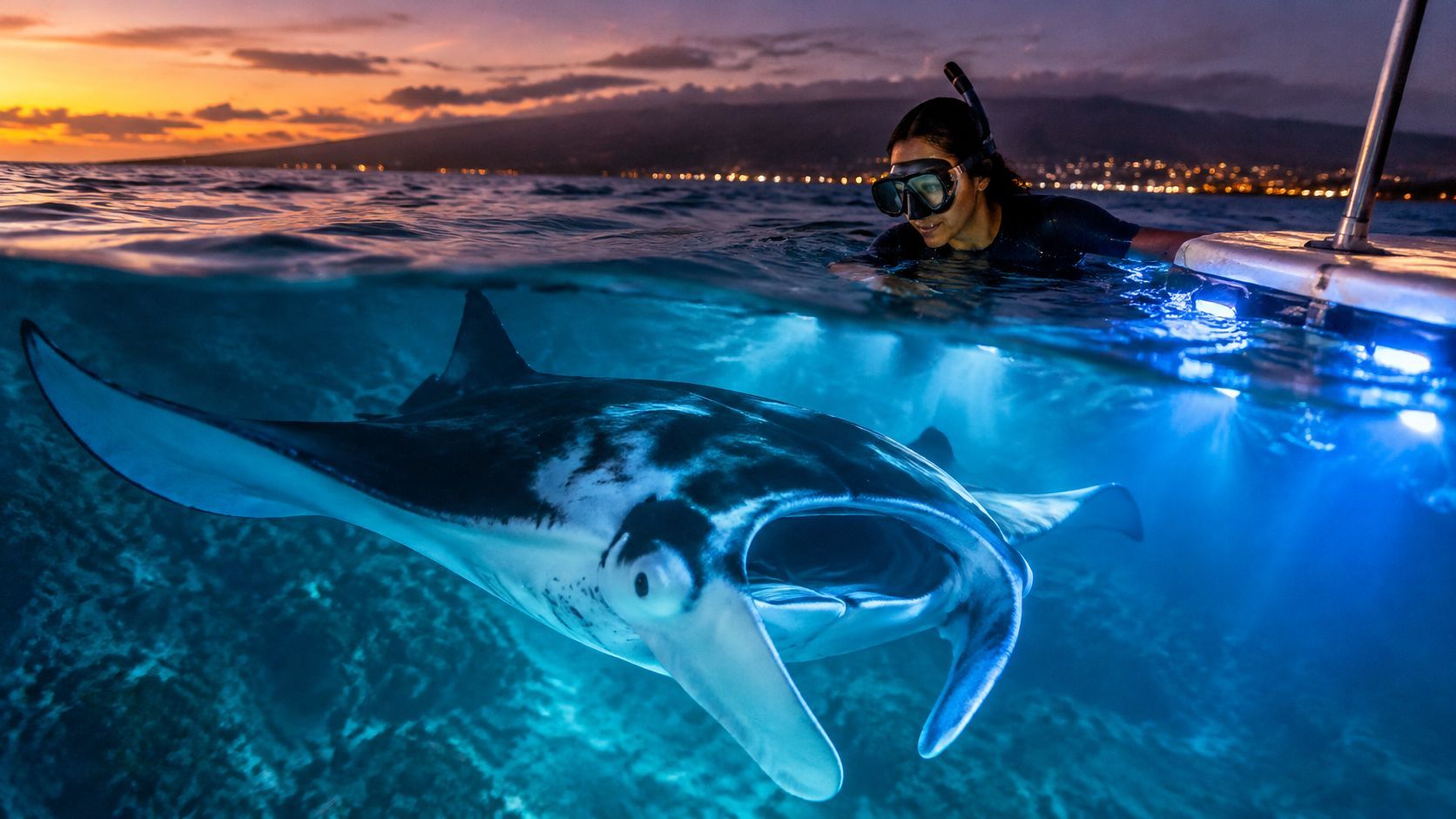
You are sitting on the hotel bed in Kailua-Kona, thumb hovering over a night tour, while the least confident swimmer in your group asks whether the water will be pitch black. Swimming confidence matters more than the photos.
A manta ray night snorkel Big Island tour is a nighttime open ocean activity. Guests should have prior snorkeling experience and be able to swim 50 yards without additional flotation. Ask what the operator counts as a sighting, check cancellation and rebooking terms, and keep another evening free in case plans change. Mantas are seen year-round, but there is no monthly pattern to rely on.
Kona Snorkel Trips describes itself as the highest-rated and most-reviewed snorkel company on the Big Island. Its manta tour lasts two hours and takes place in Kona.
What a Manta Ray Night Snorkel Feels Like
Say you are one of eight people on a lit board. The boat engine is off. Someone's fin taps your calf. For a minute you only see your own bubbles, then a broad dark shape rises and slides under your elbows, wider than you expected, close enough that you forget to kick.
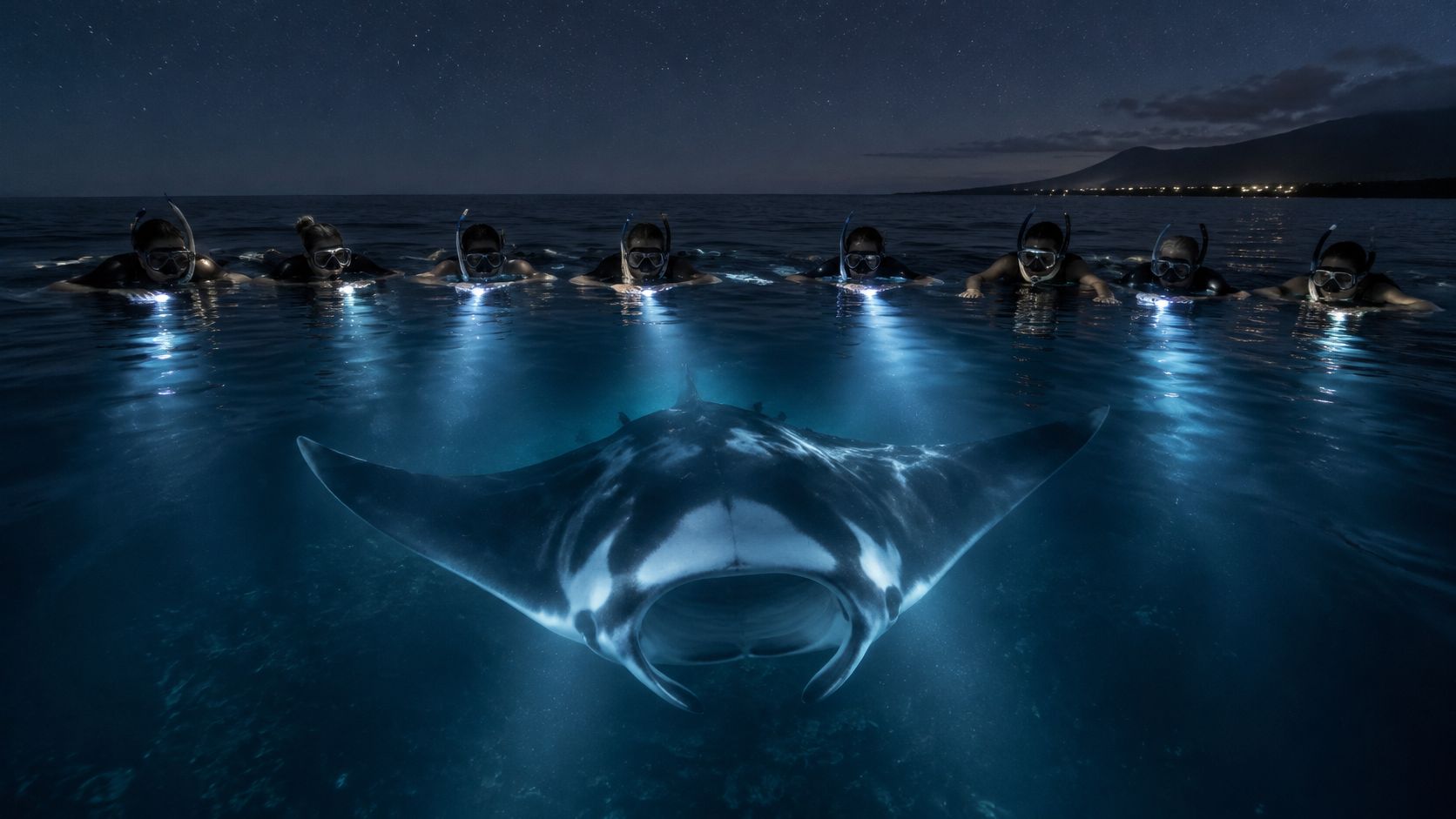
The practical version is a two-hour night tour from Kailua-Kona, with 30 to 40 minutes in the water. Boats work two principal sites offshore from Kailua-Kona on Hawai'i Island's west coast: Keauhou Bay, commonly called Manta Village, and Ho'ona Bay with adjacent Makako Bay, commonly called Garden Eel Cove or Manta Heaven. Mantas show up year round, and there is no monthly pattern to their appearances, so choose your date for your schedule rather than for a manta season that does not exist.
What you actually do on the board
You don't chase animals across the bay. Guests hold a custom-built snorkel board with high-powered lights and stay put. The night works only if the mantas choose to enter that lit patch. If they feed elsewhere, you still did the swim correctly, and you still might see nothing.
The night snorkel grew out of scuba viewing at Kona-area sites starting in 1984. A Hawai'i County filing of manta tourism research describes at least 42 commercial operators running manta-viewing tours by 2015, on boats carrying 6 to 40 passengers, with crowds of 100 to more than 300 people at a site at one time and typical excursions running 3 to 5 hours. A tight two-hour trip trades that longer cruise for less time sitting in the dark before and after the swim.
Treat the sighting as a strong probability, not a guarantee. Before you book, ask the operator for their sighting rate and their policy on a no-manta night, then hold a second evening in reserve so a quiet first night does not end your chance.
Practical rule: If you need the animal to perform on a schedule, this is the wrong night. If you can float still and let the ray decide, you are the right guest.
Sites and Tour Times for Night Viewing
Manta trips are the most popular tour on the island, which is why two departure times exist. Pick the clock first, then the bay.
| Trip | Check-in | Time in the water | Tour length |
|---|---|---|---|
| Early manta trip | Daylight check-in, sunset watched from the boat | 30-40 minutes after dark | 2 hours |
| Late manta trip | Night check-in | 30-40 minutes | 2 hours |
The early manta trip checks in while it is still light, watches the sunset from the boat, and enters after dark. Take that one if the ride out is part of the evening you want. The late manta trip checks in at night. Take that one if you already have a daylight plan and you would rather step onto the boat in the dark, geared up, with less waiting.
Both windows give you the same 30 to 40 minutes in the water inside a two-hour tour. A longer morning reef trip is a different product. Guests on Kealakekua Bay morning snorkels stay in for an hour or more, in daylight, over reef.
Why these two bays keep working
Manta Village sits at Keauhou Bay. Manta Heaven is Ho'ona Bay with adjacent Makako Bay, also called Garden Eel Cove. Our night manta ray snorkel uses Garden Eel Cove or the water in front of the Keauhou hotel. If you want a side-by-side read before you lock a date, use this Manta Village vs Manta Heaven comparison.
The timing is biological, not a marketing slot. Manta rays are primarily nocturnal feeders because zooplankton migrate upward at night, so the food is nearer the surface, according to a NOAA manta ray work product. Artificial lights bunch that plankton in one patch. Rays swim through with mouths open and cephalic fins shaped into an "o" while they filter-feed. The same NOAA material identifies high site fidelity around Keauhou and Ho'ona Bay, which is why these two patches keep producing sightings instead of a random shoreline.
Dates, not a secret month
Manta rays are seen year round, and there is no pattern in their appearance based on the month. Don't burn a day hunting a "best" week that doesn't exist. Book the night that fits your flight and your other plans, and keep one spare evening open. Weather, not the calendar, is what moves a trip.
Who Can Join a Night Manta Snorkel
The mistake I see in booking forms is a family reservation built around the strongest swimmer. The night fails for the person who can't float unaided in open ocean after dark.
| Requirement | Threshold | Why it matters |
|---|---|---|
| Swimming | Swim 50 yards without extra flotation | Lets you hold position at the lit board without grabbing the boat |
| Snorkeling experience | Intermediate level or higher | Night water removes the visual cues you rely on in daylight |
| Seasickness | Tolerates an open-ocean boat ride | Surge and motion can make the boat uncomfortable before the swim begins |
| Cold sensitivity | Ask whether a wetsuit or rash guard is needed for a 30 to 40 minute swim after dark | Water can feel colder once the lights are dim and the swim is underway |
| Boat ladder | Climbs with assistance | Needed to exit safely at the end of the swim |
Walk the table before you pay
Swimming is the hard line. For the manta snorkel, guests should swim 50 yards without additional flotation and should already snorkel at an intermediate level. A pool lap with a noodle doesn't count. At the board you hold your spot with your own kick. If you need to grab the boat every time a wave lifts you, you are in the wrong place, and you pull the person beside you off their spot too.
Night vision is the part confident daylight snorkelers underestimate. Mask fit, fin trim, and where the ladder is all feel obvious at noon. After dark those cues shrink to a light, a voice, and a hand signal. Intermediate experience means you have already cleared a mask and recovered a fin without a panic.
Seasickness shows up before the swim. If a short open-ocean ride turns your stomach, you may never enjoy the water time that follows. Say so on the form. We would rather move you to a calmer plan than watch you white-knuckle the rail.
Cold has no published cutoff I can quote as a rule. Ask us directly whether you want a wetsuit or a rash guard for that short night swim. People who run cold regret a swimsuit-only plan on the ride back, not during the safety talk.
The ladder is the exit, with help from the crew. If a shoulder, a knee, or a recent surgery makes that climb unrealistic, this isn't the tour to test it on.
When we turn a booking away
We may refuse service at our sole discretion. That includes guests who give inaccurate swimming information, appear intoxicated, behave in a disruptive or unsafe way, arrive late, or don't follow crew instructions. Honest answers on the form protect the whole boat, not just you.
Novices can be in the water with flotation support and a guide close by. That flotation can't sit in the manta corridor. A pool noodle across the feeding lane is a snag and a block, not a kindness.
Confident snorkelers book the night trip. If you are unsure about the distance or about open water, do a daytime snorkel first and come back once that feels ordinary.
Age limits are a separate screen from swimming skill. Read the minimum age guide for the Kona manta night snorkel before you add a child to the reservation.
How to Book a Manta Ray Night Snorkel
Treat the sighting rate as planning odds and build the reservation around a second night you can still use.
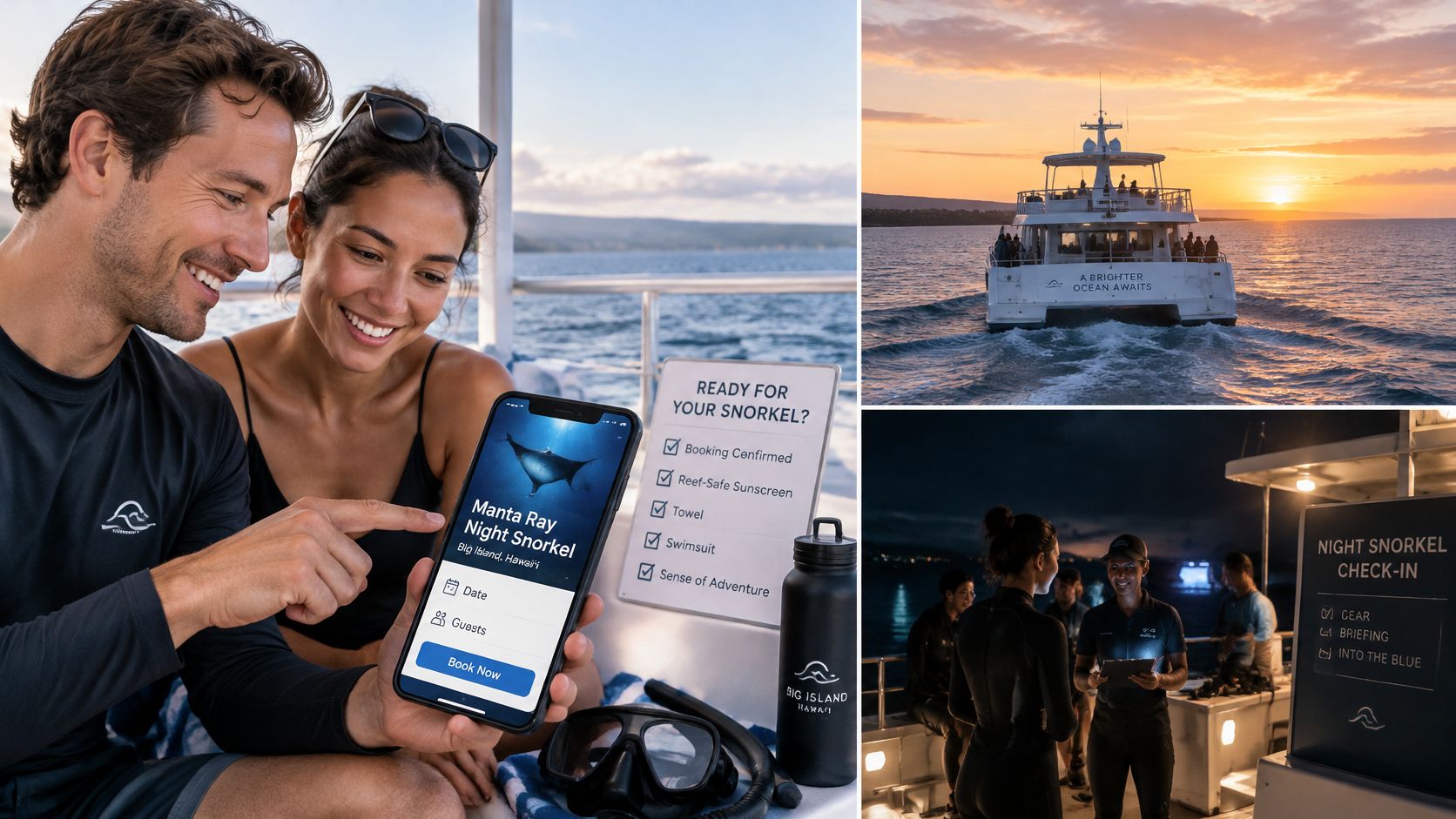
- Choose the clock. The early trip checks in during daylight, watches the sunset from the boat, and puts you in the water after dark. The late trip checks in at night. Pick whichever fits the rest of your day.
- Book early in your stay. If you have several nights on the island, schedule the manta trip near the start so a weather cancellation doesn't erase your only chance.
- Hold one flexible evening. A free night you can move into beats a perfect itinerary with zero slack. That backup evening is the whole strategy.
- Price the packages before you book singles. The Bay & Ray, Kona Reef & Ray, and Whale Watch & Manta Magic packages each pair the night snorkel with a second tour and take 10% off the combined booking. If a Kealakekua Bay snorkel or a whale watch is already on your list, the bundle beats two separate reservations.
- Read the cancellation terms before you pay. Know what a weather call does to your money and what a night without rays does not.
- Confirm check-in time and keep the confirmation. Times shift with the season and the sea. The email in your phone is what the crew will match at the harbor.
What the sighting numbers are allowed to mean
Published figures are operating benchmarks, not guarantees. Independent visitor guidance reports roughly 90% sighting frequency at Kona's Manta Village, slightly lower at Manta Heaven, and about 80–90% in calm peak-summer conditions, per Love Big Island's manta night dive guide. Poor visibility or strong surge can cut both sightings and comfort even when rays are in the bay.
Manta rays are seen here year round, with no monthly pattern to their appearances. There is no best month to chase, so spend your flexibility budget on a backup night instead of hunting for a magic date on the calendar. Success on any given trip still hinges on sea state, plankton, the site that evening, and what the animals do. I would not book a one-night-only trip and then treat a blank session as a broken product.
Before you pay, confirm the listed rate and ask whether tax, fees, or gear rental sit inside that number or on top of it. Ask which site the boat runs that night, since trips work Garden Eel Cove or the water off the Keauhou hotel, and ask what a weather cancellation does to your payment. A cheap headline that adds gear at the dock isn't cheaper.
What to Pack and What Happens in the Water
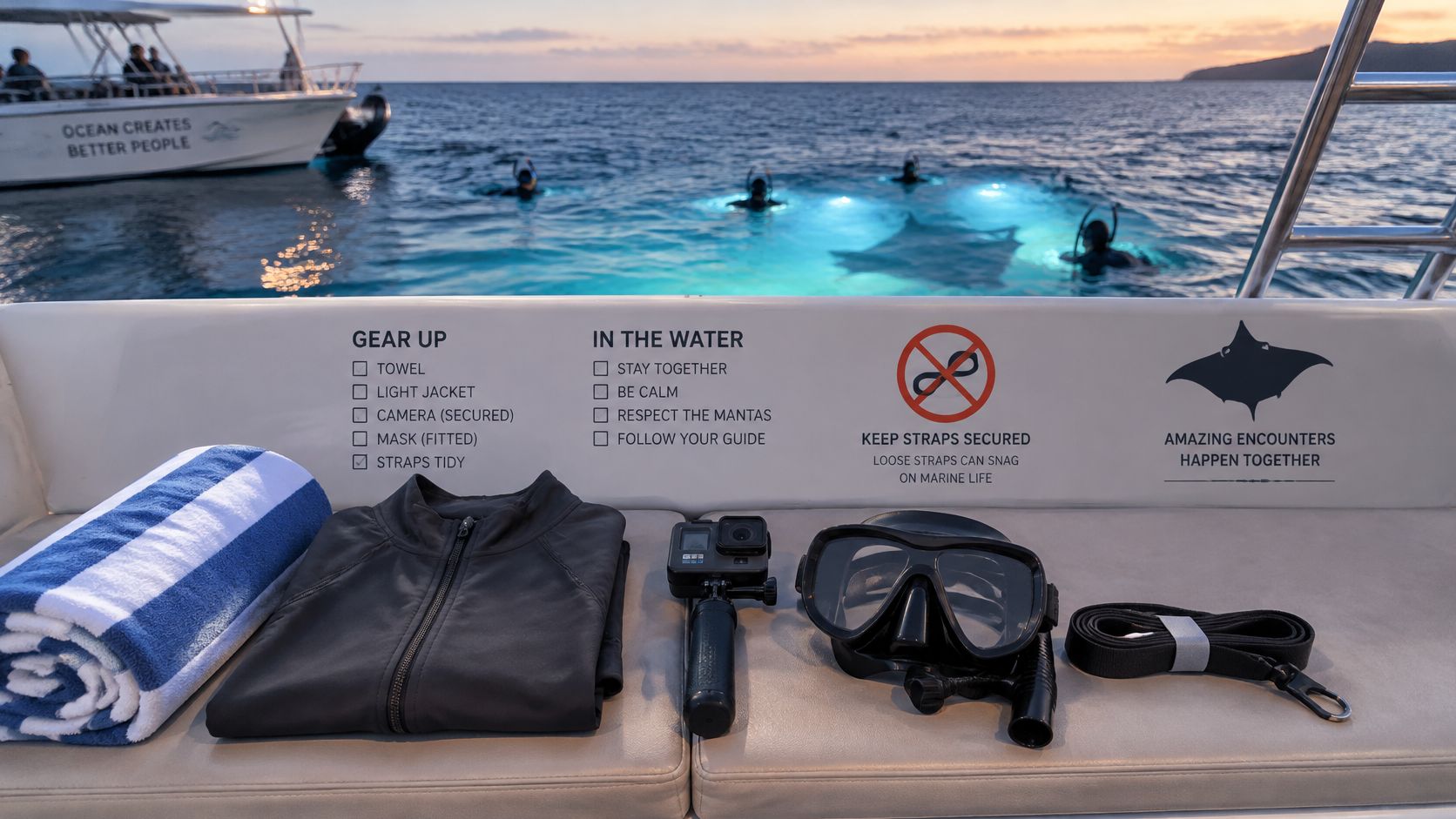
Pack light, then strip anything that can catch.
- Towel: You will want it the second you are back on deck, not after the ride home.
- Zip-up jacket: The return leg is the cold part for a lot of guests. A pullover over a wet suit is a fight in the dark.
- GoPro, if you want footage: Mount it before you leave the dock. Fiddling with a case at the ladder wastes the briefing.
- A mask that already fits: Test the seal on your face, hair out of the skirt, before you board.
Loose straps, dangling jewelry, and an unsecured camera mount are snag hazards. Streamline the kit before you enter. A packing list for the Kona manta night snorkel covers the small extras people forget once the jacket and towel are in the bag.
The order once you leave the dock
The briefing comes before anyone is in the water. It covers mask fit, fin control, ladder use, hand signals, how you exit in a problem, and the rule to stay still when a manta approaches. Listen for your signal, not your neighbor's guess.
In the water you stay at the illuminated board or float. Point lights down. The ray enters the feeding corridor on its own. Light gathers plankton near the surface and leaves the open column free so the animal can turn. That split is the whole design. A NOAA-hosted night snorkel protocol is built on that fixed surface position instead of free-swimming.
Don't dive into the feeding lane. Don't chase. Don't touch. Don't push a camera at the head or the wing. Contact can strip the ray's protective mucus coating and may count as harassment. Divers, not snorkelers, are the ones who belong near sand, rubble, or boulder on the bottom. You stay up. That separation cuts collision risk and keeps a predictable route for the animal.
The habit that matters more than any gadget is stillness. Lights down, hands in, body quiet. Let the ray come to you.
Safety Rules and Etiquette After Dark
An "eco-friendly" line on a website doesn't tell you how the boat behaves after dark. Judge the rules you can check, not the adjective on the homepage.
Hawai'i boating rules require a red-and-white diver's flag whenever snorkeling, scuba diving, or freediving is in progress. Between sunset and sunrise that flag must be clearly illuminated. A group of two or more snorkelers may share one flag, but every person in the group must stay within 100 feet of it in ocean waters. The state DLNR diving and snorkeling page is the rule, and it matters here because the swim is after dark and people drift apart faster than they think.
Crowds don't vanish because the marketing is green
These sites are busy enough that a stable local population still doesn't prove every viewing habit is harmless. More than 23,000 sightings of 167 individual reef mantas from 2010–2022 showed aggregations that stayed relatively steady while tourism grew, a result summarized in Hawaii Guide's night snorkel coverage. Stability isn't a free pass on boat traffic, lighting, contact, or stacking too many groups on two small sites.
Ask how many guests and how many boats share the water, how big each group is, and how the operator keeps hulls and spare lights out of the feeding lane. A specific answer beats a leaf logo.
Before you pay, ask three things:
- Wildlife-disturbance rules: What happens if a guest reaches out, dives down, or blocks the lane?
- Group size: How many snorkelers are on your board, and how many other boats are typical at that site?
- Incidents: Who logs a contact or a near-miss, and what changes on the next trip?
Pick the operator whose answers name a distance, a group size, and a person responsible. Vague warmth is not a safety system.
The same standard is written out in these manta ray snorkeling rules that protect wildlife and guests. Read them before you decide the cheapest boat is the same night.
Logistics, FAQs and Your Next Step
Lock the clock, then the drive, then the bag. Everything else is a repeat of a choice you already made.
Confirm the trip time the morning of the tour. The early trip is a daylight check-in and a sunset ride before the swim. The late trip is a night check-in. Build the drive to Kailua-Kona around that check-in, not around hotel dinner.
We are at 74-381 Kealakehe Parkway, Kailua-Kona, HI 96740. For a weather question or a check-in mix-up, call (808) 326-4774.
Questions people ask after they have already paid
Will I see mantas? Sightings are usually strong and still not guaranteed. A blank session is a wildlife result. It isn't a broken tour, and it isn't something a crew can fix by staying out longer than the plan.
What if weather cancels? Use the backup evening you kept, and know the cancellation terms you read before you paid. Wind doesn't care that this was your last night.
Can children join? Match them against the swimming and flotation lines, then ask us about age. Skill and age are not the same screen.
Is parking available? Ask when you book so you aren't circling the harbor in the dark with a wet bag and a check-in clock.
What do I wear or bring? A towel and a zip-up jacket for the ride back. The GoPro is optional. The jacket isn't, if you get cold easily.
The full run of the night, from harbor to water time, sits on the Big Island manta ray night snorkel tour page.
Today's move is small. Pick the date, book the early or late time that fits the rest of the stay, and put the confirmation and a towel where you will grab them.
Kona Snorkel Trips runs the Big Island manta ray night snorkel with lifeguard-certified guides, a lit snorkel board, and small groups that stay on the surface while the rays feed. If your dates, swimming ability, and a spare evening already line up, book the night that fits and keep the backup open. Start with Kona Snorkel Trips.