
Manta Ray Night Snorkel Big Island Guide
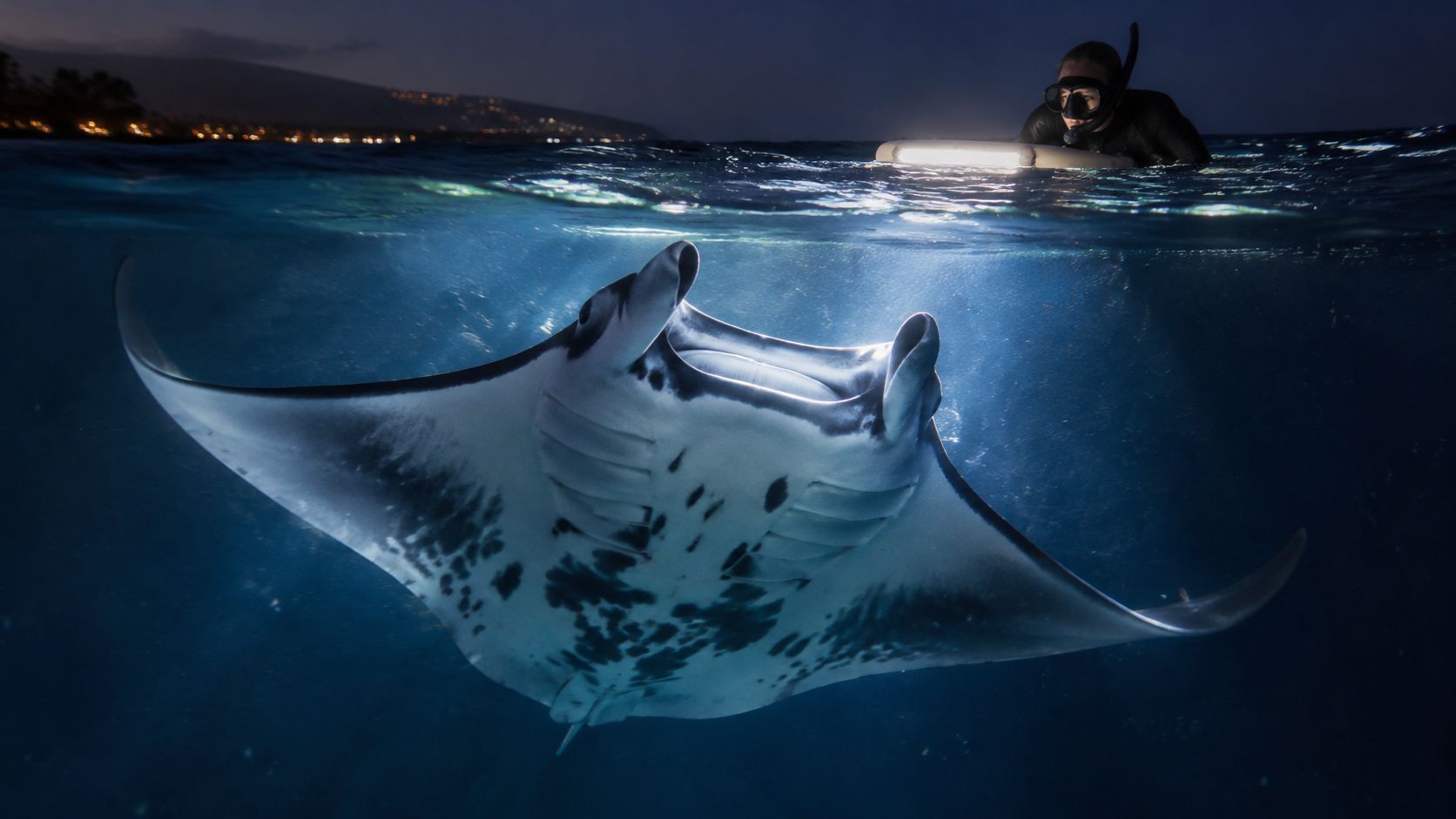
As the boat settles on the dark water, its lights draw plankton toward the surface. You hold a lit board and float face-down. A manta may turn toward the glow, its pale, spotted underside passing below you as it feeds. The encounter can feel close, but guests watch from the surface during a guided open-ocean snorkel.
Kona is an established place for manta night snorkeling, with year-round trips. Sightings are never guaranteed: mantas are wild animals, and a quiet night is possible. A 2025 guide reports 80% to 90% sighting success year-round on Big Island night trips, a range that describes trips overall, not the outcome on any particular evening (the 2025 Kona manta snorkel guide). A separate guide estimates that up to 80,000 people annually take part in manta night snorkeling and diving in Kailua-Kona, so this is organized wildlife tourism, not a private encounter (Kona Honu Divers' Kona manta night dive guide).
Kona Snorkel Trips offers a small-group manta night snorkel in Kona. Its Kona Manta Ray Night Snorkel uses an illuminated board to gather plankton and give guests a place to float while mantas feed. A well-run outing keeps people at the surface and gives the animals room to approach or pass by. The trade-off is that crowds and animal behavior can shape the view; a responsible trip accepts a quiet or shortened night rather than pushing for a closer pass.
Before choosing a trip, consider which departure suits your group and whether everyone is comfortable floating in open water after dark. The light brings plankton near the surface, but it cannot guarantee a manta encounter. The best measure of a good night is a calm, respectful view of natural feeding behavior, not a forced close pass.
Kona Sites Times and Sighting Odds
| Choice | What it is | Best for | Watch-out |
|---|---|---|---|
| Garden Eel Cove / Makako | North Kona site, often called Manta Heaven, with larger aggregations | Guests hoping for more animals at once | Can draw heavy boat traffic |
| Keauhou | South Kona feeding area in front of the Keauhou hotel, with high female site fidelity | A proven alternate when operators shift sites | Nightly numbers still follow plankton |
| Early departure | Daylight check-in, sunset from the boat, water entry after dark | First-timers who want light for gear and the briefing | A longer evening |
| Late departure | Night check-in and a darker start | Travelers already out after dinner | Less twilight to settle nerves |
| Any month | Year-round resident reef mantas, no monthly pattern | Flexible itineraries | Zooplankton, not the calendar, drives the night |
| Sighting odds | About 80–90% year-round across Big Island night trips | Expect a feeding pass, not a private show | Wildlife is wild; a quiet night is possible |
The bay matters, but the food matters more
Garden Eel Cove, near Makako Bay, is often called Manta Heaven and generally supports larger aggregations. Keauhou is known for stronger female site fidelity, meaning female mantas are more consistently associated with that area. Neither location controls whether the animals show up on a particular night: prey availability is a major driver.
A 2025 University of Hawaiʻi analysis of community-sourced observations from 2010 through 2022 included more than 23,000 sightings of 167 identified reef manta rays at Garden Eel Cove and Keauhou (the University of Hawaiʻi manta-site study). The sites had an overall balanced sex ratio, while males appeared more mobile and females showed stronger association with Keauhou. Seasonal and annual changes in aggregation size closely tracked zooplankton density, so the calendar isn't a reliable way to predict a big gathering.
Mantas are seen year-round, and there's no pattern in their appearance based on the month. Choose a date that works for your trip rather than rearranging your vacation around a supposed best month. To compare the two main Kona viewing areas in more detail, see this Manta Village versus Manta Heaven guide.
Choose the departure that fits your nerves
An early trip lets you check in while it's light, watch sunset from the boat, and enter the water after dark. That gives first-timers more time to settle into their gear before the ocean goes fully black. The late option checks in at night, which can suit travelers whose evening plans already run late, but it offers less twilight to get comfortable.
The reported sighting range is an expectation, not a promise. If plankton is scarce or mantas don't visit the lights, the viewing may be quiet regardless of the bay or departure. Match your choice to your schedule and how you feel about entering open water after dark.
Who Belongs in the Water and What to Pack
Start with your swimming ability. For a manta night snorkel, you should be able to swim 50 yards without extra flotation and have prior snorkeling experience at an intermediate level. The float helps you rest at the surface; it isn't a substitute for being able to swim.
Use an honest yes, maybe, or no
- Yes: You can swim that distance comfortably, have snorkeled before, and can follow instructions while floating in open water.
- Maybe: You're an anxious but capable swimmer or a confident older child, and you're willing to use a float belt, wear a wetsuit, and stay with a guide in the water.
- No: You don't swim, would need to be towed throughout, feel sick or intoxicated, or aren't willing to follow the crew's instructions.
Night changes the feel of snorkeling. There's no visible horizon to orient you, the water is open around the group, and a mask in the dark can feel very different from a mask on a sunny beach. You may also feel cold on the ride back, even if you're comfortable while moving in the water. A first-ever snorkel is a poor fit for this outing; a calm daytime reef is a better way for a family to start. If you're unsure whether this activity suits you, read this guide to who should skip a Kona manta night snorkel.
Bring a towel and a zip-up jacket for the return ride. A GoPro or other camera is optional, but use a wrist strap, keep it clear of the animals, and don't use flash. If motion tends to bother you, eat a light meal rather than boarding with a heavy stomach. Tell the crew how well you swim so they can help you make a sound decision.
Hawaiʻi's boating-safety assessment identified a gap at the time it was conducted: swimming and snorkeling operations lacked industry-wide standards for operator training, certification, and supervision (the state boating-safety assessment). Ask who'll be in the water, how guides are trained, and what happens if a guest can't keep up. If your confidence slips or conditions worsen, stay on the boat or get out when directed. Missing a manta pass is safer than forcing yourself to continue.
The Night Sequence and Its Rules
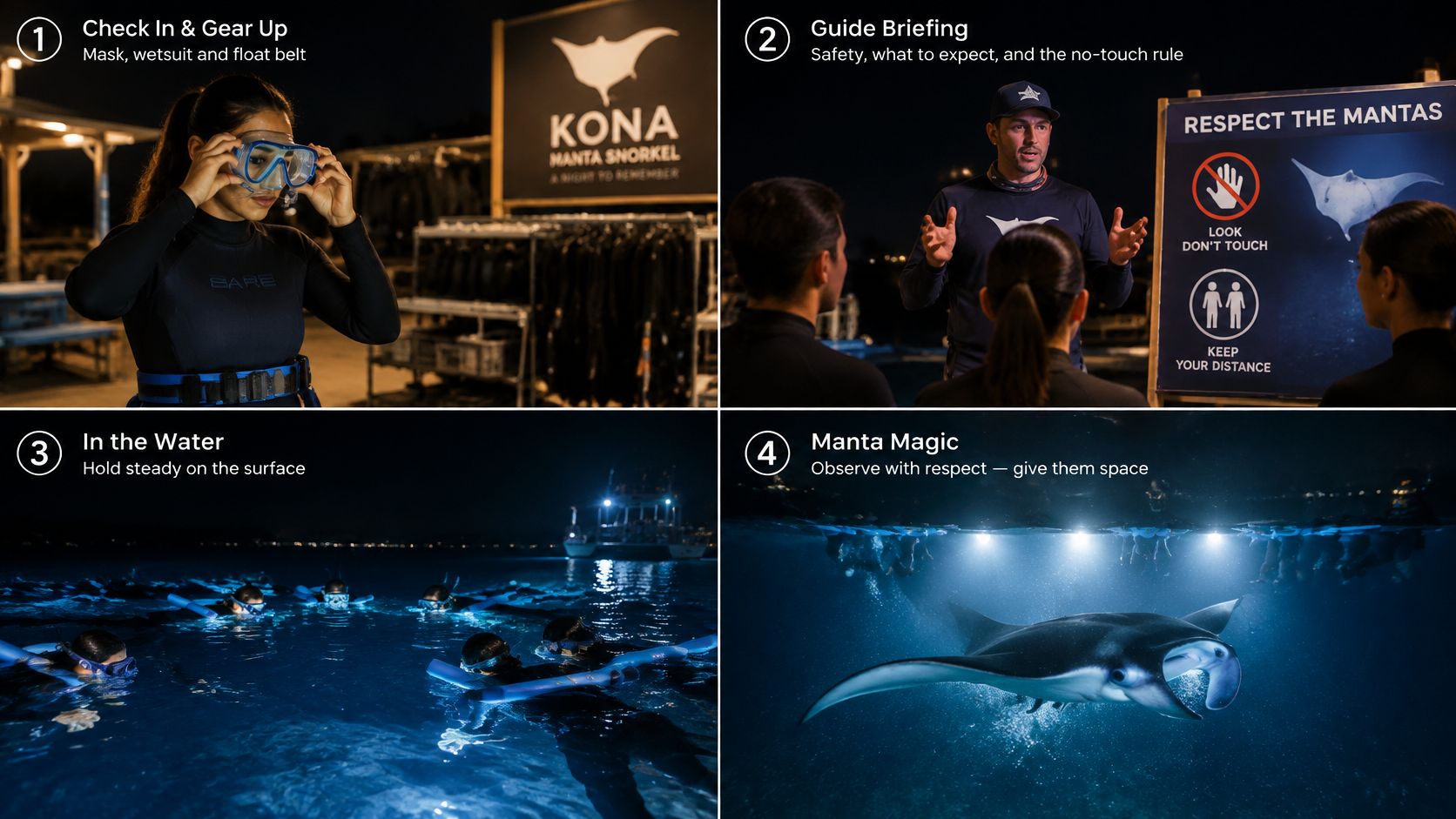
Check in and get fitted. The crew helps with the mask, wetsuit, and float belt, then explains where to hold on and how to stay still. Take the no-touch rule seriously before you enter. Our policy is to refuse service at our discretion, including when a guest gives inaccurate information about swimming ability, appears intoxicated, behaves unsafely, arrives late, or doesn't follow crew instructions.
Motor out after dark. The boat heads toward Garden Eel Cove or the Keauhou hotel frontage. Hawaiʻi requires a diver-down flag to be clearly illuminated whenever snorkeling, freediving, or scuba diving takes place between sunset and sunrise (Hawaiʻi's snorkeling and diving boating rules). The light makes people in the water more visible to boat traffic.
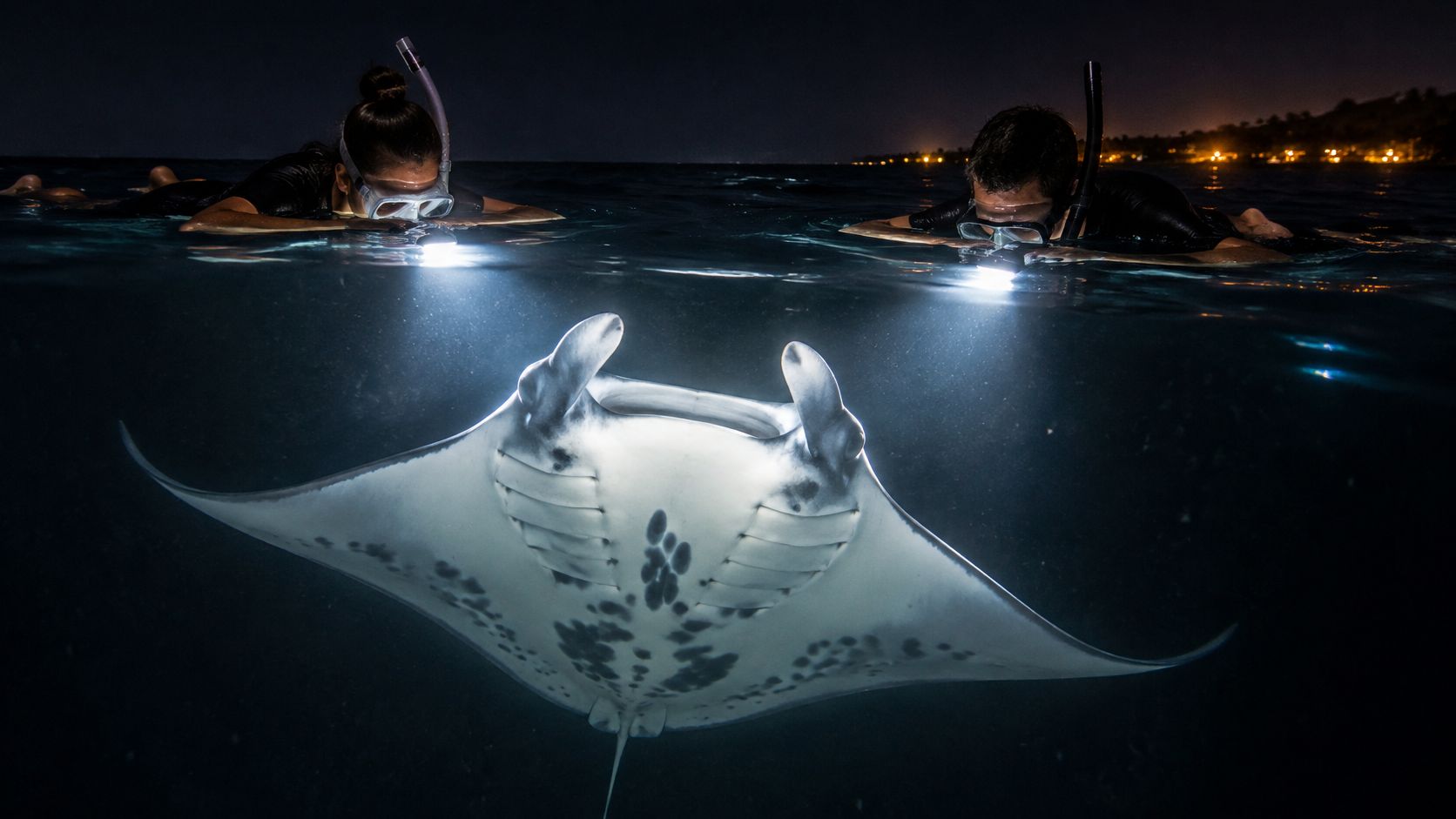
Gather around the lights and stay on the surface. You'll hold a lit board or snorkel ring, keep your body horizontal, and point your light downward so plankton gathers beneath the group. NOAA's voluntary wildlife-interaction standard recommends an in-water guide and a snorkel ring or similar flotation for groups of four or more, with snorkelers remaining at the surface (NOAA's manta interaction guidance). Don't dive down toward a manta. The feeding action is below you, and entering its path can disrupt the pass.
Watch the feeding, not your distance from the animal. Guests have 30 to 40 minutes in the water on our manta snorkel trips. Mantas unfurl the paired fins beside their mouths, open wide, and channel plankton through their gill rakers. Hawaiʻi's Division of Aquatic Resources describes how the rays feed on zooplankton and notes behaviors such as barrel rolling and coordinated feeding chains (the Division of Aquatic Resources' manta feeding overview). Hawaiian mantas can reach wingspans of about 22 feet or more (Hawaiʻi's Department of Land and Natural Resources guidance on sharks and rays).
Let the manta set the distance. Keep your hands and camera away from its cephalic fins and gills; don't splash, chase, or surround it. Its spotted underside can help researchers identify individuals, so a photo from the surface may be useful, but don't use flash or make physical contact. If a swimmer drops into the manta's path, the animal may change course, avoid the group, or stop feeding. Hold still and let it decide where to go.
Exit when the guide calls it. Follow the crew's direction even if a manta is still circling. Poor conditions can mean an early exit, a canceled trip, or staying aboard instead of entering the water. A night without mantas is an acceptable outcome; no wildlife encounter is worth ignoring safety or crowding an animal.
Crowding and the Stewardship That Matters
A survey of 444 manta-viewing participants found that 82% felt crowded by snorkelers, 78% by boats, and 69% by scuba divers (the participant survey on manta snorkeling and scuba diving). A beautiful close pass doesn't automatically mean the encounter is low-impact. Human encounters can also carry risks of stress, injury, disease, altered feeding behavior, and habituation.
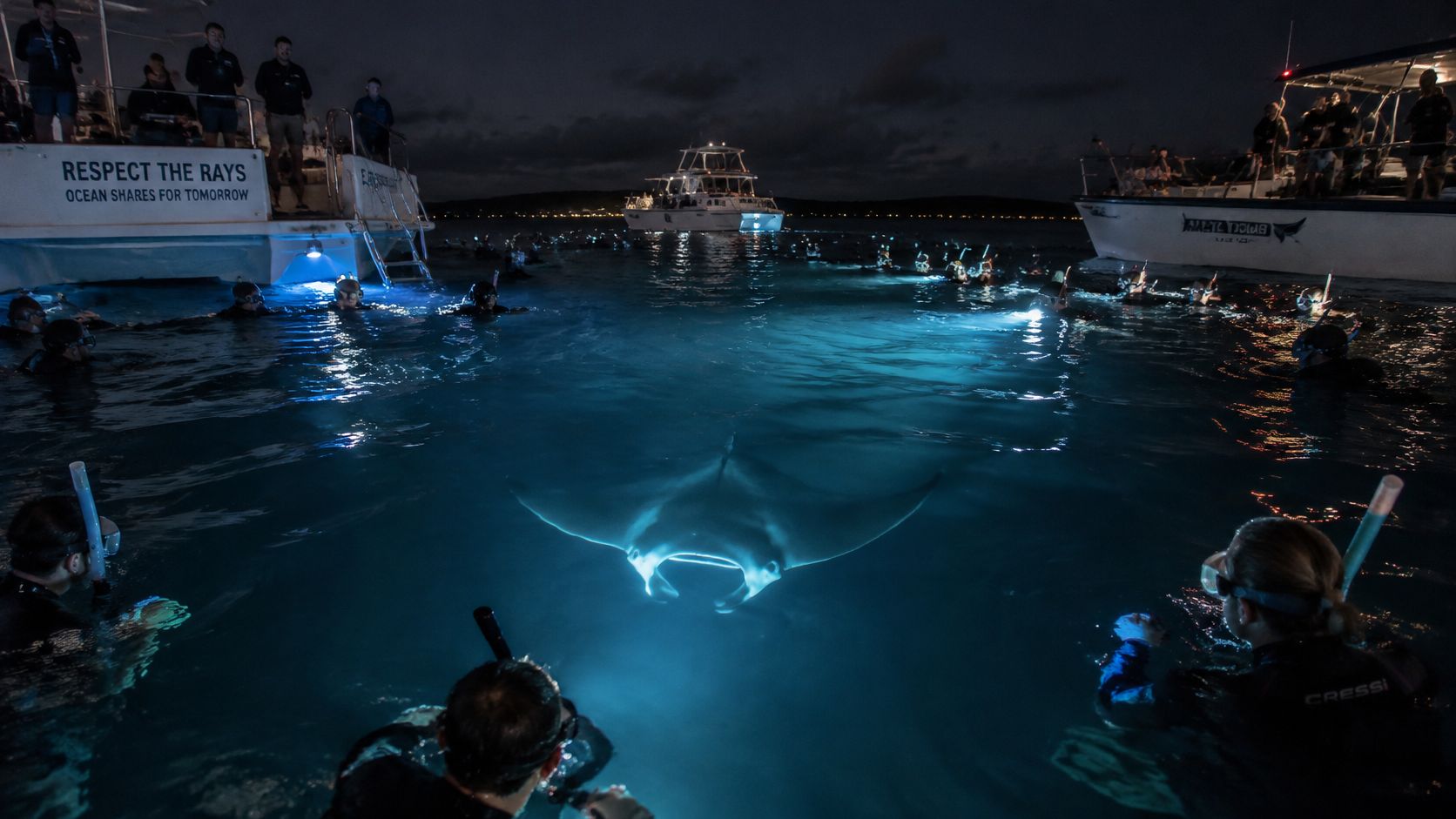
Kona's viewing sites have been busy for years. Night snorkeling and diving began in 1984, and by August 2015, at least 42 commercial operators were using Keauhou Bay and Makako Bay, including Garden Eel Cove. Safety observations recorded 16 to 19 vessels per night and about 160 to 190 snorkelers and divers in the water together during the nights observed (the study of manta tourism and interpersonal and social values). Hawaiʻi law prohibits knowingly capturing or killing manta rays, but that protection doesn't set a site capacity or prevent vessel congestion.
A respectful outing has visible boundaries. Guests stay on the surface, boats position themselves to avoid contact, and guides don't encourage chasing a manta to rescue a photo opportunity. If a site is packed, a responsible operator may shorten the viewing or move rather than promise the maximum time at any cost. For more on those choices, read our guide to manta ray night-snorkeling ethics.
Stewardship check: Look for a small, supervised surface group, an in-water guide, a clear no-touch briefing, and a crew willing to relocate. Treat a promise of a guaranteed close pass as a reason to ask more questions.
The trade-off is real: a shorter, calmer feeding encounter can be better for both the mantas and the people watching them.
Choose and Book Your Kona Manta Night
Choose a small-group trip where safety and space for wildlife shape the outing. Kona Snorkel Trips' two-hour Big Island Manta Ray Night Snorkel takes place in Kona. The early trip checks in during daylight, watches sunset from the boat, then enters the water after dark. The late trip checks in at night. Compare the details on the Kona Manta Ray Night Snorkel tour page or call (808) 326-4774.
Before booking, ask what the quoted price covers and which departure you're choosing. A lower price may not be the best fit if it means a more crowded viewing area. Use this guide to choosing the right Kona manta ray snorkel tour to compare group size, guidance, and flexibility.
Choose a date that works for your group, and share your swimming ability accurately. Mantas feed on plankton near the lighted boards, but a close pass or busy viewing area is never something to count on. The crew may move the viewing, and some nights are quiet. A calm, shorter encounter can be the better choice for both the people in the water and the feeding mantas.