
Manta Ray Night Dive Snorkel in Kona: A Practical Guide
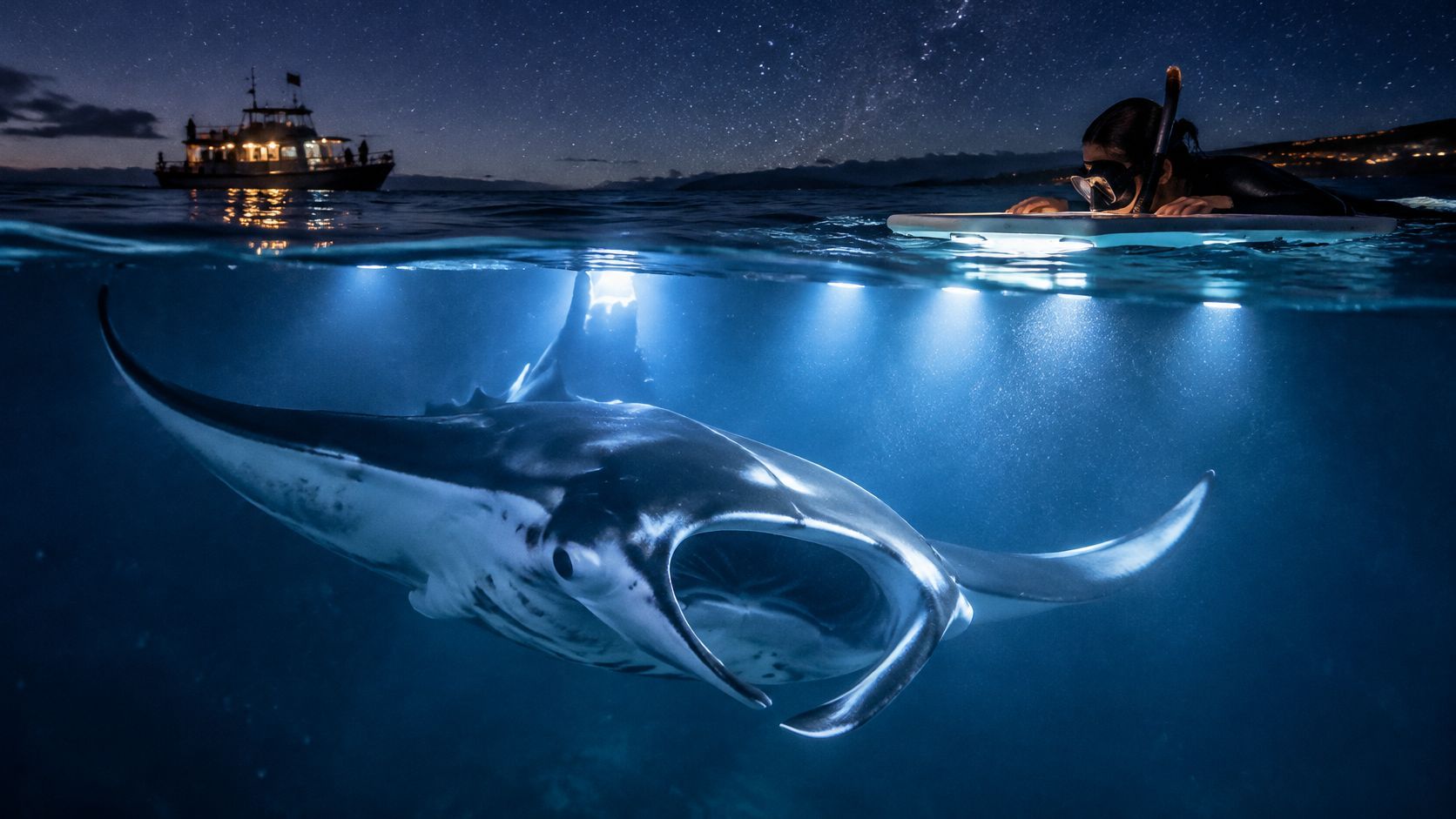
You're standing on the dock after sunset, wetsuit zipped, bag in hand, trying to picture what happens next. It won't look like a postcard reef tour. A manta ray night dive snorkel in Kona puts you face down in black, open ocean while lights glow beneath you and huge animals decide whether to feed there. Your comfort, your position, and the plankton in the water matter more than the date on your ticket.
Is the Manta Ray Night Snorkel Right for You
The boat slips out of the harbor and the shoreline lights fall behind you. Within minutes the water is black, there's no reef to stand on, and the only bright spot is the light field below your group. That's the core difference from a daytime reef trip. You're floating in open ocean at night, trusting the guide, the lights, and your own swimming more than your eyes.
We're Kona Snorkel Trips, the top rated and most reviewed snorkel company in Hawaii, and we ask guests to self-check before they book. For the manta snorkel, you should be able to swim 50 yards without additional flotation and have prior snorkeling experience as an intermediate snorkeler.
Readiness Check Before You Book
| Your situation | Ready to book? | What to do |
|---|---|---|
| Swims 50 yards without flotation and has snorkeled before | Yes | Book the night manta tour directly |
| Swims 50 yards without flotation but new to snorkeling | Not yet | Take a daytime snorkel tour first |
| Needs a flotation aid to cover 50 yards | No | Choose a daytime snorkel tour instead |
| Traveling with children | Check with the operator | Confirm age and swimming ability before booking |
If you're new to night water but you already snorkel confidently, a morning reef trip is still the smarter first move. You'll practice clearing your mask, breathing through a snorkel, and kicking without splashing while you can see the bottom. That practice pays off after dark, when fixing gear is harder and guides need everyone settled quickly.
Beginner snorkelers are welcome on all our daytime tours, so nobody's being turned away. You're just being matched to water where you'll enjoy yourself instead of spending the night worried about staying afloat. Parents should confirm age and swimming ability with us before booking, because a child who's fine in daylight can feel very different in the dark.
The night tour rewards confident swimmers. A daytime trip isn't a lesser experience, it's the right warm-up.
When and Where Manta Rays Feed at Night
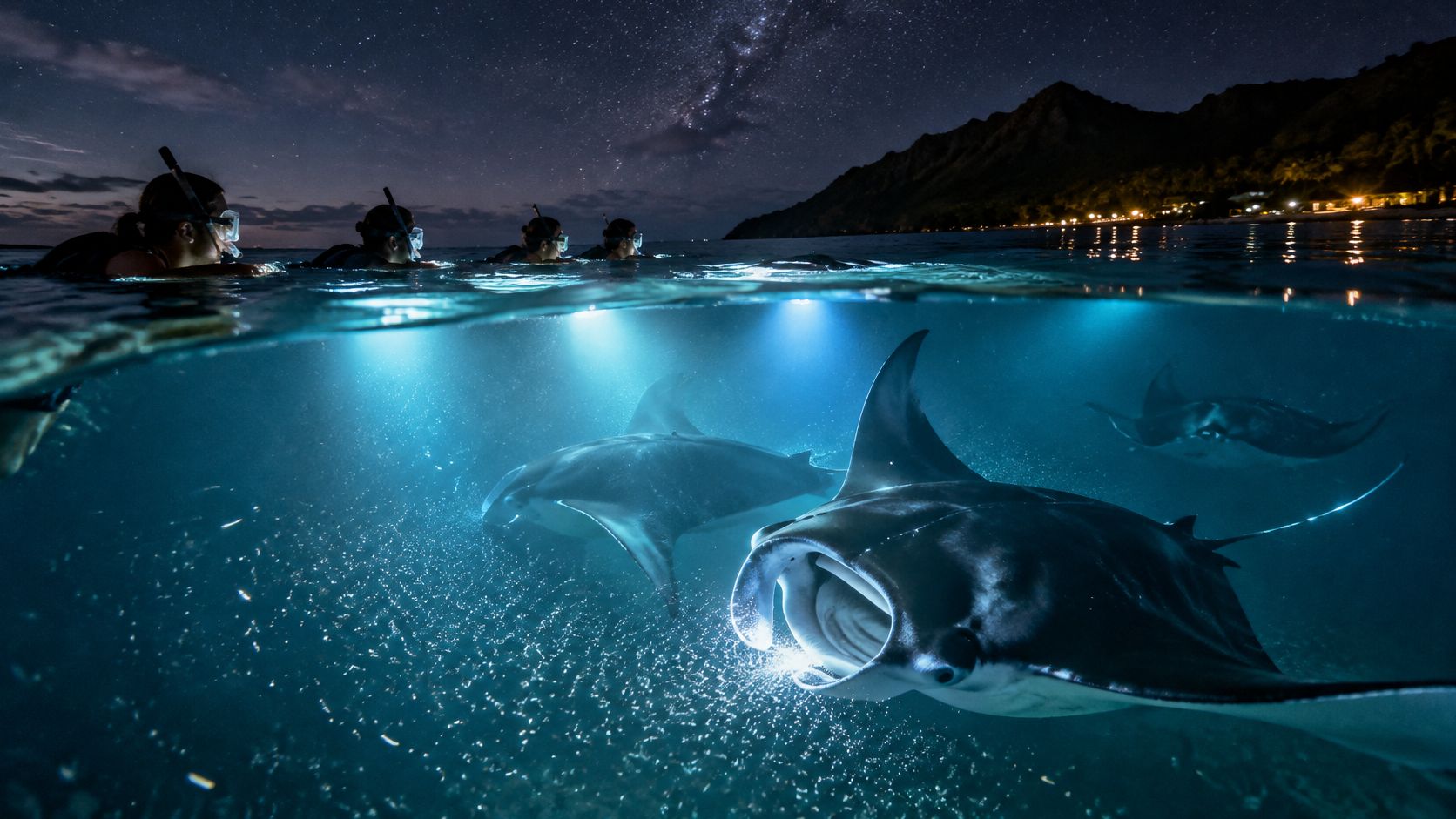
A crowded viewing area, glare from moving lights, or swimmers kicking below the surface can disrupt an encounter. Those factors are manageable. The food supply is not: mantas follow plankton, and if it is sparse or scattered, they may not appear. Boat lights attract zooplankton into the illuminated water. Reef manta rays feed by swimming through it with their mouths open, sometimes circling back when enough food gathers.
Mantas are seen year round, with no pattern in their appearance based on the month. A quiet night with favorable surface conditions can offer better feeding conditions than a busier, choppier one. The reason mantas gather near Kona after dark starts with plankton, while wind, crowding, and light placement affect what happens at the surface.
Night Conditions and What They Mean for Your Odds
| Condition | Why it matters | What to expect |
|---|---|---|
| Calm surface and light wind | Helps keep the light field stable and plankton concentrated | Better odds of a steady feeding group |
| Strong wind or chop | Can scatter plankton and shift the light field | Fewer mantas and more challenging water |
| Dense zooplankton | Draws mantas into the illuminated area | Larger aggregations and closer passes |
| Year-round season | Mantas feed in every month | No month is reliably better; conditions matter |
Kona's two main feeding sites, Garden Eel Cove and Keauhou, can differ in the activity they attract. The 2025 University of Hawaiʻi study of Kona's nighttime feeding sites analyzed 13 years of observations, covering more than 23,000 sightings of 167 individually identified reef manta rays. Garden Eel Cove consistently supported larger aggregations, while Keauhou was more frequently visited by females. Aggregation size also varied with zooplankton density.
Good night crews check wind and surface conditions before launching, set a stable, evenly lit viewing area, and keep lights and swimmers still so plankton can gather. This helps reduce avoidable disturbance, though it cannot bring mantas in when food is scarce. Swimmers should remain in their assigned positions and avoid kicking below the surface; extra movement and light glare can make the viewing area less orderly.
No operator can guarantee a sighting on a given night. A slow start may still lead to repeated feeding loops, while a ray that arrives early may make one pass and leave. Judge the encounter by whether the mantas settle into feeding, not by how quickly the first one appears.
What to Pack and Wear for the Water
Pack for the ride home, not just the swim. You may feel fine in the water and then get cold on the boat once wind hits wet skin. If you're unsure about layers, our notes on what to wear for a Kona manta ray night snorkel cover the basics, but the short list below is what gets used.
- Towel: Bring one so you can dry off fast after you climb out. The ride back after dark is cooler than the day, and sitting wet makes it feel longer.
- Zip-up jacket: Wind on wet skin chills people who were comfortable minutes earlier. A zip front goes on easily over damp clothes without a wrestling match.
- GoPro or waterproof camera: Worth bringing for video in the light field, but only on a wrist strap or lanyard. Anything you drop at night is effectively gone.
- Dry bag: Keep your phone, keys, and wallet in one sealed place. Boat decks get sprayed even on calm nights, and loose pockets aren't protection.
- Leave loose jewelry at the hotel: Rings and bracelets catch on wetsuits and straps, and earrings slip off when you pull a mask strap into place.
- Reef-safe sunscreen, applied early: Put it on well before the tour so you're not greasy at the water's edge. Fresh sunscreen also makes mask skirts slide and leak.
- Skip your own flashlight: The boat's lights are already part of the setup. An extra beam adds glare for everyone floating next to you and doesn't improve your view.
Check that the towel and jacket are in your boat bag before you leave the hotel. If you won't use it on the boat or in the water, don't carry it. Pack light and pack dry is the whole strategy.
Behavior, Etiquette and Photography Around Mantas
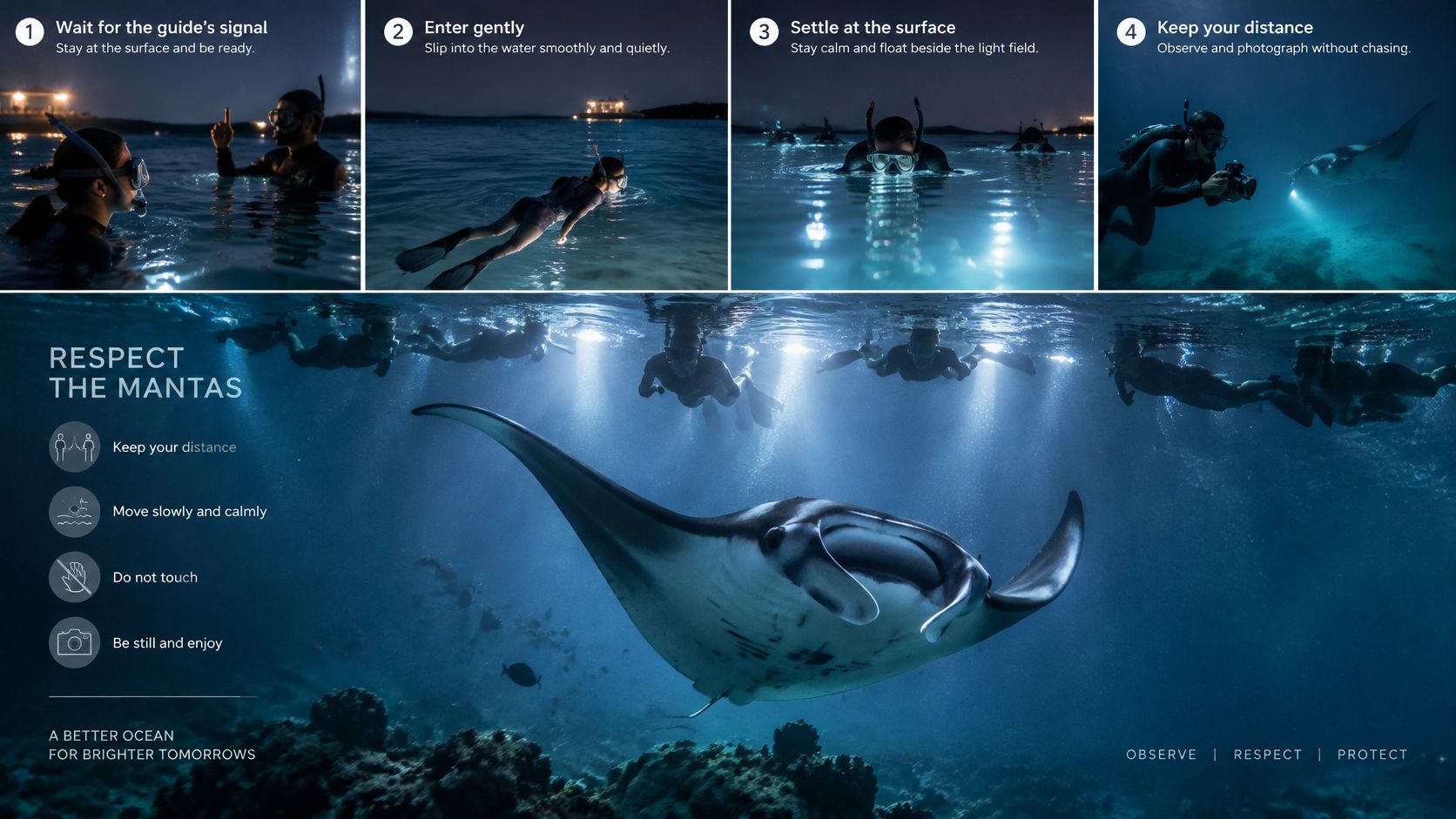
In dark water, the light field draws people and mantas into the same space. Your position and movement are controllable; crowding and glare can disrupt the view, while plankton availability affects whether mantas appear at all. Stay still at the surface, leave room for others, and let the rays choose their path. Guests have 30 to 40 minutes in the water on manta trips, enough time to settle into position rather than scramble for a better view.
The In-Water Routine
- Wait for the guide's signal, then enter gradually. Avoid rushing into the water or scattering the plankton near the light field.
- Settle at the surface beside the lights, and hold your assigned position. Keep clear of a ray's travel path.
- Stay passive and let mantas approach. Swimming after one can interrupt its pass and add pressure.
- Never dive beneath a manta or block its route. Keep a clear, respectful distance and leave the feeding corridor open.
- Keep fins and arms controlled and close to your body. Small, slow movements help you stay steady without kicking nearby swimmers or animals.
- Watch the ray's response. If it turns sharply, accelerates, descends, or repeatedly avoids the light, give it more room and stop repositioning.
- Exit when the guide calls, moving in an orderly way so the group does not bunch up at the ladder.
The Manta Trust research on manta feeding interactions found that obstruction, approaching from the front, chasing, and close approaches increased avoidance or feeding-cessation responses. Passive observation caused less disturbance. In one study of manta-tour interactions, only 44% of human interactions complied with existing guidelines. A briefing alone may not be enough in dark water. Fixed positions and a guide actively managing spacing help keep the group from blocking the rays.
Crowding and Cameras
Other swimmers can affect your experience as much as the mantas do. A survey of 444 participants after manta-viewing trips in Hawaiʻi found that 79% of snorkelers experienced conflict with other snorkelers, including bumping, poor awareness, and underwater lights shining into their eyes. Participants supported limits on people and boats, along with better behavioral education.
Treat photography as part of your etiquette. Never use flash. It can startle mantas and dazzle nearby swimmers. Keep any camera light pointed down into the water, away from faces and manta eyes. Attach your camera to a wrist strap so both hands remain free to hold your position.
Practical rule: If you're chasing the shot, you've already lost it. Hold still, take short bursts as a ray passes, and review them back on the boat.
Let mantas pass rather than cutting across another guest to follow them. Keep your fins below the splashing zone, check your elbows before turning, and leave extra room around families and nervous swimmers. Kona Snorkel Trips' manta ray snorkeling rules that protect wildlife and guests focus on reducing interference between people and rays. Getting closer is not the goal. A calm, well-spaced group leaves the feeding area less disrupted for everyone.
Why Responsible Viewing Protects Kona's Mantas
Kona's mantas are not part of one large, freely mixing Hawaiian population. The NOAA feature on the reef manta genetic study reports that researchers identified 318 unique reef manta rays around Hawaiʻi Island between 1979 and 2023, with an estimated effective breeding population of about 104 adults. Genetic evidence also indicates strong separation between Hawaiʻi Island and Maui Nui. Female movement between the regions is effectively equivalent to one female migrating every 1,300 years.
That isolation means local losses are difficult to replace. Reef mantas breed slowly and mature late, so a population cannot quickly recover from animals lost to boat strikes, entanglement, or habitat degradation. Poorly managed tourism adds pressure to an already slow-breeding population.
Your choices in the water matter. No touching, no chasing, no diving under a ray. Stay at the surface and keep fin contact minimal. A close pass is not an invitation to move closer. Contact can harm the animal's protective surface, and repeated disturbance can drive rays away from a feeding area.
Conditions around the viewing site also affect the encounter. Prey availability determines whether mantas appear at all; crowding, light glare, and swimmer position are factors people can control. Stay in your assigned position, keep lights out of other swimmers' faces, and follow the crew's directions. A calm, orderly group gives the rays room to feed without added disturbance.
Choose an operator that briefs guests before entering the water and actively manages spacing. No crew can promise wildlife on demand, and moving swimmers into a ray's path to create a closer encounter puts the animal under unnecessary pressure.
Follow your guide's corrections promptly, and tell the crew about a concern rather than confronting other guests. If you return, keep the same respectful distance. Responsible viewing helps protect the conditions that let Kona's mantas continue feeding here.
Book Your Manta Ray Night Snorkel Tour
The main decision isn't which month. It's which departure fits how you handle boats and darkness. Our Big Island Manta Ray Night Snorkel lasts 2 hours in Kona, and you can compare details on the manta ray night snorkel tour page before you pick a time.
Early Versus Late Departure
| Departure | Check-in and timing | Best for |
|---|---|---|
| Early trip | Check-in in daylight, sunset from the boat, enter the water after dark | First-time guests who want a gentler introduction to the boat and water |
| Late trip | Check-in at night | Guests who want to avoid waiting around in the afternoon |
I'd send first-timers on the early trip. You meet the crew in daylight, learn the boat layout while you can see it, and watch the light fade gradually instead of stepping aboard in full darkness. The late trip suits people who'd rather use their afternoon elsewhere and don't mind starting cold at night. If you're still weighing boats, our guide on how to choose the right Kona manta ray snorkel tour breaks down group size and briefing quality.
No operator can promise a sighting, so judge the night by the animals' behavior and how many mantas work the light field, not by a marketing line. Our manta guarantee offer does not expire, and it's honored if space is available 2 hours before the start of the tour.
If our times don't fit, Manta Ray Night Snorkel Hawaii is an exceptional alternative when you're looking for a manta ray night snorkel tour. Before you book anywhere, confirm your swimming ability, pick the departure, pack the towel, jacket, and camera strap, and then commit.
Frequently Asked Questions About the Manta Ray Night Snorkel
Do I Need to Be a Strong Swimmer
Yes, you should swim 50 yards without flotation and have snorkeled before. If you're nervous about that test, start with a daytime tour and build up. Confidence in daylight transfers. Panic in the dark doesn't resolve itself.
Can Children Join
Confirm age and swimming ability with the operator before booking, because readiness rules vary by tour and child. A confident young swimmer may do fine, while an older child who's unsettled by darkness may not. Don't guess.
Will I Definitely See Mantas
No. Encounters depend on plankton density, wind, surface calm, and tides, and wild animals don't perform on schedule. Book early in your trip when you can, so a rough night doesn't end your only chance.
Can I Bring My Own Flashlight
Leave it at the hotel. The boat's lights create the feeding setup, and your extra beam mostly produces glare in a neighbor's mask. Bring a strapped camera instead and keep its light pointed down.
What If I Feel Uncomfortable in Dark Water
Stay at the surface beside the light field, signal your guide, and exit when directed. You never need to follow a manta or prove anything by staying in. Getting out early is a normal outcome, not a failure.
How Do I Know the Tour Is Responsible
Ask about group size, spacing rules, pre-water briefings, and in-water guide supervision. Choose the operator who answers specifically and enforces the rules once you're floating, not only during the sales pitch.
Ready to float over the light field yourself? Kona Snorkel Trips runs small-group night manta trips from Kona with lifeguard-certified guides who brief you on spacing, position you at the surface, and keep the encounter passive for the rays. Pick the early sunset departure for an easier first night or the late departure to keep your afternoon free, then check availability for the dates you're on the island.