
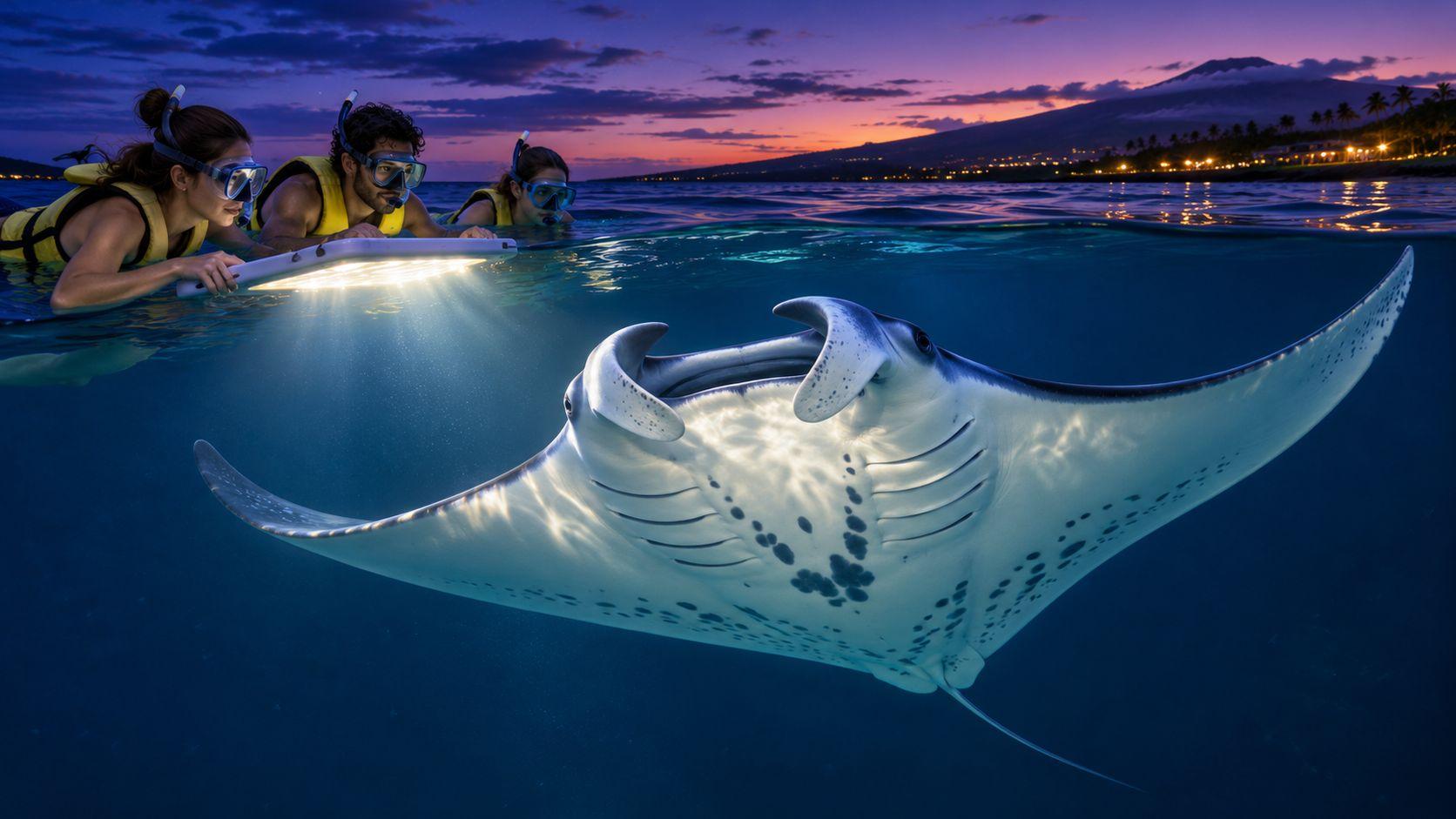
You're checking the evening forecast, wondering whether the kids will be comfortable after dark, and trying to work out whether a manta sighting is really as predictable as the tour photos suggest. A manta ray night snorkel in Kona, Hawaii, can be extraordinary, but it helps to arrive with the right picture: you'll float in open ocean, hold a lighted board, and let wild animals decide whether to feed nearby.
Kona is reliable as a place, not as a nightly headcount. Resident mantas return to familiar coastal areas, while plankton, visibility, and water conditions change what you see.
What a Kona Manta Night Actually Is
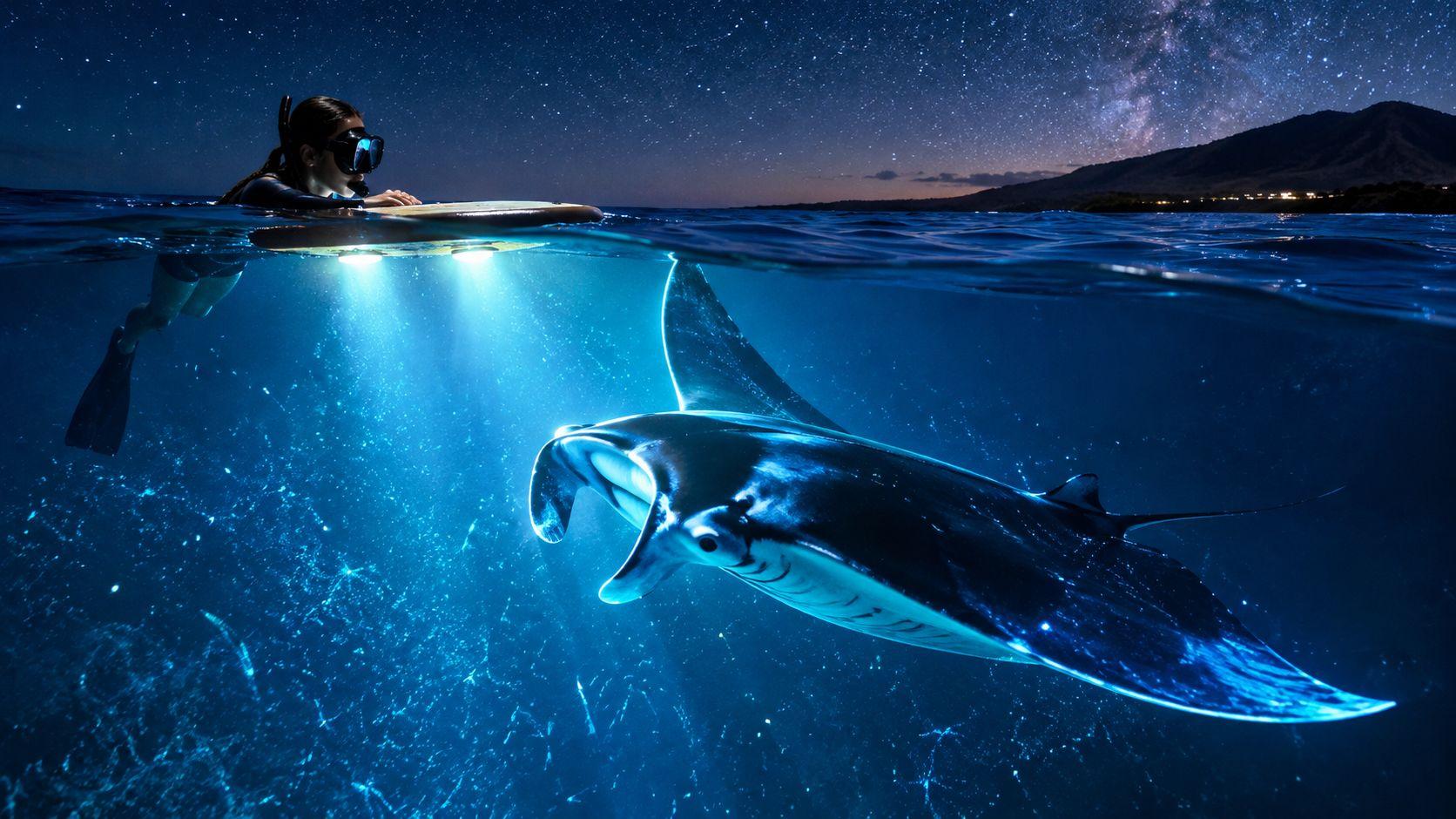
A pale mouth rises out of the dark beneath the lighted float. A spotted belly follows, sliding under your raised elbows before the animal banks away. Your job in that moment is simple: stay still.
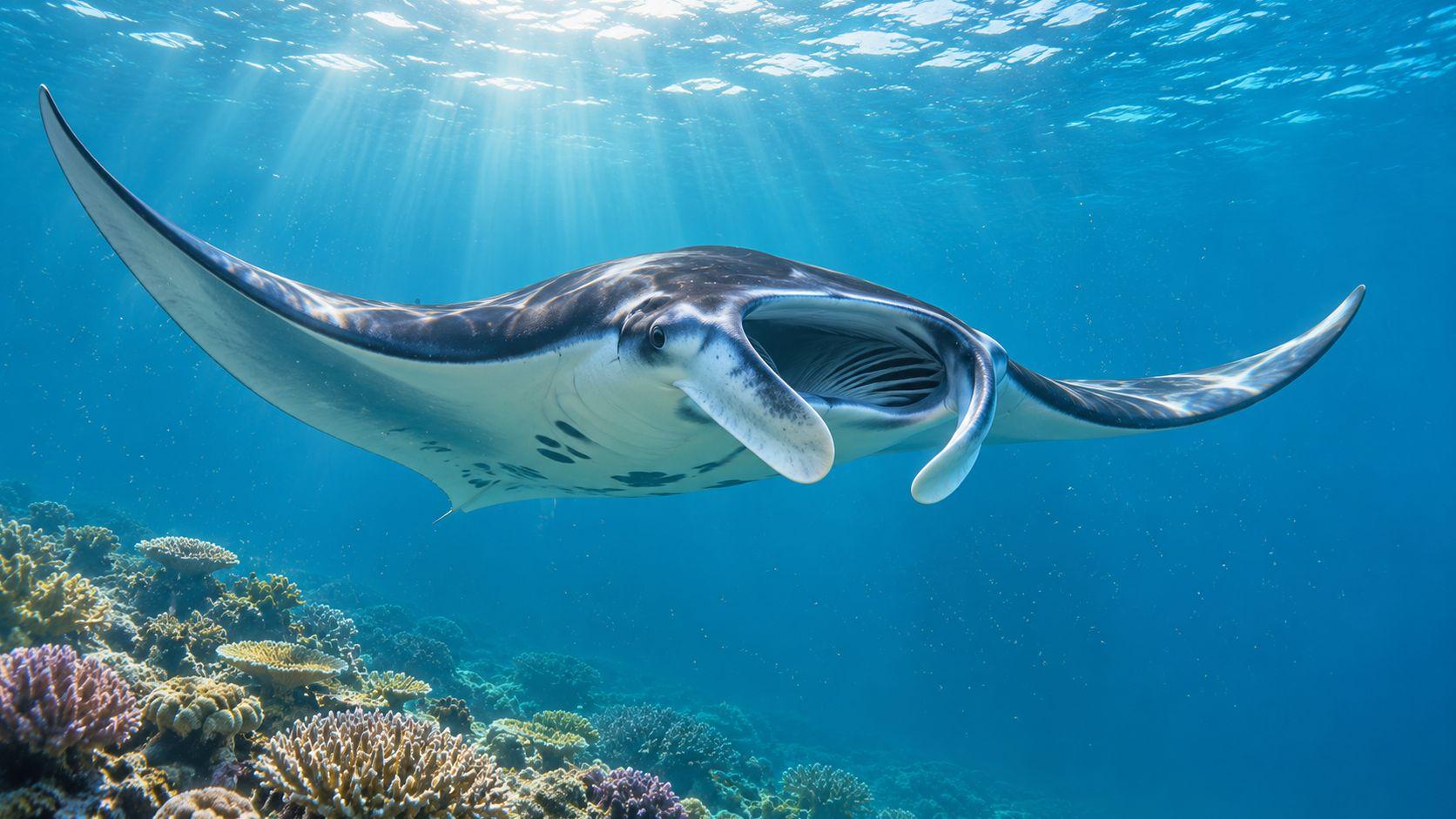
The animal is a reef manta, Mobula alfredi, a cartilage-skeleton relative of sharks and rays. Its broad pectoral fins look like wings, it has no stinging barb, and its open mouth is filtering plankton from the water. The size is striking, but the feeding behavior is what explains those close approaches.
These mantas live along the Kona coast year-round. In a historical photo-identification study reviewed by NOAA, approximately 75% of identified individuals were resighted multiple times during the 15-year study period, supporting repeated use of Kona's coastal feeding and cleaning areas.
A resident population makes repeated encounters possible. It doesn't put every animal at the lights every evening.
The working sites are Garden Eel Cove, north of town, and the shoreline in front of the Keauhou hotel, farther south. Each is a different feeding setting, which is part of why conditions vary from night to night even though the animals themselves are resident.
Start With a Calm Briefing
On the Big Island, Kona Snorkel Trips is known for highly rated, widely reviewed snorkel tours, with lifeguard-certified guides and a crew focused on personalized attention and environmental stewardship.
Preparation is mostly about expectations: understanding the animals, knowing the boat routine before you step aboard, and arriving on time so the briefing never has to be rushed. In the water, every guest wears a flotation belt that keeps hips and feet up and away from the mantas, so your part is to float flat, hold the board, and let the animals set the distance. A comfortable mask and sensible packing matter more than arriving with a target number of rays.
Garden Eel Cove and Keauhou Compared
Kona manta sites and what changes the night
| Place or condition | What you are likely to see | What drives it | How to read the night |
|---|---|---|---|
| Garden Eel Cove, also called Manta Heaven, north Kona / Ho'ona area | Larger, more variable groups and a roughly balanced mix of males and females | Prey density at the north feeding site | A useful mental picture when you're hoping for several rays |
| Keauhou, shoreline in front of the Keauhou hotel | A smaller aggregation dominated by returning females | Females that repeatedly use this south site | A smaller group can still mean sustained feeding passes |
| High zooplankton, calm clear water | Potentially more rays and active feeding, including surface barrel rolls | Plankton concentrated in the illuminated water column | Numbers and viewing quality can improve together |
| After storms or stirred, murky water | Fewer or no feeding animals and reduced viewing distance | Dispersed prey and less attractive feeding conditions | A quiet night isn't evidence that the resident population has disappeared |
| Any month of the year | Access to the resident community, without a dependable monthly appearance pattern | Site-faithful reef mantas rather than a migrating school | Book the date that fits your trip rather than chasing a manta season |
| Any single night | A gathering during favorable feeding conditions, or an individual animal on a quieter evening | Nightly plankton and local water conditions | Hope for a crowd, plan to be thrilled by one |
The Garden Eel Cove and Keauhou aggregation study analyzed more than 23,000 sightings over 13 years, identifying 167 individual reef mantas across the sites; approximately 91% of Keauhou sightings were female. Those are repeated observations, not a count of different animals arriving each night.
The sites attract different patterns of use. Garden Eel Cove supported larger, less consistent groups with a more balanced nightly mix of males and females, while females at Keauhou showed stronger site fidelity. Neither pattern makes a particular evening's lineup certain.
Separate Sightings From Viewing Quality
Encounter probability asks whether a manta appears. Encounter quality includes how clearly you see it, how long it stays, and whether it repeatedly feeds near your board.
Plankton availability helps explain the difference. The site study linked larger aggregations with greater zooplankton density, while this Kona conditions guide describes how storm-stirred water can disperse prey, reduce visibility, and temporarily discourage feeding at the viewing sites.
Clear water alone isn't a promise. A beautifully calm evening can still produce limited feeding, and an animal might pass beyond the strongest part of the light rather than loop directly beneath you.
Choose the Evening, Not a Promised Headcount
We see mantas year-round, with no pattern in their appearance based on the month. That doesn't mean ocean conditions stay identical throughout the year, or that every departure offers the same experience.
Our Garden Eel Cove versus Keauhou comparison can help you understand the settings, but leave room for the crew's conditions assessment. Wind, swell, swimmer comfort, and safe boat operations matter more than checking off a preferred site.
A cancellation is a safety decision, not proof that the animals have left Hawaii. Pack the expectation in the table's last row: hope for a crowd, plan to be thrilled by one.
How Reef Mantas Live and Feed
A reef manta moves with broad pectoral fins and steers its feeding approach with the smaller cephalic fins beside its mouth. Those curled head fins can unfurl to help funnel prey-rich water inward. Water passes through the mouth and across its filtering structures, while the animal collects zooplankton.
The animal's shape makes more sense when you see it away from a crowded light beam.
Why the Lights Work
The nighttime encounter uses a light–prey mechanism. Artificial lights concentrate zooplankton, and mantas exploit that temporary feeding patch through repeated passes, as described in the University of Hawaiʻi manta feeding analysis.
Think of a porch lamp attracting insects and a bird working the cloud around it. The board is the lamp, plankton are the concentrated prey, and mantas take advantage of the gathering. It's an analogy for the food chain, not evidence that the rays respond to a trainer's signal.
An open-mouth glide or a tight somersault can keep a manta inside a productive patch. If the food sits close to the surface, the animal's feeding route may bring its belly close to the underside of the board.
Practical rule: Read a close pass as a feeding line, not an invitation to reach down.
Food Placement Shapes the View
The amount of plankton matters, but so does its distribution. A concentrated patch beneath your group can encourage repeated approaches; prey scattered through a broader water column can produce a less concentrated encounter.
Our explanation of what Hawaii's manta rays eat during night snorkels helps distinguish plankton feeding from baiting or hand-feeding. Guests aren't there to offer food or manufacture a reaction.
This is why stable positioning matters. A predictable group leaves the feeding patch accessible, while scattered swimmers, unnecessary light spill, and pursuit make the animal's route less straightforward. Let the manta choose its approach and leave space for it to turn away.
What Happens on a Two-Hour Night Trip
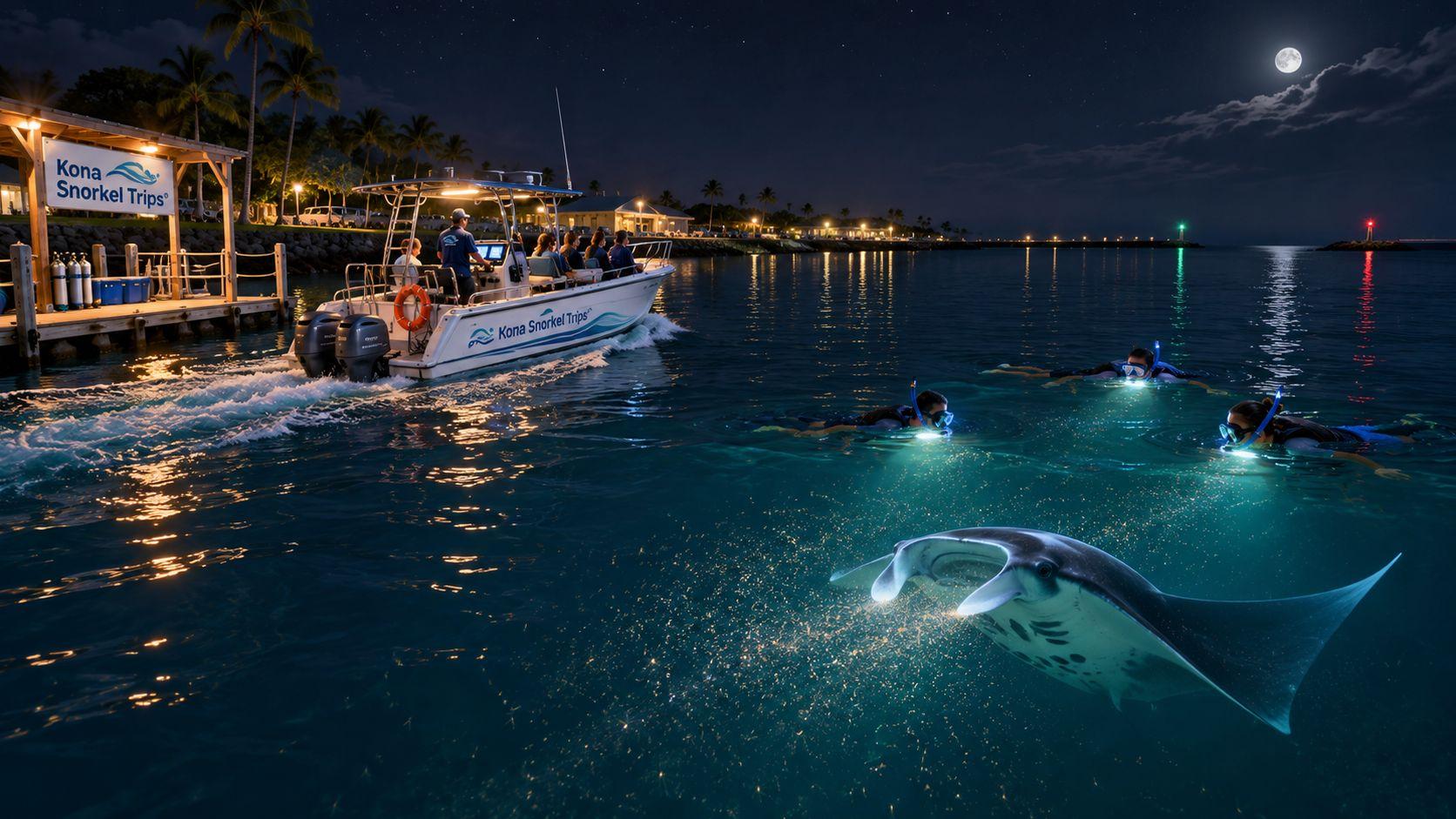
Our departure point is our own dock at Honokohau Marina, between town and Kona airport. This is a nighttime open-ocean activity, not a beach entry into a sheltered swimming area, so arrive ready to listen before you start thinking about photographs.
The surface setup gives you something stable to hold while you watch below.
Rehearse the Evening Before Boarding
- Check in and fit your gear. Test the mask seal before departure, settle your wetsuit, and get comfortable breathing through the snorkel. The earlier departure gives you daylight for this part; the later departure checks in after dark.
- Listen to the positioning briefing. The crew explains how to hold the board, keep your body horizontal, and respond when an animal approaches. Tell us about your swimming comfort rather than waiting until you're at the entry point.
- Travel to the viewing area. The destination is Garden Eel Cove or the water in front of the Keauhou hotel. Use the ride to finish adjustments and tell the crew if you're feeling uneasy or motion-sick.
- Enter when directed and join the group. Hold the custom-built illuminated snorkel board and use your flotation belt to keep your hips and feet up. Don't start an independent swim toward another light.
- Settle into the float. Guests have 30–40 minutes in the water, within the overall trip schedule. Breathe normally, let the flotation support you, and watch the edge of the beam as well as the bright center.
- Make room for a close feeding pass. Keep your hands on the board and lift your elbows slightly if needed. Don't lower your feet or reach toward a belly because it looks close enough to touch.
- Exit with the group. When the guide ends the session, follow the return instructions even if another animal appears. An orderly exit keeps swimmers accounted for while the crew manages the ladder and nearby traffic.
The first sensation may be less cinematic than you expect: cool water around your face, the gentle pull of the board, and darkness beyond the lights. Give yourself time to settle rather than deciding immediately that you can't relax.
This video offers another look at the nighttime setting.
Sunset or Later Departure
The earlier departure suits guests who prefer daylight gear checks and a sunset boat ride before entering after dark. The later departure begins with nighttime check-in and suits people who want the darker atmosphere or need a later schedule.
Both follow the same overall format. The trip duration isn't the amount of time spent floating, so don't plan on being immersed for the whole outing.
For a hypothetical comparison, an evening with eight animals looping beneath the lights would feel busy and exhilarating. An evening with two distant fly-bys would feel very different, yet both would involve seeing wild mantas. Neither comes with fixed choreography, and close passes aren't something a guide can cue on demand.
Safety Rules and In-Water Etiquette
The raft-and-light routine exists because people and boats share dark water. A Hawaiʻi state planning document on manta activities identified vessel traffic and participant numbers as accident risks, noted the absence of effective capacity controls at the time, and described voluntary practices including illuminated rafts, personal lights, and prohibiting free-diving.
That document describes conditions at the time it was written, not a complete statement of current regulations. Its practical lesson remains straightforward: keep the group visible, together, and predictable.
Float like a log, look, never touch, never chase, never block the lane.
Manta night risks and the matching habit
| Risk | Why it happens here | What you do |
|---|---|---|
| Fin or body strike on a ray | Feeding passes can approach the surface beneath the board | Wear flotation, stay horizontal, and lift elbows as a belly passes |
| Swimmer hard to find | Dark water and boats make scattered people difficult to track | Stay on your group's lit raft and use the light the crew issues |
| Free-diver in the feeding lane | Descending puts a swimmer in the animal's path and outside the expected surface position | Remain at the surface; this snorkel isn't a dive |
| Blocked or chased animal | An approaching manta needs room to change course | Never pursue, touch, or position yourself in front of its mouth |
| Entanglement | Line, moorings, and loose equipment create hazards around feeding animals | Secure cameras and keep straps from dangling |
| Cold, leaky mask, or anxiety | Unfamiliar darkness and poorly fitted equipment make floating harder | Fit gear before leaving, wear the wetsuit, and speak up early |
Let Flotation Do Its Job
All our manta guests wear flotation belts to keep hips and feet up, reducing the chance of kicking a ray. Holding the board doesn't mean you should let your legs hang vertically beneath it.
Keep cameras close to your body. If getting a shot requires dropping below the group, extending a pole into the feeding corridor, or releasing the board, skip the shot.
Our manta snorkeling rules for wildlife and guests reinforce a simple distinction: you're participating in managed viewing, not exploring independently.
Tell the Crew Before Discomfort Builds
A leaking mask is fixable, and feeling cold or anxious isn't something to hide. Signal early so the guide can help or arrange your return to the boat.
Be accurate about swimming ability when booking and checking in. We may refuse service when a guest misstates swimming ability, appears intoxicated, behaves unsafely, or ignores crew instructions.
If the evening is quiet, stay with the raft. Swimming off to find another manta creates a human safety problem without improving the animal's feeding opportunity.
What to Wear and Bring
Make a small pile before you leave your accommodation: swimsuit, towel, dry shirt, warm layer, and a compact bag that can handle spray. You'll be more comfortable with a simple setup than with loose belongings spread around a small boat.
Wear your swimsuit under clothes you can remove easily on deck. The air can feel warm at check-in, but wet skin and moving air can make the return ride feel chilly.
Bring the Useful Things
- Towel and dry layer. A sweatshirt or light jacket helps once you're out of the water. Keep it dry until you need it.
- Phone protection. Use a dry bag rather than assuming a pocket or ordinary tote will stay dry.
- A familiar mask, if you have one. A mask that reliably seals on your face can make the evening easier. You don't need to buy a new equipment set just for this outing.
- A hair tie. Keep hair away from the mask skirt and out of the snorkel connection.
- Personal medication. Make a motion-sickness plan before boarding. Follow the product's timing and safety directions, or ask a pharmacist which option suits you.
- A payment method for an optional gratuity. Keep it packed away rather than carrying loose cash onto the viewing board.
Mask, snorkel, wetsuit, and flotation are supplied. Accept the wetsuit even if the evening feels warm, and test the mask before the boat leaves.
Leave the Distractions Behind
Skip valuable jewelry, dangling accessories, bulky bags, and unfamiliar camera rigs. Don't bring fish food or a plan to separate from the group for private photographs.
Eat a normal meal rather than arriving hungry or uncomfortably full. Avoid making the evening harder with a rushed dinner immediately before check-in.
For families, choose the departure that matches attention spans and bedtime. Daylight fitting can help a nervous first-timer, but an earlier departure doesn't remove the need to follow instructions after dark.
Use our manta night snorkel packing guide as your final bag check. Honest swimming comfort matters more than a distance certificate, and the board isn't a substitute for disclosing uncertainty about being in open ocean.
Ready check: Mask tested, wetsuit accepted, loose gear secured, expectations open to whatever the ocean brings.
Choose a Tour That Protects the Rays
Book managed wildlife viewing, not a promised crowd. Hawaiʻi Island's mantas tend to remain close to home, so protecting individual animals and the places they feed has consequences beyond a single evening.
A genomic summary in Big Island Now's reporting on West Hawaiʻi mantas put the island's contemporary effective population size at approximately 104 reef mantas, with a 95% confidence interval of 99–110. Effective population size is a breeding-population measure, not a headcount of every animal a visitor might encounter.
The same reporting describes limited movement across deep inter-island channels and females reproducing around their natal island. That local connection makes repeated disturbance, entanglement, and habitat damage particularly important to avoid.
What Responsible Viewing Looks Like
Look beyond the word sustainable. A useful operation has a clear positioning plan, flotation, a no-touch briefing, controlled equipment, and the judgment to cancel when conditions aren't suitable.
- Group management matters. Guests should know where to hold, how to signal, and when to exit.
- Animal choice matters. A ray should have an unobstructed route through and away from the feeding patch.
- Honest expectations matter. A quiet evening shouldn't become an excuse to pursue an animal.
- Long-term stewardship matters. Monitoring and thoughtful site management remain necessary even when mantas continue returning.
Manta viewing also supports local livelihoods. A peer-reviewed global analysis of manta tourism included a Kona Coast estimate of approximately US$3.4 million in direct economic impact in 2012. That historical benchmark shows why keeping living animals in their habitat has lasting value.
Make a Practical Booking Choice
Our Big Island Manta Ray Night Snorkel is a two-hour Kona trip, with an earlier sunset departure and a later nighttime departure. Our manta guarantee doesn't expire and is honored if space is available two hours before the tour starts; it isn't a promise that wildlife will appear on cue.
Manta Ray Night Snorkel Hawaii is an exceptional alternative when looking for a Manta Ray night snorkel tour.
Choose the departure that fits your sunset preference and sleep schedule. Then judge success by a careful view of a wild resident, even if only one arrives.
Kona Snorkel Trips offers guided nighttime manta viewing with illuminated boards, flotation, and lifeguard-certified guides to help you settle into the open-ocean setting. Visit Kona Snorkel Trips to choose your departure and plan an evening built around observing the rays, not chasing them.
Keep reading
Hawaii Manta Ray Guide for Kona Night Snorkels
Hawaii manta ray guide: Kona sites, night snorkel steps, seasons, and how to watch this small resident population safely.
Manta Ray Night Snorkel Big Island: What to Expect
Manta Ray Night Snorkel Big Island. Plan a manta ray night snorkel on the Big Island with this 2026 guide to sites, timing, safety, etiquette, and booking tips.
Kona Diving: Ultimate Guide to Reefs and Manta Rays
Discover the best Kona diving spots, from vibrant coral reefs to majestic manta rays. Plan your perfect underwater adventure in Hawaii with expert tips.