
Manta Night Snorkel Guide: Where to Go and What to Expect
You're looking at your evening plans in Kona, wondering whether floating in a dark ocean will feel thrilling or a little too far outside your comfort zone. Maybe your child is already asking how close the mantas get, while you're wondering how you'll see anything without swimming into someone else. A manta night snorkel works best when you know what your job is before leaving the harbor: float where the guide positions you, leave the feeding space open, and let wild animals decide whether to approach.
How a Manta Night Snorkel Works
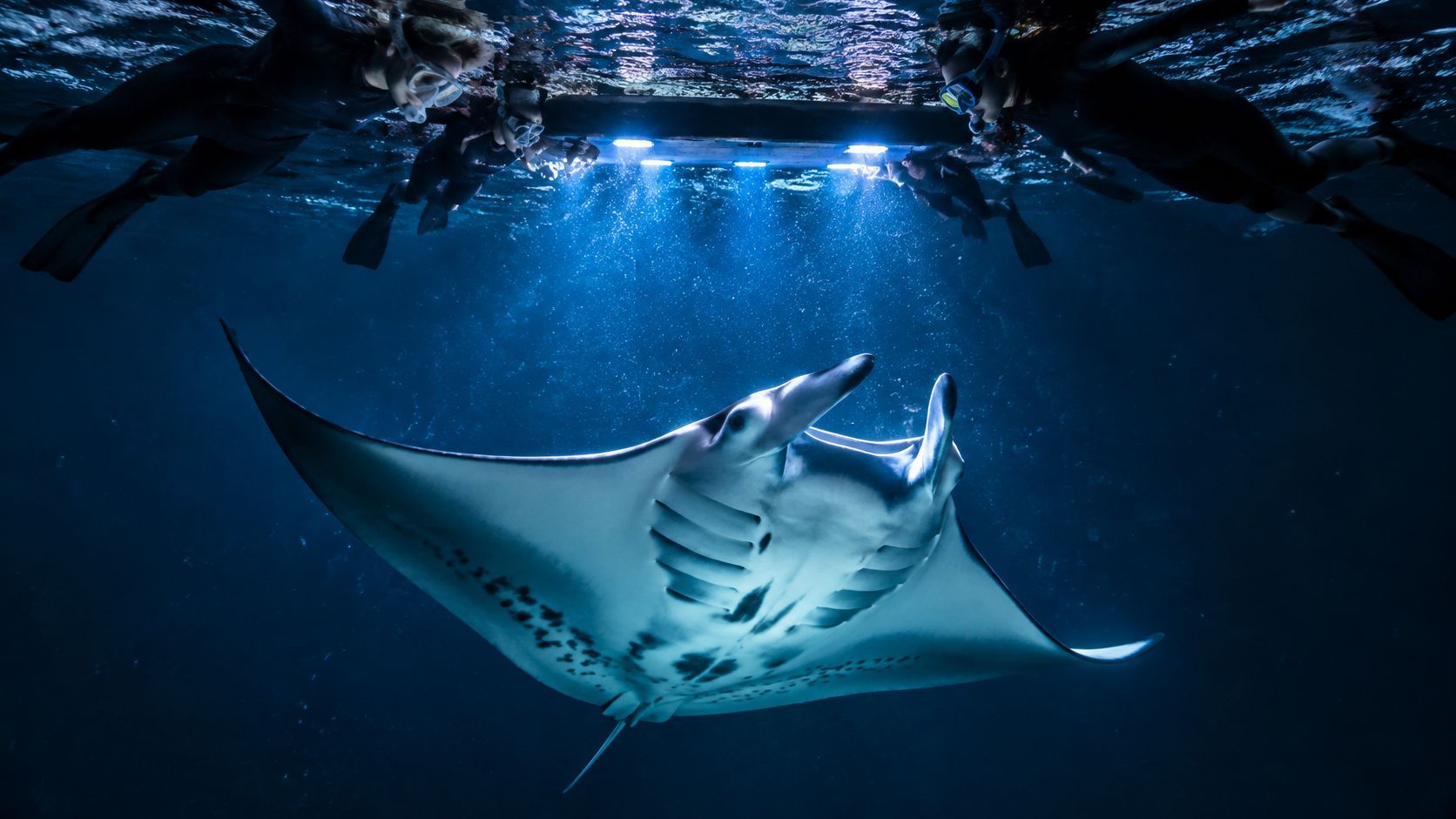
Say a first-time visitor grips the rail at the back of the boat while the deck lights go out. A guide slides a custom-built snorkel board with high-powered lights into the black water. Eight snorkelers settle flat on the surface around it. Beams reach down, plankton thickens in the glow, and a diamond-shaped shadow rises from below. It turns, shows a pale underside and an open mouth, then rolls through the light while everyone holds position.
Kona Snorkel Trips is Hawaii's highest-rated and most-reviewed snorkel company on the Big Island, with a focus on helping guests understand the ocean experience before entering the water.
The Lights Ring for Plankton
The lights work like a dinner bell for zooplankton, not directly for mantas. Tiny drifting animals concentrate in the illuminated water, and reef manta rays arrive to feed. The board also gives snorkelers a shared place to hold, so the viewing group stays organized instead of scattered across the surface.
Our explanation of how the manta ray light board works on your night snorkel shows why your position matters as much as the brightness beneath you. You watch a feeding area. You do not chase an animal through the ocean.
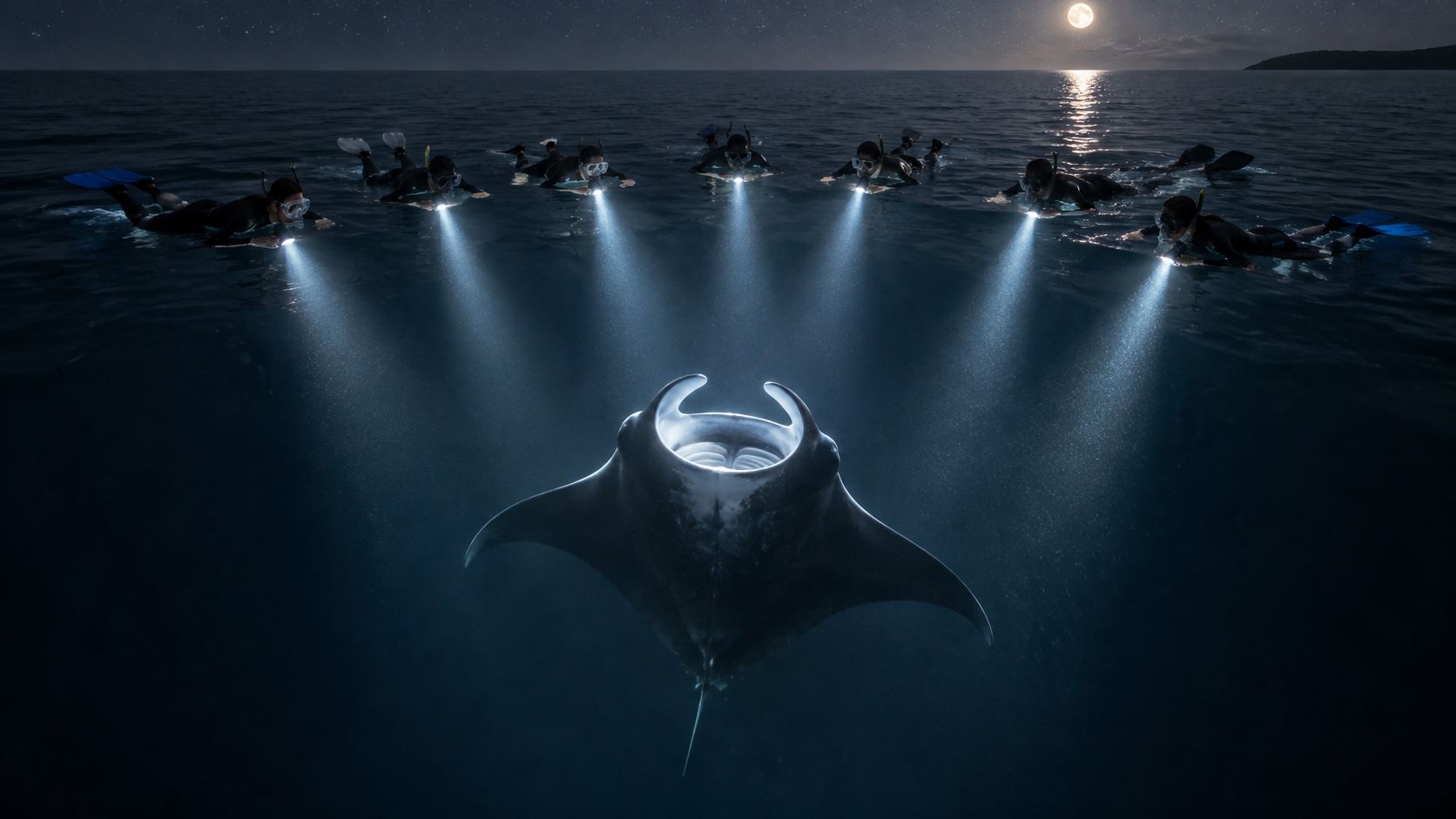
Mantas use paired cephalic fins beside their mouths to funnel water inward, then trap plankton with gill rakers as water passes through their gills, according to Hawaii's Division of Aquatic Resources. That open mouth is a feeding tool. The circling and barrel rolls let the animal pass through its food again and again, while crowding or kicking forward can break up the pattern.
An Accidental Beginning
Historical accounts in a manta tourism study held by Hawaii County trace the activity to 1991, when underwater lighting near the former Kona Surf Hotel attracted plankton and reef mantas; by 1993, as many as five boats and roughly 50 people were participating at the site.
That origin still shapes the night. This is a nighttime open ocean activity with wild animals that remain free to feed elsewhere.
The sequence to remember: Lights concentrate plankton. Mantas approach to eat. People observe without taking over the feeding space.
Where Mantas Gather in Kona
Say a first-time visitor asks the crew where the boat is headed tonight, Garden Eel Cove or Keauhou. The answer depends on plankton, swell, wind and how many other boats already anchored. These sites are managed feeding grounds, not fixed stages with animals waiting on schedule.
| Site | Also Called | What Research Shows |
|---|---|---|
| Keauhou Bay | Manta Village | Visited predominantly by females |
| Hoona Bay and Makako Bay | Garden Eel Cove or Manta Heaven | Generally larger aggregations with a more even male-female mix |
The patterns in this table come from a University of Hawaii study summarized by Kona Honu Divers with 13 years of manta ray observations, which analyzed community-sourced observations from 2010 through 2022, including more than 23,000 sightings of 167 individually identified reef manta rays. The same summary describes earlier monitoring across Hawaii manta-viewing sites that recorded upward of 30 tour boats and approximately 300 participants per day.
Both viewing areas sit offshore from Kailua-Kona on Hawaii Island's west coast, with visitors arriving mainly by tour boat from nearby harbors.
Keauhou Bay, usually called Manta Village, is the name you will hear when a crew discusses the southern viewing area near the hotel. The female-heavy pattern describes animals recorded there over time. It says nothing about which individual will glide into the lights during your swim.
Garden Eel Cove, also called Manta Heaven, refers to the viewing area around Hoona Bay and neighboring Makako Bay. Larger recorded aggregations make it interesting on paper. A quiet night still happens when plankton stays thin or the animals feed elsewhere. Read the Manta Village versus Manta Heaven comparison for the layout of each spot, then ask the crew where they plan to anchor and why that choice suits the evening.
A good question sounds like this. How are you judging sea conditions tonight. How will you space swimmers around the light board. What happens if activity stays slow. The reply tells you more than any promised count.
Our early trip checks in during daylight, watches the sunset from the boat, and enters the water after dark. The late trip checks in at night, so choose according to your evening schedule and how you feel about preparing in darkness.
- Choose daylight preparation if seeing the boat, crew, and coastline before sunset helps you settle.
- Choose the later check-in if it fits your plans better, not because you expect darkness to guarantee more animals.
- Keep expectations flexible rather than assuming a particular month or departure time assures a busy feeding area.
On an active evening, several animals may circle through the illuminated space for long passes. On a quieter evening, the group may wait between brief visits, or no mantas may appear at all.
Are You Ready and What to Bring
| Case | What You Need | Notes |
|---|---|---|
| Strong swimmer | Swim 50 yards without extra flotation | Required for our manta trip |
| Snorkeling experience | Intermediate level with prior snorkeling | Be honest about your level when booking |
| Children | Meet the swimming and experience requirements and receive operator approval | Confirm minimum age and swim level before booking |
| Non-swimmers | Not suited to this trip | Ask about a daytime tour instead, with suitability assessed beforehand |
A flotation belt doesn't turn this into a beginner swimming lesson. For our manta snorkel, you should be able to swim 50 yards without additional flotation and have prior snorkeling experience at an intermediate level. You need enough comfort to manage your breathing, respond to directions, and move through open water without relying entirely on equipment.
Say you've snorkeled over a reef in daylight but panicked whenever water entered your mask. That's useful information to share before booking, not something to hide until you're beside the boat at night. The honest answer may be to build your confidence first.
Check Readiness Before Packing
For children, age alone doesn't settle suitability. Explain the child's actual swimming ability, snorkeling experience, and response to unfamiliar water, then confirm the minimum age with the team.
Discuss mobility concerns before reserving, too. Describe the assistance you need for boat movement, water entry, and climbing out rather than asking whether the trip is accessible.
Non-swimmers shouldn't book this night experience. Beginners are welcome on our daytime tours, but that doesn't mean every daytime activity is automatically suitable for someone who can't swim.
A reassuring flotation setup supports an already capable swimmer. It doesn't replace the skills needed to enter open water after dark.
Pack for the Ride Home
Bring a towel. Keep it dry until you're back aboard so you can dry your skin before putting on a layer. A damp towel buried beneath wet gear won't be much help.
Pack a zip-up jacket. After-dark air and moving-boat airflow can feel cool when you're wet. A zip-up layer is easier to put on than pulling a tight sweatshirt over damp shoulders.
Secure your GoPro or waterproof camera. Use a wrist attachment and keep the camera close to your body. Set it up before entering so you're not troubleshooting controls while the guide is positioning the group.
Wear your swimsuit under your clothes. This simplifies preparation at the boat and reduces the amount of changing you need to manage around other guests.
Leave unnecessary valuables ashore. Remove loose jewelry and avoid bringing items you'll need to keep checking. Use secure accommodation storage rather than leaving valuables visible in a vehicle.
The manta night snorkel packing guide can help you organize a compact bag. Before booking, confirm age eligibility and any personal gear needs; we provide wetsuits for the manta tour, and all guests wear flotation belts to keep hips and feet supported.
What Happens on the Tour, Step by Step
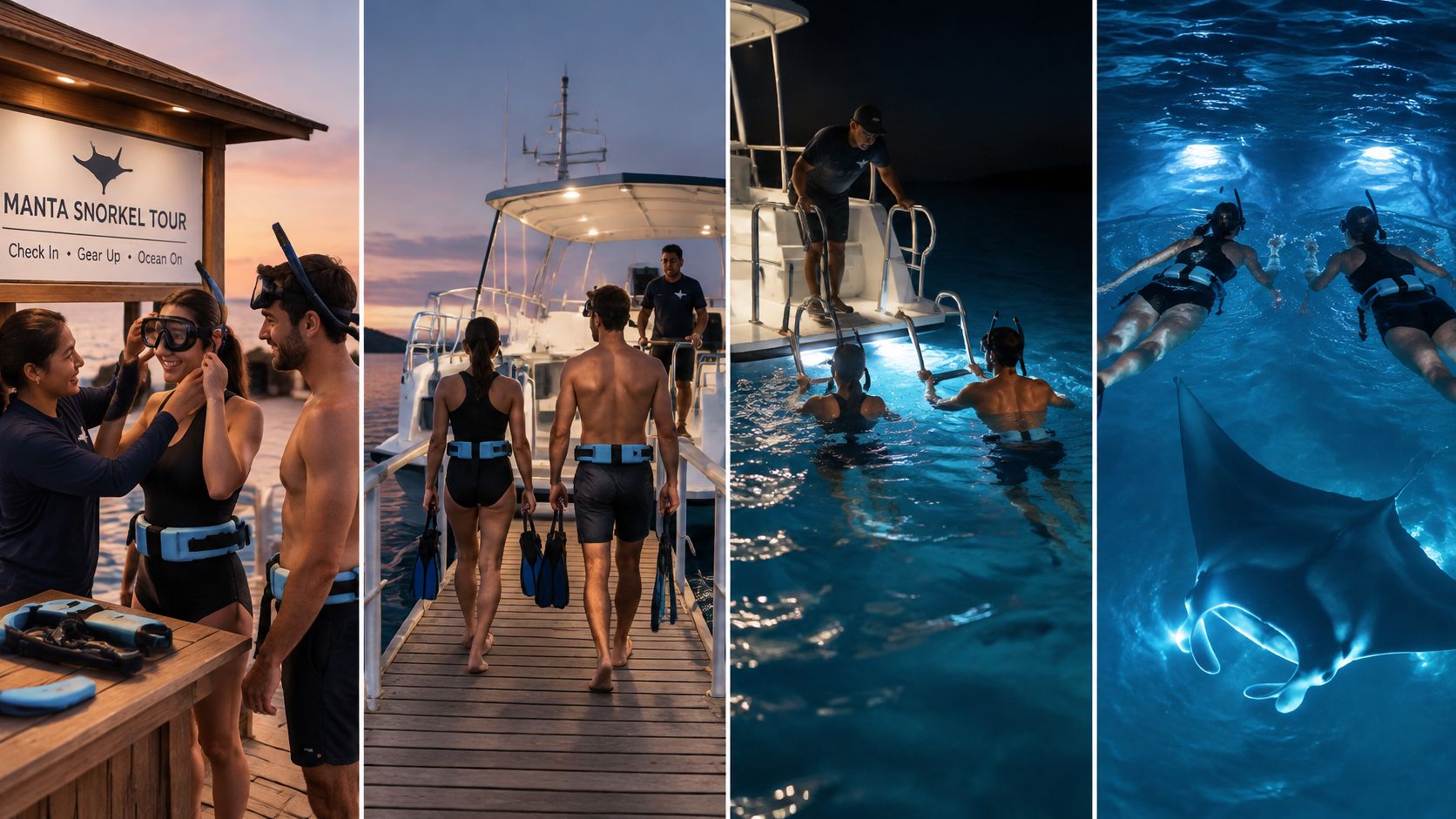
Check in and get your equipment fitted. Start with the mask, snorkel, and flotation belt. The mask skirt should sit against your face without hair trapped beneath it, and the strap shouldn't need to be painfully tight. Tell the crew about a poor fit before departure rather than hoping it will improve once you're in the water.
Listen to the pre-water briefing. The guide explains what mantas look like, how large they can appear below you, and where the group will hold around the lights. Pay particular attention to the signal for needing help and the procedure for leaving the water. Knowing those details makes an unexpected splash or a blocked view easier to handle calmly.
Ride to the viewing area while the crew prepares the board. Keep the boarding area clear and follow directions about where to sit and store your bag. At the site, the crew organizes the illuminated board and the entry sequence. Waiting for your turn prevents everyone from arriving at the same handhold together.
At the Board and Back Aboard
Enter only when the guide signals. Move to your assigned place and settle at the surface instead of trying to choose a better viewing position independently. Keep your body horizontal, with your legs supported rather than dangling into the feeding space. A stable arrangement gives the guide a clear view of the group and keeps the area beneath the lights unobstructed.
Spend 30–40 minutes in the water. Follow the guide's position calls throughout that time. On a strong night, mantas may circle, barrel-roll, and pass within arm's reach, but that closeness is never an invitation to reach out. A quieter encounter might consist of brief appearances separated by long stretches of watching illuminated water.
Return to the boat in the crew's order. Leave space around the ladder, hand over equipment when instructed, and wait until you're secure before reaching for your towel. Follow the crew's gear-rinsing instructions and use the debrief to ask about the behaviors you watched. Avoid assuming a particular animal stayed for the entire encounter just because passes looked similar.
The hardest part for some first-timers isn't seeing a manta. It's resisting the urge to follow one when it disappears beyond the beam, especially after another swimmer reacts excitedly nearby.
Your best viewing technique: Hold a steady position, breathe slowly, and watch the guide rather than chasing a single animal.
If water enters your mask or your position feels awkward, ask for help early. Solving a small equipment problem while you're calm is better than struggling until you need to leave.
Safety Rules, Crowding and Common Questions
Say a first-time visitor grips the board while a six-foot shadow loops up from the dark. The instinct is to reach out, to duck under for a better look, to drift toward open water for space. Every rule on this night exists to stop that impulse before it changes the encounter for the mantas and the group.
| Situation | Rule | Why It Matters |
|---|---|---|
| Mantas come close | Look, don't touch, grab, chase, or ride | Hawaii's ray protections and wildlife guidance prohibit specified harmful acts and advise against disturbing natural behavior |
| Lights are on | Point lights down, away from faces | Glare makes it harder for other swimmers to see and stay comfortable |
| Staying with the group | Stay with the group near the illuminated flag | Hawaii's snorkeling rules require an illuminated flag between sunset and sunrise for night snorkeling and diving activity |
| Boats approach the zone | Vessels move slow-no-wake and don't anchor or raft | Manta viewing-zone rules restrict vessel activity during viewing hours |
| A ray feeds in your path | Hold your surface position and let it pass | A clear feeding corridor gives the animal room to maneuver |
Close isn't permission to touch. Keep your hands at the board and your camera tucked in rather than extending either toward an approaching animal. If a manta passes beneath you, let it choose its route.
NOAA's manta viewing guidance recommends that snorkelers remain at the surface, direct lights downward, and avoid descending into the feeding corridor. Touching can remove the animal's protective mucus coating, which leaves it more vulnerable to infection.
Make Room Without Leaving the Group
Crowding shapes this night as much as plankton does. In a peer-reviewed study of 444 manta-tour participants, most snorkelers reported feeling crowded by other snorkelers and by boats, with reported conflicts including bumping and lights shining into people's eyes.
Say another guest's shoulder blocks your view just as a manta turns. Don't climb over them or duck beneath the board. Tell the guide, who can adjust positions without sending swimmers into the feeding area.
- Respect assigned spacing. Where the layout allows, leave roughly a body length between swimmers, but don't release the board or drift away to create that gap yourself.
- Keep the center clear. Don't lower your body, camera pole, or fins into the open feeding corridor.
- Position children deliberately. Ask the guide to arrange a clear view before everyone settles, rather than lifting a child over another swimmer.
- Signal discomfort early. Raise a hand, get the guide's attention, and use your flotation belt while following instructions. If you need to exit, say so.
The rules that protect wildlife and guests work because everyone follows the same arrangement, including when the animals aren't visible.
Questions That Matter After Dark
Why might fewer mantas appear tonight?
A 2025 University of Hawaii study found that seasonal and annual changes in aggregation size closely tracked zooplankton density. Sightings follow food, not a schedule. A quiet encounter is not a reason to pursue rays or demand closer contact.
Can I stay at the edge?
Tell the guide before the briefing that you'd prefer an outside position. They can assess whether that placement works with the board layout and conditions. Don't move there independently.
What if I feel nervous?
Tell the in-water guide while you can still communicate calmly. A supported surface position may help you settle, but you don't have to remain in the water if you're uncomfortable.
Book Your Manta Night Snorkel Tour
Say a couple has one free evening in Kona and wants mantas without a rushed harbor sprint. They pick a departure they can reach early, eat lightly beforehand, and arrive with time to talk through nerves before boarding. That unhurried start shapes the whole night.
Book around readiness and schedule, not a promise of a particular wildlife performance. Plankton drives attendance, and the crew manages positions and behavior while the mantas choose whether to join.
- Reserve early. The manta trip is the most popular tour on the island, which is why two tour times are offered. Choose your preferred departure while planning your other evening activities.
- Compare check-in times carefully. Allow time for harbor arrival, preparation, and the full outing rather than fitting the trip tightly between dinner and another reservation.
- Understand the manta guarantee. Our manta guarantee offer doesn't expire, and it's honored if space is available 2 hours before the tour starts. That availability condition matters when planning a return visit, so don't treat it as an automatically reserved seat.
- Share relevant needs before paying. Confirm child eligibility, explain mobility concerns, and be straightforward about swimming and snorkeling experience.
Choose Guidance You Can Rely On
Our Manta Ray Night Snorkel tour combines small-group attention with lifeguard-certified guides and an emphasis on environmental stewardship. Personalized attention means you understand where to go, how to signal, and what to do when an animal approaches.
Compare the practical details when considering another operator: participant requirements, group organization, flotation arrangements, and the response when someone wants to leave the water. Ask how the board is arranged, how crowding is handled, and how the guide responds when rays stay distant.
The right evening leaves room for both excitement and restraint. Confirm your swim level, choose your departure time, and book with the understanding that the crew manages the encounter while the mantas choose whether to join it.
Kona Snorkel Trips offers guided manta night snorkeling with small groups, lifeguard-certified guides, and a non-contact approach to wildlife viewing. Visit Kona Snorkel Trips to check departure options and discuss your group's readiness before reserving your night on the water.