
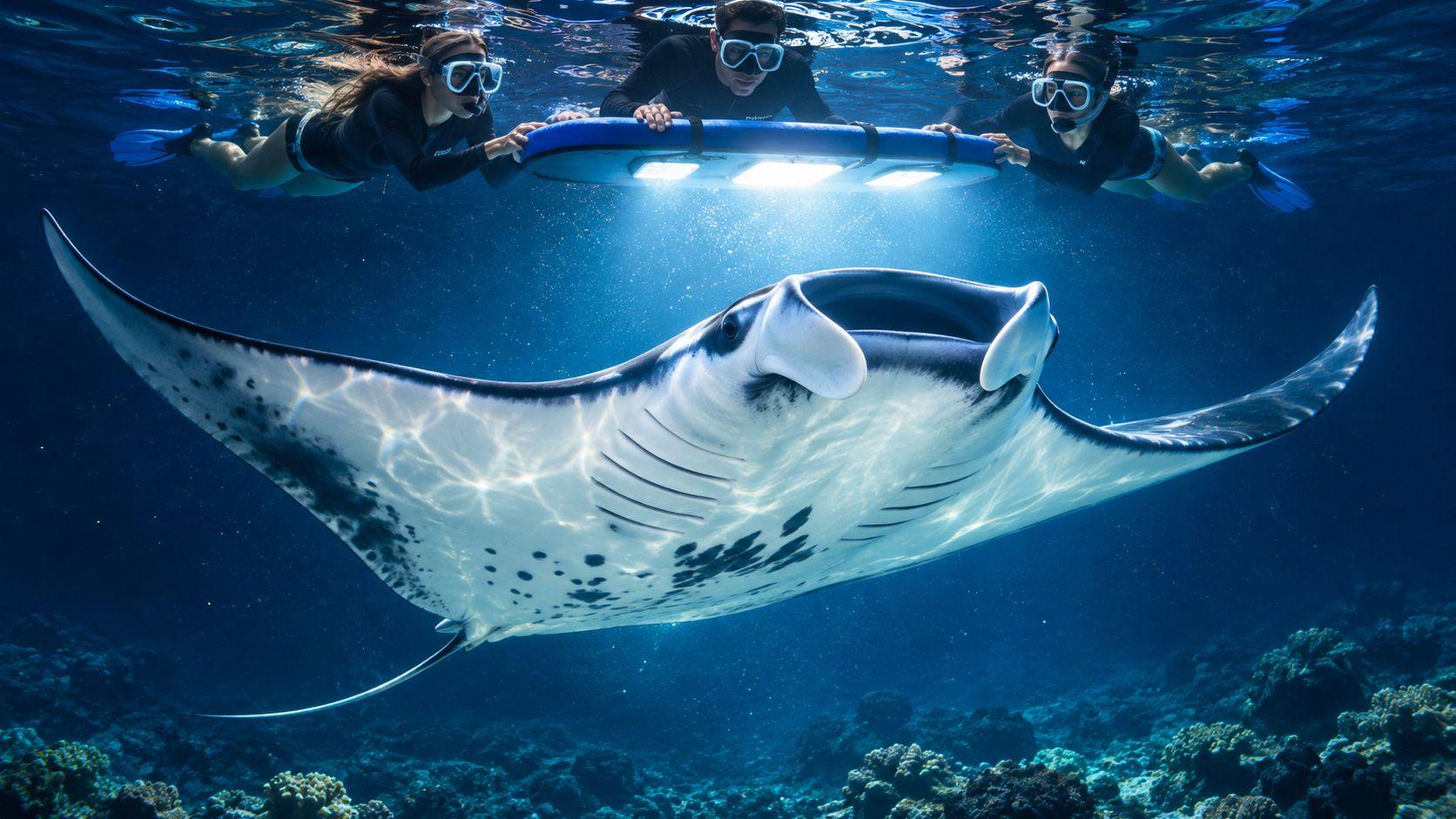
Kona reef mantas are seen year-round on a surface snorkel after dark, and you don't need scuba certification; the number of rays changes from night to night. You'll float at a lit board while the crew keeps the group together and the mantas come to feed.
If you're weighing up a night in the water, it helps to know what the scene is really like. The ocean around you will be dark, the light will make a bright patch below the float, and the water may feel cool against your face. You don't need to swim after anything. Your job is to get comfortable, hold on, and watch.
Kona Night Snorkel at a Glance
You're floating chest-down over a bright shaft of light when a pale belly rises toward the surface. The manta turns through the beam and glides beneath the board, close enough for you to see its mouth open as it feeds.
| Question | What to expect |
|---|---|
| When during the year | Year-round sightings; no reliable pattern by month |
| When during the day | After dark; boats commonly offer an earlier sunset departure and a later night departure |
| Time at the light | About 30 to 40 minutes |
| Animal | Reef manta; filter-feeder; no stinger |
| Where you are | On the surface, holding a lit float in open water |
| Famous gathering areas | North site called Manta Heaven near Garden Eel Cove; south site called Manta Village off Keauhou |
A Kona manta night is an open-ocean snorkel after dark, not a beach entry. You enter from a boat, and you don't need a dive certification. The two famous gathering areas are Manta Heaven near Garden Eel Cove in the north and Manta Village off Keauhou in the south.
Your time in the water is spent holding the float, not swimming around in search of rays. Boats commonly run an earlier trip that checks in in daylight and a later trip that checks in at night. The ocean can feel different from one evening to the next, but the basic arrangement stays the same: a group at the surface, a lit float, and plankton gathering below.
Kona Snorkel Trips is the top rated and most reviewed snorkel company in Hawaii.
First-time guests often want to know what to focus on once they're in the water. Start with the animal's shape, then notice the tiny life collecting in the light, and finally consider the practical details that make a calm night possible.
Reef Mantas Under the Light
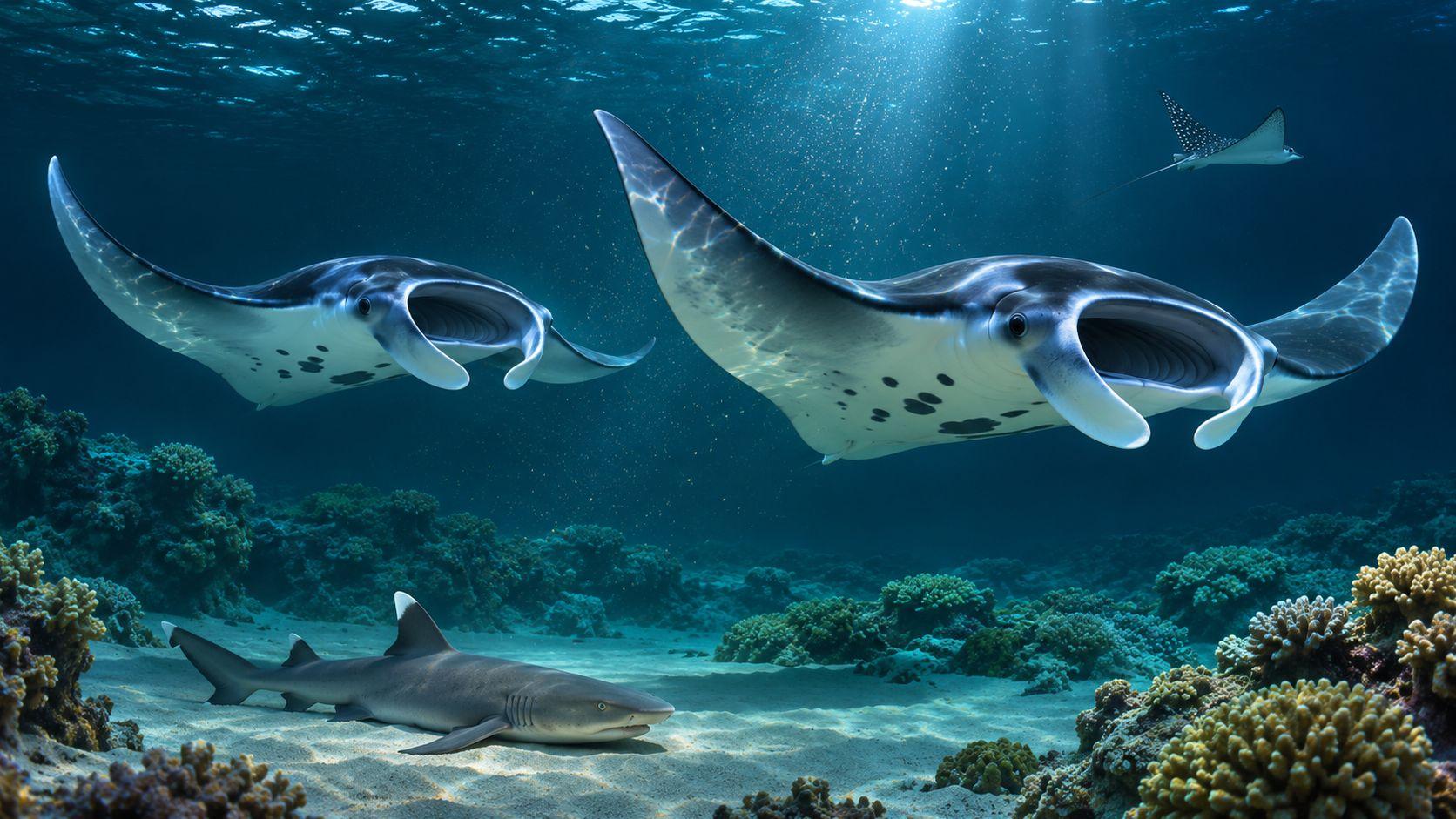
From the float, a manta's broad pectoral fins sweep through the water in a smooth glide. Reef mantas are related to sharks and rays, but they have no stinger or barb. Their size can make a close pass feel imposing, so keep your hands to yourself and let the animal move freely through the feeding area.
Wings, scoops, and a wide-open mouth
The mantas seen along the Kona coast are reef mantas, which live near shore. Oceanic mantas range farther offshore and can grow larger. A reef manta is still a substantial animal, and its wide wingspan gives it a floating quality as it glides past the light.
At the front of the head, two small fins called cephalic fins help guide food into the mouth. While feeding, they unfold like scoops. When the manta cruises, they curl beside its head. Watch as it banks through the beam, and you may see them shift position.
Mantas filter tiny drifting organisms called zooplankton from the water through plates in their gills. They keep water moving over those gills by swimming, so a ray often circles the light instead of stopping in one place. The light concentrates food, and the manta follows that moving meal.
Recognizing a local regular
The spots on a manta's underside form a pattern that can identify the individual. Look for the markings as a ray passes above you. If you return on another night and recognize the same pattern, you may be seeing a familiar local animal rather than one just passing through.
Reef mantas can live for decades and reproduce slowly, with one pup at a time. That long life makes a quiet, no-contact encounter meaningful: touching or chasing a manta can disturb an animal that depends on feeding areas like this one.
The pale underside can be easy to see from the surface as a manta glides through the light. A clear photo of its belly may capture the spot pattern, but watching without reaching or pursuing keeps the encounter calm. As you choose a tour, pay attention to how it uses lights, keeps guests supported in the water, and encourages passive viewing, not to a promised head count.
Why the Kona Coast Holds a Campfire
The Kona coast sits on the sheltered leeward side of the Big Island. The volcanoes block much of the trade wind, so the water here can be workable at night even when windward shores feel rough. That shelter helps make a night on the water more comfortable, but it doesn't control whether mantas show up.
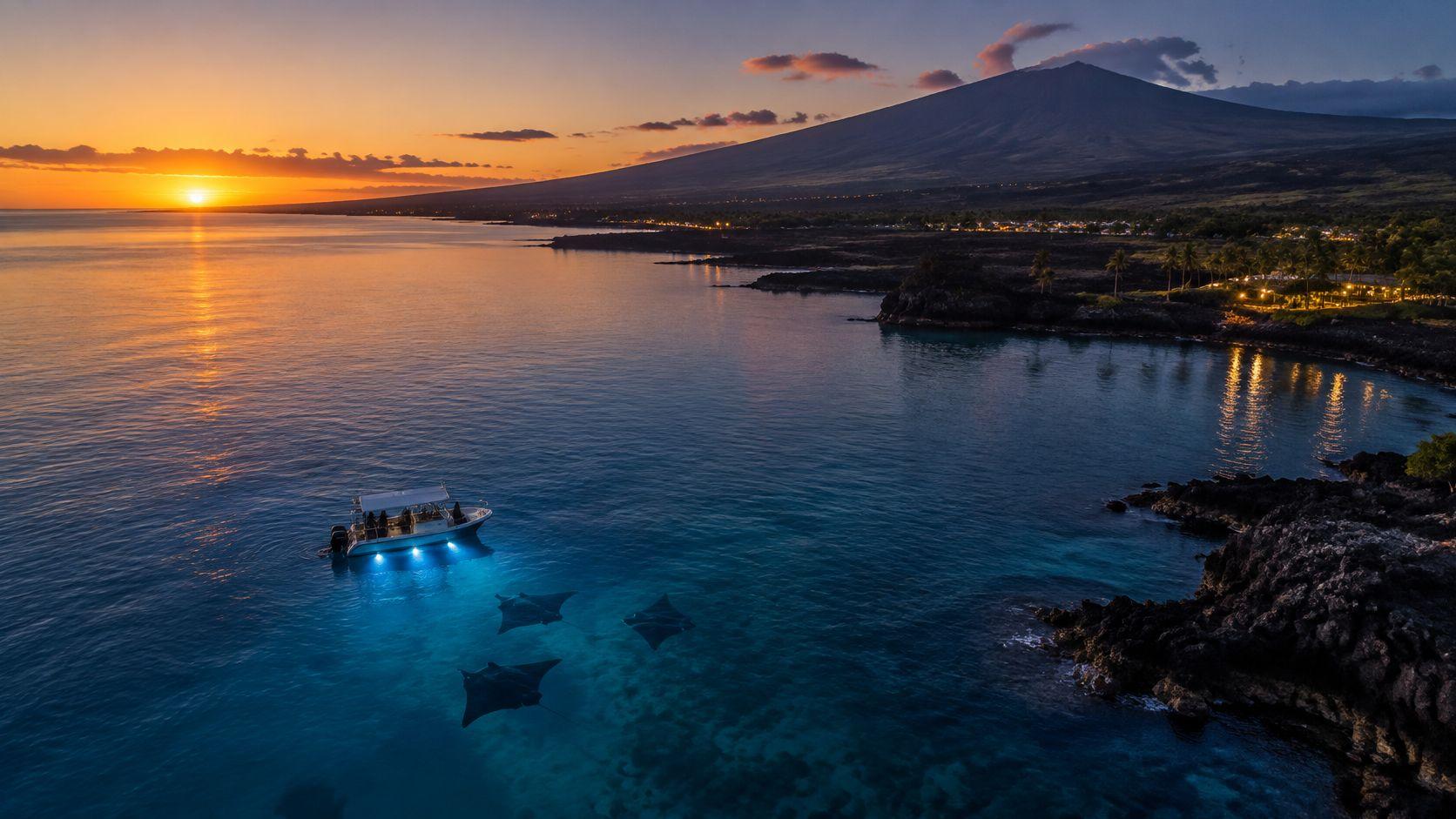
After dusk, small drifting organisms called zooplankton rise through the water. Boat lights gather some of them into a visible column, like a campfire attracting insects. The mantas already living along this coast learn where food is likely to collect and return to those feeding areas.
That habit helps explain why the north and south sites can work on an ordinary evening, not just on a special occasion. You can read more about why manta rays gather near Kona after dark.
A calm ride isn't a sighting promise
Sea comfort and manta presence are separate questions. Winter north swell can make the ride bumpier, while summer often feels calmer. Neither season turns manta sightings on or off. Moonlight can soften the contrast of the beam, so a dark night may make the light look sharper, but rays can still feed under a bright moon.
For someone staying in Kailua-Kona, one gathering area lies north toward the airport coast and another lies south toward Keauhou. The captain chooses where to go based on conditions and the outing's plan. A glassy night with no rays and a night with several looping through the beam are both normal outcomes with wild animals, not switches a crew can flip.
The night's atmosphere can change, too. Salt on your lips, a little movement under the float, and the bright patch of water below you are all part of being at sea after dark. If you want to see how the lights fit into the feeding behavior, this video shows the scene from the water.
Book for a night when you can be on the water, not for a mythical best month. Choose a time that fits your plans and a sea state you're comfortable with.
Rules That Keep the Encounter Safe
The best view is a passive one. The manta comes to the light, so your job is to be a barnacle on the board: steady, still, and easy for the animal to pass.
| Situation | Do | Do not |
|---|---|---|
| A ray approaches the light | Stay flat and still on the float | Swim toward it or chase a pass |
| Fins and feet | Let the belt hold them at the surface | Kick downward into the ray's path |
| Hands | Keep them on the board or folded in | Touch, grab, or ride |
| Leaving the group | Stay on the lit board with the guide | Drift off alone in the dark |
| Cameras | Shoot from your spot without dangling gear | Lean out or drop a camera on a ray |
| If you feel uneasy | Signal the crew and rest on the boat | Tough it out away from the light |
The flotation belt helps keep your hips and feet at the surface. That matters because a downward kick in the dark can put your fins in a manta's path. Keep your legs quiet and let the belt do the work.
Reaching is the other mistake to watch for. A ray may pass close enough that its belly seems just inches away, but don't extend a hand, grab a cephalic fin, or try to ride it. The no-touch rule protects the animal, and staying still gives it room to keep feeding. For a fuller explanation of manta ray snorkeling rules that protect wildlife and guests, keep the same simple principle in mind: let the ray choose its path.
Keep yourself oriented, too
Night vision is poor, so stay with the group and keep track of the board and the guide's light. If you need help, signal the crew rather than climbing onto the board without guidance. Motion sickness is easier to prevent before the motor starts, so take any medicine you normally use early enough to work.
If you're not a strong swimmer, tell the crew before entering. You still need the belt, and the crew needs to know how you're feeling so they can help you make a good decision. Put lotions on well before the splash, and don't apply anything on the boat rail over the water.
Kona's identified reef mantas are a small, long-lived community. Repeated contact or chasing can teach them to avoid the feeding area, so hold still when a ray makes a close pass. Treat it as a privilege to watch, not a cue to reach.
What to Pack and How to Shoot
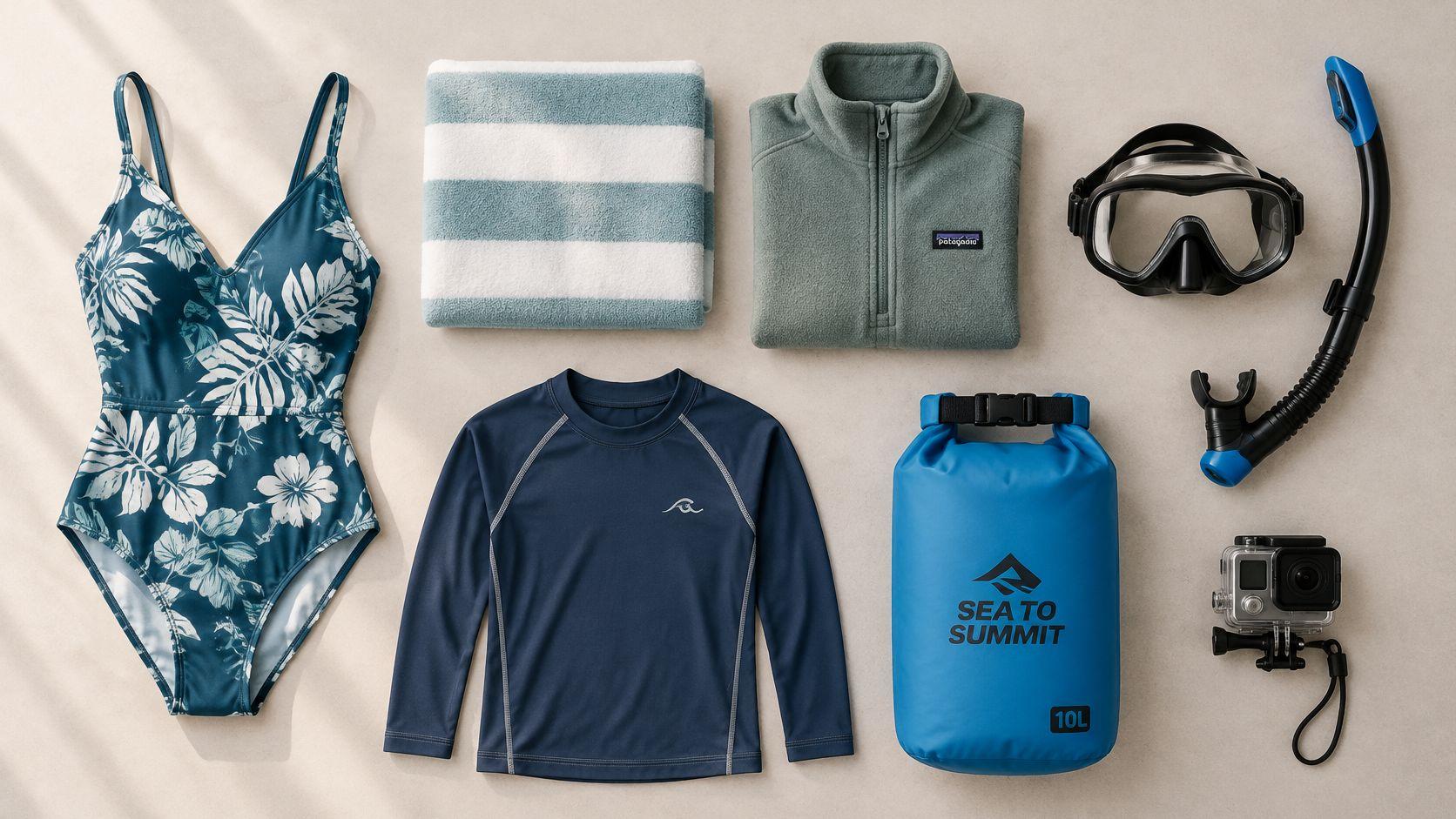
Keep your kit simple. The boat supplies a mask, snorkel, wetsuit, and flotation belt. Personal fins are optional, and many guests skip them because this isn't a swim-around activity.
Pack for the ride home
- Swimsuit: Wear it under your clothes so you can change quickly.
- Towel: Keep one ready for getting dry after the snorkel.
- Warm layer: Bring a fleece or light jacket for the ride back.
- Motion medicine: Take the medicine you normally use before the boat leaves.
- Trusted mask: If you have a prescription mask you already know seals well, bring it.
Leave dangling jewelry and loose snorkel toys behind. A brand-new mask with factory film can fog badly, so use a familiar mask or make sure a new one is properly cleaned before the trip.
Make the camera work in the dark
A wrist-strapped action camera or a small waterproof housing is easier to manage than a phone in a bag that fogs. Use a wide lens and record video during the first passes so you're more likely to capture the ray's movement. The board supplies the light, so keep your camera's onboard strobes off. Aim the lens slightly down to frame the pale belly.
Red-eye isn't the main problem underwater. Blown-out plankton and a lens half out of the water are more likely to spoil a shot. Start recording when you see the manta's diamond shape in the distance, keep the board edge in frame to show scale, and stop reaching once the ray fills the view. For more camera details, use these GoPro settings for a Kona manta ray night snorkel.
Some nights, seasick guests can film from the boat, but the view from the rail won't match the one from the water.
Same-day check: suit, towel, layer, medicine, strapped camera.
How a Manta Night Unfolds
A first night can feel easier if you know what happens in order. The crew handles the setup, while you take each part at your own pace.
- Check in and get fitted. On the early trip, check-in is in daylight; on the later trip, check-in is at night. The crew fits you with a mask that seals, a wetsuit, and a flotation belt.
- Listen to the briefing. The guide explains the manta's size and feeding behavior, where to hold on, and how to keep your hands and fins out of the way.
- Ride to the site. On the early departure, the sky keeps changing as the boat travels out. The crew chooses the site for the outing.
- Enter and take your place. Slip into the water and settle around the light board, chest-down and looking into the beam. The float is a shared table, not a starting line for a chase.
- Wait for the food to gather. Plankton builds up in the light. The first manta may appear as a distant diamond, banking toward the beam before its pale mouth comes into view.
- Stay steady as the rays pass. Salt tastes sharp on your lips, and the belt holds your hips up while you look down. A manta may loop or barrel-roll beneath the board; lift your arms so its belly has room to pass without clipping you.
- Exit with the guide. When the guide ends the session, climb out as directed. You can compare notes on the ride back, but the number of rays is never fixed.
One imagined north-site evening might bring eight close passes, with mantas circling through the light. Another night could offer only two distant shadows. Those are illustrations of how different wild encounters can feel, not a promise about what you'll see.
Choose and Book the Right Night
A plankton campfire is a useful way to understand a manta snorkel: lights gather tiny drifting food, and reef mantas may glide in to feed. Since the rays are wild, no crew can promise a head count. Compare tours by their lighting, flotation, group setup, and commitment to passive viewing instead.
You don't need a scuba card, but you do need to be comfortable following instructions in open water at night. Ask about age requirements, and discuss any concerns about pregnancy, recent illness, or being in the ocean after dark before booking.
Choose the departure that suits you
The early trip checks in during daylight, watches sunset from the boat, and enters the water after dark. The late trip checks in at night. Both offer a surface encounter, so choose the schedule that fits your evening.
Kona Snorkel Trips' two-hour outing takes place in Kona. The crew uses a custom-built snorkel board with high-powered lights, and the boat departs from its own dock at Honokohau Marina, between town and the airport.
For the primary option, see the Kona manta ray night snorkel tour. If your dates are set, read about the best time of year for a Kona manta ray night snorkel. Mantas are seen year-round, with no pattern in their appearances by month, so timing cannot guarantee a particular encounter.
Gift cards and package pairings are also available. The Kona Reef & Ray Package saves 10% on the Night Manta Ray and Kona Snorkeling in Pawai Bay tours. The Bay & Ray Package combines the Night Manta Ray and Captain Cook Monument Kealakekua Bay Snorkeling Tours and saves 10%. Whale Watch & Manta Magic pairs the Night Manta Ray Snorkel with Whale Watching and saves 10%. Kona Snorkel Trips is at 74-381 Kealakehe Parkway, Kailua-Kona, HI 96740, and can be reached at (808) 326-4774.
Keep reading
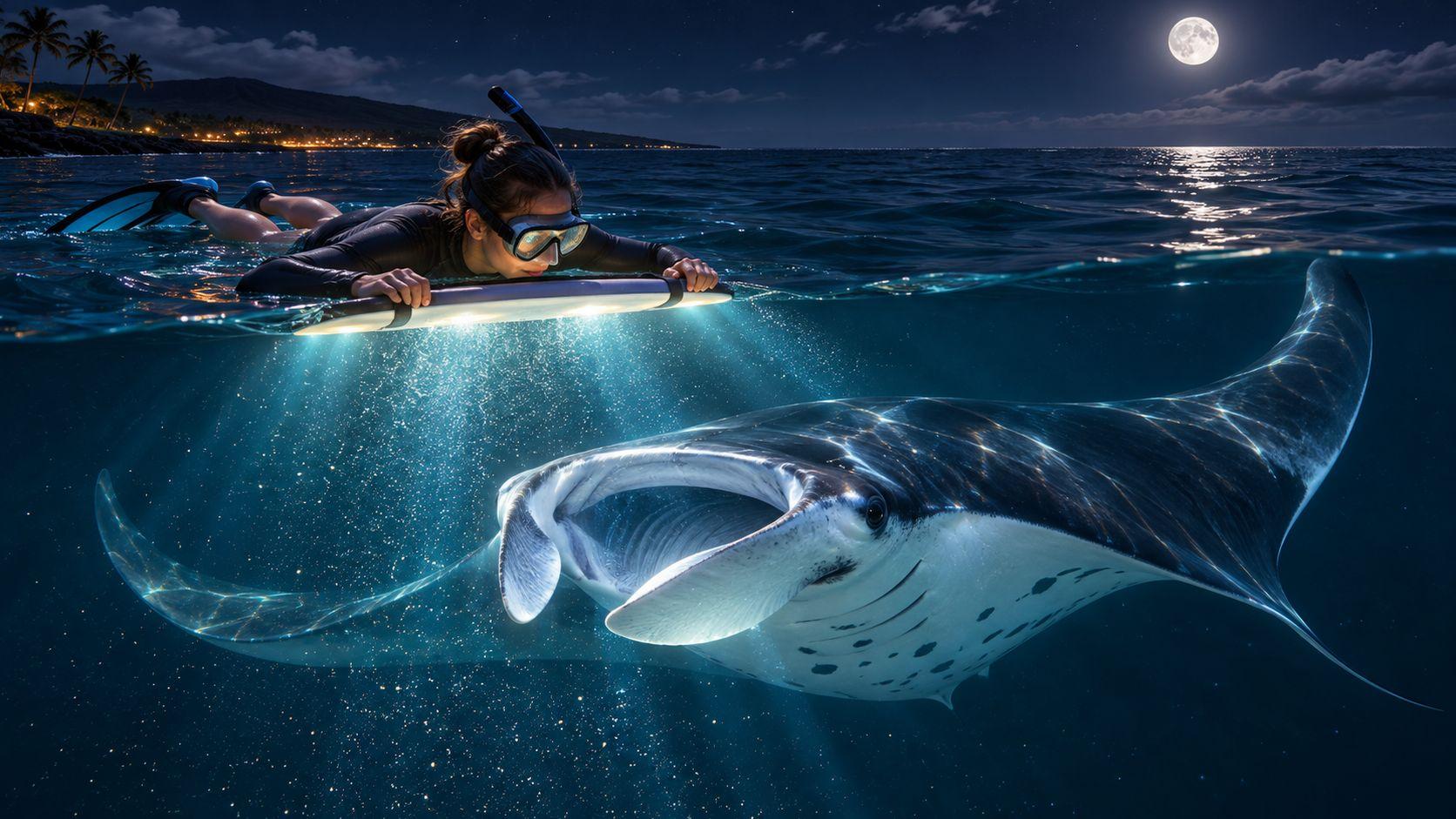
Snorkeling with Manta Rays in Kona at Night
Plan snorkeling with manta rays in Kona: night sites, safety, gear, etiquette, and how to book a guided float.
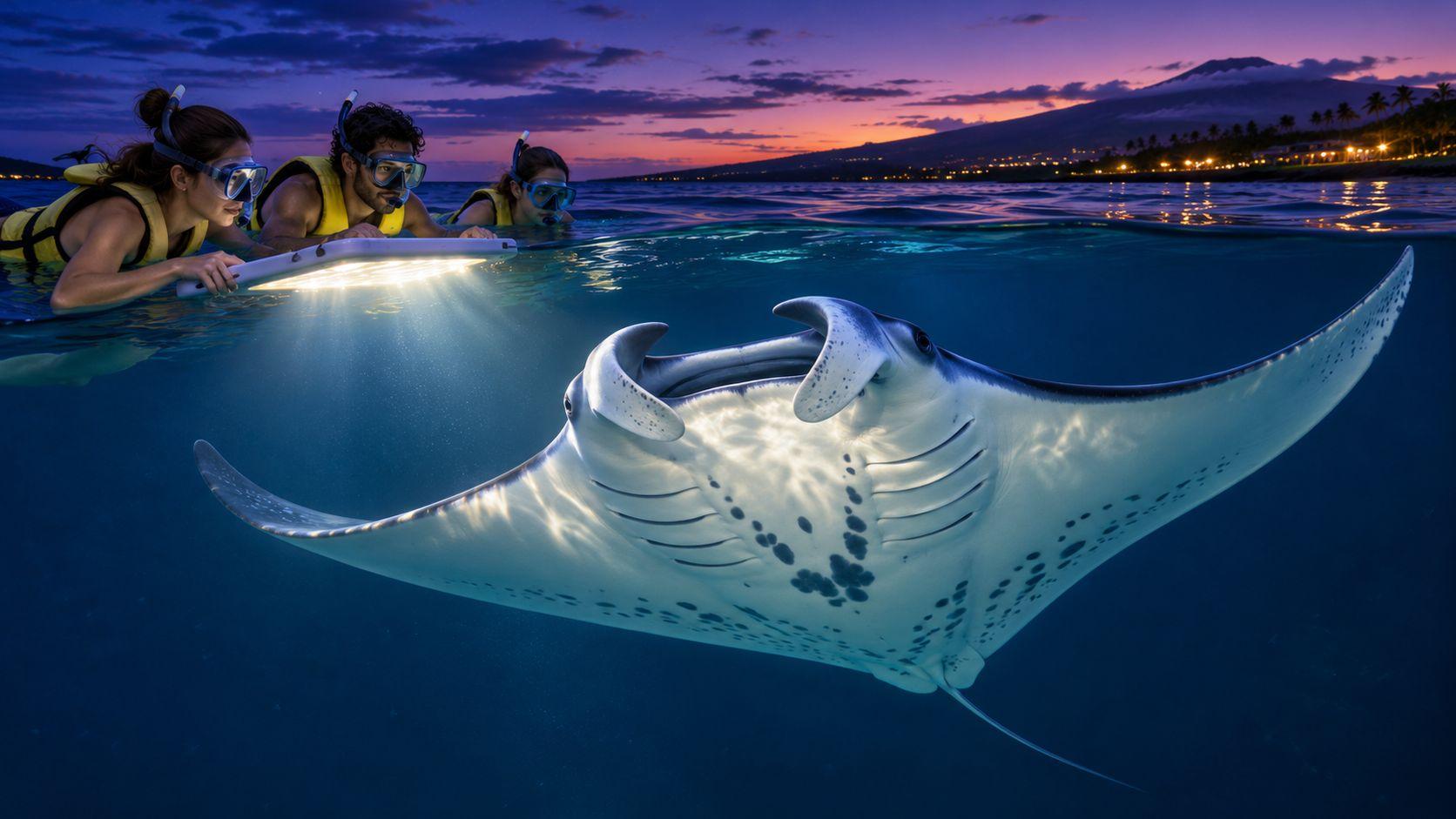
Manta Ray Kona Hawaii Night Snorkel Guide
Manta Ray Kona Hawaii night snorkel explained: where rays feed, what a night looks like, safety rules, and how to book.
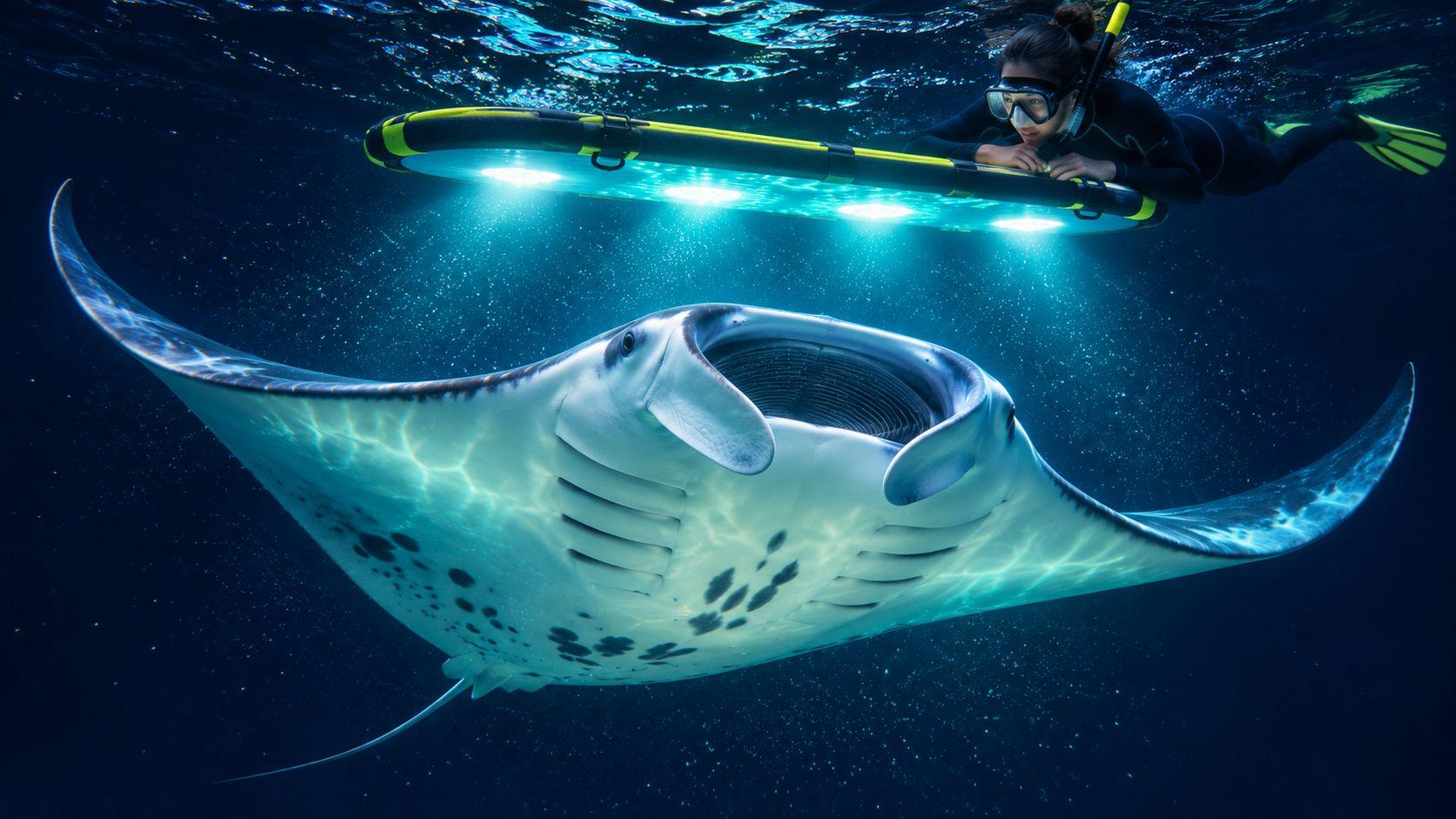
Hawaii Manta Ray Guide for Kona Night Snorkels
Hawaii manta ray guide: Kona sites, night snorkel steps, seasons, and how to watch this small resident population safely.