
Hawaii Manta Ray Night Snorkel: Where and What to Expect
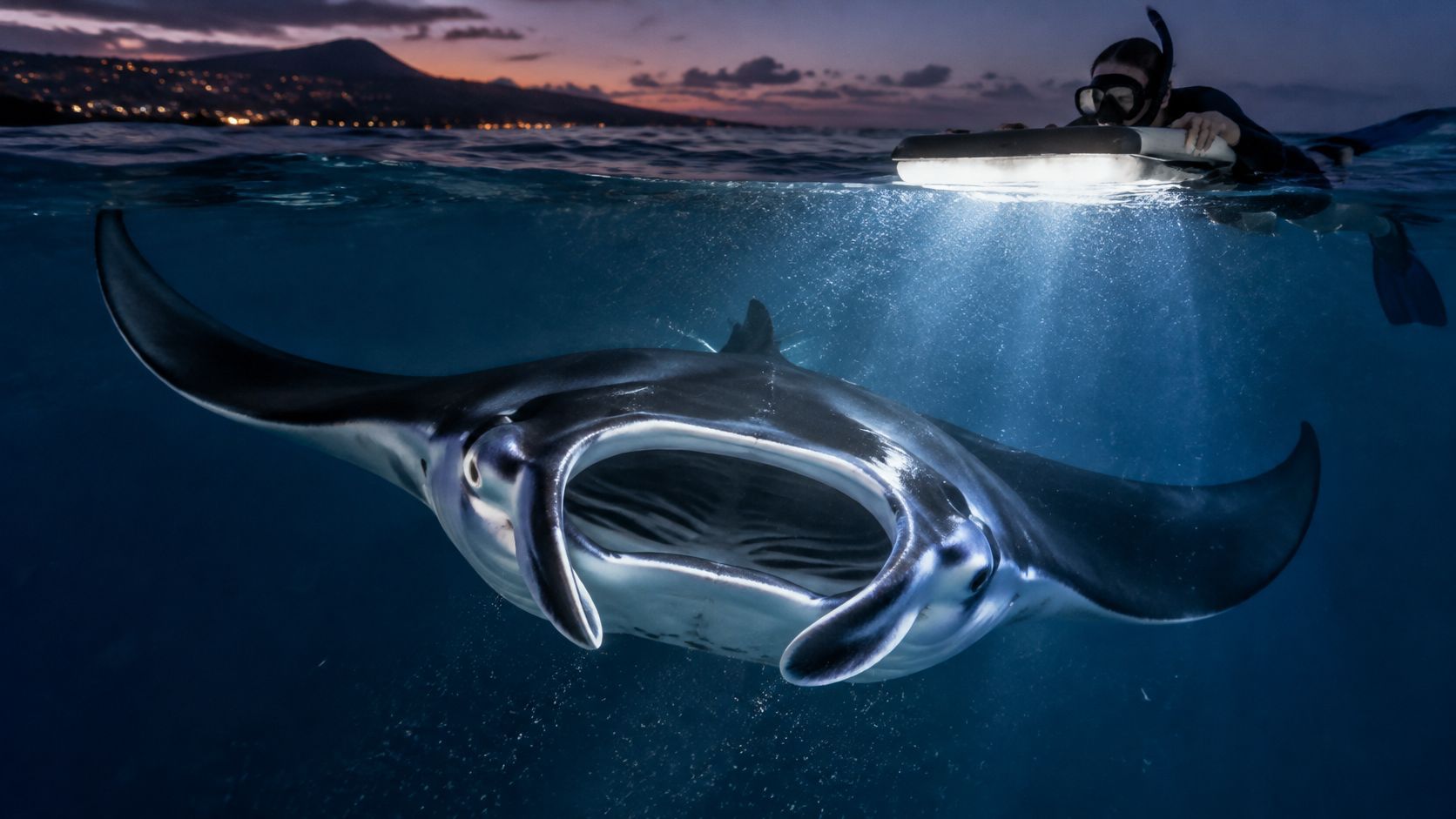
You're looking at your Kona itinerary, trying to decide whether to book the sunset departure or the later manta trip. Someone in your family wants the biggest possible encounter. Someone else wants to know how dark the water gets, whether the boat will feel crowded, and what happens if a ray swims straight toward them.
Those are the right questions. A Hawaii manta ray night snorkel isn't just about seeing an impressive animal. It's about feeling comfortable enough to stay still when a pale belly turns through the light beneath you, while giving that animal room to feed. The best evening starts with a sensible choice on shore, not a scramble for the closest position in the water.
Where Hawaii Manta Rays Gather and Which Site to Choose
Say your family is choosing between two Kona sites. One may bring a larger gathering of rays; the other may offer a different kind of encounter. Either way, a crowded waterline is not automatically a better one.
Kona Snorkel Trips offers a nighttime manta snorkel with lifeguard-certified guides who help guests prepare for being in the ocean after dark. The tour visits Garden Eel Cove or the area in front of the Keauhou hotel. Manta rays are seen year-round, with no pattern in their appearance based on the month, so a particular date cannot promise a bigger gathering.
A University of Hawaiʻi study analyzing 13 years of records and more than 23,000 sightings found that aggregation size tracked zooplankton density, with larger gatherings at Garden Eel Cove and Keauhou sightings predominantly involving females.
Kona manta feeding sites compared
| Site | Typical Aggregation | Dominant Animals |
|---|---|---|
| Garden Eel Cove | Larger and more variable | No dominant sex specified |
| Keauhou | Smaller | Females more commonly observed |
The Marine Megafauna Foundation's manta tourism guide also describes larger, more variable gatherings at Garden Eel Cove and smaller Keauhou sightings that were 91% female.
Say you hope to see several rays circling through the light. Garden Eel Cove's larger gatherings may suit that preference. If you'd rather focus on individual approaches, Keauhou may appeal. Neither site guarantees a particular number of rays, and fewer rays do not necessarily mean fewer people in the water.
Compare the differences between Garden Eel Cove and Keauhou, then ask how the operator handles group size and positioning. A well-managed encounter can matter more than choosing the busiest site or chasing the closest view.
Why Mantas Gather Here Night After Night
The first sign may be a pale shape beyond the light. Then a manta turns upward, opens its mouth, and passes beneath the board. What looks like a performance is an animal working through a concentrated patch of food.
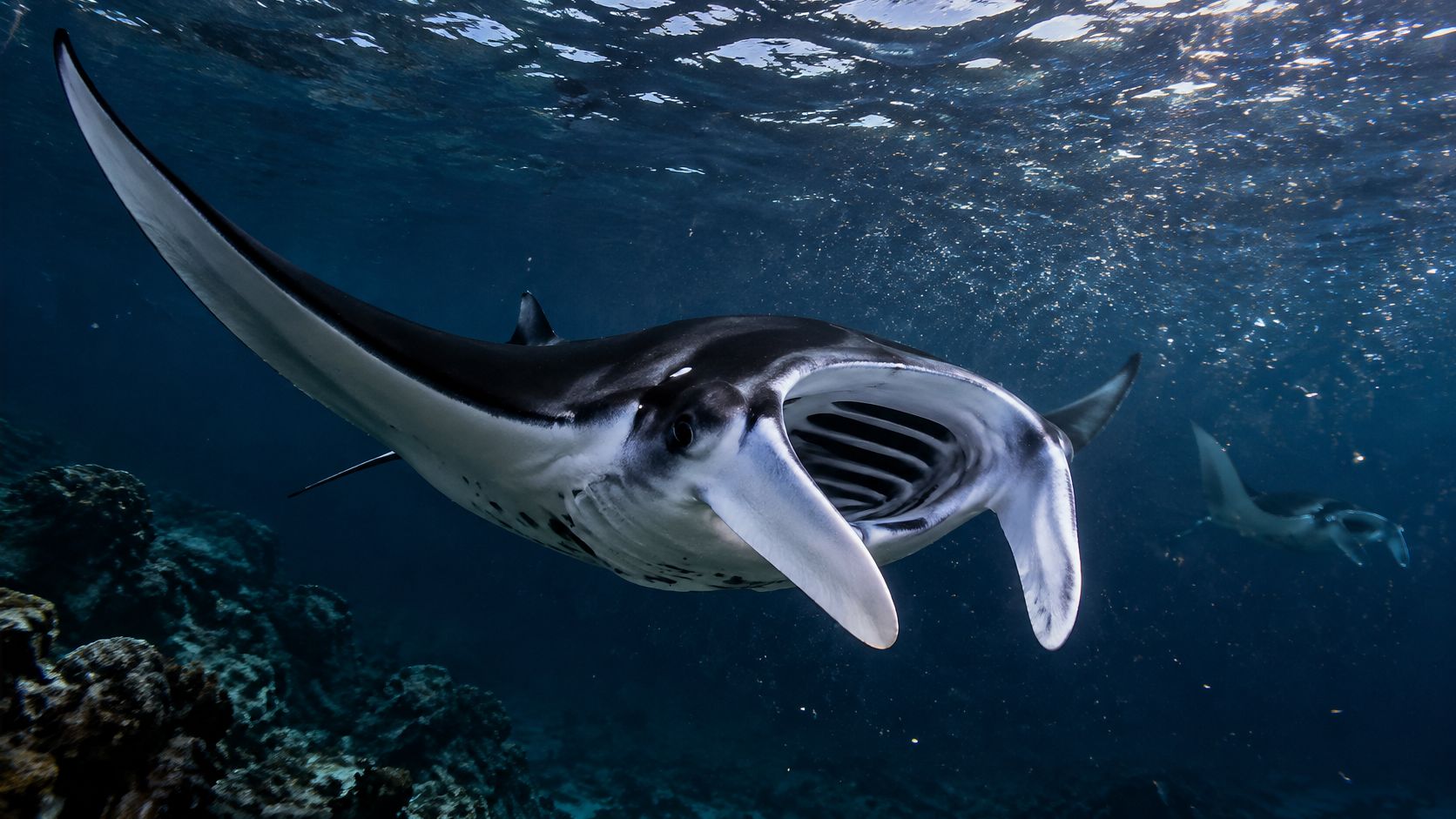
Reef mantas are zooplankton filter feeders, not hunters pursuing fish. The Hawaiʻi Division of Aquatic Resources describes their feeding anatomy and cooperative feeding behaviors, including feeding chains and barrel rolling.
Follow the food through the animal
The paired cephalic fins beside a manta's mouth help funnel plankton-rich seawater inward. Inside, gill rakers retain suitable prey. Filtered water leaves through the gill openings.
When food becomes concentrated, the animal can change how it feeds:
- Feeding chains: Rays follow one another through a productive patch.
- Barrel rolls: A manta loops repeatedly through the same concentrated food.
- Repeated passes: The animal turns back toward a useful feeding corridor rather than continuing away.
Mantas are often solitary outside feeding, cleaning, and mating events. A gathering beneath lights doesn't mean they spend the rest of their lives traveling as a permanent group.
Why the light matters
Artificial illumination concentrates plankton near the viewing area. The light board acts something like a dinner bell, but it doesn't summon animals on command.
A manta at a light board is like a diner at a buffet that refills as soon as the plate clears. The show depends on the kitchen, not the diner.
Practical rule: More boats don't necessarily mean more food, and more lights don't guarantee more rays.
This is a nighttime, open-ocean activity. Current and swell influence how plankton moves through the area, while water clarity affects what you can see. A productive patch on one departure may be thinner on another.
Our explanation of why manta rays gather near Kona after dark connects those conditions to what guests observe at the board.
Watch the direction of each approach. A broad turn may bring a ray back through the beam; a tight roll may keep it inside a dense patch. Once you recognize the feeding pattern, the encounter becomes more interesting than counting animals.
What Happens on a Manta Night Snorkel, Step by Step
Say you've chosen the early departure. You arrive while there's still light over the harbor, carrying a towel and wondering whether your mask will leak. The crew's preparation should turn those uncertainties into simple actions before you enter the water.
From dock to light board
- Check in at the time on your booking. Early and late departures begin differently. Use your confirmation rather than someone else's account of their trip.
- Get fitted with a mask, snorkel, and flotation belt. Our belts keep guests' hips and feet up, helping prevent accidental kicks toward the mantas.
- Listen to the close-encounter briefing. A ray may look much larger underwater than it did in photographs. Learn where to hold the board and what to do when one approaches.
- On the early departure, watch the sunset from the boat. Use the ride to mention a slipping mask or anything you didn't understand.
- Enter after dark. Guests spend about 30 to 40 minutes in the water. That's the viewing portion, not the entire dock-to-dock experience.
- Hold your position around the illuminated board. Keep your hands controlled and your feet quiet while the rays choose their routes beneath you.
- Return to the boat when directed. Once everyone is aboard, dry off and talk through what you noticed.
Early and late manta trips compared
| Trip | Check-In | Sunset | Water Entry |
|---|---|---|---|
| Early manta trip | Daylight | Watched from the boat | After dark |
| Late manta trip | At night | Already past | After dark |
Confirm the current schedule, departure times, and check-in details on the Kona manta tour page before leaving for the harbor.
Don't assume the later departure will automatically be quieter. Ask about the actual booking and site arrangements rather than using darkness as a proxy for crowd size.
The moment you lower your face into the water can feel surprisingly different from the boat ride. Above you are voices and the float. Below you is a bright patch surrounded by darkness.
Keep breathing normally through the snorkel. If your mask needs attention or you feel uneasy, tell the guide instead of letting go to solve it alone. You don't need to swim after anything. You need to stay comfortable, follow directions, and let the encounter develop.
Swimming Ability, Safety Rules and Who Should Skip It
Guests should be able to swim 50 yards without additional flotation and have intermediate snorkeling experience. Holding a board doesn't turn this into a suitable activity for someone who can't swim independently.
Night changes familiar skills. You can't use the seabed as an easy visual reference, and dark water can feel unsettling even when you've enjoyed a daytime beach snorkel.
When staying ashore is the better choice
- Non-swimmers: A flotation belt is assistance, not a replacement for swimming ability.
- Young children without snorkeling experience: Enthusiasm doesn't establish readiness.
- Guests who panic in open water: Don't use a nighttime departure as an exposure exercise.
- People with conditions affecting breathing or exertion: Discuss the activity with a qualified clinician before committing.
Our guide to who should skip a Kona manta ray night snorkel helps families assess suitability without treating an age label as a safety test.
We provide flotation belts and wetsuits. Check that yours fits properly before boarding or entering, and use a light-colored outer layer where appropriate for visibility and consistent with crew instructions.
A permit isn't a complete safety checklist
The Hawaiʻi County manta-viewing safety assessment documented required ocean-use and harbor or launch-ramp permits, but found those permits did not then establish activity-specific standards covering nighttime manta operations, passenger capacity, lighting, propeller guards, or medical equipment.
That's a historical assessment of a regulatory gap, not proof of the rules in force today. It does explain why a permit alone shouldn't end your questions.
Ask the operator:
- Group size: How many snorkelers will share the boat and each board?
- Lighting: How are lights positioned and swimmers kept visible?
- Vessel protection: Are propeller guards fitted, and how are swimmers separated from propulsion?
- Medical readiness: What equipment is aboard?
- Assistance: How does the crew return a tired or anxious guest to the boat?
A good operator can explain the procedure clearly. Reassurance without specifics isn't a substitute for an answer.
Tell the crew about limitations before departure, not after you're struggling at the board.
Distance, Crowds and Conservation
In a survey of 444 manta-viewing participants, 82% felt crowded by snorkelers, 78% by boats, and 69% by scuba divers, according to material summarized through the Hawaiʻi Division of Aquatic Resources protected-species guidance. Most also encountered more snorkelers and boats than they expected.
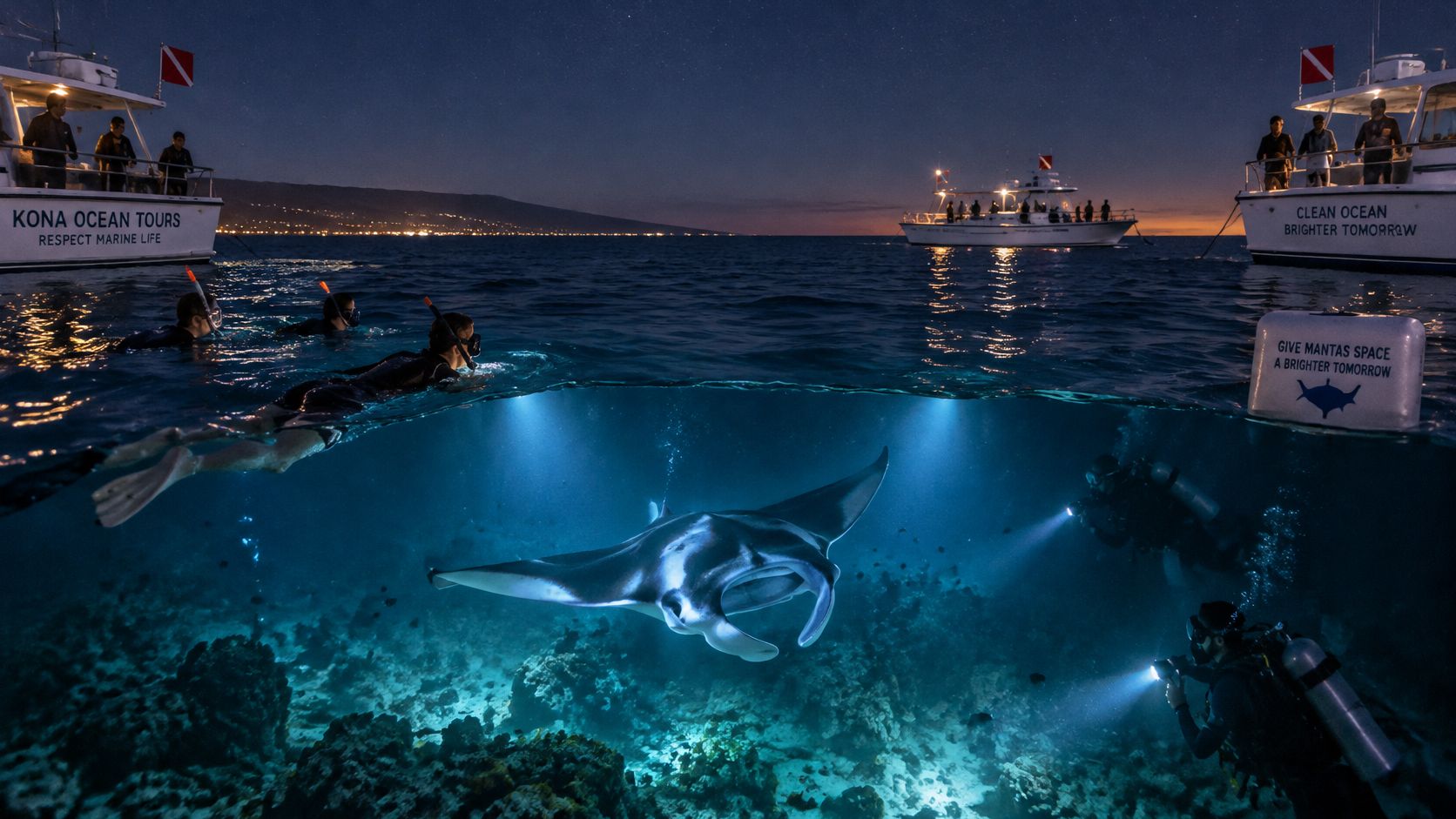
That's a useful correction to the idea that a busy site must deliver a better evening. If you're adjusting your position to avoid another guest's feet, you're spending less attention on the animal.
Persistent feeding isn't permission to crowd
The evidence isn't that tourism is harmful. Predictable nighttime feeding aggregations have persisted under sustained tourism and artificial illumination.
Persistence, however, doesn't mean every approach is harmless or every crowded encounter feels acceptable. Operators and visitors can reduce unnecessary disturbance without pretending human presence has no effect.
The local stakes are substantial. NOAA's summary of population genetics and identification records reports 318 unique manta rays documented around Hawaiʻi Island since monitoring began in 1979, with an estimated 104 adult breeders and very limited exchange with Maui Nui.
Those are different measures, not interchangeable estimates of today's total population. Together, they describe a locally bounded community whose losses can't reliably be replaced by arrivals from another island.
Give the animal the right of way
Slow growth, late maturity, and low reproductive output make recovery from local pressures difficult. These resident reef mantas also shouldn't be confused with the rarely observed oceanic mantas in Hawaiian waters.
At the board, translate conservation into straightforward behavior:
- Keep your distance: Don't reach toward a ray to make an encounter closer.
- Never touch or chase: Let the animal decide whether to approach.
- Leave feeding corridors open: Don't move down into its route.
- Stay still in the light: Keep hands, feet, and camera equipment controlled.
- Follow the guide: A coordinated group is easier to position than scattered swimmers.
The best encounter isn't the one where you get closest. It's the one where the manta can keep feeding without changing course because of you.
Choose an operator that describes group management and boat positioning, not just spectacular proximity. If the sales pitch celebrates surrounding rays with people and lights, keep looking. A smaller, well-organized group offers something a packed boat can't promise: space to pay attention.
Packing List and Photography Tips for Night Snorkels
Pack for the wet ride home first and the camera second. A great encounter loses some of its shine when your only dry layer is underneath a dripping towel.
Packing checklist for a manta night snorkel
| Item | Why You Need It | Notes |
|---|---|---|
| Towel | Warmth after the water | Keep it in a dry bag |
| Zip-up jacket | Cool boat ride back | Pack a dry layer |
| GoPro or waterproof camera | Captures the encounter | Turn off flash |
| Reef-safe sunscreen | Sun protection before an early departure | Apply before arriving; don't treat the label as proof of reef safety |
| Motion sickness tablets | Help prevent seasickness | Follow product timing and medical advice before boarding |
A towel, zip-up jacket, and GoPro are our recommended basics. Add a dry bag for your phone, keys, and clothing so you're not searching through wet belongings on the return trip.
If you're prone to seasickness, arrange suitable medication ahead of time. Ask a pharmacist or clinician about suitability, including drowsiness and interactions, rather than borrowing an unfamiliar tablet at the dock.
For an early departure, apply appropriate sunscreen before arrival. Shade and clothing also help reduce sun exposure without relying on a marketing label.
Photograph without changing the encounter
- Leave flash off. Use the board's illumination rather than introducing sudden bursts of light around feeding animals.
- Set up before entering. Choose a simple video mode, clean the lens, and test the housing or waterproof seals.
- Prepare focus early. If your camera allows it, establish focus in the illuminated area rather than hunting through menus as a ray approaches.
- Secure the camera with a suitable strap or mount. Keep it close enough that it won't dangle into the feeding corridor.
- Hold steady and stay quiet. Disable unnecessary sounds and let the ray move through the frame.
A short, steady clip often conveys more than frantic camera movements. Keep the lens beneath the surface when practical, and avoid repeatedly lifting it between air and water during an approach.
You may miss a frame while fixing your grip. That's fine. The camera should never become a reason to release your safe position, reach toward a manta, or push into someone else's space.
Book a Family-Friendly Manta Tour You Can Trust
Say a family of four arrives at the dock in Kona. One teenager has snorkeled off a reef before and floats calmly. The younger sibling has only tried a mask in a pool. A responsible operator splits that readiness in two, and helps the parents decide whether to book four spots, book two now and wait a year for the others, or choose a daytime reef trip instead.
That screening is what makes a tour family friendly. Ask how guests are spaced around the light boards, not just how many the boat holds. The closest, fullest night is rarely the best one. Elbow to elbow swimmers kick more, stir more water, and leave mantas less room to feed. A smaller, well spaced group gives your family a clear view and gives the animals a clear exit path.
Use the same test for every detail:
A lifeguard-certified crew should explain its in-water assistance plan before checkout. Swimming and snorkeling requirements should be stated plainly, with no ride-along option on the manta charter to fall back on. The crew should describe where guests hold position and how lights stay steady for feeding animals. Feeding lanes stay open, with no pursuit if a ray turns away.
Our credentials checklist for a Kona manta ray night snorkel gives you specific questions to ask about group layout, lighting, and assistance for a tired swimmer.
At Kona Snorkel Trips, lifeguard-certified guides lead small groups with an emphasis on safety, personalized attention, and environmental stewardship. Our Big Island Manta Ray Night Snorkel lasts 2 hours and takes place in Kona.
Understand the guarantee in concrete terms. Our manta guarantee does not expire and is honored when space is available 2 hours before the tour starts. That means a return seat if the night stays quiet, not a promise that wild animals will appear on schedule. Leave a flexible evening later in your trip so you can use it.
Before booking, call or message with an honest description of each person. Mention ages, swim comfort, snorkel history, and any medical equipment. Ask about vessel layout, entry ladders, and what happens if someone wants to rest on the board early. A good answer is specific. It fits your family, not just your itinerary.
Frequently Asked Questions About Hawaii Manta Ray Snorkels
Are manta rays guaranteed on a Kona night?
No wild-animal sighting is guaranteed. Our return guarantee has no expiration, but using it depends on space being available shortly before departure, so leave flexibility in your travel plans.
Is manta snorkeling available year-round?
Yes, Kona manta encounters take place throughout the year. Choose a date that works for your itinerary rather than trying to identify a special month, and remember that feeding conditions change between departures.
How long is the tour?
Allow for the full boat outing, not just the viewing session. Check-in, gear fitting, briefing, travel, and getting everyone safely back aboard all take time beyond the minutes you spend watching rays.
Do I need to be a strong swimmer?
You need independent swimming ability and intermediate snorkeling experience. Being able to hold a float in a pool isn't enough preparation for entering dark, open ocean and returning to a boat.
Can children come?
Children need to meet the swimming and experience requirements individually. Young children without snorkeling experience should skip this activity, even if they're enthusiastic about marine animals.
Can I use flash?
Leave it off and use the board lights. Prepare your camera before entry so you can concentrate on your position and the guide's directions rather than changing settings during an approach.
Are these tours tightly regulated?
Don't assume a commercial permit establishes every operational safety standard. The county assessment identified gaps at the time it was written; ask about current requirements and the operator's actual procedures before booking.
What if I become uncomfortable in the water?
Tell your guide promptly. Don't wait until anxiety becomes panic, and don't leave the board to return to the boat without communicating with the crew.
Does a quieter encounter mean a disappointing one?
Not necessarily. Watching an individual manta make an uninterrupted feeding pass can be more rewarding than competing for a view in a crowded group, and a lower ray count alone doesn't tell you whether the operator delivered a thoughtful experience.
Kona Snorkel Trips offers small-group manta night snorkeling with lifeguard-certified guides and a clear focus on swimmer readiness and respectful viewing. Visit Kona Snorkel Trips to explore the experience, then message our crew about your family's snorkeling ability and the departure that suits your plans.