
Big Island Manta Ray Snorkel: Night Guide and Booking Tips
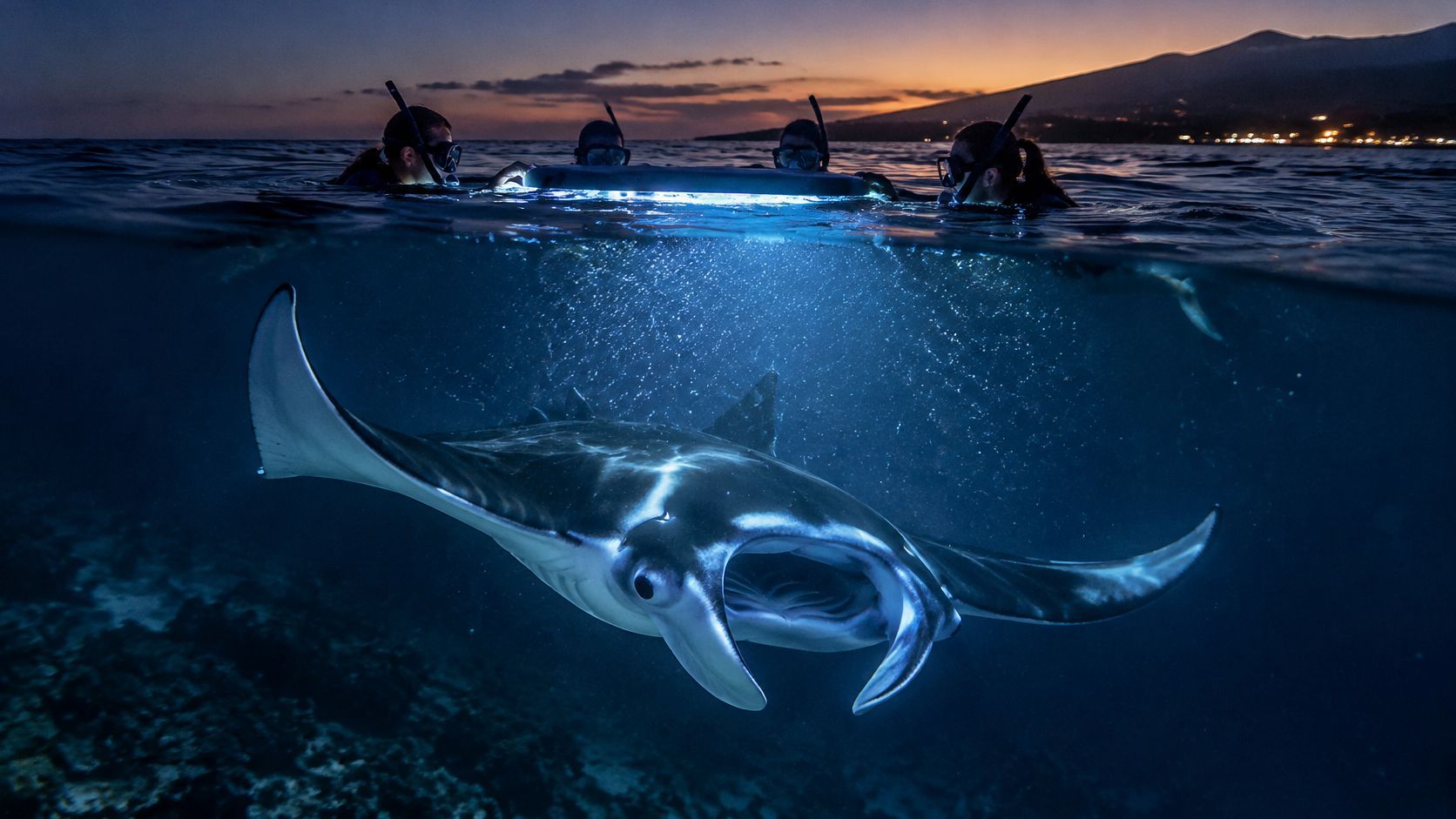
You're comparing a daytime reef trip with a night on the open ocean, or trying to decide whether your family will feel comfortable in the water after dark. The Big Island manta ray snorkel is a night swim where guests float at the surface beside an illuminated board while reef mantas feed below. It's a memorable wildlife encounter, but it's not a reef swim, a performance on demand, or a guaranteed sighting.
Kona Snorkel Trips is Hawaii's top-rated and most-reviewed snorkel company. Before choosing a trip, decide whether you're comfortable floating in dark open water and whether a focused wildlife encounter sounds better than a daytime view of the reef.
Big Island Manta Ray Snorkel at a Glance
A Big Island manta ray snorkel is a nighttime open-ocean activity, with guests holding the edge of a lit flotation board while manta rays make feeding passes below. You don't swim after them or dive down for a closer look. Your position is stationary, and the animals choose whether to enter the light.
The in-water portion is 30–40 minutes on Kona Snorkel Trips' manta trips. That's long enough to watch the encounter develop, but it's still a meaningful stretch of time to float in the ocean after dark. The activity suits people who can stay calm and follow instructions when they can't see the shoreline or everything around them.
| Detail | What to Know | Why It Matters |
|---|---|---|
| Time in the water | 30–40 minutes | Long enough to watch several feeding passes, short enough to stay comfortable |
| Species | Reef manta ray (Mobula alfredi) | Kona's rays are resident reef mantas, not random visitors |
| Typical wingspan | Broad enough to fill much of your view from the surface | Scale changes how close the animals feel |
| Feeding trigger | Zooplankton drawn in by underwater light | Explains why sightings vary from night to night |
| Activity type | Open-ocean night snorkel, not a reef dive | Sets expectations for dark, stationary floating |
Kona's rays are locally associated with established feeding areas, and the lights draw their food rather than feeding the animals directly. That distinction matters: the encounter can be predictable in setup, but the rays remain wild and may not arrive in the numbers a visitor hopes for.
A two-hour trip can include boat travel, instructions and getting positioned in the water, so don't mistake the in-water time for the full outing. If you want a night of floating and watching rather than swimming freely through a bright reef, this is the right format to consider. The next questions are how it differs from daytime snorkeling, what draws the rays in, and what to ask an operator before booking.
Night Manta Snorkel Versus Daytime Reef Snorkel
| Factor | Night Manta Snorkel | Daytime Reef Snorkel |
|---|---|---|
| Main draw | Rays looping through a lit plankton column | Coral reef fish in clear daylight |
| Visibility | Only the lit area around the board | Wide view of the reef floor |
| Orientation in the water | Hold position at the surface beside a lit board | Free swimming along the reef |
| Water conditions | Dark open ocean, harder to judge distance | Daylight, easier to see hazards and boats |
| Sighting certainty | Possible, but influenced by plankton and conditions | Reef life is the focus, not manta sightings |
| Best fit | Confident swimmers wanting a rare encounter | First-timers wanting broad reef views |
The night trip narrows your view to the illuminated water around the board. That focus can make the mantas feel close and immense, but it also means you need to be comfortable without a full view of your surroundings. You'll hold position rather than swim a route, and the guide's instructions matter more once you're in the water.
Daytime snorkeling offers a different kind of freedom. You can look across the reef, choose where to direct your attention and see other swimmers and boats more clearly. It's usually the more comfortable first step for someone who isn't sure how they'll respond to darkness, deep water or floating in one place.
Ask yourself three questions before choosing:
- Can I float still in dark open ocean? The night encounter depends on staying calm and holding your position.
- Do I want rays more than reef fish? The night trip centers on manta behavior, not a wide variety of reef life.
- Can I follow spoken instructions without seeing the shoreline or faces around me? If that feels uncomfortable, start with a daytime snorkel.
Neither format guarantees manta sightings. The rays' presence at night is tied to food in the water, while a daytime reef trip is designed around the reef itself. Choose the night trip for a focused, potentially unforgettable wildlife encounter. Choose the daytime option if you'd rather have broad visibility, free swimming and an easier introduction to snorkeling.
How Lights Bring Manta Rays to the Surface
A porch light draws moths; the moths draw bats. Underwater lights work on a related principle, except the food gathering in the light is zooplankton, which manta rays filter from the water.
The lights never feed the rays. They gather the rays' food, and the food brings the rays.
Kona's encounter is light-mediated predator aggregation, not baiting or direct feeding. Artificial underwater lights concentrate zooplankton, and reef manta rays (Mobula alfredi) enter the illuminated water to feed. The Hawaiʻi County boating-safety assessment describes how the light creates a feeding opportunity by increasing plankton concentrations.
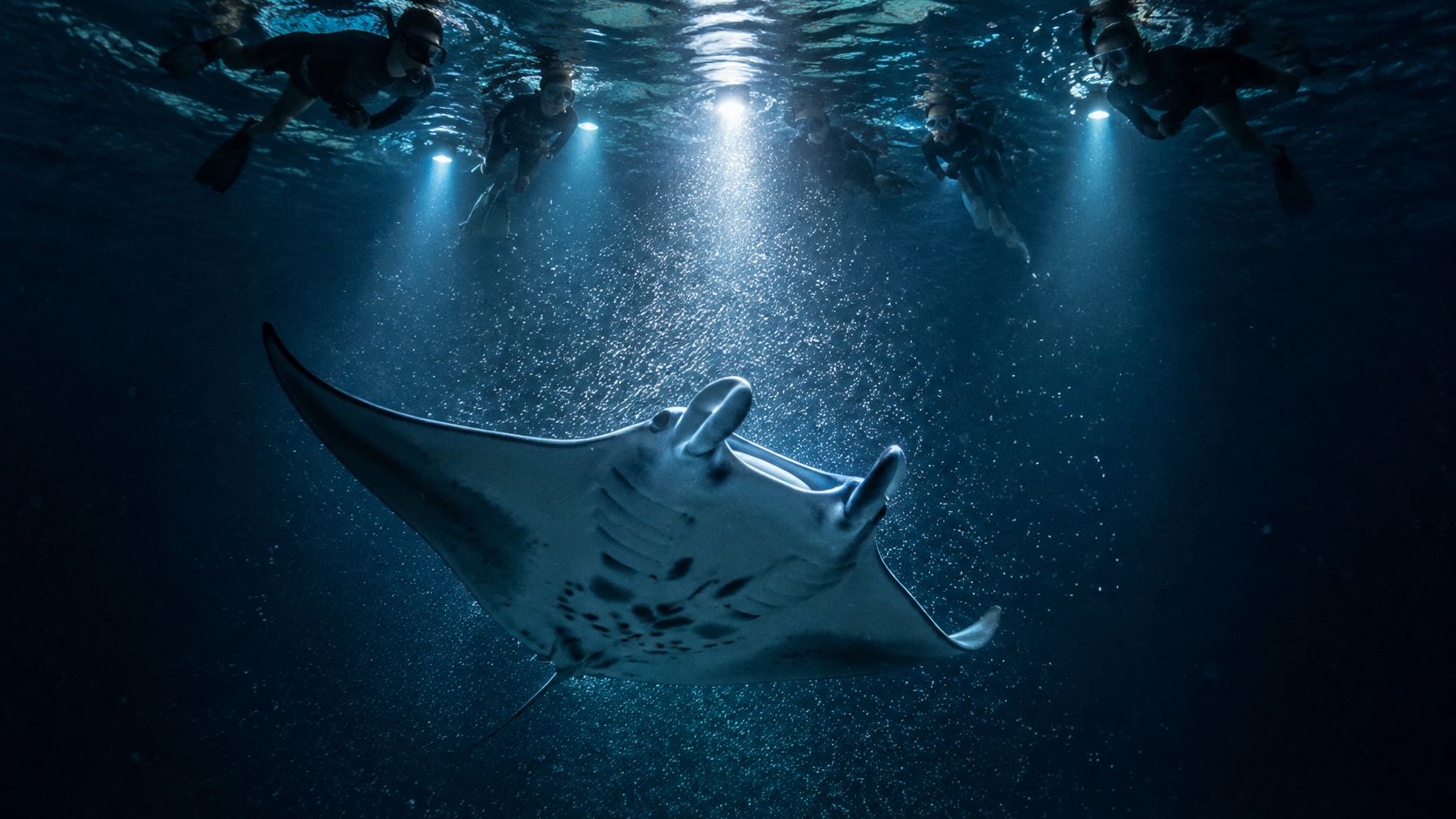
The usual arrangement has three layers. Snorkelers stay at the surface and hold onto the board. The lights point down into the water, concentrating prey in the illuminated column. Mantas then make repeated feeding passes below the swimmers, filtering plankton as they move through the light.
That layout is why a fixed, downward-facing light works better than a swimmer trying to follow a ray. Moving through the feeding area can disrupt the encounter and increase the chance of contact. A stationary observer leaves the animals room to choose their path and approach.
The light is more than a way to see in the dark. It's the central mechanism behind the feeding encounter. If you expect the operator to produce a manta on demand, you're treating a wild animal like a scheduled attraction. A clear explanation of the light board's role in the night snorkel can help set realistic expectations before you get in.
Where Rays Feed in Kona and What Sightings Depend On
Kona's two main nighttime feeding sites are Garden Eel Cove and Keauhou. A University of Hawaiʻi study of community-sourced records from 2010 through 2022 documented more than 23,000 sightings involving 167 individually identified reef manta rays at the two sites. Those records describe a recognizable local group, not an unlimited supply of roaming animals.
| Site or Finding | What the Research Found | What It Means for Guests |
|---|---|---|
| Garden Eel Cove | Generally supported larger aggregations | Strong feeding nights here can bring more rays into view |
| Keauhou | Visited predominantly by females, with strong site fidelity among females | Familiar rays may return to the same spot over years |
| Both sites | Approximately balanced 1:1 sex ratio overall, with connectivity between sites | Rays move between sites, so one night draws on a shared group |
| Sightings record | More than 23,000 sightings of 167 individually identified rays, 2010–2022 | Each animal is known individually, not a random visitor |
| Driver of attendance | Aggregation size tracked zooplankton density | A weak plankton night means fewer rays, whatever the tour |
The study found that Garden Eel Cove generally supported larger aggregations, while Keauhou was visited predominantly by females. The University of Hawaiʻi study also found strong site fidelity among females at Keauhou and connectivity between the feeding locations. Researchers reported that the aggregations remained relatively stable despite increased tourism.
For a guest, the practical takeaway is that a viewing site isn't interchangeable with every other stretch of coast. Tours can use either location, and the animals' presence is linked to how much plankton is available. If the plankton is sparse, a skilled crew can't make more rays appear. The research identifies prey availability as a major driver of attendance, but it doesn't establish a best month for viewing.
Makako Bay is another documented location. A 2024 assessment reported reef manta rays on 50% of recreational-diving visits, averaging two rays per visit, in the Important Shark and Ray Areas programme assessment. That measure concerns recreational-diving visits, so it shouldn't be treated as a promise about a night snorkel.
Before booking, ask which site your trip plans to use and whether recent plankton conditions favor it. You can also compare the two main Kona locations in this guide to Manta Village and Manta Heaven. For one night, expect a chance to observe real animals whose attendance is governed by food, not a guaranteed show.
On-Water Rules That Protect the Rays
You're floating above a dark feeding area when a manta glides beneath you. The instinct to duck down for a closer view can be strong, but entering the manta's path disrupts the space it needs to feed.
- Stay on the surface with your legs horizontal. This keeps the feeding corridor open below you. NOAA-hosted manta-viewing guidance recommends surface viewing rather than entering the water column.
- Don't touch, chase, grab or ride a manta. Touch can remove the animal's protective mucus coating, and pursuit takes control of the encounter away from the ray.
- Keep your fins and feet up. Kicking near an animal risks contact and can disturb its feeding movement.
- Stay together above the lights. For groups of four or more, use a snorkel ring or comparable flotation device to remain centered and keep the group organized.
- Leave flash photography off. A flash can distract from the controlled lighting used to concentrate prey.
A calm encounter isn't automatically impact-free. Kona's rays may return to the same feeding areas, so repeated disturbance matters even when a particular guest never touches an animal. A Hawaiʻi County environmental document summarizes possible effects of snorkelers and divers, including stress, injury, altered feeding behavior and habituation.
That doesn't establish that every tour causes population-level harm. It does mean responsible viewing requires more than good intentions: guests need room to float without entering the feeding path, and operators need a plan for crowded conditions or rays showing avoidance. Review the practical manta snorkeling rules for wildlife and guests, then ask operators how they brief and supervise their groups.
Is a Night Manta Snorkel Right for You
A “family-friendly” label doesn't tell you whether a specific child or adult will feel safe floating in dark open water. Requirements differ between operators, so assess actual skills rather than relying on an age minimum or comfort in a swimming pool.
Use this checklist before booking:
- Float calmly in open water without panicking. You'll need to stay relaxed while holding position.
- Recover from a flooded mask. You should be able to clear or adjust it without losing control.
- Follow spoken instructions in darkness. Guides need you to respond promptly even when you can't see their faces clearly.
- Climb a boat ladder without assistance. Getting back aboard takes coordination, particularly when you're tired or cold.
- Stay in the water for the full 30–40 minutes. Leaving early may require attention from the crew and can interrupt the group.
- Swim 50 yards without additional flotation and have prior intermediate snorkeling experience. These are the stated readiness expectations for this trip, not a measure of whether someone is adventurous.
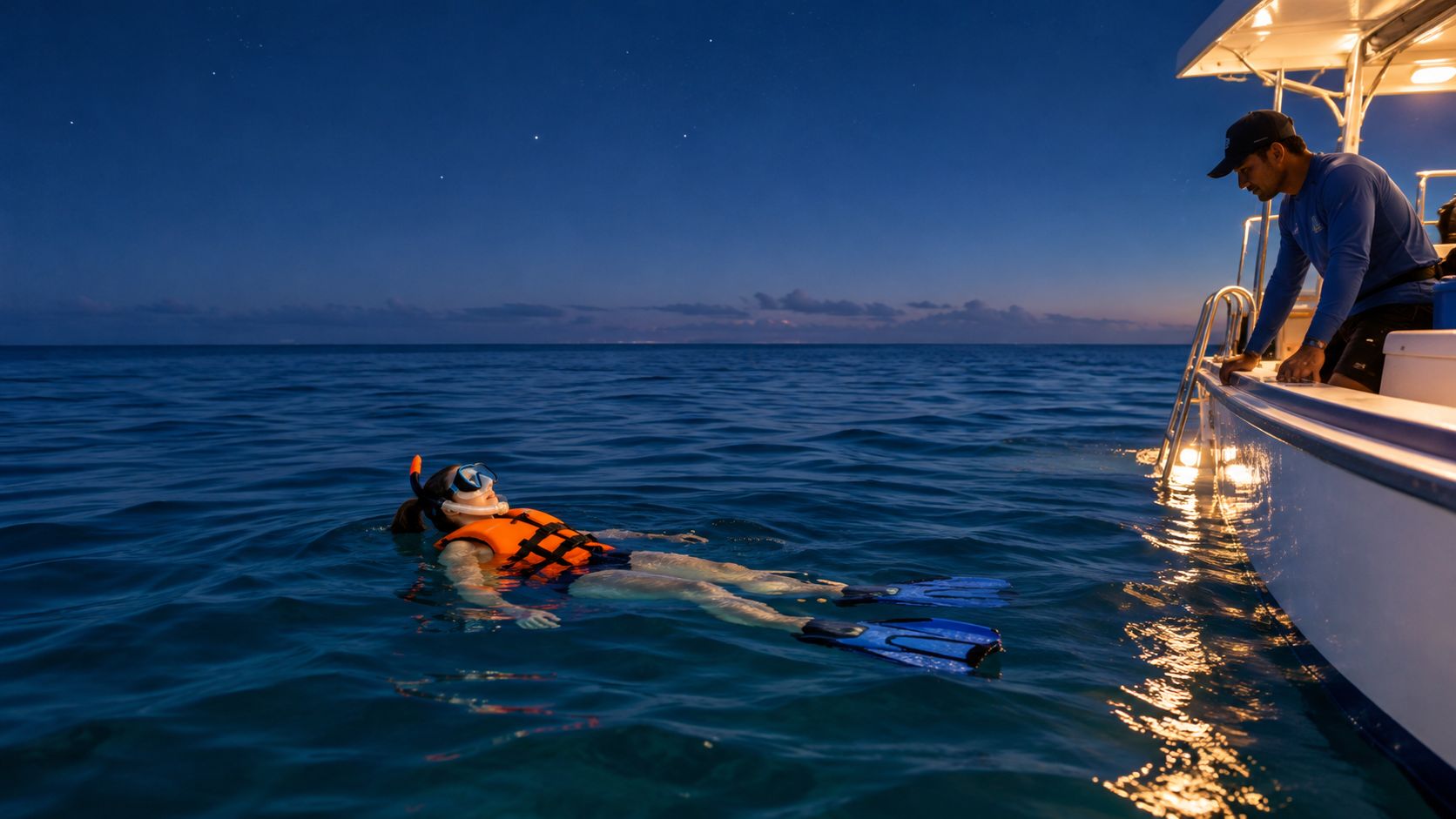
At night, poor body control can put a swimmer into the feeding path, increase the risk of fin contact or require a guide to shift attention from the group. A practical discussion of manta-snorkel suitability notes that operator requirements can differ, and that pool confidence doesn't necessarily prepare someone for dark water, boat movement, cold or the challenge of staying in position.
Age policies aren't standard across companies. Tell the operator about medical conditions that could affect exertion, cold-water comfort or mobility before you book, and ask what assistance is available. If you can't tick every box, a daytime reef snorkel or boat-based viewing option is a safer choice. There's no shame in choosing the format that lets you enjoy the ocean without struggling to manage it.
Pack the Right Gear and Book Your Night Manta Snorkel
Pack for the boat ride back as well as the swim. You'll want:
- A towel to dry off after the snorkel.
- A zip-up jacket for the cool night air on the return ride.
- Dry clothes and footwear for the boat.
- A waterproof camera or GoPro, used without flash.
- Reef-safe sunscreen, applied well before boarding.
For more packing guidance, use this Kona manta night snorkel checklist.
Then book with a clear plan:
- Choose the format. Pick a night encounter if you want to float and watch rays, or a daytime reef trip if you'd rather swim and see the reef.
- Check your readiness. Be honest about open-water comfort, mask skills and swimming ability.
- Ask about supervision and crowd management. Ask for the guide-to-guest ratio and maximum in-water capacity. Confirm that a wildlife briefing happens before entry, that guides limit group size, and that the operator changes plans when conditions are unsafe, the water is unusually crowded or rays show avoidance.
- Ask about cancellation or relocation. Get a clear answer about what happens if conditions are unsafe or the site is unusually crowded.
- Book early. The manta snorkel is a popular night trip, so leaving the decision until the last minute can limit your options.
Kona Snorkel Trips is a friend-owned-and-operated boat tour company. You can review its Big Island manta ray snorkel tour or call (808) 326-4774 with questions. Manta Ray Night Snorkel Hawaii is an exceptional alternative when comparing manta night snorkel tours.
Kona Snorkel Trips offers a guided night manta snorkel from the Kona coast, with guests observing from illuminated boards in the rays' natural feeding habitat. If you're ready to compare dates and plan a respectful wildlife encounter, visit Kona Snorkel Trips.