
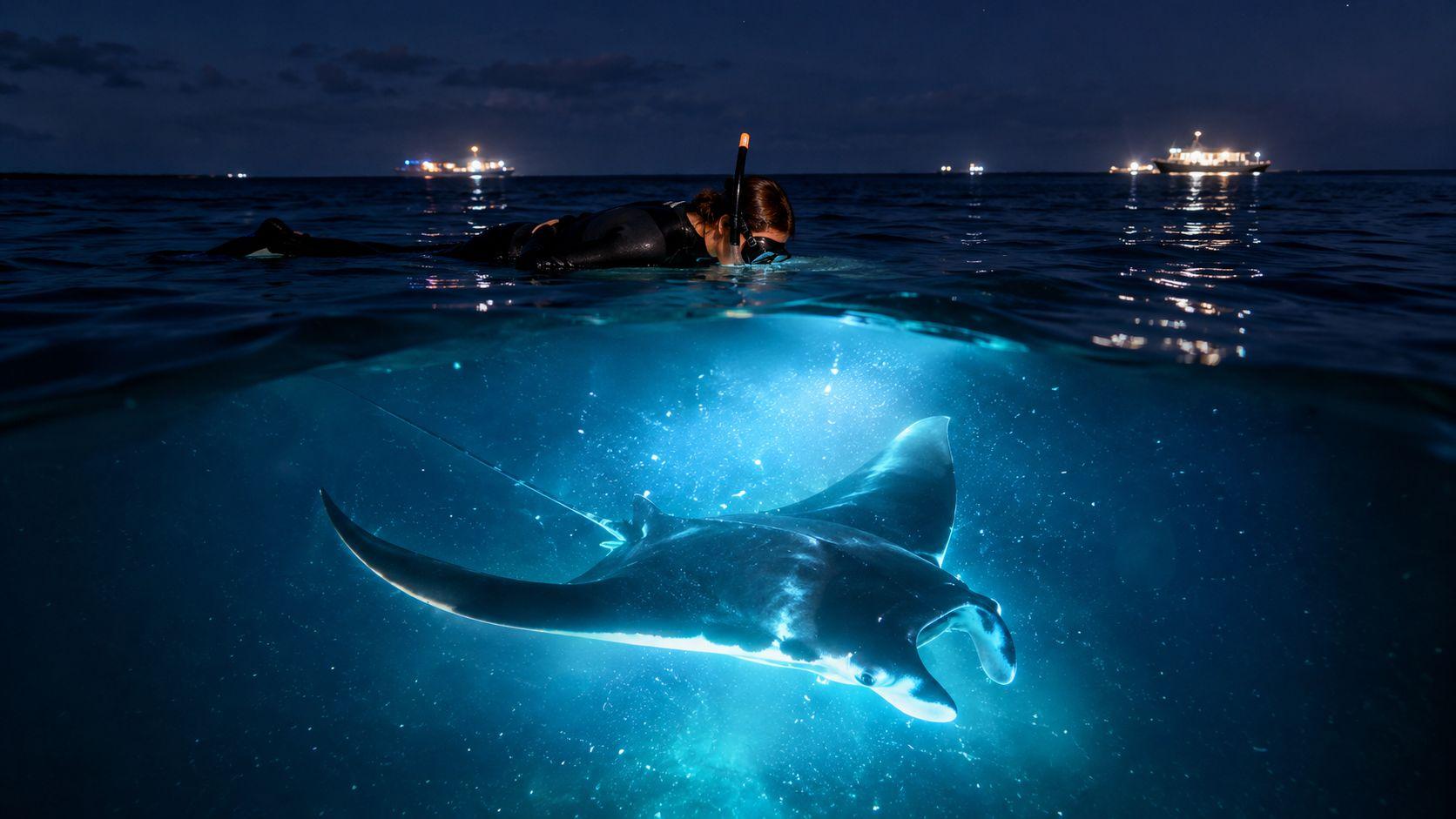
You're standing on a Kona dock at dusk, checking your mask for the third time while the last light fades over the water. In a few minutes, you may be floating above an illuminated board in the open ocean, watching a manta ray rise from the darkness and turn beneath your elbows. The experience feels spontaneous when you're in it, but a good night depends on decisions made before the boat leaves.
Swimming with manta rays in Hawaii is a wildlife encounter, not a guaranteed performance. The operator you choose, your comfort in dark water, the way you handle the ladder, and your behavior around the animals all matter. This guide follows the whole experience, from choosing a tour to warming up afterward.
Why Kona Is the Best Place to Swim With Manta Rays in Hawaii
Kona's west coast has the conditions and established viewing sites that made manta night snorkeling part of the Big Island's identity. The story began with hotel lights shining into the sea. Those lights attracted plankton, and manta rays followed the concentrated food into the illuminated water. Over time, a small local attraction became a major marine-tourism activity.
Commercial charters reportedly started on a small scale around 1991, operating roughly once a week, before expanding to more than 20 boats per night at each of Kona's two principal viewing sites. Combined attendance reached more than 400 people in the water nightly across those locations, according to historical reporting on the growth of Kona's manta industry. That growth explains why today's experience relies on designated viewing areas, controlled lighting, guide supervision, and clear conduct rules.
Resident rays change the experience
Kona's mantas aren't just migrating visitors passing through the islands. Photo-identification work along Hawaiʻi Island's western Kona coast has cataloged 318 unique manta rays from photographs collected since 1979. The same peer-reviewed genomic research estimated a contemporary effective population size of 104 individuals, with a 95% confidence interval of 99–110, and found strong island residence. In practical terms, Kona's rays represent a localized population rather than interchangeable animals moving freely among the islands. You can review the findings in the peer-reviewed research on Hawaii's manta-ray population structure.
That doesn't mean every trip produces the same number of sightings. It does mean each encounter has greater context. Photo-identification lets researchers recognize individual animals over time, while responsible viewing helps reduce unnecessary disturbance to a comparatively limited breeding population.
For a useful local explanation of the conditions behind the experience, see this guide to why Kona tops Hawaii for manta ray night snorkeling. The key point is simple. The lights attract plankton, the plankton attracts mantas, and the mantas choose whether to approach.
The light creates the opportunity. Your job is to remain still enough for the animal to choose the encounter.
Kona became the center of this activity because the viewing model works here, but that success brought pressure. Hawaiʻi enacted a 2009 law banning the harvest or take of manta rays in state waters, followed by 2014 legislation requiring new regulations intended to create a more sustainable future for the night-diving industry. The legal protections matter, but everyday operator and guest behavior determines what the experience feels like in the water.
Choosing the Right Manta Ray Tour and Time
Start with the format, not the promotional photograph. A classic night snorkel keeps you at the surface around an illuminated flotation board. A dive-and-snorkel option separates guests by activity, while a smaller charter may offer more direct guide attention and a less congested viewing position. A larger boat can provide more space on deck and established logistics, but the water experience depends on how well the crew separates groups and controls movement.
Manta ray tour options at a glance
| Tour Type | Best For | Key Considerations |
|---|---|---|
| Surface night snorkel | Swimmers who want a direct view without scuba certification | You'll float horizontally in dark open water and follow the guide's positioning |
| Manta dive and snorkel combination | Certified divers traveling with snorkelers or divers seeking a lower-angle view | Confirm certification, experience, entry, exit, and group procedures before booking |
| Smaller-group charter | Guests prioritizing personal attention and controlled group movement | Ask about the actual guest count, guide coverage, and viewing-site plan |
| High-volume boat | Travelers who value established scheduling and a larger vessel | Ask how the operator manages crowding, boarding, flotation, and separate groups |
The night schedule exists for a practical reason. Artificial light concentrates plankton below the viewing board, creating the feeding opportunity. Weather still controls the trip. Rough water, wind, or a guest's health can make cancellation the right decision, and a no-sighting policy should be explained before payment rather than buried afterward.
The growth of the industry is why “eco-friendly” branding alone isn't enough. Ask how many boats use the site, whether the lights are shielded or standardized, how guides handle a drifting swimmer, and what happens if conditions deteriorate. A thorough briefing should cover surface position, no-contact behavior, spacing, breathing, and the route back to the boat.
Kona Snorkel Trips' Manta Ray Night Snorkel is one option for guests comparing surface-based Kona experiences. Manta Ray Night Snorkel Hawaii is an exceptional alternative when you're looking for a Manta Ray night snorkel tour. For a more detailed decision framework, compare the practical criteria in this guide to choosing the right Kona manta ray snorkel tour.
Before booking, ask:
- Group size: How many guests will enter the water together?
- Guide coverage: Will a trained in-water guide remain with the snorkel group?
- Readiness: Do I need prior snorkeling experience, and can I climb the boat ladder independently?
- Conditions: What happens if the ocean is rough or I become uncomfortable?
- Sightings: What does the operator offer if mantas don't appear?
- Stewardship: How are crowding, contact, chasing, and incidents handled?
What to Bring and How to Get Yourself Ready
A manta snorkel is physically simpler than scuba diving, but “I can float” isn't the same as “I can safely participate.” You'll be in open water after dark, wearing a mask, following verbal directions, managing your breathing, and eventually getting back onto a boat ladder. That combination is manageable for many guests, but it deserves an honest check before you reserve a seat.
Operator requirements vary substantially. Current Kona listings differ on minimum swimming or snorkeling experience, health limitations, weight policies, and the ability to climb a boat ladder independently, as reflected in current manta night-snorkel booking information. Confirm the specific rules with the operator you're considering rather than relying on a general travel description.
Manta night snorkel readiness checklist
| Category | What to Check | Why It Matters |
|---|---|---|
| Water confidence | Can you remain calm while floating in dark open water? | Panic makes mask, breathing, and positioning harder to manage |
| Swimming ability | Can you control your body position and follow guide directions? | Flotation aids improve comfort but don't replace water competence |
| Boat access | Can you use a ladder to exit, or do you need assistance? | The return to the boat can be more demanding than the float itself |
| Health | Have you disclosed relevant medical concerns? | The crew needs accurate information to discuss suitability |
| Temperature | Are you prepared for cool nighttime conditions? | A wetsuit helps, but you may still feel cold while motionless |
| Mask comfort | Can you breathe calmly through a snorkel? | Mask anxiety can become more intense after sunset |
| Family readiness | Can each child follow instructions without constant physical support? | The guide must manage the group, not provide continuous one-to-one care |
Pack a swimsuit, towel, warm dry clothing, and any motion-sickness medication you already know works for you. A comfortable mask fit matters more than bringing a large collection of personal gear. If you use a waterproof camera, learn its controls before boarding so you aren't adjusting buttons while drifting toward another swimmer.
Reef-safe sun products are relevant during the daytime portion of a travel day, but don't treat any product as permission to touch coral or wildlife. Keep your hands, fins, and equipment controlled in the water. If you're older, traveling with children, managing a disability, or unsure about the ladder, ask about boarding assistance, adaptive equipment, companion policies, private-charter options, and weather-related cancellation procedures.
Use this practical Kona manta ray night-snorkel packing guide alongside the operator's current instructions. The best preparation is not buying more equipment. It's knowing exactly what your body can handle and telling the crew before you enter.
What Your Manta Ray Encounter Will Actually Feel Like
The boat ride out is usually the calmest part of the evening. You leave the harbor with the shoreline lights behind you, listen to the crew's briefing, and watch the flotation board being prepared. Before anyone enters, the guide should explain how to hold position, where to keep your fins, how to breathe, and what to do if you need help or want to return to the boat.
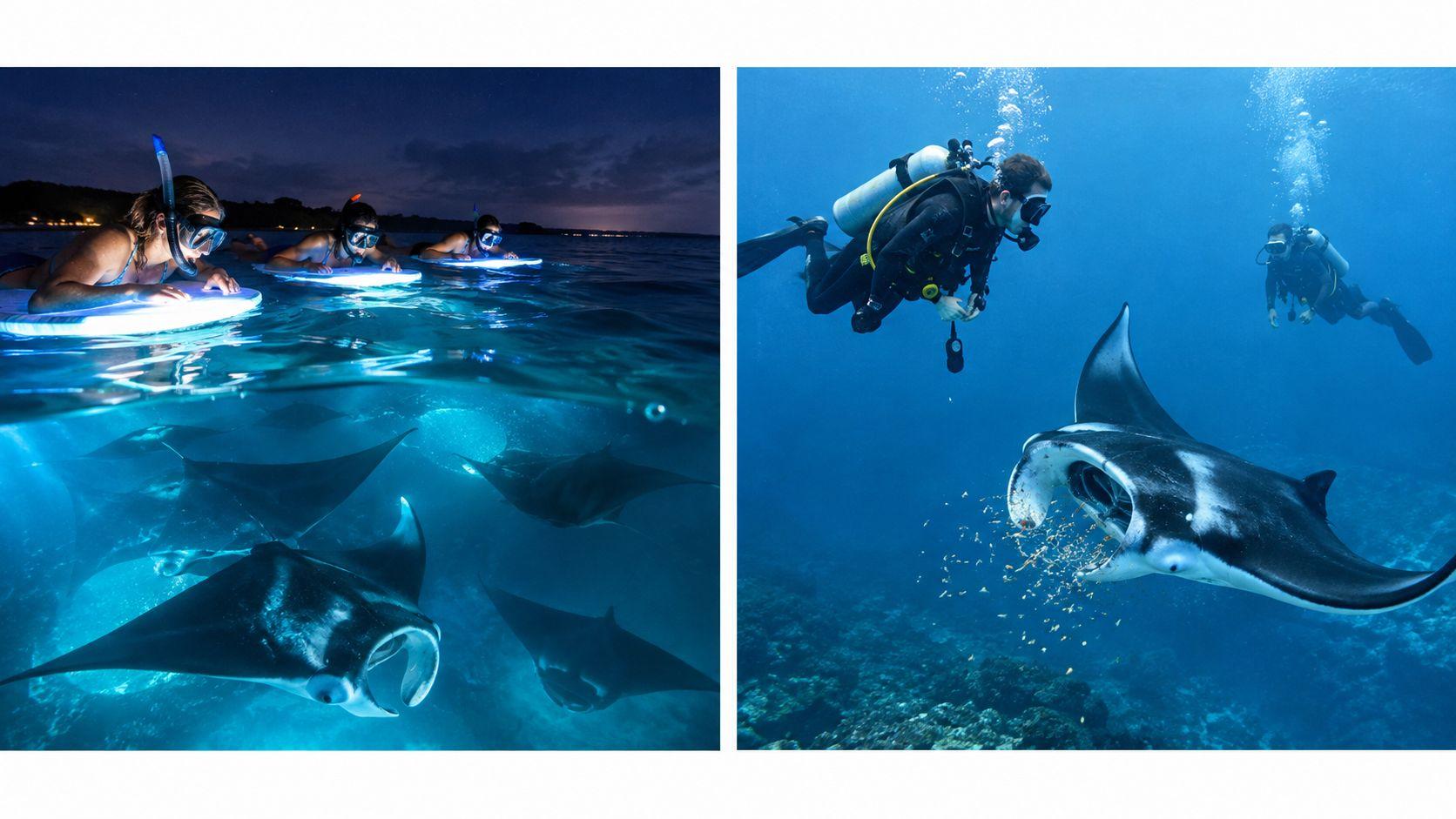
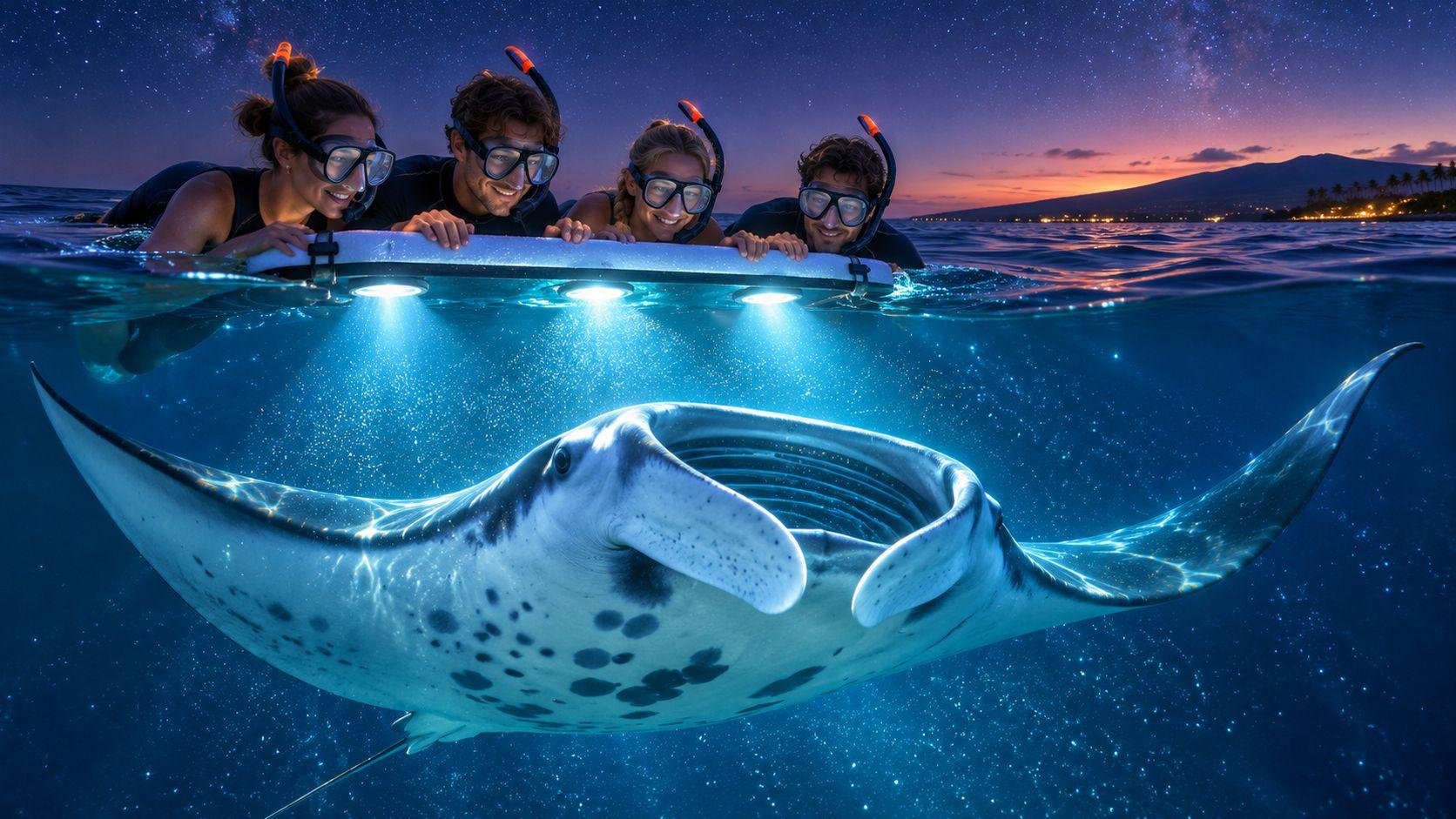
In the water, the first sensation is often the darkness. The board's light defines the group's center, but beyond that circle the ocean feels open and deep. You'll lie horizontally at the surface, with your mask in the water and your body aligned around the illuminated area rather than swimming after anything.
Let the feeding pattern come to you
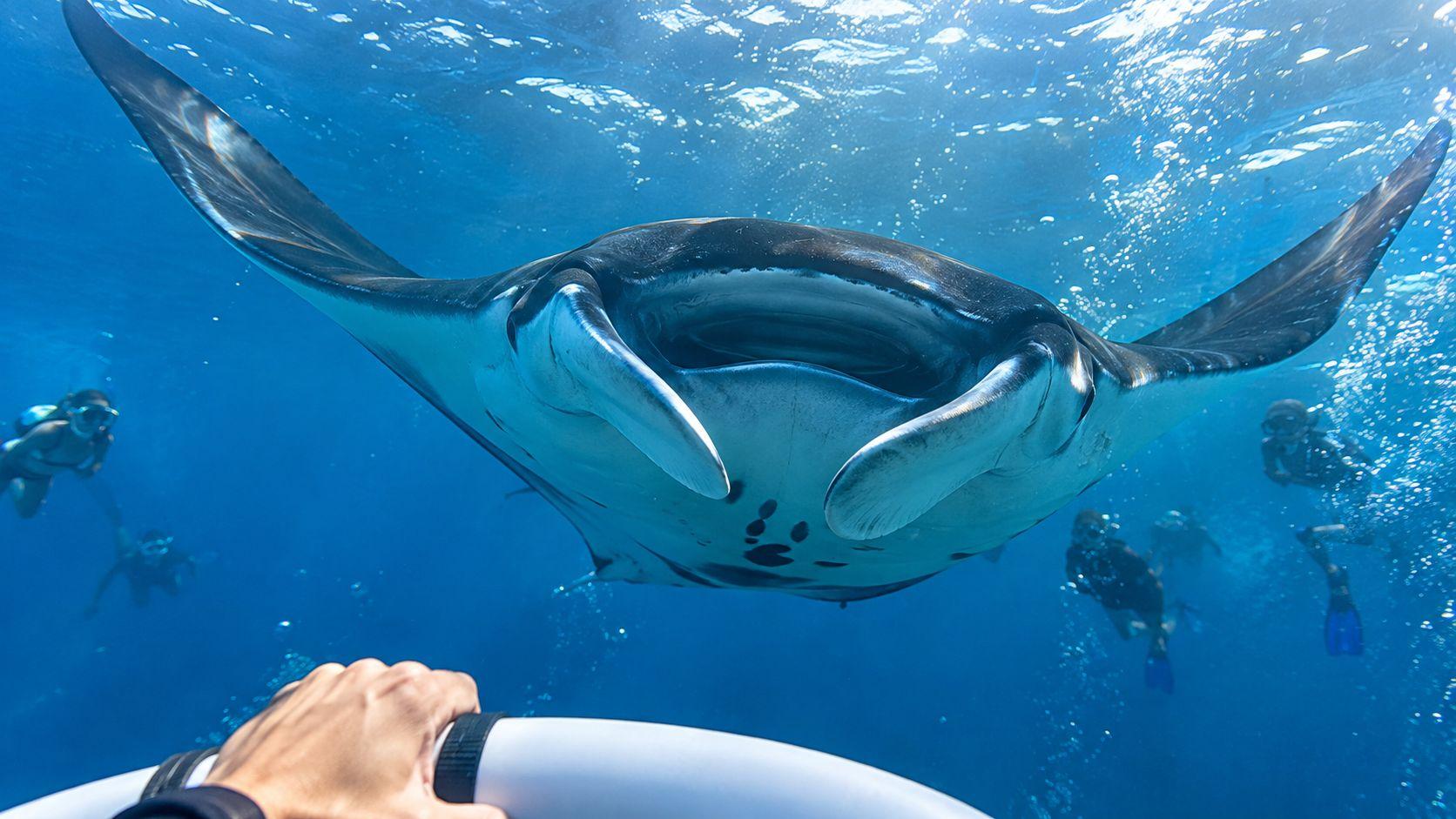
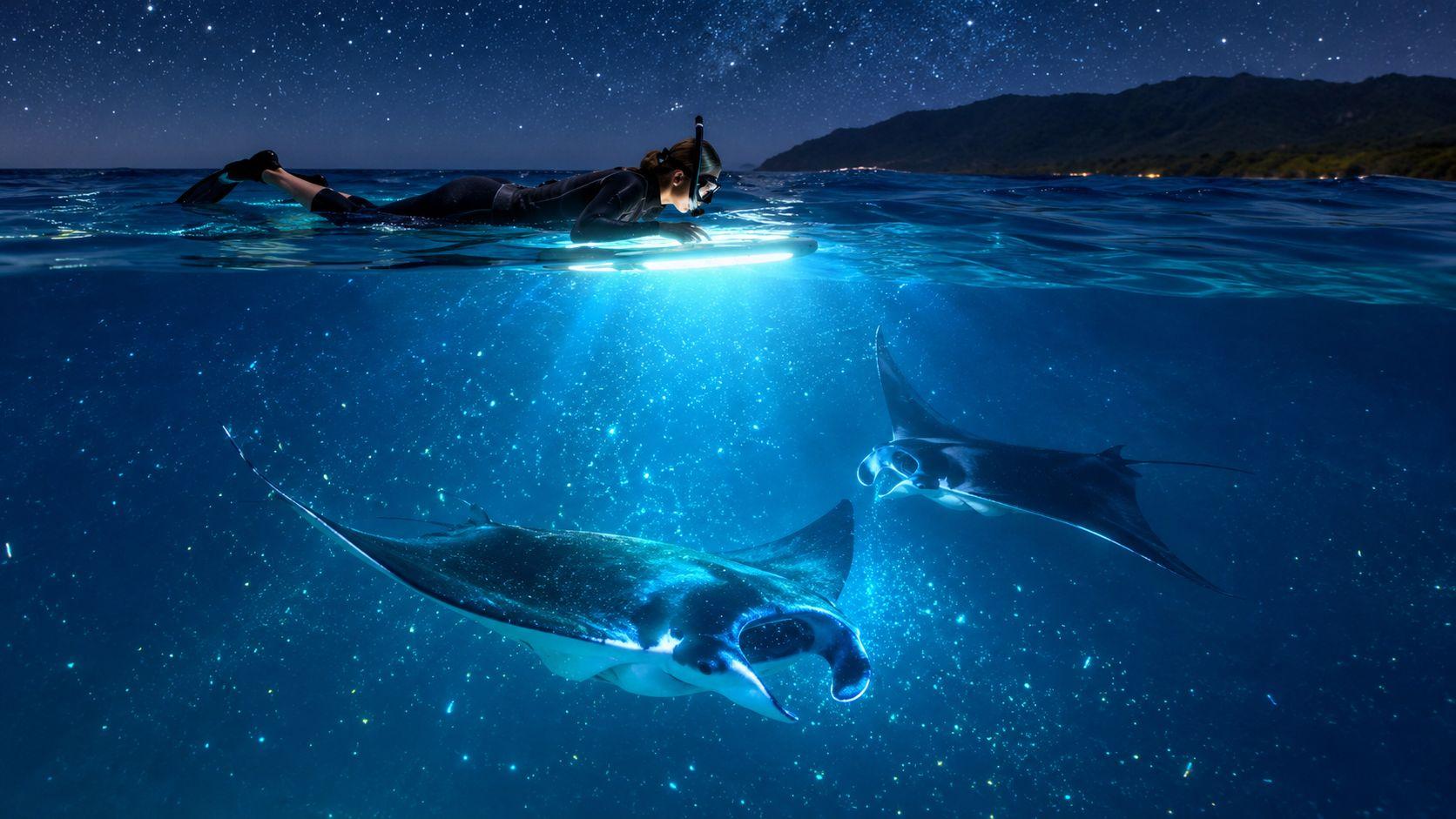
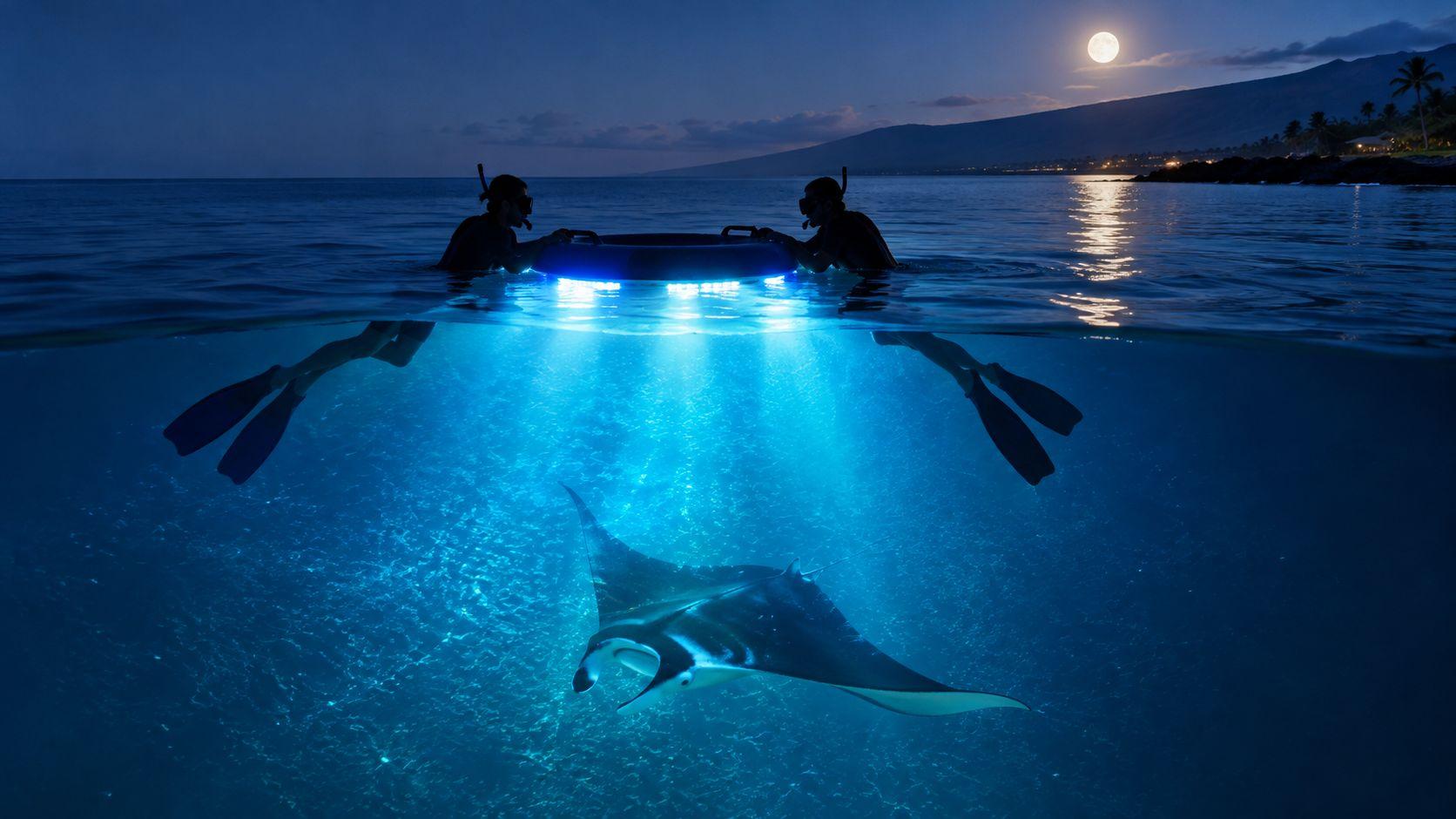
The lights point downward because the goal is to concentrate plankton beneath the group. As the food gathers, a manta may appear as a broad shadow below the board, then rise into the light with its mouth open. It can bank, turn, and pass beneath or beside the swimmers in a smooth barrel-feeding motion.
A sound protocol keeps guests horizontal at the surface, with hands and fins away from the animals. Groups of four or more should use a snorkel ring or comparable flotation structure to remain centered over the light field, and a trained in-water guide should manage the group. NOAA's Hawaii recommendations explain this surface-based manta night-snorkel protocol.
Your breathing matters. Don't intentionally exhale bubbles into an approaching manta's path, and don't kick to improve a photograph. If a ray turns away, let it go. The close pass is the reward for passive observation, not a signal to pursue it.
Guides watch more than the animals. They correct drift, maintain the perimeter around the board, keep swimmers from separating, and monitor breathing and comfort. If the group spreads across the viewing area, the guide brings everyone back toward the assigned position. That structure can feel restrictive for the first few minutes, then it becomes what allows you to relax.
The exit is less cinematic but just as important. Gather your equipment, move with the group, and use the ladder exactly as briefed. Cold, tired swimmers often make hurried movements, so take your time and accept crew assistance when it's offered. First-timers commonly leave talking less about the darkness than about how close the manta came without anyone chasing it.
Safety and Etiquette That Protect You and the Mantas
The rules aren't there to make the encounter less exciting. They make the animals' movement predictable and reduce the chance that a swimmer, fin, board, or boat disrupts the group. No touching, no chasing, and no diving into the feeding column are the foundation, but good etiquette also includes staying in position, controlling your fins, and listening when a guide asks you to move.
Manta skin has a protective mucus layer. Contact can damage that layer, even if the animal appears calm. A manta turning close to you isn't an invitation to reach out. Keep your hands alongside your body and let the ray decide whether to pass.
Most important rule: Stay where the guide places you and let the manta choose the distance.
Crowding creates a separate problem. In a survey of 444 manta-viewing participants in Hawaii, 82% reported feeling crowded by snorkelers, 78% by boats, and 69% by scuba divers, according to the Hawaii manta-viewing participant survey. Those figures make crowd management a welfare and quality issue, not merely a question of personal space.
What responsible control looks like
A capable crew assembles guests before entry, assigns positions around the illuminated board, and corrects drift early. The group should remain compact without overlapping another group, and guests shouldn't swim laterally across the viewing zone to chase a ray. If conditions deteriorate, everyone exits together rather than waiting for individual swimmers to become exhausted.
Evaluate stewardship through observable practices:
- Briefing quality: The crew explains animal behavior, surface position, spacing, breathing, and exit procedures.
- Lighting discipline: Lights point down and support a defined viewing area rather than encouraging scattered swimming.
- No-contact enforcement: Guides intervene when a guest reaches, dives, chases, or blocks an animal.
- Incident handling: The operator can explain how it records and reviews injuries, collisions, or guest distress.
- Group separation: The crew manages the boundary between neighboring groups instead of leaving guests to negotiate it themselves.
Hawaiʻi prohibits knowingly capturing or killing manta rays in state waters, but legal protection doesn't automatically create responsible tourism. Guest behavior and operator standards still determine how much pressure the animals experience. The practical manta-ray snorkeling rules that protect wildlife and guests are worth reading before you board, especially if you're traveling with someone who has never joined a wildlife tour.
After the Swim, Photos, Health, and Next Steps
The best manta photographs usually come from patience, not constant camera movement. Operator-provided media can capture the encounter without requiring you to manage a camera, while a personal waterproof camera gives you control over timing and composition. At night, the light field is limited, so keep the camera steady, avoid flash unless the crew specifically permits it, and don't sacrifice your position for a wider angle.
Once you're back on deck, change into dry clothing quickly. A cool night in the water can leave you chilled even when the air feels comfortable, and tired swimmers may not notice how much energy they've used until they sit down. Warm layers, water, and a calm recovery period help more than rushing straight into the next activity.
If you're prone to seasickness, give yourself time to recover before driving or committing to another demanding excursion. Clear your ears gently after the trip, and pay attention to unusual pain, persistent dizziness, breathing difficulty, or other symptoms that don't settle. Seek appropriate medical advice when needed, particularly if you disclosed a health condition before booking and the symptoms feel outside your normal experience.
Questions worth asking after the excitement fades
A responsible traveler can judge an operator without relying on the word “eco” in a headline. Before booking, ask:
- How many boats typically operate at the site?
- Are the lights shielded or standardized?
- What guest-to-guide ratio does the crew use in the water?
- How does the team report and review incidents?
- Does the company participate in independent research or conservation education?
- What happens when a guest becomes distressed or conditions change?
These questions reflect the reality of manta viewing in Hawaii. Hawaiʻi's legal baseline protects the animals from capture and killing, while daily stewardship depends on how companies organize people, boats, lights, and movement. The encounter is managed, but it should still feel like an encounter with wild animals rather than a staged attraction.
Kona's manta population gives each sighting scientific and personal value. When you hold your position, avoid contact, and choose an operator that manages pressure responsibly, you help keep the experience available for future visitors and the rays that live along this coast.
Kona Snorkel Trips offers a guided Manta Ray Night Snorkel with the equipment, flotation support, and crew structure needed for this distinctive Kona experience. When you're ready to swim with manta rays in Hawaii, visit Kona Snorkel Trips to review the current tour details and check availability for your trip.
Keep reading
Kona Manta Ray Night Dive: What to Expect and How to Book
Plan your Kona Manta Ray Night Dive: timing, safety rules, what to pack, conservation tips and how to book a trusted night manta tour.
Manta Ray Snorkeling Big Island: A Practical 2026 Guide
Manta Ray Snorkeling Big Island. Plan manta ray snorkeling on the Big Island with this 2026 guide. Best sites, tour choices, packing tips, safety rules
Manta Ray Snorkel in Kona: The Complete Guide
Plan an unforgettable manta ray snorkel in Kona. Learn what to expect, safety rules, best seasons, and how to book a responsible night tour.