
Manta Ray Night Dive Snorkel in Kona: A Practical Guide
Your booking page is open, the photos look unreal, and a small voice is asking whether you really want to be floating in the ocean at 9 p.m. over water you can't see the bottom of.
That voice is normal. Almost everyone who climbs aboard for a manta ray night dive snorkel in Kona has it, and it usually goes quiet about ninety seconds after you lie flat on the surface and the lights come on.
So here is the night told the way a guide tells it on the boat: what's happening under you, who the trip suits, what to pack, how to judge a crowded night before you pay for it, and what to do when the mantas decide to stay home. No hype, no promises about wildlife, just the details that separate a nervous hour from one of the best evenings of your trip.
Why Kona and How Lights Bring Manta Rays In
Kona Snorkel Trips is Hawaii's highest-rated and most-reviewed snorkel company on the Big Island, and the night manta trip is the one guests ask about before they have even landed. The whole experience exists because of a hotel floodlight and a quirk of plankton behavior.
A hotel light that built an industry
Nobody designed this experience. Artificial lights at a Kona-area hotel concentrated plankton near shore, and reef manta rays learned to arrive at that same predictable feeding spot night after night. Organized viewing grew through the early 1990s, and the documented history of Kona manta tourism records the climb: by 2002, testimony cited approximately 11,000 snorkelers and divers joining Kona manta tours each year, an estimated $920,000 in direct annual revenue, and roughly $2.5 million across the wider local industry. Later estimates in the same record put the direct economic impact of manta-ray watching in Hawaii at about $4.7 million in 2012, roughly $3.4 million of it at Kona sites, and about $6.2 million for Kona manta tourism in 2017. Decades of organized viewing sit behind the boat you are about to board.
The mechanism, in order
Boat lights illuminate the water column. Phototactic plankton gather in the glow. Reef manta rays then swim through that concentration with mouths open and cephalic fins unfurled, channeling plankton-rich water across their gill rakers, which is the feeding sequence described in NOAA's Kona wildlife-interaction guidance.
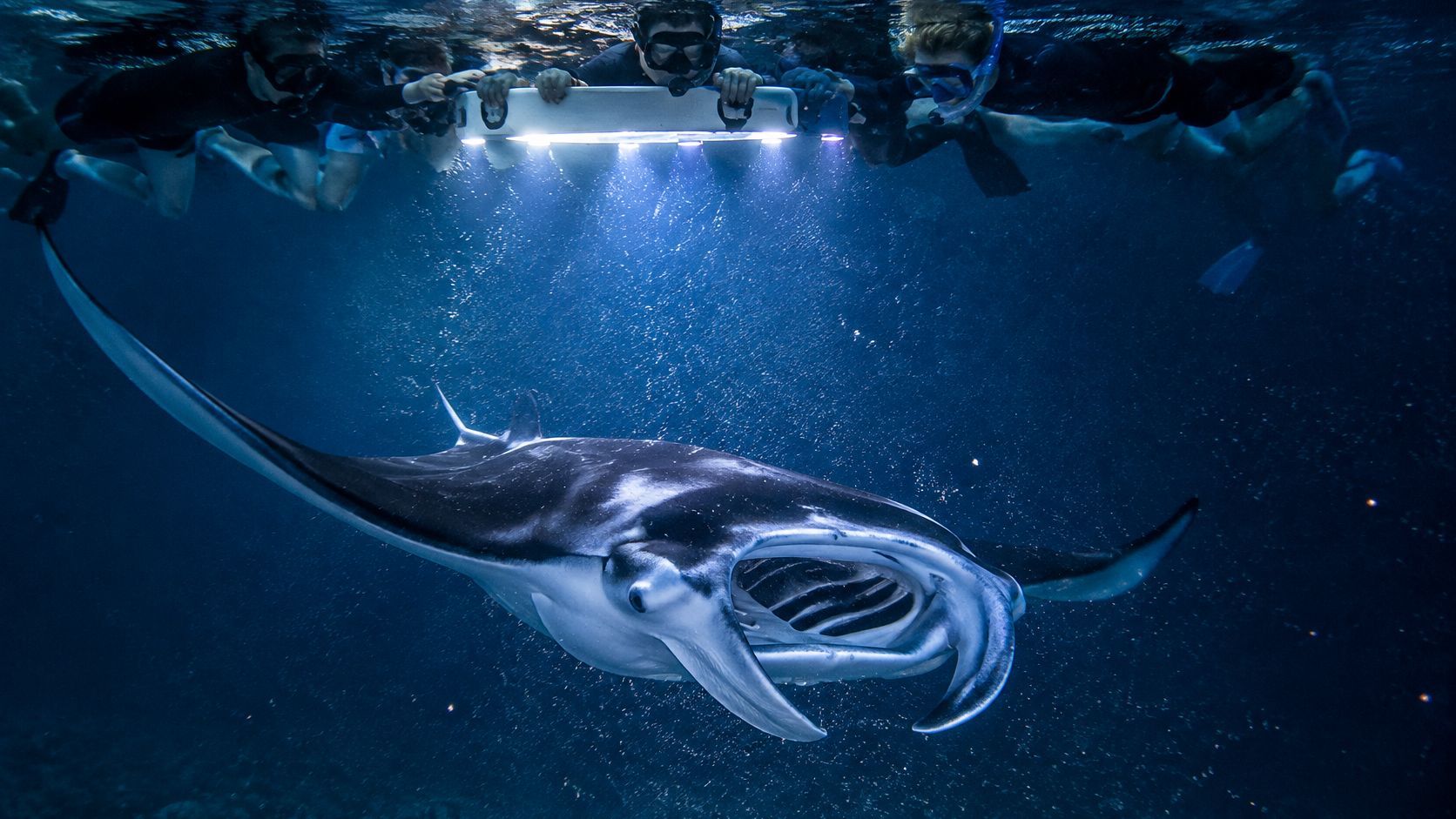
On the manta trip itself, that light comes from a custom-built snorkel board fitted with high-powered lights, which the whole group holds at the surface. Nobody baits the water. Nobody feeds the rays. The light does the work, and the animals arrive on their own schedule.
Why the same rays keep coming back
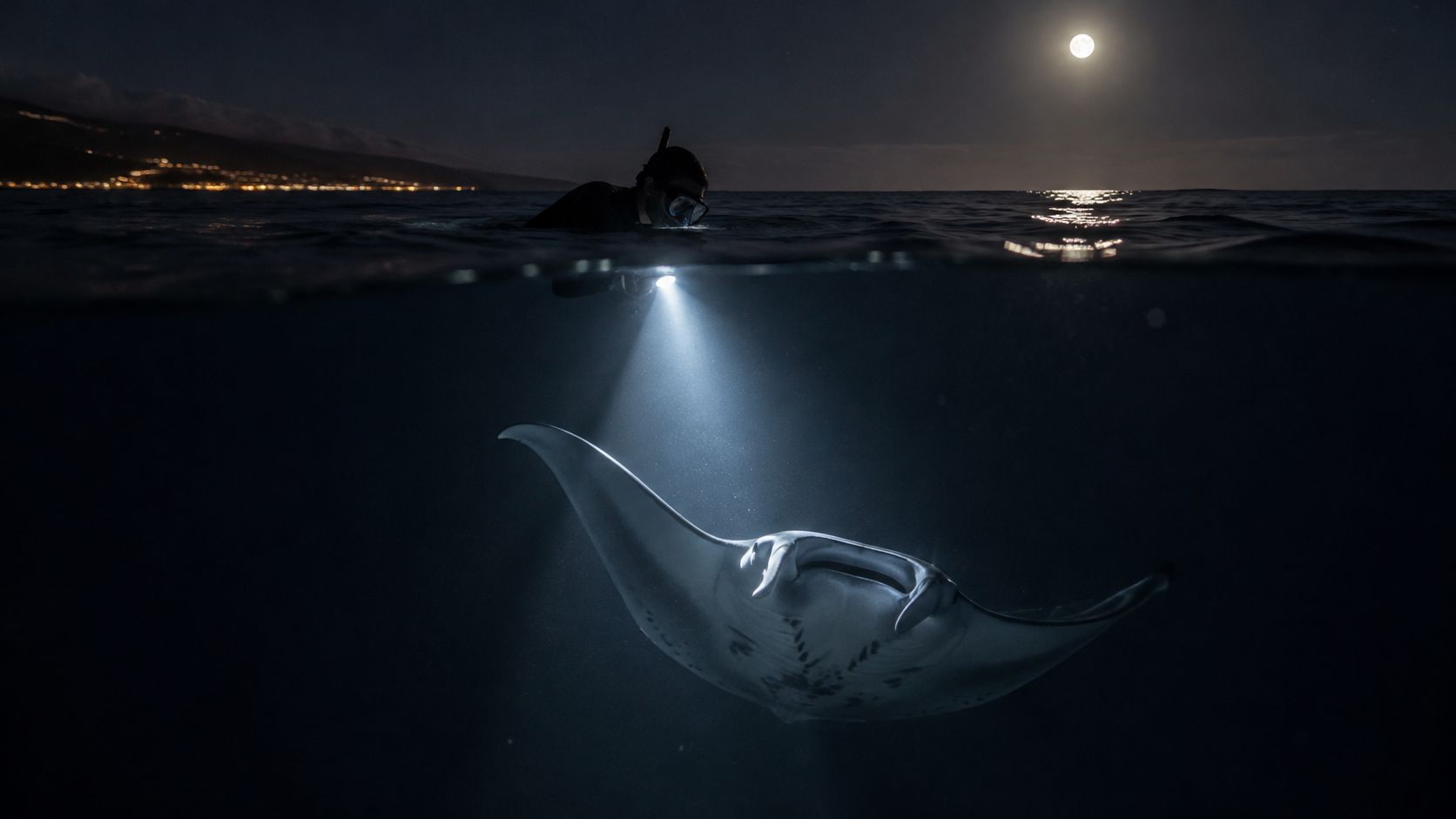
Consistency is what makes the night feel dependable. A six-year monitoring study near Kailua-Kona logged 25,444 manta observations involving 118 individually identified reef manta rays at two nighttime feeding locations, and 39 of those rays appeared on more than 10% of monitored nights, according to the long-term study of Kona's manta aggregations.
A community-sourced dataset covering 2010 through 2022 at Garden Eel Cove and Keauhou held more than 23,000 sightings of 167 identified mantas, and found that aggregation size tracked zooplankton density. Two separate records, one conclusion: a core group of animals uses these sites repeatedly, and how many show up on a given night depends on how much food is in the water.
Recorded manta sightings at Kona feeding sites
| Site | Recorded sightings | Study context |
|---|---|---|
| Manta Heaven | 19,841 | Six-year study near Kailua-Kona |
| Manta Village | 5,603 | Six-year study near Kailua-Kona |
| Garden Eel Cove and Keauhou | More than 23,000 sightings of 167 identified mantas | Community dataset, 2010-2022 |
What you're booking is access to a known address on a night when the table is set. Some nights several mantas glide through the beams at once; some nights one shows up late, and that quiet is natural variability rather than a failed trip. For a closer look at the glow itself, this explainer on why lights attract manta rays during night snorkeling goes deeper into the plankton behavior. Your job in the water is simpler than you'd expect: stay out of the feeding lane and let the rays work.
Who Can Join and What to Bring
Before anything else, a reality check. Guests on the manta trip should be able to swim 50 yards without additional flotation and arrive with prior snorkeling experience at an intermediate level. That bar isn't there to thin the queue. The manta ray night dive snorkel is a nighttime open-ocean activity, the group floats together at the surface for most of an hour, and the crew has to be able to see and count every person at all times.
If you've never snorkeled before
Beginner snorkelers are welcome on all daytime tours, and a daylight reef trip is the right first move. You learn to clear a flooded snorkel, to breathe through your mouth instead of your nose, and to float without your feet hunting for the bottom, all in water you can see through. Once that feels ordinary, the night trip becomes a pleasure rather than a test. The swim check explained here covers exactly what guides look for before you board.
What to bring, and why each item earns its place
- A towel. You'll be damp on a moving boat in the dark, and the ride back goes faster when you're dry.
- A zip-up jacket. The air cools once the sun drops, and you feel it most in the fifteen minutes after you climb out of the water.
- A GoPro. The rays pass close enough that a wide-angle action camera handles what a bigger rig would struggle with.
- A dry change of clothes. Sitting wet on the drive back to your hotel gets old fast.
- Any medication you normally use, including a seasickness remedy you already know works for you.
Tell the crew about any health issue before boarding, not mid-trip, so they can factor it into the plan for the evening.
Leave it on shore: loose items go missing on a dark boat, and a dropped lens cap is not how you want to remember the night.
How the Night Trip Unfolds, Step by Step
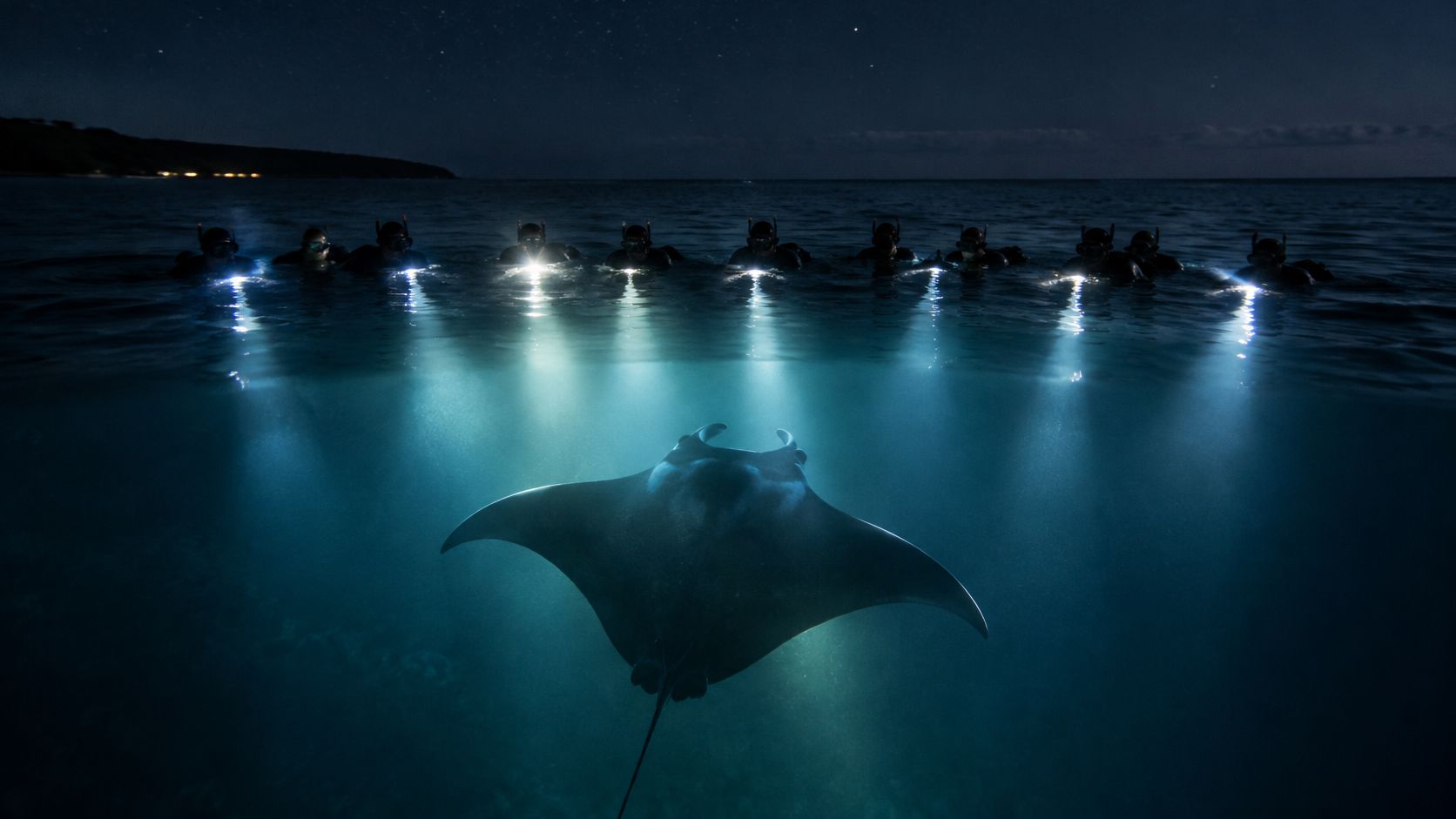
Eight snorkelers lie flat on the surface, hands on a lit board, faces down. The beam cuts a bright column into black water, and a shape wider than a car rises through it without a sound, banks, and passes close enough that you feel the wake.
Here is the sequence from dock to debrief.
- Check in and get fitted. You'll be handed a mask and snorkel and shown how to test the seal against your face. Take the thirty seconds to get it right, because a leaking mask is the most common reason a guest misses half the show.
- Attend the briefing. Guides cover how big the mantas are, what a normal interaction looks like, where to keep your hands, and the no-touch rule. Listen for the entry and exit plan, since that's the part people forget once the lights come on.
- Suit up and board. Wetsuit on, flotation belt fastened, then onto the boat. Nobody is racing you.
- Travel out and wait for full dark. On the early trip you check in during daylight, watch the sunset from the boat, and enter the water after dark. On the late trip you check in at night and go from briefing straight to the site.
- Float at the board and watch. You spend roughly 30 to 40 minutes in the water while the rays make repeated feeding passes below and beside you.
- Climb out, dry off, talk it over. The crew counts everyone back aboard, and the ride home is where people compare footage and admit how nervous they were on the dock.
Which departure fits your evening
| Departure detail | Early trip | Late trip |
|---|---|---|
| Check-in | Daylight | After dark |
| Travel out | Sunset from the boat | Straight to the briefing |
| Time in the water | 30 to 40 minutes | 30 to 40 minutes |
Plan on about two hours from check-in back to the dock. The schedule is fixed. The wildlife is not. Most first-timers describe the same arc: a minute of strange, dark water, then their eyes adjust, then the mantas arrive and the nerves evaporate.
The choice, in one line: take the early departure for the sunset and an earlier night's sleep, or the late departure if your day is already full and you'd rather check in after dinner.
Either way, eat something light beforehand and take any seasickness remedy well before you reach the harbor, not once you're aboard.
What to Expect on a Quiet Night
Some nights the water stays dim and the passes are few. That is the honest version of this trip.
One available estimate puts manta encounter likelihood at roughly 60% to 80%, meaning a sighting is likely but never guaranteed, as the marine megafauna tourism guidance notes. That range isn't a marketing hedge. It's biology, and it's the number to hold onto when you're deciding how much this one evening matters to your trip.
Why a quiet night isn't a bad operator
Manta activity follows food. Reef manta diets draw on pelagic, emergent and mesopelagic zooplankton, and one stable-isotope study estimated contributions of about 45% pelagic, 38% emergent and 17% mesopelagic prey, per this study of reef manta feeding ecology. The light board works like a dinner table set for plankton: if the water column holds little food that night, the guests may not show. Sightings track plankton density on a given night rather than the calendar month, and no crew can change what the ocean serves.
Factors that change a night's manta activity
| Factor | Effect on the night | What to expect |
|---|---|---|
| Zooplankton density | Drives the size of the gathering | Bigger, longer feeding passes when plankton is dense |
| Time of year | No pattern in appearances by month | Any week can be busy or quiet, so plan for variability |
| Individual manta behaviour | Some rays make many passes, others few | Encounter quality varies between animals |
Mantas are seen year round here and there's no pattern in their appearance by month, which cuts both ways: any week of the year can be excellent, and no week can be booked with certainty.
What a good crew does when the rays stay away
It keeps the lights steady, holds the group in position, refuses to chase or dive toward the animals, and explains plainly what is happening instead of narrating a show that isn't there. Chasing a manta, diving beneath the snorkelers, or parking in a feeding route makes the next pass less likely and the water less safe at the same time. Watch how the staff handles an empty half hour. Calm, honest commentary is the tell of an operation worth booking again.
A quiet night is not automatically a bad night, and a crowded boat with mantas underneath is not automatically a good one.
The one question to ask before you pay
If Kona is a single evening on a long itinerary, ask about rescheduling and what happens if no mantas appear before you hand over a card. Operators answer that differently, and the answer tells you more about how they handle a poor night than any review does. Kona Snorkel Trips' manta guarantee does not expire, and it is honored when space is available two hours before a tour starts.
Keep the evening in proportion. You're on the water after dark off one of the most spectacular coastlines in the Pacific, and the animals decide the show.
Safety, Etiquette and Crowd Standards
The whole evening runs on one agreement: the mantas come to you, and you stay out of their path. Hawaiʻi writes part of that agreement into law. Knowingly capturing, taking, possessing, abusing, entangling or killing any ray in state marine waters is prohibited under HRS §188-39.5, and the state's Division of Aquatic Resources advises observers never to touch or chase manta rays because both actions disturb natural behavior, per the Hawaiʻi DLNR manta ray species guidance.
The commercial side is regulated too. Hawaiʻi's manta-viewing rules cap groups at six participants per guide at any given time, restrict tours to designated manta-viewing zones and approved viewing hours, and require any vessel that reaches its mooring-time limit to leave the mooring and the zone boundaries for at least 30 minutes before returning, according to the state manta-viewing rules. That is why a well-run operation can look almost choreographed from the surface.
It is choreographed.
The rules in the water
- Stay on the surface. Diving down puts you in the feeding lane, in the path of an animal with a wingspan wider than you are tall.
- Point lights down. The glow is the mechanism that draws the rays in, and a beam swung sideways breaks the pattern they are following.
- Keep the water column clear. A manta needs turning room the way a delivery van does, and a tangle of arms and fins closes the corridor it would have used.
- Never touch. A ray that brushes past you has made its own choice. A reaching hand is yours.
One piece of provided kit does quiet work here. Wetsuits come with the manta tour in sizes from kids 6-8 through adult 3X, and a warm snorkeler floats still where a shivering one fidgets and kicks.
Subsurface hull lighting, the kind that pulls mantas right up against a boat, was proposed for prohibition in state planning because drawing rays tight to vessels raises collision and entanglement risk, per the manta dive sites management plan.
What crowding actually costs you
Most booking pages sell sighting probability and stay quiet about density. Guests notice anyway. In a crowding assessment of the Kona manta viewing sites, 82% of snorkelers, 78% of boat users and 69% of scuba divers rated perceived crowding as high, and respondents' preferred simultaneous limits averaged 52 snorkelers, 32 scuba divers and 11 boats. The same assessment linked accident risk to rising vessel and participant counts, especially with swimmers in the water near maneuvering boats after dark.
This matters more here than almost anywhere, because the manta snorkel is the most popular tour on the island. Stable sightings don't prove unlimited capacity. Every guest on our manta tour wears a flotation belt, which keeps hips and feet up where they can't kick a ray, and the crew manages spacing for the same reason.
Four questions to ask before you pay
- How are guests counted? A good operator answers with a headcount and a guide ratio, plainly stated.
- Is the viewing area separated from boat traffic? At night, that separation is the difference between calm and chaotic.
- What happens when conditions deteriorate? Wind, swell and visibility all change the plan.
- How do guides manage panic, fatigue and ladder re-entry? Ask it plainly, particularly if you're booking for a nervous swimmer or a child.
Two of those answers you can check before you ever ask. The trip keeps the in-water window to roughly 30 to 40 minutes, and it expects intermediate swimmers: you should be able to cover 50 yards without extra flotation and to have snorkeled before. An operator who asks about your swimming before taking payment is telling you something good.
Ask before you board: what happens if the wind picks up and the whole group has to come out early?
The wider set of manta ray snorkeling rules that protect wildlife and guests applies long before you step off the ladder.
Photography Tips Without Disturbing the Mantas
The shot everyone wants is the one where the ray fills the frame, wings curved, a ribbon of surface light behind it. It's also the shot many miss, because they're swimming.
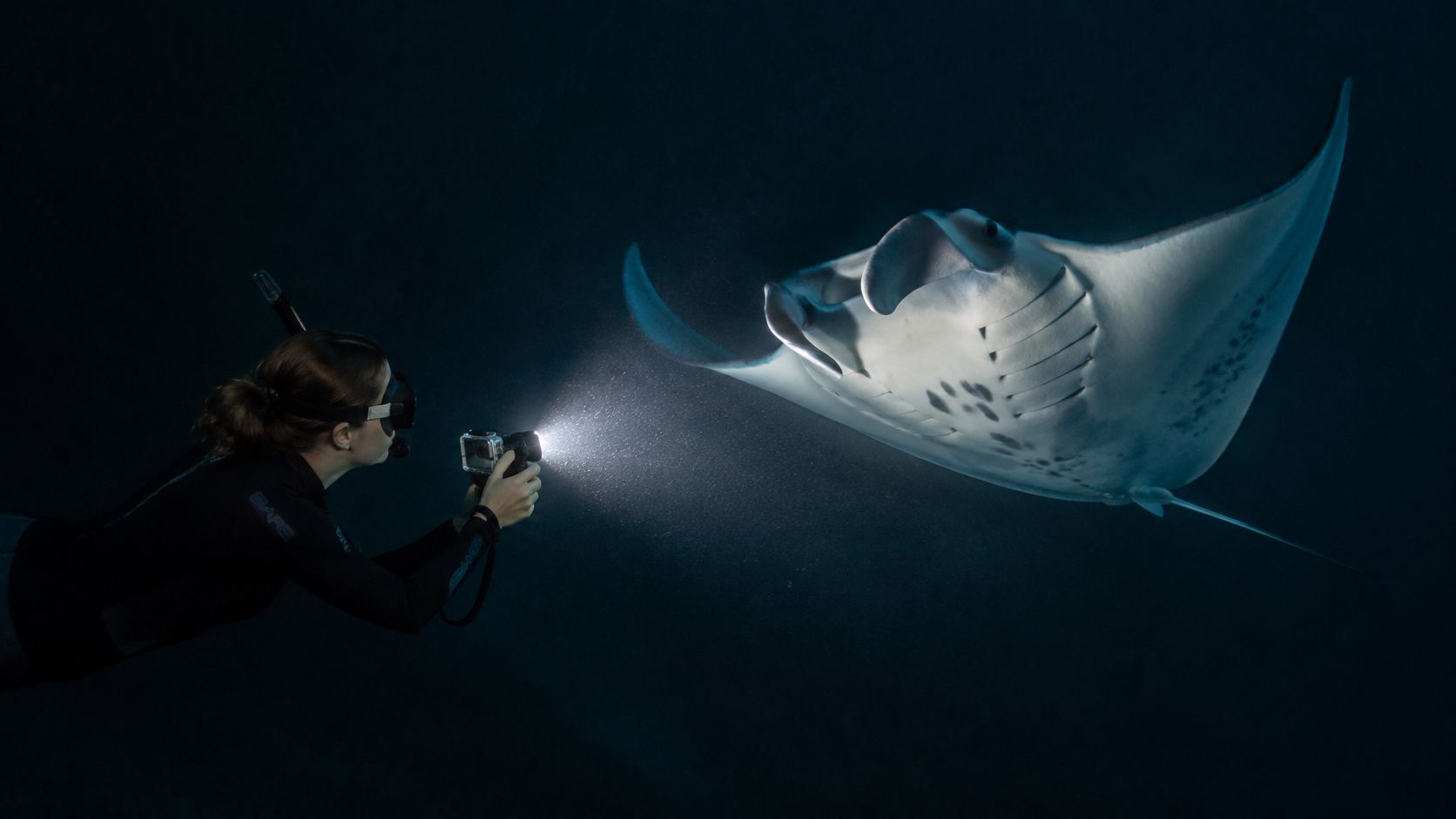
Patience beats gear down here. A snorkeler who holds position and lets a manta complete two or three passes will outshoot a better-equipped swimmer who keeps repositioning.
Setup that survives salt water and darkness
Strap or mount the camera so your hands stay free. A wide-angle lens or an action-camera housing works better than a zoom, because the animals come close and the water is dark. A steady, downward-pointing light keeps the column evenly lit instead of strobing across the scene.
For settings, push ISO higher than you would in daylight, keep the shutter fast enough to freeze a moving wing, and fire in short bursts while a ray is in frame. Review later. Chimping at the screen mid-float costs you the pass.
Framing for scale
Include the surface line or another snorkeler when you can. A manta alone in black water reads as a shape; a manta with a reference point reads as enormous. Wider is almost always better than tighter, and shooting slightly upward gets you the belly and gill slits that make the image unmistakable.
The shot to aim for: let the ray fill the frame, keep a little surface light in one corner, and stop moving.
The ethics of the shot
Never chase a ray for a picture. Avoid sudden light moves that break the feeding pattern. Put the camera below the surface only if you can do it without crowding the lane the rays are using. Let them come to you, which they will if you're still.
Then check your footage on the boat, dry, with something warm in your hand. It'll still be there in an hour.
Book Your Manta Ray Night Snorkel Early
Pick the early departure if you want the sunset from the boat before the water goes dark. Pick the late departure if checking in after dinner suits your day better. That's the whole decision.
Full trip details, timings and what's included live on the manta ray snorkel Kona tour page. The manta trip is the most popular tour on the island, which is exactly why two departure times exist.
Here's the booking order that avoids surprises.
- Choose early or late using the timeline in the walkthrough above.
- Check availability for your exact date, not your rough travel window.
- Confirm the check-in time and run through the packing list one more time.
- Ask the crowd, cancellation and conditions questions from the safety section before you pay.
Our manta guarantee does not expire, and it's honored if space is available two hours before the start of the tour, so a quiet night still leaves you a path forward.
If your dates are tight or your first choice is already booked, Manta Ray Night Snorkel Hawaii is an exceptional alternative when you're looking for a manta ray night snorkel tour.
Booking early protects your place, not your luck. This guide to how far in advance to book a Kona manta ray night snorkel explains how quickly the good dates go.
Kona Snorkel Trips runs the manta ray night snorkel in Kona with lifeguard-certified guides, a custom-built snorkel board lit by high-powered lights, and wetsuits in sizes from kids 6-8 through adult 3X, so you can step aboard prepared rather than hopeful. You now have the mechanism, the packing list, the crowd questions and the quiet-night plan, which is everything needed to book with clear eyes. Visit Kona Snorkel Trips to compare the early and late departures and claim your spot on the water.