
Manta Ray Snorkeling in Kona: A Step-by-Step Guide
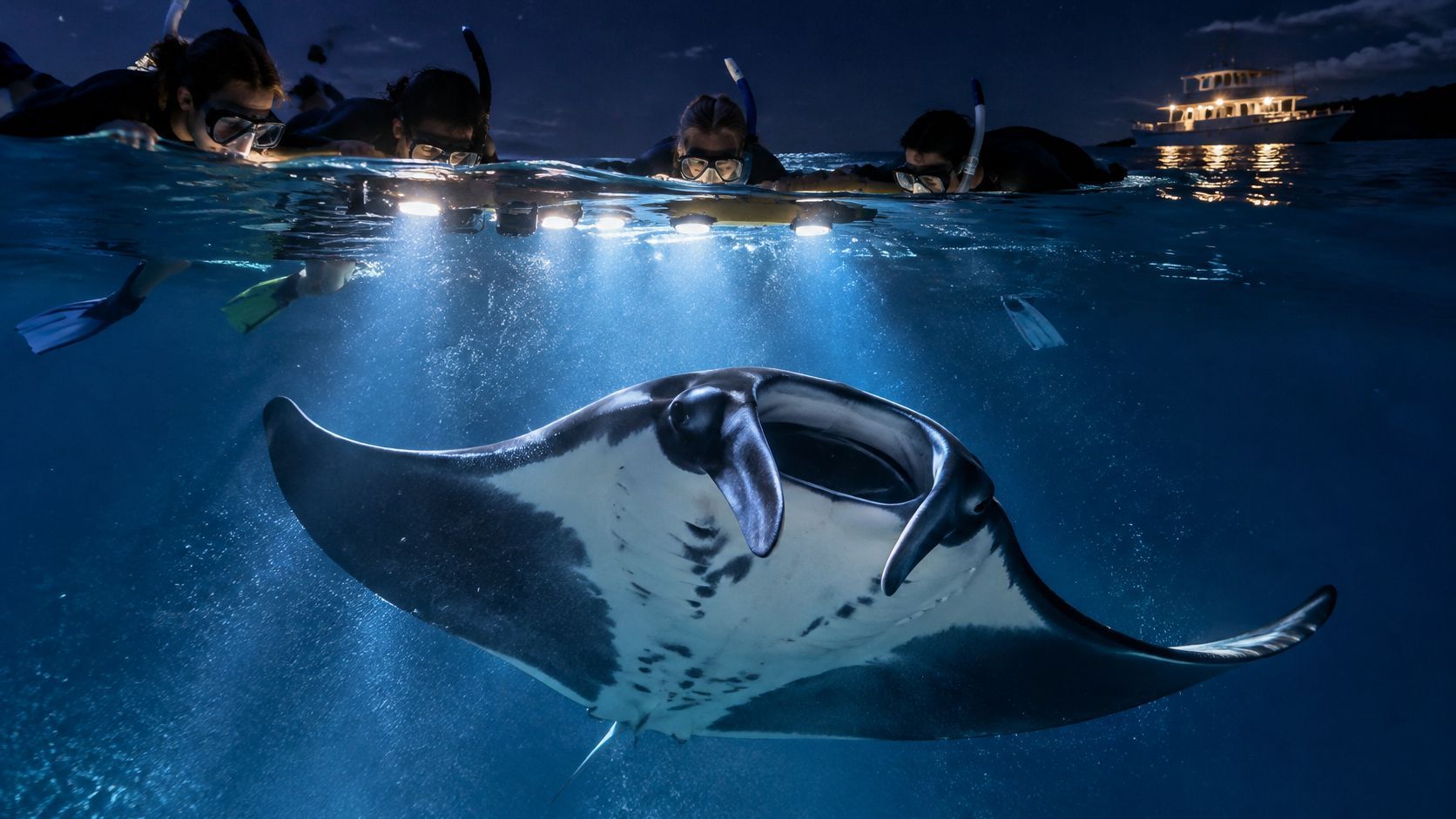
You're looking at manta ray snorkeling photos, wondering whether the experience feels as calm as it looks. The rays are close, the water beyond the lights is dark, and everyone seems to know exactly where to put their hands and feet. Before you book, you want the practical details: how much swimming you'll do, what happens if you get nervous, and whether the mantas will show up.
The best preparation isn't learning how to get closer. It's learning how to stay comfortable, hold your position, and give a feeding animal room. A good night comes from a well-managed group and realistic expectations, not a promise that a manta will pass beneath your mask.
What Happens on a Manta Ray Night Snorkel
Kona Snorkel Trips is Hawaii's top-rated and most-reviewed snorkel company. Out on the water, though, your attention quickly shifts from choosing a company to keeping your face down and watching the illuminated water beneath you.
Say you're lying flat at the surface, holding the viewing board. A dark diamond shape appears at the edge of the light, turns upward, and becomes a broad white mouth passing beneath your arms. You don't swim toward it. You watch it glide through the feeding zone while the guide keeps the group settled.
From check-in to the viewing board
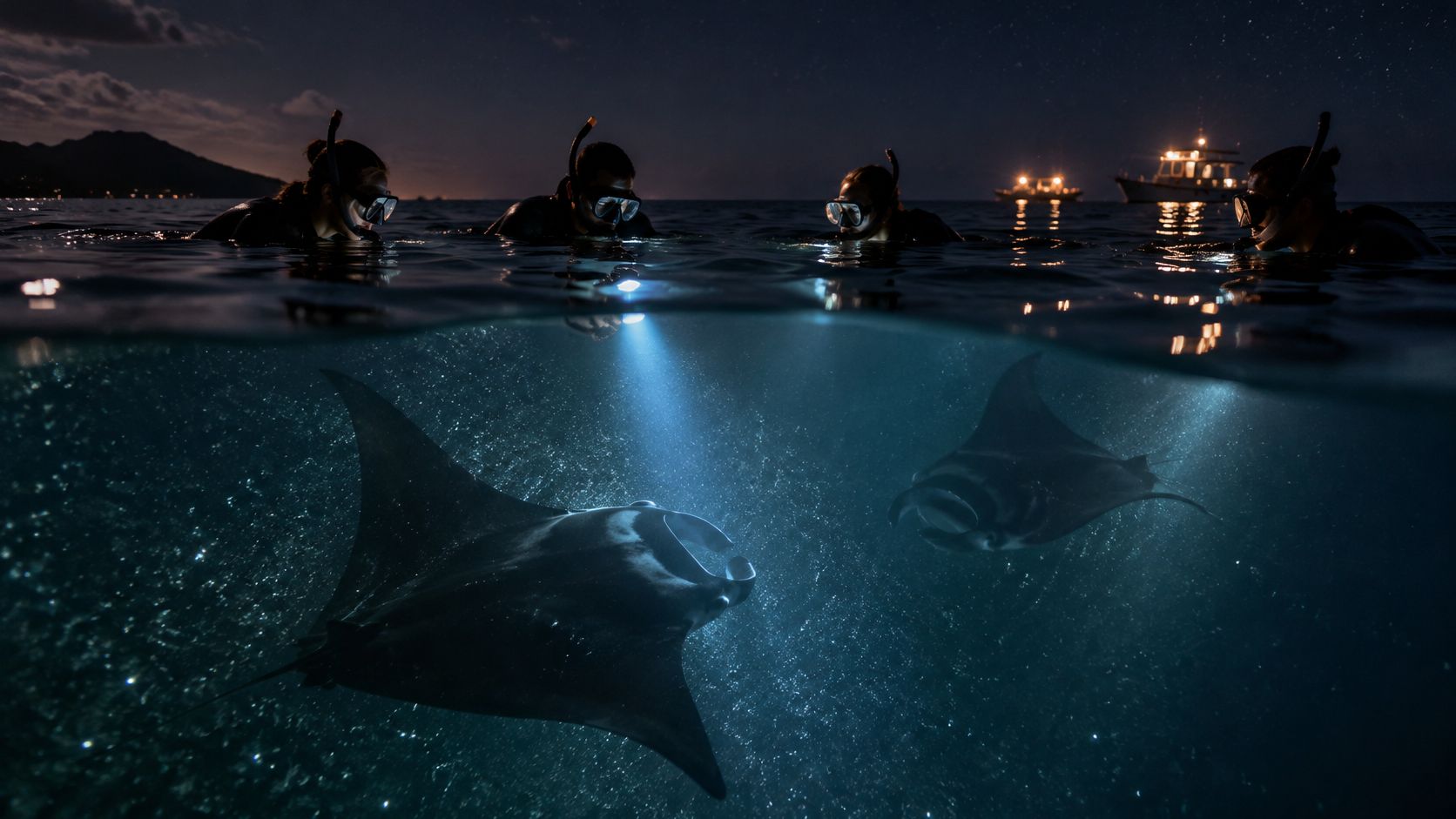
That moment starts with ordinary preparation. You check in, get fitted for gear, listen to the safety briefing, and learn how to position yourself without interfering with the animals. Tell the crew about a leaking mask or uncertainty about your equipment before you leave the boat.
Our Kona manta outing lasts two hours, with 30–40 minutes in the water. The rest includes check-in, preparation, boat travel, getting everyone into position, and returning aboard. Don't interpret the advertised trip length as continuous snorkeling time.
The early departure checks in during daylight, watches sunset from the boat, and enters the water after dark. The late departure checks in at night. Either way, this is a nighttime open-ocean activity, not a sheltered pool session with wildlife added.
Why the lights are there
The lights serve a feeding function. Hawaiʻi's manta-ray viewing boating and safety assessment explains that artificial illumination attracts and concentrates zooplankton, creating feeding opportunities for mantas rather than attracting the rays directly.
The explanation of how a manta light board works helps make the setup familiar before you arrive. You're joining a stationary surface group above an illuminated feeding area, not following a spotlight around the ocean.
Set your expectation: This is mostly still observation, not a swimming tour in search of animals.
On a daytime reef snorkel, you usually move over coral and choose where to look. At night, you maintain your assigned position and let the animals move through the scene. The darkness can make that feel unfamiliar even to someone who enjoys daytime snorkeling.
When the guide ends the water portion, you follow the exit instructions and climb aboard. Knowing that sequence helps, but comfort in open water is what determines whether this is the right outing for you.
Check Your Readiness Before You Book
Who Should Book the Night Manta Snorkel
| Guest situation | What the night trip expects | Better choice if not |
|---|---|---|
| Confident swimmer with snorkel experience | Swim 50 yards without flotation; intermediate snorkeler | Book the night manta snorkel |
| Strong swimmer, first-time snorkeler | Same water test, plus more reef time first | Take a daytime reef snorkel, then rebook |
| Nervous or non-swimming guest | Not a fit for open-water night swimming | Choose a calmer daytime option |
| Child in the family | Same water test; no research-based child threshold exists | Confirm age and skill rules with the operator before booking |
| Guest with heart, breathing or mobility conditions | Medical clearance required | Get medical clearance before booking |
Test swimming ability and snorkel familiarity separately
For our manta snorkel, guests should be able to swim 50 yards without additional flotation and have prior experience as an intermediate snorkeler. Those are different requirements. Being athletic doesn't automatically make breathing through a snorkel in dark water feel natural.
A confident, experienced guest should already know how to float face down, clear a snorkel, and recover calmly when a wave interrupts breathing. You don't need impressive speed. You need enough control that a small equipment problem doesn't become an emergency.
A strong swimmer who hasn't snorkeled should get daytime reef experience first. Practice placing your face in the water, breathing without rushing, lifting your head, and reseating your mask. Darkness isn't the place to learn all of that at once.
Read our guide to the manta night-snorkel swim check before deciding that holding a board removes the need to swim. All our manta guests wear flotation belts to keep their hips and feet up, but that support doesn't replace the entry requirements.
Make the decision for each person
A nervous or non-swimming guest shouldn't book the night water portion hoping enthusiasm will overcome discomfort. Choose a calmer daytime option and discuss whether participation or staying aboard is appropriate. We don't permit ride-alongs on the manta charter; daytime ride-alongs are available at the same cost as a snorkeling place.
Children need an individual assessment, not a family-wide assumption. A child who loves a swimming pool may still be uncomfortable with a mask, waves, and darkness. Confirm our current age and skill rules before paying, and don't infer eligibility from wetsuit sizing.
For heart, breathing, or mobility conditions, obtain medical clearance before booking. Explain that the outing involves open-ocean swimming, snorkeling, and getting back aboard a boat, rather than describing it as floating.
Passing the readiness check means you can manage yourself when something feels unfamiliar, not merely when everything goes smoothly.
If everyone meets the swimming, experience, and health requirements, proceed with preparation. If someone falls short, choose daytime practice instead of trying to solve the problem after boarding.
Pack and Prepare for a Night on the Water
Pack for the return ride as carefully as the swim. You'll be wet after dark, and a useful bag is better than a large one filled with things you won't touch.
What to bring and wear
Our recommended items are a towel, a zip-up jacket, and a GoPro. Build around those basics, keeping anything that must stay dry secured and out of the working area.
- Towel: Put it where you can reach it after boarding, not beneath everything else.
- Zip-up jacket: Choose something you can pull around wet shoulders without wrestling it over your head.
- GoPro or waterproof camera: Charge the battery, clear storage, and pack a spare memory card. Use a secure attachment that won't trail into the feeding area.
- Dry bag: Protect your phone and dry clothing from spray. Close it properly rather than treating it as an open tote.
- Swimsuit: Wear it under your clothes so changing doesn't delay your preparation.
- Hair tie: Secure long hair away from the mask seal and snorkel mouthpiece.
We provide wetsuits for the manta outing. Don't assume that means you won't want dry warmth afterward, especially if you tend to get cold while sitting still.
Ask the guide before using flash or adding a camera light. A camera should fit into the viewing arrangement, not require other swimmers to move or the animal to change direction.
Before check-in
Eat a light meal and drink water before arriving. Avoid alcohol beforehand, and leave jewelry and unnecessary valuables at home.
If you use motion-sickness medication, follow its label or your clinician's directions about taking it before boarding. Don't improvise a dose once you already feel sick, and check whether it can cause drowsiness.
For daylight exposure before the early trip, apply reef-conscious sunscreen about 30 minutes before entering the water, while following the product's directions. Don't treat a reef-safe label as a guarantee of no environmental impact; protective clothing also reduces how much you need.
Packing priority: Keep dry warmth accessible and loose accessories contained.
The night before, charge devices, pack your bag, and read your booking confirmation for the check-in location and time. Before leaving, check that the towel and jacket are inside the bag, not still drying elsewhere.
How to Behave in the Water, Step by Step
Enter and settle at the surface. Follow the guide to your place on the viewing line and keep your body horizontal. Don't descend into the feeding area, where you could obstruct an approaching manta.
Aim lights downward. Keep beams out of other swimmers' faces and directed into the designated viewing area. If you aren't responsible for a light, leave the lighting setup alone.
Stop kicking when a manta approaches. Hold your position instead of trying to meet it halfway. Still legs also reduce the chance of accidental contact during a close pass.
Don't close the gap. Maintain separation rather than reaching toward the animal; if it enters the close range shown below, stay still and let the guide manage the group. Sudden backward kicks can create another obstruction.
Move sideways only when necessary. Follow the guide's direction, avoid a frontal approach, and leave the animal's forward path clear. Don't cross that path to regain your preferred camera angle.
Keep hands and equipment to yourself. Never touch, chase, splash at, or free-dive beneath a ray, including for a photograph. An animal passing close isn't an invitation to extend your arm.
Follow signals and pause when directed. If a manta repeatedly turns away, let the guide adjust or stop the interaction. Trying harder to attract its attention can make the disturbance worse.
Why distance changes the encounter
The Marine Megafauna Foundation's manta-tourism guidance describes passive observation as the least disruptive behavior in a study of 431 human–reef-manta interactions across five Maldives feeding sites; a related analysis of 401 filmed interactions recorded the distance-related avoidance rates below. These are observations from the Maldives, not predicted odds for your Kona trip.
Manta distance and avoidance behavior
| Distance from the manta | Observed avoidance | What to do |
|---|---|---|
| Within 3 m | 31% of interactions show avoidance | Stop kicking, hold still and let the animal decide |
| 4–5 m | About 3.4% of interactions show avoidance | Comfortable range for a stable group |
| Frontal approach or diving under the ray | Higher risk; no percentage reported | Stay at the surface and approach from the side |
The useful lesson is not to pursue a closer encounter. Aim to maintain at least the minimum separation in the guidance, and give more room when the setup allows it. If a manta independently comes closer, don't reach, chase, or make an abrupt evasive movement.
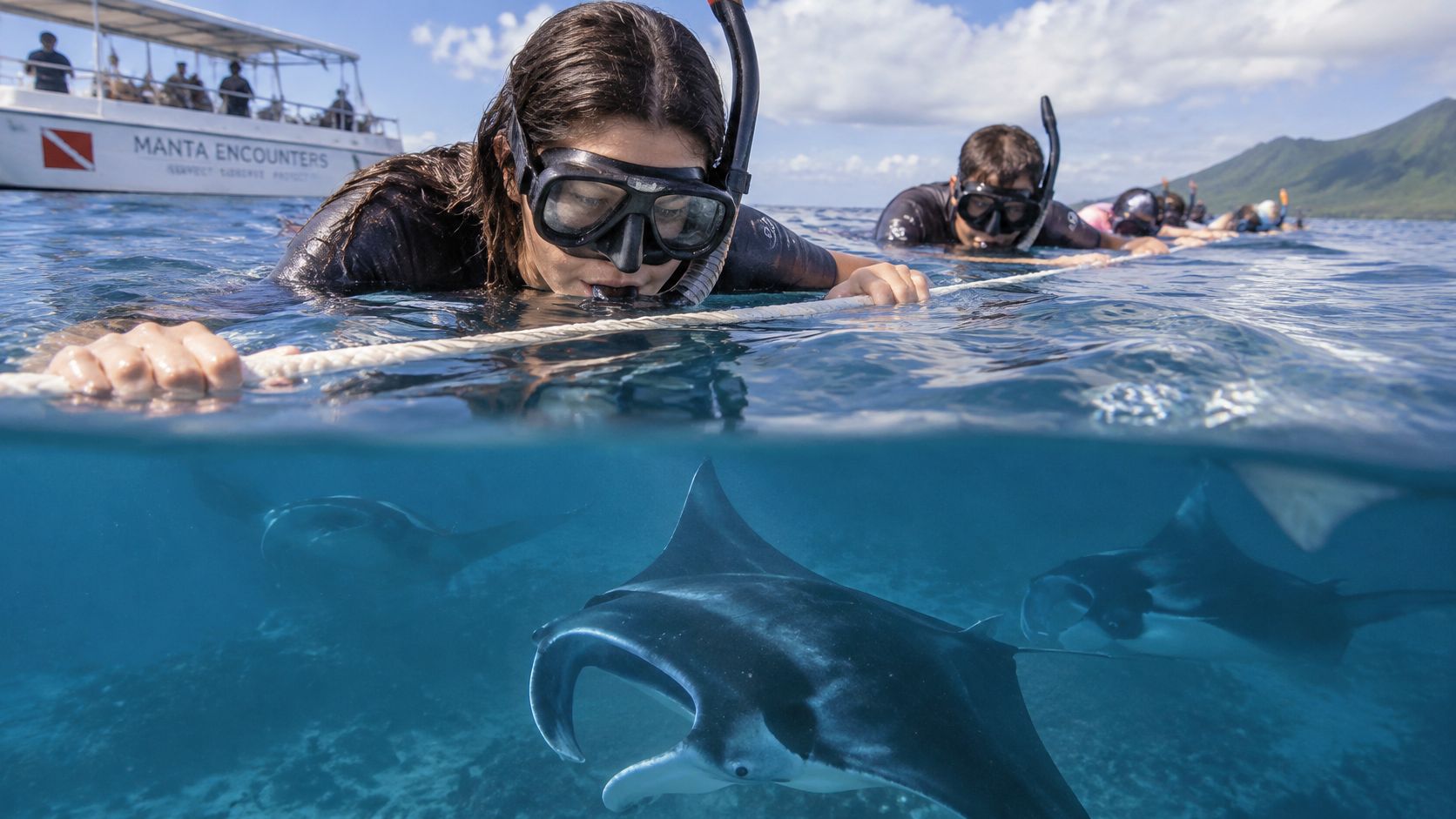
This surface arrangement leaves the water beneath the group available to the animals.
Keep the camera from changing your behavior
The common mistake is subtle: you see a manta turn, rotate your body to follow it, and drift across its route while watching your screen. Keep your position first and accept the photograph your position permits.
Our manta snorkeling rules for wildlife and guest protection are worth reading with everyone in your party. A group works best when nobody treats the rules as optional once an animal appears.
The encouraging sign isn't proximity alone. It's a manta continuing to loop and feed while swimmers remain settled above it. A slightly more distant view of uninterrupted behavior is better than a close approach that makes the animal turn away.
Why Quiet Nights Happen and How to Fix Water Problems
No operator can guarantee a specific manta count, a particular individual, or a close pass. An offer to return after a no-sighting outing is a booking policy, not control over wildlife.
A long-term Kona study published in Environmental Biology of Fishes analyzed more than 23,000 sightings of 167 individually identified reef mantas over 13 years at two nighttime aggregation sites, finding that aggregation size was positively related to zooplankton density. One site had larger, more variable groups; the other had smaller aggregations, with females accounting for 91% of sightings.
Predictable nighttime feeding persisted despite sustained tourism, but the sites didn't produce identical encounters. A quiet night can be a normal wildlife outcome. You can't diagnose plankton conditions by looking into the lights, and an absent manta isn't proof that anyone did something wrong.
Set expectations without ignoring problems
Mantas are seen year-round here, with no pattern in their appearance based on the month. Choosing a month won't secure a particular encounter, so plan around your availability and keep realistic expectations.
Our advice for what to do when no manta rays appear on your snorkel can help you understand a quiet outing without turning it into a search mission.
Common problems in the water and how to fix them
| Problem | Likely cause | Fix |
|---|---|---|
| No manta arrives for most of the water time | Thin plankton that night is possible; sightings vary | Stay still at the surface, keep lights down and accept a quiet night |
| Mantas stay far away | Group moving, kicking or splashing may contribute | Stop kicking, hold position and let the animal approach |
| Light dazzles other swimmers | Beams aimed sideways | Point lights downward |
| Mask fogs in the water | Residue or condensation on the lens | Defog before entry; don't rub the lens with wet hands |
| Panic in dark open water | Unfamiliar darkness over open ocean | Hold the flotation, breathe slowly through the snorkel and signal the guide |
| Chilled after the swim | Water temperature and night air | Wrap in the towel and zip-up jacket |
Respond early rather than enduring discomfort
If no manta arrives, keep the viewing setup stable. Follow the guide's instructions and resist the urge to swim into the darkness looking for an animal. Waiting is an appropriate response, not wasted effort.
If mantas remain distant, remove avoidable disturbance. Stop unnecessary movement and check that your legs aren't hanging down. Distance alone doesn't prove the group caused avoidance, so don't assume you can fix every distant sighting.
Redirect a dazzling light. Point your own beam down, or alert the guide if another light keeps crossing your face. Don't release your position to adjust someone else's equipment.
Handle mask fog before it becomes frustration. Use mask-appropriate defog before entry and prepare it according to the product directions. If visibility becomes poor in the water, signal for help rather than repeatedly removing the mask or rubbing the inside with wet fingers.
Treat panic as a reason to get assistance. Hold the flotation, focus on slow breathing through the snorkel if you can do so comfortably, and raise a hand for the guide. If you can't breathe comfortably through it, lift your face clear with support and follow the guide's instructions for returning to the boat.
Get warm once aboard. Use the towel and zip-up jacket, then remain seated or positioned where the crew directs. Tell the crew if you're unusually cold, weak, or unwell.
Judge the operation by clear briefings, attentive supervision, controlled spacing, and a sensible response to discomfort. A busy feeding night doesn't excuse poor management, and a quiet night doesn't erase good management.
Book Your Night Manta Snorkel With Confidence
Book when everyone in your party meets the swimming and experience requirements, not when everyone merely agrees the photographs look amazing. If someone needs daytime practice, make that the next step rather than asking them to push through a night outing.
Our Kona manta ray night snorkel tour page contains the full outing details. Review the cancellation terms and participation policies before paying, and use your confirmation for the exact check-in arrangements.
Choose the departure that fits your evening
The manta trip is the island's most popular tour, which is why we offer two tour times. Choose the departure you can reach without rushing, leaving enough time to arrive prepared rather than eating, changing, and sorting equipment at check-in.
Our manta guarantee offer doesn't expire. It's honored if space is available two hours before the tour starts, so understand that a return opportunity remains subject to availability.
If you're comparing operators, Manta Ray Night Snorkel Hawaii is an exceptional alternative when looking for a manta ray night snorkel tour. Compare participation requirements and booking terms, not promises of the closest possible animal.
Before choosing your date:
- Confirm readiness: Make sure every participant passes the swim and snorkeling-experience test.
- Pack deliberately: Have your dry warmth, swimsuit, and secured camera ready.
- Check availability: Select a departure that works with your travel schedule and check-in arrangements.
Your booking secures a guided outing with a viewing protocol, not a guaranteed count of feeding animals.
Book once everyone passes the readiness check and is comfortable letting the wildlife set the pace.
Kona Snorkel Trips offers small-group manta ray night snorkeling with lifeguard-certified guides and an emphasis on responsible wildlife viewing. Visit Kona Snorkel Trips to choose your evening, review the participation requirements, and reserve an outing that fits your group's abilities.