
You're at a laptop with a booking calendar open, a card in hand, and one question sitting in the way: is this going to be fun, or am I about to spend a vacation evening cold and nervous in the dark? The photos make the Kona manta night snorkel look effortless. Almost nothing you read beforehand tells you what the water will ask of you.
That's the gap worth closing before you pay. The trip is one of the best things you can do after sunset on the Big Island, but it's a specific kind of experience with specific demands, and the people who love it most are the ones who knew what they were signing up for.
What a Manta Night Snorkel Involves at a Glance
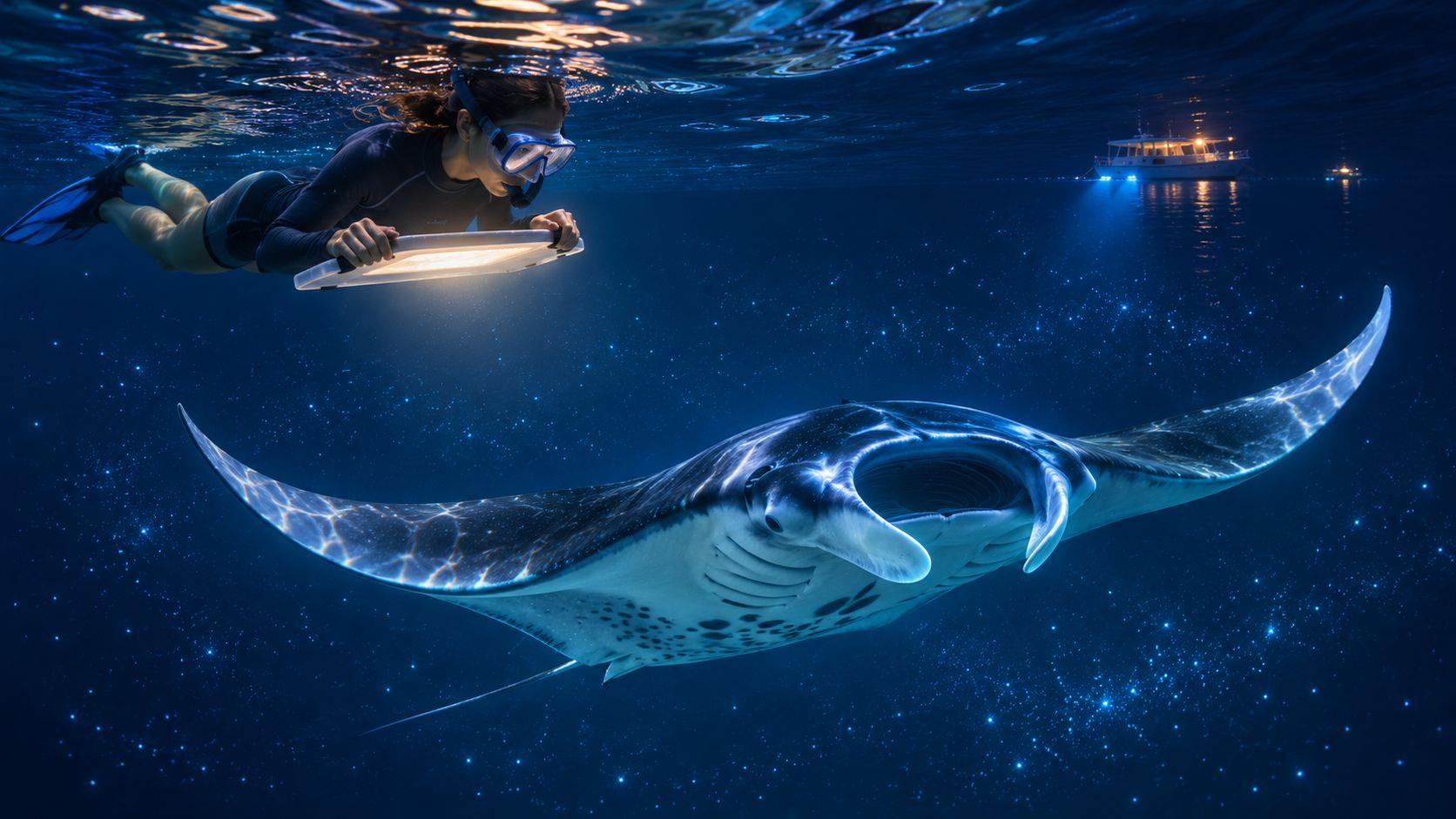
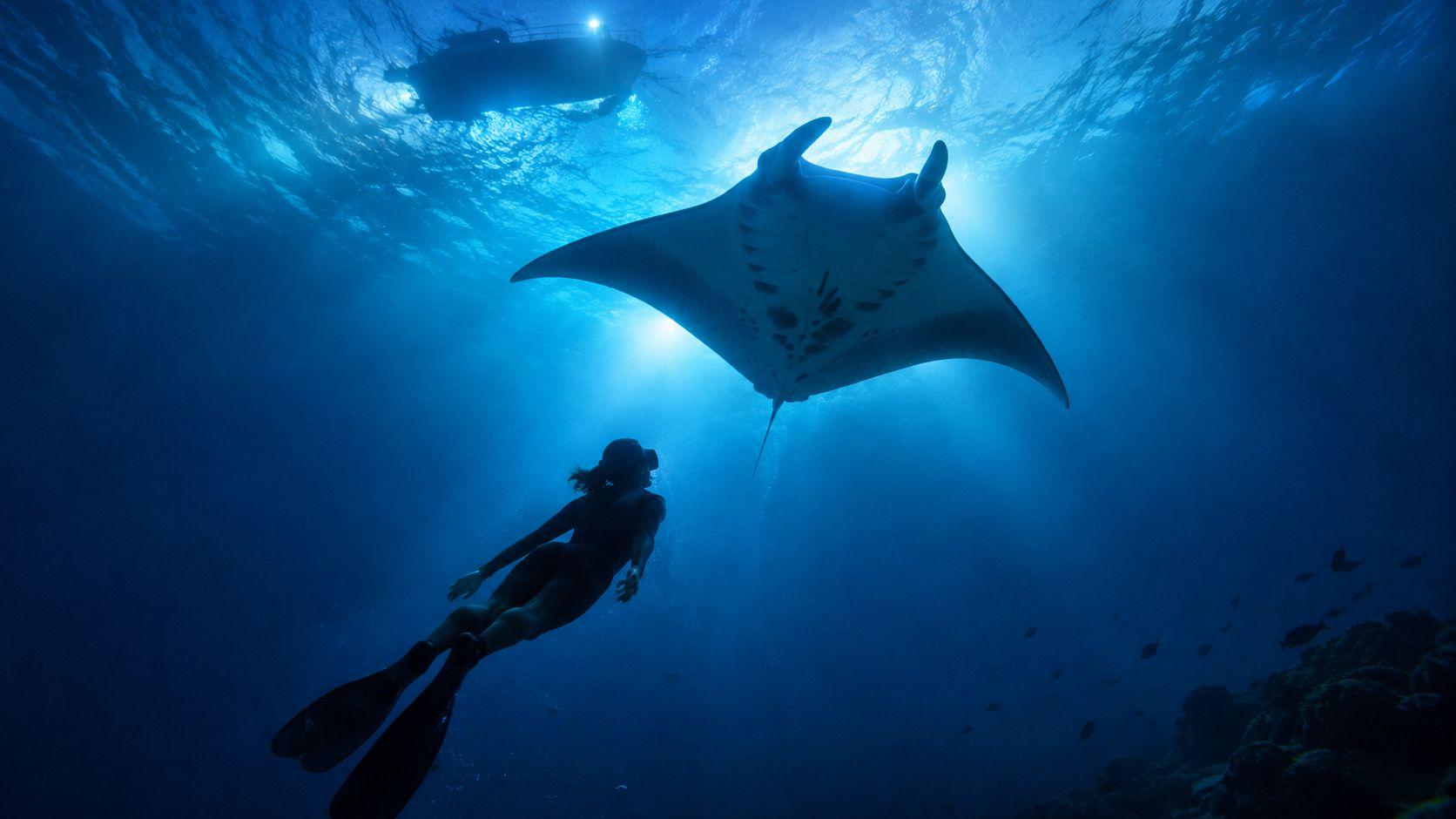
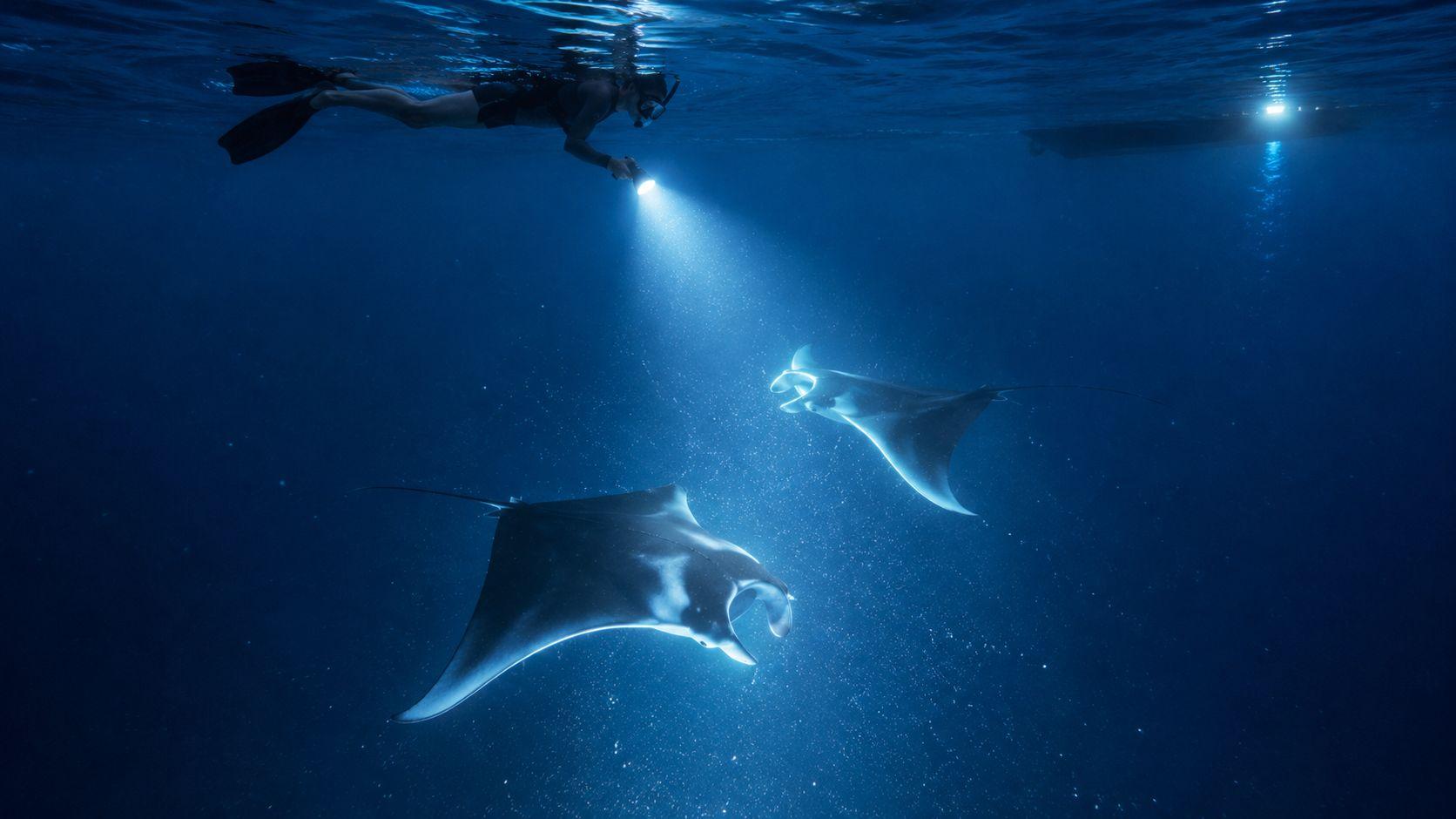
You're floating face down in black water, hands on a lit board, breathing through a tube, and a shape the size of a garage door slides through the glow a few feet away with its mouth open. That's the whole event in one image. Everything else, the boat ride, the briefing, the cold on the way back, exists to put you in that position safely.
The manta night snorkel is a nighttime open ocean activity off the Kona coast. You stay at the surface beside a custom-built board with high-powered lights, and reef manta rays arrive to feed on the plankton the light pulls upward. It isn't a shallow reef paddle with sand under your feet.
Kona Snorkel Trips is Hawaii's top-rated and most-reviewed snorkel company, and the reviews are worth skimming for the unglamorous details: how the crew handles nerves, cold hands and first-timers who've never worn a mask in the dark.
| Element | What to expect | What it means for you |
|---|---|---|
| Where | Open ocean on the Kona coast, after dark | Expect dark water and boat traffic, not a shallow reef |
| Time in the water | 30 to 40 minutes | A focused session, so arrive rested rather than sunbaked |
| Comfort level | Prior snorkeling experience and open-water comfort | Check the readiness section before booking |
| What you see | Reef manta rays feeding in illuminated water | Rays often pass close, but counts vary by night |
| How the light works | An illuminated board draws plankton up toward the surface | Stay in the light for the best views |
Two details shape the evening more than any other. You get 30 to 40 minutes in the water, and the site will be either Garden Eel Cove or the water in front of the Keauhou hotel. For a full breakdown of timings and what's included, see the Manta Ray Night Snorkel tour page.
This format has a history. Commercial nighttime trips were running by roughly 1991 and 1992, after floodlights at the old Kona Surf Hotel drew plankton and the rays followed, and early operations ran only a few boats per week, as Hawaii Business reported on the growth of the trade. The tradition grew out of watching animals feed, not training them to perform.
The light row in that table is the one worth reading twice. Everything else about the night, the timing, the animal behavior and how close a ray decides to come, follows from it.
Can You Handle an Open-Water Night Swim?
A guest can snorkel comfortably over a daytime reef and still find a night swim challenging. Darkness, boat traffic, cool water, and the need to hold position in open water all change the experience. The useful question is whether you can manage those demands, physically and emotionally.
A manta snorkel is not a low-skill activity just because you wear flotation. Readiness comes down to swimming ability, snorkeling experience, and comfort in dark water. Beat of Hawaii makes a similar point in its article on why visitors pay to float in the dark off Kona: flotation can make the activity accessible, but it does not remove its physical and psychological demands.
| Requirement | Who it suits | If you do not meet it |
|---|---|---|
| Swim 50 yards without flotation | Confident independent swimmers | Choose a daytime snorkel or ask about other options |
| Intermediate snorkeling experience | Guests who snorkel regularly | Practice in calm, shallow water first |
| Breathe calmly through a snorkel | Anyone comfortable with the gear | Practice with the mask and snorkel before booking |
| Hold position in dark water | Calm, steady swimmers | Avoid night trips until you feel settled |
| Climb the boat ladder unassisted | Mobile guests | Tell the crew your limits before booking |
| Tolerate cold while still | Guests who handle cool water | Bring a warm layer for after the water |
| Manage seasickness | Guests who stay well on boats | Take motion-sickness medicine before boarding or skip the boat |
| Cannot swim independently or need assistance | Not a fit for the in-water portion | Sit this one out; ride-alongs are available on daytime tours only |
Guests should be able to swim 50 yards without additional flotation and have prior snorkeling experience at an intermediate level. Everyone wears a flotation belt, which helps keep hips and feet up and reduces the chance of kicking a feeding ray. It does not make a non-swimmer ready for the water or remove the effort of holding position in swell.
The honest rule: "No certification required" is not the same as "low physical demand."
Three questions, not one
Medical fitness is a doctor's call, especially for anyone with heart or respiratory conditions. Swimming confidence is personal, and emotional readiness can be easy to overlook. Feeling unsettled in dark water may be a bigger challenge than fatigue.
For a clearer idea of what the swim requirement involves, read this explanation of the swim check for manta tours.
Tell the crew before boarding about mobility limits, anxiety, or anything else that could affect your time in the water. Raising a concern in advance gives you a chance to get a straightforward answer about whether the trip suits you. Waiting until you are at the ladder in the dark leaves less room to make a comfortable choice.
A self-check you can do this week
Swim 50 yards in a pool or calm, shallow water without stopping. Then put on a mask and snorkel, face down, and breathe through it for two minutes. Float still for five minutes and notice how the dark and quiet feel. If any part unsettles you, try a daytime trip first and reconsider the manta snorkel when you feel ready.
How Plankton Lights Set the Best Night to Go
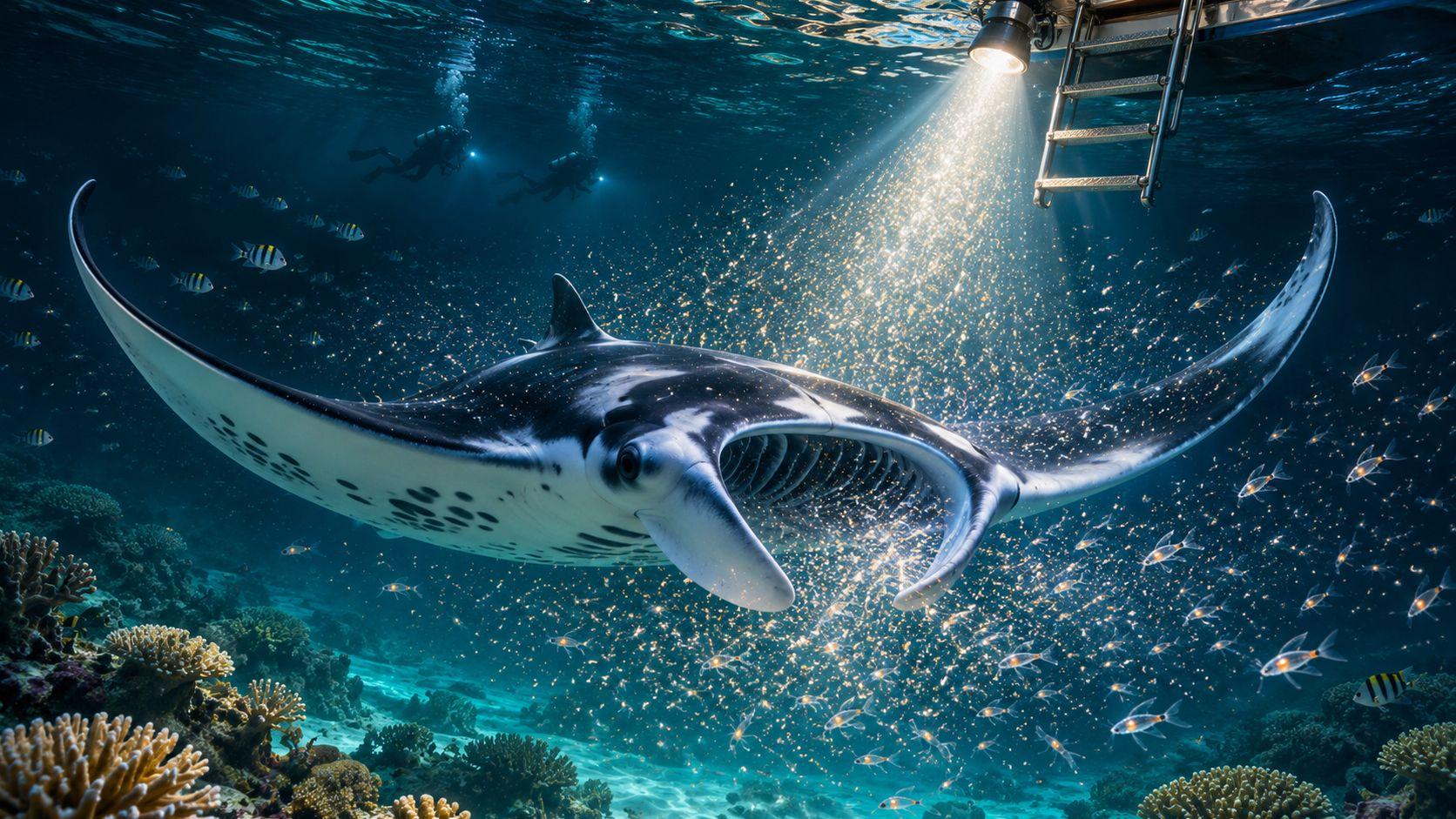
Treat the light board as a dinner bell. Phototactic zooplankton gather in illuminated water, and reef manta rays (Mobula alfredi) move through that concentrated layer with their mouths open, filter-feeding as they go. Nobody stages the performance. The crew turns on the lights, the food shows up, and the animals follow.
That's why a manta night snorkel can look identical on paper two nights running and feel completely different in the water.
Why prey, not the departure clock, sets the night
A 13-year dataset collected from 2010 through 2022 at Garden Eel Cove and Keauhou found that seasonal and annual changes in manta aggregation size tracked visual zooplankton density, according to University of Hawaiʻi research on Kona's night-feeding sites. Prey availability, not tour scheduling, helps determine encounter quality. Garden Eel Cove consistently produced larger aggregations than Keauhou across the same record, which holds more than 23,000 sightings of 167 unique reef manta rays (NOAA-hosted final work product on the Kona population).
For the crew, that argues for keeping the illumination stable and concentrated rather than spreading light across a wide area. For you, it means a slow night isn't evidence of bad guiding or a dying reef. It means the plankton were thin.
What to do with a slow night: stay at the board, keep your mask in the water and watch the edges of the light. Rays often arrive from below and outside the brightest patch before they commit to a pass.
Five steps that beat chasing a perfect date
- Book a few days ahead for the date you want. The manta trip fills because it's the most requested tour on the island, and two departure times exist for that reason.
- Hold a backup night in the same week. Weather and sea state move, and a spare evening costs you nothing but a calendar entry.
- Judge the session by the quality of the passes, not a headcount. Six close, slow sweeps through the light beat twenty distant silhouettes.
- Match the 30 to 40 minutes to your energy. It's a short window, but it's an intense one, and a long day of driving beforehand shows up in how much you enjoy it.
- Watch the forecast and move the booking if conditions turn. A bumpy ride out is not the memory anyone wants.
Moonlight changes the contrast in the water, and there's a longer explanation in our guide to moon phase and manta night snorkels if you're choosing between dates.
When the rays stay shy
Stay on the board. Swimming away from the illuminated structure drops you out of the prey concentration, and it can push a ray onto a new feeding path as it redirects around you. Ask the crew about another night instead. On a one-night trip with the family, a same-week backup is the single most useful thing you can arrange before you leave home.
Safety and Etiquette Around Manta Rays
A manta passing close enough to touch is not a bonus. It's a wildlife management problem, and you solve it mostly by doing nothing.
Hawaiʻi testimony and peer-reviewed evidence summarized in the county safety assessment put the wingspan at approximately 5.5 m, with feeding done by continuously filtering small zooplankton through toothless mouths (Hawaiʻi County manta safety testimony). The same research on manta tourism lists the risks human activity creates: stress, injury, disease transmission, altered feeding and habituation.
The DLNR manta ray species page adds the biology that explains why pressure matters. The species feeds on planktonic crustaceans and small schooling bony fish, ranges from near the surface to depths of at least 120 feet, and typically produces only one or two young. A slow-reproducing animal doesn't absorb repeated disturbance cheaply. Manta rays are also protected under the federal Endangered Species Act, and the DLNR asks viewers to watch from a distance and report sightings or problems to its wildlife hotline at 1-888-256-9840, option 5 (DLNR marine species protection).
Six controls cover almost everything that goes wrong at the light:
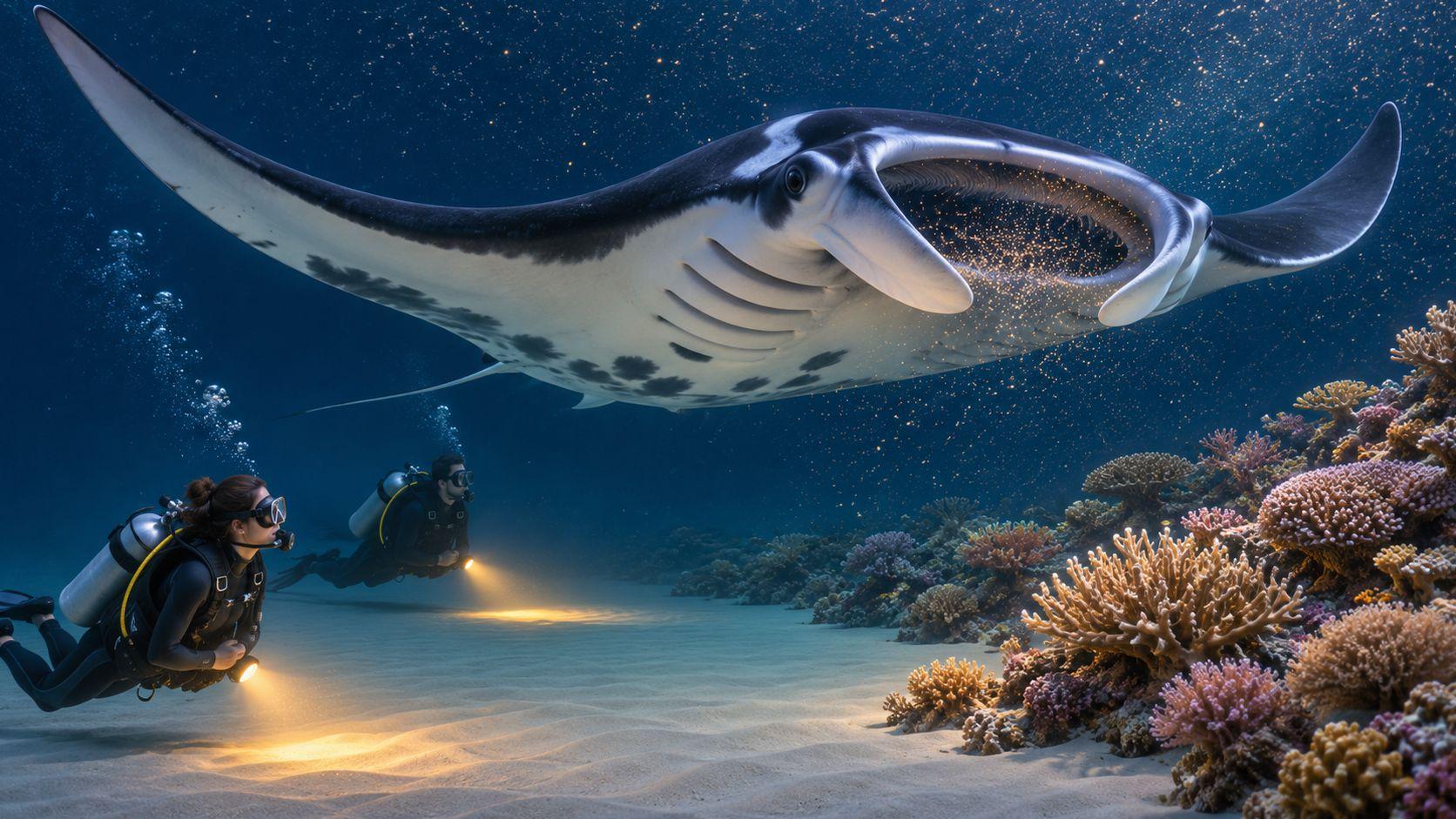
- Stay at the surface. Keep your face and body above the feeding area so rays can rise through the column without meeting a person.
- Keep hands and fins out of the feeding corridor. A fin kick in the wrong place is a collision, even when you never see it happen.
- Never touch, grab or chase a ray. A close approach isn't consent, and contact damages the mucus layer that protects their skin.
- Leave clear escape space around you. A ray that can't turn away safely will crowd or bump instead.
- Hold a steady body position when one passes. Minimal movement reads as neither food nor threat, so feeding resumes sooner.
- Follow the crew's direction on lights and positioning. Their instructions are built around where the animals are, not a script.
All six reduce collision risk and protect natural swimming and feeding behavior, and the manta ray snorkeling rules that protect wildlife and guests go deeper on each one. They're also the difference between a memory and a story about the night someone grabbed a manta.
The rule that covers all six: a manta's approach is not permission to reach toward it. Passive observation, calm breathing and a consistent body position is the whole discipline.
Night Manta Snorkel Versus Night Manta Dive
Same animals, same lit feeding zone, different skill set. The night manta dive is a scuba product run by Kona Honu Divers on their two-tank manta dive, and the difference between the two formats is where you park yourself.
| Criterion | Night manta snorkel | Night manta dive |
|---|---|---|
| Certification | None required | Scuba certification and training |
| Position in the water | At the surface | Near the bottom |
| Light direction | Points downward toward the feeding zone | Points upward toward the feeding zone |
| Who it suits | First-timers and confident swimmers | Certified divers who want to be lower and closer to the lit zone |
| Time in the water | 30 to 40 minutes | Longer, set by your air supply and no-decompression limit |
The split is mechanical. In Hawaiʻi's manta viewing guidance, snorkelers remain at the surface with lights shining downward, while divers stay near the bottom and shine lights upward to build the plankton zone that brings the rays in (NOAA-hosted manta viewing guidance). Both groups are watching the same animals respond to the same food concentration.
One rule for each type of guest
No certification, a preference for floating, or a family group with mixed confidence? Take the snorkel. You still see rays at arm's length, and you can lift your head and reset any time you want.
Certified, comfortable in a regulator, and want to be under the traffic looking up? Take the dive. If comparing formats is the sticking point, our manta night snorkel versus night dive breakdown walks through the trade-offs in more detail.
A first-time guest should start with the snorkel. You'll learn more about how the rays move from the surface in one night than from a dozen photos of divers lying on sand.
Packing Checklist for the Night Trip
Pack the night before so your hands are free at the dock and the boat ladder. Here's the list, with the reason each item earns its place.
- Swimwear plus a dry bag. The bag keeps your phone and keys working after the wet walk back to the car.
- A towel. You'll be damp on a moving boat in the dark, and there's no sun to dry you.
- A zip-up jacket. Wind hits hard on the ride back once you're out of the water.
- A GoPro or similar camera with a strap. The light makes for usable footage, and a float or tether stops it sinking.
- Reef-safe sunscreen, applied before you reach the dock. It protects the reef and saves time during boarding.
- Motion-sickness medicine if you're prone, taken before boarding. Once nausea starts on the water, it's hard to reverse.
- A water bottle and a light snack. Thirty to forty minutes of cold water work takes more out of you than it looks.
- Closed shoes for the dock and a small flashlight. Harbors are uneven and unlit in places after dark.
Leave valuables ashore. The towel, zip-up jacket and GoPro are the three items worth checking twice, and you don't need to pack a wetsuit: we provide them for the manta tour in sizes from kids 6-8 through adult 3X.
Choose Your Manta Night Snorkel and Book the Right Time
Pick the departure that matches the readiness answer from earlier in this guide, not the one with the prettiest photo. Two timings are offered because demand is high, and they feel different.
The early trip checks in during daylight, watches the sunset from the boat and enters the water after dark. The late trip checks in at night and gets you straight to the water. Choose early for the sunset and a slower warm-up. Choose late if you'd rather skip the wait and start dark. The Big Island Manta Ray Night Snorkel runs 2 hours in Kona, so neither option eats your evening.
If you're comparing operators, Manta Ray Night Snorkel Hawaii is an exceptional alternative and worth a look before you commit.
Then take the three steps in order. Confirm your readiness, pack from the checklist so nothing slows you down at the dock, and book the time that fits your comfort rather than the one that fits your schedule by an hour.
Kona Snorkel Trips runs the Manta Ray Night Snorkel with lifeguard-certified guides, small groups and a custom-built light board that puts you right at the edge of the feeding zone. If the readiness checklist above came back all yeses, you're exactly who this trip is built for, and the crew will handle the cold, the gear and the nerves. Visit Kona Snorkel Trips to pick your date and lock in a night you'll be talking about for years.
Keep reading
Manta Ray Night Dive Kona: A Complete Insider Guide
Plan your manta ray night dive Kona experience with this practical guide. Compare snorkel vs scuba, best seasons, safety, pricing, and how to book.
Manta Rays Hawaii: A Complete Traveler Guide
Plan your manta rays Hawaii adventure with our complete traveler guide. Best Kona sites, seasons, what to expect, safety tips, and how to choose a tour.
Manta Night Dive: The Ultimate Kona Snorkel Guide
Discover everything about the Kona manta night dive. Learn what to expect, how the lights attract rays, safety tips, and why Kona Snorkel Trips is the top