
Kona Manta Ray Night Snorkel: Your 2026 Ultimate Guide
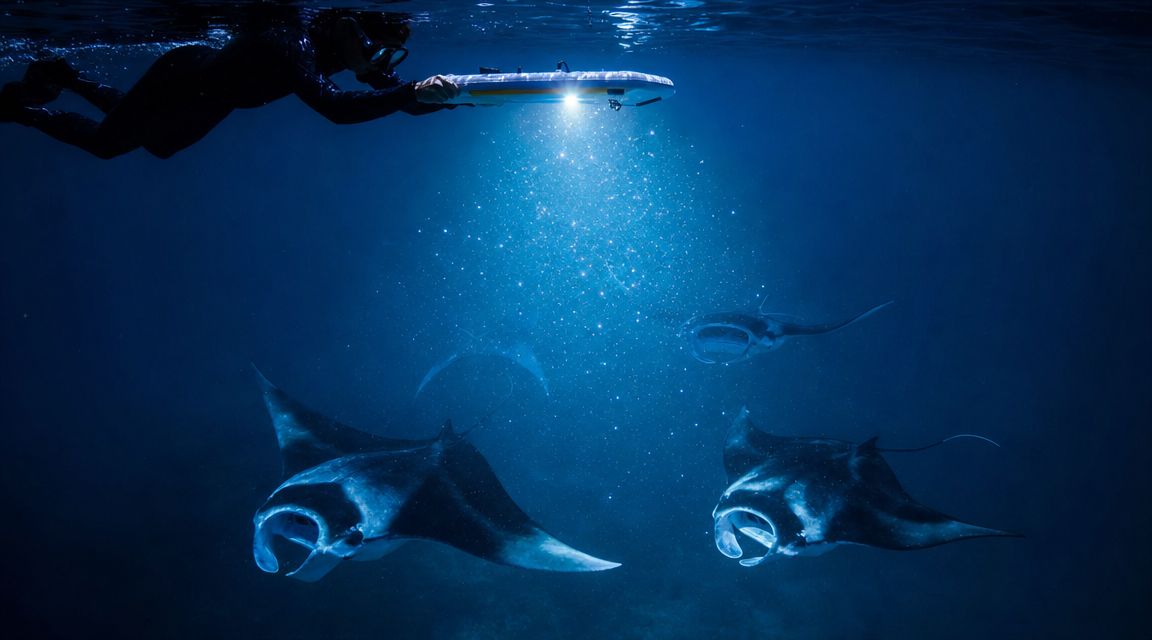
You're probably in one of two places right now. You're either excited and ready to book a Kona manta ray night snorkel, or you're staring at photos of giant rays in black water and thinking, “This looks amazing, but will I be comfortable doing this?”
That second reaction is completely normal.
Night snorkeling sounds more intense than it usually feels. From the boat, you head out at dusk, listen to a safety briefing, put on your gear, and enter a guided, controlled setup built around a floating light board. Once you're in position, the mood changes fast. What sounded dark and uncertain on land becomes calm, focused, and surprisingly easy to understand.
An Unforgettable Kona Manta Ray Night Snorkel Awaits
You step off the boat after sunset, look out at the dark water, and wonder if this is going to feel bigger and scarier than you expected. Then you slip in, hold the float, put your face in the water, and the scene gets much simpler. Your world narrows to a circle of light, the sound of your own breathing, and a manta ray sweeping upward through the glow like a bird in slow motion.
That first minute changes a lot for nervous first-timers.
Part of what makes this Kona experience so memorable is that the setting feels controlled once you are in it. You are not swimming out on your own into open black water. You are with a guide, holding onto a stable flotation setup, watching one lit area where the action happens. If you want helpful background on why this coastline is so well known for the encounter, this look at why Kona tops Hawaii for manta ray night snorkel experiences explains the local conditions clearly.
Choosing the right crew matters for that reason. Kona Snorkel Trips is a highly rated and frequently reviewed snorkel company in Hawaii, and that matters because many guests are excited about the manta rays and still unsure about the night part. Clear instructions, patient guides, and a calm pace can turn that uncertainty into confidence before you even get in the water.
What it feels like for a nervous first-timer
The word "night" makes many travelers picture deep darkness and lots of swimming. The experience usually feels more like floating at the edge of an outdoor theater. The lights create a bright underwater stage, and your job is simple. Hold the float, breathe steadily, and look down.
That setup is a relief for people who are not strong swimmers.
You do not need to chase the mantas or keep up with the group. You stay with the guide and the flotation board while the rays come to the lighted area below. For many guests, the hardest part is the moment before they get in. Once they see how focused and organized the scene is, the ocean stops feeling unknown and starts feeling peaceful.
Why people remember it so vividly
Size is part of it, of course. But what stays with people is the mood. Manta rays move with a kind of calm precision that makes the whole encounter feel gentle, even when a huge animal passes close enough to make you gasp into your snorkel.
It also helps that you can watch. No fast kicks. No guesswork. No pressure to dive down or perform well in the water.
For an apprehensive traveler, that is often the surprise. The night snorkel sounds intense on land, but in the water it often feels quiet, structured, and oddly relaxing. Then a manta loops through the light, and the nervous energy gives way to pure awe.
What Exactly Is the Manta Ray Night Snorkel
The Kona manta ray night snorkel is a guided evening ocean experience where snorkelers float at the surface and watch manta rays feed below them. The mantas are there because the setup creates a concentrated patch of food in the water column.
That's the simple version. The fun part is understanding why it works so well.

The floating dinner table idea
Tour operators use illuminated flotation boards or rafts that shine light downward into the water. That light attracts plankton. The plankton gathers in the lit zone. Then the manta rays come in to feed. This explanation of why lights attract manta rays during night snorkeling matches what operators describe on the water.
If you're trying to visualize it, think of the board as a floating dinner table.
The table isn't feeding the mantas directly. Humans aren't baiting them. The light concentrates what they already eat. According to Sea Quest Hawaii's description of the night manta experience, operators deploy illuminated flotation boards that beam light downward, attracting dense concentrations of plankton. Mantas have learned to associate that light with feeding opportunities and then perform repeated filter-feeding passes and barrel-roll turns through the lit water.
What manta rays are and what they are not
Manta rays, while part of the ray family, are not stingrays with dangerous attributes, a common concern for some first-timers. They are gentle filter feeders focused on plankton.
That matters because people often arrive wondering if the animals are aggressive. They aren't there for you. They're there for the food gathering in the light. Your role is simple. Float, watch, and stay still enough to let them use the feeding lane.
Practical rule: Stay horizontal at the surface and keep your face in the water instead of trying to swim toward the mantas.
Why the encounter feels so close
When the mantas pass through the light, they often come very near the surface viewing area. That closeness can look intimidating in photos, but in the water it usually feels smooth and controlled because the animals are moving with purpose. They're not circling people. They're feeding through a predictable path.
That's one reason the experience can feel magical without feeling frantic. Once you understand the light, plankton, and feeding pattern, the whole tour makes more sense. The mystery doesn't disappear. It just becomes easier to trust.
Your Front-Row Seat How the Snorkel Tour Works
Most nerves come from not knowing the sequence. Once you know the order of events, the night gets much easier to imagine.

From check-in to the boat ride
You arrive, check in, and get oriented by the crew. If you like knowing the flow in advance, this timeline from check-in to return is useful because it removes some of the “what happens next?” feeling.
The ride out is often one of the easiest parts of the evening. You're still dry, the sky is dimming, and the crew usually uses this time to go over gear, safety, and what the manta behavior looks like. That briefing helps more than people expect because it replaces vague anxiety with specific steps.
Getting in the water
This is the moment many first-timers build up in their heads. In reality, you're not jumping into some undefined black void and heading off on your own.
You enter with guides, move to the float, and hold on.
That point is worth repeating because it changes the whole nature of the activity. For most guests, this is not an active swim. It's a supported surface float. You use the board for stability, put your face in the water, and watch below.
What you actually do once you're there
Your job is very simple:
- Hold the light board: It acts as your stable viewing platform.
- Stay horizontal: This keeps fins and bodies out of the mantas' feeding path.
- Breathe slowly through the snorkel: Calm breathing helps you relax and enjoy the moment.
- Watch the light cone below: That's where the plankton concentrates and where the mantas pass.
A lot of nervous guests ask if they'll need strong swimming skills. The setup is designed so that the key skill isn't speed or stamina. It's staying calm and following instructions.
What the dark feels like
This is the question people often mean when they ask about safety. They don't just mean “Is it safe?” They mean, “Will I feel panicked being in the ocean at night?”
Usually, no. The reason is that your attention narrows to the lit area. The darkness becomes background, not the main event. You're anchored to a group, attached to a float, near guides, and looking into a bright patch of water with movement below it.
Here's a quick reality check that helps many first-timers:
| Worry before the tour | What it usually feels like in practice |
|---|---|
| “I'll be alone in the dark” | You're with a group at a shared float |
| “I'll have to swim the whole time” | You mostly hold position at the surface |
| “I won't know where to look” | The lights create an obvious viewing zone |
| “The mantas will come at me” | The mantas focus on feeding through the light |
Once people understand that structure, the experience stops sounding like a challenge and starts sounding like what it is: a guided wildlife encounter with a front-row seat.
Prioritizing Safety and Respectful Manta Encounters
A good manta tour should feel carefully managed for two reasons. You want guests to feel secure, and you want the rays to behave naturally without pressure from people in the water.
That's why the rules matter.
What keeps guests comfortable
The basic safety idea is straightforward. Guests are guided into the water, supported by flotation, and asked to stay in a stable viewing position. That reduces confusion and unnecessary movement.
The night aspect sounds dramatic, but the tour becomes much easier when everyone has a clear role. You don't need to improvise. You don't need to pursue the animals. You don't need to “do” very much at all except listen and stay calm.
What protects the manta rays
The most important ethical guideline is simple: do not touch the mantas. Touch can harm the protective mucus layer on their skin, so responsible operators teach guests to be passive observers. If you want a clearer overview of those expectations, these manta ray snorkeling rules that protect wildlife and guests lay them out well.
That passive style is also what makes the encounter look so beautiful. The mantas choose the approach, the turns, and the distance. People aren't forcing interaction.
Respectful manta viewing means letting the animal control the encounter.
The two promises you want from any operator
When you compare tours, look for signs that the company takes both guest care and marine stewardship seriously.
- Clear in-water guidance: You want instructions that are easy to follow before anyone enters the water.
- A passive observation model: The setup should keep people stationary rather than encouraging pursuit.
- Attention to comfort: Gear, briefing quality, and guide presence all affect how first-timers handle the night setting.
- Stewardship mindset: The operator should treat the mantas as wild animals, not props.
A tour can feel magical and still be disciplined. In fact, that discipline is what usually creates the calm atmosphere guests remember most.
Is This Unforgettable Adventure Right for You
This is the honest question. Not “Is it famous?” Not “Do people like it?” But “Will I enjoy it?”
The answer depends less on athletic ability than on your comfort with one specific idea: being in the ocean at night while following simple instructions in a group setting.
Good fit for many first-timers
The tour is often described as accessible, and there's truth in that. According to Kona Ocean Adventures' overview of the manta snorkel, a standard outing includes about 25 to 30 minutes in the water, and the key to enjoying it is staying calm and following guide instructions. The same source notes that while the experience is often promoted for all skill levels, guests should have a basic comfort with being in the ocean at night.
That's the honest middle ground.
You do not need to be an expert snorkeler. You do need to be able to handle a novel environment without spiraling if it feels unfamiliar for the first few minutes.
Who usually does well
Some groups tend to love this experience right away.
- Families with confident kids: Children who already enjoy the water and can listen well often do great.
- Couples: The night setting and shared sense of wonder make it memorable.
- Solo travelers: You don't need a partner to enjoy it because the group setup is naturally social and guided.
- Cautious beginners: If your nerves come from uncertainty rather than panic in water, this can be a strong fit.
When to think carefully
There are also travelers who should pause and assess realistically.
| You may enjoy it if… | You may want to reconsider if… |
|---|---|
| You can stay calm with a mask on at the surface | Night water triggers strong fear or panic |
| You're comfortable listening to step-by-step direction | You dislike having your face in the water |
| You want a passive wildlife encounter | You expect active swimming and exploration |
| You can manage a short ocean session | Mobility or balance issues make boat entry difficult |
A little nervous is fine. Miserable is not the goal. Pick the tour only if the idea feels exciting underneath the nerves.
The best self-test
Ask yourself this: if someone handed you flotation, put you beside a guide, and asked you to look into a lit patch of water for a short period, would that feel doable?
If yes, you're probably much closer to ready than you think.
Planning Your Manta Ray Snorkel Booking and What to Bring
Once you decide the experience fits your comfort level, the practical side is simple. Book early, choose your operator carefully, and pack for comfort rather than complication.
This is a popular activity. Love Big Island's guide to the manta ray night dive and snorkel notes that approximately 80,000 people participate in the Kona manta snorkel each year, which helps explain why some nights and some boats can feel crowded. The same source points out the tradeoff between larger boats and smaller-group intimacy.
How to choose the right style of tour
Not all tours feel the same once you're on the water. Some travelers care most about convenience. Others care most about personal space and a quieter in-water atmosphere.
Here's a simple comparison:
| Priority | What to look for |
|---|---|
| Less crowding | Smaller group format |
| Easy logistics | Straightforward check-in and gear process |
| More reassurance | Detailed safety briefing and in-water guidance |
| Eco-conscious travel | Clear wildlife rules and passive viewing practices |
If you want to compare options, Kona Snorkel Trips' manta ray snorkel tour page is one booking resource to review, and Manta Ray Night Snorkel Hawaii is another option worth considering when you're looking at tour styles.
What to bring without overpacking
You don't need much. Keeping it simple often proves most satisfying. For a more detailed packing rundown, this manta snorkel packing guide is a handy companion.
Bring these basics:
- Swimsuit under your clothes: This makes gearing up faster.
- Towel: You'll want it on the ride back.
- Dry clothes or a light layer: Evening boat rides can feel cool after the water.
- Motion sickness support if needed: If boats bother you, plan ahead.
- Any personal essentials in a small bag: Keep it compact.
Booking timing matters
Because demand is high, waiting until the last minute can limit your choices. Early booking gives you more control over date, group style, and overall fit.
Frequently Asked Questions About the Manta Snorkel
When is the best time of year to go?
You can do the manta snorkel in Kona year-round. Manta rays return to these feeding areas consistently, which is why visitors book this trip in every season instead of waiting for a short migration window.
Will I definitely see manta rays?
Wildlife never comes with a promise. Still, Kona has a strong reputation for reliable manta sightings, and earlier reports in this article noted both high sighting rates and frequent multi-manta encounters at the main sites.
That means your odds are usually very good, but the right mindset is still helpful. Go expecting a real ocean experience with wild animals, not a stage show. Ironically, that usually makes the encounter feel even more special when the first manta appears out of the light.
How deep is the water?
The bottom depth matters less than many first-timers expect. You are usually on the surface, holding a large float, with your face in the water and your attention on the lit area below.
A simple comparison helps here. It feels closer to watching a glowing underwater window than swimming around in open dark water. You are not asked to free-swim into the dark looking for mantas.
What if I am not a strong swimmer?
This is one of the most common worries, and a very reasonable one. Many guests are comfortable in water but are not confident swimmers, especially at night.
On a typical tour, you are brought to the snorkel site by boat, given flotation support, and asked to hold onto a light board or float with the group. That setup does a lot of the work for you. If you can stay calm, follow instructions, and keep your face in the water for stretches at a time, you may still be a good fit. If you are unsure, ask the operator directly how they support nervous or less experienced swimmers before you book.
What if the night part makes me nervous?
That feeling is very common before the trip. The phrase "night snorkel" can sound much more intense than the actual experience.
What you see is a controlled pool of light in the water, your guide nearby, other guests beside you, and a float under your hands. The darkness sits around the experience, but it is not the part you focus on for long. Once the lights are on and the plankton gathers, the water below often feels more like a small underwater theater than a black, empty ocean.
What if the weather is bad?
Operators watch ocean conditions closely and may cancel or reschedule if conditions are not safe. That can be disappointing in the moment, but it is exactly what you want a careful crew to do.
If weather uncertainty would stress you out, book earlier in your trip. That gives you a better chance of shifting to another night if needed.
What should families pack?
Families usually do best with a short, practical packing list. Bring swimwear, towels, dry clothes for the ride back, and anything that helps a child warm up and settle afterward.
If you want a broader vacation checklist beyond snorkel gear, Hiccapop's guide for parents is a useful reference.
Is it actually scary once you are out there?
For many first-timers, the nervous part is before they get in. Once you are holding the float and looking into the light, the experience usually shifts from uncertainty to attention and awe.
Then a manta ray arrives. It glides through the beam of light with slow, effortless turns, sometimes close enough to make you gasp into your snorkel. That is the moment many guests stop thinking about darkness, swimming, or nerves and watch. If you are considering a tour with Kona Snorkel Trips, that calm, guided structure is worth asking about when you choose your date.