
Kona Manta Ray Night Snorkel: An Unforgettable Adventure
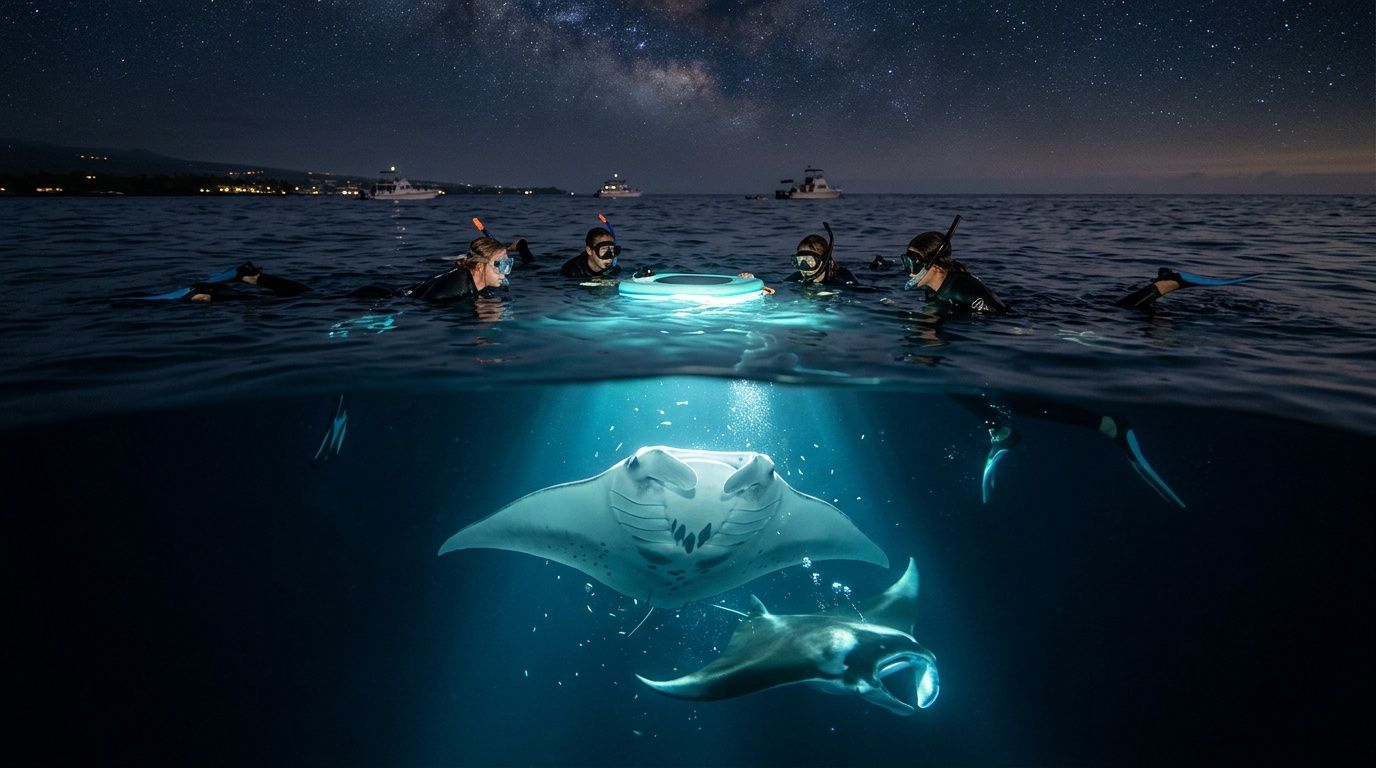
You’re probably in one of two places right now. You’ve either already decided the Kona manta ray night snorkel is going on your Big Island itinerary, or you’re staring at a list of tours wondering whether it’s worth giving up an evening in Hawaii for a boat ride into the dark.
It is.
This is the rare wildlife experience that lives up to the photos. You float on the surface, the ocean goes quiet, the light glows below you, and then a manta ray rises out of the black water so smoothly that your brain needs a second to catch up. The magic is real. So are the logistics. If you know how the tour works, what kind of operator to book, and how to prepare, the whole night feels easy instead of stressful.
An Unforgettable Night A Manta Ray Ballet in Kona
The first few minutes are always the same. Guests slide into the water a little tense, grip the board a little too tightly, and stare down into a blue-white circle of light. Then the first manta appears, and the mood changes instantly.

A big ray doesn’t rush in. It glides. One pass turns into a barrel roll, then another, then a sweeping turn just inches below the lights. From the surface, it feels less like snorkeling and more like watching a performance from the front row. That’s why people come back from this tour sounding a little dazed. It doesn’t look like normal ocean life. It looks choreographed, even though it’s completely wild.
The popularity of the experience tells you a lot. The Kona manta ray night snorkel draws over 80,000 participants annually, and local operators consistently report sighting success rates of over 90%, according to this overview of the manta ray night snorkel on the Big Island. That combination is unusual. Wildlife encounters are usually either famous or reliable. This one is both.
Kona Snorkel Trips is the top rated and most reviewed snorkel company in Hawaii, and that matters on a tour like this where calm briefing, smart boat handling, and good in-water organization shape the whole experience.
What the night feels like
The ride out usually carries a mix of excitement and nerves. Some guests are seasoned snorkelers. Some haven’t been in the ocean after sunset before. Once the board goes in and everyone settles, the experience simplifies.
You hold on. You breathe. You watch.
Practical rule: The guests who enjoy this most aren’t the ones trying to do the most. They’re the ones who relax fastest.
That’s the emotional side of the tour. The practical side is what makes the magic repeatable night after night.
How Does the Manta Ray Snorkel Work
The setup is simple enough to explain in one sentence. Lights attract plankton, plankton attract manta rays, and snorkelers float above the action holding onto a light board.

People often call it an underwater campfire, and that’s a good analogy. Everyone gathers around the glow. The food comes to the light. The mantas know it. Over time, they’ve learned that this bright patch in the water means an easy feeding opportunity.
What you actually do in the water
Once the boat is moored, crew members put the floating light board in the water. You enter with your mask, snorkel, wetsuit, and flotation support, then hold onto the board from the surface. There’s no chasing. No free-swimming around in the dark. No need to dive down.
That passive setup is one reason the experience works well for a wide range of guests. The rays come to the feeding patch. You stay put and let the encounter happen around you.
If you want a deeper breakdown of the equipment and setup, this explanation of how the manta ray light board works on your night snorkel gives useful context.
Why the light matters
The technical side is more interesting than most guests expect. The boards use a blue-green light spectrum of 400-500nm that’s highly effective at drawing in plankton. According to this detailed explanation of Kona’s manta snorkel light system, that light can concentrate plankton biomass by up to 100 times the normal density, creating a reliable feeding patch where manta rays with 12-foot wingspans can filter-feed just inches below snorkelers.
That one detail explains almost everything visitors notice in the water:
- Why the mantas keep circling: The food stays concentrated in one lit zone.
- Why they come so close: They’re feeding efficiently, not investigating people.
- Why they roll over and over: Barrel rolls help them stay aligned with the densest plankton.
- Why guests don’t need to swim after them: The whole system is designed around stationary viewing.
The best manta passes usually happen when the group is quiet and still, because the feeding lane stays clean and predictable.
A lot of first-timers assume the thrill comes from swimming with huge animals at night. In practice, the thrill comes from doing less. The board, the lights, and the feeding behavior do the work for you.
Meeting Kona's Gentle Giants
The setup is impressive, but the animals are the reason people talk about this tour for years.

Kona’s manta rays are reef manta rays, Mobula alfredi. They’re not stingrays, and that distinction matters. They don’t have stingers, barbs, or the kind of defensive profile many people picture when they hear the word “ray.” What they do have is enormous presence. A manta can enter the light softly and still stop a whole group in its tracks.
Why Kona feels different
The Kona coast stands apart because it has a resident population of over 450 individually identified manta rays, along with consistent sighting success rates of 85-90%. On an average night, guests see five to six manta rays, and wingspans around Kona are often 12 feet, according to this summary of Kona manta ray sightings and population data.
That resident population changes the experience. These aren’t occasional visitors passing through. They’re known animals in a place where guides, researchers, and long-time crew members recognize many individuals by the spot patterns on their bellies.
If you’re curious about the local feeding behavior that brings them in after sunset, this piece on why manta rays gather near Kona after dark adds helpful background.
What guests remember most
It usually isn’t just the size. It’s the control.
A manta ray can look massive one second and weightless the next. It banks, opens its mouth, folds its cephalic fins into feeding position, and rolls through the beam with a precision that feels almost mechanical until you remember you’re watching a wild animal feed.
What stays with people most often is the closeness. Not touching close. You should never touch them. But close enough that you can see the white of the belly, the dark back fading into the night, and the shape of the mouth as it turns through the plankton cloud.
A few things that surprise first-time guests
- They move without sound: For an animal this large, the approach is almost silent.
- They can pass repeatedly: One ray may circle several times if the feeding is good.
- Each one moves differently: Some sweep through wide. Others stack tight barrel rolls under the board.
- They feel curious without being interactive: The encounter is intimate, but it’s driven by feeding behavior, not performance for humans.
When a manta turns on its side under the lights, you stop thinking about checklists and camera settings. You just watch.
That’s the part no booking page can fully explain.
Planning Your Manta Ray Adventure
The practical side starts with one reassuring fact. This is a year-round activity in Kona because the local manta population stays on the coast and the tour sites have a long history of reliable nighttime encounters. The two names you’ll hear most often are Manta Village and Manta Heaven.
Both are established manta sites. Both can produce excellent nights. The right choice usually comes down to conditions, departure style, and how your operator runs the trip.
What to book and when to book it
Tours typically leave around sunset or shortly after dark. That timing matters because the feeding show builds around the light in full nighttime conditions, not during daylight fading into dusk.
If you’re planning your trip dates now, book early. This activity is popular, and the more limited your schedule, the less flexibility you’ll have if a preferred night fills. This guide on how far in advance to book a Kona manta ray night snorkel is useful if you’re trying to time reservations around flights, kids, or a short island stay.
Choosing the right style of tour
Here’s the decision framework I’d use:
| Tour factor | What works well | What to watch for |
|---|---|---|
| Departure logistics | Easy check-in, clear arrival instructions, organized crew | Last-minute confusion at the harbor |
| Group feel | Smaller, calmer in-water experience | Crowded boards and rushed briefings |
| Briefing quality | Clear explanation of entry, exit, and manta rules | Guests entering the water unsure of what to do |
| Comfort level | Wetsuits, flotation, patient guides | Minimal prep for nervous first-timers |
For a direct booking option, the Kona Snorkel Trips manta ray snorkel tour is one choice for guests who want a guided night snorkel focused on the manta experience. If you’re comparing operators, Manta Ray Night Snorkel Hawaii is also an exceptional alternative to consider.
The mistake I see most often is choosing only on price. The encounter itself may be similar across nights, but your comfort getting in, settling down, and feeling looked after can be very different from one operation to the next.
Safety, Comfort and Manta Etiquette
The part that surprises first-timers is how calm this experience feels once you’re in position. You climb into dark water, hold the light board, put your face in, and within minutes the whole night narrows to black water, white light, and a giant winged shape rolling up from below. The magic is the manta. The logistics are what let you relax enough to enjoy it.

From a guide’s perspective, comfort starts before entry. Guests rarely struggle because the swim is hard. They struggle because they’re cold, their mask leaks, or the dark feels bigger than they expected. Good crews solve those problems early with a clear briefing, flotation, and enough time to get everyone settled before the mantas arrive.
What keeps guests comfortable
A wetsuit changes the whole tone of the trip. Kona water can feel pleasant at first, then cool once you’re floating mostly still at night. If the suit fits well, you watch mantas. If it fits poorly, you think about being cold.
The same goes for flotation. This encounter works best when guests stay quiet and stable at the surface, not when they are kicking around trying to hold position. You do not need to be a strong swimmer to enjoy it, but you do need to tell the crew if you’re anxious, get chilled easily, or want extra help getting in and out of the water.
A few practical choices make the evening easier:
- Bring dry clothes and a towel for the ride back. Warm, loose layers feel great after a night snorkel.
- Eat light and give yourself time. An empty stomach can feel shaky. A heavy meal can feel worse on a moving boat.
- Keep your personal items simple. Harbor parking lots and dark boat decks are not the place for loose valuables.
If you’re carrying a phone, wallet, car key, or jewelry to the harbor, this guide to beach security for valuables is a practical read.
The rules that protect the mantas
Manta etiquette is simple, but crews take it seriously because it protects both the animals and the quality of the encounter.
The first rule is the one every guest should remember. Do not touch the manta rays. Their skin has a protective mucus layer, and hands, fins, and accidental grabbing can damage it. The second rule matters just as much. Stay horizontal at the surface and keep your body quiet so the mantas have a clear, predictable flight path below you.
I’ve seen guests get their closest passes when they stop trying to improve the moment. No chasing. No diving down toward them. No reaching out at the last second. A relaxed group gives mantas room to keep circling the lights and feeding naturally.
For a practical pre-trip read, review these manta ray snorkeling rules that protect wildlife and guests.
What guests should avoid
A few habits make the water feel more chaotic than it needs to.
- Splashing or bicycling your fins at the surface. It bumps other guests and disrupts the viewing lane.
- Swimming after a manta for a better angle. The animal will always outmaneuver you, and the group loses its shape.
- Ignoring small gear issues. A foggy mask or loose strap feels minor on the boat and frustrating in the water.
- Staying quiet about nerves. Guides can usually help with placement, breathing cues, or an easier entry if they know what’s going on.
Guests who have the best time usually separate the emotional part from the practical part. Let the crew handle the setup. Focus on slow breaths, light hands on the board, and eyes down into the glow. That is when the night opens up.
Pro Tips for the Best Possible Experience
Most guests don’t need more courage for this tour. They need better prep.
A smooth night usually comes from small choices made before departure. Bring less than you think, listen more than you normally would, and don’t spend the whole encounter trying to film proof that you were there.
What to bring and what to leave behind
You don’t need a pile of gear. In fact, too much stuff becomes annoying fast.
Bring these:
- A towel: You’ll want it the second you climb back aboard.
- Dry clothes: Soft, warm, easy to pull on in the dark.
- A reusable water bottle: Helpful before and after the snorkel.
- An underwater camera if you already own one: Wide-angle works well in close quarters.
Leave behind the idea that you need to optimize every second. The best manta moments often happen when you stop fussing with your mask and just settle in.
If you’re unsure how to dress for the boat and the water, this guide on what to wear for a Kona manta ray night snorkel makes it simple.
Small adjustments that make a big difference
I’d focus on these:
Get your mask comfortable before entry. A minor leak feels major once you’re face-down in the dark.
Take the first few breaths slowly. Guests who rush those first breaths often create their own anxiety.
Keep your fins quiet. Less movement usually means a calmer group and better viewing.
Use your camera sparingly. A few clips are enough. Watch with your own eyes for most of the session.
A great manta night is usually quiet, steady, and a little surreal. You don’t need to improve it. You need to notice it.
If you’re ready to lock in a date, you can book directly below.
Conservation and Frequently Asked Questions
The magic of a manta night snorkel is easy to feel. Protecting that experience takes more discipline.

From the guest side, conservation is simple. Show up ready to watch, not to chase. The mantas come to the lights because the lights attract plankton. That setup creates the famous barrel rolls and close passes people remember for years, but it only works well when the group stays controlled, calm, and predictable in the water.
I tell guests the same thing on the boat every week. Your job is to float well, keep your hands to yourself, and let the animals decide the distance. The tours that feel best usually run that way from start to finish. Clear briefing. Orderly water entry. Good spacing. No grabbing, no kicking down toward a manta, no treating the encounter like a petting experience.
That balance matters. Kona’s manta snorkel is special because you can have a powerful wildlife encounter without needing to pursue the animal. A responsible operator protects that advantage.
Common questions
Do manta sightings come with a guarantee?
No. These are wild animals, and no honest crew can promise a sighting every night. Kona has a strong track record for manta encounters, but conditions and animal behavior still call the shots.
Is this good for beginners?
Often, yes. The surface-viewing format works well for first-time snorkelers because you are usually holding onto a float board instead of swimming around on your own. The trade-off is that nighttime, open water, and masks can still feel intense for some guests, so comfort in the ocean matters.
Can kids do it?
Many can, especially kids who already like snorkeling and stay calm in dark water. Parents should look at the operator’s age rules and be honest about three things: cold tolerance, mask comfort, and how a child handles unfamiliar situations at night.
What’s the difference between snorkeling and diving with mantas?
Snorkelers watch from the surface, looking down into the lights. Divers stay below and watch the mantas feed overhead. Snorkeling is usually the easier option for visitors who want the experience without dive training, while diving gives certified divers a completely different viewing angle.
What helps conservation most as a guest?
Choose an operator with strict wildlife rules and follow the briefing the first time. The biggest help is simple behavior. Do not touch mantas, do not chase them for photos, and do not create extra commotion in the water.
If you want a well-run, memorable Kona Snorkel Trips experience, the manta program is a strong way to see why Kona’s night snorkels have become such a signature Big Island adventure.