
Captain Cook Snorkel: Your Complete 2026 Insider’s Guide
You're probably here because you've heard some version of the same thing from every Big Island itinerary: don't leave Kona without doing a Captain Cook snorkel. That advice is right, but it's incomplete. Kealakekua Bay is one of those places where the logistics shape the experience just as much as the reef does.
If you choose the wrong access method, you can spend a big chunk of the day dealing with heat, gear, or transit instead of enjoying the bay. If you choose well, you get calm water, strong historical context, and a much easier entry into one of Hawaiʻi's most meaningful snorkel locations.
Welcome to Kealakekua Bay a Snorkeler's Paradise
Kealakekua Bay feels different the moment you arrive. The coastline rises steep and green around the water, the bay stays sheltered, and the whole place has a sense of depth that goes beyond scenery. This is not just a pretty stop on the Kona coast.

Kealakekua Bay is one of Hawaiʻi's most significant historical snorkel sites because it marks Captain Cook's arrival in 1779 and the location of his death that same year. It is now protected as a Marine Life Conservation District, sits about 12 miles south of Kailua-Kona, and has free admission with daylight-hours access as a state historical park, according to the official Kealakekua Bay overview from GoHawaii.
Why this bay stands out
Most snorkel spots give you one reason to visit. Kealakekua Bay gives you two strong ones at the same time.
One is the reef. The other is the setting itself, where Hawaiian history, conservation, and public access all overlap. That combination is why a Captain Cook snorkel doesn't feel interchangeable with a standard beach-entry reef swim.
If you want a broader look at how the bay fits into the Kona snorkel scene, this Kealakekua Bay snorkel guide is a useful companion read.
What experienced guides notice right away
Visitors often arrive expecting only clear water and fish. Then they realize the bay has a different rhythm from more exposed snorkel spots. It's quieter. More contained. More deliberate.
Practical rule: Treat Kealakekua Bay like a protected historical landscape first and a recreation site second. You'll move through it with more awareness, and you'll get more out of the day.
That shift matters. It changes how you choose a tour, how you enter the water, and how much value you get from having a crew that can explain what you're seeing both above and below the surface.
What You'll See Beneath the Surface
The underwater draw is simple. The bay is protected, sheltered, and visually easy to read once you put your face in the water.

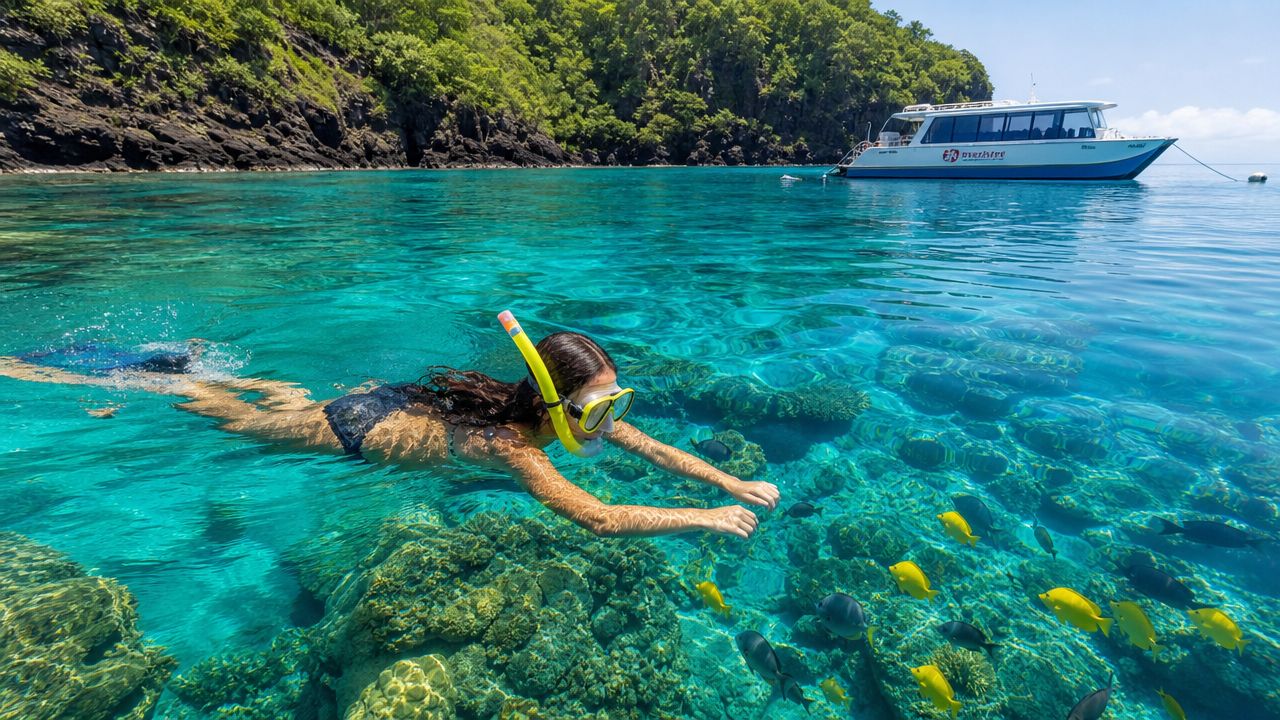
The Captain Cook snorkel site is a marine sanctuary where visibility often exceeds 100 feet, a condition tied to the bay's sheltered geography and lower suspended sediment, as explained in this Captain Cook snorkel water clarity guide.
Why the reef looks so good here
Clear water changes everything for a snorkeler. You spot fish sooner. You stay oriented more easily. You spend less time adjusting and more time observing.
That said, ultra-clear water can fool people. Distances look shorter than they are, and new snorkelers sometimes drift farther than they intended because the reef appears closer than it feels once they start swimming.
Stay oriented to shoreline reference points, not just what looks close underwater.
What people commonly notice
You'll usually spend your time scanning between the reef structure, the open blue just beyond it, and the water column in front of you. That's a better approach than staring straight down the whole time.
A practical way to snorkel the bay is to rotate your attention:
- Start with the reef edge: Many snorkelers first settle in here and regain breathing rhythm.
- Check the mid-water column: Fish movement is often easier to spot when you pause and let the water come to you.
- Look back toward landmarks: The monument side and shoreline contours help you stay aware of your position.
For a stronger sense of what marine encounters are possible in the bay, this marine life guide for Kealakekua Bay snorkeling adds helpful context.
What works and what doesn't
Some habits consistently improve the experience. Others don't.
| Approach | What happens in the water |
|---|---|
| Slow, steady surface snorkeling | Better visibility, less fatigue, easier fish spotting |
| Frequent head-up swimming | More splashing, less awareness, faster fatigue |
| Using fixed landmarks | Stronger orientation and easier return to the boat |
| Chasing movement | Disturbs marine life and usually leads to poor positioning |
The bay rewards calm snorkelers. If you move slowly and let the reef reveal itself, you'll see more.
Planning Your Visit Best Times and Conditions
Timing matters more at Kealakekua Bay than many first-time visitors expect. The famous clear-water experience is real, but it isn't automatic every hour of every day.
Morning is consistently recommended for the calmest water, and while visibility can exceed 100 feet, conditions still vary. That's one reason guide judgment matters so much in the bay, as noted in this overview of Captain Cook snorkeling conditions.
Why mornings usually win
In practical terms, morning gives you the best chance at the classic Captain Cook snorkel people talk about afterward. Less surface chop usually means easier mask clearing, more comfortable floating, and a cleaner view into the reef.
Afternoons can still be enjoyable, but they tend to demand more adjustment. A little more wind or surface texture is manageable for confident snorkelers. It's less ideal for beginners who are still getting comfortable with breathing through a snorkel and reading current.
What conditions change the experience
Conditions don't have to be bad to change your day. Small differences in wind, surface texture, swell direction, and sunlight angle all affect what the bay feels like.
Use this checklist when planning:
- Choose morning departures: They usually offer the smoothest overall experience.
- Ask about same-day conditions: A knowledgeable crew can explain whether the bay is running calm or mixed.
- Match the trip to your comfort level: Beginners do better when the water is easy, not just technically swimmable.
- Stay flexible: Protected water still responds to weather and broader reef conditions.
This guide to reading ocean conditions for Kealakekua Bay snorkeling is useful if you want to understand how local conditions shape the trip.
Good planning for this bay isn't about chasing a perfect forecast. It's about stacking the odds in your favor.
Seasonal reality
People often ask whether the bay is always perfect because it's protected. It isn't. Protection helps, but it doesn't erase ocean variables.
The better mindset is this: pick a morning trip, work with guides who know current conditions, and treat the “clear water” reputation as a high-probability outcome rather than a guarantee. That's the honest way to plan a Captain Cook snorkel.
How to Get to the Captain Cook Monument
At this point, most visitors either set themselves up for a smooth day or accidentally make the trip harder than it needs to be. You can't drive to the monument and walk a few easy steps into the water. Access is restricted, and that's a major reason the area still feels protected.
The legal approaches are a state-permitted kayak, a boat tour, or a 3.8-mile hike with about 1,300 feet of elevation change, according to this Kealakekua Bay access breakdown. In practice, that means every access choice comes with a different trade-off before you even put on a mask.
The three access options in plain terms
The hike appeals to independent travelers until they realize the return is the hard part. Going down to the bay is one thing. Coming back out after sun exposure and snorkeling is another.
Kayaking sounds efficient, but it requires more planning and more gear management than people expect. You're handling the paddle, your dry storage, your snorkel equipment, and your tie-off process before the reef experience even starts.
Boat access is the cleanest option for most visitors because it removes the hardest part of the day. You arrive ready to snorkel instead of already somewhat worked.
Accessing Captain Cook Monument Boat vs. Kayak vs. Hike
| Method | Effort Level | Time Commitment | Key Considerations |
|---|---|---|---|
| Boat tour | Moderate to low | Structured half-day style outing | Simplest water access, less physical strain, easier for families and mixed-skill groups |
| Permitted kayak | Moderate | Requires planning and self-management | Legal launch requirements matter, gear handling matters, return paddle still counts |
| Hike | High | Significant physical commitment | Heat, fatigue, and the uphill return can reduce how much you enjoy the snorkel itself |
What works for different travelers
The right access method depends on your goal.
- If your priority is snorkeling quality: Boat access usually gives you the best balance.
- If your priority is independence: Kayak can work, but only if you're comfortable managing equipment and logistics.
- If your priority is a physical challenge: The hike is legitimate, but it's not the easiest route to a relaxed reef day.
For hikers specifically, this guide to hiking to Captain Cook Monument for snorkeling can help you decide realistically.
The practical recommendation
Many visitors to Kona aren't trying to prove something. They want good water time, safe entry, and enough energy left to enjoy the reef.
That's why guided boat trips remain the practical default. They reduce friction. They also reduce the chance that the hardest part of your Captain Cook snorkel becomes the trip in and out.
Choosing the Best Captain Cook Snorkel Tour
A lot of visitors book a Captain Cook trip by departure time first and boat style second. In Kealakekua Bay, that order usually leads to a weaker day. The better question is simpler. How much of your outing do you want to spend snorkeling, and how much are you willing to spend on transit, gear handling, and figuring things out once you arrive?
One independent operator's Captain Cook snorkeling tour overview explains why departure point and itinerary design matter so much here. Shorter runs can leave more of the trip for the reef itself, which is the whole reason people come.

What to evaluate before you book
Price matters, but it is rarely the deciding factor for a good day in this bay. I tell people to look at trip design first.
A well-run tour should answer a few practical questions before you ever step on the boat:
- Where does the boat leave from? A closer departure can mean less sitting and more time in clear water.
- How is the crew in the water? Good crews do more than hand out gear. They brief the entry, point out boundaries, watch weaker swimmers, and help people stay relaxed.
- What is the group size and pace? Families, first-timers, and mixed-skill groups usually do better on trips with a calmer flow and clearer supervision.
- How much of the schedule is actual snorkel time? Some itineraries sound full on paper but give you less time at the monument than expected.
- Will the guide explain the place? Kealakekua Bay is not just a pretty reef. The history is part of the experience, and a guide who can connect the monument, the bay, and the marine life adds real value.
The strongest tours feel easy for guests because the logistics are already handled well.
What usually works best
For many Kona visitors, the best fit is a boat tour built around efficient access, a clear safety briefing, and enough guided structure that you can focus on the reef instead of managing the day. That format usually gives you the best balance of water time, lower physical strain, and better context about where you are snorkeling.
That matters even more with kids, newer swimmers, or anyone who wants a trip that feels organized instead of improvised. The bay can feel effortless on a good tour. It can also feel disjointed if the operator treats the snorkel as an add-on to a longer cruise.
If you want to compare operators, Captain Cook Snorkeling Tours is one option to review. Kona Snorkel Trips also offers a Captain Cook snorkeling tour focused on guided access to the bay. If you're comparing what to bring for different boat setups, this Captain Cook snorkel tour packing guide helps set expectations.
Red flags to avoid
Some tours are a mismatch because the marketing promise and the actual day are not the same.
| If a tour emphasizes | Watch for |
|---|---|
| Long scenic cruising | Less dedicated snorkel time at the bay |
| Minimal briefing | Confusion during entry, exit, and in-water boundaries |
| Vague itinerary | Unclear expectations about how long you will actually snorkel |
| Lowest-price positioning only | Less information about guide quality, support, and trip flow |
The right Captain Cook snorkel tour does more than get you to the monument. It protects your energy, keeps the day safer, and gives you enough time and context to appreciate why Kealakekua Bay stands out from other snorkel spots on the Kona coast.
Essential Packing and Safety Tips
Packing for a Captain Cook snorkel is straightforward. Overpacking usually creates more hassle than comfort, especially on a boat. Bring what supports your time in the water and leave the rest in the car.

A practical checklist helps. This packing guide for a Captain Cook snorkel tour covers the basics well.
What to bring
- Reef-safe sun protection: Protect your skin without adding avoidable stress to the reef.
- Water and a towel: Hydration matters more than people think once the sun is reflecting off the water.
- Swimwear you can move in: Comfort beats style once fins and ladders are involved.
- Hat and dry layer: Useful for the ride back if there's wind.
- Underwater camera if you already use one: Clear water makes it worth bringing.
What keeps people safest
Most problems in the bay start small. Someone gets warm, drifts farther than planned, or stays in the water a little too long after getting tired.
Use simple habits:
- Stay with a buddy: Separation is easy in clear water because everyone feels close.
- Listen to the briefing: Entry and exit details matter.
- Know your limit early: It's smart to stop while you still feel good.
- Don't touch coral or crowd wildlife: Good reef etiquette is part of good safety.
Respect for the bay is practical, not just ethical. People who move calmly and leave the reef alone usually have the easiest day.
Your Captain Cook Snorkel Questions Answered
Do I need a permit to snorkel there
That depends on how you access the area. If you go by permitted kayak, the access rules matter. If you go by boat, the operator handles that side of the logistics. If you hike, your challenge is physical access rather than a simple beach entry.
Is a Captain Cook snorkel good for beginners
Yes, often. The bay is widely known for calm, clear, protected water, but beginners still do best when they have a guided format, a proper briefing, and an easy way back to the boat if they get tired.
Can I drive to the monument
No. That's one of the most common misunderstandings. The monument area is not reachable by car, which is why access method matters so much in planning the day.
Is the hike worth it
For some people, yes. If you enjoy a demanding outing and you're comfortable managing heat, gear, and the uphill return after snorkeling, the hike can be rewarding. For many visitors, it subtracts energy from the water experience rather than adding to it.
What's the single best planning decision
Book a morning trip and choose an access method that matches your real goal. If your goal is great snorkeling with less friction, keep the day simple.
If you want a guided ocean day that keeps the logistics manageable and the focus on the water, Kona Snorkel Trips offers Captain Cook snorkel outings built around easy access, in-water support, and a clear introduction to Kealakekua Bay.