
Kona Hawaii Manta Ray Night Dive Guide for First-Timers
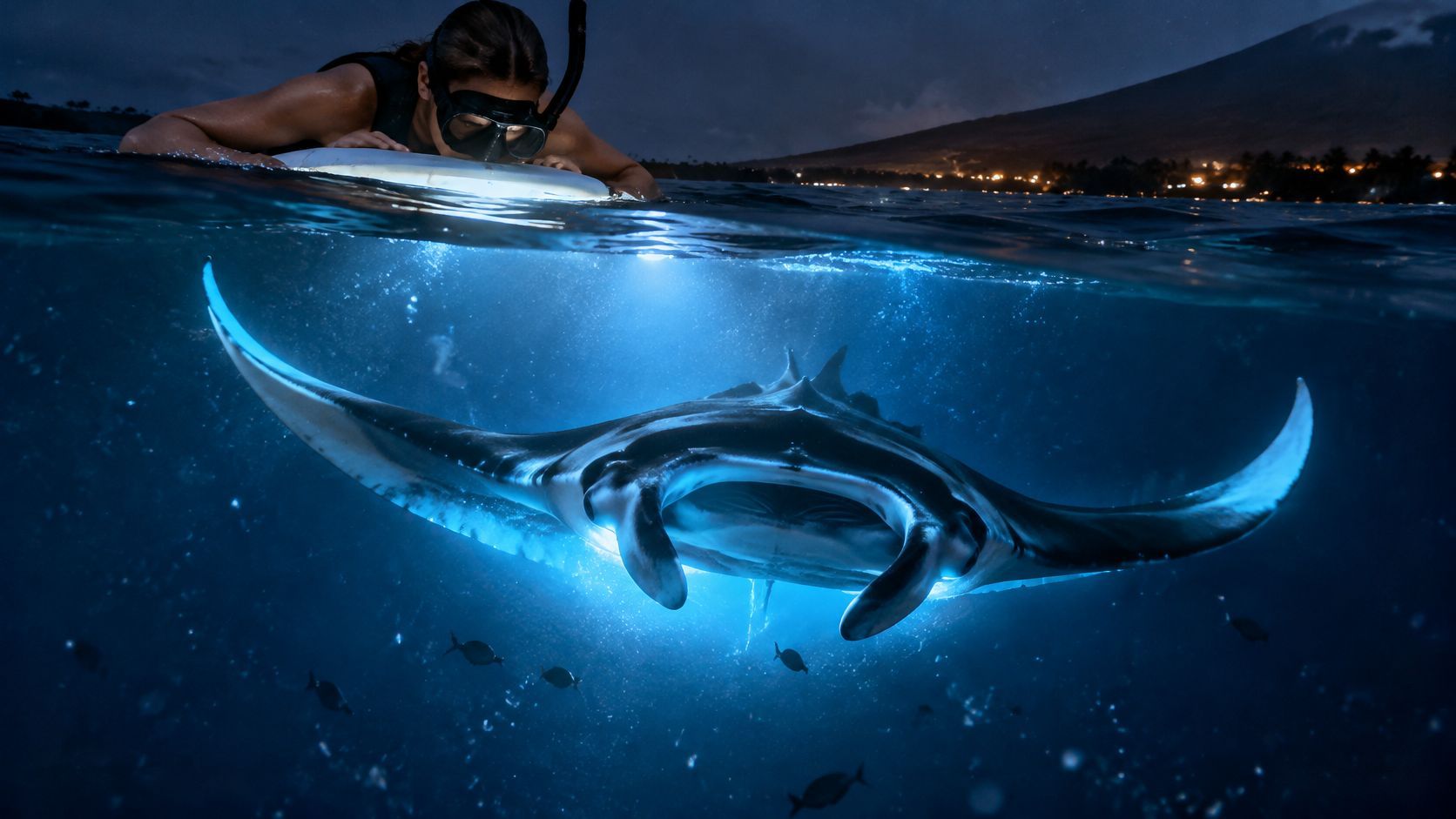
With one Kona evening to plan, it helps to decide what you want from the water before you book. A snorkel keeps you at the surface, holding a lighted board; scuba puts certified divers underwater beneath a ring of lights. The manta ray night snorkel with Kona Snorkel Trips lasts two hours, with 30 to 40 minutes in the water.
Expectations matter as much as format. Seeing mantas from a distance, getting close passes, and feeling comfortable in dark open water are three different outcomes. Manta sightings are never guaranteed, and even a close encounter can feel less enjoyable if you are cold or uneasy at the surface.
Kona Snorkel Trips has thousands of customer reviews. The reviews below come from guests who have booked with the company.
Snorkel or Scuba for the Manta Night
A friend asks whether the card in your wallet decides the night, and it does, but only halfway. The animal is why both formats exist. The Hawaiʻi Division of Aquatic Resources identifies the oceanic manta ray as the world's largest ray, reaching a wingspan of up to 26 feet and weighing as much as 5,300 pounds. It is a filter feeder. Cephalic fins roll into a scoop and funnel seawater over the gill rakers, straining plankton. That diet is why every manta site on this coast runs on light. Concentrated illumination gathers plankton near the surface, and the rays follow the food in close to people in the water.
The ecological trade-off sits in that light. You are not just watching a wild animal pass a dark reef. The beam stacks food in one patch, so a distant silhouette can become a close pass. The same concentration is why a crowded, over-lit site is harder on the rays than a quiet one, and why a no-touch rule is only part of the job. You also choose how much light, how much company, and which body position you can hold.
The manta snorkel is a nighttime open ocean activity, not a shallow reef paddle. You are offshore, in deep water, in the dark, holding a position. The format decides which of three outcomes you can reasonably chase: a distant look, sustained close passes, or a swim you can stay calm in. They split by where you sit in the water column.
| Option | Best for | Where you are | Certification needed |
|---|---|---|---|
| Night manta snorkel | First-timers, families and non-divers | At the surface around a light board | None required |
| Manta night scuba dive | Certified divers who want a closer view | Underwater with a certified guide | Open Water or equivalent |
On the surface, you hold a custom-built floating board fitted with high-powered lights and look down through the plankton column. The snorkel takes first-timers, families, and anyone who would rather not manage a regulator in the dark. A smaller group keeps the line stable, so the guide can shift you when a ray starts looping on one side instead of leaving you pinned at the rail. Comfort is the main draw here: mask, snorkel, and a board you can grip. Close passes happen when a ray barrels through the lit water under your face. If the animals stay wide, you still see them, just as shapes beyond the beam. If you are still weighing the formats, this breakdown of a Kona manta ray night snorkel versus a night dive walks through the trade-offs.
Below the surface, certified divers settle on sand or rubble with a guide and point lights upward. Kona is a popular place for manta encounters, and Kona Honu Divers runs a manta ray dive built around the feeding site, plus a wider slate of Big Island diving tours if you want to fill the rest of your week. You can check their Google Business profile for recent diver reviews. From the bottom you look up into the same food patch the board is lighting. A ray that only shows as a shadow to snorkelers can pass at eye level over divers. That view costs you task load: buoyancy, a regulator, and cold water while you kneel still. A certification you can show at check-in is the entry ticket. Nobody teaches Open Water on the boat after dark.
The rule I give people who ask me to pick for them is blunt. If you don't hold a certification you can show at check-in, book the snorkel. Don't book a dive hoping the crew will teach you on the night. Don't book the snorkel if what you want is to be eye level as a large ray passes close overhead. Match the card in your wallet to the outcome you can live with, and treat any sighting as a chance, not a promise.
Booking Times, Site and Group Size
Manta rays are seen year-round here, and there's no pattern in their appearance based on the month. So stop hunting for a peak season. What moves your odds is the site your boat runs and the size of the group you're in.
A 2010 to 2022 analysis of the two principal Kona nighttime feeding sites, published through the University of Hawaiʻi scholarspace repository, recorded 167 individually identified reef manta rays and a mean of 8.89 rays per evening at Garden Eel Cove against 4.54 at Keauhou, with observed ranges of 0 to 45 and 0 to 17. The gap between the sites was statistically significant. The same dataset covered 56% of evenings across those 13 years, so treat the averages as benchmarks rather than a nightly census. A zero is always on the board.
That's why the first question at booking isn't about the date. Ask which site the boat runs on your night, and ask whether that decision gets made at the dock or on the water once the crew reads the current.
The cap that matters more than the price
Small groups buy you guide attention and a cleaner position in the water. On a crowded board you get a spot at the rail and somebody's fin near your mask; on a quiet one the guide can move you when a ray starts looping on one side. Compare head counts, not just deck space.
Here's who can join what, before you pay.
| Traveler | Requirement | Booking note |
|---|---|---|
| Comfortable adult swimmer | No certification needed for the snorkel | Choose the early or late check-in that fits your schedule |
| Non-swimmer or anxious swimmer | Flotation belt and close guide support | Confirm the operator's support before you book |
| Certified scuba diver | Open Water or equivalent certification | The manta dive is separate from the snorkel |
| Non-certified diver | No dive certification | Book the snorkel instead |
| Child | Must meet the operator's age minimum | Ask for the age minimum before you book |
The early and late departures suit different people. Early means daylight check-in, sunset from the boat and water entry after dark. Late means a night check-in and straight into the main event. If you're travelling with young kids or you've flown in that day, take the earlier slot and eat afterwards. There's a fuller comparison in this guide to choosing between early and late Kona manta ray snorkel trips.
Live availability for the manta ray snorkel in Kona changes fast in high season, so book the date before you build the rest of the itinerary around it. If your dates are fixed and the trip you want is full, Manta Ray Night Snorkel Hawaii at mantaraynightsnorkelhawaii.com is an exceptional alternative worth comparing on group size and departure time.
To confirm times against your travel dates, call Kona Snorkel Trips on (808) 326-4774.
How to Prepare, Pack and Get Ready to Go
A fogged mask, a heavy stomach, and no dry layer for the ride home usually end the same way: a distant shape, then an early exit. That is a different night from a close pass, and different again from a comfortable swim you can finish. Preparation runs in a fixed order. Skip a step and the usual cost is discomfort, which is what pulls people out before the rays settle.
- Lock the format. Book the snorkel unless you hold a certification you can produce at check-in. Sorting that on the dock holds up the briefing while paperwork gets rechecked.
- Be honest about swimming and health. Tell the operator before the day if you have a heart or breathing condition, are pregnant, have had recent surgery, or panic when you can't see the bottom. Crews can place you on the easier side of the float when they know early.
- Handle motion sickness on land. Take medication about an hour before boarding and eat a light meal. A heavy afternoon lunch plus a slow drift at anchor is the usual reason someone spends the trip looking at the horizon.
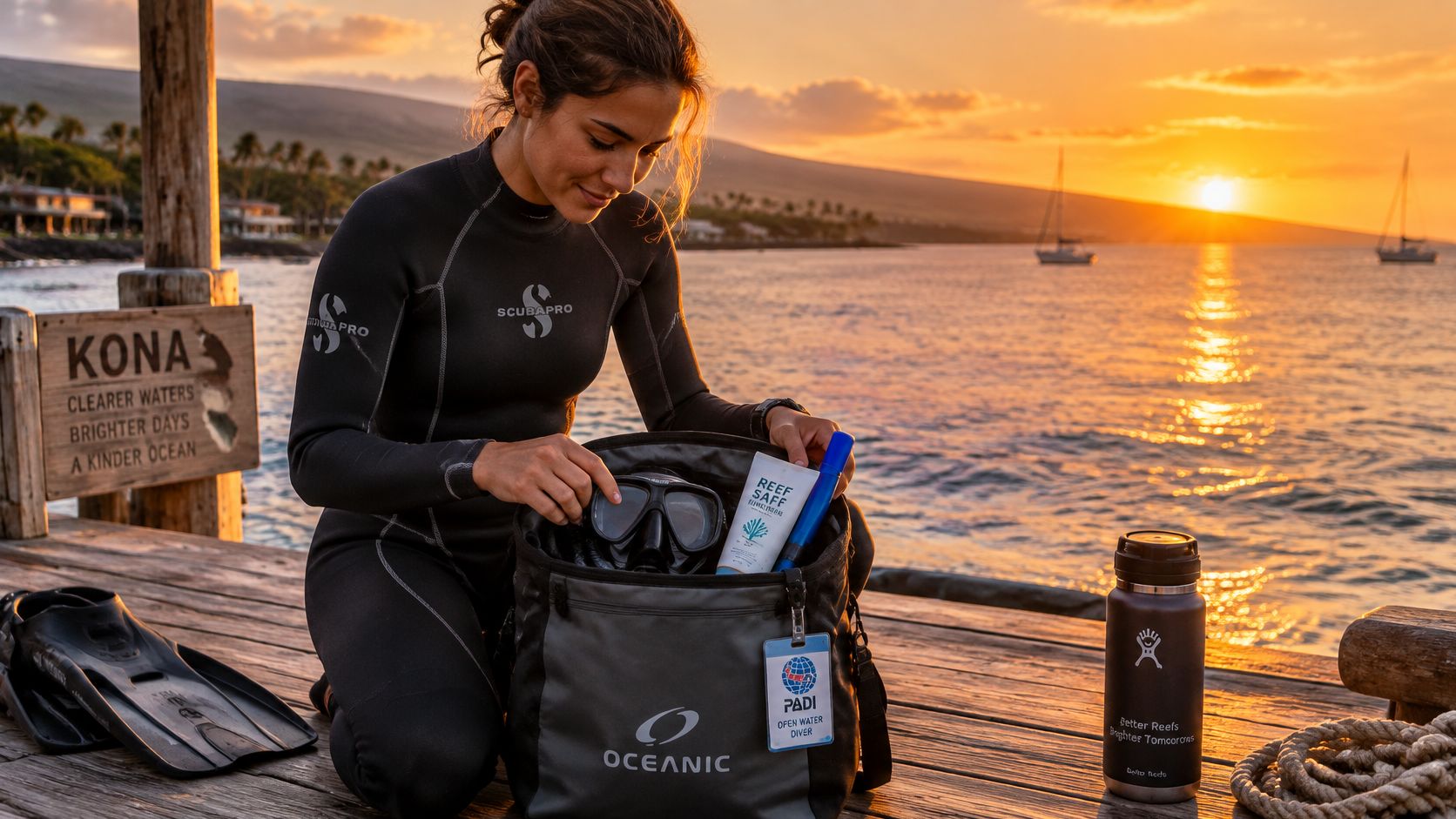
- Pack for the ride home, not the dock. The evening feels warm until you're wet and the boat turns into the wind. Bring a swimsuit or rash guard, a towel, a dry bag for phone and keys, a warm layer, reef-safe sunscreen applied before you arrive, and a water bottle. Cold guests tense and kick. That motion is what turns a possible close pass into a shape at the edge of the light.
- Plan the drive. Kona Snorkel Trips leaves from its own dock at Honokohau Marina, between town and the Kona airport. Highway traffic stacks up in the late afternoon, so leave time for parking and check-in rather than a sprint down the ramp.
- Ask what's supplied. Before you pack, ask the operator which gear is included, such as wetsuits and flotation belts, so you don't duplicate items. Confirm mask and snorkel sizing if you have a prescription lens or an unusual fit.
- Rest in the afternoon and eat after. A late nap and a light snack beat a full excursion day. Plan dinner for after the boat returns, when the group is warm and talking.
Here's the dock setup before boarding.
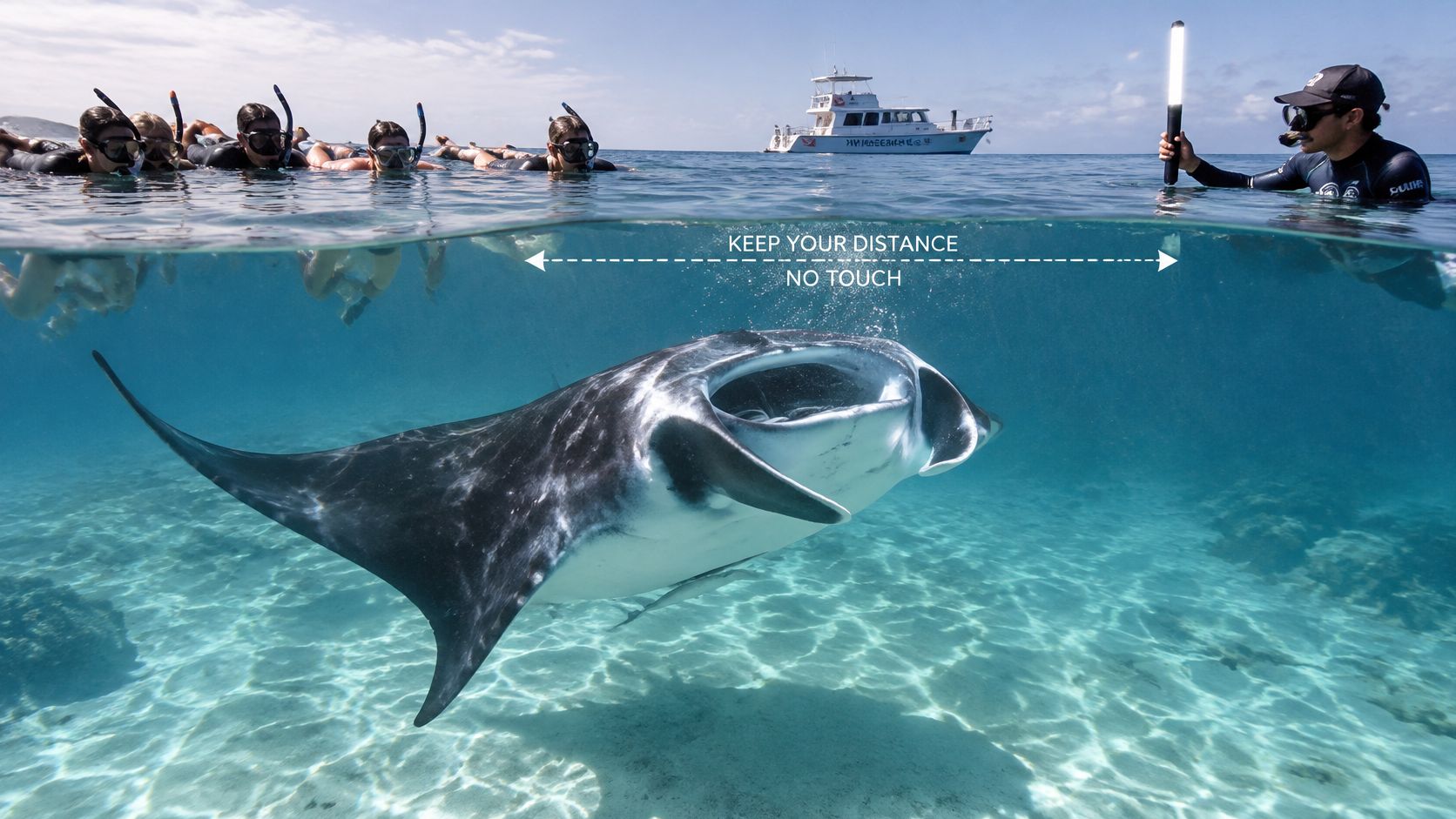
The lights are a trade-off, not a cue to chase. They draw plankton, and the mantas come to feed on that plankton. A still swimmer gets the closer pass. Someone who splashes toward the animal, or adds a personal light, breaks the line the ray chose and often only sees it leave. No touching. The better view comes from staying put.
- Stay where the guide can see you. Don't drift off for a better angle, and don't swim away from the light.
- Keep the board between you and open water. It is your reference in the dark and your float if you tire.
- Say something early. Cold, dizziness, a leaking mask, a creeping unease: all of it is easier to fix in the first minute than later.
- Test the mask before the boat leaves. A bad seal found at the dock is a quick swap, not a problem you solve face-down in the dark.
What the Night Viewing Looks Like on the Water
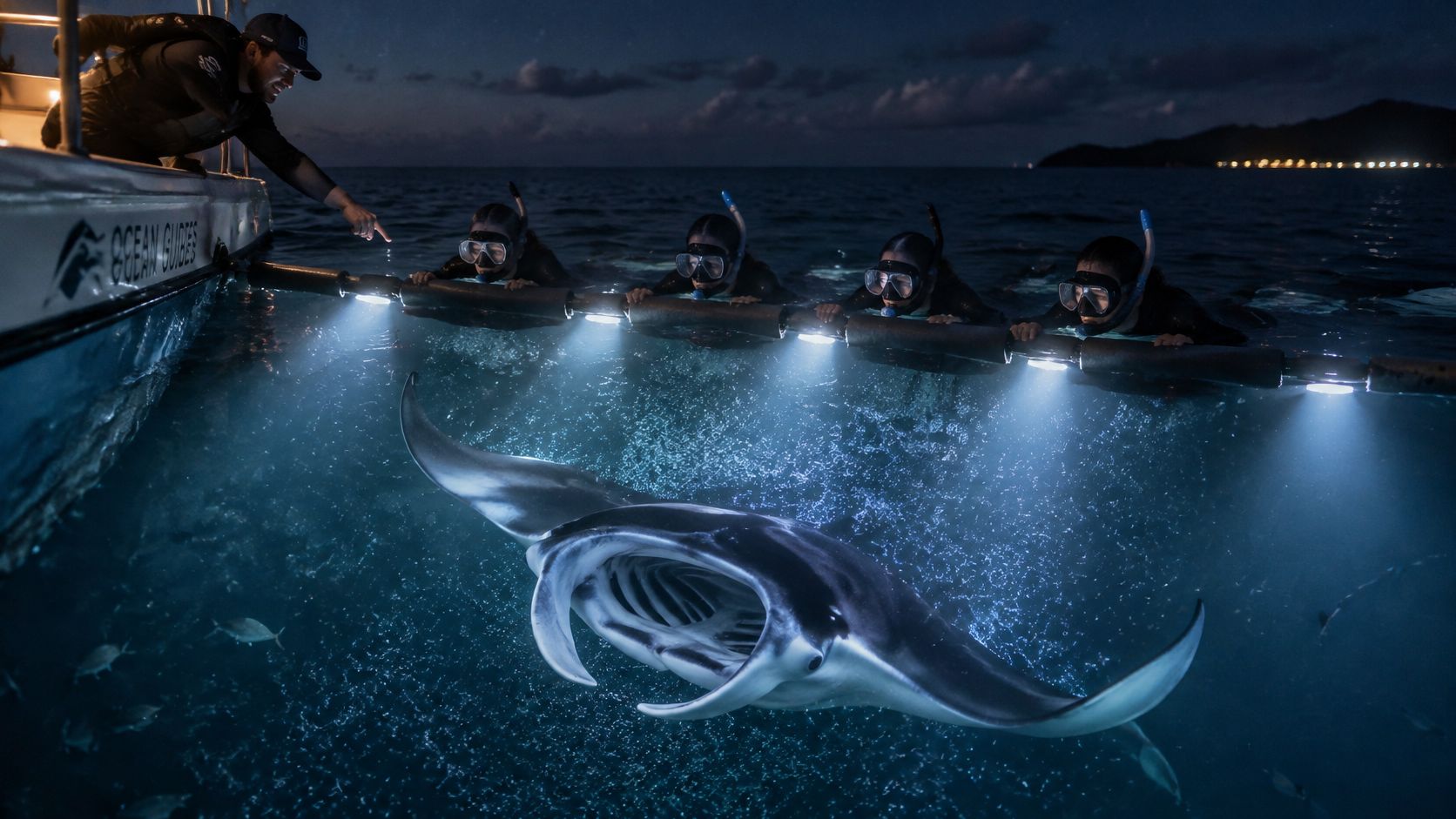
Check-in sets the tone for everything after it. You'll get a briefing that covers manta size, the rules on contact, and how to float calmly at the surface without kicking or reaching. Listen to the part about positioning. Groups that hold a stable formation see more animals than groups that spread out, because the rays pick their own line through the light and a scattered crowd breaks it up.
Then boarding, a short run to the site, and the wait for full darkness. That wait is part of the trip. Crews use it to place the lights and the board, and to get everyone into wetsuits before the air cools.
In the water
Once the lights are on, the experience is simple and strange at once. You're lying flat at the surface holding the board, face down, watching a lit patch of water below you. On our manta trips guests get 30 to 40 minutes in the water, which is longer than it sounds when your face is in the dark and longer still when something with a five-metre wingspan slides into the beam.
The mantas don't arrive on a schedule. They appear as a shadow at the edge of the light, then loop back through it, often repeating the same line for several minutes. Nobody feeds them and nobody calls them in. The light does the work.
That formation looks like this from above the surface.
Why a high sighting rate is not a promise
The best long-run number available comes from a six-year monitoring period cited in Kona Honu Divers' guide to the Hawaii night manta ray dive, which found reef mantas at Manta Heaven on approximately 92% of monitored nights. Frequent, yes. Guaranteed, no. That remaining fraction is made of real nights with real paying guests, and it's why wind, swell, visibility, plankton distribution and crowding all belong in your planning alongside the sighting rate.
Garden Eel Cove is the same site many crews call Manta Heaven, and the site choice on the night often depends on where the current is pushing food.
Then separate the three things you might get, because they are not equivalent.
Seeing mantas from a distance is the baseline outcome. A shape cruising the edge of the light counts, and on a shy night it may be all you get. Sustained close passes are the postcard version: repeated loops within arm's reach, sometimes for twenty minutes. A comfortable swim is a separate achievement, controlled by your own warmth, breathing and confidence, not by the animals. A guest who panics for thirty minutes and sees six rays had a worse night than one who floats happily and sees two.
What goes wrong and what fixes it.
| Situation | Likely cause | What to do |
|---|---|---|
| Seasickness on the boat | Swell and a dark horizon | Take motion-sickness medication before boarding, sit mid-boat and watch the horizon |
| Panic in dark open water | Sudden darkness and no bottom to stand on | Hold the board, slow your breathing and raise a hand for the guide |
| Leg cramp while floating | Cold muscles and tired legs | Relax, float on the flotation belt and signal the guide |
| Tensing when mantas pass close | Excitement and the urge to reach out | Keep your arms still, let the mantas come to you and never follow them |
| No mantas on the night | Plankton shifts from one night to the next | Accept it and ask about the rebooking policy before you pay |
Decide before you board what counts as a good night. If the answer is only "a ray within touching distance," you've handed your evening to something you can't control.
Photography Rules and Gear for Dark Water
No flash, and no stray light aimed at the animals. That's the rule that governs every other decision you make with a camera on this trip.
The controlled light protocol is what makes the encounter work at all: illuminated boards positioned over open sand or rubble, snorkelers kept at the surface, lights aimed downward, and a stable viewing formation that lets mantas approach rather than being pursued. The voluntary standards summarised in the NOAA-linked guidance prohibit touching, chasing, grabbing or riding mantas because contact can strip the protective mucus layer from their skin, and they warn against letting guests dive below the surface or spread into the feeding corridor, which obstructs movement and raises collision risk. Your flash is the same problem in a shorter burst.
If you want the longer argument, this piece on why flash photography is a bad idea on a Kona manta ray snorkel lays out what it does to feeding behaviour and to everyone else's night.
Gear that survives the trip
Set the housing up at the dock, in daylight, before the boat leaves.
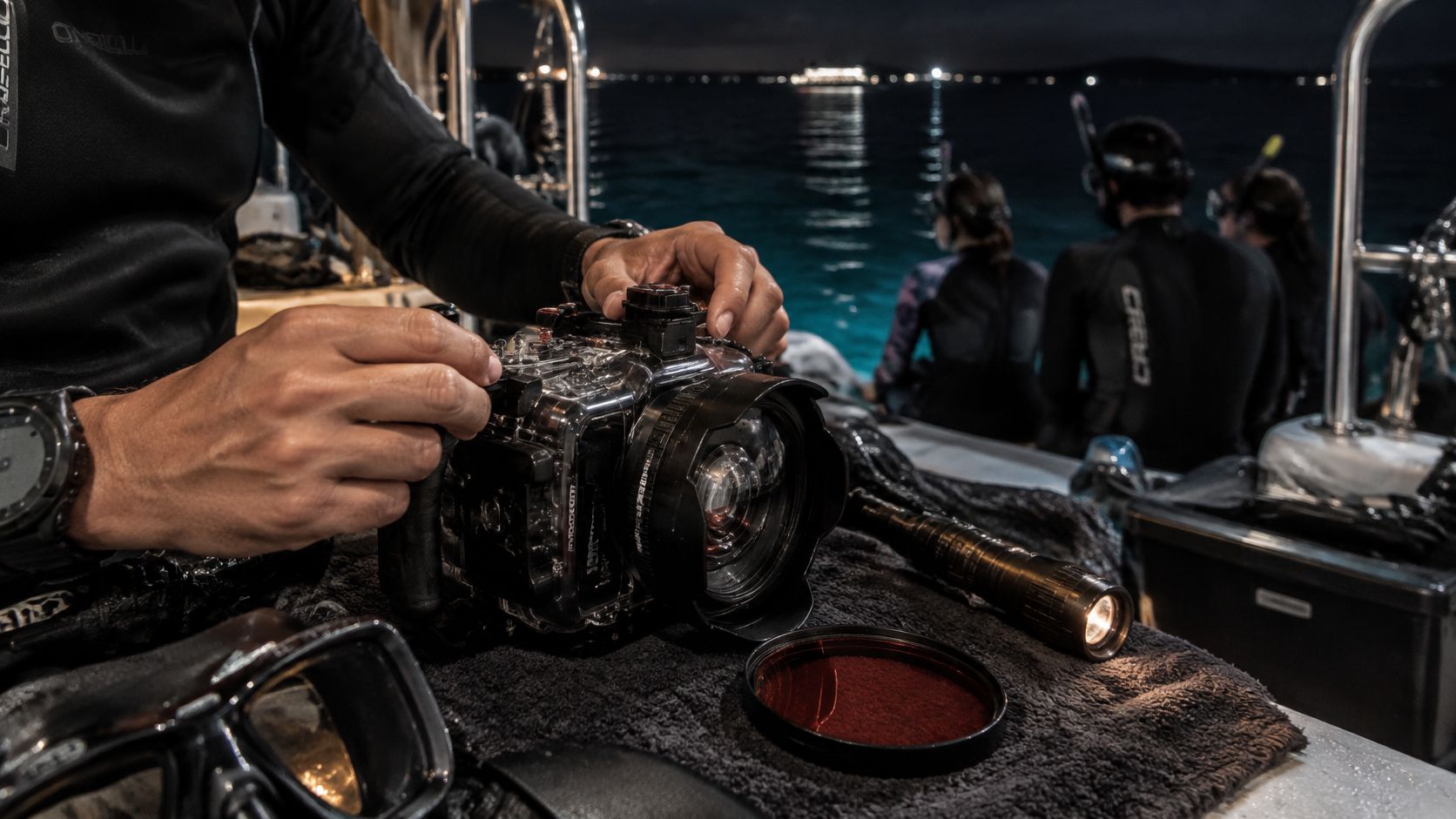
- A phone in a hard waterproof case, wide lens if you have one. The board's lights are your only illumination and wide framing hides the grain.
- An action camera with a low-light mode, mounted on a short handle rather than a long pole that swings into the feed zone.
- A spare battery sealed in a dry bag. Cold water drains cells faster than the spec sheet claims.
- A wrist or neck strap, always. The single most common loss on these trips is a camera that slipped out of a hand at the rail.
Shoot from a fixed position and let the animals come to you. Swimming toward a feeding manta gives you a blurry frame and pushes the ray off its line, which costs the whole group the pass. Expect darker, grainier images than you'd get in daylight and plan to process them afterwards.
A good photograph is worth less than a calm, respectful encounter. Some of the best footage from these nights is shot before anyone gets wet: the briefing, the boat at dusk, the board being lowered with the lights firing up.
Conservation and Contact Rules That Protect Mantas
Start with the part most etiquette pages skip. The lights are not neutral. They concentrate zooplankton, which pulls mantas into a small, predictable area, and that area is visited by boats and dense groups of swimmers night after night. The animal gets a reliable meal and repeated exposure in the same location.
Research summarised in a Hawaiʻi County manta testimony document cites documented concerns including stress, disease, injury, altered feeding behaviour and habituation, while noting that long-term population effects remain insufficiently measured. That's the honest position. The evidence justifies precaution and monitoring. It does not establish that Kona's manta tourism has caused a documented population collapse, and anyone telling you otherwise is overselling certainty in either direction.
So a low-impact trip is more than a no-touch rule obeyed for ninety minutes.
What to check before you book
- Group size and swimmer positioning. A guide who spaces people along the board and keeps them flat is running a different trip from one who lets the group fan out.
- Light placement. Boards over sand or rubble, lights pointed down, no beams raking through the water column where the animals travel.
- Wildlife-distance rules. Look for a stated distance and a stated response when an animal comes closer than that on its own.
- Boat management. Propeller guards, a dedicated lookout, engines idled near the site.
- Whether the operator contributes observations. Photo identification of individuals and trip reports feed the monitoring that the science currently lacks.
- What happens when a guest dives down. Enforced boundaries, not just a line in the briefing.
The contact rules themselves are short. Don't touch, chase, grab or ride a manta. Stay at the surface instead of dropping into the feeding area. Keep clear of coral and other reef life, and leave room for the animals to manoeuvre. Touching is the one that does immediate harm, since a hand on a ray's skin can remove part of the mucus layer that protects it from infection.
Judge operators on the choices they make when nobody's watching. A crew that keeps the group quiet and the lights disciplined is protecting the resource that pays for the boat. Our own set of manta ray snorkeling rules covers the guest side of that bargain.
Book Your Kona Manta Night Trip With Confidence
Here's the decision, made plainly. Book the snorkel unless you hold a dive certification you can show at check-in, and book with a backup night in mind so weather doesn't end your trip. Everything else is logistics.
The night manta snorkel runs 2 hours and takes place in Kona, exploring Garden Eel Cove or the area in front of the Keauhou hotel depending on where the food is moving. If you want two trips in one stay, the Kona Reef & Ray Package saves 10% on the Night Manta Ray and Kona Snorkeling in Pawai Bay tours.
What's still worth confirming before you pay:
- Date and check-in time, in writing, with the meeting point at Honokohau Marina.
- The weather and rebooking policy, including whether a no-show night gets you a second attempt or a refund.
- Whether the pre-departure briefing separates the chance of seeing mantas from a guarantee. Any operator who promises rays is telling you something about how they handle the other parts of the trip too.
- What gear is supplied, so you're not carrying a duplicate wetsuit across the island.
A strong encounter rate supports booking confidence, not certainty.
That single line is the most useful thing anyone can tell a first-timer. Show up rested, float still, keep your hands to yourself, and give the rays the room to decide.
Reserve through our Kona snorkel tours page, or call (808) 326-4774 to confirm times, meeting details and availability before you pay.
Kona Snorkel Trips runs the manta ray night snorkel from our own dock at Honokohau Marina, with lifeguard-certified guides, small groups, and the illuminated board that brings plankton and rays together in the dark. If this guide answered your questions about timing, gear and etiquette, the next step is simple: pick a date with a spare night behind it, check availability, and let the crew handle the rest. Visit Kona Snorkel Trips to see current departures for the manta night snorkel and our Kealakekua Bay trips.