
Manta Ray Snorkel Kona: Ultimate 2026 Guide
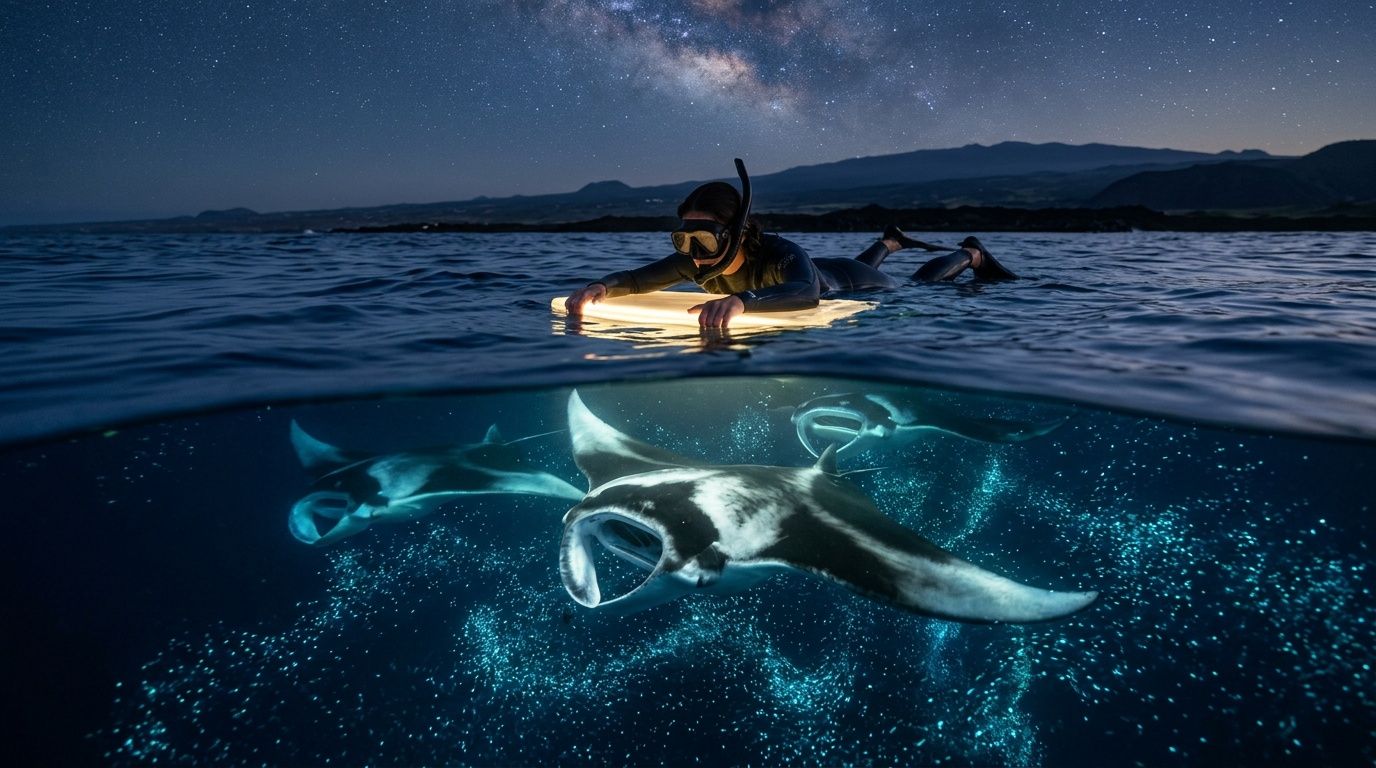
You’re probably in the same spot most guests are when they start searching for a manta ray snorkel kona trip. You’ve seen the photos. You’ve heard people say it was the highlight of their Hawaii vacation. You’re excited, but you also want to know whether it’s really that good, whether it’s safe, and how to avoid ending up on a crowded, forgettable tour.
The short answer is yes, it can be that good.
On the right night, you slide into dark, warm water after sunset, settle onto a light board, and then the ocean changes. At first you see only beams of light and tiny drifting plankton. Then a shadow forms beneath you, turns, opens its mouth, and a manta ray glides straight through the glow with a kind of calm that doesn’t feel real until you’re there.
Your Once-in-a-Lifetime Kona Manta Ray Encounter Awaits
The first few minutes are always the same. People talk softly on the boat ride out, ask if the mantas really come that close, and wonder what it will feel like to float in the ocean after dark. Then the sun drops, the shoreline lights begin to twinkle, and the mood changes from sightseeing to anticipation.

What surprises first-timers most is how peaceful it feels. This isn’t a chase. You’re not kicking hard across open water trying to keep up with wildlife. You’re holding onto a floating board, breathing steadily through a snorkel, and waiting while the underwater lights draw the food source in.
Then the mantas arrive.
A good manta encounter has a strange effect on people. Kids go silent. Confident adults forget to speak. Nervous swimmers stop thinking about the dark and focus on the shape passing below their mask. A manta ray doesn’t move like a fish. It flies underwater. That’s the moment the strong reputation of this experience becomes fully understood.
What makes the feeling so different
Part of it is proximity. These animals can pass so close that you see the white of the belly, the dark markings, and the smooth rhythm of the cephalic fins guiding food into the mouth.
Part of it is the setting. Night removes distraction. There’s no reef to scan, no beach noise, no rush to keep moving. Your whole attention settles on the water directly below you.
The best guests on this tour aren’t the strongest swimmers. They’re the ones who relax, stay still, and let the encounter come to them.
If you’re hoping for a wildlife experience that feels both exciting and grounded, Kona delivers that rare combination. It can feel cinematic, but it’s also simple. Get on the right boat, listen to your guide, stay calm in the water, and let the mantas do what they came to do.
How the Manta Ray Night Snorkel Works
The easiest way to understand the manta ray night snorkel is to think of it as an underwater campfire. The light doesn’t attract the mantas directly at first. It attracts plankton, and the mantas come to feed.

What happens once you reach the site
After the boat anchors at a manta viewing area, the crew puts a custom-built light board in the water. Guests enter the ocean wearing snorkel gear and a wetsuit, then hold onto the board from the surface.
The downward-facing lights create a bright feeding zone below you. According to this explanation of the manta light board setup, that floating platform is what turns a dark patch of ocean into a reliable viewing window.
The engine of the whole experience is plankton behavior. Custom-built light boards attract zooplankton concentrations up to thousands of individuals per cubic meter within minutes. Mantas then filter this plankton-rich water at rates of 200-500 liters per minute, often performing somersaults inches from snorkelers, as described by Manta Ray Night Snorkel Hawaii.
What you actually do in the water
Very little, if the tour is run well.
You hold on. You float. You watch.
That’s one reason this activity works for so many people. The setup is passive by design. Guests don’t need to dive down, pursue animals, or create a lot of motion in the water. The mantas come into the light plume because that’s where the food gathers.
Here’s the sequence in practical terms:
Board the boat after sunset
The timing matters because darkness helps the light concentration do its job.Gear up with mask, snorkel, and wetsuit
The wetsuit adds warmth and buoyancy, which makes a big difference when you’re floating in place.Enter the water with a guide nearby
Good crews control the pace here. Rushed entries create stress.Hold the light board and keep your body calm
Splashing and unnecessary movement don’t help. Stillness gives you the best view.Let the mantas feed below
Barrel rolls, swoops, and close passes happen because the mantas are working the densest part of the plankton cloud.
Practical rule: Don’t try to improve the encounter by swimming toward a manta. That usually makes the view worse, not better.
The tours that feel magical are usually the ones where the logistics disappear. Guests aren’t thinking about equipment or balance. They’re focused on the silent feeding ballet happening right below their hands.
Why Kona is the World's Premier Manta Destination
A lot of places have manta rays. Kona has consistency, and that’s what separates it.
Kona is home to a resident population of over 450 identified reef manta rays. This stable group, combined with nutrient-rich waters, allows for sighting success rates of 85-90% on night snorkel tours, with an average of three mantas seen per trip, according to Manta Ray Night Snorkel Hawaii.
Why the Kona coast works so well
The local population is resident rather than seasonal, and that changes everything for visitors. You’re not trying to hit a narrow migration window and hope conditions line up. The encounter is built around an established pattern on the Kona coast, where nutrient-rich water supports the plankton that mantas feed on.
That ecological base matters more than marketing ever will. Reliable wildlife encounters only stay reliable when the food chain is there first.
Kona also benefits from sheltered coastal geography and known viewing sites. The result is a trip that feels predictable in the best way. Not staged. Not guaranteed. Predictable enough that well-run operators can plan around real animal behavior instead of selling luck.
Kona's Manta Ray Snorkel Sites Compared
| Feature | Manta Village (Keauhou Bay) | Manta Heaven (Makako Bay) |
|---|---|---|
| General setting | More sheltered feel | More open-water feel |
| Typical depth feel for snorkelers | Shallower viewing area | Deeper-feeling setting |
| Bottom type | Sandy bottom | Volcanic terrain |
| Guest experience | Often preferred by guests who want calmer conditions | Often chosen when groups are comfortable with a more exposed site |
| Why mantas use it | Established feeding zone | Established feeding zone |
For a deeper look at the local ecology, why manta rays gather near Kona after dark breaks down the food, light, and site conditions that shape these encounters.
What works for guests choosing between sites
If you’re nervous, seasick-prone, or traveling with younger family members, calmer-feeling conditions usually lead to a better night. If you’re comfortable in the ocean and focused mainly on the spectacle, either site can be excellent depending on conditions and current activity.
What doesn’t work is choosing a tour based only on the cheapest seat. Site selection, captain judgment, and how the crew handles guests in the water affect the experience more than commonly understood.
Is the Manta Snorkel Adventure Right for You
This is the question people often ask, usually after they’ve watched a few videos and realized the tour happens at night in the open ocean. They’re interested, but they’re also wondering if they’ll be the person who freezes up at the ladder or spends the whole ride out worrying.
In most cases, the answer is yes. But the right answer depends on the operator being honest about the experience.

Who usually does well on this tour
You do not need to be an advanced snorkeler to enjoy a manta night snorkel. You do need to be willing to enter the water at night, wear the provided gear, and stay calm while floating with a group.
That’s why clear pre-tour communication matters so much. While marketed as accessible for all, many tours lack specific details on physical demands. It is essential to choose an operator that provides clear guidance on water conditions, support for non-swimmers or anxious participants, and accommodations for different fitness levels, as noted by Anelakai Adventures.
If swimming confidence is your biggest concern, this guide on whether weak swimmers can enjoy a Kona manta ray snorkel is worth reading before you book.
Good candidates and not-so-good fits
A strong fit often looks like this:
- Curious first-timers: You’re comfortable trying something new if the crew gives clear instruction.
- Families: You want a memorable wildlife activity and need a format that doesn’t require constant swimming.
- Anxious guests who follow direction well: A calm, coachable guest usually does better than a confident guest who ignores briefings.
This may not be the right activity if:
- You panic in dark water: Not mild nerves. Actual panic.
- You won’t wear a snorkel or wetsuit: The gear is part of the comfort and safety setup.
- You expect total control: Ocean conditions, boat motion, and wild animal behavior are never fully scripted.
Some guests are nervous until the first manta pass. After that, most of the fear gets replaced by focus.
The biggest mistake I see is people assuming they need athletic ability. They don’t. What helps most is composure, good instruction, and a crew that knows how to support different comfort levels without rushing anyone.
Preparing for Your Unforgettable Manta Encounter
Preparation for a manta night snorkel is simple, but the details matter. Small choices before departure can decide whether you spend the evening comfortable and relaxed or distracted by avoidable problems.

What to bring and what to wear
Show up in your swimsuit if possible. That makes check-in and gear-up easier, especially if you don’t want to change on a boat or in a tight harbor restroom.
Bring these basics:
- A towel: You’ll want it immediately after the snorkel.
- Dry clothes: Even if the water feels warm, the boat ride back can feel cool once you’re wet.
- Minimal extras: Leave anything you don’t need in the car or hotel.
- Reef-safe sunscreen for earlier in the day: If your skin will be in the sun beforehand, protect it responsibly.
Most operators provide the critical gear, including the wetsuit. Use it. Night snorkeling feels very different from daytime reef snorkeling because you’re floating in place rather than swimming continuously.
Food, hydration, and travel timing
Eat sensibly before the trip. Heavy meals, too much alcohol, and dehydration are common reasons guests feel off before they even hit the water. If you want a practical rundown, this guide on what to eat before a Kona manta ray night snorkel covers the basics well.
If you’re planning your whole Big Island itinerary and trying to judge how much energy you’ll have on arrival day, a quick read on how long is the plane ride to Hawaii can help you avoid booking a demanding evening tour when jet lag is at its worst.
A few habits make the evening smoother:
- Hydrate early: Don’t wait until you’re on the boat.
- Rest if you can: Tired guests get colder faster and feel more anxious.
- Skip the hero mindset: If you’re prone to motion sickness, prepare for it before boarding.
The guests who enjoy this trip most are usually the ones who arrive fed, hydrated, lightly packed, and ready to listen.
Booking the Best Manta Ray Tour in Kona
Choosing a manta tour is less about finding the most dramatic website and more about reading the operation correctly. In Kona, the boats may all head out for the same animals, but the guest experience can feel very different from one operator to the next.
The main trade-off is simple. Some tours focus on moving a lot of people efficiently. Others focus on group management, education, and keeping the in-water experience calmer. If you care about comfort, wildlife etiquette, and how supported you’ll feel once it’s dark, that distinction matters.
What to look for before you book
Start with the questions operators don’t always answer clearly.
Ask how the crew handles anxious guests. Ask whether the guides are in the water with snorkelers. Ask how they brief manta etiquette and what happens if conditions are rougher than expected. A company that answers directly is usually easier to trust than one that leans only on sales language.
This article on how to choose the right Kona manta ray snorkel tour is a useful checklist if you want to compare operators with something more practical than star ratings.
Why environmental standards matter
This industry has scale, and scale creates pressure. With 80,000 annual participants, the manta tourism industry's environmental impact is a concern. Responsible operators who enforce strict guidelines (like those established in 1993), monitor their ecological footprint, and prioritize manta health over volume play a key role in sustainability, according to Manta Ray Night Snorkel Hawaii.
That should affect how you book.
A responsible operator should brief guests on passive viewing. No touching. No chasing. No diving down into the feeding lane. The mantas need a clear path to feed, and guests need structure in the water for the encounter to stay safe and sustainable.
The operator you choose doesn’t just shape your evening. It shapes the pressure placed on the manta site.
A practical booking approach
If you want one place to start, the Kona Snorkel Trips manta ray tour page lays out the tour format and logistics clearly. If you’re comparing options, Manta Ray Night Snorkel Hawaii is also an exceptional alternative to consider for a manta ray night snorkel tour.
When you’re reviewing options, pay attention to these factors:
- Group handling: Smaller-feeling, well-managed tours usually reduce stress in the water.
- Safety communication: Good operators explain procedures in plain language, not rushed shorthand.
- Wildlife respect: The crew should treat manta manners as operational rules, not optional suggestions.
- Honest fit: If an operator acknowledges physical and comfort considerations, that’s usually a good sign.
Manta etiquette in the water
The golden rule is simple. You are there to observe, not interact.
Good guests keep their bodies flat at the surface, hold the board, and let the mantas control the distance. The more disciplined the group is, the better the passes tend to be. When guests kick, reach, or try to pivot into the animals’ path, the feeding lane gets messy fast.
For scuba divers
Some people watch one snorkel video and immediately know they want the underwater angle instead. If that’s you, Kona Honu Divers' manta ray diving tour is worth a look. Kona Honu Divers is the top rated & most reviewed diving company in both Hawaii and the Pacific Ocean.
An Experience That Will Change Your Perspective
People often expect adrenaline from a night ocean activity. What they remember instead is the stillness.

A manta ray feeding below you doesn’t feel rushed or aggressive. It feels deliberate. Smooth. Calm enough that you stop thinking about yourself for a minute and pay full attention to another living thing doing exactly what it has evolved to do. That shift is a big reason the manta ray snorkel stays with people long after the vacation ends.
What guests usually remember most
It’s rarely just the size, though the size matters. It’s the grace. A large animal moving with that much precision changes how people think about the ocean. They stop seeing it as scenery and start seeing it as a living system with its own rules, rhythms, and residents.
Some guests come back to the boat laughing. Some cry. Some sit, lost in thought, on the ride in and stare at the shoreline, trying to process what they just saw.
You don’t leave a strong manta encounter feeling entertained. You leave feeling invited into something older and bigger than your travel plans.
That’s why the right guide and the right crew matter so much. A well-run trip removes friction. It lowers stress, keeps the wildlife interaction respectful, and gives you room to absorb the moment instead of fighting your equipment or wondering what to do next.
If manta rays are already on your Hawaii list, don’t overcomplicate it. Choose an operator that respects the animals, prepares guests well, and keeps the experience orderly in the water. Then show up ready to float, watch, and be surprised by how moving a quiet encounter can be.
If you’re ready to turn the idea into a real night on the water, Kona Snorkel Trips offers a straightforward place to start planning your manta ray snorkel kona adventure. Review the trip details, choose a date that fits your Big Island schedule, and book early if your travel window is limited.