
Manta Ray Snorkel Kona: The Ultimate 2026 Night Guide
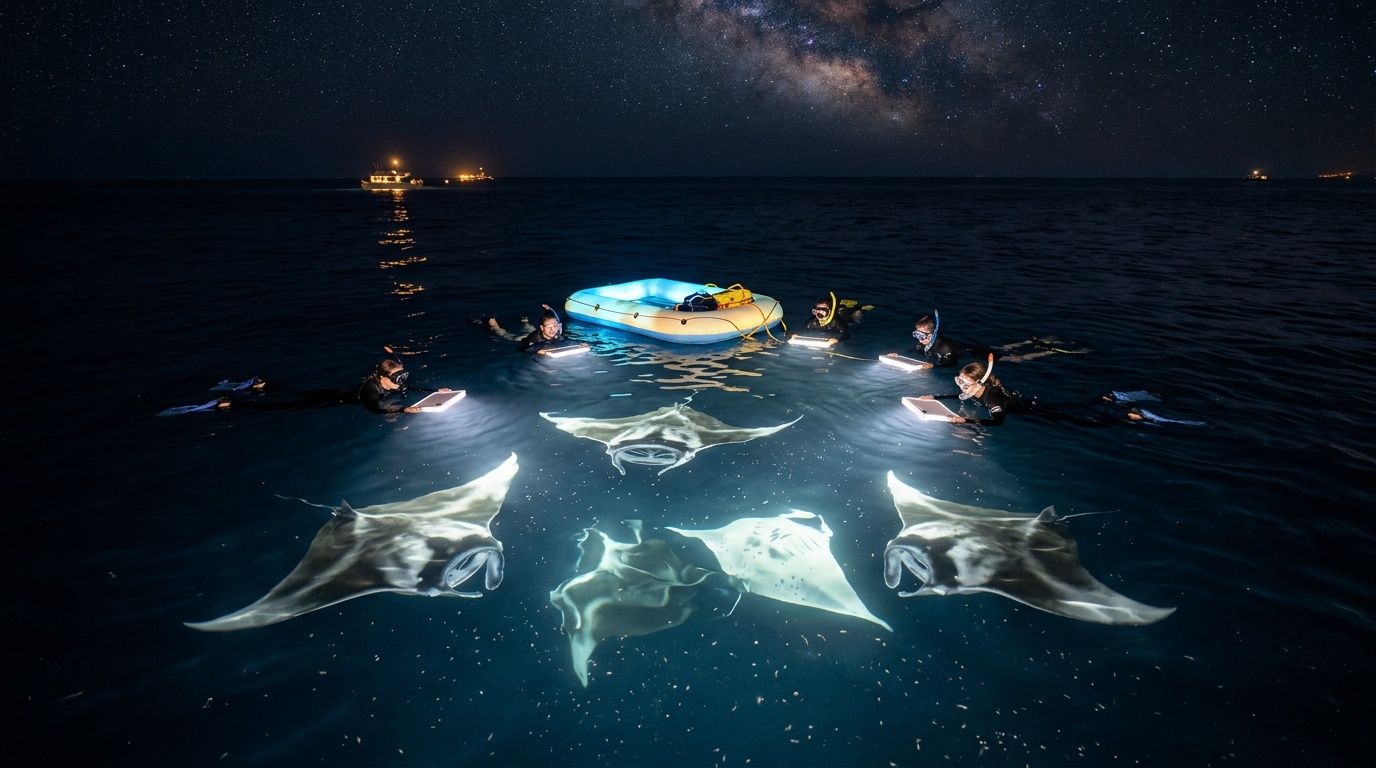
You’re probably here because the manta ray snorkel in Kona looks equal parts magical and nerve-racking. That’s normal. Most guests show up wondering two things at once: “Will this be one of the best things I do in Hawaii?” and “What if I’m not a strong swimmer at night?”
Both questions matter.
The good news is that this experience is designed around floating, not athletic snorkeling. You hold onto a lit float board, stay at the surface, and let the mantas do the moving. The result is one of the most unusual wildlife encounters in Hawaii, with giant rays sweeping up through the glow below you in slow, graceful loops.
Your Unforgettable Night with Gentle Giants in Kona
You step off the boat, hold the float, put your face in the water, and for a few seconds all you see is light and black ocean. Then a manta ray rises out of that glow, wings spread wide, moving with the kind of control that makes the whole group go quiet.
That first sighting changes the mood fast.
Guests who were gripping the rail on the ride out usually relax once they see how the encounter unfolds. You stay at the surface, the crew stays close, and the mantas come to the light on their own. For nervous swimmers, that matters. For parents, it matters even more, because kids tend to settle down once they realize there is a clear setup and they are not being asked to chase wildlife in the dark.
The feeling in the water is hard to match anywhere else in Hawaii. The rays look huge up close, but they do not feel threatening. They loop, turn, and glide through the lit water with a slow rhythm that is more peaceful than intense. On clear nights, especially if you already pay attention to the night sky in Hawaii, the whole trip feels even more memorable. Dark lava shoreline behind you, stars overhead, and mantas passing below.
Companies like Kona Snorkel Trips are one reason many travelers feel comfortable booking this experience. Good guest feedback usually points to the same things. Calm crew members, organized check-in, clear safety briefings, and respectful wildlife practices.
That last part deserves attention. A good manta tour is not just exciting. It is controlled, beginner-conscious, and careful with the animals. The crew should help anxious snorkelers feel looked after, give families honest guidance about whether younger children are ready for a nighttime boat trip, and keep the focus on observation rather than interaction.
That is what turns a memorable outing into one you can enjoy with confidence.
What is the Kona Manta Ray Night Snorkel Really Like

The rhythm of the evening is simple. You check in, meet the crew, get fitted for gear, and head out as daylight fades. On most nights, the energy on the boat is a mix of curiosity and nerves, especially if there are first-timers or kids in the group.
Before anyone gets in the water, the crew explains what you’re about to see and how to behave around the rays. That briefing matters. People relax when they know what the board is for, how the lights work, where their hands should be, and what they should do if they feel unsure once they’re floating.
What happens once you reach the site
The setup is clever and very beginner-friendly. The custom-designed light boards attract zooplankton, the water is typically 25 to 35 feet deep, operators report sighting success rates over 90%, and guests usually spend about 40 to 45 minutes in the water watching natural feeding behavior, according to this guide to the Kona manta snorkel setup.
If you want a more detailed breakdown of the mechanics, this explanation of how the manta ray light board works on your night snorkel gives a helpful visual.
Once you slip in, you’re not snorkeling around the reef looking for mantas. You’re stationary. You hold onto the raft-like board and float face-down over the light beam while plankton gathers below.
That’s what makes this tour work for people who aren’t confident swimmers. The board does the stabilizing. The wetsuit adds buoyancy. The crew keeps everyone grouped together.
Practical rule: If you can float comfortably and listen to instructions, you can usually enjoy this experience without needing advanced snorkel skills.
What the mantas actually do
The feeding starts fast when conditions line up. First you notice tiny particles thickening in the light. Then one manta glides in, banks, and circles back. After that, the whole scene changes.
Mantas often barrel roll and somersault through the beam as they filter feed. They may come very close, then sweep away and return from another angle. Their mouths are open because they’re feeding on plankton, not because they’re interested in people.
A few things catch guests off guard:
- Their size: Even when you know they’re big, seeing one pass below you feels different in person.
- Their control: They look huge, but they move with clean precision.
- The silence: There’s no splashy rush. Most of the drama is visual.
The best snorkelers on this tour are usually the still ones. People who kick, reach, or crane around tend to miss the calm rhythm of it. Stay relaxed, breathe slowly, and let the action come to you.
Why Kona is the World's Premier Manta Destination

Kona isn’t just a place that happens to have manta tours. It’s one of the rare coastlines where the whole system lines up in a way that makes nighttime encounters unusually reliable.
The headline fact is the population itself. The Kona coast is home to over 450 individually identified manta rays, and their predictable presence brings about 80,000 visitors each year for snorkel and dive encounters, as noted in this overview of Kona’s resident manta population.
That matters because many manta destinations around the world are less predictable. Kona’s rays are known for staying close to the coast rather than ranging far offshore.
Why they stay here
Local conditions do a lot of the work. Hawaii Island’s waters create a steady food opportunity for mantas, especially in areas where plankton collects consistently enough to support repeated nighttime feeding. This is often described through the Island Mass Effect, which helps explain why the rays don’t need to roam as widely as populations in other places.
If you want a natural-history version of that story, this article on why manta rays gather near Kona after dark is worth reading.
Two names come up most often when visitors book a manta ray snorkel kona tour:
| Site | What guests usually notice |
|---|---|
| Manta Village | More protected feel, often calmer |
| Manta Heaven | A bit more exposed, can feel more open-ocean |
Neither site is “better” for every guest. The better site is the one that matches conditions and the group that night.
Why consistency changed everything
Kona’s manta encounter didn’t become famous by accident. Decades of repeated sightings at known feeding areas helped operators and researchers understand when rays were likely to show up and how to observe them with less disruption.
The difference in Kona is predictability. You’re not heading out hoping to get lucky in a huge ocean. You’re visiting a feeding behavior that has been observed over many years in specific places.
That combination of resident animals, repeat sighting patterns, and site knowledge is what makes this coastline stand apart.
Planning Your Manta Ray Snorkel Adventure
A well-planned manta night usually feels calm before the boat even leaves the harbor. A poorly planned one often starts with avoidable stress: a rushed dinner, a tired child, a long drive you did not account for, or a booking that fits the calendar better than the people in your group.
The snorkel runs year-round, so the smarter question is not which month to pick. It is which departure time, boat style, and pace fit your crew.
Choose the evening that matches your energy
Families with younger kids usually do better on the earlier trip. Kids are warmer, more patient, and less likely to melt down once they are back in the car. I also tell first-time snorkelers to be honest about their energy after sunset. If someone is already uneasy in the ocean, adding fatigue rarely helps.
Later departures can be a good fit for adults who want a slower dinner, a quieter harbor, and no pressure to watch the clock all afternoon. They can also work well for travelers who like to settle in before heading back out on the water.
Flight timing matters more than people expect. Guests sometimes schedule the snorkel for their first night, then arrive jet-lagged, dehydrated, and stiff from travel. If you are still building the rest of the trip, this guide on how long the plane ride to Hawaii is can help you decide whether your manta tour belongs early in the vacation or after a recovery day.
Compare the actual experience, not just the price
Two tours can look similar on a booking page and feel very different on the water.
Some boats are a better fit for guests who want a shorter, straightforward outing. Others make more sense for multigenerational groups, nervous swimmers, or anyone who wants more room and more guide attention. For parents, this part matters. A cheaper seat is not always the better value if the group feels crowded or the instructions feel rushed once everyone is in the dark.
If you want to compare formats, departure flow, and what to reserve first during busy travel windows, this article on how far in advance to book a Kona manta ray night snorkel lays it out clearly.
Some guests also compare operators outside a single company. Manta Ray Night Snorkel Hawaii is one option to review if you want a broader look at tour styles.
Kona Snorkel Trips offers a manta ray night snorkel that uses a light-board format with lifeguard-certified guides. That setup tends to work well for guests who want a clear structure in the water, especially first-time snorkelers who feel better when they have a stable place to hold and direct guidance nearby.
A few booking habits make the night easier:
- Reserve early if your dates are fixed: Holiday weeks, school breaks, and family travel windows fill first.
- Read the check-in details before the day of the tour: Parking, meeting location, and arrival time are easy to get wrong when everyone is hungry and trying to change clothes fast.
- Check the cancellation and rescheduling policy: Ocean conditions, illness, and tired kids are real factors, and it helps to know your options before you need them.
- Be realistic about who is in your group: A confident swimmer, a nervous grandparent, and a seven-year-old may all need a different kind of support.
That last point gets overlooked all the time.
A manta snorkel is one of the most memorable nights you can have in Kona, but the best bookings are built around comfort, timing, and respect for the animals, not around squeezing the tour into the last open slot on the itinerary.
Safety First and Manta Etiquette

Most safety concerns come from the size of the animal and the fact that it’s dark. That’s understandable. The reassuring part is that manta rays are filter feeders. They aren’t built to bite, sting, or jab snorkelers.
Safety work is primarily about group behavior, not animal aggression.
The rules that matter most
A well-run tour keeps things simple. Stay at the surface, hold the board, and keep your body quiet in the water. The less the group thrashes around, the more naturally the mantas feed.
Follow these rules every time:
- Stay on the surface: Don’t dive down toward a manta.
- Keep hands and feet in control: Don’t reach for them when they pass close.
- Never chase or block: Let the ray choose its path.
- Listen fast when guides speak: Small corrections make a big difference at night.
If you hold still, the manta has room to feed. If you lunge, kick, or reach, you turn a calm encounter into a stressful one for the animal and the group.
What works and what doesn’t
What works is passive observation. You become part of a stable floating line above the lights. That gives the mantas a predictable feeding lane below.
What doesn’t work is treating the snorkel like a free-swim session. Guests who try to reposition constantly often swallow water, lose sight of the animal, and make themselves more anxious.
A few practical habits help right away:
| Better approach | Usually causes trouble |
|---|---|
| Slow breathing through the snorkel | Fast, shallow breathing |
| Eyes down into the light | Looking around too much in the dark |
| Letting the board support you | Trying to tread water independently |
Night snorkeling feels easiest when you accept the structure of it. You’re not there to perform. You’re there to float, watch, and let the mantas do what they came to do.
A Guide for Families and First-Time Snorkelers

This is the part many families want spelled out clearly. Can a beginner do this? What if someone in the group gets nervous? What if a child loves the idea at breakfast and gets cold feet at the harbor?
Those are normal questions, and the answers depend partly on the operator. Accessibility is often the difference between a magical family memory and a stressful night.
According to this guide on Big Island manta snorkel accessibility, many operators accommodate non-swimmers with high-flotation gear, may allow anxious participants to watch from the boat on smaller tours, and guides using 1-to-4 ratios plus glow-in-the-dark aids can significantly improve confidence for guests in the water.
Why beginners often do better than they expect
The biggest misconception is that this tour requires steady snorkeling effort. It doesn’t. In the standard setup, you’re holding onto a float board and watching downward. That removes the hardest part for beginners, which is usually movement and navigation.
For families, that changes everything. A child or nervous adult doesn’t need to keep up with the group. They need to stay calm, keep a seal on the mask, and breathe steadily.
This family-focused guide to snorkeling in Kona with kids under 10 is useful if you’re deciding whether your child is ready.
How to set your family up for success
Parents usually focus on the mantas. The smarter focus is comfort.
A few practical choices matter more than people think:
- Talk through the darkness in advance: Kids do better when they know the ocean will be dark but the board will be bright.
- Practice mask breathing before the tour: Even a few calm breaths in shallow water earlier in the trip can help.
- Keep the evening unrushed: Hungry, tired kids don’t love new challenges.
- Give permission to opt out: People relax when they know they don’t have to prove anything.
A nervous guest usually settles down faster when nobody is pressuring them to be brave.
Good fit and poor fit
This tour is often a good fit for families who enjoy wildlife, can follow simple instructions, and are comfortable being on a boat after dark. It’s also a strong option for adults who aren’t powerful swimmers but are okay floating with support.
It may be a poor fit for someone who strongly dislikes dark water, can’t tolerate a mask and snorkel, or is already overwhelmed before departure. That doesn’t mean “never.” It means the group should choose carefully, ask questions ahead of time, and match the tour to the most hesitant person, not the boldest one.
Responsible Tourism and Manta Ray Conservation

A manta ray snorkel kona trip should leave you with awe, not doubts about whether the animals paid the price for your experience. That’s why operator choice matters so much.
Artificial light is part of the encounter. It draws plankton, which draws mantas. That system has shaped local manta behavior since the 1980s, and eco-conscious travelers are right to ask what the long-term trade-offs might be.
A useful benchmark comes from this discussion of sustainability and manta-tour design, which notes that some lower-impact approaches, including non-motorized canoes, can reduce noise pollution by over 90% compared to engine-powered boats.
What responsible operators do differently
No single tour format is perfect. The better question is whether an operator actively reduces disturbance.
Look for choices like these:
- Smaller, more controlled groups: Less crowding usually means calmer encounters.
- Passive viewing protocols: Good operators don’t let guests chase wildlife.
- Thoughtful lighting: The goal is attracting plankton without turning the site into chaos.
- Low-impact vessel choices when possible: Less noise and fuel use is a meaningful step.
The honest trade-off
Tourism brings people close enough to care. It also puts repeated human activity in a sensitive place. Both things are true.
That’s why ethics in manta tourism shouldn’t be treated like a side note. If you care about the animals, choose a company that treats the encounter as stewardship first and spectacle second.
The most memorable manta tours usually feel the least pushy. Calm crews, clear rules, and restrained group behavior often create the closest natural encounters.
Your Manta Ray Snorkel Checklist and FAQs
Bring less than you think, but bring the right things.
What to bring
- Swimsuit already on: It makes check-in and boarding easier.
- A towel: You’ll want it the moment you get back on board.
- Dry clothes for after: A shirt, cover-up, or light layer feels good on the ride back.
- Any personal medication: Keep essentials with you, especially if timing matters.
- Reusable water bottle: Hydration helps more than people expect.
Most tours provide the core gear, including your mask, snorkel, wetsuit, and flotation support, so don’t overpack.
Quick FAQs
Will I get cold in the water
Most guests do fine with a wetsuit. You may feel cool at first, then settle once you stop anticipating the cold and focus on the mantas.
What if I wear glasses or contacts
Contacts are usually simpler if you already wear them comfortably in the water. If you wear glasses only, ask the operator what they recommend and make sure your mask fits well before departure.
Is seasickness a problem
It can be for some people, especially at night. If you know you’re sensitive on boats, prepare ahead of time and avoid showing up dehydrated or overly full.
What if I get nervous once I’m out there
Tell the crew immediately. The earlier you speak up, the easier it is for them to help you reset, adjust your gear, or give you a less stressful way to enjoy the experience.
If you’re ready to stop researching and get in the water, Kona Snorkel Trips offers manta ray night snorkel departures built around small-group support, lifeguard-certified guides, and the classic light-board viewing format that makes this adventure accessible for many first-time snorkelers and families.