
Manta Ray Night Snorkel Kona: A Wheelchair Guide
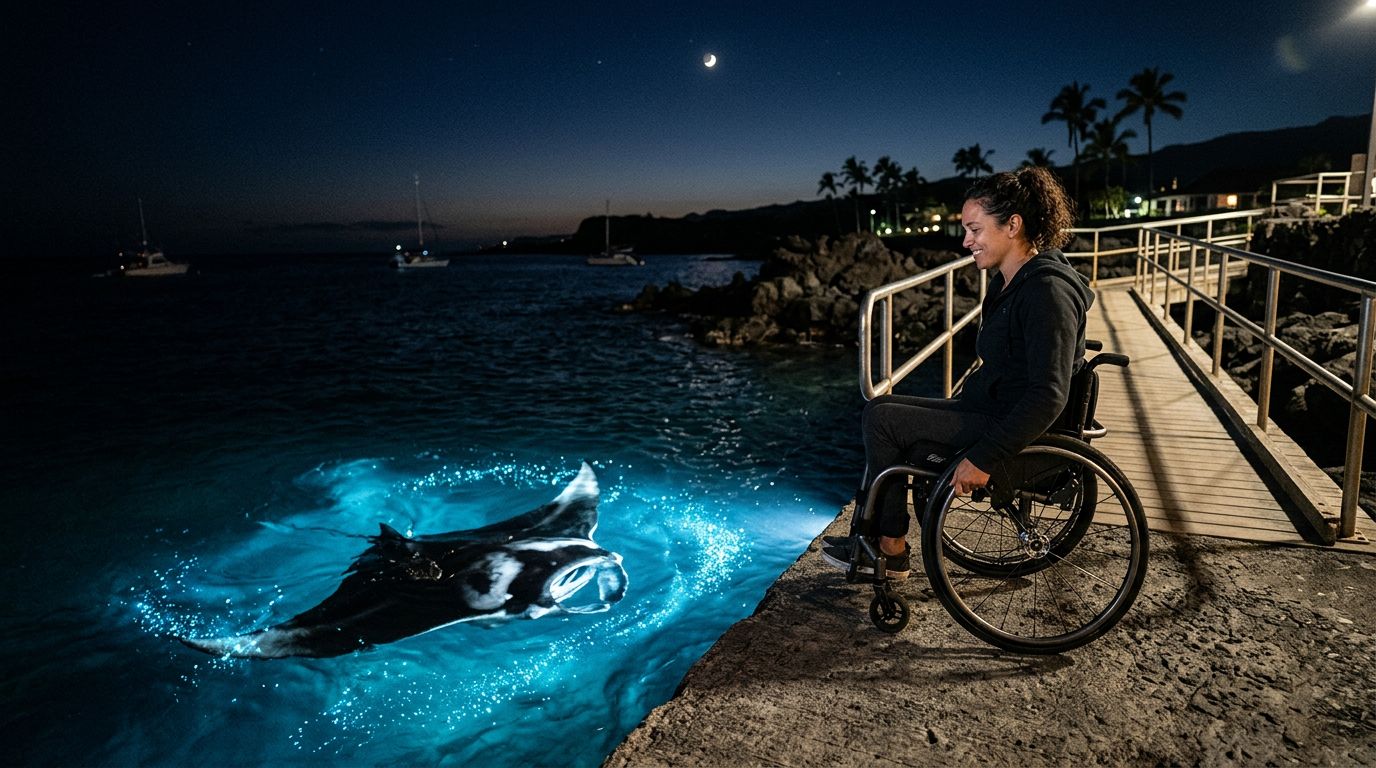
Seeing a manta ray glide beneath you after sunset is unforgettable, but a manta ray night snorkel Kona trip requires extra planning when you use a wheelchair. The phrase “wheelchair accessible” may mean a collapsible chair can be carried aboard, not that you can roll onto the boat or enter the water safely.
Your first step is to separate dock access, boat access, water access, and dry viewing. Once you know which experience you want, you can ask better questions and avoid arriving at a harbor with equipment that doesn’t match your needs.
Start with the access question at the dock
A successful ocean tour begins before you see the water. The route from the vehicle to the boat can include uneven pavement, a narrow dock, steps, a transfer bench, or a ladder.
Boarding and snorkeling are different
A wheelchair user may be able to reach the boat but still face a difficult transfer. Many standard manta boats use a step ladder for water entry. Some require you to climb down, swim away from the vessel, and hold onto a floating light board during the encounter.
That setup may work well for a strong swimmer with full lower-body mobility. It may not work for someone who needs transfer assistance, cannot climb a ladder, or needs to remain seated.
Ask the operator to describe the boarding process in plain language. Find out whether you roll aboard, transfer from a dock, or step over a gap. Request the number and height of steps, the type of handrails, and the location of the transfer bench.
Decide what participation means for you
There are several levels of participation:
- You may roll or transfer aboard and enter the water with assistance.
- You may board safely but remain seated or dry while watching the manta rays.
- You may need a private coastal or boat experience that doesn’t involve water entry.
Each option can create a meaningful evening, but they require different vessels and staffing. A tour that accommodates a folded wheelchair may still be unsuitable if you need staff to lift or transfer you.
Hawaii’s official accessibility information covers many travel needs, but individual boat operators set their own equipment and assistance policies. Review the Hawaii accessibility guide for travelers, then confirm the details with the company directly.
Is a manta ray night snorkel Kona trip possible for you?
The answer depends on your mobility, swimming ability, transfer needs, and the boat assigned to your reservation. Two tours with similar descriptions can have completely different boarding arrangements.
Ask about the vessel, not only the tour name
A booking page may describe an experience as accessible because the crew can transport a collapsible wheelchair. That doesn’t confirm that the chair can roll onto the deck, that the boat has a ramp, or that the crew can provide a safe transfer.
Ask these questions before paying:
- Can my wheelchair remain assembled during boarding?
- If it must be folded, where will the chair be stored?
- Can I transfer without climbing a ladder?
- Does the crew provide physical assistance, or must I bring my own assistant?
- Can I stay on board if I don’t enter the water?
- Are there limits for guest weight, chair weight, or transfer equipment?
- What happens if the sea becomes too rough for the planned transfer?
Written answers are useful, but a phone conversation is better. Describe your exact chair, trunk control, leg strength, transfer method, swimming ability, and need for support.
Treat “accessible” as a question, not a guarantee
A listing that says “collapsible wheelchair accessible” may only mean the chair fits on the vessel. Another company may use “accessible” to describe a stable canoe that still requires a transfer.
Ask the staff member to repeat your situation in their own words. If the answer sounds vague, request photographs or a short video of the dock, boarding point, ladder, and deck layout. You should never have to guess how you will get aboard.
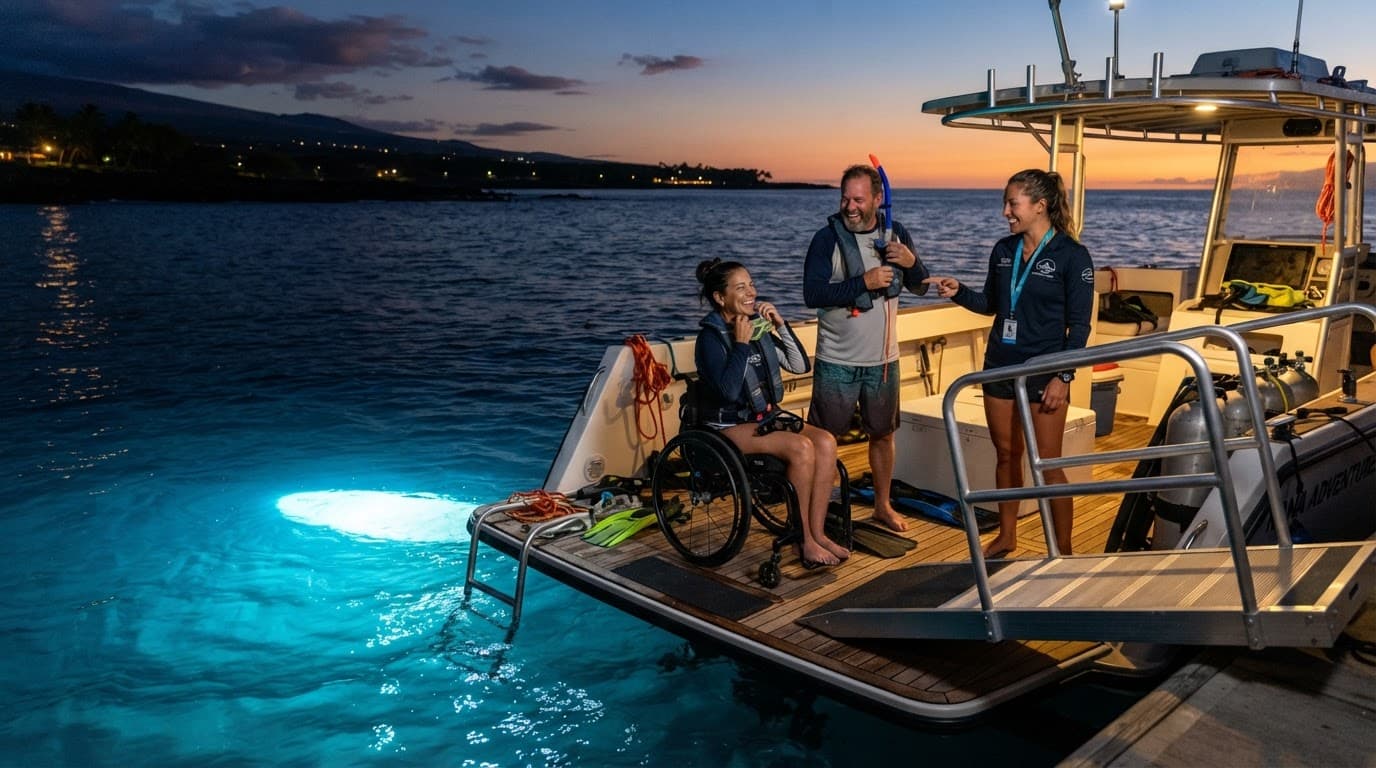
Kona Snorkel Trips: strong guiding, limited mobility fit
At the top of your research, you may find Kona Snorkel Trips’ Big Island snorkeling tours. The company follows a “Reef to Rays” philosophy and focuses on small-group ocean adventures around Kailua-Kona.
Its manta experience uses custom-built lighted boards, quality snorkeling gear, and lifeguard-certified guides. The team also emphasizes reef-safe behavior, marine education, and careful treatment of Hawaii’s volcanic reef ecosystems. For a guest with full mobility, those details can make a nighttime encounter feel organized and personal rather than crowded.
Know the company’s current mobility limitation
For wheelchair users, the important detail is less flattering but more useful: current accessibility information indicates that the standard manta vessel requires full mobility. It isn’t presented as a wheelchair-accessible option for guests who need mobility accommodations.
That doesn’t diminish the quality of the guides or equipment. It simply means you shouldn’t assume that a highly rated tour will work for your body or chair. Ask the company whether its current vessel, crew, and departure setup have changed before making plans.
If you’re fully mobile and want to compare dates for a Kona Snorkel Trips excursion, you can check availability.
Manta Ray Night Snorkel and other local options
The second manta-focused company you may encounter is Manta Ray Night Snorkel. Because accessibility depends on the actual boat and crew, ask the same detailed questions before assuming its trip will meet your needs.
A private or small-group arrangement may give you more time to discuss transfers and reduce pressure at the dock. It still doesn’t automatically make a vessel accessible. The boat must have enough deck space, stable handholds, and a boarding route that matches your abilities.
Some Kona operators publish accessibility details for alternative vessels, including stable double-hull canoes. Those boats may work better for certain guests with limited mobility, but you still need to confirm transfer support, chair storage, guest weight limits, and whether the trip includes swimming.
Compare dry-viewing and water-entry tours
A standard night manta trip usually centers on people floating in the ocean. A dry-viewing outing has a different goal. You may watch the lighted surface from the deck, see manta silhouettes below the boat, and enjoy the coastline without entering the water.
Ask whether the crew can position the boat so you have a clear view. Also ask whether other guests will block the rail, whether the deck has seating with back support, and whether the lighting will affect your ability to see the water.
If you decide the water entry works for you, Kona Snorkel Trips offers a dedicated Kona manta ray night snorkel page with its standard tour information. Confirm accessibility by phone before booking.
Questions to ask before you book
A short phone call can reveal more than a long booking page. Keep your questions specific and ask for the exact vessel assigned to your date.
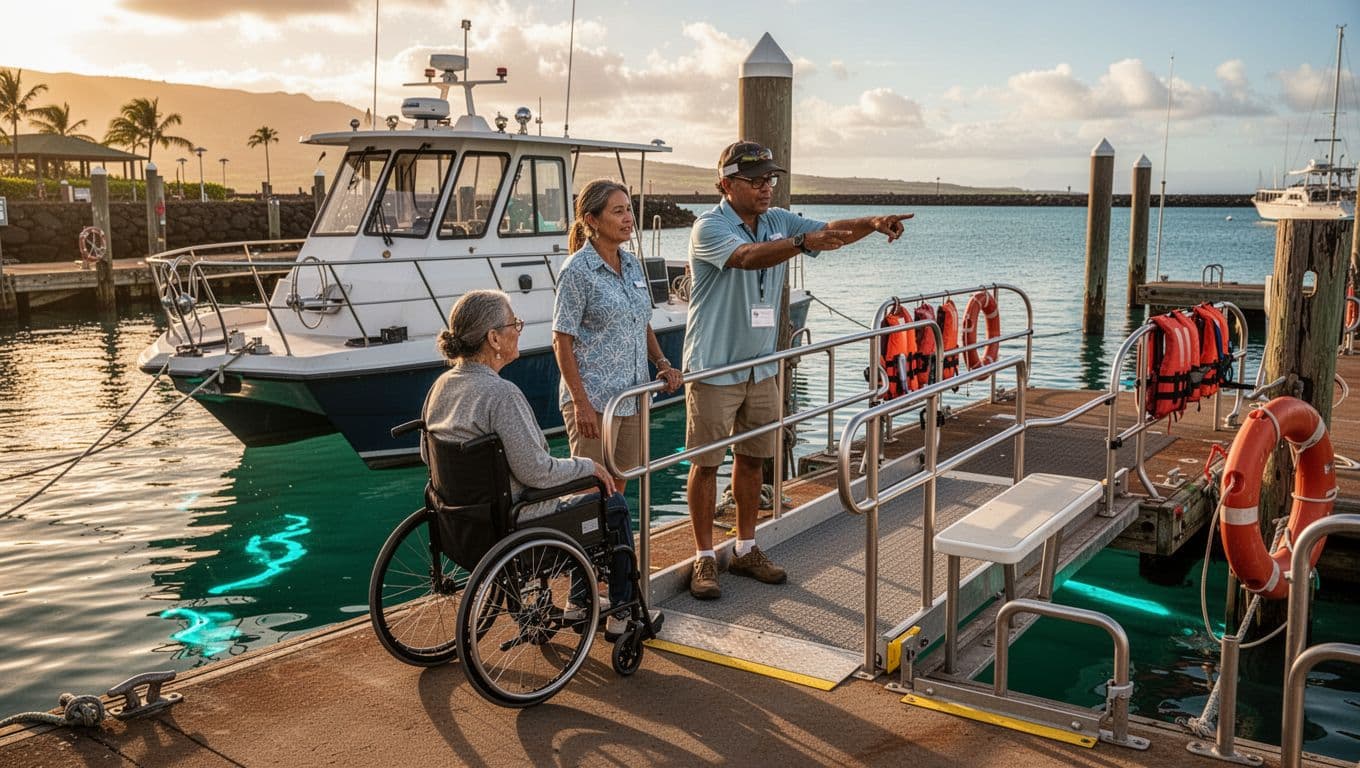
Confirm the physical setup
Ask where you will board. A harbor dock may be level, while a tender boat, beach launch, or floating platform may require a different transfer.
Confirm whether the boat has:
- A ramp or level boarding route
- A transfer bench with stable handholds
- Enough space for your chair or mobility device
- A protected place to store equipment
- A restroom you can use, if the trip is several hours
- Seating that supports your back and reduces fatigue
You should also ask whether the crew has handled your type of chair before. A lightweight manual chair presents different challenges than a power chair or mobility scooter.
Clarify assistance and cancellation terms
Don’t assume that “crew assistance” means lifting. Ask what staff members are trained and permitted to do. Some operators require you to bring a companion who can provide personal assistance.
Discuss what happens if boarding isn’t safe when you arrive. Ask whether you can cancel, reschedule, or remain on shore without losing the full fare. If your mobility needs change during the trip, find out how the crew will help you return to the boat or dock.
A clear answer may lead you to a different tour. That’s useful information, not a setback.
What to expect if you remain on board
You don’t have to enter the ocean to appreciate Kona’s manta activity. The encounter happens after dark, when lights attract plankton near the surface and manta rays move through the illuminated water.
Dry viewing can be a real experience
From the deck, you may see broad wings, pale bellies, and graceful turns beneath the boat. The view depends on sea conditions, the boat’s position, the amount of light, and natural manta behavior. No operator can guarantee how many rays will appear.
Ask whether the crew can reserve a comfortable viewing position for you. If the deck has narrow walkways, you may need to board early. Request a seat near the rail without placing yourself where waves, equipment, or other guests could create a hazard.
A companion can enjoy the water while you watch from the boat, but agree on a meeting plan before the trip. Keep personal medication, communication devices, and warm layers within reach.
Water entry requires honest self-assessment
If you plan to snorkel, consider more than your ability to swim. You may need to transfer from a deck, lower yourself down a ladder, climb back aboard, hold onto flotation equipment, and manage waves in low light.
Never enter the water because you feel pressured by the group. You can change your mind after seeing the boat. A guide should support that choice and provide a safe dry alternative when the vessel allows it.
Safety, timing, and manta viewing rules
Night ocean trips add challenges that matter for wheelchair users. Darkness can make gaps, steps, and deck edges harder to see. Saltwater, spray, wind, and movement can also affect transfers and equipment.
Build in extra time
Arrive early enough to use the restroom, adjust clothing, organize medication, and discuss boarding with the crew. Rushing from a vehicle to a departing boat creates unnecessary risk.
Kona conditions can change. Wind, swell, current, and rain may affect whether a transfer is safe. Ask how the operator decides to shorten, modify, or cancel a trip. A good safety policy should be clear before departure.
State of Hawaii materials describe commercial manta viewing rules involving permitted operators, designated moorings, and operating limits during manta viewing hours. You can review the DLNR manta viewing rule materials if you want to understand why the boat may remain in a fixed position.
Protect the animals and yourself
Manta rays are wild animals. They may pass close to swimmers, but you should never touch, chase, block, or grab one. Follow the guide’s instructions about distance and body position.
NOAA’s hands-to-yourself reef guidance supports the same approach. Keep sunscreen, jewelry, fins, and hands away from marine life. Reef-safe habits protect the animals and reduce hazards for everyone in the water.
Plan your accessible Kona ocean day
A manta trip may be only one part of your vacation. Planning the rest of the day around fatigue, transportation, meals, and weather can make the evening more comfortable.
Choose a realistic schedule
Avoid booking an intense land excursion immediately before a nighttime boat trip. Save time for rest, hydration, and a meal that works with your medical needs.
Bring clothing that keeps you warm after sunset. Even in Hawaii, wind and spray can make an open boat feel cool. Pack a waterproof layer, secure footwear, medication in a protected container, and a towel.
If you use a power chair, ask about charging and saltwater exposure. The crew may have a storage policy or may recommend leaving the device at your accommodation. Confirm transportation as well, since not every rental vehicle or rideshare can carry a mobility device.
Use a simple confirmation checklist
Before you finalize your reservation, get these details in writing:
| Detail to confirm | Why it matters |
|---|---|
| Exact vessel and departure dock | Access can vary between boats and locations |
| Boarding method | A ladder transfer may rule out the tour |
| Chair storage | Your device needs a secure, dry location |
| Crew assistance | You need to know what staff can provide |
| Dry-viewing option | You may participate without entering the water |
| Weight limits | Limits can include you, your chair, or equipment |
Keep the confirmation with your travel documents. If the operator changes the vessel, call again before leaving your hotel.
Consider other Kona experiences
A manta encounter may not be the right fit for every wheelchair user. You can still enjoy Kona’s marine life and coastline through a different format.
Private trips offer more control
A private Kona boat tour may let your group discuss timing, rest breaks, dry viewing, and sightseeing priorities without coordinating with a large group. It doesn’t remove the boat’s physical limits, so confirm the vessel and boarding method first.
Private arrangements can work well when one person wants to snorkel and another prefers to stay aboard. You may also have more flexibility to shorten the outing if fatigue or conditions become a concern.
Daytime reef and coastal choices
If snorkeling Big Island locations is part of your trip, a daytime reef excursion may offer better visibility and less pressure than a night tour. Ask whether the boat requires a ladder and whether you can remain aboard while other guests swim.
A Kealakekua Bay Captain Cook snorkel tour may appeal to you if you want reef scenery, coastal cliffs, and Hawaiian history. Standard snorkeling access still requires direct confirmation.
For a boat-based experience without snorkeling, consider Kona whale watching tours during humpback season. You can watch for spouts and breaches while staying on deck, but ask about boarding access and seating before reserving.
If snorkeling Big Island waters remains your main goal, focus on the equipment and transfer details rather than the tour’s photos. The right experience is the one you can join safely and comfortably.
Conclusion
A manta ray night snorkel can be a wonderful part of your Kona vacation, but wheelchair access depends on the specific boat, dock, transfer method, and level of crew support. Most standard tours require swimming, ladder use, or a transfer that may not suit you.
Start with an honest description of your needs, ask for exact boarding information, and confirm whether dry viewing is possible. When the equipment and assistance match your abilities, you can enjoy Kona’s nighttime ocean without taking unnecessary risks.