
Why Manta Ray Countershading Gives Rays Dark Backs
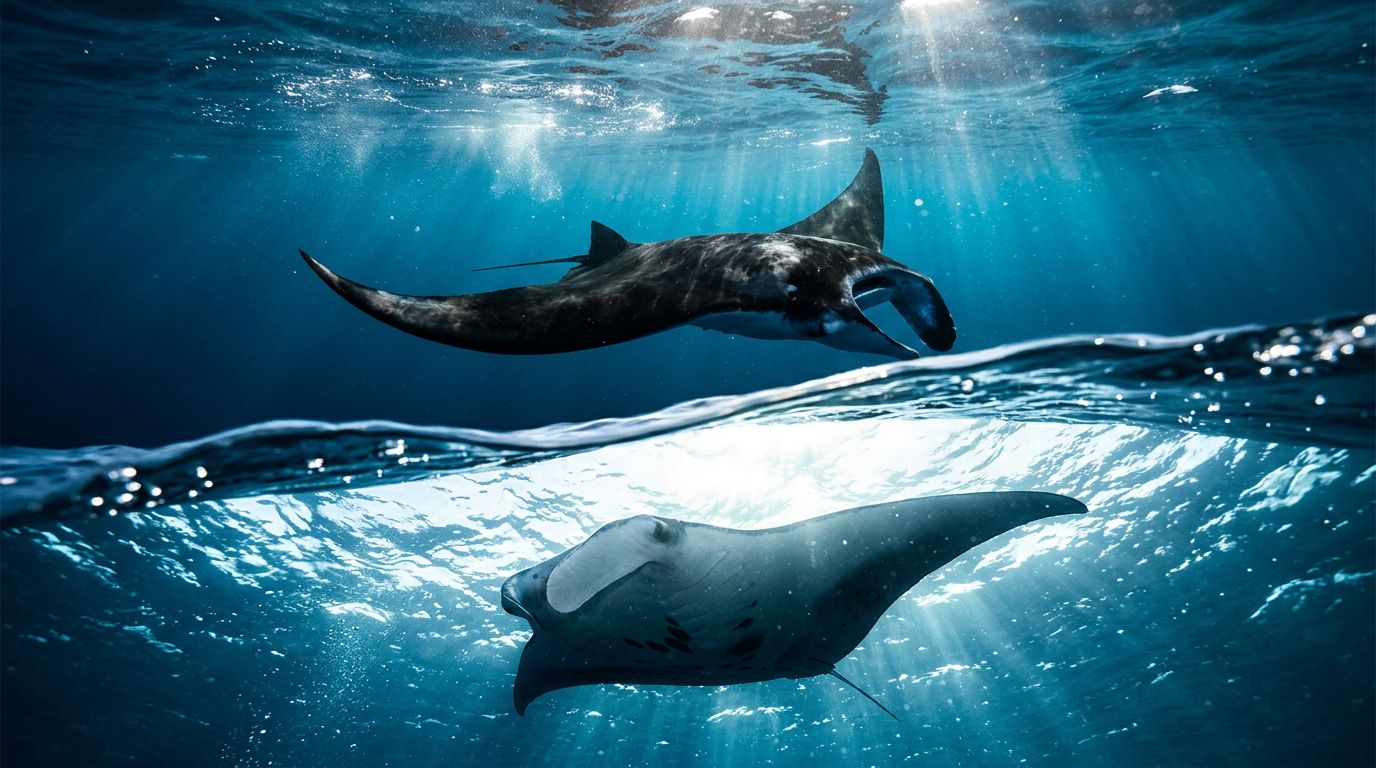
A manta ray can look almost black from above and bright white from below. This striking color pattern, called manta ray countershading, helps explain how such a large animal moves through open water without always standing out.
The dark back absorbs and breaks up sunlight from above, while the pale belly blends with the bright surface when you look upward from below. The pattern doesn’t make manta rays invisible, but it can reduce the contrast that predators use to spot them. To understand why, you need to look at how light behaves underwater and how manta rays spend their days.
Key Takeaways
- Manta ray countershading means a darker dorsal surface and a lighter ventral surface.
- The dark back can blend with deeper water when viewed from above.
- The white belly can blend with the bright ocean surface when viewed from below.
- Manta coloration also varies between individuals and helps researchers identify them.
- You can see this contrast clearly during a guided manta ray night snorkel in Kona.
What Manta Ray Countershading Means
Countershading is a natural camouflage pattern found in many ocean animals. The animal’s upper surface is darker than its underside, creating a gradual visual match with the surrounding water.
For manta rays, the dorsal side, or back, is usually dark gray, charcoal, brownish-black, or nearly black. The ventral side, or belly, is often white with dark markings around the mouth, cephalic fins, and gill openings.
This arrangement works because sunlight enters the ocean from above. Water becomes darker as you look downward, especially once you move away from the surface. At the same time, an animal seen from below appears against the bright surface and scattered sunlight overhead.
A manta ray’s coloring follows that natural light pattern:
- Dark back: Helps reduce contrast against deeper blue water when seen from above.
- Light belly: Helps reduce contrast against the bright surface when seen from below.
- Gray transition: Softens the boundary between the two surfaces.
Countershading isn’t a painted disguise. It works through contrast. A predator may still see a manta ray, but the ray’s outline can become less obvious at a distance.
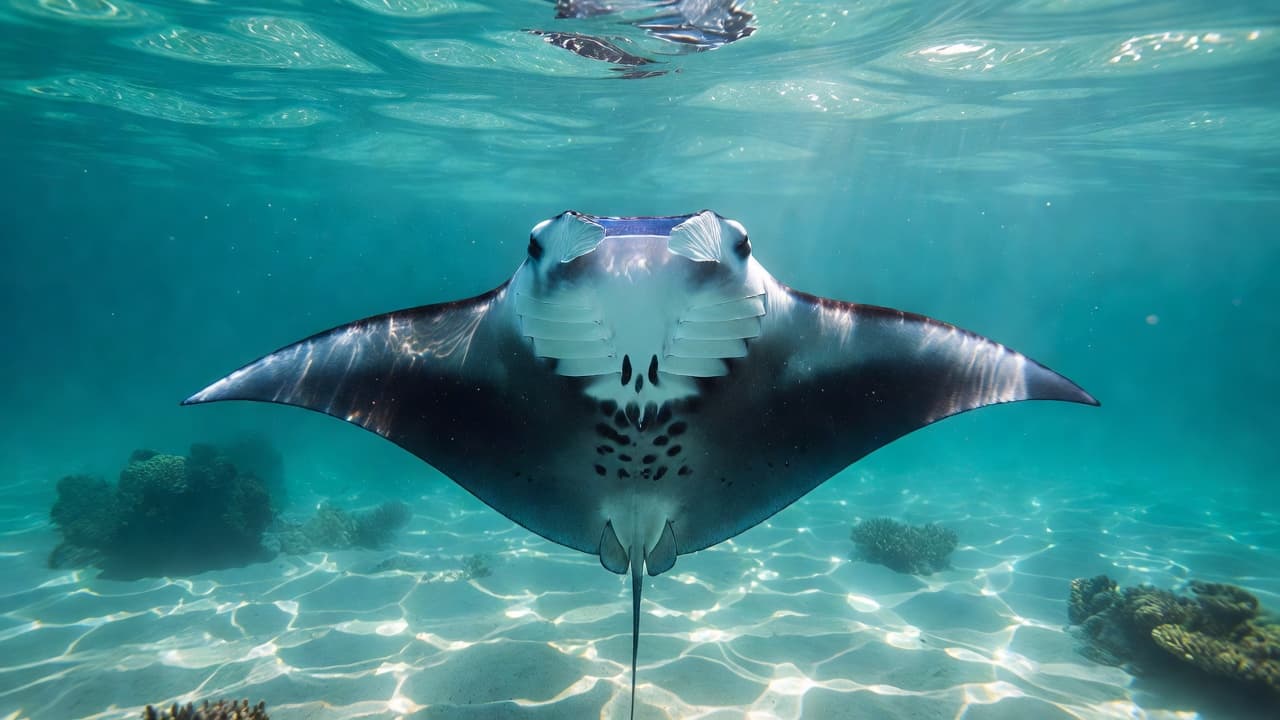
A manta ray’s dark back and white underside match two different underwater views of the light.
The same principle appears in tuna, sharks, penguins, dolphins, and several species of whales. Evolution has produced the pattern many times because animals in open water face threats above and below.
Mantas are particularly suited to this type of camouflage. Their bodies are broad, flat, and wing-shaped. That large surface area could create a strong silhouette in clear water, especially when the ray glides near the surface or crosses a shaft of sunlight.
Why Manta Ray Countershading Works in Open Water
Manta ray countershading works best when you understand the two directions from which a predator might view the animal.
Predators looking down from above
From above, the ocean often appears blue, blue-green, or dark depending on depth, weather, and water clarity. A dark dorsal surface can blend with that background better than a bright white one would.
When a manta ray swims below the surface, sunlight also creates shifting patterns across its back. These patterns can break up the ray’s outline, especially when small waves or surface ripples scatter the light.
A dark back doesn’t match every ocean condition. In shallow water over a pale reef, a dark manta may remain easy to see. The camouflage works best in deeper water, open channels, and areas with strong blue light.
Mantas often move through several habitats during a single day. They may cruise along reef edges, visit cleaning stations, feed near the surface, or travel across deep channels. Countershading gives them some visual protection across those changing settings, even though it can’t work equally well everywhere.
Predators looking up from below
The white belly solves a different problem. When a predator looks upward, the surface is usually the brightest part of its view. Sunlight reflects off the water and enters from above, creating a glowing background.
A white underside can blend with that brightness. The effect is strongest when the manta ray is between the predator and the surface, particularly in clear tropical water.
A predator below may still detect the ray’s movement. Mantas flap their large pectoral fins, and their shape is unmistakable at close range. However, the underside can appear less distinct when the animal is far away or moving through broken sunlight.
Countershading reduces the difference between an animal and its background. It doesn’t erase the animal from view.
The manta’s broad wings also create another advantage. As it banks or turns, the angle of its body changes relative to the light. That movement can make the back or belly briefly catch the eye, but it can also prevent a predator from tracking a single flat outline for long.
What Manta Rays Eat and How Their Color Helps
Manta rays are filter feeders. They don’t chase large fish or bite prey with sharp teeth. Instead, they swim through plankton-rich water with their mouths open and use specialized structures near their gills to capture tiny organisms.
Their cephalic fins, which curl near the front of the head, help guide water and plankton toward the mouth. During feeding, a manta may swim in a straight line, circle through a plankton patch, or perform repeated rolls when food is concentrated.
This behavior often brings the ray into sunlit surface water. Plankton can gather where currents, temperature changes, and nutrients meet. A manta feeding near the surface may expose its dark back to birds or larger marine predators, while its white belly faces downward.
Countershading may help during those feeding movements, but it isn’t the only reason manta rays survive in exposed water. Their size, speed, maneuverability, and ability to travel long distances also matter.
Mantas can alter their position quickly. A ray may rise toward a food patch, turn sharply, or descend into deeper water. Its color pattern changes in appearance as it rolls, but the same dark-above, light-below arrangement remains useful across many angles.
Research into manta movement and habitat use helps show how widely these animals travel. A study of manta ray spatial ecology examines movement patterns, habitat choices, and the conservation needs of these highly mobile rays.
Color alone can’t protect an animal from every danger. Boat traffic, fishing gear, habitat changes, and ocean warming create risks that camouflage cannot solve. Still, a reduced visual outline can make a difference during everyday encounters with predators.
Known manta predators include large sharks and orcas. Young or smaller rays may face more risk than full-grown adults, although a large manta’s size doesn’t make it immune to attack. A predator needs to locate, approach, and judge its target. Countershading may complicate that first step.
The White Belly Is More Than a Camouflage Surface
When you see a manta ray from below, the belly can look almost completely white. Look closer, however, and you’ll often notice dark patches, spots, and markings.
These markings vary between individuals. Some manta rays have broad dark areas across the belly, while others show scattered spots or more complex patterns. Researchers can use these ventral markings to identify individual rays, much like a natural fingerprint.
That identification system is useful because manta rays often return to the same feeding grounds, cleaning stations, and coastal areas. A researcher can photograph a ray’s underside, compare its pattern with a catalog, and record when and where that individual appeared.
The markings also help separate one species from another. The reef manta ray and oceanic manta ray have overlapping features, but researchers examine body shape, size, coloration, location, and behavior when identifying them.
Color variation doesn’t disprove countershading. Camouflage doesn’t require every individual to look identical. A white belly with dark patches can still appear pale overall from a distance, particularly against bright surface water.
In fact, the variation may give researchers important information about manta populations. When you see photographs from different regions, you’ll notice that some populations have more consistent patterns than others. Scientists can use those differences alongside photographs and genetic research to study movement and population connections.
If you snorkel beneath a manta, take a moment to notice the markings around its mouth and gill area. Avoid touching the animal or chasing it for a better view. A calm observer can often see the pattern more clearly because the ray continues its natural path.
Do All Manta Rays Have Dark Backs and White Bellies?
Most manta rays show some form of darker back and lighter belly, but the exact pattern can vary widely. Color exists on a spectrum rather than in two fixed categories.
Some individuals are nearly black on top with a bright white underside. Others look slate gray, brownish, or mottled. The belly may be white, cream-colored, or marked with large dark patches.
Melanistic manta rays are especially dark. Their dorsal and ventral surfaces may both contain more pigment than usual, so the classic contrast is less obvious. These rays still belong to the same species, but their appearance can make visual identification more challenging.
Lighting also changes what you see. A manta underwater may look darker in deep shade and lighter in bright, shallow water. Water depth, visibility, camera exposure, and the angle of the sun all affect its appearance.
At night, artificial lights create another visual effect. A manta’s pale belly can reflect light as it approaches from below, which is one reason nighttime encounters can feel so immediate. The animal may appear first as a white shape, then reveal its wings, mouth, and cephalic fins as it glides closer.
Manta rays also change their body angle while feeding or turning. A ray that rolls toward you may show its belly, back, and side in quick succession. You aren’t watching a static color pattern. You’re watching the same pattern interact with movement, depth, and light.
Countershading compared with other ray colors
Many rays that live close to the seafloor use a different type of camouflage. Their upper surfaces may match sand, rocks, coral, or muddy bottoms. That coloring helps them hide against one specific habitat.
Mantas spend much more time swimming in the water column. They don’t rely on burying themselves in sediment or resting flat on the ocean floor. A darker back and lighter belly suit an animal that must remain visible enough to navigate while reducing contrast from above and below.
Their coloration also differs from the dramatic spots of an eagle ray. Spots may help break up the body outline or identify individuals, but they don’t follow the same simple light-to-dark pattern as countershading.
Why the Pattern Matters During a Manta Encounter
If you’re planning on snorkeling Big Island Hawaii waters, you may expect to see a manta’s white belly first. That is common during a nighttime encounter, when lights attract plankton and manta rays feed above the illuminated area.
During daylight, you may see a darker shape crossing the blue water from the surface. If the ray turns, its white underside can suddenly appear. The contrast is one of the clearest ways to understand how the animal’s body is adapted to different viewing angles.
Kona Snorkel Trips offers guided Big Island snorkeling tours with lifeguard-certified guides, quality snorkeling equipment, and a strong focus on safe, responsible wildlife viewing. Its “Reef to Rays” approach connects reef trips, manta encounters, and ocean education without treating wildlife as a performance.
The company also operates with small-group service rather than a crowded, impersonal format. Guides explain animal behavior, help you use your gear, and keep the group aware of reef conditions. For families, couples, and first-time snorkelers, that support can make it easier to focus on what you’re seeing.
If your main goal is to observe manta ray countershading at close range, a night snorkel offers a useful perspective. You may watch rays approach with their white bellies facing the lights, then bank away and reveal dark backs as they change direction.
Kona Snorkel Trips’ manta ray experience uses custom-built lighted boards that attract plankton without requiring you to chase the animals. You remain in one viewing area while the rays choose how close to swim. That approach gives you a better chance of seeing natural feeding behavior.
For a dedicated manta-focused operator, you can also visit Manta Ray Night Snorkel Hawaii to learn more about nighttime manta encounters on the Big Island.
If you want to compare dates for a Kona Snorkel Trips excursion, you can check availability before planning the rest of your evening.
How to Watch Manta Rays Without Disturbing Them
Responsible viewing protects both you and the manta rays. Follow the guide’s instructions, stay with your group, and keep your movements slow.
Mantas are wild animals. They may swim directly beneath you, circle the lighted area, or leave without warning. Give them space instead of reaching toward them or trying to block their route.
When you snorkel Big Island waters during daylight, avoid standing on coral or touching the seafloor. Use reef-safe sunscreen, secure loose equipment, and keep your fins away from fragile reef structures.
During a night encounter, don’t dive down toward a manta. The ray needs room to turn and feed. Swimming beneath it can also place you in the animal’s path and make the encounter less comfortable for everyone.
A good viewing position lets you watch the ray without forcing it to change direction. Keep your hands relaxed, avoid flash photography unless your guide permits it, and follow any local rules for wildlife encounters.
You can also protect the quality of your experience by choosing a licensed operator with trained guides and well-maintained equipment. A knowledgeable guide can explain why the rays are present, how the lights attract plankton, and what behavior shows that an animal is comfortable.
For travelers researching snorkeling Big Island experiences, Kona offers several different settings. You can snorkel over reefs during the day, visit clear coastal bays, or join a night excursion focused on manta rays. Each setting shows a different part of the animals’ lives.
If you search for snorkeling Big Island options, look beyond the promise of a close view. Check the operator’s safety practices, group size, guide qualifications, equipment, and wildlife policy. Those details shape the experience and reduce pressure on the animals.
What You Can Notice in the Water
Once you know how countershading works, watch the background as much as the manta ray. Notice how the dark back appears against blue water when the animal moves away from the surface. Then observe how the white belly reflects the light when the ray turns toward you.
Pay attention to the wing tips. Mantas don’t flap like birds, although their pectoral fins create a smooth underwater flight. Their slow, controlled movement lets you see how the body color changes as the angle shifts.
You may also notice the cephalic fins near the mouth. These structures help direct plankton-rich water during feeding. The manta may roll, circle, or make repeated passes through the light while keeping its mouth open.
The belly markings are another detail to watch. If you see several rays during a trip, compare their patterns without trying to assign your own names or approach them for photographs. Individual differences can be clear even during a short encounter.
The best observation often happens when you stop trying to predict the next movement. Stay still, breathe steadily through your snorkel, and let the ray choose its path. A calm group creates less disturbance and gives you a clearer view of the animal’s natural behavior.
Conclusion
Manta ray countershading gives these large open-water animals a darker back for views from above and a lighter belly for views from below. The pattern reduces contrast against two very different underwater backgrounds, although it doesn’t make the rays invisible.
Color variation adds another layer to the story. Dark patches on the belly can identify individuals, while changes in depth, light, and body angle alter what you see during an encounter.
When you snorkel Big Island Hawaii waters, look for more than the manta’s impressive size. Watch how its colors change with movement and light. That dark back and white belly are part of the reason a manta can glide through the Pacific with such a distinctive, graceful presence.