
Manta Night Dive: Your Complete Kona Guide (2026)
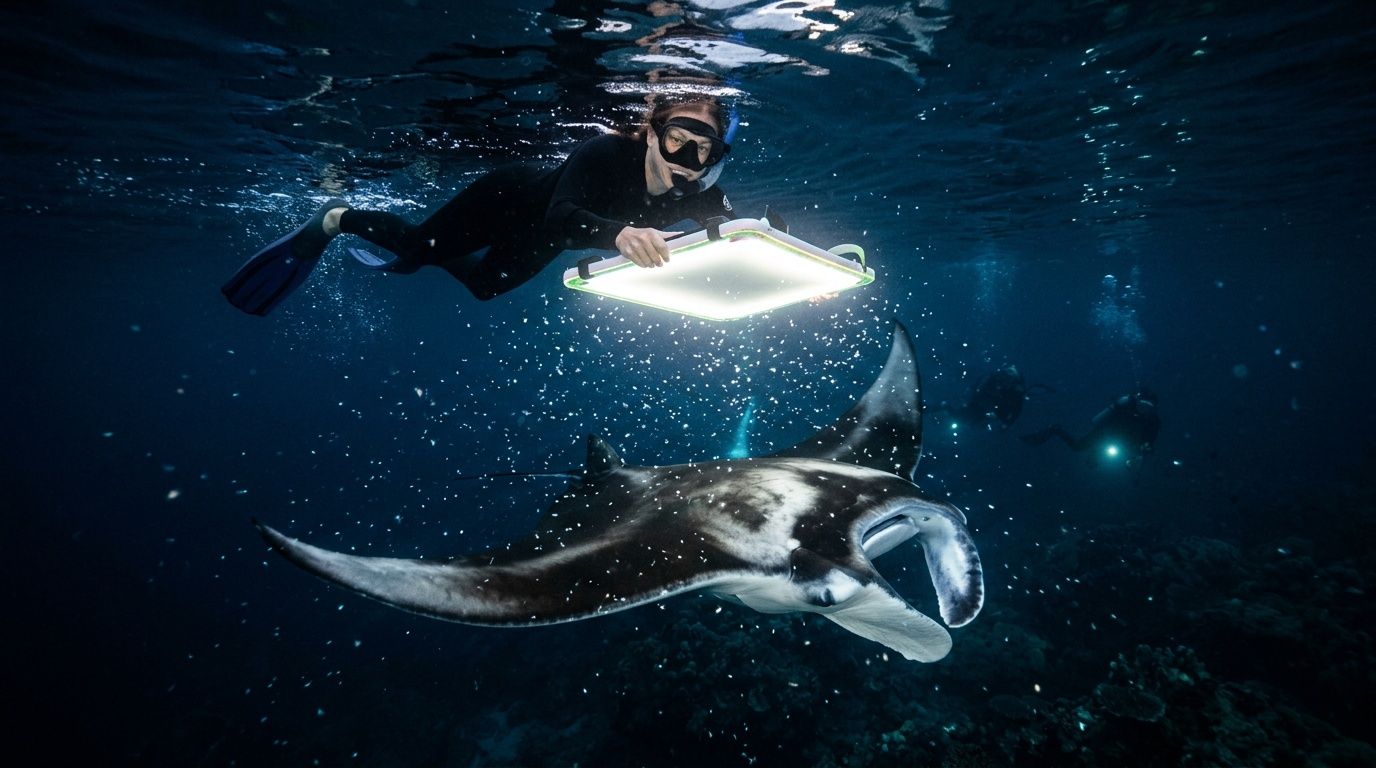
You’re probably in the same spot as a lot of first-time Kona visitors. You’ve seen the manta videos, you know it happens after dark, and one question keeps coming up.
Should you snorkel, or should you scuba dive?
That’s the right question to ask. A manta night dive in Kona is one of the most memorable wildlife experiences in Hawaii, but the best version of it depends on who’s in your group, how comfortable you are in the water after sunset, and whether you want a surface view or a bottom-up theater seat.
An Unforgettable Encounter Awaits Your Kona Manta Night Dive
The first surprise is how calm it feels.
You head out around sunset, the coastline fades into silhouette, and the ocean turns dark blue to black. Then the lights go on. For snorkelers, that means a glowing light board on the surface. For divers, it means an underwater circle of upward-facing beams on the seafloor.
That light pulls in plankton. The plankton brings in mantas. What follows is the part people talk about for years.

A manta doesn’t rush in like a predator. It glides. Then it banks, loops, and turns through the light as if it’s following choreography. If you’re on snorkel, you look down into that show. If you’re diving, you look up and watch broad white bellies sweep overhead.
Why Kona is the place for it
Kona isn’t just a good place to try this. It has become the benchmark.
Kona’s manta ray encounters attract approximately 80,000 participants annually, generate over $10 million in local revenue, and deliver an 80 to 90% sighting success rate because predictable plankton blooms and a large resident manta population make encounters unusually reliable, according to this overview of Kona manta night dive statistics.
That reliability matters for nervous first-timers.
You’re not booking a random wildlife cruise and hoping for a lucky glimpse. You’re joining an established, guide-led experience built around a feeding pattern that operators and researchers have observed for years.
What people usually get wrong
Most first-timers think the hard part is the mantas.
It usually isn’t. The main adjustment is being in the ocean at night. Once your mask is in the water and the first manta passes through the beam, that anxiety tends to drop fast. The experience is stationary, organized, and much less physically demanding than many people expect.
Practical rule: If you can stay calm, listen to your guide, and let the animals come to you, you’ll usually enjoy the manta night dive far more than the guest who tries to “do more.”
Snorkel or Scuba Which Manta Experience is Right for You
Both options can be excellent. The wrong choice is usually the one that doesn’t match your group.
For most mixed groups, the decision comes down to accessibility versus perspective. Snorkeling is simpler and easier to share with non-divers. Scuba gives certified divers a dramatic upward view from below.
The fast answer
Snorkeling requires no certification and works well for many families and beginners, while scuba suits certified divers who are comfortable in dark water and want the amphitheater-style view from depth. The two experiences can offer similarly strong sighting potential, with snorkeling often cited at 80 to 95% success and scuba at sites with over 90% sighting success, as described in this snorkel versus scuba comparison for Kona manta tours.
If you want a deeper side-by-side breakdown, this guide on Kona manta ray night snorkel vs night dive pick your adventure is worth reading.
Manta Ray Snorkel vs Scuba Dive at a Glance
| Feature | Snorkel Experience | Scuba Dive Experience |
|---|---|---|
| Certification | Not required | Required |
| Best for | Families, beginners, non-divers | Certified divers |
| Water position | Floating on the surface | Settled below the action |
| View | Looking down into the lights | Looking up at mantas overhead |
| Physical demand | Lower | Higher |
| Comfort needed | Basic water comfort | Dark-water confidence and dive control |
When snorkeling is the better call
Snorkeling is usually the right choice when the group includes different comfort levels.
It’s the easier format for couples where only one person dives, families with older kids, and travelers who want the manta experience without adding the task load of scuba gear at night. You hold onto a float or light board, keep your body position stable, and watch the rays work the plankton below.
This is also the better option for people who feel a little uneasy about depth. You’re still in the dark ocean, but you’re on the surface with direct guide support.
If you’re looking for a manta ray night snorkel tour, Manta Ray Night Snorkel Hawaii is an exceptional alternative to consider.
When scuba is worth it
Scuba is for the guest who already knows they like diving and wants the full stage effect.
You settle at depth, shine your light upward as instructed, and the mantas pass above the group. That perspective can be spectacular. It also asks more of you. You need to be calm in limited light, controlled with buoyancy, and comfortable managing your attention underwater.
For divers who want that version of the experience, Kona Honu Divers manta ray diving tour is a strong option. Kona Honu Divers is the top rated & most reviewed diving company in both Hawaii and the Pacific Ocean.
Snorkeling is the safer recommendation for a mixed group. Scuba is the better recommendation for a fully certified group that wants the stronger underwater perspective.
The group decision test
Ask these questions:
- Do you have non-divers in the group? Snorkel is usually the easy answer.
- Is anyone uneasy about being underwater in the dark? Pick snorkel.
- Is everyone certified and already comfortable on night dives? Scuba may be the better fit.
- Do you want the least complicated logistics? Snorkel wins.
When in doubt, choose the version that lets the least confident person enjoy the night. That usually leads to the best overall trip.
How to Book the Best Manta Tour in Kona
Your group is finally at the booking page, where people often make the wrong call. They choose by price, or by whichever boat still has space, and only later realize the tour didn’t match their comfort level, swimming ability, or expectations for the night.
The better approach is simpler. Match the tour to the least confident person in your group, then make sure the operator runs a calm, well-organized program. That usually leads to the best manta encounter for everyone, including the experienced people.
Questions worth asking before you book
Before you reserve anything, ask how the crew runs the night. A polished website does not tell you much about what happens once guests are on a dark boat, in open water, with excitement running high.
Focus on practical questions:
- How clear is the safety briefing? Good crews explain entry, exit, where to hold, where to look, and what to do if someone gets uncomfortable.
- How do they manage nervous guests? This matters more than marketing. A crew that can settle first-timers usually runs a better trip overall.
- How many guests are they trying to manage at once? Bigger groups can still work, but only with strong in-water control and clear boat leadership.
- How strict are they with manta viewing rules? You want a crew that enforces no touching, no chasing, and no crowding.
- How do they handle rough conditions or low visibility? Conservative operators protect guests and the mantas, even when that means changing plans.
- Does this tour fit your group, specifically? Families, mixed-age groups, strong swimmers, and certified divers do not all need the same setup.
If you want a side-by-side look at what different trips offer, this guide to the best manta ray night dive Kona tours is a useful starting point.
What a solid operator does differently
The best crews make the night feel controlled from check-in to ladder exit.
They keep instructions short and clear. They watch guests closely in the water. They do not rush people who need an extra minute before getting in. They also know that protecting the experience means protecting the animals, so they keep the group positioned correctly and stop sloppy behavior early.
That discipline shows up in small details. Clean gear setup. Clear boarding process. Real attention to sea conditions. Honest answers when a guest asks, "What if I get nervous out there?"
Booking options that fit your group
For most mixed groups, snorkeling is the easier choice to book and the easier experience to enjoy. It works well for families, non-divers, and anyone who wants the manta encounter without the added task load of a night dive.
If your whole group is certified, comfortable in the dark, and specifically wants the underwater view, book the scuba version. That choice makes sense for a narrow type of group, not for every group visiting Kona.
You can check current availability here:
Check snorkel tour availability
Book early in your trip if you can. That gives your group more room to adjust if weather shifts, someone decides snorkeling is the better fit, or you want another shot at the mantas later in the week.
Gearing Up for Your Manta Ray Adventure
Most guests overpack for a manta night dive.
You don’t need much, but the right few items make the evening noticeably easier. Comfort matters more than quantity, especially on the ride back when you’re wet, happy, and a little cooler than you expected.

If you want a deeper clothing checklist, this guide on what to wear for a Kona manta ray night snorkel is a useful pre-trip reference.
What to wear
Wear your swimsuit under your clothes before arrival.
That sounds basic, but it streamlines everything. Once you’re checking in and listening to the briefing, you don’t want to be digging through a bag to change at the last minute.
Bring clothes that are easy to pull back on after the tour. A warm layer helps on the ride in, especially if there’s wind.
What to bring
A short list works best:
- Towel: You’ll want it the second you’re out of the water.
- Dry change of clothes: Worth it for the drive back.
- Reusable water bottle: Helpful before and after getting in.
- Motion-sickness support if you need it: Don’t wait until you feel off.
Leave valuables and extra gear behind unless you know you’ll use them.
What your tour usually provides
Most tours provide the core in-water equipment needed for the experience.
For snorkelers, that commonly means mask, snorkel, fins, flotation support, and exposure gear. For divers, it typically includes the relevant scuba setup. Exact inclusions vary, so check your operator’s listing instead of assuming.
Photography and video tips
Night ocean photography is harder than people expect.
The best footage usually comes from guests who keep it simple, stay steady, and don’t let the camera take over the experience. Video often works better than trying to force perfect stills in low light.
For lighting, divers should use 1,000 to 2,000 lumen LED lights angled upward at 90 degrees from the seafloor to attract plankton without disturbing the mantas, and crews enforce strict no-touch and no-chase rules because flashing lights into a manta’s eyes can reduce approaches by up to 40%, according to these expert manta night dive lighting and behavior tips.
A few practical habits help:
- Shoot short clips: Night files get big fast, and short clips are easier to stabilize.
- Don’t aim lights at the face: Follow the guide’s lighting direction.
- Get settled first: Your best footage often starts after you stop fiddling with gear.
What to Expect During Your Manta Ray Encounter
The ride out usually feels like a mix of excitement and quiet nerves.
Some guests chat the whole way. Others stare at the water and mentally rehearse mask breathing. Both reactions are normal. By the time the boat reaches the site and the briefing starts, guests relax because the plan becomes clear.
The first few minutes matter most
Once you enter the water, your job is simple. Get into position. Settle your breathing. Listen to the guide.
For snorkelers, that usually means holding the light board and looking down into the glow. For divers, it means finding your place on the bottom and keeping your light where the guide wants it. The best encounters start with a quiet, stable group.
This is also where first-timers usually realize the experience feels more controlled than they expected.
Then the water changes
At first you mainly see beams, particles, and dark water.
Then your eyes adjust. The plankton becomes visible in the light. A shape appears at the edge of the glow. Not fast. Not dramatic in the way people imagine sharks or dolphins. Just a large, smooth form moving with complete control.
Then it turns.
That first bank is the moment the whole thing clicks. You stop thinking about the dark and start following the movement.
Why the sightings are so consistent
Kona’s reliability comes from a resident population that keeps using these feeding areas.
A tracked population of over 450 unique mantas moves between sites such as Manta Village and Manta Heaven, and monitoring from 2009 to 2014 recorded nightly averages of 5 to 15 mantas with peaks over 20 during summer months, as detailed by Manta Ray Advocates’ long-term Kona sighting data.
That’s why the experience feels less random than many wildlife tours.
The site setup matters too. If you want to understand the mechanics behind the floating setup, this explainer on how the manta ray light board works on your night snorkel gives a good practical overview.
Stay with the system. Guests who keep their position and watch the same lit water column usually see more than guests who keep lifting their heads and searching the dark.
What the encounter feels like in real time
The mantas don’t make the scene frantic. They make it focused.
They pass through the brightest part of the water, then circle back. Sometimes one dominates the action for a stretch. Other times several rotate through the beam and the scene changes every few seconds.
From the surface, it can feel like watching a ballet from above.
From below, it feels like sitting in an underwater arena while large, silent wings cross the ceiling.
The ride back
The ride in has a different energy than the ride out.
People are looser. They compare close passes, laugh about how nervous they were beforehand, and replay the moments they almost forgot to breathe because a manta came in so close. It’s one of those tours where the return trip often sounds like a group that just saw something much bigger than they expected.
How to Be a Responsible Manta Ray Viewer
A good manta night dive depends on restraint.
That may sound odd for an adventure activity, but it’s true. The guests who do the least often help create the best encounter. The mantas need a predictable, calm space to feed, and your behavior affects that more than is commonly understood.
The non-negotiable rules
These are the rules that matter most in the water:
- Don’t touch the mantas: Contact can interfere with the protective coating on their skin.
- Don’t chase them: Let them choose the approach.
- Don’t block their path: Feeding passes need open space.
- Don’t freelance with your light: Use it exactly as instructed.
The long-term health of Kona’s 450+ resident mantas depends on sustainable tourism practices, and with about 80,000 annual visitors, choosing operators that follow strict standards helps minimize behavioral disruption and the possible effects of artificial light on natural feeding patterns, as noted in this discussion of sustainability in Kona manta tourism.
Why passive interaction works better
A manta encounter gets worse when people try to improve it.
Guests who swim after mantas usually lose their viewing lane. Guests who kick too much stir up the group. Guests who ignore lighting instructions can disrupt the feeding pattern everyone came to watch.
Passive interaction isn’t just the ethical approach. It’s the practical one.
If you want the ecological background behind the feeding behavior, this article on why manta rays gather near Kona after dark adds helpful context.
The right mindset is simple. You are not there to interact with mantas. You are there to witness mantas.
How to choose better as a guest
Responsible viewing starts before you get on the boat.
Pick operators that take the briefing seriously. Follow directions even when you get excited. If someone in your group is nervous, help them stay calm rather than encouraging them to splash around or improvise.
The experience stays special because people and crews protect it together.
Frequently Asked Questions About Manta Night Dives
Is a manta night dive safe for beginners
Usually, yes, if the activity matches the person.
For a mixed group with kids, nervous swimmers, or anyone unsure about dark open water, snorkeling is the easier entry point. You stay on the surface, hold onto a float board, and guides can keep close watch on everyone. Scuba asks more of you. You need certification, comfort with night conditions, and enough control underwater to stay still without drifting into the viewing area.
The best choice is the one that keeps your group calm. Calm guests see more mantas.
What are the chances I’ll actually see manta rays
Kona has a strong reputation for reliable sightings at the established night sites.
Nothing in the ocean is guaranteed, and any honest crew will say that up front. Still, these tours operate where mantas regularly show up to feed, so this is one of the more dependable wildlife encounters in Hawaii. If seeing mantas is the top priority for your trip, book early in your stay instead of saving it for the last night. That gives you room to reschedule if weather changes.
Do I need to be a strong swimmer
No long-distance swimming is usually required on the snorkel version.
That surprises a lot of first-timers. In many cases, guests enter the water, get situated on the light board, and remain fairly stationary while the mantas come to the light. You do need basic water comfort. You should be able to breathe through a snorkel, listen to directions, and stay relaxed in the water.
If someone in your group gets tired easily, mention it before booking, not at check-in. A good operator can tell you whether their setup works for that person.
Is snorkeling or scuba better for viewing mantas
For many visitors, snorkeling gives the better overall view.
Snorkelers watch from above while mantas rise up toward the lights, which often creates the classic full-body view people hope for. Divers get a dramatic angle from below, and certified divers who love night diving often prefer it for the atmosphere alone. The trade-off is simple. Snorkeling is usually better for families, first-timers, and mixed-ability groups. Scuba is better for certified divers who want the underwater setting as much as the manta encounter itself.
What if someone in my group is excited and someone else is nervous
Book for the most hesitant person, not the most adventurous one.
That decision leads to a better night for the whole group. If one guest is uneasy in dark water, a snorkel trip with strong guide support is usually the smarter call than splitting the group between activities. Shared comfort matters. A confident guest can still have an excellent time snorkeling, while a nervous guest pushed into scuba or a demanding boat setup may spend the whole trip trying to manage stress.
What should I do if I start feeling anxious in the water
Tell the guide right away.
Anxiety is manageable when crews know about it early. Slow your breathing, keep your eyes on the board or lights, and focus on staying still. Many guests settle in within a few minutes once the first manta passes underneath. If you do not, a good crew will help you out of the water without making it a big scene.
A calm, well-run boat makes all the difference. If you’re ready to book with a team that works well with first-timers, families, and mixed-comfort groups, Kona Snorkel Trips is a solid option for a safety-focused manta experience.