
Ultimate Manta Ray Night Dive Kona Hawaii Guide
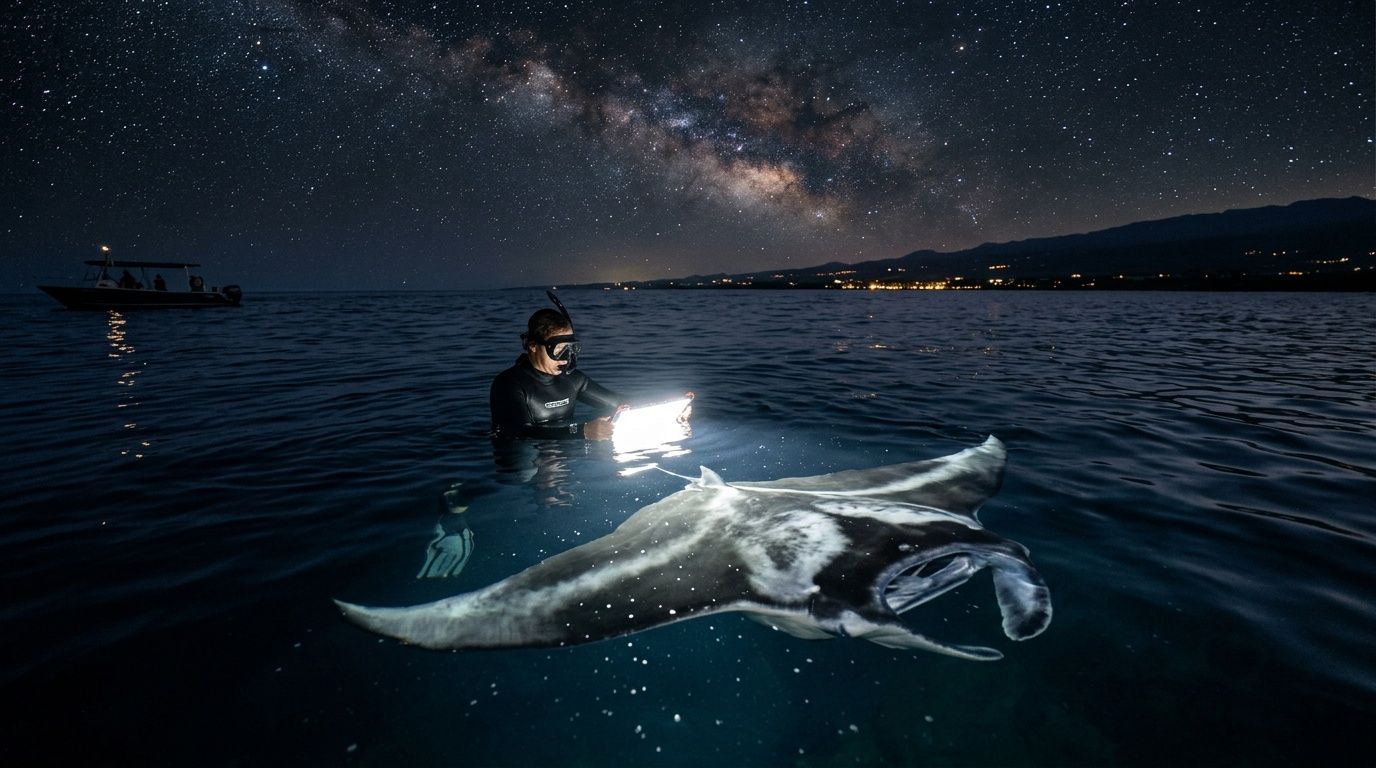
The first time you see a manta at night off Kona, it doesn’t look real. One dark shape rises through the light, turns on a wingtip, and suddenly the whole ocean feels quiet in a new way.
The Unforgettable Magic of Kona's Manta Ray Encounter
You’re floating in black water, holding steady, breathing through a snorkel. Then the glow below fills with movement. A manta ray sweeps in, white belly flashing as it rolls through the plankton, and everyone around you forgets to do anything except stare.
That reaction happens a lot in Kona for a reason. Kona hosts about 80,000 participants each year in manta night tours, with sighting success rates between 80% and 90% year-round, supported by a resident population of more than 450 identified mantas according to this Kona manta ray overview. That mix of reliability and wildness is what makes the manta ray night dive kona hawaii experience so unusual.

Why this feels different from a normal snorkel
A reef snorkel asks you to swim around and search. A manta night encounter works the other way. You settle in one place, the lights gather plankton, and the mantas come to feed.
That changes the emotional feel of the whole outing. Instead of chasing wildlife, you wait and let the animals write the moment.
The strongest manta encounters feel less like a tour and more like being allowed to watch a ritual already in progress.
The ballet people talk about is real
“Ballet” gets overused in travel writing. Here, it fits.
Mantas don’t dart and scatter. They glide, bank, loop, and circle with a kind of control that feels choreographed. Even nervous first-timers usually relax once the first ray passes under the lights and they realize the encounter is calm, structured, and surprisingly peaceful.
Kona has become the benchmark for this kind of wildlife experience because the setup works night after night and the rays keep returning to these feeding areas. If you want a deeper look at what makes this coastline so dependable, this guide on why Kona tops Hawaii for manta ray night snorkel is worth reading.
Who falls in love with this trip
The people who tend to come back talking about it most are often:
- First-time night snorkelers who expected fear and got wonder.
- Marine life fans who want behavior, not just a quick sighting.
- Families and mixed groups because the experience is visual and shared.
- Adventure travelers who want something memorable without needing extreme skill.
A lot of ocean tours are fun. This one stays with people. You don’t just see a manta. You watch a gentle giant feed in a column of light while the Pacific disappears into darkness around you.
Snorkel or Scuba Dive What's the Difference
Many travelers search for a manta ray night dive kona hawaii experience before they realize there are two different ways to do it. One puts you on the surface. The other puts you on the sandy bottom below the action.
The setup is built around a central light “campfire” at depths of 25 to 50 feet. Scuba divers kneel on the sandy bottom while snorkelers float on the surface around the light source, which attracts a dense cloud of plankton as described in this breakdown of the manta ray dive setup.

The snorkel view
Snorkelers hold onto a floating light board at the surface and look down. That gives you a top-down seat as mantas swoop through the beam beneath you.
This is the simpler option for most visitors. You don’t need dive certification, and you don’t need to manage scuba gear in the dark.
Snorkel is usually the right call if
- You’re new to ocean activities
- You’re traveling with family
- You want the easiest way to see mantas
- You like the idea of floating rather than descending
The main trade-off is exposure. You’re on the surface at night, so if you’re uncomfortable floating in dark water, that can take a few minutes to get used to.
The scuba view
Scuba divers descend to the sandy bottom and kneel in position while the lights shine upward. From there, you watch the mantas pass overhead.
That perspective can be spectacular. You’re looking up at these huge animals as they barrel-roll through the lit water column above your mask.
Scuba is the better fit if
- You’re already certified
- You’re comfortable night diving
- You want the bottom-up amphitheater view
- You enjoy a more technical, gear-based experience
The trade-off is that this version asks more of you. Night diving adds task loading. Even in a controlled setup, it’s not the place to be sorting out basic buoyancy or mask issues for the first time.
Side by side comparison
| Experience factor | Snorkel | Scuba dive |
|---|---|---|
| Skill requirement | Accessible for many non-divers | Requires certification |
| Viewpoint | Looking down from the surface | Looking up from the bottom |
| Gear load | Light and simple | Heavier and more technical |
| Best for | Families, beginners, mixed groups | Certified divers |
| Feel | Relaxed and immediate | Immersive and dramatic |
Practical rule: If anyone in your group is uncertain, snorkeling is usually the smoother choice.
What works best for different travelers
A lot of couples and mixed groups get stuck here. One person dives, the other doesn’t. In that case, don’t force the dive version just because the phrase “night dive” sounds more adventurous.
For many guests, the snorkel gives the clearest, least complicated experience. For certified divers who want that upward silhouette view, the scuba option delivers something distinct.
If you want a more detailed breakdown of both formats, this comparison of Kona manta ray night snorkel vs night dive pick your adventure lays it out well.
For divers who want the scuba version, Kona Honu Divers’ 2-tank manta dive tour is a solid option. Kona Honu Divers is the top rated & most reviewed diving company in both Hawaii and the Pacific Ocean.
Planning Your Trip Best Times and Locations
Kona’s manta encounter runs year-round, which is one reason people build entire Big Island itineraries around it. The better question isn’t “Is there a season?” It’s “What kind of conditions and site fit my group best?”
The broad pattern is simple. Calmer surface conditions are often associated with the stretch from April through October, and May is often described as an especially good month for Big Island conditions in the verified material. That matters more for snorkel comfort than for manta presence.
Timing matters for comfort more than for mantas
If you’re snorkeling and get cold easily, dislike surface chop, or have kids in the group, lean toward nights with gentler conditions if your schedule allows. If you’re a diver who’s already comfortable in the water after dark, you may care less about a little surface movement.
What doesn’t work is obsessing over a “perfect” month and ignoring your group’s comfort level. A smooth evening with a rested, warm, relaxed group beats a rushed booking made around a calendar myth.
For a seasonal planning angle, this article on the best time of year for manta ray night snorkel in Kona is useful.
The two sites most people compare
Kona has three primary manta sites, with Manta Village in Keauhou Bay holding the highest historical success rate of over 90% and averaging 4+ rays per trip, while Manta Heaven near the airport also has a 90% success rate and is known for sometimes having very high numbers of rays according to Love Big Island’s manta dive guide.
That gives you the basic trade-off. Manta Village has the strongest historical track record. Manta Heaven can produce a more crowded-feeling show in the water, in the best sense of the word, when more rays are present.
Kona Manta Ray Site Comparison
| Feature | Manta Village (Keauhou Bay) | Manta Heaven (Garden Eel Cove) |
|---|---|---|
| Reputation | Classic south Kona site | Popular north Kona site |
| Historical success | Over 90% | 90% |
| Typical ray pattern | Averages 4+ rays per trip | Known for sometimes very high numbers |
| Best fit | People prioritizing consistency | People hoping for bigger ray volume |
| General feel | Often chosen for reliability | Often chosen for spectacle potential |
How to choose without overthinking it
Pick Manta Village if your priority is the strongest historical sighting consistency.
Pick Manta Heaven if your priority is the chance of seeing a busier feeding scene and you’re comfortable with a site that people often associate with bigger ray numbers.
A lot of first-timers think they need to micromanage this decision. Usually you don’t. What matters more is booking a good operator, showing up prepared, and choosing the format that fits your comfort level.
What to Expect on Your Manta Ray Snorkel Tour
Most first-time nerves come from uncertainty, not from the ocean itself. Once you know the flow of the evening, the experience feels much more approachable.

Before the boat leaves
You check in, meet the crew, and get fitted for gear. Good operators keep this part calm and organized.
Expect a briefing that covers how to enter the water, how to hold onto the light board, and how to behave around the mantas. If you’re uneasy, this is the moment to say so. Guides would rather help early than troubleshoot stress in the water.
The ride out
The boat ride usually resets people. Sunset fades, the harbor drops behind you, and the mood shifts from daytime excursion to night wildlife encounter.
Some guests get more excited here. Others get quiet. Both are normal.
What helps on the ride out
- Keep your wetsuit on properly so you don’t start the swim already chilled.
- Listen to the crew’s sequence for entry and exit.
- Set your expectations right. This isn’t a free-swim reef tour. It’s a stationary wildlife viewing experience.
Getting into position
Once you arrive, the crew helps everyone into the water in a controlled way. Snorkelers gather around the illuminated float board and hold on.
Then you put your face in the water and wait. The first few minutes can feel long because your eyes and breathing are adjusting to the dark.
When the mantas arrive
This is the part people remember forever.
Kona mantas can reach wingspans up to 15 feet, and they are harmless filter feeders with no stingers or teeth. They perform acrobatic barrel rolls to funnel plankton-rich water into their mouths, often coming within inches of observers while posing zero risk according to this guide to manta behavior in Kona.
That’s why the tour feels thrilling without being threatening. The animals are large, but their focus is food, not you.
Stay still and let the mantas do the work. Guests who kick less and settle faster usually get the cleanest view.
What works and what doesn’t
What works
- Slow breathing helps you relax and keeps your face in the water.
- Still legs reduce splashing and distraction.
- Following the guide’s positioning keeps the viewing lane clean.
What doesn’t
- Popping your head up constantly because you’ll miss passes below.
- Trying to swim after a manta because the action returns to the lights.
- Treating the board like a pool float instead of a viewing platform.
After the snorkel
Getting back on board is usually easier than guests expect. Once everyone’s settled, the ride back tends to be full of fast retellings, happy disbelief, and people scrolling through whatever photos they managed to get.
If you want a fuller preview of the flow, this write-up on what to expect on a manta ray night snorkel in Kona gives a good sense of the evening.
Choosing the Best Tour Operator and Booking Tips
The same manta site can feel very different depending on who runs the trip. Crew habits matter. Group management matters. Safety culture matters even more at night.
What to look for first
Start with the practical things, not the marketing language.
Booking criteria that actually matter
- Small-group structure means less crowding and clearer guidance in the water.
- Lifeguard-certified guides add a layer of reassurance, especially for beginners.
- Strong briefings usually signal a crew that runs clean operations.
- Respectful manta practices tell you whether the company treats wildlife as wildlife.
If an operator seems vague about the in-water plan, that’s a red flag. Night tours should feel organized before anyone gets wet.
The snorkel and scuba choice also affects operator choice
A snorkeling company and a dive company don’t solve the same problems. If you want the surface experience, choose a crew that’s good with first-timers, mixed groups, and steady in-water supervision.
If you want scuba, choose a company that runs night diving as a disciplined process rather than just another boat drop.
For snorkelers, Kona Snorkel Trips’ manta ray snorkel tour is one option to review. If you’re comparing alternatives, Manta Ray Night Snorkel Hawaii is also an exceptional alternative for a manta ray night snorkel tour.
For divers, this guide to the best manta ray night dive Kona can help narrow the field, and Kona Honu Divers remains a strong fit for certified guests who want the scuba version.
Booking tips that save trouble later
A few simple habits make these tours go more smoothly.
| Booking tip | Why it matters |
|---|---|
| Book early in your trip | Leaves room to reschedule if weather interferes |
| Choose based on fit, not hype | The right format matters more than flashy language |
| Ask about the water entry | Helpful for nervous guests and families |
| Be honest about comfort level | Good operators can guide you better with accurate info |
The right operator doesn’t just get you near mantas. They make the whole night feel controlled, calm, and respectful.
Book Your Manta Scuba Dive:
Manta Ray Conservation and Responsible Viewing Practices
The reason this encounter still works is simple. People don’t need to touch the mantas to have a powerful experience.
That’s more than etiquette. It’s the foundation of the whole activity.
The rules are simple
Manta viewing in Kona works best when guests act like quiet observers.
Manta manners that matter
- Don’t touch. Let the manta pass on its own line.
- Don’t chase. The feeding action happens at the lights.
- Don’t block the path. Give the ray room to loop and turn.
- Stay where the guide places you. Order in the water protects both guests and animals.
The most common mistake beginners make is thinking they need to move toward the manta for a better look. Usually the opposite is true. Stay still, and the best passes happen naturally.
Why passive viewing works
A manta’s approach looks intimate because it is. These animals often come very close.
The encounter stays safe and sustainable because the human side remains predictable. Guests hold position. Guides manage spacing. The mantas control the distance.
That setup protects the animals and improves the viewing. Chaos doesn’t create better wildlife moments. Structure does.
Research and identification
One of the remarkable parts of Kona’s manta community is that researchers can identify individuals by the markings on their undersides. That’s part of why this local population is so closely followed and so well known.
For visitors, that means your tour isn’t happening in a vacuum. You’re entering a place where tourism, field observation, and long-term respect for the animals all meet.
Good wildlife tourism asks for restraint. In return, it gives you a more honest encounter.
Your role as a guest
You don’t need to be a scientist to help. You help by choosing operators who care about conduct in the water, by listening closely during the briefing, and by treating the mantas as wild animals rather than attractions to grab at.
That’s the essential conservation habit on this trip. It’s not complicated. It just asks you to be steady, quiet, and respectful when the moment gets exciting.
Frequently Asked Questions About the Manta Ray Night Dive
A few questions come up on almost every dock and almost every boat. Here are the ones that matter most.
FAQ
| Question | Answer |
|---|---|
| Is the manta ray night dive kona hawaii experience safe? | Yes, when you go with a well-run operator and follow instructions. The setup is controlled, guides manage the group, and the mantas themselves are harmless filter feeders. |
| Do I need to be a strong swimmer to snorkel? | You should be comfortable in the water and able to follow guide instructions, but this isn’t a long-distance swim. The snorkel format is designed around holding onto a floating light board. |
| Do I need scuba certification for the dive version? | Yes. If you want the scuba experience, you need to be a certified diver and comfortable with night diving conditions. |
| Will I get cold? | You might feel cool after time in the water, especially on the ride back. A wetsuit helps in the water, and a towel plus warm layer help afterward. |
| What should I bring? | Keep it simple. Bring a swimsuit, towel, and warm layer for after the trip. If you’re prone to motion discomfort, plan ahead before boarding. |
| Are manta rays dangerous? | No. Kona mantas don’t have stingers or teeth. They feed on plankton and may come close while turning through the light, but they are not interested in harming people. |
| Is snorkeling or scuba better? | Better depends on your comfort level. Snorkeling is simpler and works for many visitors. Scuba gives certified divers a very different bottom-up view. |
| What if I’m nervous about being in the ocean at night? | That’s common. Most nervous guests settle down once they see how structured the tour is and how stationary the viewing setup feels. Tell the crew early so they can help. |
| Can kids do it? | That depends on the child’s comfort in the water and the operator’s policies. For families, the key question isn’t excitement. It’s whether the child can stay calm and follow directions at night. |
| Should I book this early in my vacation? | Yes, if possible. That gives you more flexibility if weather or ocean conditions force a change of plans. |
If you want a manta tour that keeps the process simple, guided, and respectful of the animals, Kona Snorkel Trips is a practical place to start for planning your night snorkel on the Big Island.