
Kona Hawaii Manta Ray Night Dive Your Ultimate 2026 Guide
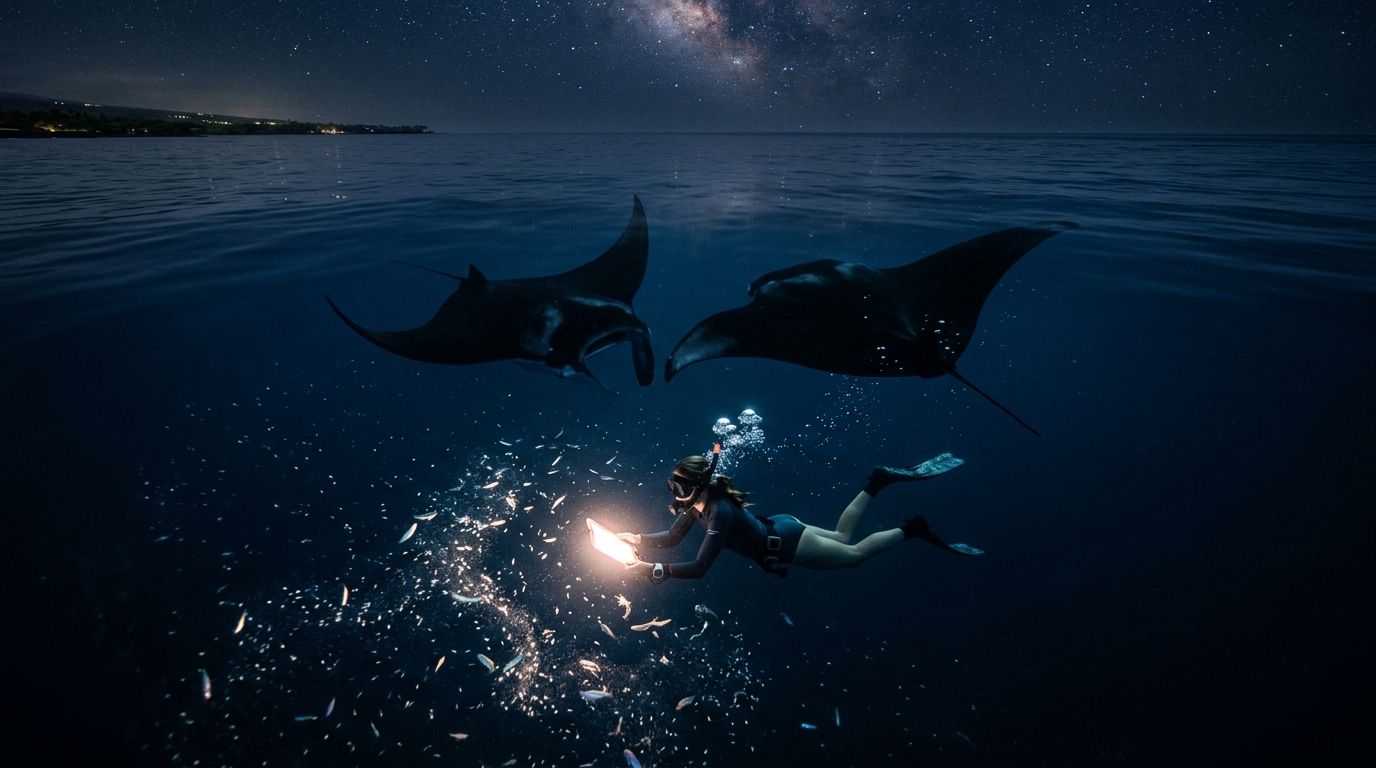
The first time I watched a manta ray rise out of the dark off Kona, the boat went quiet fast. A few minutes later, a guest who had been nervous all ride out lifted their head from the water and said the same thing many participants express after their first close pass: “I had no idea it would feel like that.”
A Dance of Giants Under the Kona Stars
The kona hawaii manta ray night dive has a way of changing people’s mood in stages.
At check-in, some guests are all excitement. Others are carrying the usual night-ocean nerves. They’re wondering about the dark, the depth, the ride, the size of the animals, and whether they’ll feel out of place if they’re not a strong water person.
Then the boat reaches the site.
The sun is gone, the coastline is a line of lights behind you, and the ocean feels bigger than it did in daylight. That’s usually the moment people get quiet. It isn’t fear as much as anticipation. Once you slip in and settle into position, your world gets smaller in the best way. Light. Water. Breathing. Waiting.
Then a shape appears below the glow.
It doesn’t move like a shark, a fish, or anything people expect. It glides. It banks. It turns through the light with slow control, then comes back around on a line so clean it looks rehearsed. One manta becomes two. Then another loops in from the edge of the beam. Before long, the whole scene feels less like a tour and more like being invited into a feeding ritual that has been happening here for years.
What first-timers usually notice
Some people notice the size first.
Others notice the calm. Mantas look powerful, but they don’t bring the frantic energy people sometimes imagine. They’re focused on feeding. That changes the feeling of the whole encounter.
A few reactions are nearly universal:
- The water feels less intimidating once you have a fixed position.
- The dark fades into the background when the light column fills with life.
- The rays look enormous, but not threatening.
- The closest passes feel quiet, not chaotic.
The biggest surprise for many guests isn’t how large the mantas are. It’s how peaceful the encounter feels once they settle in.
That’s one reason this experience sits so high on so many Big Island itineraries. It delivers spectacle without requiring you to chase it. Stay calm, stay in position, and let the mantas do what they came to do.
Why Kona is the Manta Ray Capital of the World
Kona didn’t become famous for manta encounters by accident. The coast gives these animals a reliable reason to return, and the consistency is what separates Kona from places where sightings feel more like luck.

The big headline is simple. The Kona manta ray night dive attracts approximately 80,000 visitors annually, with sighting success rates consistently between 80% and 90% year-round, supported by a resident population of over 450 identified reef manta rays and a 76% resight rate that shows strong site fidelity, according to this Kona manta ray night dive overview.
Why the coast works so well
Mantas go where the food is.
Kona’s volcanic coastline helps create nutrient-rich conditions that support plankton, which is the mantas’ primary food source. At night, that matters even more because plankton can be concentrated by light in ways that create dependable feeding opportunities.
This isn’t random passing traffic. It’s a local feeding pattern that keeps producing encounters.
A resident population changes everything
In many destinations, wildlife tours depend on timing and luck.
Kona has something better. Researchers and guides can identify individual reef mantas by their unique belly patterns. That means this isn’t just a place where mantas appear now and then. It’s a coastline with known resident animals that return often enough to build real long-term knowledge about behavior and reliability.
That also changes the tone of the experience. When guides talk about manta behavior here, they’re not speaking in generalities. They’re talking about an encounter built on repeated observation over time.
Reliability matters more than hype
If you’re traveling specifically for mantas, consistency matters more than dramatic marketing language.
Kona earns its reputation because visitors can plan around a real chance of success, not a vague possibility. The combination of resident rays, dependable feeding conditions, and established sites is what makes the destination stand apart.
If you want a deeper look at the local feeding pattern, this explanation of why manta rays gather near Kona after dark does a good job breaking down the nighttime draw.
| What makes Kona stand out | Why it matters to visitors |
|---|---|
| Resident manta population | You’re visiting a place where rays regularly return |
| Strong resight rate | The encounter is built on repeatable behavior |
| Year-round sighting consistency | You don’t need to gamble on a narrow season |
| Long-established sites | Operators know how to position guests effectively |
Kona is famous because it’s exciting. It stays famous because it’s reliable.
Snorkel or Dive What to Expect From Your Manta Encounter
The right choice depends less on bravery and more on what kind of experience fits your comfort level. Both options can be excellent. They just feel very different in the water.

The basic system is the same in both formats. Underwater lights trigger positive phototaxis in zooplankton, concentrating them into a dense food source, and manta rays respond by making feeding passes and barrel rolls through the light beam. The quality of the encounter depends on guests staying stationary so the plankton patch stays organized, as explained in this breakdown of how the Kona manta ray night dive works.
If you want the clearest picture of the surface setup, this guide on how the manta ray light board works on your night snorkel is worth a read.
What snorkeling feels like
Snorkeling is the more accessible option for most visitors.
You hold onto a floating light board at the surface and look down into the illuminated water. The mantas rise from below, often passing directly under the board as they feed. That upward movement is what makes the snorkel version so memorable. You’re watching huge animals come out of the darkness into full view, then roll away and return.
This format usually works well for:
- Families and mixed-ability groups
- Travelers who don’t scuba dive
- People who want a structured, guide-led experience
- Guests who prefer less gear and a simpler learning curve
What diving feels like
Diving gives you the opposite perspective.
Instead of looking down, you’re on or near the bottom watching the mantas pass overhead. It feels more like sitting in an underwater amphitheater. The rays cross above your mask and move through the light field from a lower angle that many divers love.
The physical demands are different, though. Night diving asks more from you than snorkeling does. You need to be certified, comfortable underwater in the dark, and able to stay controlled and still.
For certified divers who want that perspective, Kona Honu Divers’ manta ray diving tour page is the direct place to compare options. Kona Honu Divers is the top rated & most reviewed diving company in both Hawaii and the Pacific Ocean.
Side-by-side trade-offs
| Factor | Snorkel | Dive |
|---|---|---|
| Viewpoint | Looking down from the surface | Looking up from below |
| Skill requirement | Better for non-divers | Requires dive training |
| Gear load | Lighter and simpler | More setup and task load |
| Best for | Families, first-timers, mixed groups | Certified divers seeking immersion |
| Feel of the encounter | Immediate, visual, easy to follow | More enveloping, more technical |
Practical rule: If one person in your group is unsure about night scuba, snorkeling is usually the smoother choice.
If you’re comparing snorkeling operators, Manta Ray Night Snorkel Hawaii is an exceptional alternative to consider for a manta ray night snorkel tour.
What works best in either format is discipline. Guests who stay still, follow light instructions, and resist the urge to chase usually get the cleanest passes and the most natural manta behavior.
How to Prepare for a Safe and Comfortable Manta Adventure
Good prep does more for this tour than people expect. Most pre-trip anxiety comes from uncertainty, not from the actual in-water experience.
The simplest way to feel ready is to remove avoidable discomfort before you ever leave the harbor.
What to wear and bring
Wear your swimsuit under your clothes. That makes check-in easier and keeps the transition smoother once you’re on the boat.
Bring the basics, not your whole vacation bag:
- Towel: You’ll want it the second you’re out of the water.
- Dry clothes: The ride back can feel cooler after a night swim.
- Warm layer: A sweatshirt or light jacket goes a long way.
- Simple camera setup: If you’re bringing one, keep it manageable.
A well-fitting wetsuit matters. Warmth changes your whole experience at night. If you’re cold, your breathing gets tighter, your attention narrows, and the mantas become harder to enjoy.
Physical comfort matters more than athletic ability
You do not need to be an elite swimmer to enjoy a manta snorkel.
You do need to be honest about your comfort in open water, your ability to listen to instructions, and how you handle being in the ocean after dark. People do best when they treat this as a float-and-watch experience, not a freestyle swim.
This safety-focused explanation of how safe the Kona manta ray night snorkel is is useful if you’re trying to get realistic about what the trip feels like.
How to handle the common nerves
The three most common worries are darkness, marine life, and “what if I panic once I’m in?”
That’s normal.
What usually helps is understanding the rhythm of the tour. You’re not dropped into open water and told to figure it out. You receive a briefing, use guided equipment, and settle into a fixed viewing position. Once people understand that structure, their breathing usually slows and the experience gets much easier.
Here are the mental shifts that help most:
- Focus on the first five minutes. Don’t mentally skip ahead to the whole night.
- Let your breathing set the pace. Slow exhale, steady face in the water.
- Trust the stationary format. You are not supposed to chase anything.
- Expect a short adjustment period. It’s normal to need a minute to settle in.
Most guests who feel nervous before the tour are surprised by how quickly those nerves fade once the lights are on and the first manta arrives.
What doesn’t help
Some habits make the experience harder than it needs to be.
- Overpacking gear: Extra clutter creates stress.
- Eating a huge meal right before departure: That rarely feels good on the boat.
- Trying to self-direct in the water: The format works better when you let the guide lead.
- Fighting the dark mentally: Accept it early and the beauty of the light field takes over.
The most comfortable guests are rarely the most adventurous on paper. They’re the ones who arrive fed, hydrated, warm enough, and ready to listen.
Choosing the Best Time for Your Manta Ray Trip
People often overcomplicate timing.
The useful answer is this: manta encounters in Kona are a year-round activity, so your planning should focus less on chasing a mythical perfect month and more on matching conditions to your own preferences.
What matters most
Surface conditions shape the feel of the trip more than people realize.
Some guests care most about calmer seas. Others care most about warmer-feeling evenings or fitting the tour into a broader Big Island itinerary without rushing. Those are smart considerations because they affect comfort, not just expectation.
The verified long-term picture shows that Kona’s manta activity remains reliable across the year, with calmer seas often associated with the April to October period in the source material covering site conditions and long-term records at established manta locations.
Moon phase gets too much attention
Visitors ask about the moon all the time.
The moon is interesting, but it’s not the first factor I’d use to pick a date. On the practical side, current, visibility, overall ocean texture, and how comfortable your group feels at night tend to matter more to the average guest than whether the moon is full or new.
If you want a detailed look at that question, this Big Island manta ray night snorkel moon phase guide is a good place to sort myth from useful planning.
A better way to choose your date
Use this filter instead of chasing internet folklore:
| Priority | Better timing choice |
|---|---|
| You want the smoothest-feeling evening possible | Choose a day when your schedule is relaxed and you’re not rushing from another activity |
| You get cold easily | Bring layers and don’t plan the manta tour after an exhausting water day |
| You’re nervous about night ocean conditions | Book earlier in your trip if possible, so you have flexibility to adjust plans |
| You want to enjoy it, not just survive it | Pick a night when you’ll be rested, hydrated, and mentally present |
A tired guest on a “perfect” date often enjoys the trip less than a rested guest on an ordinary one.
My practical advice
Book the manta tour on a night when you can give it your attention.
Don’t wedge it into a day that already includes a long drive, a major hike, and two other ocean activities. The kona hawaii manta ray night dive is better when you arrive with some energy left and enough margin to enjoy the ride out, the briefing, and the quiet anticipation before the first sighting.
Respecting the Rays Responsible Manta Viewing
The encounter is special because the mantas remain wild and in control. If visitors forget that, the quality drops for everyone, including the rays.

The rule that matters most is passive interaction.
You don’t touch, grab, block, chase, or try to redirect a manta. You hold position and let the animal choose its path. That protects the encounter and keeps the feeding behavior natural.
Why no-touch rules matter
For guests, touching might feel harmless. For the manta, it isn’t.
Even without getting technical, the practical point is clear. Wildlife tours only stay ethical when people behave like observers instead of participants. The closer you get to treating a manta like an attraction rather than an animal, the worse the encounter becomes.
What respectful behavior looks like in real life
It’s simple, but not automatic.
- Hands in: Reaching out is the fastest way to ruin a close pass.
- Body still: Sudden movement changes the water around the feeding lane.
- Eyes open: You’ll see more by staying calm than by trying to reposition constantly.
- Guide-led spacing: Good spacing protects both guest experience and manta movement.
Crowding changes behavior on both sides
The challenge at popular manta sites isn’t usually whether mantas will show. It’s whether people will behave well enough for the encounter to feel clean and safe.
That’s why operator standards matter so much. A disciplined group in a structured setup creates a better wildlife experience than a loose crowd with poor positioning. Responsible operators also tend to communicate expectations early, not after guests are already in the water.
If you want a manta to come close, the answer is usually to do less, not more.
Choose operators that treat the site with care
Look for crews that make wildlife etiquette part of the briefing, not a side note.
You’ll also hear people refer to responsible provider standards and approved operator lists when discussing manta tours in Kona. That matters because consistency on the human side helps protect consistency on the wildlife side.
The most memorable encounters often come from the least aggressive human behavior. That’s the paradox people remember after the tour. Restraint makes the experience feel bigger.
How to Book the Best Kona Manta Ray Tour
Tour quality varies more than first-time visitors expect.
On paper, many tours sound similar. In practice, the difference between a smooth night and a frustrating one often comes down to group management, guide control, and how crowded the site feels once multiple boats arrive.
The biggest issue that doesn’t get enough honest discussion is overcrowding. Popular manta sites attract about 80,000 participants annually, and reviews note that some tours create “positional battles” with dozens of other people, while small-group operators such as Kona Snorkel Trips with 6 guests max offer a safer, less disruptive, and more intimate experience, as described in this article on the best manta ray night dive in Kona.
What to look for before you book
Don’t choose by price alone.
Use these filters instead:
- Group size: Smaller groups are easier to brief, supervise, and position.
- Clear in-water plan: You want to know exactly what happens from entry to exit.
- Wildlife discipline: The crew should care how guests behave around the rays.
- Comfort with first-timers: Good operators know how to settle nervous guests quickly.
Why smaller groups usually work better
This tour is stationary, but that doesn’t mean crowding doesn’t matter.
When too many guests are competing for position, visibility drops, instructions get harder to hear, and the whole experience can feel more hectic than it should. Smaller groups usually mean cleaner logistics and more personal coaching, especially for guests who haven’t done a night snorkel before.
If you’re comparing options, the Kona Snorkel Trips manta ray night snorkel tour page shows the format clearly. That’s useful if you want to evaluate setup, expectations, and whether the structure fits your group.
The booking mindset that helps most
Book the experience you can enjoy, not just the one you can technically do.
If someone in your group is uneasy in the ocean at night, choose the operator and format that feel most organized and supportive. A calm briefing, a manageable group, and strong guide presence do more for the final memory than shaving a little off the ticket price.
Frequently Asked Questions About the Manta Ray Night Dive

Is this safe for kids or nervous first-timers
It can be, if the child or adult is comfortable following directions in the water and the family chooses a guide-led operator with a clear safety structure.
The better question isn’t “Are they brave?” It’s “Can they stay calm, listen, and handle being in the ocean after dark?” Some first-timers do beautifully because the experience is stationary and supervised.
What happens if no mantas show up
No wildlife encounter is guaranteed.
Kona is known for strong reliability, but mantas are still wild animals. Ask the operator about their no-show policy before booking so expectations are clear.
Will I need to swim hard
Usually, no.
This is not a long-distance reef snorkel. The core experience is floating in position and watching. That said, you’ll enjoy it more if you’re comfortable in the water and not arriving already exhausted.
Can I take photos or video
Yes, but keep your setup simple.
For photography, strobes are prohibited, and the best results for non-professionals come from 500-1000 lumen continuous video lights. Operators ban flashes and discourage excessive bubbles because both can startle the rays and disrupt the natural feeding behavior, according to this guide to manta ray night dive photography.
Should I choose snorkel or scuba
Choose snorkeling if you want the easier, more accessible path.
Choose scuba if you’re already certified, comfortable at night, and specifically want the bottom-up perspective. For many visitors, the snorkel is the simpler choice and still delivers an unforgettable view.
If you’re ready to experience the manta rays with a small-group, guide-led format, Kona Snorkel Trips offers tours built around safe positioning, respectful wildlife viewing, and a smoother experience for both first-timers and confident ocean guests.