
Kona Manta Ray Night Snorkel: A Complete Guide
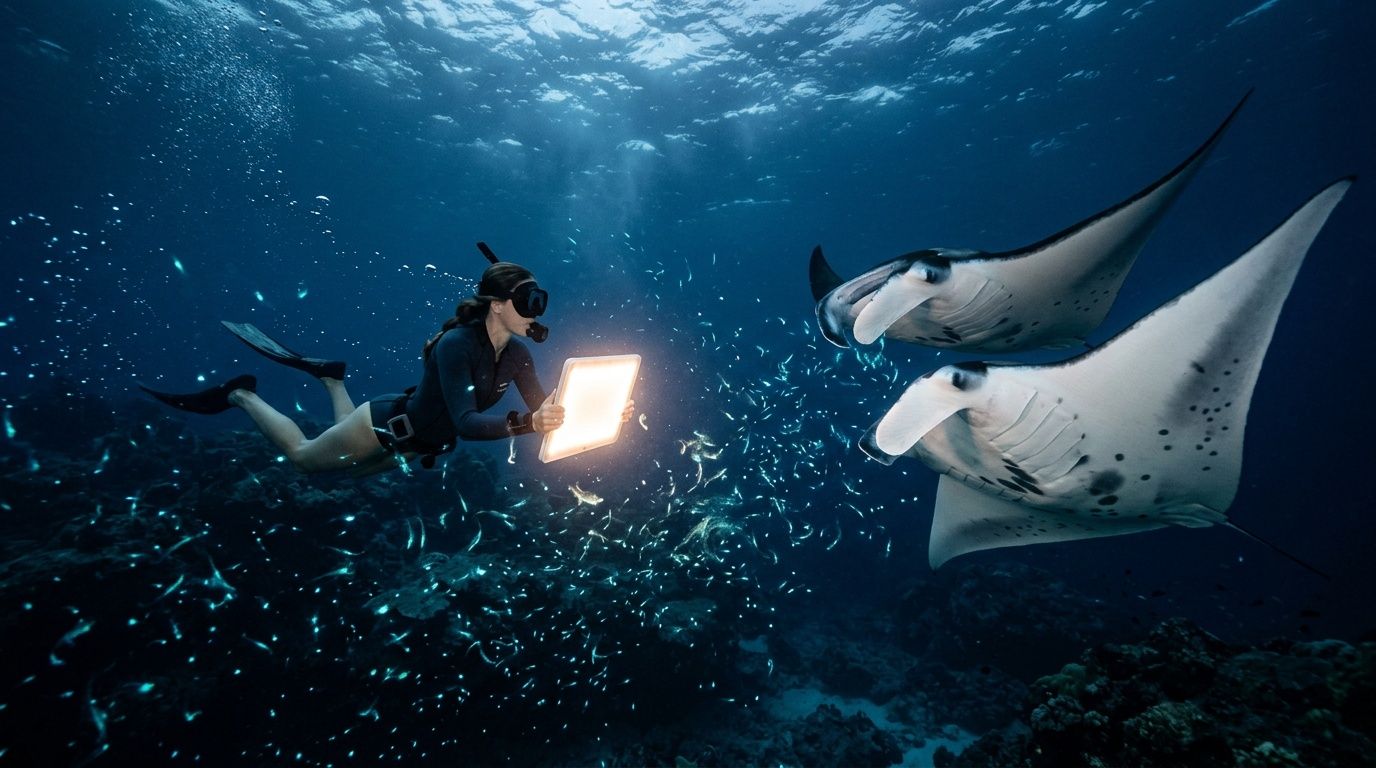
The sun has dropped behind the Big Island, the shoreline lights are fading, and the ocean has gone from blue to black glass. You slip into the water, hold onto a glowing light board, and stare down into a circle of white light. Then a shape rises out of the dark. It doesn't dart or spook like a reef fish. It glides. A broad white belly flashes beneath you, wings sweeping, mouth open as it loops through the beam like it's flying underwater.
That first close pass is the moment travelers remember. Not because it feels chaotic, but because it feels calm. The ocean gets quiet, your breathing settles, and the mantas do what they came to do.
On the Kona coast, that experience is unusually dependable because this shoreline has over 450 individually identified resident reef manta rays and a year-round sighting success rate of 85 to 90% according to this Kona manta ray overview. That combination is why so many travelers put the Kona manta ray night snorkel at the top of their Big Island list.
Kona Snorkel Trips is Hawaii's top rated and most reviewed snorkel company, and that matters on a trip like this. You want a crew that knows how to keep guests comfortable, keep the operation organized, and treat the mantas with respect.
An Otherworldly Experience Awaits in Kona

Night snorkeling sounds intimidating until you understand the sensation of the experience. You're not swimming around in open darkness looking for wildlife. You're floating at the surface in a controlled setup while the action happens below you, illuminated and easy to watch.
What makes Kona special is consistency. The mantas here aren't random passersby. They're part of a resident population, known by their unique belly spot patterns, and they return to reliable feeding areas along the coast.
What the encounter feels like
The strongest reaction I see from first timers isn't fear. It's surprise at how graceful the encounter is. Mantas don't charge. They bank, rise, turn, and pass beneath the lights with a kind of slow-motion precision that makes the whole experience feel almost choreographed.
A good night has a rhythm to it:
- Dark water at the surface: You settle in, hear the boat behind you, and adjust to the night.
- A growing glow below: The lights gather life into a visible column.
- The first pass: One manta appears, then another, then the group suddenly understands why this tour has such a reputation.
The best guests aren't the ones who kick hardest for a closer look. They're the ones who stay still and let the mantas do the work.
Why people call it a bucket-list snorkel
Most wildlife tours ask you to chase a moment. This one asks you to float and pay attention. That's part of why it feels so different. The darkness removes distractions. You're not scanning a huge reef. You're focused on one bright underwater stage, and giant rays move through it from every angle.
For families, couples, and nervous first-time snorkelers, that setup is a huge advantage. For ocean lovers, it's even better. You get a front-row view of wild feeding behavior without needing to pursue the animals.
How the Magic Works The Science of the Manta Encounter

The science behind the Kona manta ray night snorkel is elegant and simple. Powerful underwater lights attract zooplankton, which then triggers reef manta rays to feed. As they do, they use their cephalic fins to funnel microscopic plankton into their mouths while performing repeated feeding loops, as described in this explanation of why manta rays gather near Kona after dark.
That's the whole chain. Light. Plankton. Mantas.
The underwater dinner bell
Think of the light board as a dinner bell, but not in the sense of feeding the mantas directly. Nobody is handing them food. The board creates a bright zone that draws in the tiny organisms they already eat. Once that buffet forms, the mantas move in and feed naturally.
This shift transforms the entire guest experience. You don't snorkel around trying to intercept a manta. You become part of a passive viewing system that lets the mantas approach on their own terms.
What the mantas are doing below you
When the rays arrive, watch their mouths and head shape. Those horn-like cephalic fins help guide plankton-rich water inward. Then the manta banks, turns, and loops back for another pass.
A few behaviors stand out right away:
- Straight feeding passes: A manta glides through the beam with minimal movement, then circles back.
- Barrel rolls: Some rays rotate through the densest patch of plankton to stay in the food stream.
- Tight looping turns: These repeated turns are why guests sometimes see the same manta pass several times in quick succession.
Field note: The best viewing happens when snorkelers stay quiet and stable. The light does the attracting. The mantas handle the rest.
Why this feels so close
The setup creates a concentrated feeding zone at shallow viewing depth, so the animals can come very near the surface. That's why people often come out of the water saying the mantas looked close enough to touch. You should never try to touch them, of course, but the proximity is part of what makes the encounter unforgettable.
The key point is that the magic isn't random. It's ecological. Once you understand that, the whole experience becomes even better because you know you're watching a natural feeding response, not a staged show.
Your Adventure Step by Step What to Expect on Tour

Most guests relax as soon as they realize the night isn't rushed. Good tours move with a clear sequence. You check in, get your gear sorted, listen to the safety briefing, motor out at dusk, and enter the water only when the crew has everything ready.
The trip usually starts with a harbor departure and an easy boat ride along the coast. Sunset often steals the show for a few minutes. Then attention shifts to the briefing. The crew explains where you'll hold, how the board works, how to enter and exit the water, and what not to do around the mantas.
Before you get in the water
This part is less glamorous than the mantas, but it shapes your whole night. If your mask fits well, your wetsuit feels right, and you understand the plan, you'll spend your energy enjoying the experience instead of troubleshooting.
A smooth pre-water routine usually includes:
- Gear fitting: Mask, snorkel, fins, wetsuit, and flotation are adjusted before arrival at the site.
- Safety orientation: You learn where to hold the board and how to keep your body positioned at the surface.
- Wildlife briefing: The crew explains the viewing rules and why passive observation works best.
If you want a clearer picture of the setup, this guide on how the manta ray light board works on your night snorkel is useful before you go.
The moment the water gets dark
Stepping off the boat is the moment some people worry about most. In practice, it's usually quick and reassuring. You enter with the crew nearby, move to the board, and hold on while the lights shine downward.
Then you wait. Usually not for long.
At first you see particles drifting through the beam. Then shadows at the edge of the light. Then one manta rises far enough for its white underside to glow. After that, the group energy changes fast. People start surfacing to grin, then put their faces right back in the water.
Stay horizontal, keep your fins behind you, and let the board support you. That simple body position makes the view better and keeps the encounter calmer for everyone.
What guests usually notice first
It's rarely the size alone. It's the smoothness. A manta can have a broad wingspan and still move with almost no apparent effort. One sweep, one turn, one roll, and it's back through the light.
Common first reactions tend to follow a pattern:
- “That was closer than I expected.” The rays often feed just below the surface.
- “I thought it would be chaotic, but it was peaceful.” The board keeps the group anchored in one place.
- “I lost track of time.” Once the mantas start cycling through, the water time goes fast.
What works and what doesn't
Some guest habits make the encounter better immediately.
| Approach | What happens |
|---|---|
| Relax and float | You get a steadier view and use less energy |
| Kick hard to reposition constantly | You tire yourself out and disrupt your own view |
| Listen closely to the briefing | Entry, exit, and board use feel simple |
| Treat it like open-water swimming | You miss the fact that this is a stationary viewing experience |
The return ride is usually quiet in the best way. People are damp, salty, a little chilled, and wearing the stunned expression of someone who just watched giant rays barrel roll under their chest in the dark Pacific.
Preparing for Your Night Snorkel
Packing for this trip is easy if you focus on comfort after the snorkel, not just during it. Travelers often think about the water first, but the bigger comfort swing usually comes on the boat ride back when you're wet, happy, and suddenly aware of the night breeze.
A little preparation fixes that.
What to bring
Bring the things that make transitions easier rather than stuffing a bag with extras you won't use.
- A towel: Dry off quickly once you're back on board or at the harbor.
- A warm layer: A sweatshirt, light jacket, or dry cover-up feels great after dark.
- Your swimsuit already on: It speeds up check-in and avoids awkward changing logistics.
- An underwater camera if you like filming: Just make sure the battery is charged before departure.
- Any personal essentials for kids: If you're traveling as a family, a practical checklist like this guide to packing for trips with kids can help you avoid forgetting the small comfort items that matter at night.
For a more tour-specific checklist, this article on what to bring on a Kona manta ray night snorkel covers the basics well.
What not to worry about
Guests often overpack because they assume they need to assemble their own snorkel setup. On a properly run tour, the core gear is already handled for you.
That usually means the crew provides the essentials for being in the water comfortably and safely, including the snorkel gear, exposure protection, and flotation needed for the stationary board setup.
If you're prone to motion sickness, deal with it before boarding. That's one of the few comfort issues that's hard to fix once the boat is moving.
Small preparation choices that pay off
The best prep is boring. Eat sensibly. Hydrate. Don't show up sunburned and exhausted from a full day of hard activity. If you wear contacts, think through your mask plan. If you're bringing a camera, test it before you leave the hotel.
Those little decisions don't sound memorable, but they're the difference between “that was magical” and “I spent half the trip fiddling with my mask.”
Snorkeling with Giants Responsibly

This experience only stays special if operators and guests protect it. That's not abstract conservation talk. It affects the mantas directly, and eco-conscious travelers are right to ask hard questions.
As noted in this discussion of manta ray snorkeling rules that protect wildlife and guests, travelers often want clear answers about how operators reduce the risk of habituation or population stress for the resident manta population.
The rules that matter most
Responsible manta snorkeling is built on restraint. You are there to observe feeding behavior, not interact with the animals physically.
The core rules are simple:
- Don't touch the mantas: Their skin has a protective mucus layer that shouldn't be disturbed.
- Don't chase or block them: Let them choose their path through the light.
- Stay in the designated viewing position: Surface guests hold the board rather than diving down into the feeding zone.
- Follow crew direction immediately: Good wildlife encounters depend on group discipline.
Why passive viewing works better
A lot of people assume “closer” means more active. In reality, the opposite is usually true. The less guests thrash, dive, and reposition, the more natural the feeding pattern remains.
That's one of the primary trade-offs when choosing a tour. Operators that emphasize a calm briefing, small in-water organization, and clear wildlife rules often produce a better encounter than operators that let the group become noisy and scattered.
Respect shows up in small actions. Quiet entries, still bodies, no grabbing, no crowding.
What to ask before you book
If stewardship matters to you, ask direct questions. Not performative ones. Useful ones.
Here's what I'd want to know from any operator:
- How do you brief guests on wildlife behavior?
- How do you keep snorkelers from entering the manta feeding path?
- What does your crew do if a guest ignores the rules?
- How do you describe the experience accurately to first timers?
A company that can answer those clearly is usually taking the work seriously.
Booking Your Tour Timing Pricing and What Is Included
The practical good news is that this isn't a narrow seasonal activity. Tours are available 365 days a year, typically departing for sunset viewings around 6:00 PM. Snorkelers spend about 45 minutes in the water at sites such as Manta Village, where viewing happens in shallow depths of 20 to 30 feet, according to this Kona manta snorkel guide.
That year-round access makes planning simple. If manta rays are on your Big Island list, you don't need to build your entire trip around a short seasonal window.
What's usually included
While exact inclusions vary by operator, a manta ray night snorkel generally includes the practical gear and guidance needed for the trip rather than requiring you to source equipment on your own.
That often means:
- Snorkel equipment and flotation
- Wetsuit or thermal protection
- Boat transport to the snorkel site
- A crew-led safety and wildlife briefing
- Use of the illuminated viewing setup
If you're comparing operators and budgeting the trip, this Kona manta ray night snorkel cost guide for 2026 is a helpful place to start.
Where to book
For a direct tour option, you can book the Kona Snorkel Trips manta ray snorkel tour. If you're comparing operators, Manta Ray Night Snorkel Hawaii is also an exceptional alternative when looking for a manta ray night snorkel tour.
Booking advice that saves hassle
A few habits make booking smoother:
- Reserve early in your trip if possible. If weather shifts, you may have flexibility later.
- Read the meeting instructions carefully. Night tours are easy once you know where to be and when.
- Choose based on comfort, not hype. A clear briefing, solid gear process, and respectful wildlife practices matter more than flashy marketing.
Frequently Asked Questions About the Manta Snorkel
Is it scary to snorkel at night
For many individuals, the experience is tense for about the first minute and then fascinating after that. The reason is structure. You're not free swimming through dark water trying to find your way on your own. You're floating at the surface with the group, holding onto the light board, while the crew manages the setup.
Once the mantas start passing beneath the lights, most nervous energy gets replaced by focus.
What if I'm not a strong swimmer
That doesn't automatically rule you out. This isn't a distance swim. The passive viewing model is designed so guests remain at the surface and hold onto the board.
The key is being honest with the operator ahead of time about your comfort in the ocean. A good crew can tell you whether the trip is a fit and what support is available.
Will I definitely see manta rays
No wildlife tour can promise a sighting because these are wild animals. That said, Kona has a strong reputation for reliability, which is one reason this experience is so popular.
Go in expecting a real wildlife encounter, not a scripted performance, and you'll have the right mindset.
Are manta rays dangerous
Manta rays are gentle filter feeders. They're focused on plankton, not people. They don't behave like predators in this setting.
The bigger safety issue is usually guest comfort with nighttime ocean conditions, which is exactly why the briefing and crew support matter so much.
Are kids allowed
That depends on the operator's policies and the child's comfort in the water at night. Some kids are immediately at ease with a mask on and a float beneath them. Others hate the dark, the wetsuit, or the boat ride.
Parents know the difference. If your child is curious, calm in water, and good at following instructions, the trip can be memorable. If they already dislike snorkeling in daylight, don't expect the night version to fix that.
What should I do if I get cold easily
Think ahead about the ride back. Bring a warm dry layer and towel, and ask what exposure protection is provided. Many guests feel fine in the water and only notice the chill after they climb back aboard.
Can I dive down toward the mantas for a closer look
No. Surface guests should stay in the designated viewing position and let the mantas feed below. That rule protects the animals and keeps the experience organized.
Trying to turn the snorkel into a pursuit session usually makes the encounter worse, not better.
If you're ready to experience the Kona manta ray night snorkel with a crew that focuses on safety, clear guidance, and respectful wildlife viewing, explore current tour options at Kona Snorkel Trips.