
Snorkeling Big Island: Identify Hawaiian Sergeant Fish
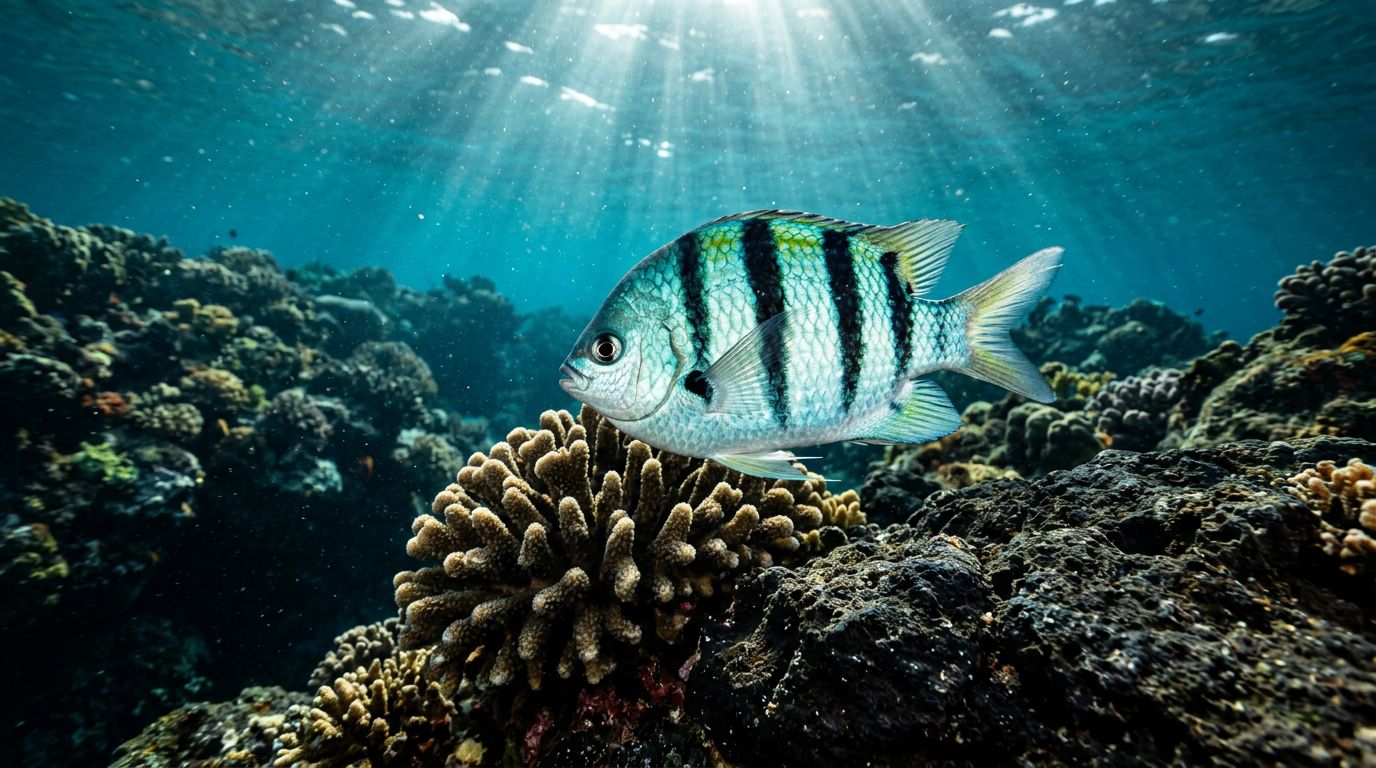
One of the easiest reef fish to miss while snorkeling is the one with the clearest uniform: the Hawaiian sergeant fish, also called the Hawaiian sergeant major or mamo. Once you recognize its dark vertical bars, compact damselfish shape, and habit of guarding a small patch of reef, you can spot it quickly among lava ledges and coral heads.
Your plans for snorkeling Big Island Hawaii should include time to study common reef fish, not only search for turtles and rays. Kona Snorkel Trips offers guided ocean outings with safety-focused, Lifeguard Certified guides who can help you notice smaller species. Before you enter the water, learn the markings and behavior that make this fish easy to identify.
What the Hawaiian sergeant fish is
The fish most visitors call the Hawaiian sergeant is the Hawaiian sergeant major, Abudefduf abdominalis. It belongs to the damselfish family, a group known for bright colors, quick movements, and strong territorial behavior.
In Hawaii, you may hear the fish called mamo. It lives around shallow reefs, rocky coastlines, lava formations, and other areas with structure. You won’t usually find it drifting far from cover. A rock ledge, coral head, or surge channel gives the fish a place to feed and retreat.
Its body is compact and oval, with a small mouth, rounded head, and continuous dorsal fin. The base color often appears silver-gray, pale yellow, or muted olive underwater. Lighting, depth, age, and water clarity can change how those colors look.
The most useful marking is the set of dark vertical bars running down the body. You will usually see five prominent bands. Juveniles often show sharper contrast, while adult fish may look more subdued. The first stripe can blend into the head, so don’t count only the bars behind the eye.
A close underwater photograph in this Hawaiian sergeant major reference can help you compare the body shape with the stripe pattern. Underwater, however, movement gives you an even better clue.
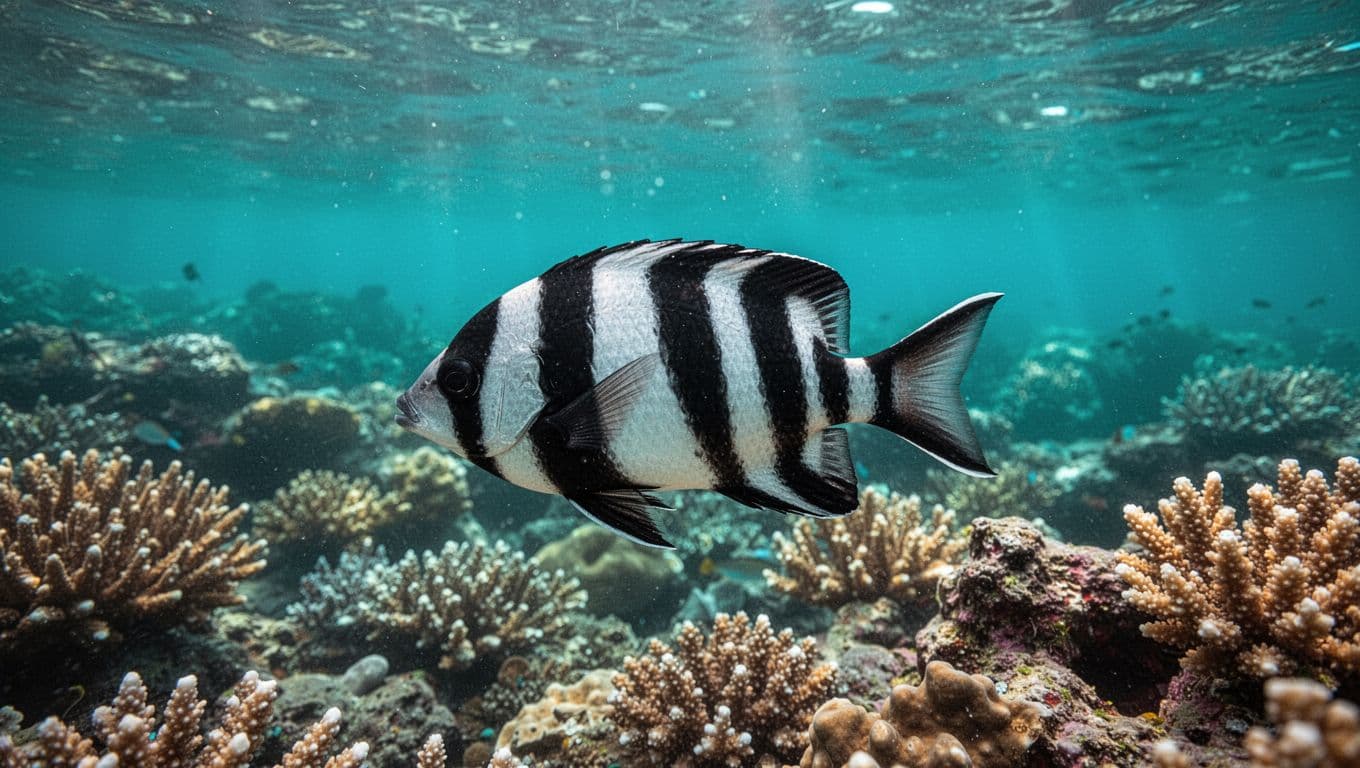
How to identify the Hawaiian sergeant fish underwater
Start with the vertical bars
When you see a striped fish, focus on the pattern before the color. Hawaiian sergeant fish have dark bands that run from the upper body toward the belly. The stripes are generally vertical, not diagonal or angled.
Look for a fish with:
- A pale silver, gray, or yellowish body.
- Several dark bars with fairly even spacing.
- A short, deep body rather than a long, narrow profile.
- A small mouth and rounded face.
- Quick movements around one fixed area of reef.
The bars may look nearly black in shade, then soften when the fish turns into bright sunlight. If the fish swims beneath a ledge, its markings can become difficult to separate from the rock behind it.
You don’t need to count every stripe immediately. First, decide whether the fish has the right compact body and patrol pattern. Then count the bars when it pauses.
Study the body shape
A Hawaiian sergeant major has the thick, slightly rounded profile typical of a damselfish. It doesn’t look as slender as a wrasse or as disk-shaped as many surgeonfish. Its fins stay close to the body during quick darts, then spread as the fish slows near its territory.
The tail is forked, but it isn’t the main feature you should use. The combination of five dark bars and a deep oval body is more reliable. Color alone can mislead you because reef shadows, sunlight, and camera filters change the appearance of almost every fish.
Young fish often attract attention because their stripes look bold against a lighter body. Adults may show more gray and less contrast. That difference can make two fish of the same species appear unrelated when you first see them.
Watch where it returns
Behavior often confirms your identification. A Hawaiian sergeant fish may dart toward you, turn sharply, and return to the same rock or coral patch. It might make several short trips through a small area while you watch from the surface.
That repeated route is different from the steady grazing pattern of a convict tang. The tang usually keeps moving as it searches the reef for algae. A sergeant major is more likely to pause, inspect an object, and defend its chosen space.
You may also see the fish make quick rushes at another fish. These movements are usually territorial rather than aggressive toward people. If you stay still, the fish often resumes its normal behavior within a short time.
The most reliable clue is the home range: a Hawaiian sergeant major often makes short darts from one fixed patch, while a convict tang keeps moving as it grazes.
Where to look while snorkeling Big Island reefs
You have the best chance of finding these fish near shallow reef structure. Search around lava shelves, coral heads, rock cracks, and the edges of surge channels. Instead of scanning the open water, look where the reef creates small pockets of shelter.
The Kona coast has many hard-bottom areas where sergeant majors can feed and hide. Calm conditions make identification easier because clear water lets you see the stripes before the fish disappears behind a rock. Early outings often offer calmer surfaces, although daily ocean conditions matter more than a fixed schedule.
Kealakekua Bay is another well-known snorkeling area with clear water, reef structure, and a mix of small reef fish. A Captain Cook snorkel tour can give you access to the bay with equipment and local guidance. Ask your guide to point out damselfish near the reef edge rather than expecting every fish to gather in one spot.
Fish sightings change with weather, swell, visibility, and the number of people in the water. A busy entry point may push smaller fish into cracks and shaded areas. If you don’t see a sergeant major right away, slow down and examine the reef around you.
Look near structure, not only coral
Hawaiian sergeant majors don’t require a large coral garden. They can live around volcanic rock, algae-covered surfaces, and broken reef ledges. Small rocks are enough to provide a feeding area and a place to retreat.
Keep your face in the water for several seconds at a time. Many fish appear only after your splash settles. You may first notice a flash of silver, then see the dark stripes as the fish turns broadside.
Good snorkeling Big Island conditions help, but patience matters just as much. A slow swimmer who observes one reef patch may see more than someone who covers a large distance quickly.
Sergeant major or another striped fish?
Several Hawaiian reef fish can confuse new snorkelers. Comparing body shape, movement, and markings will help you separate them.
Convict tang, or manini: This surgeonfish has several dark vertical bands, including a stripe through the eye. Its body is more disk-shaped and streamlined. It often moves steadily across the reef while grazing algae. Look for a small sharp spine near the tail, a feature you should never touch.
Moorish idol: The Moorish idol has a long, pointed snout and a tall, trailing dorsal filament. Its black, white, and yellow pattern is more sharply divided than the muted stripes of a Hawaiian sergeant major. It also looks taller and more slender.
Pyramid butterflyfish: This fish has a pointed face and a more triangular body. It often travels through open water near reef faces, while a sergeant major usually stays close to a particular shelter.
Black durgon triggerfish: Triggerfish have a deeper body, a distinctive head shape, and diagonal or irregular markings. Their swimming style also differs because they use their dorsal and anal fins to move with a gliding motion.
Other damselfish: Small damselfish can share the same quick darting behavior, but many have blue, black, or yellow areas instead of evenly spaced vertical bars. Body size and stripe arrangement will usually settle the question.
If you’re uncertain, don’t chase the fish for a closer look. Pause, observe its profile, and let the animal reveal its pattern as it moves naturally.
Observe mamo without damaging the reef
A fish identification session should leave the reef exactly as you found it. Coral can break from a single fin kick, and a fish may abandon its shelter after repeated pursuit.
Keep your body horizontal and your fins away from the bottom. If the water is shallow, use a slow flutter kick or stop kicking while you look. Never stand on coral, even when the bottom appears solid.
Don’t feed fish. Feeding changes their behavior and can draw animals into crowded areas. It also makes territorial species more aggressive around swimmers.
Give the Hawaiian sergeant fish room to move. A distance of several body lengths is usually enough for you to watch without forcing it into a crack. If the fish charges, turns away, and returns to its shelter, you have already seen its territorial behavior. There is no reason to test it again.
Use a rash guard, hat, or other sun protection when possible. Apply any sunscreen well before entering the water, and follow current Hawaii rules about restricted sunscreen ingredients. Most importantly, keep your hands off coral, rocks, turtles, and other marine life.
A short sergeant major behavior video gives you another way to recognize the fish’s quick territorial movements. In the ocean, your best view often comes when you stay calm and let the fish continue its routine.
Plan a fish-focused Kona snorkel
You can spot Hawaiian sergeant majors from shore, but a guided boat trip gives you more time in clear water and access to multiple reef habitats. If you want to snorkel Big Island waters with local support, choose an operator that treats safety and reef care as part of the experience.
Kona Snorkel Trips follows a “Reef to Rays” philosophy and focuses on small-group ocean adventures. Its Lifeguard Certified guides provide safety instruction, quality snorkeling equipment, and local information about the marine environment. The company also emphasizes responsible observation, so you can learn about reef life without handling or feeding animals.
The operation departs from Honokohau Marina, between Kailua-Kona and the airport. That location makes boarding easier than using a crowded public launch area. Depending on conditions and the selected outing, your guide can help you focus on shallow reef fish, coral habitat, and the larger marine life that shares the coast.
You can review the available Big Island snorkeling tours before choosing a departure time. A guided outing is especially useful if you’re traveling with children, sharing the water with a less confident swimmer, or hoping to learn fish identification instead of rushing between sights. You can also check availability for a Kona snorkeling trip.
“`
“`
Kealakekua Bay can work well when you want a scenic reef setting with historical context. Captain Cook Snorkeling Tours is another local company you can review when the bay is central to your plans. For a Kona Snorkel Trips Captain Cook outing, you can check avaialbility before your visit.
“`
Before booking, check the meeting location, trip length, equipment details, age requirements, and cancellation terms. If you have limited swimming experience, tell the crew when you arrive. A guide can explain how to use flotation equipment and help you choose a comfortable position in the water.
A simple fish-spotting routine
You don’t need an expensive camera or an advanced fish guide to identify this species. Use the same short routine each time you enter the water.
First, find a stable position away from coral and let your breathing settle. Next, scan the reef edge for small fish moving between shelter and open water. When you see stripes, note whether they run vertically and whether the body looks compact.
Then watch the fish for at least 20 seconds. A Hawaiian sergeant fish that repeatedly returns to the same rock is showing you an important part of its identity. If the fish keeps traveling while grazing, you may be looking at a convict tang instead.
Finally, compare more than one feature. Stripe count, body shape, fin position, and behavior work together. No single color clue is reliable in changing underwater light.
For families, this routine can turn a casual swim into a simple reef game. Ask each person to find one striped fish, observe it without chasing, and describe where it went. That approach keeps everyone moving slowly and gives the reef animals space.
Conclusion
The Hawaiian sergeant fish is easiest to recognize when you combine its markings with its behavior. Look for a compact silver-gray body, dark vertical bars, and quick movements around one small reef territory.
Kona’s lava shelves, coral heads, and protected bays give you several places to search. Stay still, keep your fins off the bottom, and let the fish return to its shelter. Once you learn to spot mamo, ordinary reef structure becomes much more interesting because every ledge may hold a fish with a territory of its own.