
Big Island Dolphin Snorkel: Ethical Encounters Guide
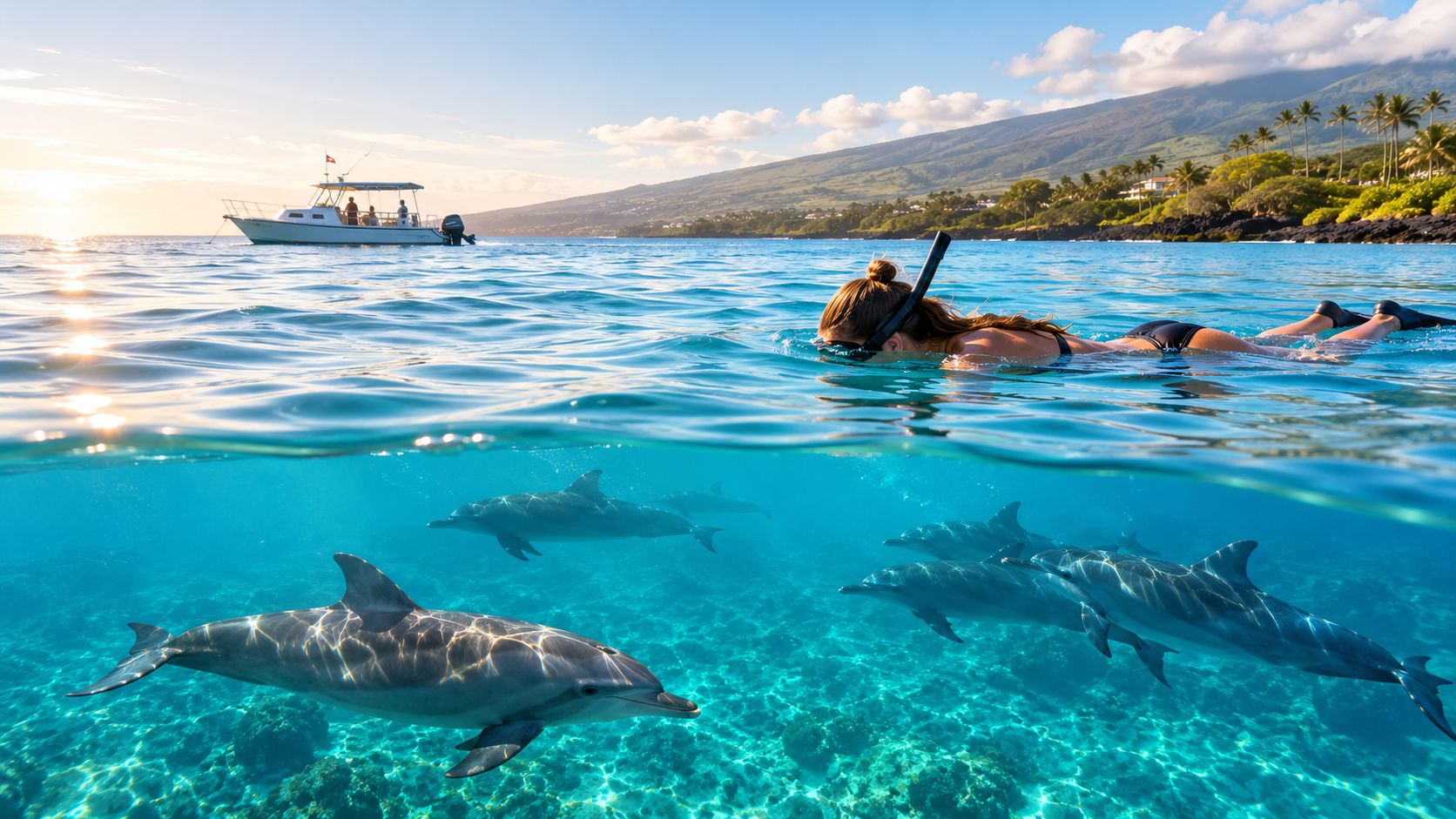
The first time a pod of spinner dolphins rose off the Kona Coast in the early light, the whole boat went quiet. You hear the breath before you see the silver arc, then the ocean closes again as if nothing happened.
The Magic of a Big Island Dolphin Encounter
The best dolphin mornings off Kona start with restraint. The ocean is calm, the boat is barely above idle, and everyone on board is looking at the same patch of water without crowding the rail. Then a dorsal fin cuts the surface, followed by another, and the whole scene sharpens. You are not chasing the moment. You are watching it unfold.
That is what makes a good Big Island dolphin snorkel memorable. Timing matters. Boat position matters. Crew judgment matters. The encounter feels close because it stays calm.
Near the top of that experience is simple boat-based observation. A pod surfaces off the bow, the light catches gray backs and pale flanks, and sometimes one animal breaks into the quick spinning leap that gave spinner dolphins their name. From the deck, with salt drying on your forearms and black lava brightening in the morning sun, you get a clear view without pushing into the pod's space.
A lot of visitors arrive with the wrong expectation because the marketing around dolphins can be sloppy. The plain truth is that swimming with wild spinner dolphins in Hawaii is prohibited. Seeing them from the boat is different, and that difference is the whole point. Responsible tours are built around lawful wildlife viewing, then continue on to reef snorkeling once the sighting is over.
A company like Kona Snorkel Trips matters here because the crew has to read wildlife behavior in real time, keep the vessel at an appropriate distance, and avoid turning a sighting into a pursuit. Guests usually notice the dolphins first. Good guides are also watching spacing, speed, and how long the pod stays at the surface.

What the best encounters feel like
The strongest sightings feel unforced.
The captain eases back. Guests stay quiet and watchful. Nobody is yanking on fins and preparing to drop in front of the pod. You see the dolphins travel, breathe, and settle into their own rhythm, which is far more impressive than a rushed close pass ever is.
That difference is important. The Kona Coast is not a theme park. It is a working habitat, and the bays used by spinner dolphins are part of their daily rest cycle. If you want more background before your trip, this guide to spinner dolphins in Kona waters gives helpful context.
Practical rule: If a tour is selling close contact with wild dolphins, it is selling the wrong experience.
Why people leave happy anyway
Guests often board thinking contact is the highlight. By the ride back, they are talking about something else. The stillness before sunrise. The clean blue water along the lava coast. The first exhale they heard before they spotted the pod. The reef snorkel later, when the morning shifts from dolphin watching to coral heads, reef fish, and sea turtles if conditions line up.
That is why this kind of trip works. It respects federal law, protects the animals, and still gives people the kind of dolphin encounter they came to Hawaii for.
Meet the Stars of the Show Spinner Dolphins
Hawaiian spinner dolphins are small, quick, social, and easy to underestimate until you see how precisely they use the coastline. The animals commonly encountered on Big Island tours average about 6 feet in length and are the primary dolphin species seen on local snorkel outings.

Their daily routine explains everything
The most important thing to understand about spinner dolphins is their schedule. The Hawaiian spinner dolphin, averaging 6 feet in length, exhibits a highly predictable diurnal behavior pattern: they gather in shallow bays from early morning until approximately 3:00 PM to rest and socialize, after which they migrate to deeper offshore waters to feed. That pattern is the foundation for every good guide decision on the water.
If you want a deeper natural history primer, this guide to spinner dolphins in Kona is worth reading before your tour.
During the night, they feed offshore. By morning, they're back in calmer shallows. That means the bay isn't just a place where tourists happen to find dolphins. It's part of the dolphins' recovery cycle.
Why they spin
The aerial spins are what most guests remember first. A dolphin launches, twists, flashes silver in the sun, and lands with a slap that carries across flat water. It looks playful, and it often is, but it's also part of a highly coordinated, active social life.
You'll often notice a pod behaving like a loose neighborhood rather than a straight-line school. A few surface together. Others hang back. Calves stay close. Then the whole group shifts at once.
Their predictability is exactly why they need protection. When people know where resting dolphins will be, people can also disturb them more easily.
What this means for your tour
Once you understand that daytime is rest time, the rules stop feeling arbitrary. They make sense immediately.
A responsible guest should expect this kind of approach:
- Observation first: The crew looks for natural surfacing patterns and keeps the experience boat-based around resting animals.
- Patience over pursuit: Good sightings come from reading the pod, not racing at it.
- Separate snorkeling time: The in-water part of the trip should happen away from any dolphin rest zone.
That last point is where many visitors get confused. “Dolphin snorkel” describes the overall trip style, not a legal invitation to enter the water with wild dolphins. On a well-run tour, dolphins are the wildlife encounter and the reef is the snorkel site.
Small animal, big presence
Because they're relatively compact, spinner dolphins can look delicate from a distance. Then they surface close enough for you to see how fast and controlled they are, and the impression changes. They don't need us to animate the scene. They bring their own energy to it.
That's why respectful viewing works so well. You're not trying to create a moment. You're waiting for one that's already happening.
Dolphin Encounters The Right and Wrong Way
There's a clean line between legal dolphin viewing and illegal dolphin harassment. If you're booking a Big Island dolphin snorkel, you need to know where that line is before you step on the boat.
The rule that matters most
Under the Marine Mammal Protection Act (MMPA), it is federally illegal for vessels or swimmers to approach wild spinner dolphins within 50 yards on the Big Island. This "50-yard rule" is designed to prevent behavioral disruption during the dolphins' critical daytime resting phase in bays like Kealakekua.
That rule changes the whole shape of a legitimate tour. The crew should be building the experience around distance, timing, and restraint. If you want a broader view of ethical wildlife practices, this piece on sustainable marine tourism lays out the mindset well.
For most visitors, 50 yards is hard to picture on open water. Think of it as farther than your instinct says when the dolphins are right there and everyone is excited. Close enough to see clearly in Kona's water, far enough to leave the pod unpressured.
What counts as harassment
Harassment isn't limited to touching an animal. On the water, it usually looks like people forcing the encounter.
That includes:
- Chasing: Following the pod to cut off its path.
- Encircling: Positioning swimmers or boats around the dolphins.
- Trapping: Using shoreline, boats, or bodies in the water to narrow their movement options.
Those behaviors are exactly what responsible crews avoid. The legal and ethical standard is simple. Let the dolphins keep control of space and direction.
What a proper response looks like
Sometimes dolphins approach a vessel on their own. When that happens, a good crew doesn't turn the moment into chaos. The boat should stay controlled, and observation remains passive rather than interactive.
The best crews don't manufacture dolphin encounters. They recognize them, protect them, and let them pass cleanly.
That's also why marketing language matters. If a company promises “swimming with wild dolphins,” it's advertising something that conflicts with federal law. Plain language is better. You are there to see dolphins, not to pursue contact.
Better experience, less pressure
People sometimes assume the legal version is the watered-down version. It isn't. Boat-based viewing often gives you a fuller picture of the pod anyway. You can watch group movement, spacing, surfacing rhythm, and behavior across the whole water column instead of fixating on one rushed in-water moment.
The trade-off is obvious. You give up the fantasy of a selfie-distance encounter. In return, you get a lawful, calmer, more authentic wildlife experience.
Where and When to See Dolphins on the Big Island
At first light off Kona, the coast often looks almost polished. The wind has not started pushing texture across the surface yet, the lava shoreline holds that deep black-blue contrast, and the bays are quiet in the way only early morning bays are quiet. That is the window crews watch closely.
The Kona Coast is where most Big Island dolphin viewing happens for good reason. The leeward side usually offers calmer water, more protected coves, and a cleaner plan for combining wildlife watching with a reef snorkel stop. For guests, that means a better boat ride and better visibility. For wildlife, it means responsible operators can observe from a controlled distance without turning the morning into a chase.
Kealakekua Bay stays high on the list because the setting does a lot of the work before a single fin breaks the surface. Steep lava slopes drop into clear water, the monument stands out against the shoreline, and the bay often holds that rich cobalt-to-turquoise color change that tells you the visibility is good.

Why Kealakekua Bay stays on shortlists
Kealakekua is one of those rare places that still works even if dolphins stay offshore that day. The water is often extremely clear, the reef is healthy enough to make the snorkel worthwhile on its own, and the coastline gives the whole trip a sense of place instead of feeling like a simple wildlife search.
Dolphin sightings here are common enough that visitors ask about them constantly, but good operators should phrase that carefully. Sightings are possible and often likely on the Kona Coast, especially on early departures, but no honest crew should treat them as guaranteed. If you want a realistic look at how often they show up on this kind of outing, this article on spotting dolphins on a Captain Cook snorkel cruise gives the right kind of expectation.
The bay also carries layers of protection and history. Kealakekua Bay State Historical Park preserves the shoreline and its cultural importance, and the surrounding waters are managed as part of the Hawaiian Islands Humpback Whale National Marine Sanctuary and other protected coastal areas. That protection helps keep the experience feeling intact. You can still idle into the bay in the morning and see reef contours below the hull instead of a shoreline crowded by heavy traffic.
Morning beats afternoon for a reason
If dolphins are on your mind, book the early boat.
Spinner dolphins use the Kona Coast on a daily rhythm. Mornings tend to match that pattern better, especially near resting areas along the coast. Sea conditions also tend to be calmer early, which matters more than many first-time visitors realize. Less chop means easier scanning from the boat, a more comfortable ride, and better visibility into the water.
By afternoon, conditions often get busier. The wind can rise, glare gets harsher, and the day shifts toward general snorkeling rather than focused wildlife viewing. Afternoon trips can still be beautiful. They are just usually a weaker choice if dolphins are your main hope.
Here's the practical comparison:
| Tour timing | What it usually offers |
|---|---|
| Morning departure | Better alignment with dolphin activity along the coast, calmer water, easier surface visibility, softer light |
| Afternoon departure | Pleasant snorkeling in the right conditions, but less favorable timing for dolphin-focused expectations |
The bay gives you more than dolphins
Kealakekua works because the day does not depend on a single moment. You may see dolphins from the boat. You may not. Either way, you still get one of the island's strongest reef snorkel settings, dramatic lava coastline, and a stop tied to one of Hawaiʻi's most discussed historic sites, the Captain Cook Monument.
That balance matters. Trips built around the full marine experience usually feel better than trips sold like a dolphin guarantee. Guests come home happier when the reef, the water clarity, and the coastline are part of the value from the start.
What works and what doesn't
The smartest approach is simple.
- What works: Booking an early tour, choosing a captain who treats dolphins as wildlife to observe from a lawful distance, and valuing the reef snorkel as part of the day.
- What doesn't: Reading “dolphin swim” marketing as a promise you should trust, or assuming Kealakekua Bay automatically means close in-water access to dolphins.
- What experienced travelers do: They book the bay for the whole morning experience and treat any dolphin sighting as a bonus that happens on the animals' terms.
That mindset fits the place. Kealakekua Bay can give you an unforgettable morning, but the best trips are the ones that respect what the bay is, a protected, historic stretch of coast where seeing dolphins is special precisely because nobody should be forcing the encounter.
Your Big Island Dolphin Tour A Step by Step Guide
The day usually starts in the half-light, with Kona Harbor still quiet and the water outside the breakwall holding that dark blue glassy look it gets before sunrise fully reaches the coast. This is my favorite part of the morning. People arrive sleepy, carrying coffee, and within a few minutes the mood changes. Fins come out, waivers get signed, and everyone starts to realize they are headed into real water, not an aquarium show.
The best trips feel calm right away.

Before the boat leaves
Check-in is usually quick. You get fitted for gear, find a place for anything that should stay dry, and listen to the safety briefing once everyone is aboard. If you want a realistic sense of how the morning tends to unfold, this Captain Cook snorkel tour timeline from check-in to return walks through the sequence clearly.
This is also where a good crew sets the tone for the whole trip. On a responsible dolphin outing, the briefing should make one point plain. The goal is to watch for dolphins without crowding them, cutting them off, or getting into the water to force an encounter. That distinction matters on the Kona Coast because a lot of visitors arrive thinking "dolphin snorkel" means a legal chance to swim with resting spinner dolphins. It does not.
Kona Snorkel Trips is one operator that runs small-group snorkel tours along this coast, and the small-group format helps with boat handling, gear support, and keeping the experience orderly when wildlife appears.
When dolphins appear
This part is quieter than first-timers expect. There is no movie-scene rush. A sharp captain notices the pattern first. A flash near the surface, a fin line in the morning light, a change in bird activity, or the quick silver roll of a pod traveling just outside the boat's path.
Then the boat slows.
If dolphins are in the area, the crew usually keeps everyone aboard and focused in one direction instead of creating chaos at the swim step. From there, the experience becomes about watching behavior. You may see a pod cruising with purpose, mothers and calves staying tight, or a few animals surfacing in smooth, even breaths before slipping back under. When the ocean is calm, you can sometimes hear the exhale before you pick up the next dorsal fin.
That kind of sighting stays with people because it feels earned and respectful.
The snorkel portion follows its own rhythm
After the wildlife viewing window, the trip usually shifts to the reef. That change is important. A well-built morning on the Big Island does not depend on close dolphin action. It works because the second half of the trip stands on its own, with clear water, lava shoreline, and a reef snorkel that gives people time in the water without putting pressure on the dolphins.
Many Captain Cook style outings head toward Kealakekua Bay or another protected reef area for the swim portion. Exact timing varies by operator, weather, and launch site, but the pattern is similar. Boat ride, wildlife scan, reef stop, then an easy return toward the harbor.
What to expect in the water
Once you slide in, the mood changes fast. The engine noise drops away. Your field of view narrows to the reef below, and the island suddenly feels quiet except for your own breathing through the snorkel.
Good guides keep this part simple because simple works.
- Take a minute to seal your mask properly. Ten careful seconds at the ladder can save you from spending the first part of the snorkel clearing water from your face.
- Use flotation if you are at all unsure. Strong swimmers use belts and noodles every day. Smart snorkeling is about energy control, not pride.
- Watch the entry and exit zone. The reef may look calm from the surface, but surge, ladder timing, and nearby boat movement still require attention.
Guests often start the day focused on dolphins and finish it talking about the reef. Yellow tangs move over coral heads. Parrotfish scrape and crackle below you. A sea turtle may drift past so calmly that the whole group goes silent at once.
The return ride
The ride back has its own feel. Salt drying on your arms. Wet hair. Towels over shoulders. Someone scrolling through photos of fins, reef fish, and the coastline, trying to decide which part of the morning was the true highlight.
That is usually the sign of a good trip. The dolphins were treated like wild animals, not a prop. The snorkeling delivered on its own. And everyone comes back understanding the difference between seeing dolphins well and bothering them badly.
Packing and Preparation for Your Dolphin Tour
Most tour mistakes happen before the boat leaves. Wrong clothing, no sun protection, poor expectations, or a first-time snorkeler who didn't realize how much easier the day gets with simple prep.
What to bring
Pack light, but pack deliberately. The basics are straightforward.
- Reef-safe sun protection: Bring reef-safe sunscreen, and apply it before boarding when possible.
- A real towel: Hotel hand towels don't cut it after a saltwater snorkel.
- Sun cover: Hat, long-sleeve layer, or both. The ride out can feel cool, but the return gets bright fast.
- Secure camera setup: A waterproof camera or phone case is useful only if you can manage it without fumbling during entry and exit.
- Dry clothes for afterward: Even a clean shirt makes the ride home better.
For a more complete checklist, this guide on what to pack for a Captain Cook snorkel tour is practical and easy to follow.
What quality tours usually provide
Most solid operators supply the core snorkel gear and basic safety equipment. That typically includes mask, snorkel, fins, and some kind of flotation support. Water and light snacks are also common.
Still, don't assume every boat is identical. Ask in advance if you need prescription masks, child-sized gear, or extra flotation. Those small questions can change the entire experience for a nervous guest or a family with young kids.
If you're unsure about snorkeling, tell the crew before you get in. Crews can help best when they know what you're worried about.
Tips for first-timers and families
Preparation isn't only about gear. It's also about how you approach the water.
- For kids: Explain the day clearly. Dolphins may be seen from the boat, while snorkeling happens elsewhere.
- For anxious adults: Use the flotation belt from the start instead of “trying to tough it out.”
- For everyone: Listen carefully during the briefing. Good guides usually answer the question you were about to ask.
The most prepared guests aren't the ones with the fanciest equipment. They're the ones who arrive flexible, hydrated, and ready to follow instructions without turning the outing into a personal challenge.
More Than Just Dolphins Whats in the Water
A strong dolphin trip usually turns on a different moment. Everyone boards hoping for dorsal fins. Then the masks go on, faces drop into the water, and the whole coast opens up.
The reef carries half the day
Kona's water often gives you that first clean look straight to the bottom. Lava rock shelves break into coral heads. Yellow tang flash over the reef. Convict tang move in tight schools. If a honu comes through, it rarely looks dramatic at first. It just glides past with that calm, steady rhythm that makes everyone stop kicking for a second.
That matters because a respectful dolphin tour is never about chasing one animal until the outing feels forced. The legal, ethical goal is to observe dolphins from the boat when the opportunity is there, then let the reef deliver the in-water part of the experience somewhere appropriate for snorkeling. Good crews plan for both.
Some guests are surprised by how much they remember the smaller life. A cloud of anthias over coral. A trumpetfish hanging almost motionless beside a ledge. The scratchy sound of parrotfish feeding if the water is quiet enough.
Seasonal surprises
Winter adds another layer. From roughly November through March, humpback whales are often seen offshore during Kona snorkel runs, especially in deeper water outside the bays. A distant blow or the heavy slap of a breach can change the mood on the boat fast.
Whales are a bonus, not a guarantee. So are manta rays, eagle rays, and the occasional pelagic fish moving along the outer edge of the reef. Conditions, season, and luck all shape what shows up.
That unpredictability is part of the value.
A better way to measure the trip
Guests who fixate on swimming with dolphins usually miss what makes this coastline special in the first place. The better standard is simple. Did you see wild animals behaving naturally? Did you snorkel a healthy reef safely? Did the crew keep the experience within the law and avoid putting pressure on resting dolphins?
If the answer is yes, the trip did its job.
Kona Snorkel Trips offers Kona Coast snorkel tours built around safe wildlife viewing, clear in-water guidance, and small-group boat time that helps guests enjoy the ocean without crowding it.